
Critical Thinking Write down your answer and bring
Critical Thinking { Write down your answer and bring it up to show me. You will have 1 minute to complete this task. No Talking!!
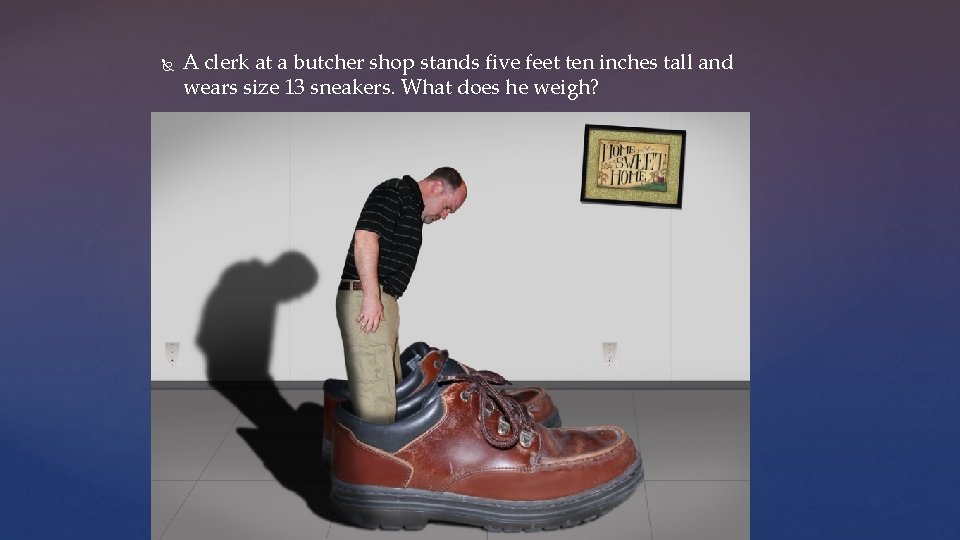
A clerk at a butcher shop stands five feet ten inches tall and wears size 13 sneakers. What does he weigh?

Meat. (He’s a clerk at the butcher’s shop. )
Today’s Goals I can utilize close reading strategies to help me determine meaning within a text. I can determine the stasis of a text.
Quick Check of Grammar Skills 1. Write a one word sentence. 2. Write a two word sentence. 3. Write a three word sentence with a subject, verb, and direct object. 4. Add a prepositional phrase. 5. Add a dependent clause at the beginning of the previous sentence. 6. Add at least three adjectives to the previous sentence and underline them. 7. Add an additional independent clause to the previous sentence and be sure to connect it using a coordinate conjunction. 8. Add an adverb to the previous sentence and circle it.
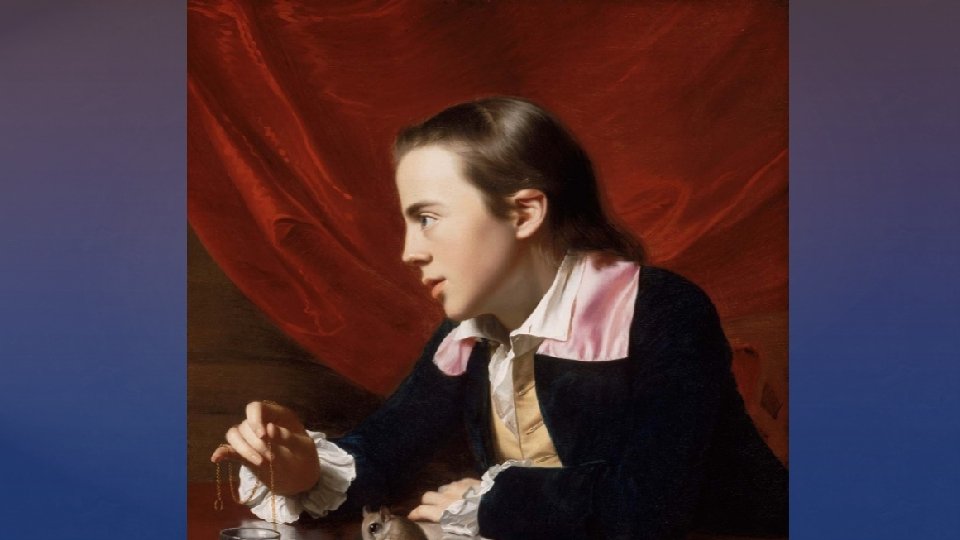
One thing we know for sure: “Just because something is available instantly to vision does not mean that it is available instantly to consciousness. ” There is Power in Patience – Jennifer Roberts teaches an entire class at Harvard titled – Power in Patience: Teaching Students the Value of Deceleration and Immersive Attention. She has a Ph. D from Yale, has taught at Harvard for over 30 years and has taught classes on the Power of Patience to US Presidents, foreign world leaders, and some of the top FBI, CIA, military, and civilian minds in the country.
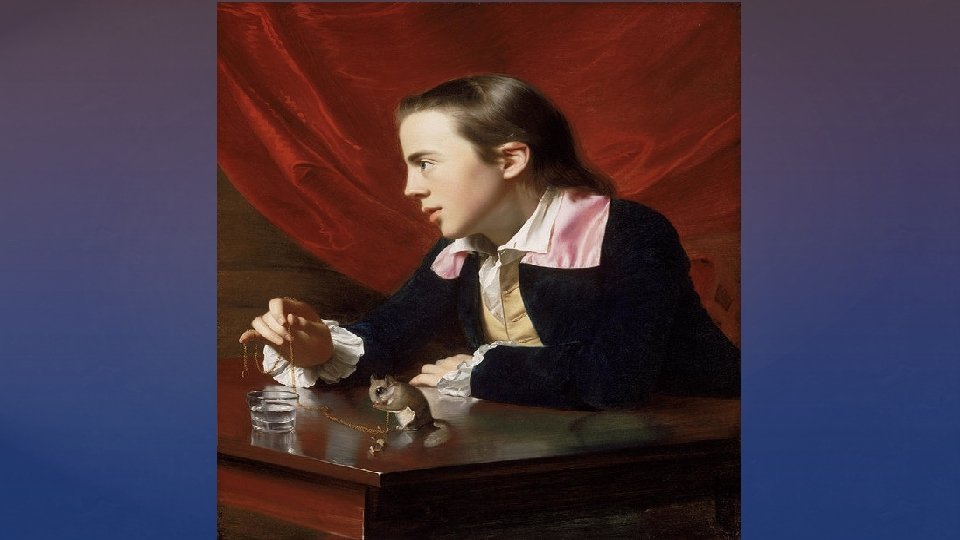
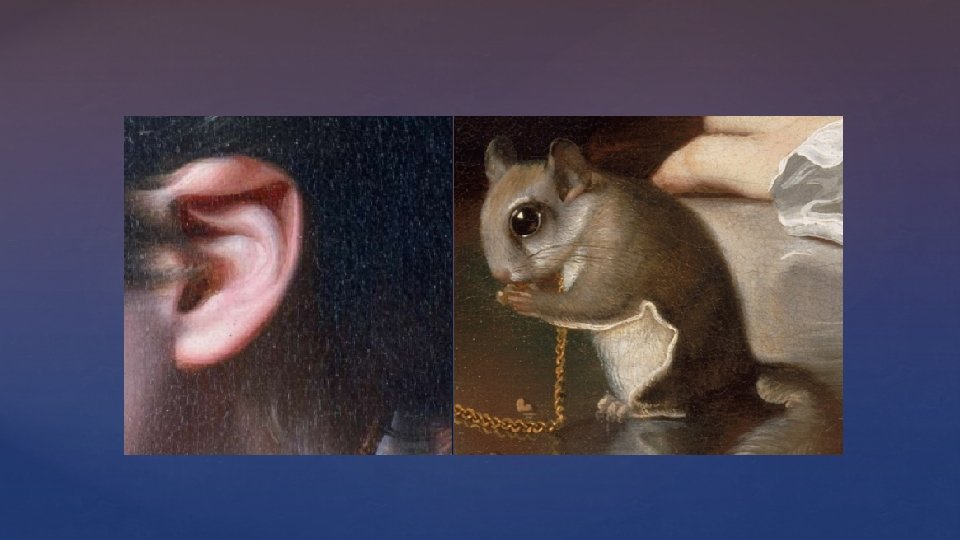
What she saw: 9 min – the shape of the boy’s ear precisely echoes that of the ruff along the squirrel’s belly. 21 min – the fingers and thumb holding the chain exactly span the diameter of water glass beneath them. 45 min – seemingly random folds and wrinkles in the background curtain are actually perfect copies of the shapes of the boy’s ear and eyes What she wondered: Is there some kind of connectedness between the animal and the human body? Maybe the sensory capacities of each because of the ear. Is there a comment on human relationship with and reliance upon water? Has Copley imagined those sensory organs distributing or imprinting themselves on the surface behind him? Harvard University art historian Jennifer L. Roberts – The Power of Patience

So how does this relate to close reading in a rhetoric and argument class? Just because you read it, doesn’t mean you fully understand it or even touched the surface of the meaning. If you want to join the conversation or even have a seat at the table, it will require some patience to understand what conversation is being had AND what people are saying about the topic at hand. Listening to a text and postponing judgment requires much more brain muscle (and good manners) than simply responding to the first thing that comes to mind. Thinking of a text as a conversation, we’re not just waiting our turn to respond, we’re engaging in reading as discovery, searching for the questions other writers are asking. We must comprehend a text before we critique it. If we jump into a conversation and contradict what’s being said before we fully understand it, we often look foolish; therefore, if a text is merely a part of a conversation, it will be wise to try to grasp what’s being said before we respond.
We must learn to pay attention. The next step is to begin to really listen closely to a text. The goal is always to figure it out entirely or as close to entirely as possible; however, even when this can’t occur, a slow, careful approach where you listen closely will help your understanding tremendously. We do this through a process called “Close Reading. ” There are many ways to conduct close readings. Annotation Developing Questions Graphic Organizers Thinking routines – See-Think-Wander/Zoom In Rhetorical Precis SOAPSTone Breaking down structure
SEE: Read the text. Annotate, highlight, pay attention to detail. At this point simply try to pay close attention and notice what’s there. THINK: How are things you see connected? What is there? Does anything stand out? Is anything unusual? Does anything seem out of place? Does he seem to emphasize anything? How is what you see connected? WONDER: Begin asking questions about meaning. Write them down. What do you wonder about some of the things Brooks said or did? There is no right or wrong…. what do you wonder about the meaning of the text? The Olympic Contradiction
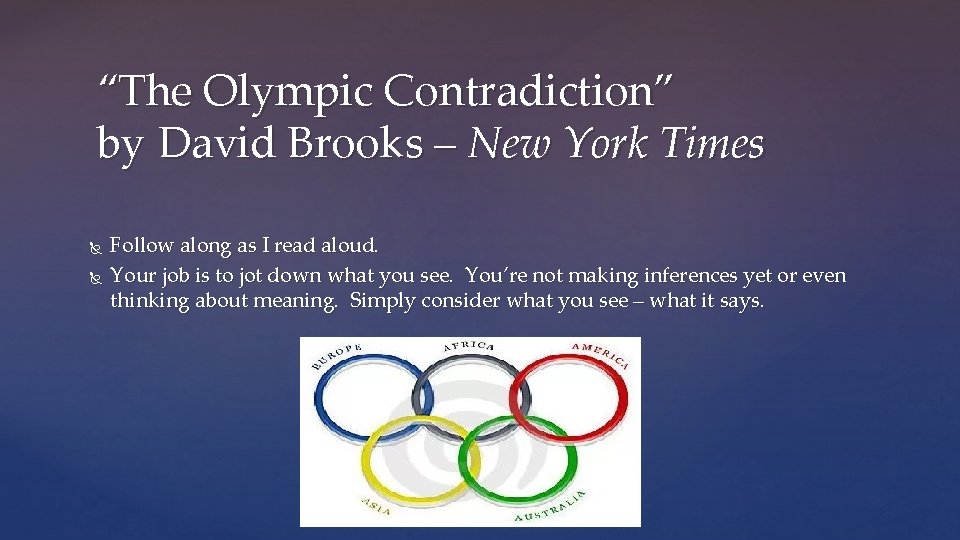
“The Olympic Contradiction” by David Brooks – New York Times Follow along as I read aloud. Your job is to jot down what you see. You’re not making inferences yet or even thinking about meaning. Simply consider what you see – what it says.
Stasis Write your name on the notecard I just passed out. Identify the central question Brooks responds to in “The Olympic Contradiction. ” Then explain why you chose the answer you selected. A. Can competitive virtues coexist with cooperative virtues? B. What is the reason for the enduring popularity of the Olympics? C. Is dance a true sport? D. Is an acceptance of opposites a characteristic of intelligence? E. Is it good to embrace the tension between contradictions? F. Is competition better than cooperation? G. Should the Olympic Games be less competitive? * Remember to justify your answer.
Now, take 3 -5 minutes to think. Really think. Without talking. Just consider what is going on in the text. Think about what you’ve seen. Think about how things could fit together. Think about things that you agreed with and those you disagreed with. Think about what is missing. Think about what meaning might be beneath the surface. Think about what conversation is taking place. See – Think - Wander
Now – take 3 -5 minutes to write down what you wander. Ask questions you still have about the text. Ask about theories you have about meaning. Ask about the unknown – what could the fact he/she left out _____ mean. Ask about known – what could _____ mean. Ask why the author did the things he did. Ask why he included certain items and why he didn’t include others. Ask anything that makes you wander – specifically concerning meaning. See – Think - Wander
Meet with your 6 o’clock appointment Now team with another pair to form a group of 4. “Around the horn” – each of you share one thing you wandered about and discuss possible answers as a group. Is there enough evidence to say that you can support your answer with evidence? Continue “around the horn” until time is up. As you do this, continue to consider what the text means. Jot down anything that helps you understand the text better.
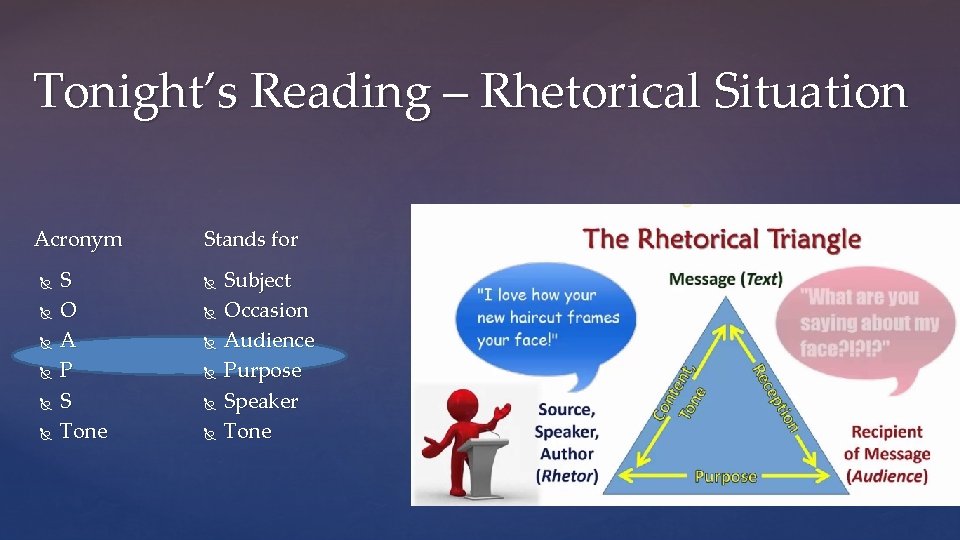
Tonight’s Reading – Rhetorical Situation Acronym S O A P S Tone Stands for Subject Occasion Audience Purpose Speaker Tone
Bringing the Conversation to Life Draw a sketch representing all the different voices you hear in David Brook’s “The Olympic Contradiction. ” You may want to conduct a quick Internet search for images of the people Brooks mentions in his article to see what they look like. These are the people who have contributed something to the conversation he’s joining. Be sure to include Brooks himself in your sketch. Stick figures are fine – the point is for you to be able to see these references or sources are real people.
Who did you have in the conversation? In or Out of the Conversation David Brooks F. Scott Fitzgerald Roger Martin Executives at Procter & Gamble Abraham Lincoln Cheerleaders Dancers Olympic Committee Yes Yes No No Quick Focus on Audience
Homework 1. 2. 3. Draw a sketch representing all the different voices you hear in David Brook’s “The Olympic Contradiction. ” You may want to conduct a quick Internet search for images of the people Brooks mentions in his article to see what they look like. These are the people who have contributed something to the conversation he’s joining. Be sure to include Brooks himself in your sketch. Stick figures are fine – the point is for you to be able to see these references or sources are real people. Read pages 1 -20 AND 44 -54 in your Language of Composition book. DUE Today – Read chapters 7, 8, 9, and 10 of The Shallows and write a summary for each chapter.
Stasis Write your name on the notecard I just passed out. Identify the central question Brooks responds to in “The Olympic Contradiction. ” Then explain if your opinion has changed. A. Can competitive virtues coexist with cooperative virtues? B. What is the reason for the enduring popularity of the Olympics? C. Is dance a true sport? D. Is an acceptance of opposites a characteristic of intelligence? E. Is it good to embrace the tension between contradictions? F. Is competition better than cooperation? G. Should the Olympic Games be less competitive?
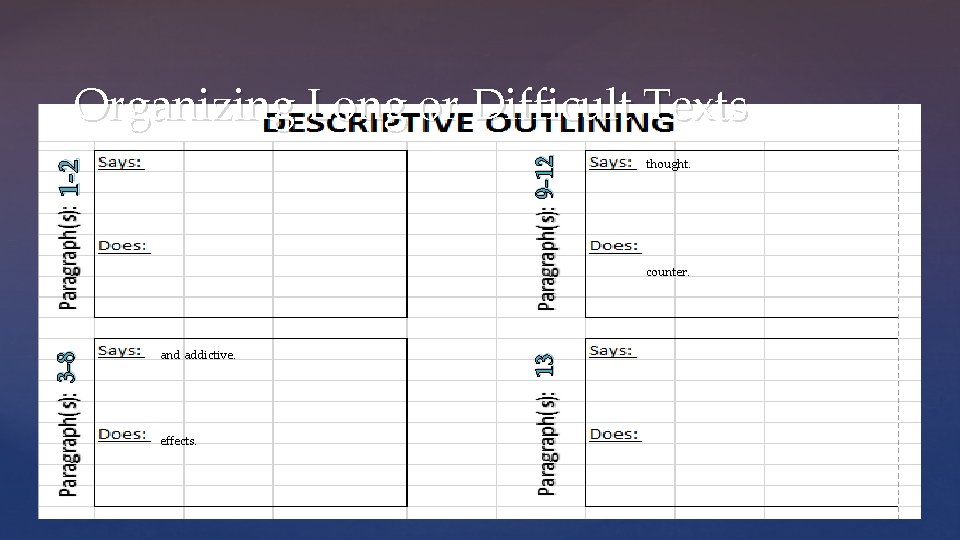
1 -2 9 -12 Organizing Long or Difficult Texts thought. and addictive. effects. 13 3 -8 counter.
Quick Breakdown of the Conversation Chapter 1 Says: Remember HAL from 2001 Space Odyssey? I feel more and more like him everyday. The way I think seems to be changing. I’m scattered and unfocused. I talk to my friends and they all feel it too. Is it possible that the internet could be causing it? I read about a study where 6, 000 young students no longer read in a linear fashion from left to right, but scan the entire page. I wonder if this is what’s happening to us all? Does: Introduces the conversation that Carr is having.
Chapter 2 Says: Scientists and doctors always believed that the brain became unchangeable around age 20. But, Nietzsche noticed a change in his writing style when he began writing on a typewriter which led him to believe that maybe his brain could be restructured late in life. After that, Merzenich began studying brain plasticity, Kandel conducted research on sea slugs and regeneration of cells, and other studied how stroke patients relearned how to walk and speak. All of this led to the understanding that our brains can be restructured. Does: He enters the conversation by saying that although people used to believe the brain couldn’t be restructured, we now know that they can be. This is ultimately allows Carr to ask a second question: Could my brain be changing because of the internet?
Chapter 3 Says: Tools such as the clock and the map had a massive impact on the way we think. The brain is structured in four different ways, but cognitive support is the part of the brain that is affected by the tools we use. Cognitive support also just happens to be the part of the brain that is most likely to change. Socrates and Plato noted many, many years ago that we should always be careful that we consider new technology because it could change us. Does: Carr is supporting his hunch that the internet (a tool) is capable of changing the brain. He further supports this hunch by giving two examples of tools that have reshaped the way we think.
Chapter 4 Says: There has been a clear progression of how the human brain shifted over the years. By far the biggest impact on thinking came as we began to write things down. This progression was slow, but as books became readily available to the masses, people began to read silently for sustained periods of time. We now know that silent sustained reading leads to deep thinking. Does: This provides evidence of how deep thinking occurs. And it allows him to ponder whether technology may push aside the benefits of deep thinking.
Chapter 5 Says: Now there is new tool – a machine that can do what many tools do. It is incredibly interactive and demands our attention. It is having three major impacts on society. First, it is reducing print media which is reducing the amount of time we sit and read. Second, it is reformatting media – a book now has hyperlinks and requires us to look around the page rather than just from left to right. And lastly is having external media impacts – it’s becoming embedded into everything we do in our day to life. In fact, majority of Americans now interact with this new machine/tool nearly eight and a half hours a day in some form. Does: It allows him to lay the groundwork for answering his last question of whether or not technology may be pushing aside deep thinking. Without really even touching on it directly, he’s provided overwhelming evidence that this new tool is absolutely pulling us away from silent sustained reading and deep thinking merely because of the fact that if we are spending this much time interacting with it, we have to be spending less time with books.
Chapter 6 Says: Even though the book has been the slowest form of media to be sucked into the land of the internet, the internet is gradually finding ways to recreate the book. With Kindles, hyperlinks and distractions are becoming embedded into the book. Not only does this affect the way we read, it also affects the way we write. The internet is chipping away at linear thinking. If linear thinking is reduced, will this affect our ability to think deeply? Does: Adds additional support to the idea that deep thinking may be getting pushed aside. He can conclude that the internet is definitely affecting linear thinking, which now means, he just needs to determine whether linear thinking is critical to deep thought.
Chapter 7 Says: There are three main types of memory (long-term, short-term, and working). The internet distracts the working memory which creates links from the short-term to the long-term. The internet is full of distractions. As the working memory gets distracted, it cannot make the connections necessary for deep thought and ultimately long-term memory. It’s like trying to catch water from a pouring spout with a thimble. Our brains simply cannot take in the information because of the combination of overload and distraction. Does: This chapter makes the connection about his question in chapter 4 of whether the internet is pushing aside deep thinking and how the brain actually works. It’s clear that this is a tool that not only distracts and affects linear thinking, it is also affecting deep thinking and longterm memory.
Chapter 8 Says: Some argue that Google is perfect tool for gaining and storing knowledge. Google, however, had to make money. The best way to make money was through advertisement. Ads were embedded into the pages full of information. Advertisers demanded their ads be seen if they were paying large amounts of money, so Google did what they could to encourage users to click on the ads and links. Does: This serves two purposes. It presents a counter-argument and addresses it. Some still believe that if information is available, we have access to knowledge. However, we already know that the more distraction there is, the more it reduced the amount of information we retain and the deeper we think about it. So, this brings Carr to his second purpose for this chapter, which is to present the great irony of the internet and Google. While it is full of information that seems to give access to knowledge, it actually causes us to have less knowledge because we simply can’t think deeply about it and we won’t remember it.
Chapter 9 Says: Socrates might have been right. We are exchanging knowledge for access to data. By overwhelming the working memory, devalue long-term memory, deep thinking, and knowledge. When synaptic connections cannot be made in our brain, individual perspective is diminished and as a result of less individual perspective our culture as a whole is being diminished. Does: Although he never explicitly states it, he is drawing a conclusion to his original question – is the internet affecting the way I think. It’s clear that it is. He has presented some counter arguments, but most of them have been addressed, and he’s careful to give some concessions. He concedes that the internet affects other parts of the brain in positive ways, which accounts for increases in IQ scores. However, he feels confident that the internet has impacted his brain in such a way that it has caused his difficulty in concentrating when he goes to read a book. Now he poses a final question: If this is the case, could this not only end up affecting individuals but also society and culture as a whole.
Chapter 10 Says: ELIZA was a computer program that was an experiment in how close we could come to making a machine human-like. We continue to experiment with this in the form of Siri and Alexa. He notes that humans have always attempted to interact with everything in a “human” way. However, as Socrates and Plato noted so long ago, we should be cautious about this. As we use tools, the tool diminishes our ability to use the skill without the tool. Does: This presents us with his final message. He fully understands that humans will be humans; however, he agrees with Socrates and Plato because the stakes have never been so high. He implies that it may have been okay to create a tractor to plow the earth. We may lose the ability to plow the earth without a tractor, but the reality is, we could always go back to plowing by hand, it would just be much, much slower. The internet is a tool that affects a skill we can’t afford to lose – how to think. If we ever lose the internet, society could and culture could take a drastic step backwards and we may lack the ability to come up with thoughtful way to turn it back around. So, his conclusion is that we should be thoughtful about this and consider all consequences.
Consider it as a whole: 1. 2. 3. 4. 5. 6. 7. 8. 9. 10. Introduced an idea or his developing thoughts on a topic. Explore whether the brain is even capable of changing – it is. Explore what changes it. It turns out tools do. The internet is a tool! Hmm. . Let’s dig deeper then into thinking. Deep, critical thinking develops through sustained reading. The internet is changing or restricting the tools we use (books, magazines, etc. ) to think deeply. Counter-argument: But can’t we just read online? Response – nope, the internet is stripping linear reading/thinking and scattering our thoughts. Explore more: If the internet is full of distraction, how does that affect the brain. Working memory is greatly affected, which reduces long and short-term memory. Counter-argument: But Google prides itself on knowledge for all. Response: Ironically, Google unintentionally has become a perfect storm for distraction. If all of the things I learned are true, then the internet is actually changing the brain by reducing synaptic connections. All of this leads to diminishing individual thought and perspective, which in turn could affect culture as a whole. Final thoughts: If tools (internet) diminishes our ability to use the skill (thinking) without the tool, then we truly do need to think about what we’re doing to ourselves and our culture because there could come a day when we ultimately lose our ability to think for ourselves.
Quick write: Write about the following questions: 1. If we assume that Carr was part of a broader conversation, what specific question did the conversation center around? How do you know? 2. Does an argument always have to end with a clear answer or solution? Why or why not? 3. Write about some discussions you’ve had that dealt with difficult topics where no one could really come to a clear solution. How did that make you feel? How was that conversation handled? What did it sound like? What question was his conversation centered around? Is it possible that the internet is could be causing my scattered and distracted thinking?
Journal Enter the conversation: Write a one page journal (about 150 -200 words) as if you were having a discussion with David Brooks about the main argument of his essay. Explain your thoughts on the conversation – make sure you are in stasis. Here’s the catch – you must include at least two similes (underline them) and you must reference at least one other person/character involved in the conversation (other than Brooks). Lastly, you must use at least three of your vocabulary words from the last two weeks (bold them) and you may only use the verbs be, being, been, is, am, are, was, were, have, has, or had two times.
- Slides: 38