
Critical Thinking Observation King of Science Laws of
Critical Thinking
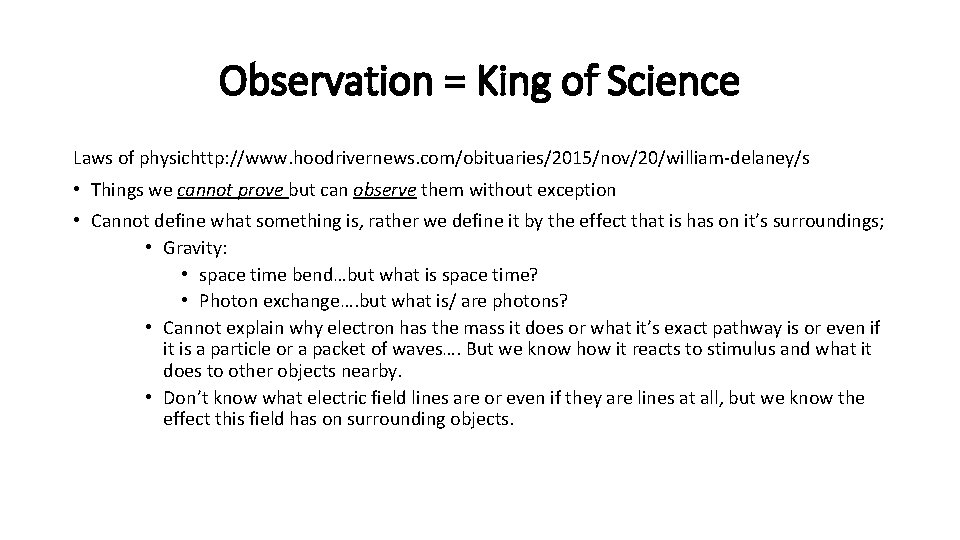
Observation = King of Science Laws of physichttp: //www. hoodrivernews. com/obituaries/2015/nov/20/william-delaney/s • Things we cannot prove but can observe them without exception • Cannot define what something is, rather we define it by the effect that is has on it’s surroundings; • Gravity: • space time bend…but what is space time? • Photon exchange…. but what is/ are photons? • Cannot explain why electron has the mass it does or what it’s exact pathway is or even if it is a particle or a packet of waves…. But we know how it reacts to stimulus and what it does to other objects nearby. • Don’t know what electric field lines are or even if they are lines at all, but we know the effect this field has on surrounding objects.
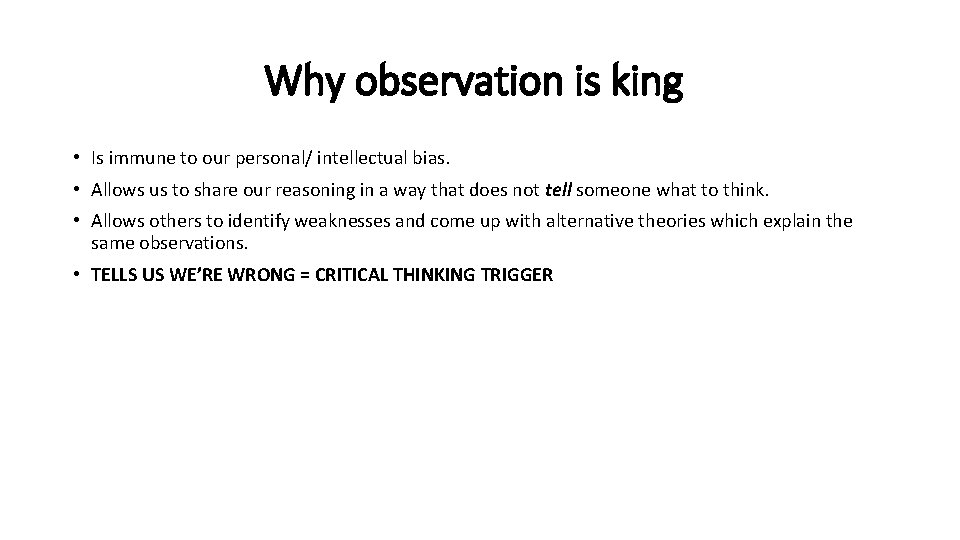
Why observation is king • Is immune to our personal/ intellectual bias. • Allows us to share our reasoning in a way that does not tell someone what to think. • Allows others to identify weaknesses and come up with alternative theories which explain the same observations. • TELLS US WE’RE WRONG = CRITICAL THINKING TRIGGER

Sharing observations = sharing stories? ? **survival mechanism Education/science spawned from sharing our observations with one another. • Science, art, literature, plays, music, etc. • Family/ relationships: Sharing our stories/ experiences/ observations is how we teach our children as well as how we build trust and understanding between us. ****Why do we help each other solve individual problems in school, yet rarely if ever does anyone share their own experiences, observations, and conclusions, i. e. their study methods?
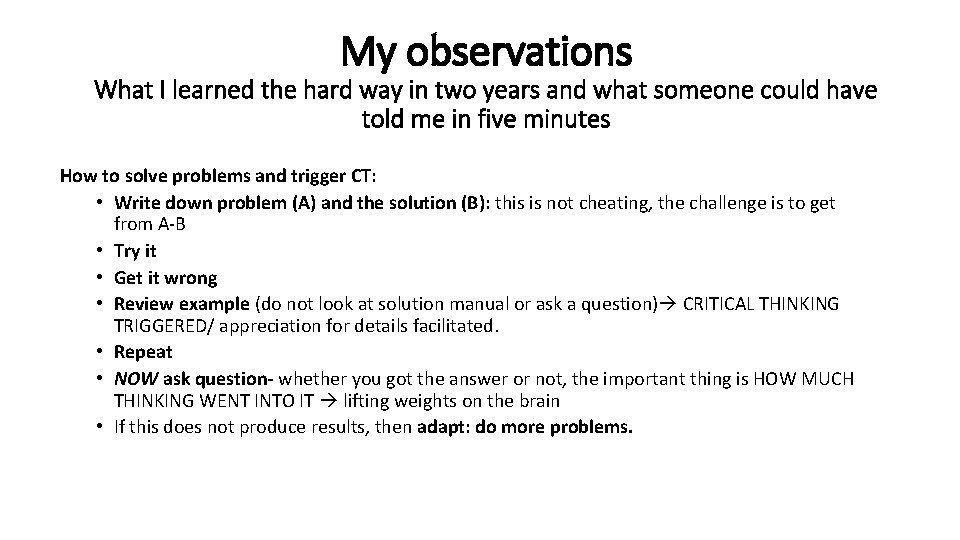
My observations What I learned the hard way in two years and what someone could have told me in five minutes How to solve problems and trigger CT: • Write down problem (A) and the solution (B): this is not cheating, the challenge is to get from A-B • Try it • Get it wrong • Review example (do not look at solution manual or ask a question) CRITICAL THINKING TRIGGERED/ appreciation for details facilitated. • Repeat • NOW ask question- whether you got the answer or not, the important thing is HOW MUCH THINKING WENT INTO IT lifting weights on the brain • If this does not produce results, then adapt: do more problems.
Effects beyond science/ academics: The ability to connect A to B Any curiosity/ obstacle/ life process that one wishes to understand can be stated in the form of a problem (A). To this problem a real life observation can be matched (B). If the mind is focused and critical thinking is invoked, the human brain is simply capable of establishing connection from point A to point B. This is not to say that the connection (relationship) identified between A and B is necessarily correct, but it is a start. From here the typical scientific method is invoked: disprove it and challenge yourself or have others challenge your thinking thereby forcing you to go deeper into critical thought. From here your mind will either come up with yet another (alternative) connection or it will identify previously ignored or overlooked possibilities and/ or relevant factors and repose the question. “Insanity: doing the same thing over and over again and expecting different results. ” -Albert Einstein Essential to the process is that one is willing to put in the time and effort as well as to endure the frustration and adaptability that critical thinking involves. It is debatable whether or not we live in a universe where there always exists a coherent chain of cause and effect, but we have yet to disprove this, and the fact that we are ALWAYS able to find a cause to which we can ascribe a given phenomena says something profound about our universe; there is a cause to be identified. And if the cause can be identified and understood then we are in a much better position to manipulate it’s effects.
Personal Benefits Helps one articulate and express his or herself better: Critical thinking is like lifting weights on the brain. This is in large part why educated individuals are often able to articulate their thoughts well- it is not just because they have a larger vocabulary, it is simply because their occupation tends to exercise their brain more than the average one. ***Try it for yourself and observe: • do you find yourself saying, “it is on the tip of my tongue, but I lost it” more or less when in the middle of a difficult course involving critical thinking? • When presented with an opportunity to engage in a discussion or debate that is of personal interest or importance to you do you find yourself backing down out of lack of ability to articulate the arguments/ thoughts that you have on the matter? How is this improved or altered when your brain is actively being “sharpened”?
Personal Benefits Continued • Comprehension: Many tasks on a day-to-day basis involve critical thinking such as a highpressure situation that needs to be dealt with at work or a new skill that needs to be learned. Critical thought not only aids one in these situations, but if nothing else it increases one’s confidence in approaching them- something that in itself can make a dramatic difference. • Memorization techniques: The basic idea of attempting something without a solution manual or guide present and being willing to get it wrong in an effort to force your brain to think critically on it can also be utilized as a memorization technique. ***Try it yourself and observe: Find a private place (or not if your comfortable with talking to yourself) and rehearse a presentation out loud and without looking at any visual or written aid. Naturally you will get it wrong and stumble a LOT in the beginning – at some points you may get stuck so bad that you simply have to pull out some form of written aid, but by attempting it and stumbling you’ll find that you have forced your brain to engage and to think about what comes next. You have also trained your vocal muscles to the pattern of the speech (similar to how your hand sometimes knows what to do before your conscious brain does on a math exam). Repeated trials will successively show improvement, and by the 10 th or 15 th time you will likely not even need to bring a piece of paper with you. Furthermore, having mastered the details of what you wish to say, you may find yourself instead focusing on the more eloquent inflections of voice and body language while presenting- all of which are valuable skills when you have something to say.
- Slides: 8