
Critical Thinking Oaklands College Why Voting Matters Session
- Slides: 20
Critical Thinking Oaklands College Why Voting Matters
Session Outcomes • To explain what critical thinking is. • To examine various methods of critical thinking. • To be able to apply critical thinking skills.
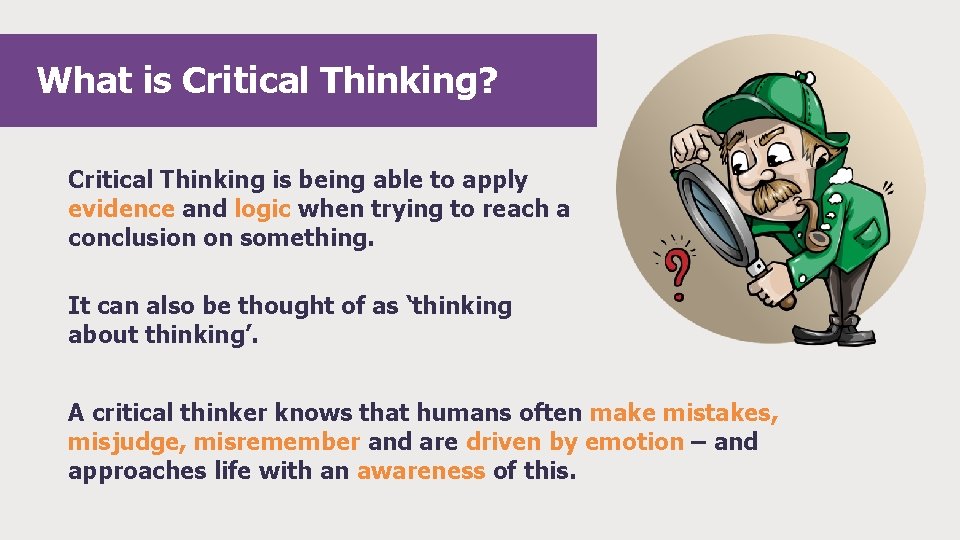
What is Critical Thinking? Critical Thinking is being able to apply evidence and logic when trying to reach a conclusion on something. It can also be thought of as ‘thinking about thinking’. A critical thinker knows that humans often make mistakes, misjudge, misremember and are driven by emotion – and approaches life with an awareness of this.
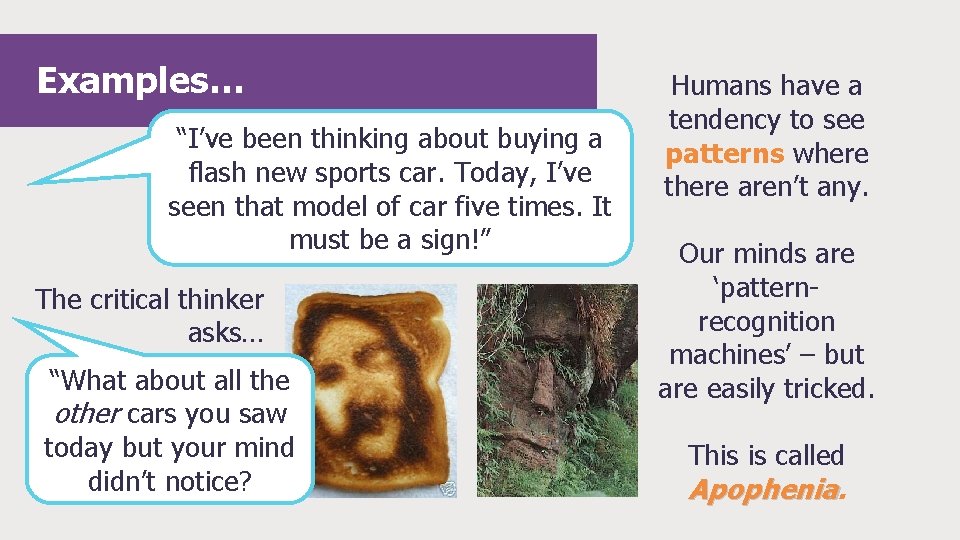
Examples… “I’ve been thinking about buying a flash new sports car. Today, I’ve seen that model of car five times. It must be a sign!” The critical thinker asks… “What about all the other cars you saw today but your mind didn’t notice? Humans have a tendency to see patterns where there aren’t any. Our minds are ‘patternrecognition machines’ – but are easily tricked. This is called Apophenia
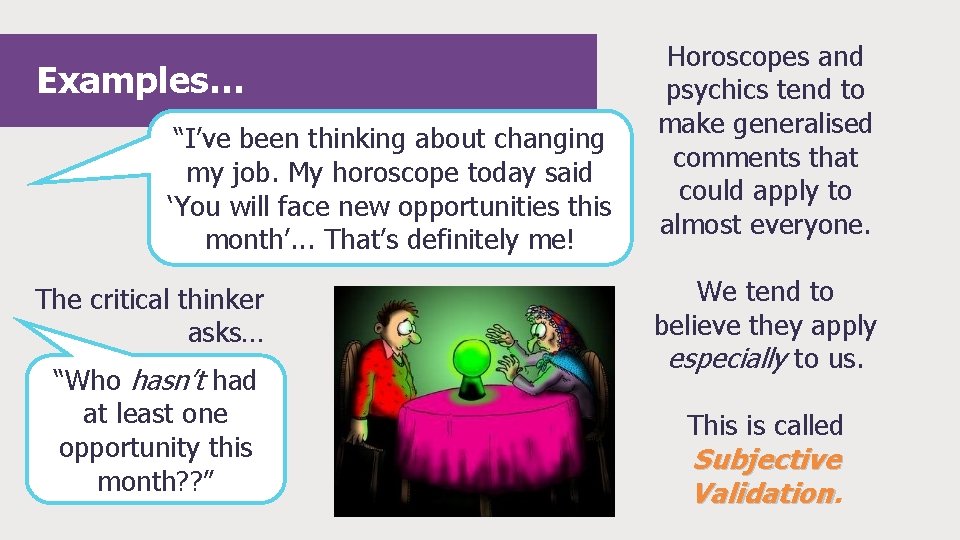
Examples… “I’ve been thinking about changing my job. My horoscope today said ‘You will face new opportunities this month’. . . That’s definitely me! The critical thinker asks… “Who hasn’t had at least one opportunity this month? ? ” Horoscopes and psychics tend to make generalised comments that could apply to almost everyone. We tend to believe they apply especially to us. This is called Subjective Validation
Creepy… or just coincidence? Watch this video about the assassinations of US Presidents Abraham Lincoln and JFK. The person who made this video has decided there is something very creepy about it…
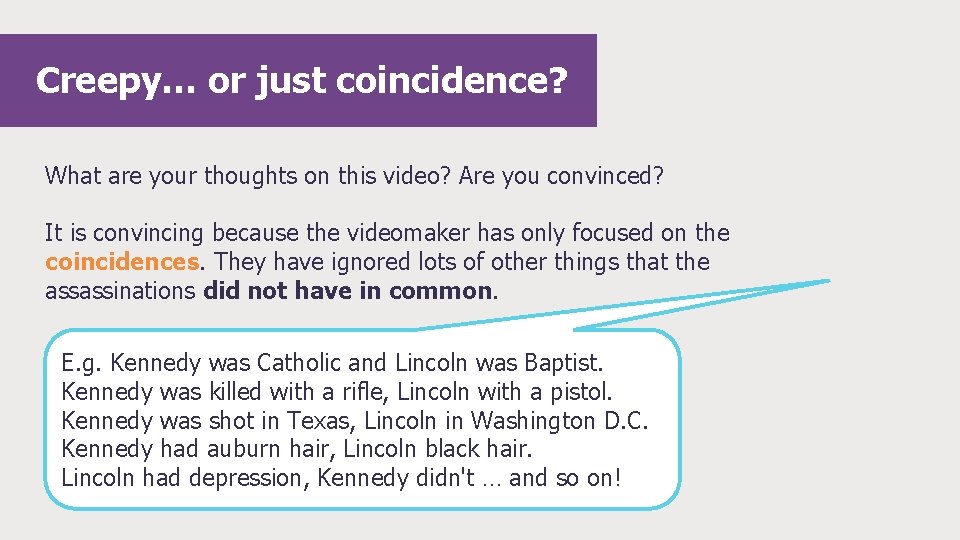
Creepy… or just coincidence? What are your thoughts on this video? Are you convinced? It is convincing because the videomaker has only focused on the coincidences. They have ignored lots of other things that the assassinations did not have in common. E. g. Kennedy was Catholic and Lincoln was Baptist. Kennedy was killed with a rifle, Lincoln with a pistol. Kennedy was shot in Texas, Lincoln in Washington D. C. Kennedy had auburn hair, Lincoln black hair. Lincoln had depression, Kennedy didn't … and so on!
Creepy… or just coincidence? When people do this it is called cherry-picking. It means only picking the evidence they want, to make people reach the conclusion they want them to reach. For example, a tobacco company may only pick out the few health benefits of smoking (e. g. “relaxation”), and ignore the harmful effects, to make people think that smoking is good for them. “Step back. Ask questions. Don’t always be taken in!”
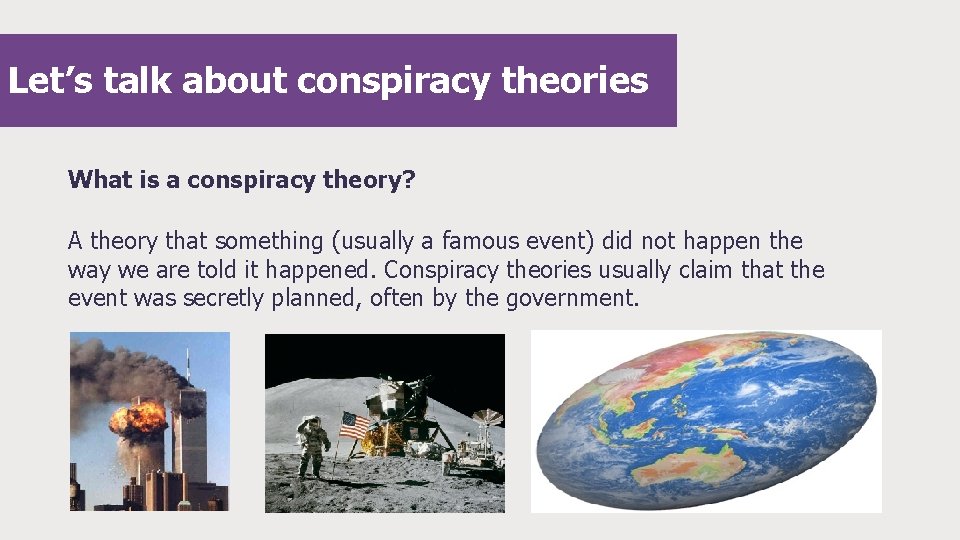
Let’s talk about conspiracy theories What is a conspiracy theory? A theory that something (usually a famous event) did not happen the way we are told it happened. Conspiracy theories usually claim that the event was secretly planned, often by the government.
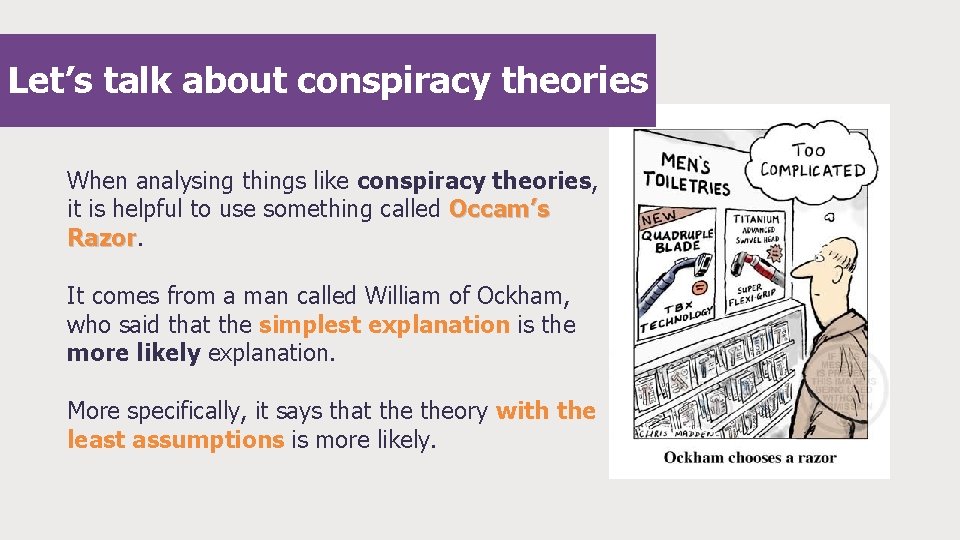
Let’s talk about conspiracy theories When analysing things like conspiracy theories, it is helpful to use something called Occam’s Razor It comes from a man called William of Ockham, who said that the simplest explanation is the more likely explanation. More specifically, it says that theory with the least assumptions is more likely.
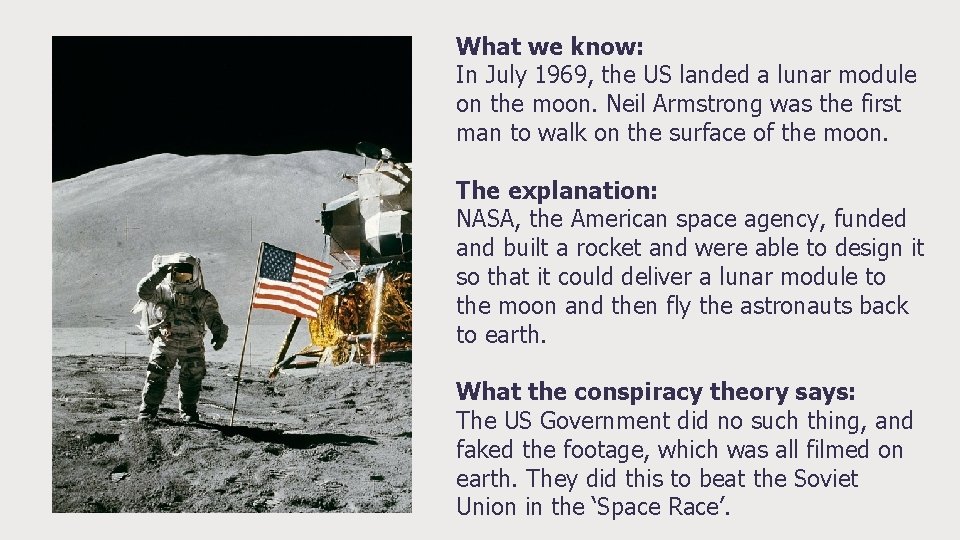
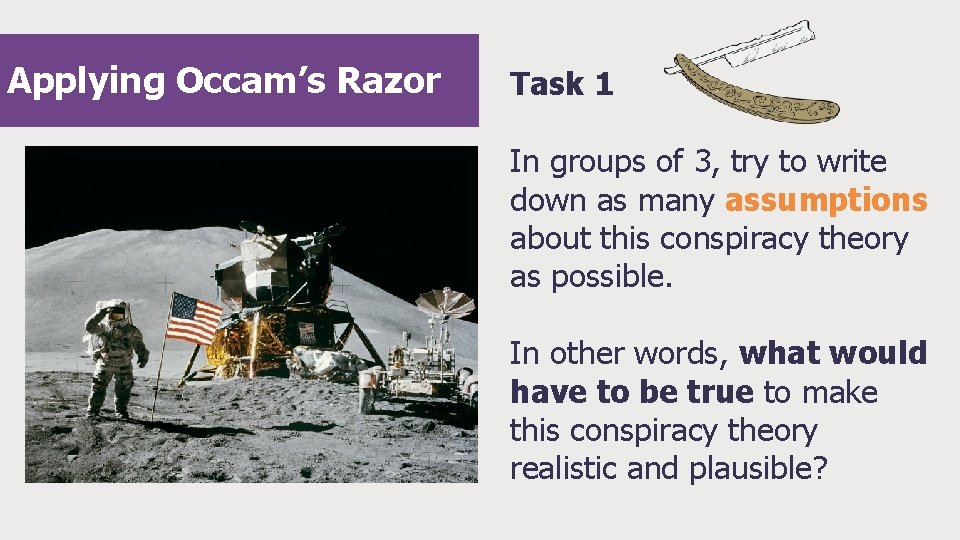
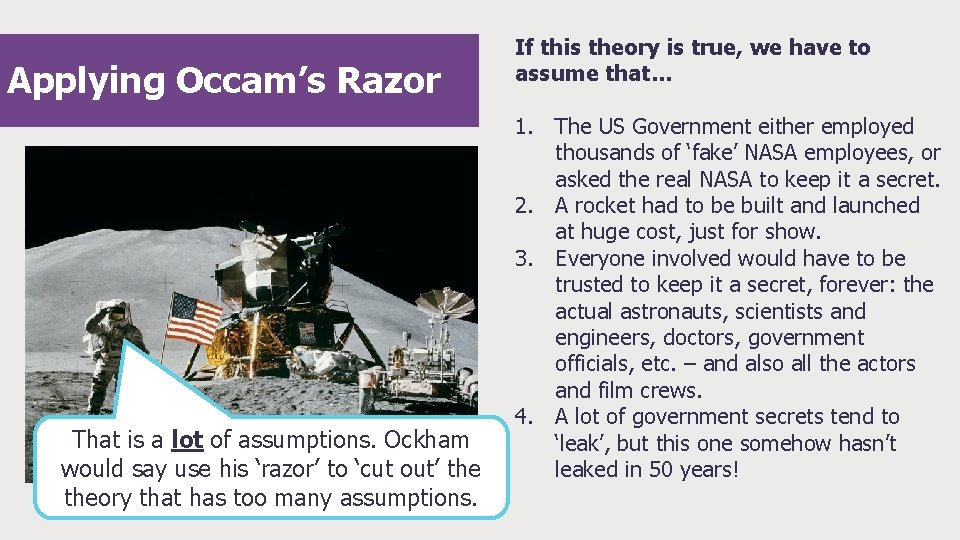
What we know: In July 1969, the US landed a lunar module on the moon. Neil Armstrong was the first man to walk on the surface of the moon. The explanation: NASA, the American space agency, funded and built a rocket and were able to design it so that it could deliver a lunar module to the moon and then fly the astronauts back to earth. What the conspiracy theory says: The US Government did no such thing, and faked the footage, which was all filmed on earth. They did this to beat the Soviet Union in the ‘Space Race’.
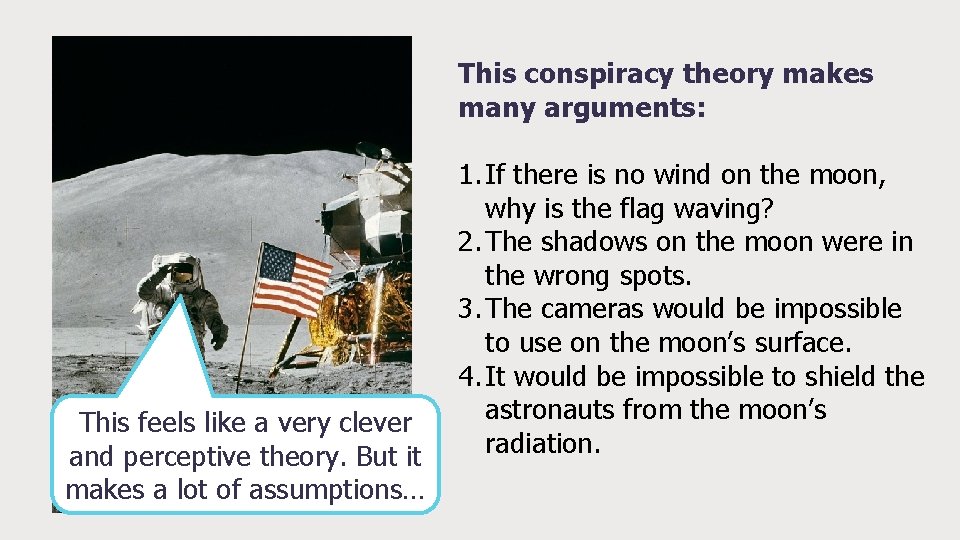
This conspiracy theory makes many arguments: This feels like a very clever and perceptive theory. But it makes a lot of assumptions… 1. If there is no wind on the moon, why is the flag waving? 2. The shadows on the moon were in the wrong spots. 3. The cameras would be impossible to use on the moon’s surface. 4. It would be impossible to shield the astronauts from the moon’s radiation.
Applying Occam’s Razor Task 1 In groups of 3, try to write down as many assumptions about this conspiracy theory as possible. In other words, what would have to be true to make this conspiracy theory realistic and plausible?
Applying Occam’s Razor That is a lot of assumptions. Ockham would say use his ‘razor’ to ‘cut out’ theory that has too many assumptions. If this theory is true, we have to assume that… 1. The US Government either employed thousands of ‘fake’ NASA employees, or asked the real NASA to keep it a secret. 2. A rocket had to be built and launched at huge cost, just for show. 3. Everyone involved would have to be trusted to keep it a secret, forever: the actual astronauts, scientists and engineers, doctors, government officials, etc. – and also all the actors and film crews. 4. A lot of government secrets tend to ‘leak’, but this one somehow hasn’t leaked in 50 years!
Logical Fallacies What is a logical fallacy? It is a failure in reasoning that makes an argument weak or invalid. It is very useful to be able to identify logical fallacies – because once you understand them… …You’ll spot them everywhere! You are about to see three very common logical fallacies…
#1: The ‘Anecdotal’ Fallacy 1) The statistics suggest that exercising helps you live longer. 2) However, I knew somebody who exercised a lot and died young. Conclusion: exercise doesn’t help you live longer! Why is this a fallacy? Because the argument relies on only one tiny piece of evidence – an ‘anecdote’ – rather than a large amount of evidence. It is the “I know someone who…” fallacy.
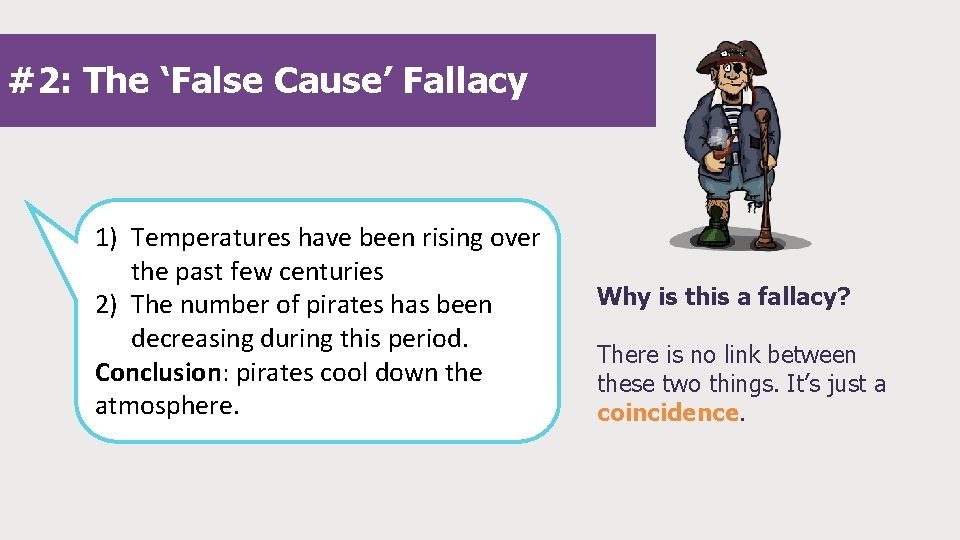
#2: The ‘False Cause’ Fallacy 1) Temperatures have been rising over the past few centuries 2) The number of pirates has been decreasing during this period. Conclusion: pirates cool down the atmosphere. Why is this a fallacy? There is no link between these two things. It’s just a coincidence.
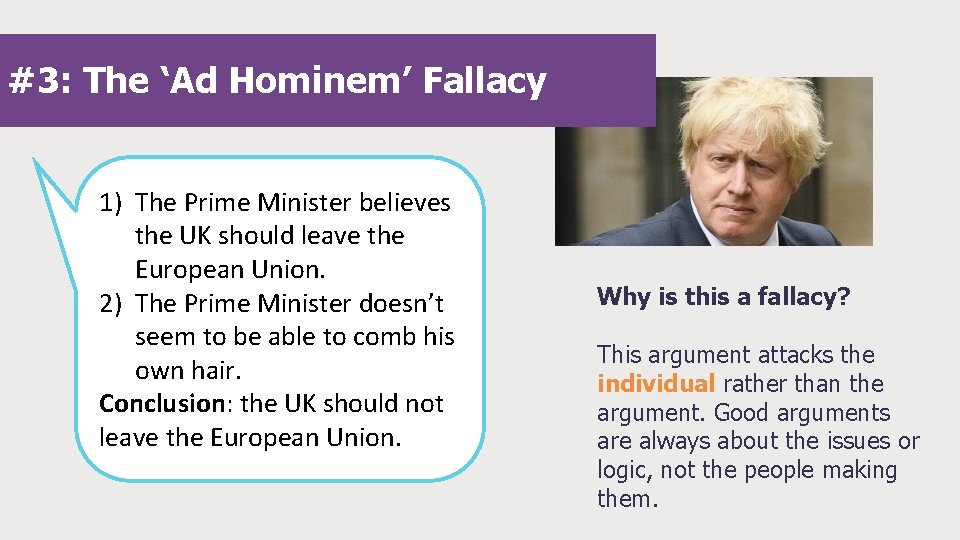
#3: The ‘Ad Hominem’ Fallacy 1) The Prime Minister believes the UK should leave the European Union. 2) The Prime Minister doesn’t seem to be able to comb his own hair. Conclusion: the UK should not leave the European Union. Why is this a fallacy? This argument attacks the individual rather than the argument. Good arguments are always about the issues or logic, not the people making them.
Come up with your own Task 2: Using the worksheet, can you come up with three of your own examples of these logical fallacies (in your groups). 1) The Anecdotal Fallacy 2) The False Cause Fallacy 3) The Ad Hominem Fallacy At the end of the task, share your examples with the class.
Review Understanding and using critical thinking will help you to approach questions and problems in life with reason and awareness, and to make better decisions. Always have an open mind. Ask for evidence. Be aware of fallacies, coincidences, and ‘bad’ mental habits. ‘Think about your thinking’. Be aware that people can be driven by emotion, or sometimes lack judgement.