
Critical Thinking Interpreting Class from practical perspective By
Critical Thinking & Interpreting Class ——from practical perspective By Penny
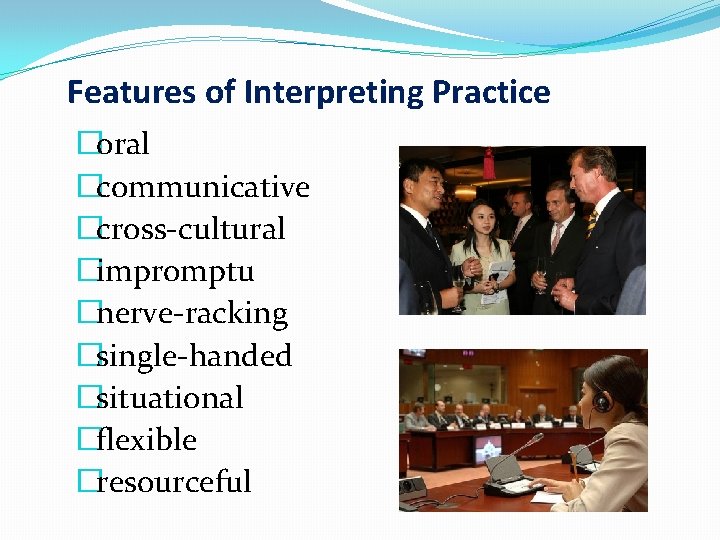
Features of Interpreting Practice �oral �communicative �cross-cultural �impromptu �nerve-racking �single-handed �situational �flexible �resourceful

Features & Requirement of Interpreting Class �small class �simulative situation �intense atmosphere �independent thinking �critical thinking �reflective thinking

Bloom’s Taxonomy �six cognitive levels �six levels of intellectual behavior in learning
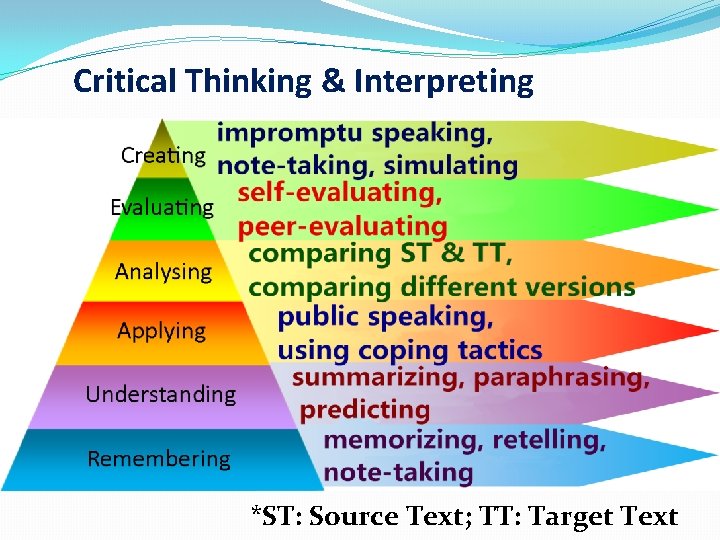
Critical Thinking & Interpreting *ST: Source Text; TT: Target Text
Activities to Develop Critical Thinking in Interpreting Class (1) Remembering: �retelling exercise �note-taking exercise �vocabulary brainstorming
Activities to Develop Critical Thinking in Interpreting Class (2) Understanding: �summarizing exercise �predicting exercise �paraphrasing exercise
Activities to Develop Critical Thinking in Interpreting Class (3) Applying �public speaking practice �utilizing coping tactics �utilizing paraphrasing skills
Activities to Develop Critical Thinking in Interpreting Class (4) Analyzing: �explaining culture-specific terms �comparing different interpretation versions �comparing source text & reference translation
Activities to Develop Critical Thinking in Interpreting Class (5) Evaluating �peer evaluating �self evaluating �writing retrospective report
Activities to Develop Critical Thinking in Interpreting Class (6) Creating: �impromptu speaking �presentation �simulative liaison interpreting �mock conference interpreting
Teaching Design for an Interpreting Class (1) �Course Title: Interpreting between English and Chinese �Lesson Title: Ceremonial Speeches �Length of Lesson: 120 minutes �Student Level: junior students in college
Teaching Design for an Interpreting Class (2) Objectives: 1. to enhance students' skills of public speaking, memorizing and paraphrasing (develop different levels of critical thinking skills); 2. to get students familiar with the style and expressions of speeches in public events and ceremonies
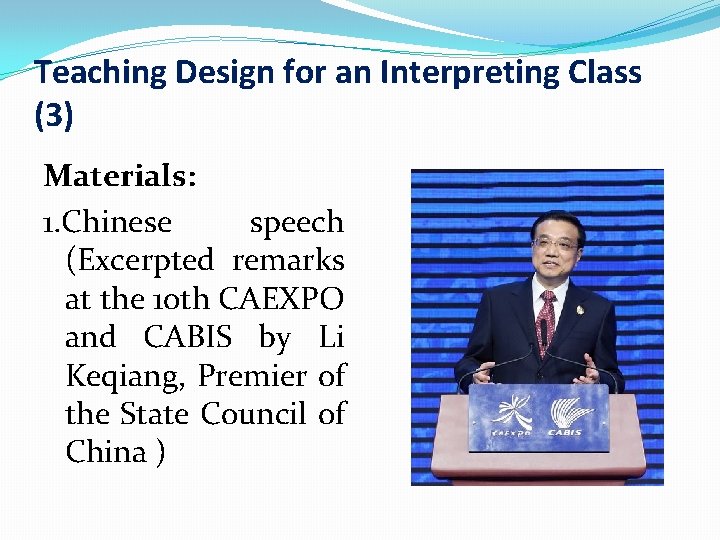
Teaching Design for an Interpreting Class (3) Materials: 1. Chinese speech (Excerpted remarks at the 10 th CAEXPO and CABIS by Li Keqiang, Premier of the State Council of China )
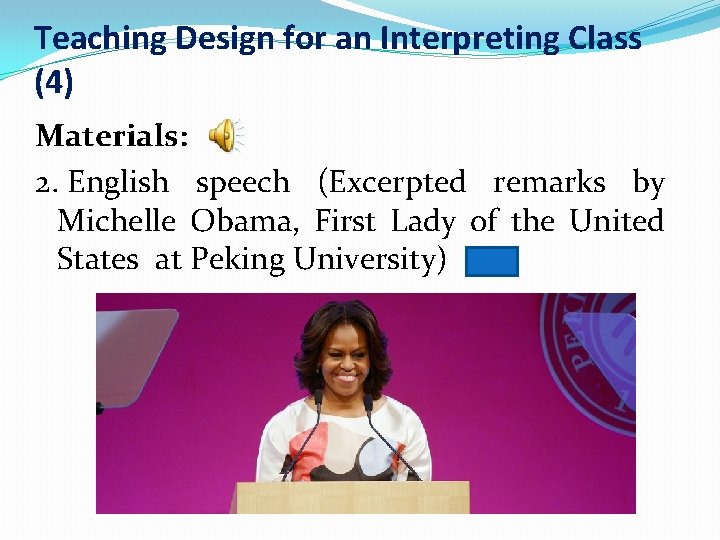
Teaching Design for an Interpreting Class (4) Materials: 2. English speech (Excerpted remarks by Michelle Obama, First Lady of the United States at Peking University)
Teaching Design for an Interpreting Class (5) Procedure: 1. Lead-in and warm-up activity of pair speaking (10 mins) 2. Public speaking, retelling and peer evaluation (25 mins) 3. Chinese-English interpreting and paraphrasing (40 mins) 4. English-Chinese interpreting and peer evaluation (35 mins) 5. Task assignment for next week (10 mins)
Step 1 (10 mins). Lead-in and warm-up activity of pair speaking——have students do pair-work of speaking in English with topics given a week ago for preparing �Welcome Speech �Opening/Closing Speech �Banquet Toast
Step 2 (25 mins). Public speaking, retelling and peer evaluating—— �have volunteer students deliver the English speeches in front of the class �call other students to retell the speeches �have students do peer evaluation with given rubrics on public speaking performance
Step 3 (40 mins). Chinese-English interpreting and paraphrasing—— �read out the excerpted Chinese speech segment by segment �call students to interpret the same segment with different versions by utilizing paraphrasing skills �have students compare different versions of interpreting
Step 4 (35 mins). English-Chinese interpreting and peer evaluation—— �play the audio/video clip of English speech for students to interpret into Chinese segment by segment �call some students to interpret to the whole class for peer evaluation with rubrics on interpreting performance
Step 5 (10 mins). Assignment: prepare for the mock conference in next week �The whole class is divided into four groups: 1. Conference Organizers (including conference host, conference secretary, Chinese speaker and English speaker) 2. Interpreters 3. Journalists 4. Assessors
Task of conference organizers: to prepare for all the affairs of the conference such as �fixing up the classroom for conference; �getting the notes or PPT ready for hosting and speaking; �rehearsing for procedure and time management.
Task of interpreters : �to prepare for the impromptu interpreting by searching information related to the conference theme, predicting contents of the speech and collecting relevant vocabulary; �to write retrospective report for self evaluation with detailed analysis.
Task of journalists: �to prepare questions related to the conference theme; �to raise the questions after the speakers have made the speeches; �to take videos of the conference and make editing afterwards.
Task of assessors: �to observe the whole process of the conference; �to take notes and assess the performance of the other three groups; �to write evaluation report from observers’ point of view after the conference.

- Slides: 26