
CRITICAL THINKING IN PROBLEM SOLVING AND NEW IDEAS

CRITICAL THINKING IN PROBLEM SOLVING AND NEW IDEAS PROF. DR. CLAUS BADERSCHNEIDER IDEAS AND GRAPHICS FROM: Fink, Dietmar: Strategische Unternehmensberatung, Vahlen
PROBLEM SOLVING What do we do when we work? • Solve problems that are - arbitrary, - almost always new and range from - operative to strategic DRAFT – not to be published!!
PROBLEM SOLVING What do consultants / teachers / coaches do? • Help solve problems - With methodological structures and solving processes - Goal: support client in his / her problem solving process - NOT: solve problem for client! DRAFT – not to be published!!
PROBLEM SOLVING What makes a problem ? Problem can be defined as „ reason to act “ resulting from - difference between a planned / expected state and observation in „reality“ - and pressure to act because of consequences of the difference Attention! - Problem versus symptom! Symptom = observation that has deeper cause DRAFT – not to be published!!
PROBLEM SOLVING Situation that the client faces: a) Client can in fact define the problem, knows what kind of help is needed. b) Client is aware that he can present only descriptions of unsatisfying single situations, and thus is aware of need for help to identify exact problem. c) Client believes to know the problem, but describes symptoms, or attributes problem to the wrong area – expects that consultant/ teacher agrees with his judgment. DRAFT – not to be published!!
PROBLEM SOLVING In order to approach the problem, we need to establish “causal chain” ÞIn beginning only “fuzzy” picture of the problem (“… it can’t go on like this…”) ÞEveryone has a different view on “facts” (”alternative facts”) • (ref: “The social construction of reality” Berger/Lukman) • Danger: One’s own reality/ knowledge taken for granted, undisputed • (ref. : “marketing myopia” by T. Levitt) DRAFT – not to be published!!
PROBLEM SOLVING Culture has impact on view on reality: Socialization results in a role (critical: role of education in shaping this view) e. g. : Engineering culture versus business culture … (ref. : “The role of academia in IT enabled business change”) We need to understand the assumptions that shape the “reality” i. e. the account of the client (or anyone that tells you something) DRAFT – not to be published!!
PROBLEM SOLVING • What makes a problem a personal problem? • Problem is never independent of the person that defines it. • It is always a personal problem, not one of an organization • Only when a person in a certain situation, given the setting of individual goals (external or intrinsic) feels a subjective pressure to act, will this situation become their problem (…reason to act) DRAFT – not to be published!!

PROBLEM SOLVING Difference: problem versus task • Same situation can be “problem” for one, and merely “task” for another Depends on: • Methodological expertise /competence • Personal engagement / motivational aspects – (what might be an existential problem for an executive, is merely a task for a consultant…) DRAFT – not to be published!!
PROBLEM SOLVING Basic structure of a problem: • Difference plan – fact (target – actual variance) • Pressure to act DRAFT – not to be published!!
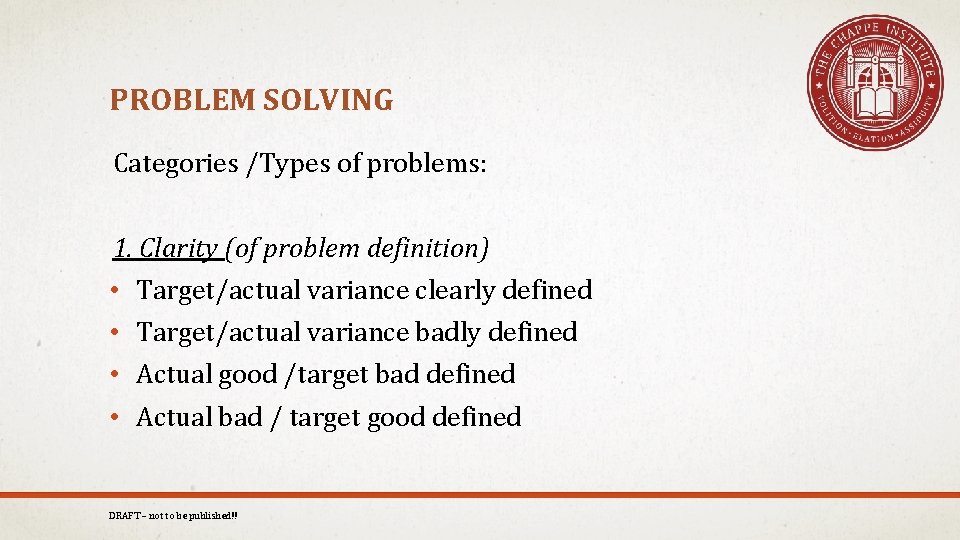
PROBLEM SOLVING Categories /Types of problems: 1. Clarity (of problem definition) • • Target/actual variance clearly defined Target/actual variance badly defined Actual good /target bad defined Actual bad / target good defined DRAFT – not to be published!!
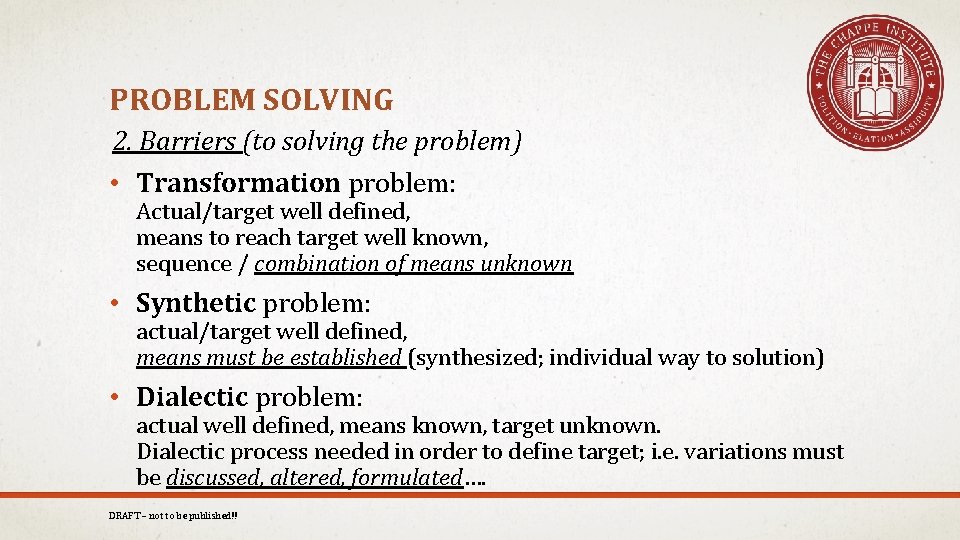
PROBLEM SOLVING 2. Barriers (to solving the problem) • Transformation problem: Actual/target well defined, means to reach target well known, sequence / combination of means unknown • Synthetic problem: actual/target well defined, means must be established (synthesized; individual way to solution) • Dialectic problem: actual well defined, means known, target unknown. Dialectic process needed in order to define target; i. e. variations must be discussed, altered, formulated…. DRAFT – not to be published!!

PROBLEM SOLVING 3. Number of elements (simple versus complex) 4. Density of connections ( view vs. many) 5. Openers of connections and cause-relationships (transparent vs. intransparent) 6. Number of goals (number of problems, potentially conflicting) 7. Number of persons involved (individuals vs. collectives) 8. Time available 9. Rivalry (with or without opponent) DRAFT – not to be published!!
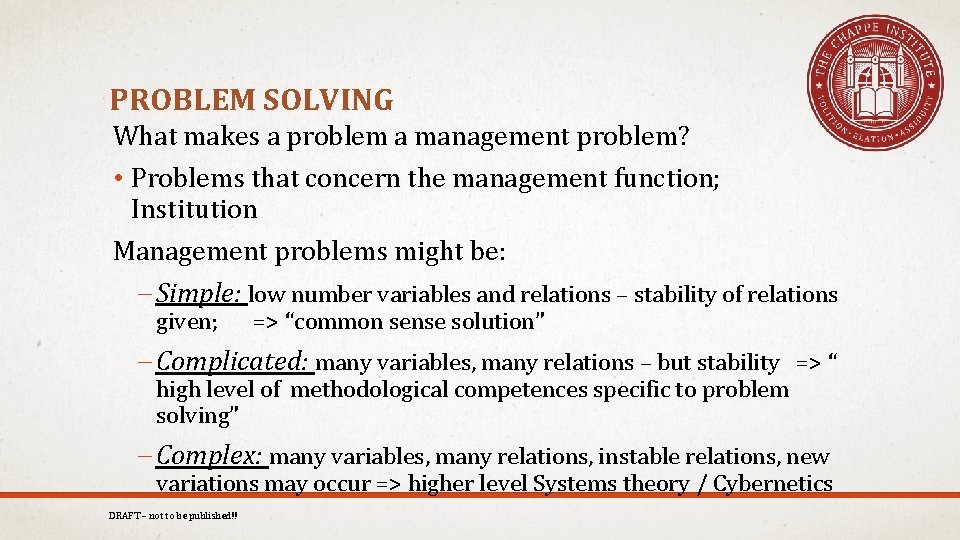
PROBLEM SOLVING What makes a problem a management problem? • Problems that concern the management function; Institution Management problems might be: - Simple: low number variables and relations – stability of relations given; => “common sense solution” - Complicated: many variables, many relations – but stability => “ high level of methodological competences specific to problem solving” - Complex: many variables, many relations, instable relations, new variations may occur => higher level Systems theory / Cybernetics DRAFT – not to be published!!
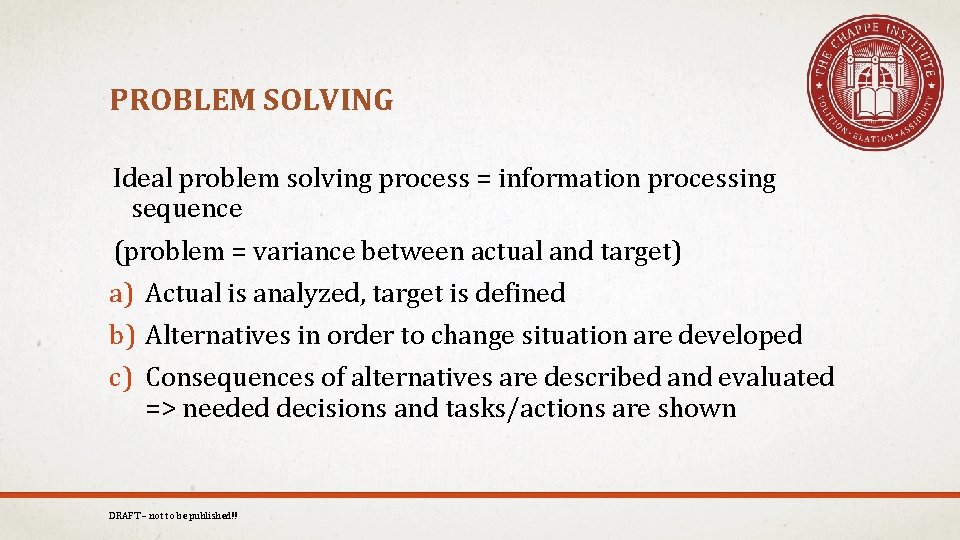
PROBLEM SOLVING Ideal problem solving process = information processing sequence (problem = variance between actual and target) a) Actual is analyzed, target is defined b) Alternatives in order to change situation are developed c) Consequences of alternatives are described and evaluated => needed decisions and tasks/actions are shown DRAFT – not to be published!!
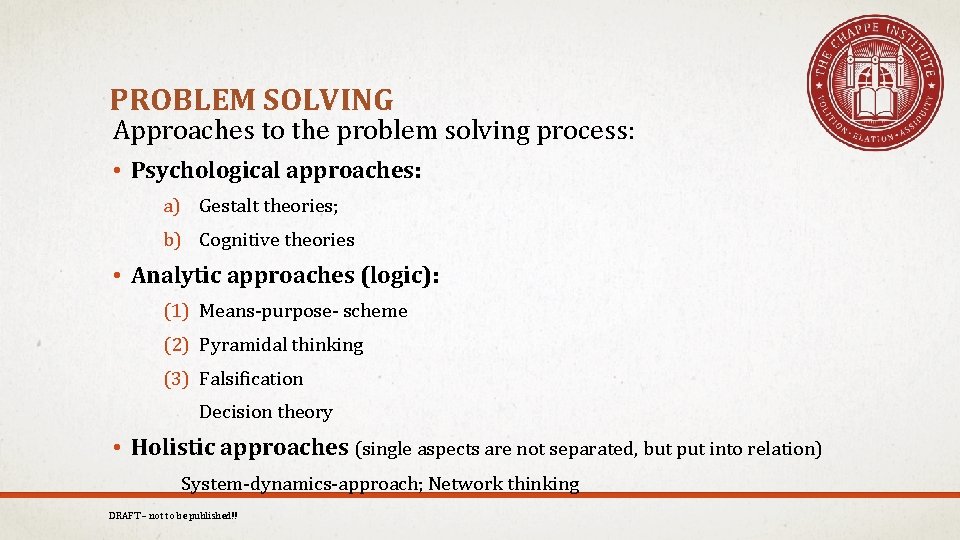
PROBLEM SOLVING Approaches to the problem solving process: • Psychological approaches: a) Gestalt theories; b) Cognitive theories • Analytic approaches (logic): (1) Means-purpose- scheme (2) Pyramidal thinking (3) Falsification Decision theory • Holistic approaches (single aspects are not separated, but put into relation) System-dynamics-approach; Network thinking DRAFT – not to be published!!
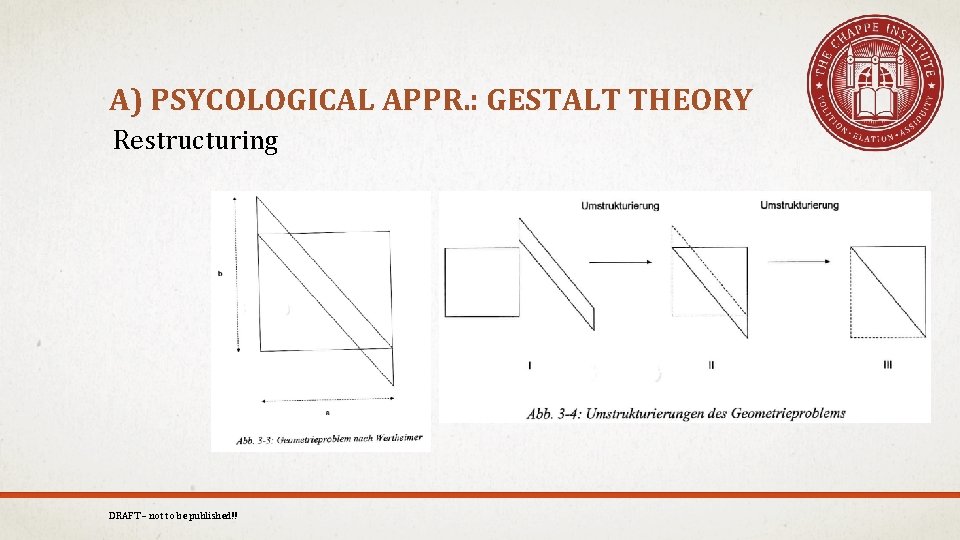
A) PSYCOLOGICAL APPR. : GESTALT THEORY Restructuring DRAFT – not to be published!!
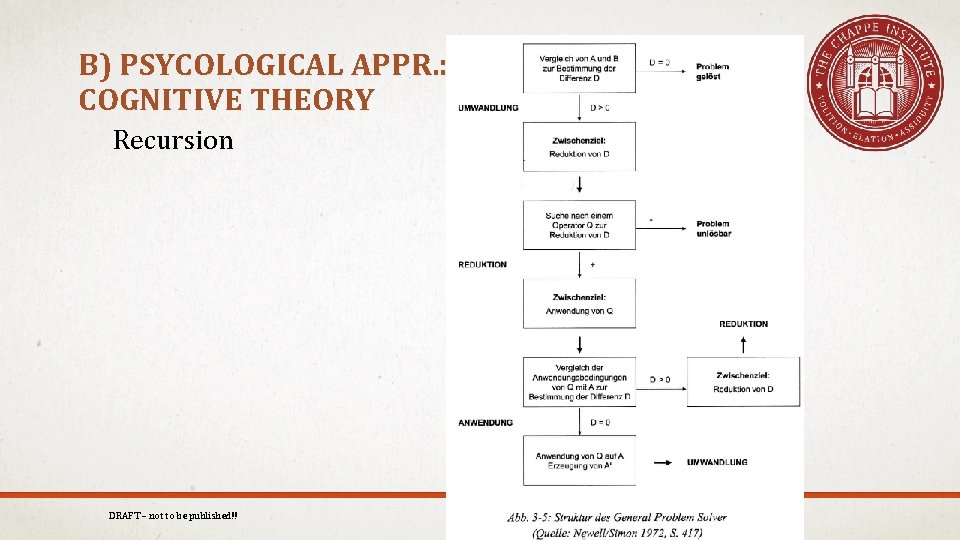
B) PSYCOLOGICAL APPR. : COGNITIVE THEORY Recursion DRAFT – not to be published!!
1) ANALYTICAL: MEANS-PURPOSE-SCHEME • Functions of a target: a) Orientation b) Fokus on desired state (target) c) Harmonized decision d) Control for contribution to solutions (change in difference actual –target) DRAFT – not to be published!!
1) ANALYTICAL: MEANS-PURPOSE-SCHEME • Conditions for operationalization: • Target-content - what? • Target-volume – how much? • Time - when? • Space- where? • Personel/resource- who? DRAFT – not to be published!! What about why?
1) ANALYTICAL: MEANS-PURPOSE-SCHEME • Order criteria: • Priority: Rank in reference to means-purpose-scheme: Top-lower priority; Main or side target… • Preference: relative importance of various targets • Target relationship: Neutral, complementary, concurring DRAFT – not to be published!!
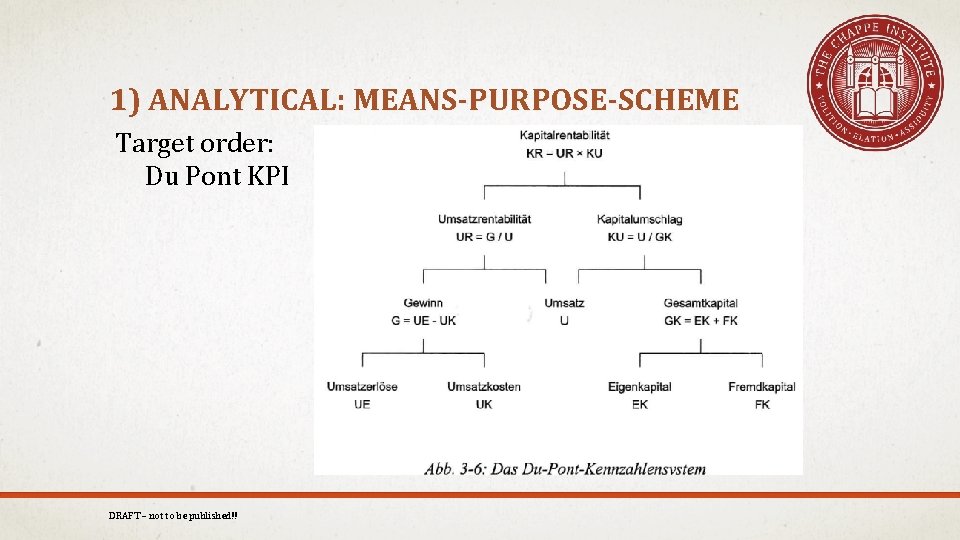
1) ANALYTICAL: MEANS-PURPOSE-SCHEME Target order: Du Pont KPI DRAFT – not to be published!!
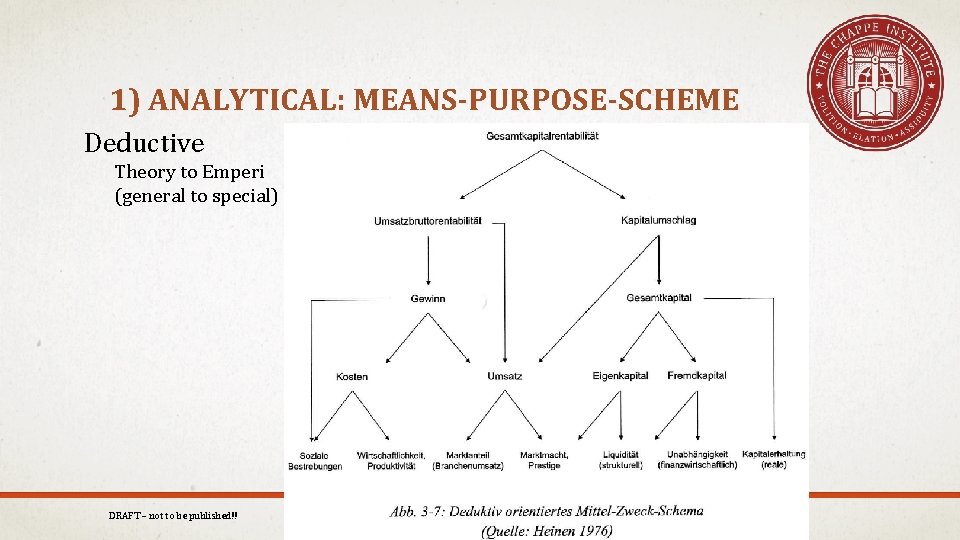
1) ANALYTICAL: MEANS-PURPOSE-SCHEME Deductive Theory to Emperi (general to special) DRAFT – not to be published!!
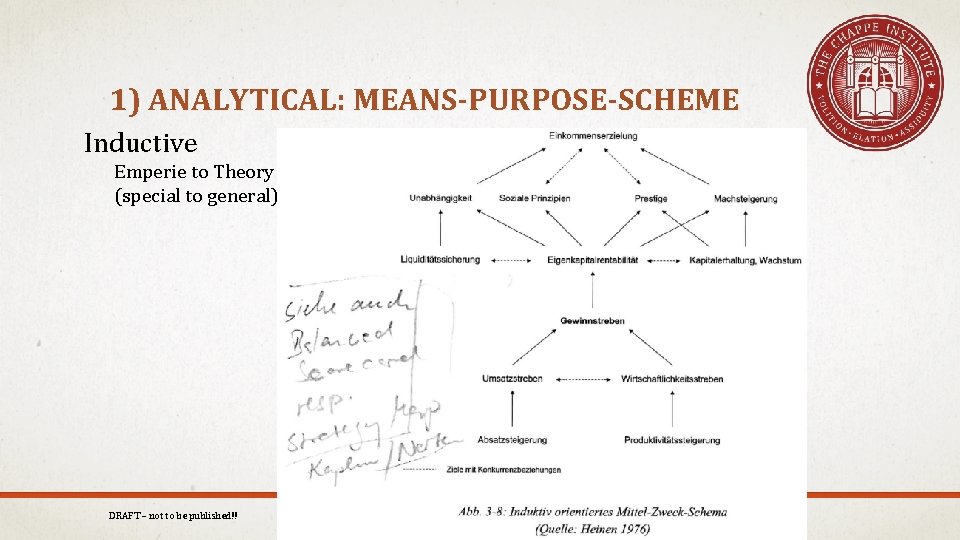
1) ANALYTICAL: MEANS-PURPOSE-SCHEME Inductive Emperie to Theory (special to general) DRAFT – not to be published!!
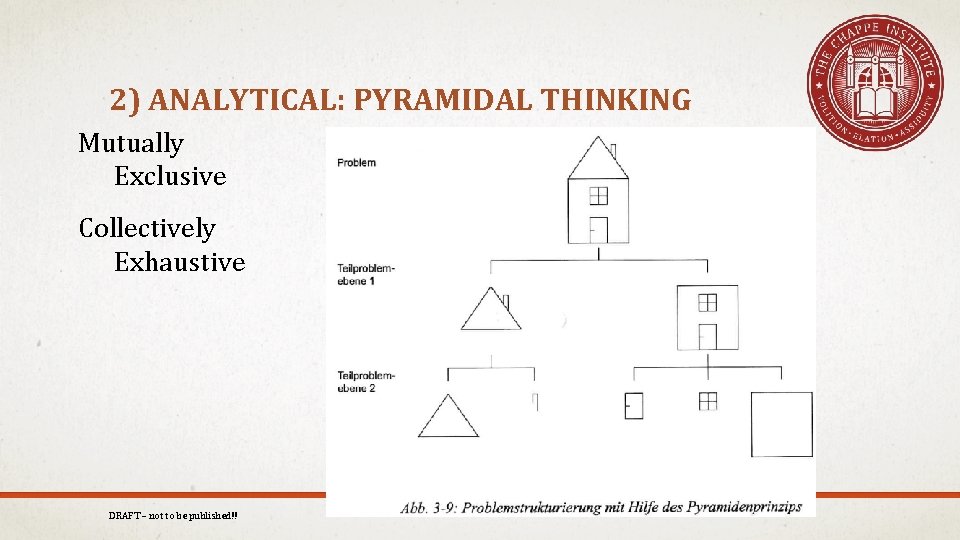
2) ANALYTICAL: PYRAMIDAL THINKING Mutually Exclusive Collectively Exhaustive DRAFT – not to be published!!
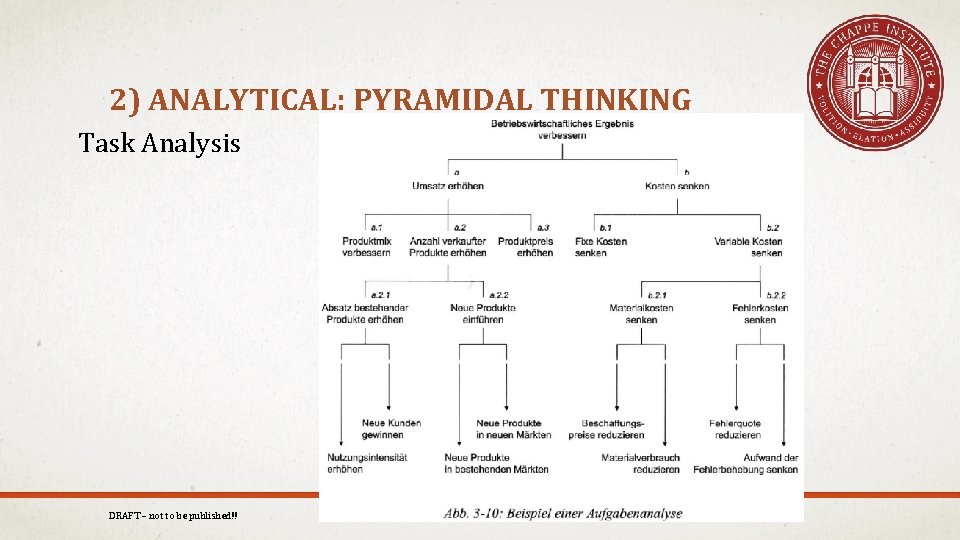
2) ANALYTICAL: PYRAMIDAL THINKING Task Analysis DRAFT – not to be published!!
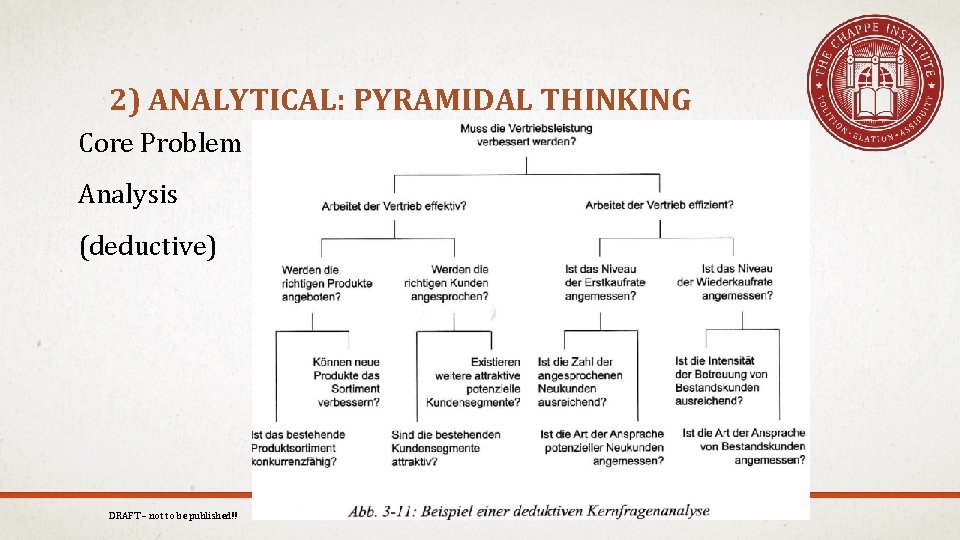
2) ANALYTICAL: PYRAMIDAL THINKING Core Problem Analysis (deductive) DRAFT – not to be published!!
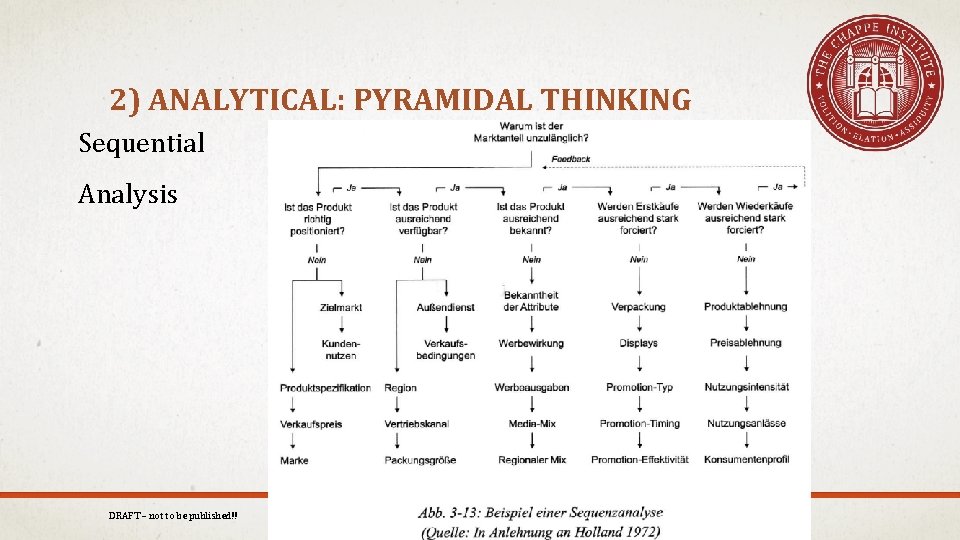
2) ANALYTICAL: PYRAMIDAL THINKING Sequential Analysis DRAFT – not to be published!!
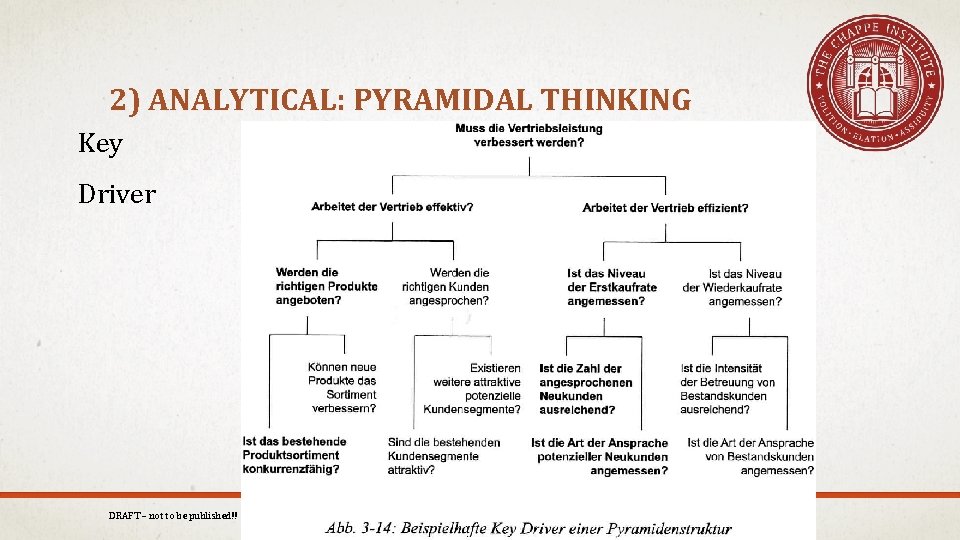
2) ANALYTICAL: PYRAMIDAL THINKING Key Driver DRAFT – not to be published!!
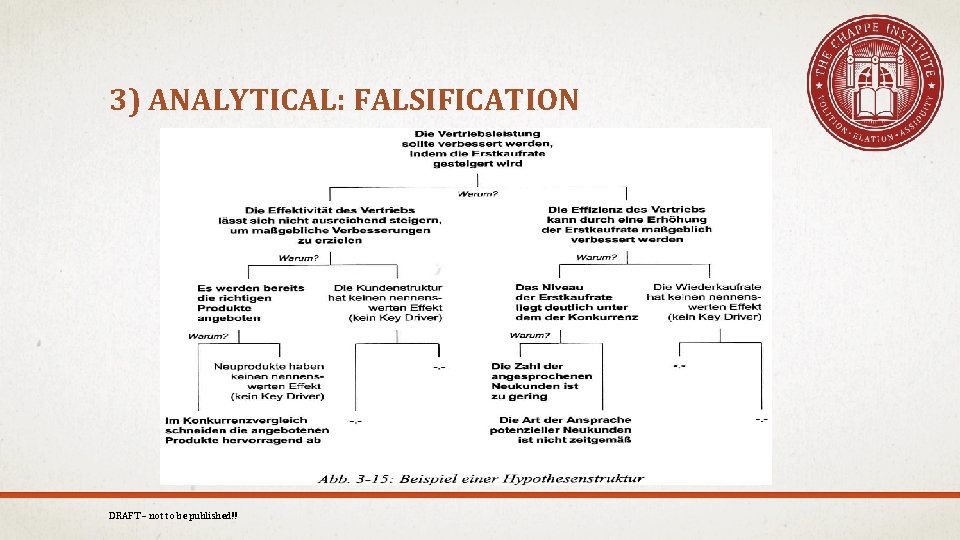
3) ANALYTICAL: FALSIFICATION DRAFT – not to be published!!
- Slides: 30