
Critical Thinking Deductively valid and invalid arguments Deductive
- Slides: 40
Critical Thinking Deductively valid and invalid arguments
Deductive validity An argument is deductively valid if it is impossible for all the premises to be true and the conclusion false. In a deductively valid argument: IF the premises are all true, the conclusion MUST also be true. Whoever the guilty person is, they are left-handed. Miss Green is not left handed. Therefore, she is not guilty. All birds lays eggs. Penguins are birds. Therefore, penguins lay eggs.
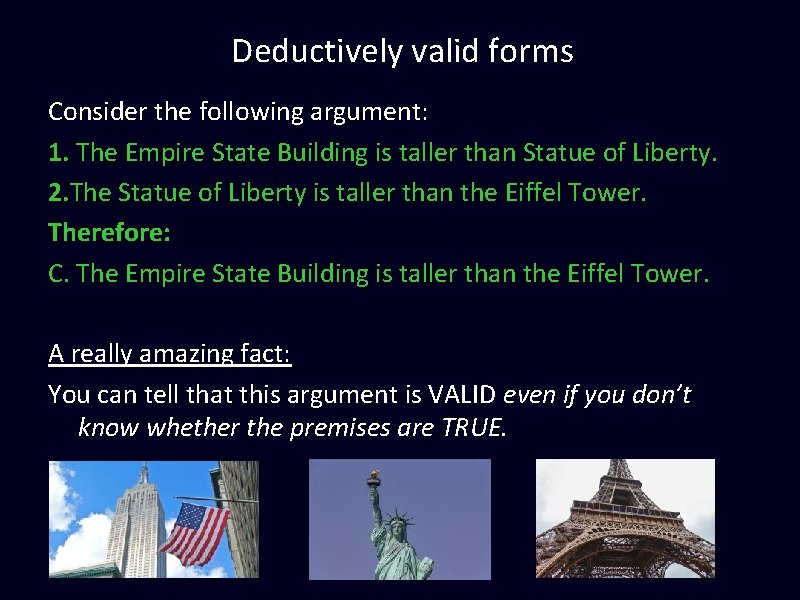
Deductively valid forms Consider the following argument: 1. The Empire State Building is taller than Statue of Liberty. 2. The Statue of Liberty is taller than the Eiffel Tower. Therefore: C. The Empire State Building is taller than the Eiffel Tower. A really amazing fact: You can tell that this argument is VALID even if you don’t know whether the premises are TRUE.
Deductively valid forms This is because the argument is valid in virtue of its FORM: 1. A is taller than B 2. B is taller than C Therefore: C. A is taller than C Any argument of this PATTERN or FORM is deductively valid. There is no way for the premises to be true and the conclusion false.
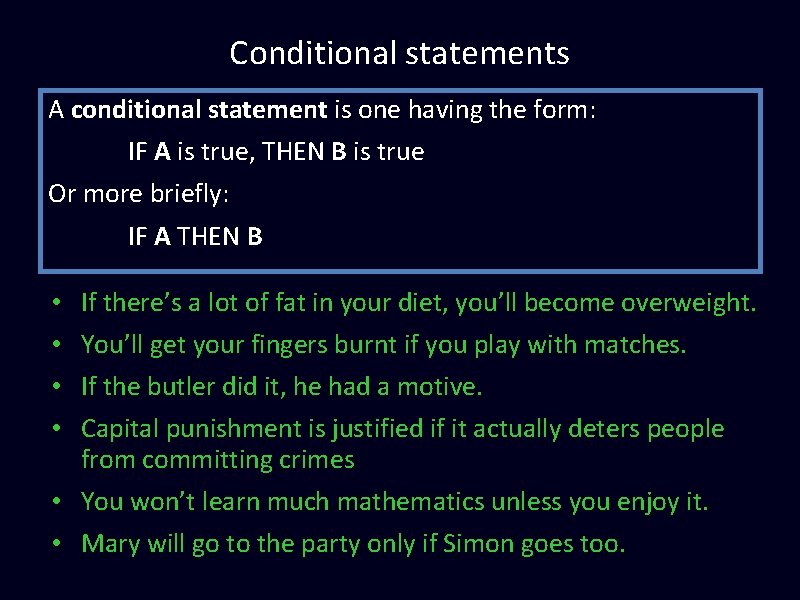
Conditional statements A conditional statement is one having the form: IF A is true, THEN B is true Or more briefly: IF A THEN B • • If there’s a lot of fat in your diet, you’ll become overweight. You’ll get your fingers burnt if you play with matches. If the butler did it, he had a motive. Capital punishment is justified if it actually deters people from committing crimes • You won’t learn much mathematics unless you enjoy it. • Mary will go to the party only if Simon goes too.
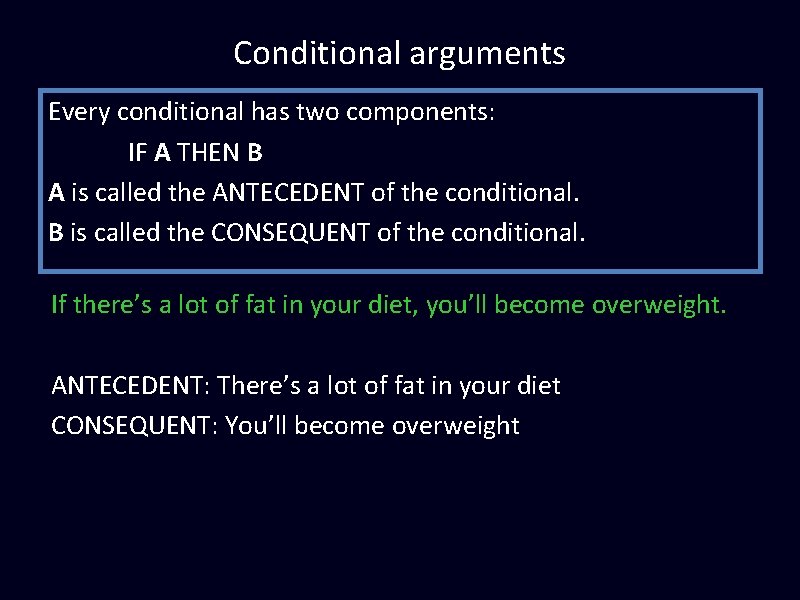
Conditional arguments Every conditional has two components: IF A THEN B A is called the ANTECEDENT of the conditional. B is called the CONSEQUENT of the conditional. If there’s a lot of fat in your diet, you’ll become overweight. ANTECEDENT: There’s a lot of fat in your diet CONSEQUENT: You’ll become overweight
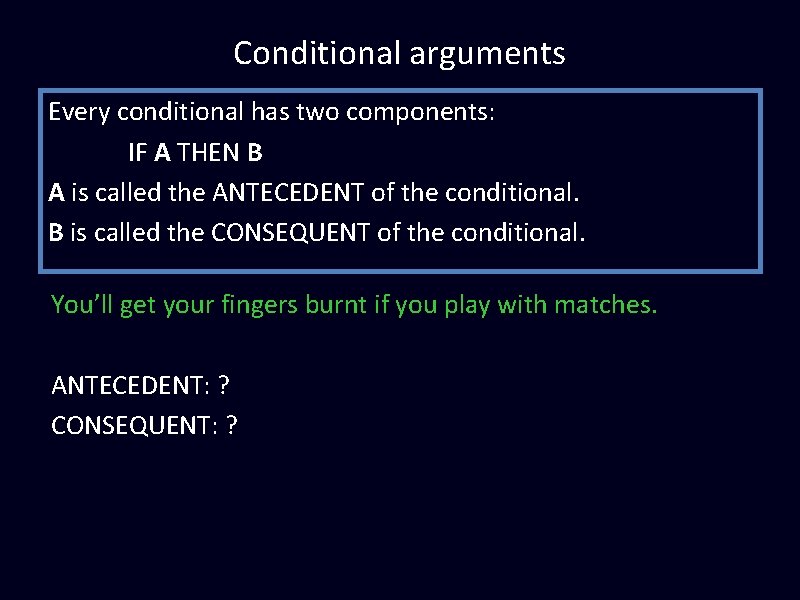
Conditional arguments Every conditional has two components: IF A THEN B A is called the ANTECEDENT of the conditional. B is called the CONSEQUENT of the conditional. You’ll get your fingers burnt if you play with matches. ANTECEDENT: ? CONSEQUENT: ?
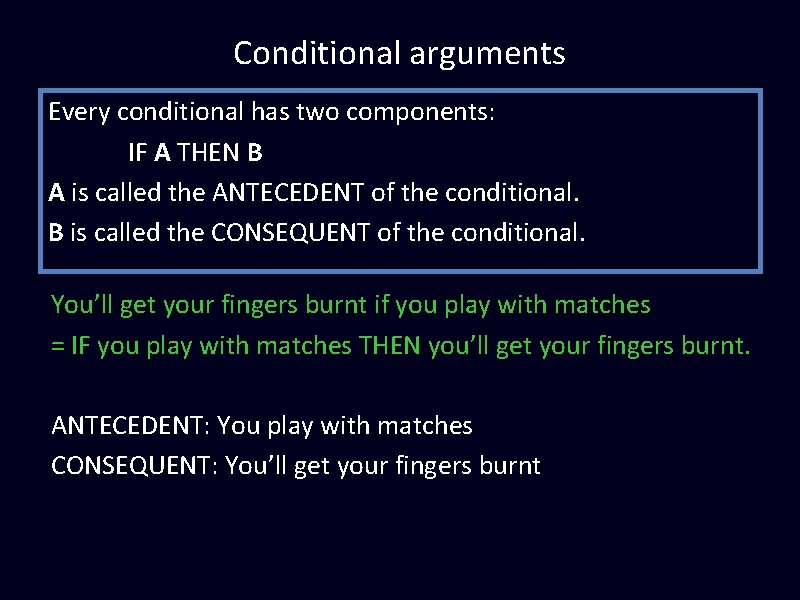
Conditional arguments Every conditional has two components: IF A THEN B A is called the ANTECEDENT of the conditional. B is called the CONSEQUENT of the conditional. You’ll get your fingers burnt if you play with matches = IF you play with matches THEN you’ll get your fingers burnt. ANTECEDENT: You play with matches CONSEQUENT: You’ll get your fingers burnt
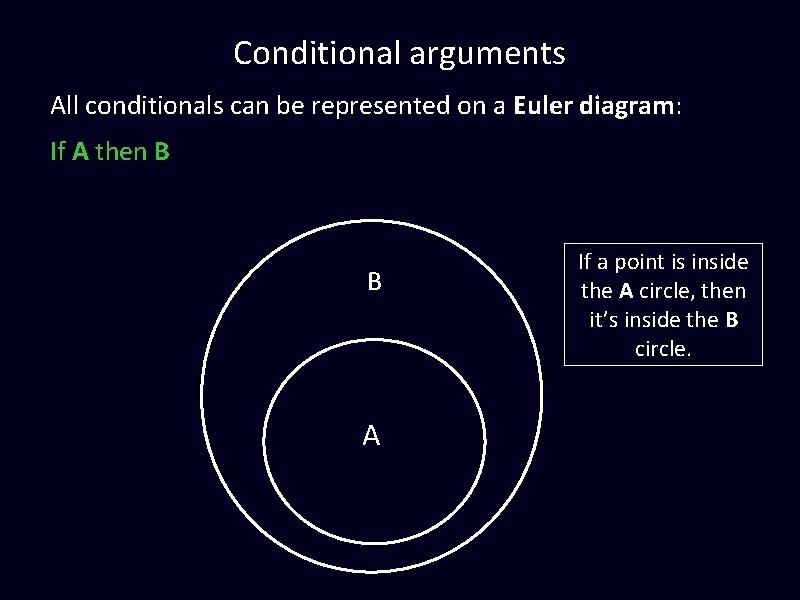
Conditional arguments All conditionals can be represented on a Euler diagram: If A then B B A If a point is inside the A circle, then it’s inside the B circle.
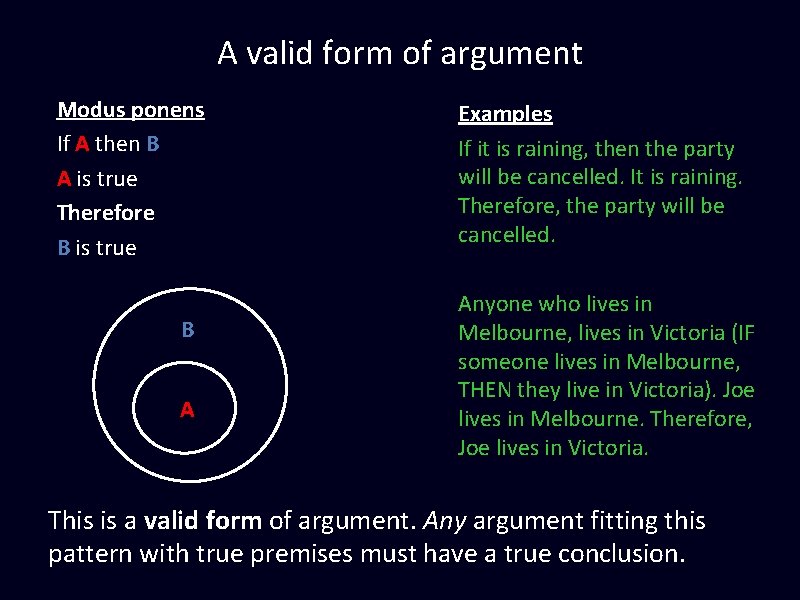
A valid form of argument Modus ponens If A then B A is true Therefore B is true B A Examples If it is raining, then the party will be cancelled. It is raining. Therefore, the party will be cancelled. Anyone who lives in Melbourne, lives in Victoria (IF someone lives in Melbourne, THEN they live in Victoria). Joe lives in Melbourne. Therefore, Joe lives in Victoria. This is a valid form of argument. Any argument fitting this pattern with true premises must have a true conclusion.
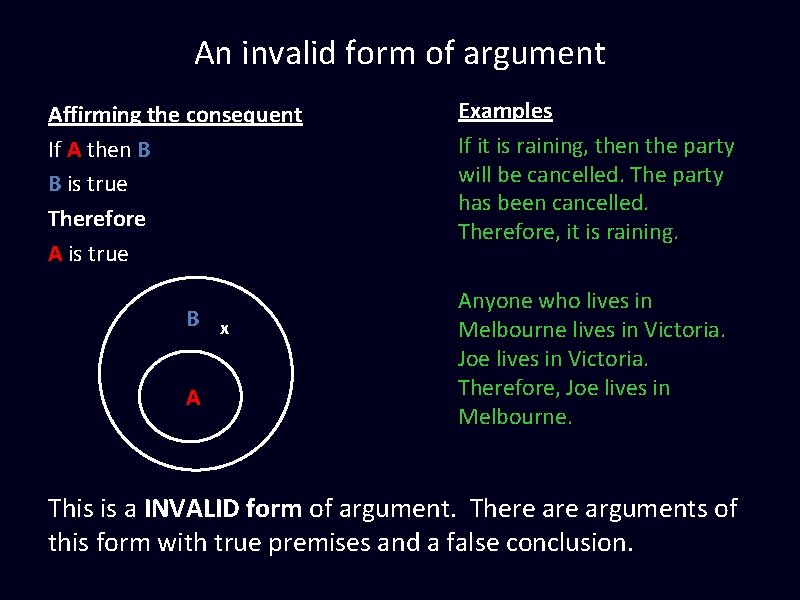
An invalid form of argument Affirming the consequent If A then B B is true Therefore A is true B x A Examples If it is raining, then the party will be cancelled. The party has been cancelled. Therefore, it is raining. Anyone who lives in Melbourne lives in Victoria. Joe lives in Victoria. Therefore, Joe lives in Melbourne. This is a INVALID form of argument. There arguments of this form with true premises and a false conclusion.
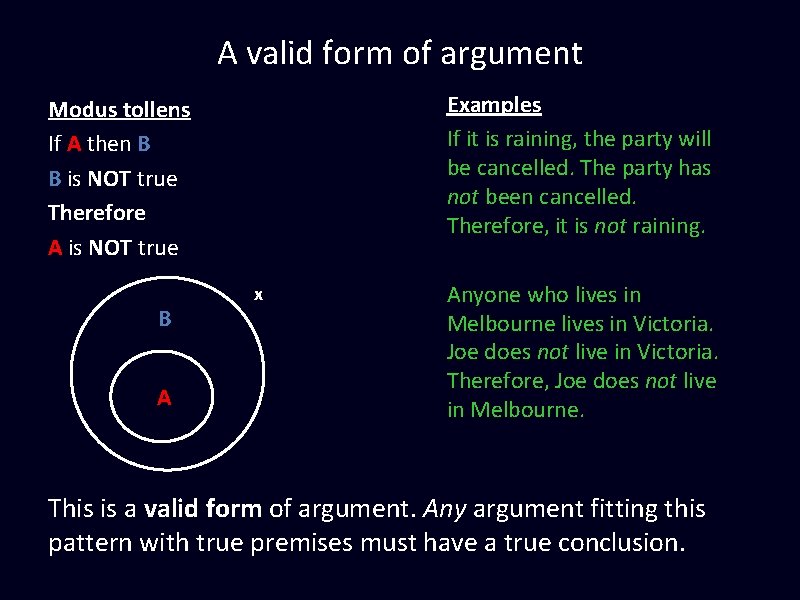
A valid form of argument Examples If it is raining, the party will be cancelled. The party has not been cancelled. Therefore, it is not raining. Modus tollens If A then B B is NOT true Therefore A is NOT true B A x Anyone who lives in Melbourne lives in Victoria. Joe does not live in Victoria. Therefore, Joe does not live in Melbourne. This is a valid form of argument. Any argument fitting this pattern with true premises must have a true conclusion.
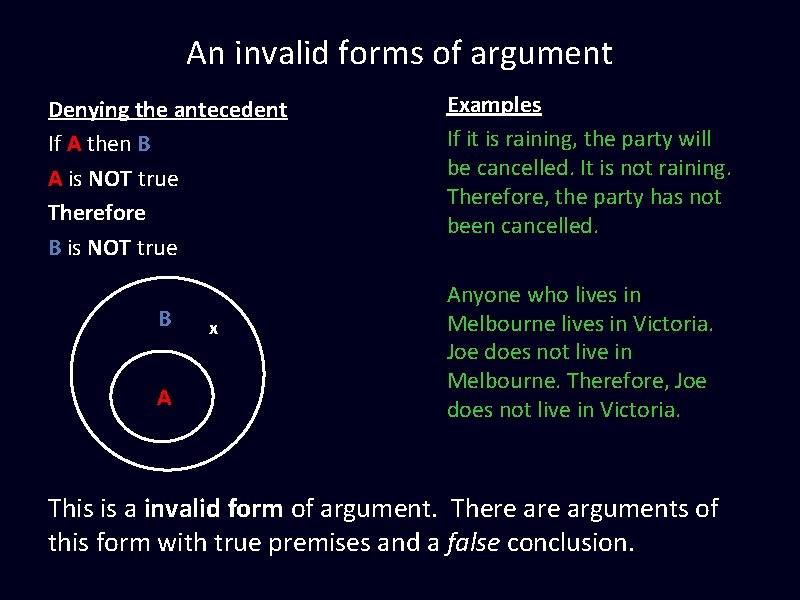
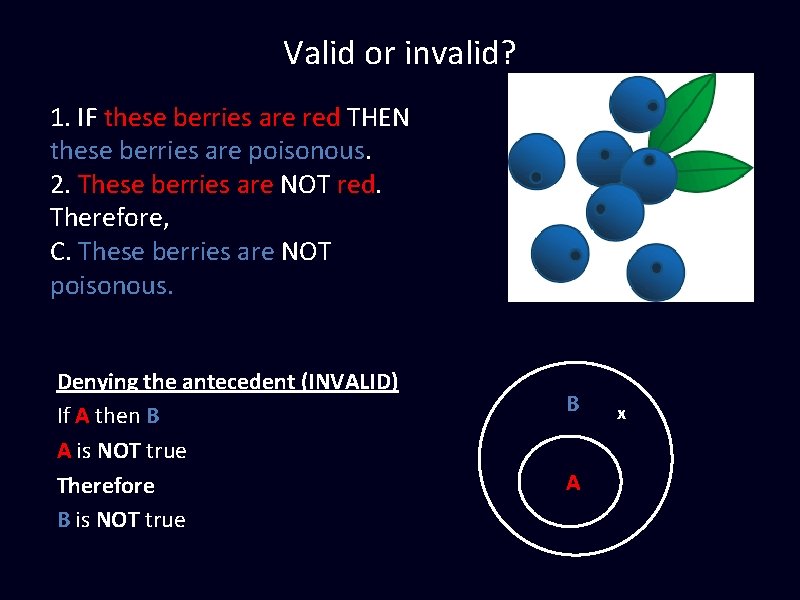
An invalid forms of argument Denying the antecedent If A then B A is NOT true Therefore B is NOT true B A x Examples If it is raining, the party will be cancelled. It is not raining. Therefore, the party has not been cancelled. Anyone who lives in Melbourne lives in Victoria. Joe does not live in Melbourne. Therefore, Joe does not live in Victoria. This is a invalid form of argument. There arguments of this form with true premises and a false conclusion.
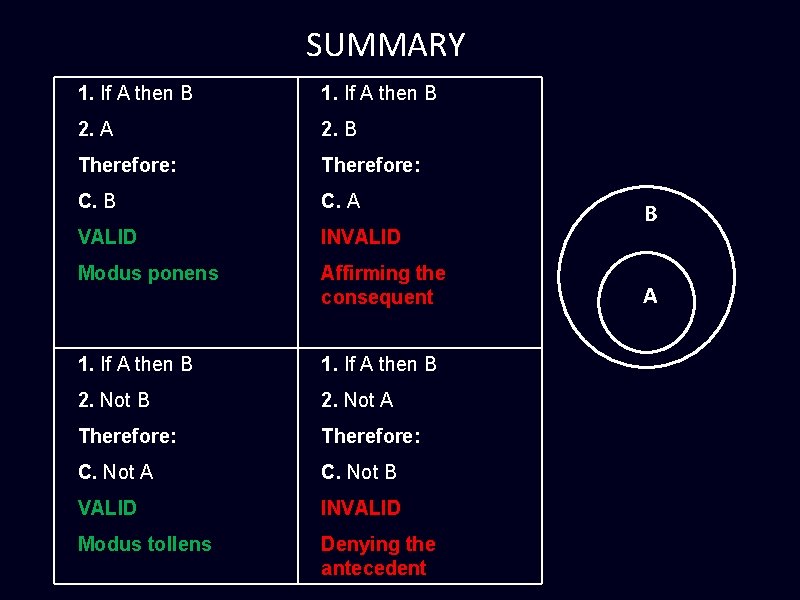
SUMMARY 1. If A then B 2. A 2. B Therefore: C. B C. A VALID INVALID Modus ponens Affirming the consequent 1. If A then B 2. Not A Therefore: C. Not A C. Not B VALID INVALID Modus tollens Denying the antecedent B A
QUIZ Valid and invalid arguments Or Logic as a matter of LIFE and DEATH
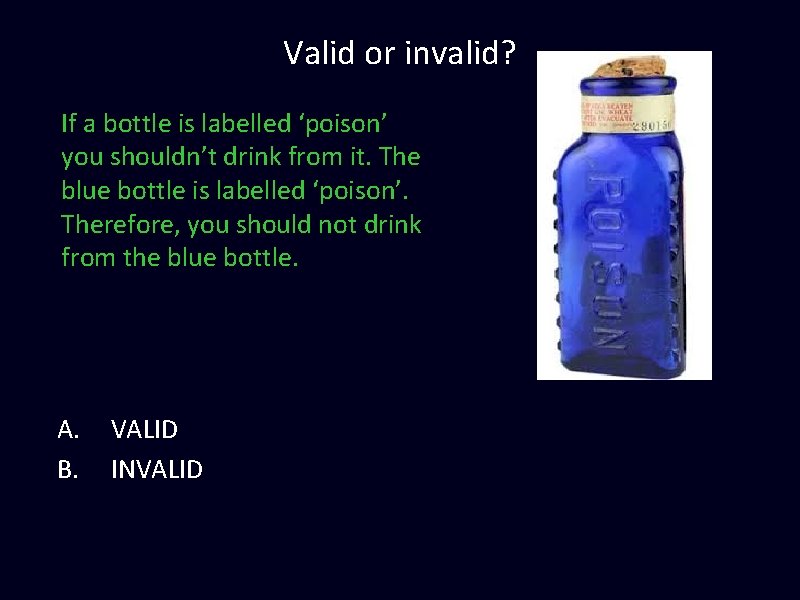
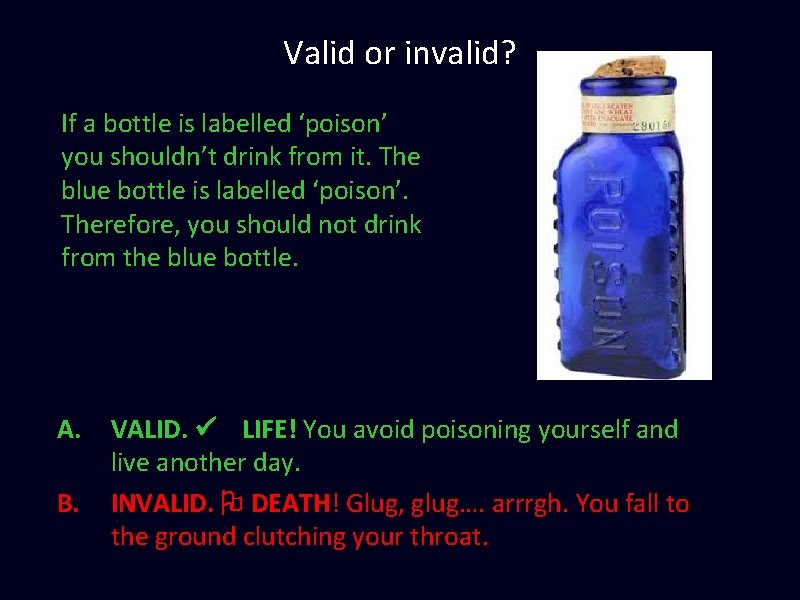
Valid or invalid? If a bottle is labelled ‘poison’ you shouldn’t drink from it. The blue bottle is labelled ‘poison’. Therefore, you should not drink from the blue bottle. A. B. VALID INVALID
Valid or invalid? If a bottle is labelled ‘poison’ you shouldn’t drink from it. The blue bottle is labelled ‘poison’. Therefore, you should not drink from the blue bottle. A. B. VALID. LIFE! You avoid poisoning yourself and live another day. INVALID. DEATH! Glug, glug…. arrrgh. You fall to the ground clutching your throat.
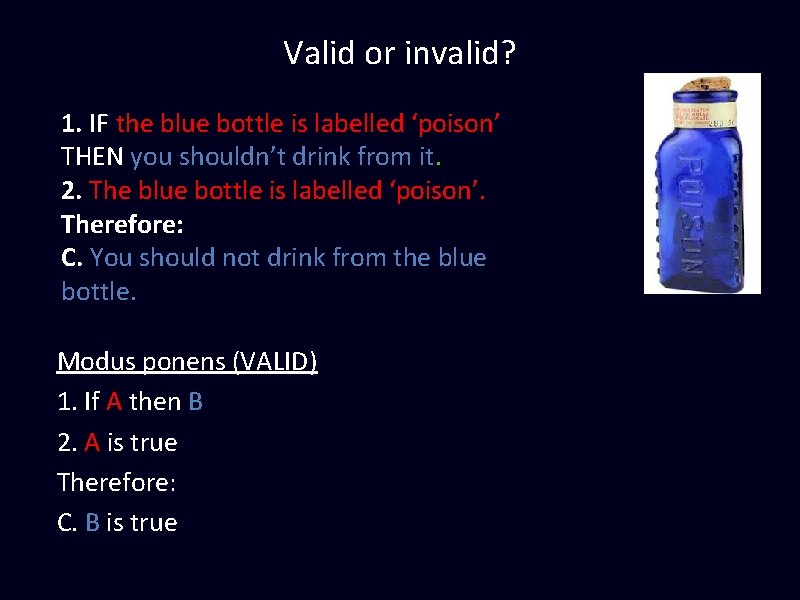
Valid or invalid? 1. IF the blue bottle is labelled ‘poison’ THEN you shouldn’t drink from it. 2. The blue bottle is labelled ‘poison’. Therefore: C. You should not drink from the blue bottle. Modus ponens (VALID) 1. If A then B 2. A is true Therefore: C. B is true
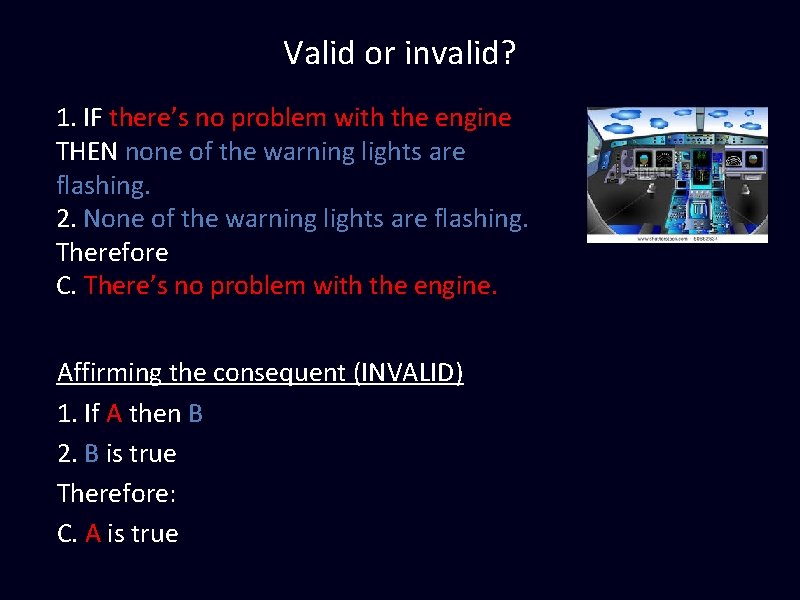
Valid or invalid? If there’s no problem with the engine, none of the warning lights will be flashing. None of the warning lights are flashing. Therefore, there’s no problem with the engine. A. B. VALID INVALID
Valid or invalid? If there’s no problem with the engine, none of the warning lights will be flashing. None of the warning lights are flashing. Therefore, there’s no problem with the engine. A. VALID. DEATH! There is a problem with the engine, but the warning lights are all broken. The plane nose dives into the ground and explodes. B. INVALID. LIFE! You look out of the window and notice smoke coming out of one engine. Luckily you have your parachute….
Valid or invalid? 1. IF there’s no problem with the engine THEN none of the warning lights are flashing. 2. None of the warning lights are flashing. Therefore C. There’s no problem with the engine. Affirming the consequent (INVALID) 1. If A then B 2. B is true Therefore: C. A is true
Valid or invalid? All the red berries in this forest are poisonous. But these berries, found in this forest, are not red. Therefore, these berries are not poisonous. A. B. VALID INVALID
Valid or invalid? All the red berries in this forest are poisonous. But these berries, found in this forest, are not red. Therefore, these berries are not poisonous. A. B. VALID. DEATH! Most of the blue berries in this forest are also poisonous. INVALID. LIFE! You do not eat the berries and live another day.
Valid or invalid? 1. IF these berries are red THEN these berries are poisonous. 2. These berries are NOT red. Therefore, C. These berries are NOT poisonous. Denying the antecedent (INVALID) If A then B A is NOT true Therefore B is NOT true B A x
Two more valid forms argument
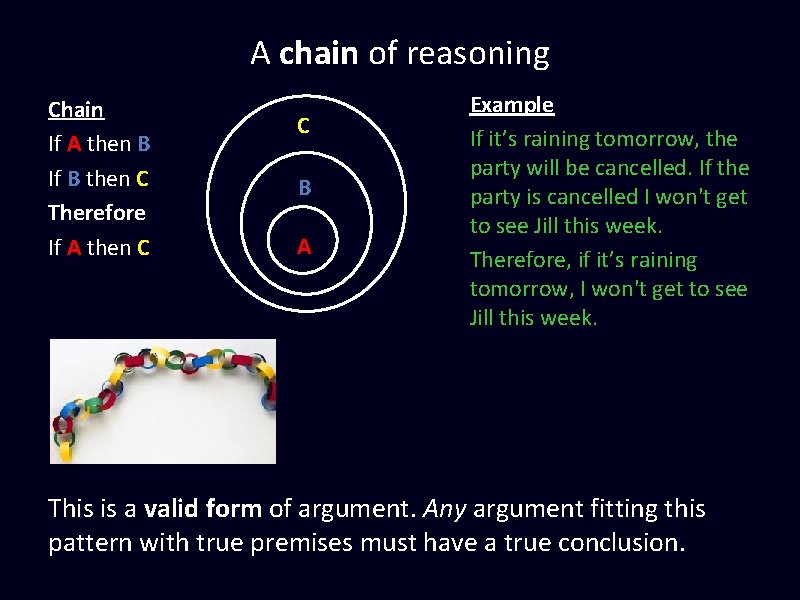
A chain of reasoning Chain If A then B If B then C Therefore If A then C C B A Example If it’s raining tomorrow, the party will be cancelled. If the party is cancelled I won't get to see Jill this week. Therefore, if it’s raining tomorrow, I won't get to see Jill this week. This is a valid form of argument. Any argument fitting this pattern with true premises must have a true conclusion.
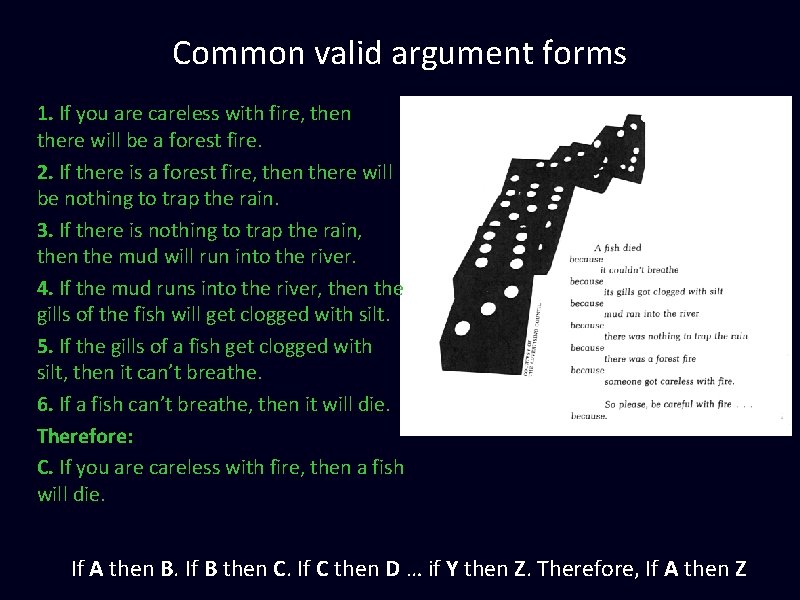
Common valid argument forms 1. If you are careless with fire, then there will be a forest fire. 2. If there is a forest fire, then there will be nothing to trap the rain. 3. If there is nothing to trap the rain, then the mud will run into the river. 4. If the mud runs into the river, then the gills of the fish will get clogged with silt. 5. If the gills of a fish get clogged with silt, then it can’t breathe. 6. If a fish can’t breathe, then it will die. Therefore: C. If you are careless with fire, then a fish will die. If A then B. If B then C. If C then D … if Y then Z. Therefore, If A then Z
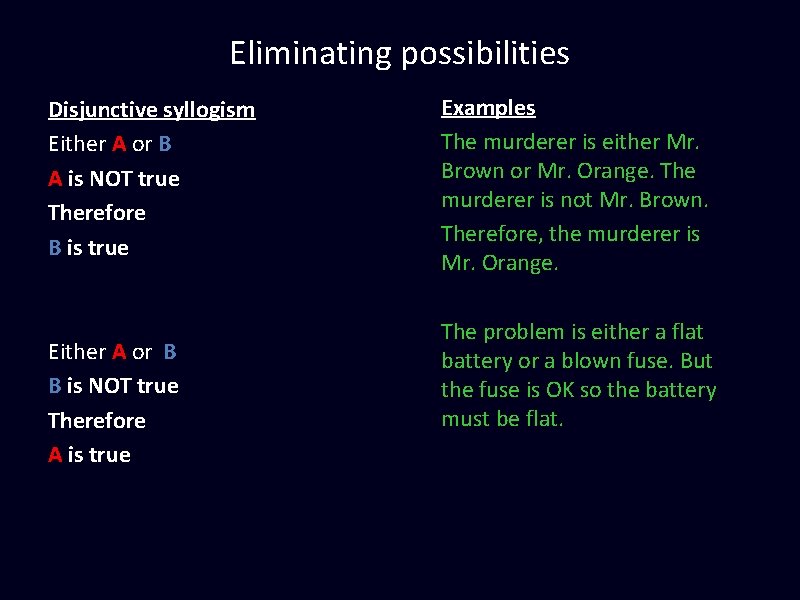
Eliminating possibilities Disjunctive syllogism Either A or B A is NOT true Therefore B is true Either A or B B is NOT true Therefore A is true Examples The murderer is either Mr. Brown or Mr. Orange. The murderer is not Mr. Brown. Therefore, the murderer is Mr. Orange. The problem is either a flat battery or a blown fuse. But the fuse is OK so the battery must be flat.
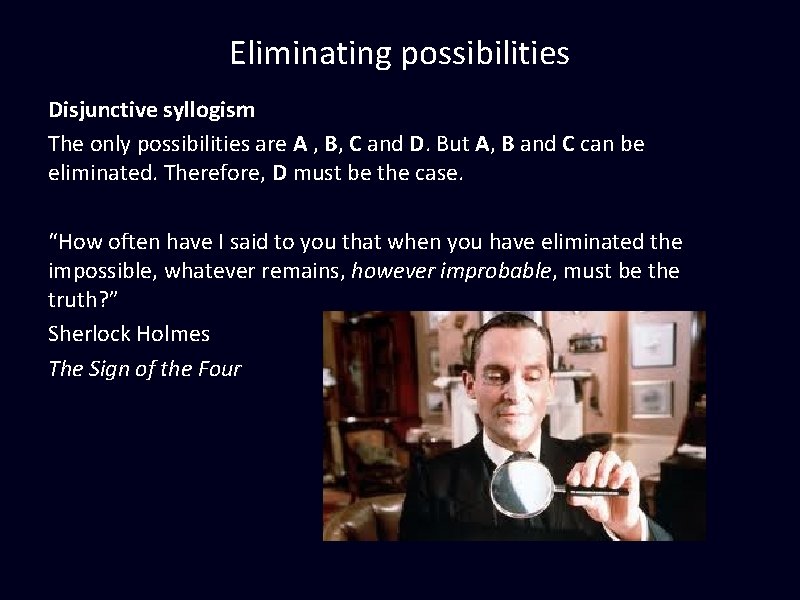
Eliminating possibilities Disjunctive syllogism The only possibilities are A , B, C and D. But A, B and C can be eliminated. Therefore, D must be the case. “How often have I said to you that when you have eliminated the impossible, whatever remains, however improbable, must be the truth? ” Sherlock Holmes The Sign of the Four
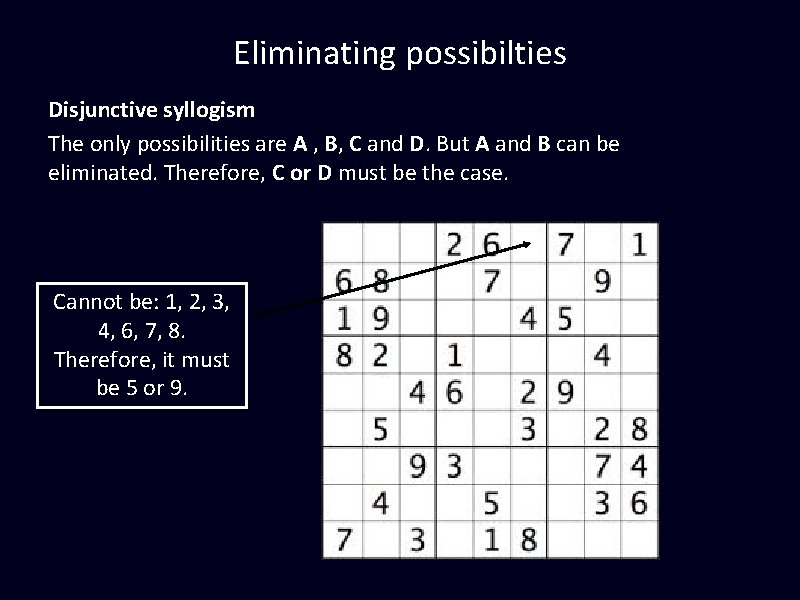
Eliminating possibilties Disjunctive syllogism The only possibilities are A , B, C and D. But A and B can be eliminated. Therefore, C or D must be the case. Cannot be: 1, 2, 3, 4, 6, 7, 8. Therefore, it must be 5 or 9.
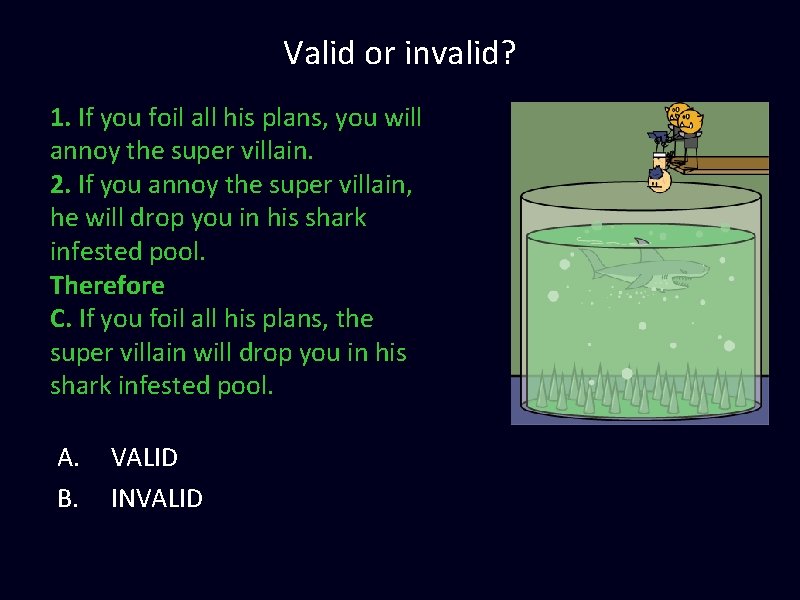
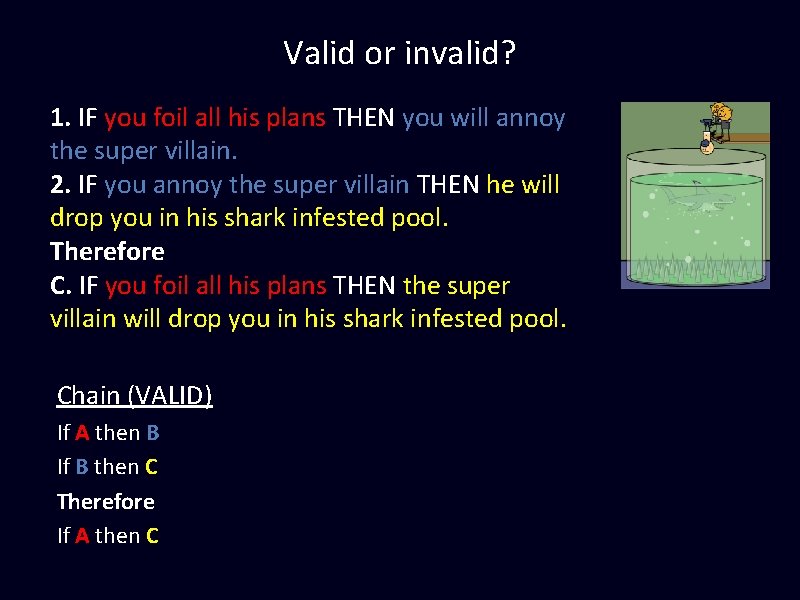
Valid or invalid? 1. If you foil all his plans, you will annoy the super villain. 2. If you annoy the super villain, he will drop you in his shark infested pool. Therefore C. If you foil all his plans, the super villain will drop you in his shark infested pool. A. B. VALID INVALID
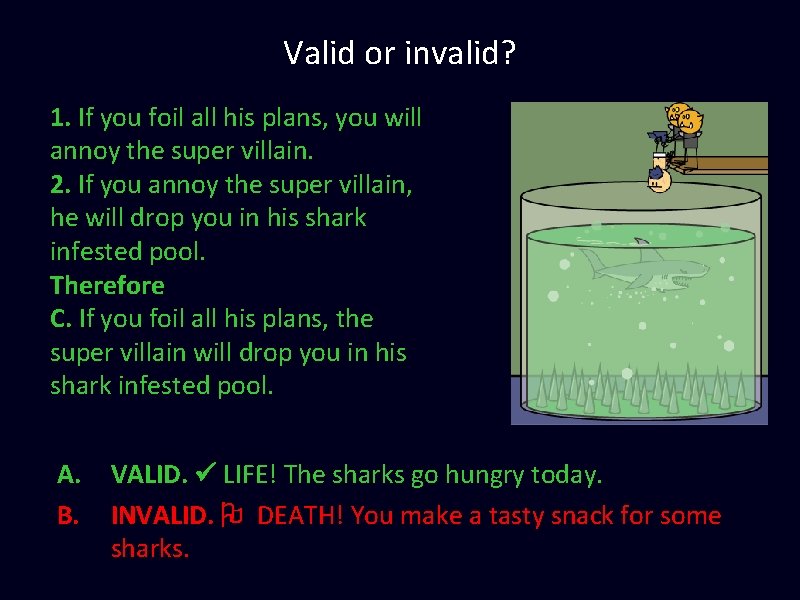
Valid or invalid? 1. If you foil all his plans, you will annoy the super villain. 2. If you annoy the super villain, he will drop you in his shark infested pool. Therefore C. If you foil all his plans, the super villain will drop you in his shark infested pool. A. B. VALID. LIFE! The sharks go hungry today. INVALID. DEATH! You make a tasty snack for some sharks.
Valid or invalid? 1. IF you foil all his plans THEN you will annoy the super villain. 2. IF you annoy the super villain THEN he will drop you in his shark infested pool. Therefore C. IF you foil all his plans THEN the super villain will drop you in his shark infested pool. Chain (VALID) If A then B If B then C Therefore If A then C
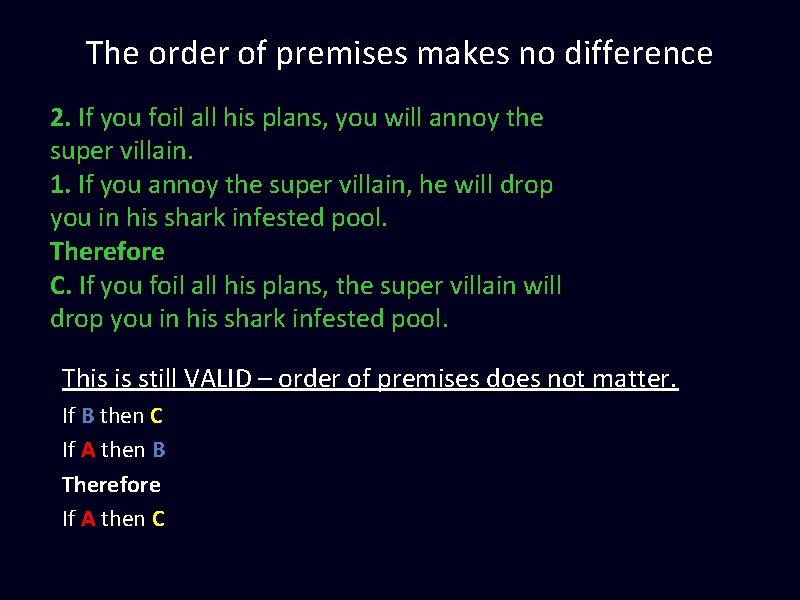
The order of premises makes no difference 2. If you foil all his plans, you will annoy the super villain. 1. If you annoy the super villain, he will drop you in his shark infested pool. Therefore C. If you foil all his plans, the super villain will drop you in his shark infested pool. This is still VALID – order of premises does not matter. If B then C If A then B Therefore If A then C
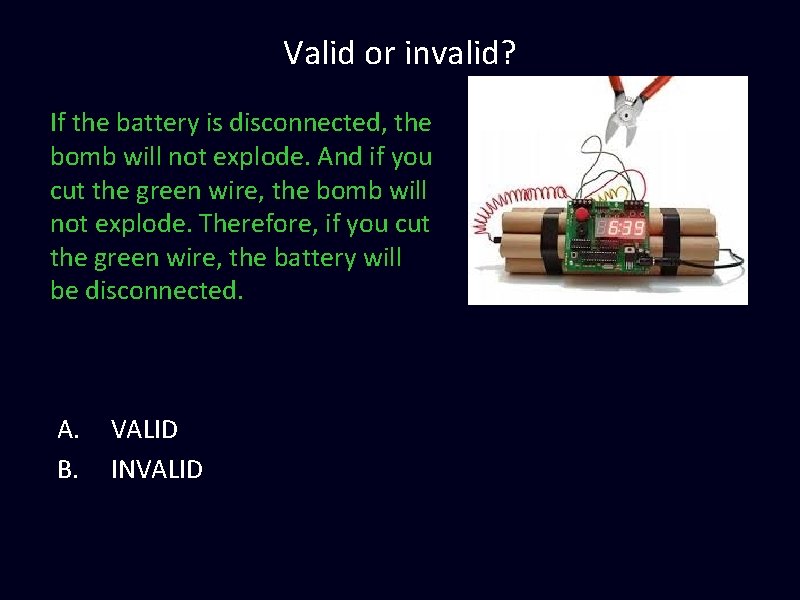
Valid or invalid? If the battery is disconnected, the bomb will not explode. And if you cut the green wire, the bomb will not explode. Therefore, if you cut the green wire, the battery will be disconnected. A. B. VALID INVALID
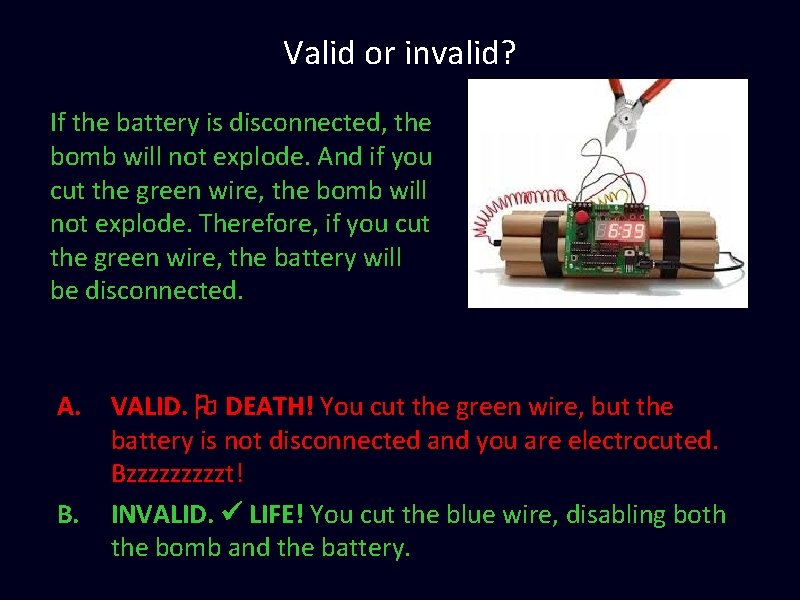
Valid or invalid? If the battery is disconnected, the bomb will not explode. And if you cut the green wire, the bomb will not explode. Therefore, if you cut the green wire, the battery will be disconnected. A. B. VALID. DEATH! You cut the green wire, but the battery is not disconnected and you are electrocuted. Bzzzzzt! INVALID. LIFE! You cut the blue wire, disabling both the bomb and the battery.
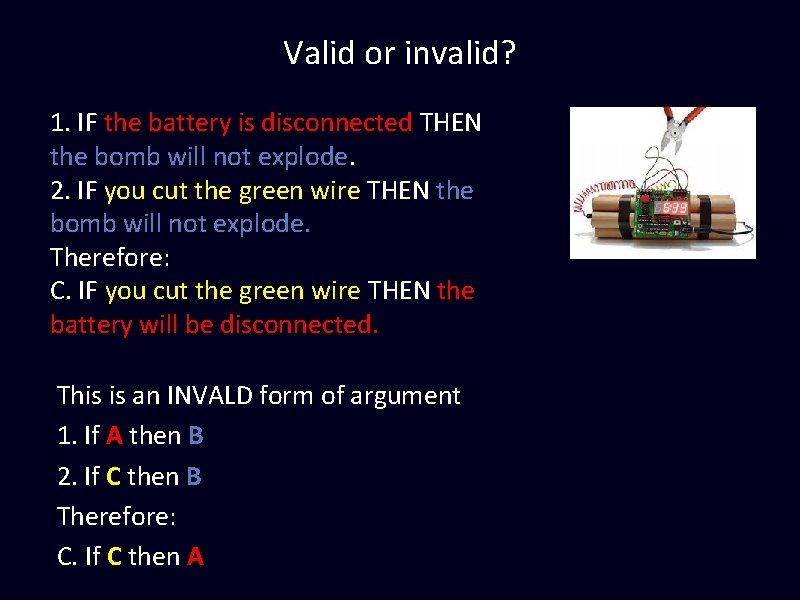
Valid or invalid? 1. IF the battery is disconnected THEN the bomb will not explode. 2. IF you cut the green wire THEN the bomb will not explode. Therefore: C. IF you cut the green wire THEN the battery will be disconnected. This is an INVALD form of argument 1. If A then B 2. If C then B Therefore: C. If C then A
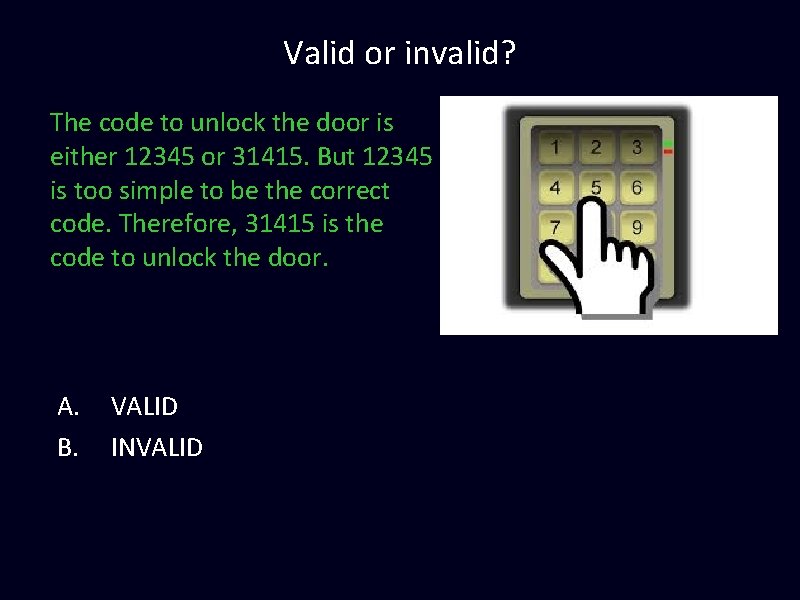
Valid or invalid? The code to unlock the door is either 12345 or 31415. But 12345 is too simple to be the correct code. Therefore, 31415 is the code to unlock the door. A. B. VALID INVALID
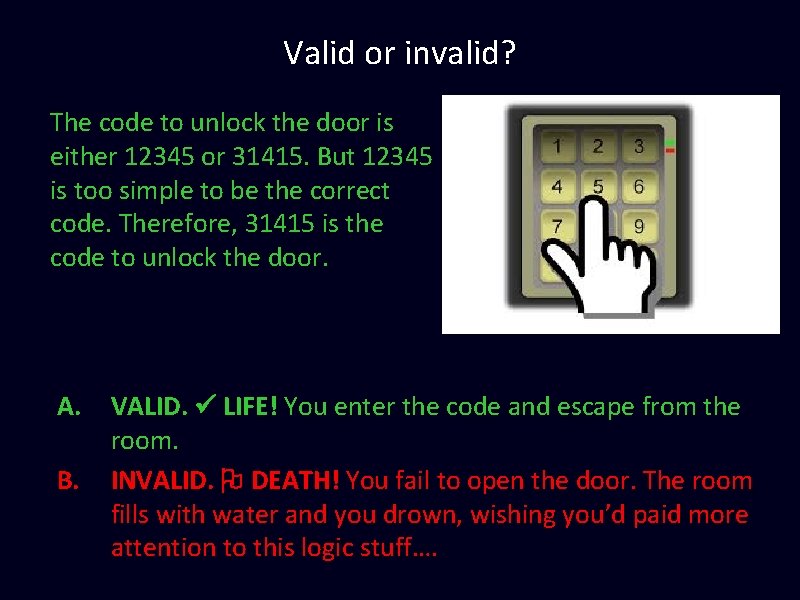
Valid or invalid? The code to unlock the door is either 12345 or 31415. But 12345 is too simple to be the correct code. Therefore, 31415 is the code to unlock the door. A. B. VALID. LIFE! You enter the code and escape from the room. INVALID. DEATH! You fail to open the door. The room fills with water and you drown, wishing you’d paid more attention to this logic stuff….
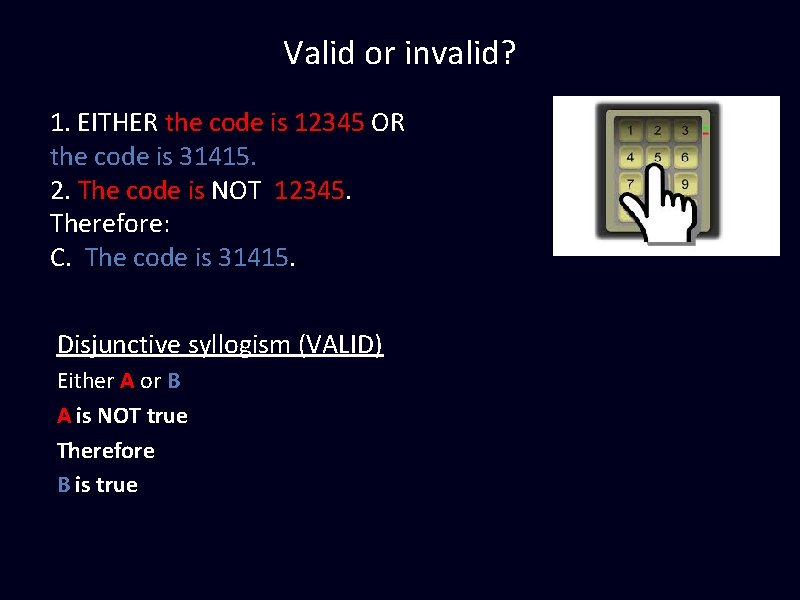
Valid or invalid? 1. EITHER the code is 12345 OR the code is 31415. 2. The code is NOT 12345. Therefore: C. The code is 31415. Disjunctive syllogism (VALID) Either A or B A is NOT true Therefore B is true