
Critical Theory System Thinking Critical System Thinking Hans

- Slides: 60
Critical Theory + System Thinking = Critical System Thinking Hans de Bruin (HZ University of Applied Sciences, Big Picture Lab) March 2020
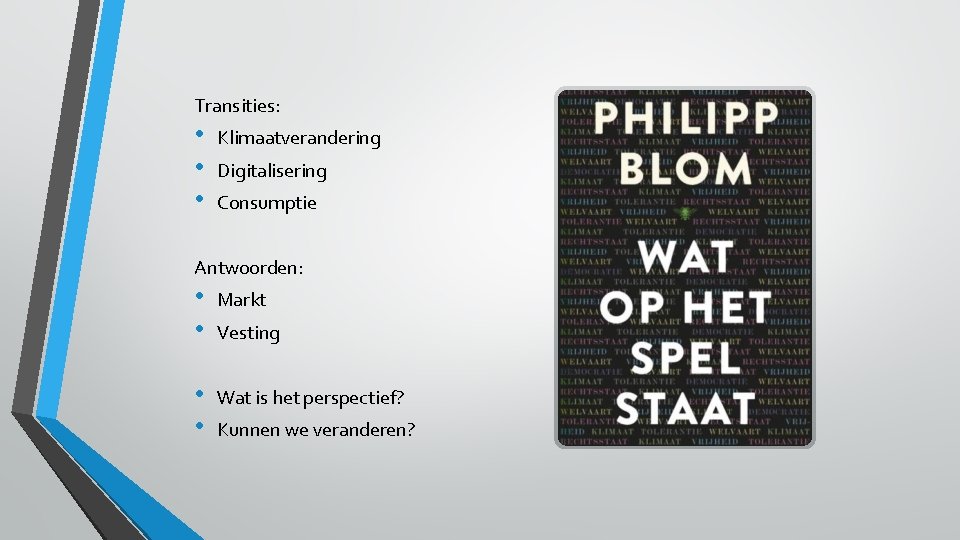
Transities: • • • Klimaatverandering Digitalisering Consumptie Antwoorden: • • Markt • • Wat is het perspectief? Vesting Kunnen we veranderen?
Wicked problems • • • The problem involves many stakeholders with different values and priorities. The issue’s roots are complex and tangled. The problem is difficult to come to grips with and changes with every attempt to address it. The challenge has no precedent. There’s nothing to indicate the right answer to the problem. Nevertheless, in our experiences, it is possible to make progress by using the right methods.
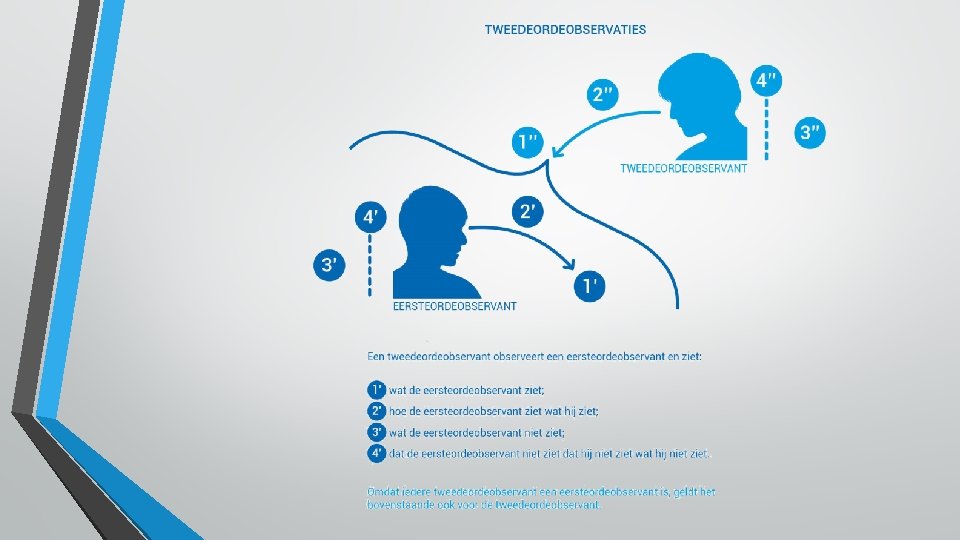
Contents • Critical theory • Systems thinking • Second order cybernetics: Laws of Form and observing • Critical Systems Heuristics (CSH) + exercise • Trends
Critical theory • A social theory oriented toward critiquing and changing society as a whole. • In contrast to traditional theory oriented only to understanding or explaining it. • Critical theories aim to dig beneath the surface of social life and uncover the assumptions that keep us from a full and true understanding of how the world works.
Critical theory • • Critical theory as it is known today can be traced to Marx's critique of economy. • The relationship between economic base and ideological superstructure, and tends to focus on how power and domination operate, in particular, in the realm of the superstructure. Frankfurt School • • Max Horkheimer asserted that a critical theory must do two important things: it must account for the whole of society within historical context, and it should seek to offer a robust and holistic critique by incorporating insights from all social sciences. Further, Horkheimer stated that a theory can only be considered a true critical theory if it is explanatory, practical, and normative, meaning that theory must adequately explain the social problems that exist, it must offer practical solutions for how to respond to them and make change.
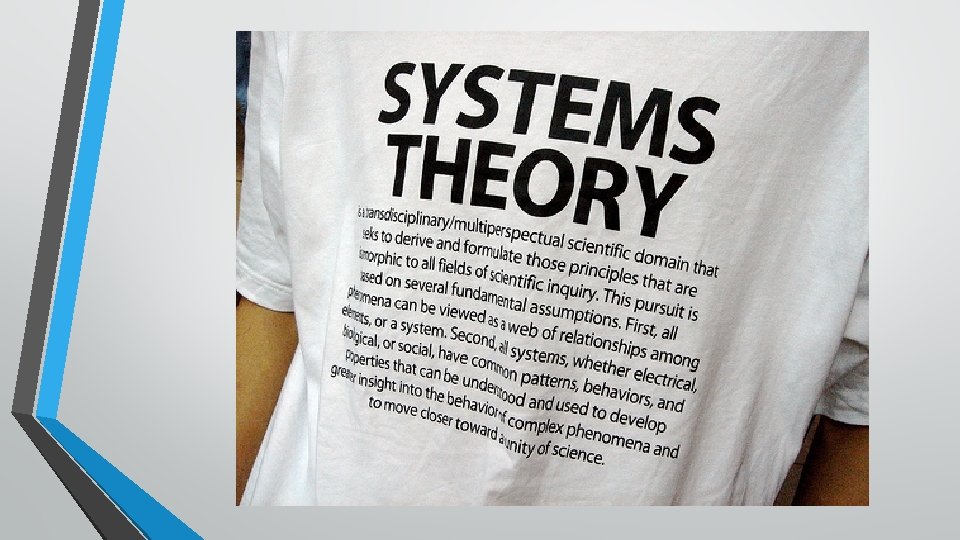
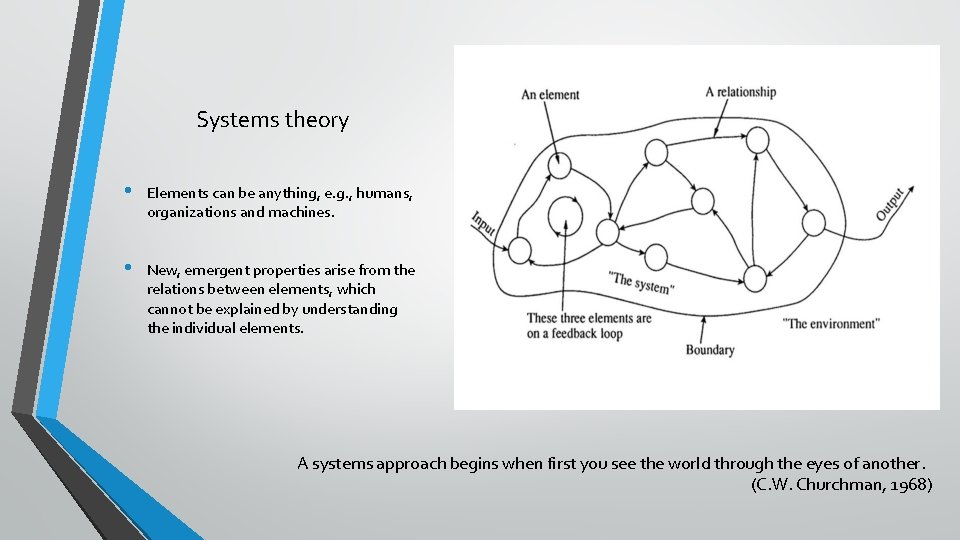
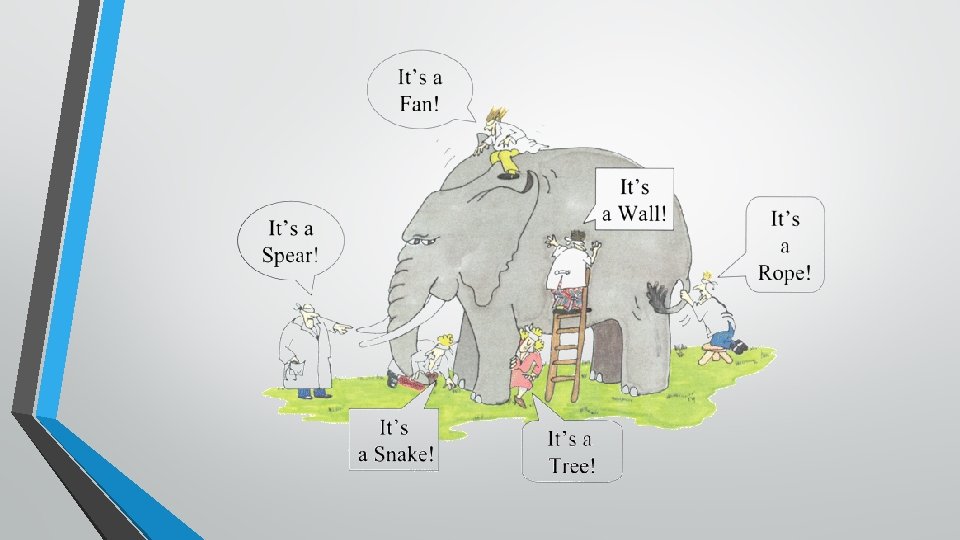
Systems theory • Elements can be anything, e. g. , humans, organizations and machines. • New, emergent properties arise from the relations between elements, which cannot be explained by understanding the individual elements. A systems approach begins when first you see the world through the eyes of another. (C. W. Churchman, 1968)
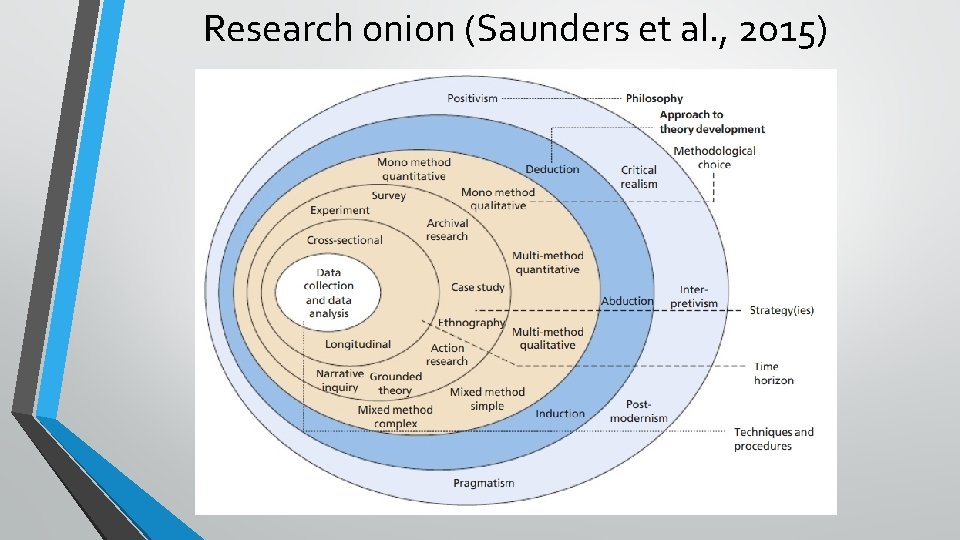
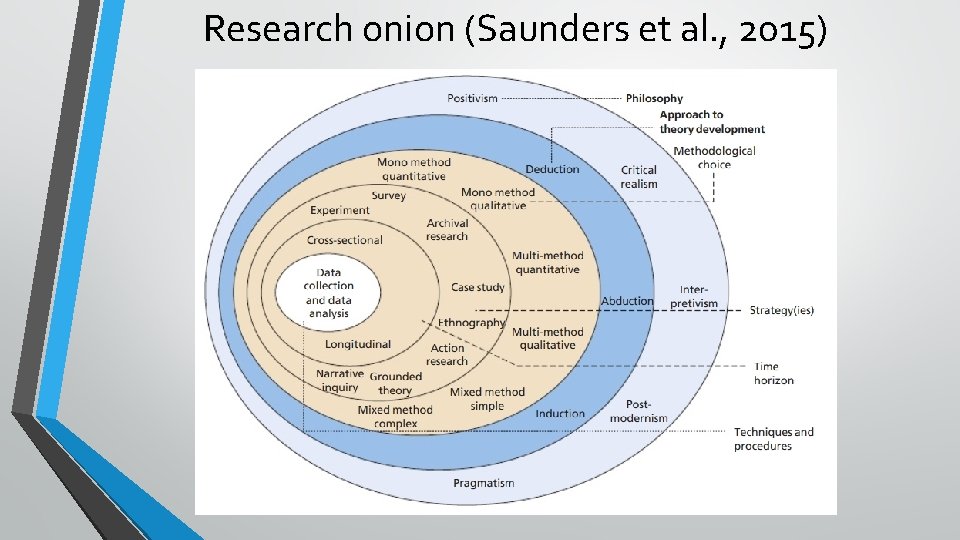
Research onion (Saunders et al. , 2015)
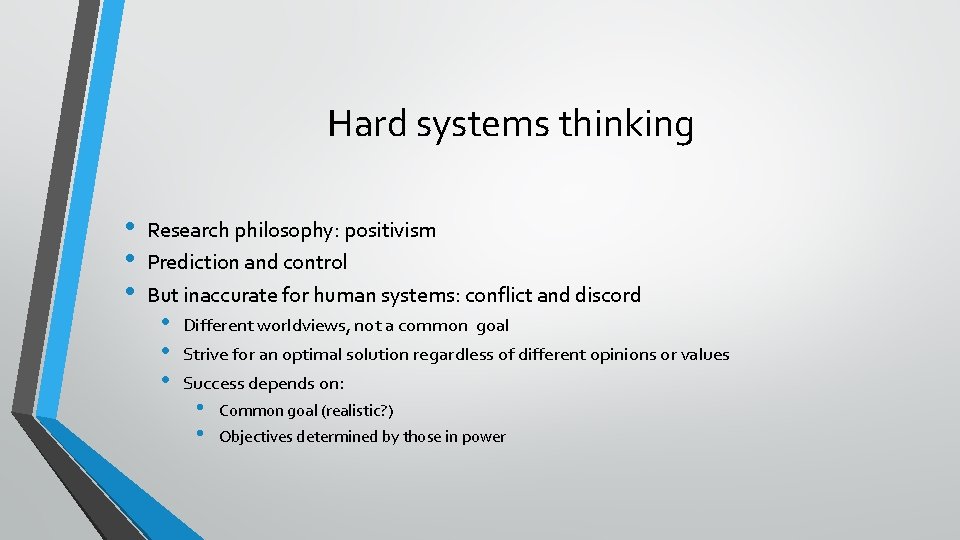
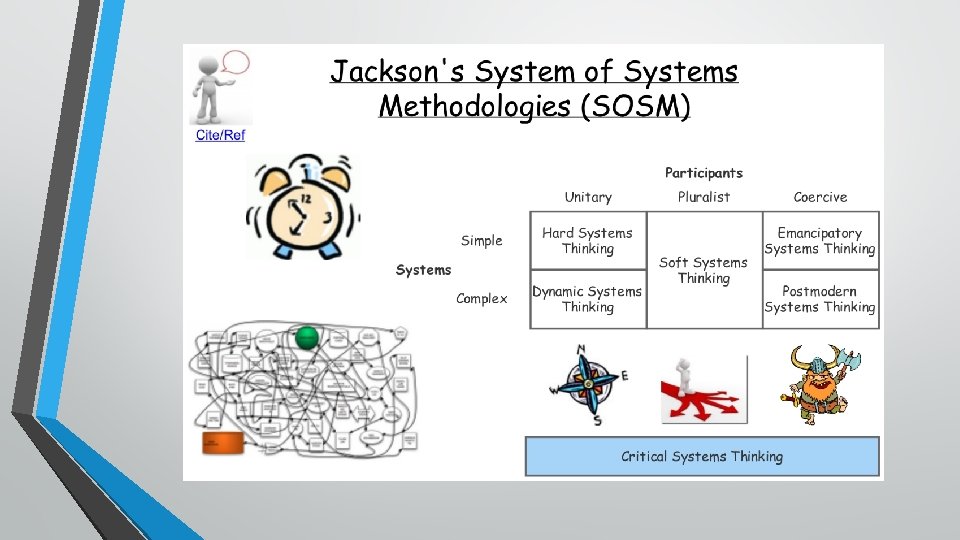
Hard systems thinking • • • Research philosophy: positivism Prediction and control But inaccurate for human systems: conflict and discord • • • Different worldviews, not a common goal Strive for an optimal solution regardless of different opinions or values Success depends on: • • Common goal (realistic? ) Objectives determined by those in power
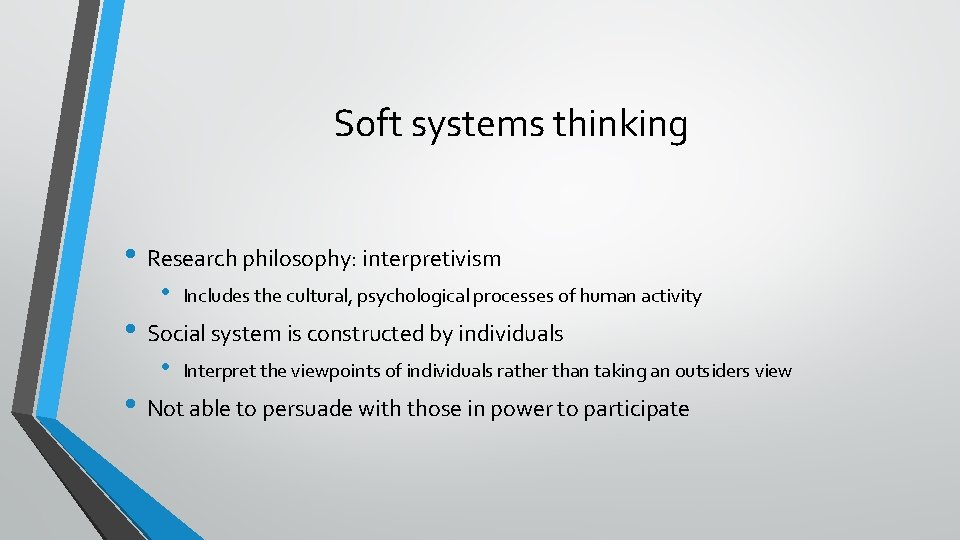
Soft systems thinking • Research philosophy: interpretivism • Includes the cultural, psychological processes of human activity • Social system is constructed by individuals • Interpret the viewpoints of individuals rather than taking an outsiders view • Not able to persuade with those in power to participate
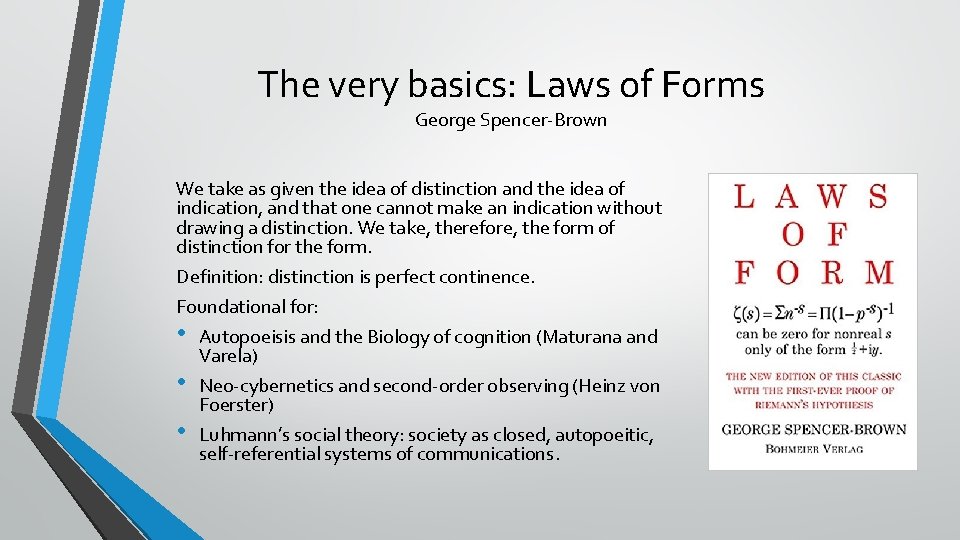
The very basics: Laws of Forms George Spencer-Brown We take as given the idea of distinction and the idea of indication, and that one cannot make an indication without drawing a distinction. We take, therefore, the form of distinction for the form. Definition: distinction is perfect continence. Foundational for: • Autopoeisis and the Biology of cognition (Maturana and Varela) • Neo-cybernetics and second-order observing (Heinz von Foerster) • Luhmann’s social theory: society as closed, autopoeitic, self-referential systems of communications.
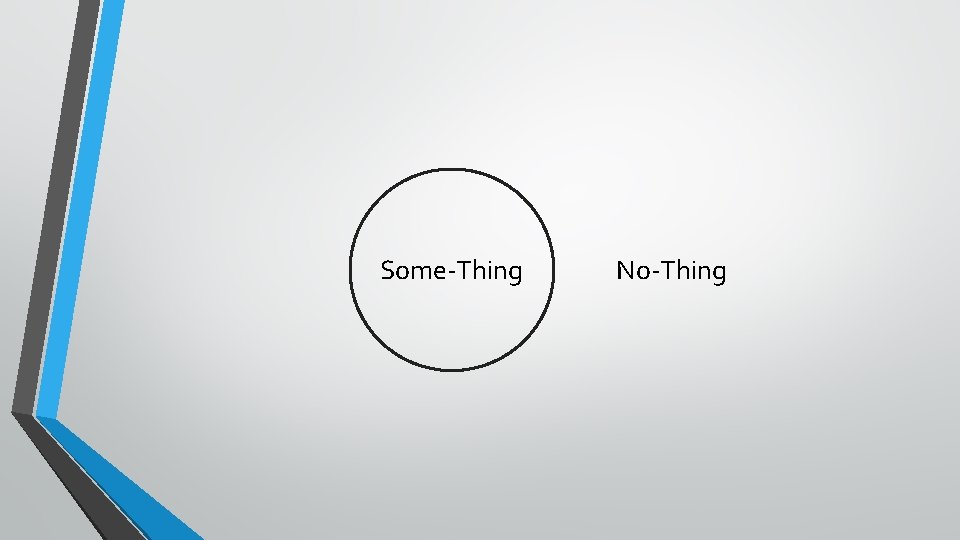
Some-Thing No-Thing
Laws of Forms The theme of this book is that a universe comes into being when a space is severed or taken apart. The skin of a living organism cuts off an inside from an outside. So does the circumference of a circle in a plane. By tracing the way we represent such a severance, we can begin to reconstruct, with an accuracy and coverage that appear almost uncanny, the basic forms underlying linguistic, mathematical, physical, and biological science, and can begin to see how the familiar laws of our own experience follow inexorably from the original act of severance. The act is itself already remembered, even if unconsciously, as our first attempt to distinguish different things in a world where, in the first place, the boundaries can be drawn anywhere we please.
Book of Genesis In the beginning God created the heavens and the earth. Now the earth was formless and empty, darkness was over the surface of the deep, and the Spirit of God was hovering over the waters. And God said, “Let there be light, ” and there was light. God saw that the light was good, and he separated the light from the darkness. God called the light “day, ” and the darkness he called “night. ” And there was evening, and there was morning—the first day. God has made his first distinction after the first day: the distinction between light and darkness. And this was the starting point of many more distinctions eventually resulting in God’s creation of mankind as an image of his own.
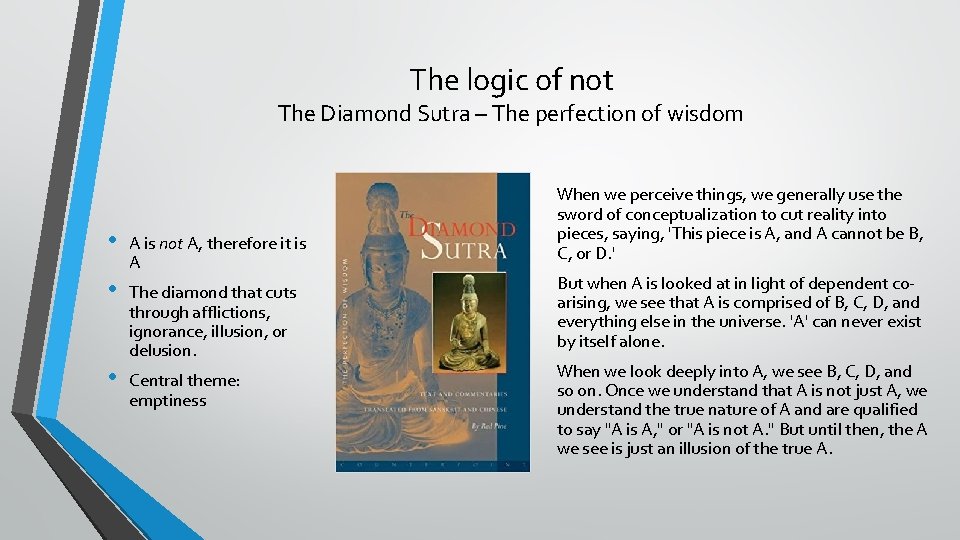
The logic of not The Diamond Sutra – The perfection of wisdom • A is not A, therefore it is A • The diamond that cuts through afflictions, ignorance, illusion, or delusion. • Central theme: emptiness When we perceive things, we generally use the sword of conceptualization to cut reality into pieces, saying, 'This piece is A, and A cannot be B, C, or D. ' But when A is looked at in light of dependent coarising, we see that A is comprised of B, C, D, and everything else in the universe. 'A' can never exist by itself alone. When we look deeply into A, we see B, C, D, and so on. Once we understand that A is not just A, we understand the true nature of A and are qualified to say "A is A, " or "A is not A. " But until then, the A we see is just an illusion of the true A.
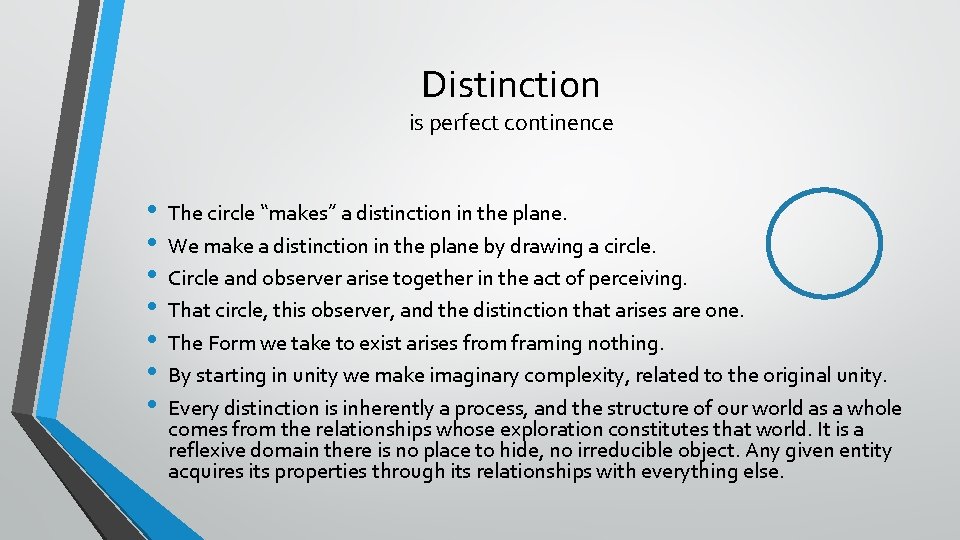
Distinction is perfect continence • • The circle “makes” a distinction in the plane. We make a distinction in the plane by drawing a circle. Circle and observer arise together in the act of perceiving. That circle, this observer, and the distinction that arises are one. The Form we take to exist arises from framing nothing. By starting in unity we make imaginary complexity, related to the original unity. Every distinction is inherently a process, and the structure of our world as a whole comes from the relationships whose exploration constitutes that world. It is a reflexive domain there is no place to hide, no irreducible object. Any given entity acquires its properties through its relationships with everything else.
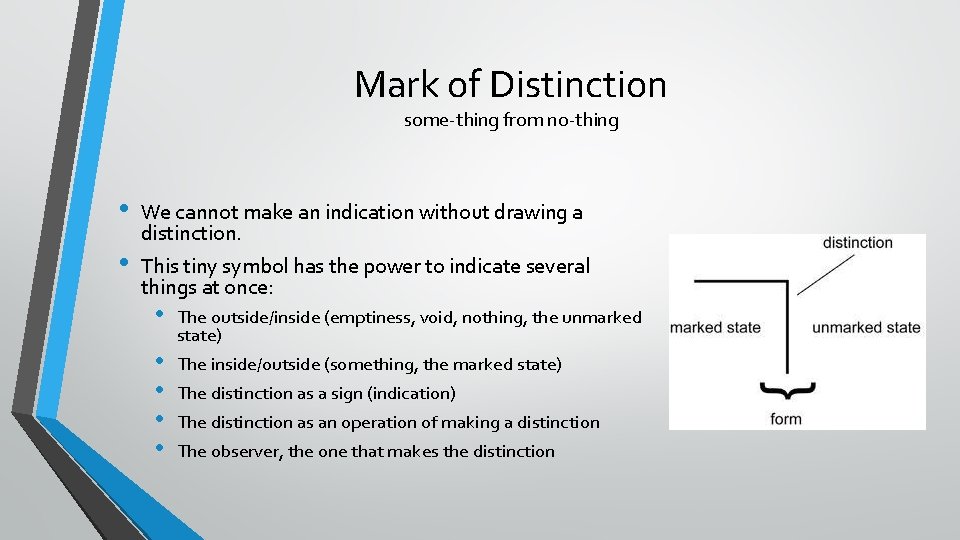
Mark of Distinction some-thing from no-thing • • We cannot make an indication without drawing a distinction. This tiny symbol has the power to indicate several things at once: • • • The outside/inside (emptiness, void, nothing, the unmarked state) The inside/outside (something, the marked state) The distinction as a sign (indication) The distinction as an operation of making a distinction The observer, the one that makes the distinction
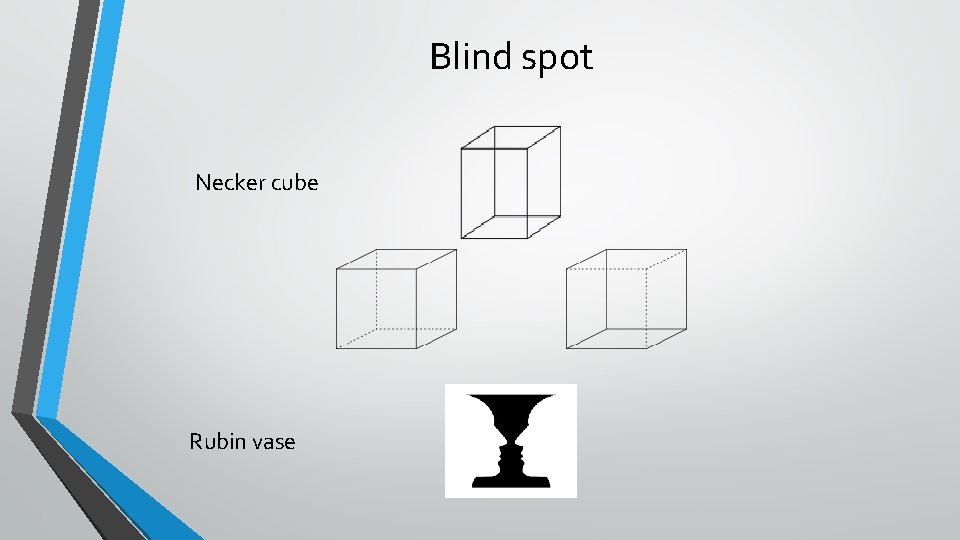
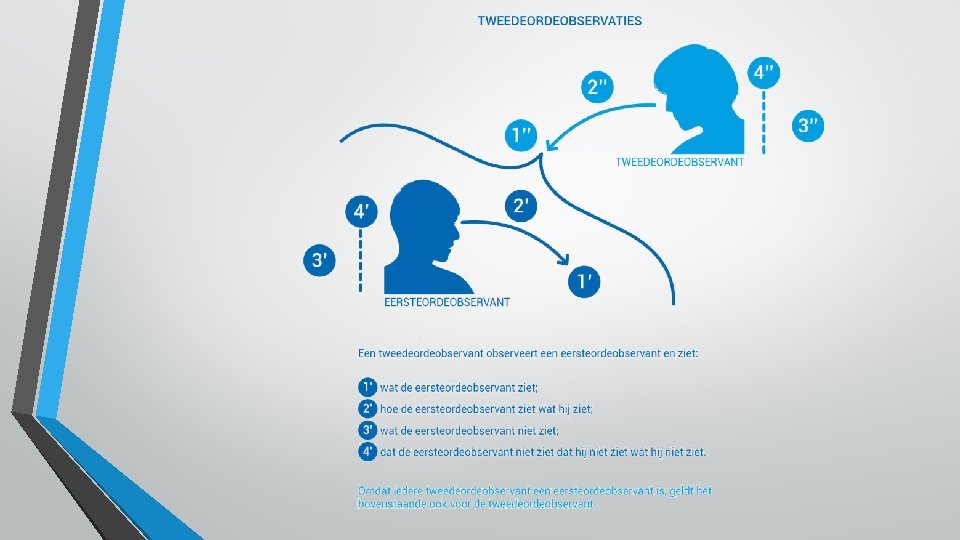
Blind spot Necker cube Rubin vase
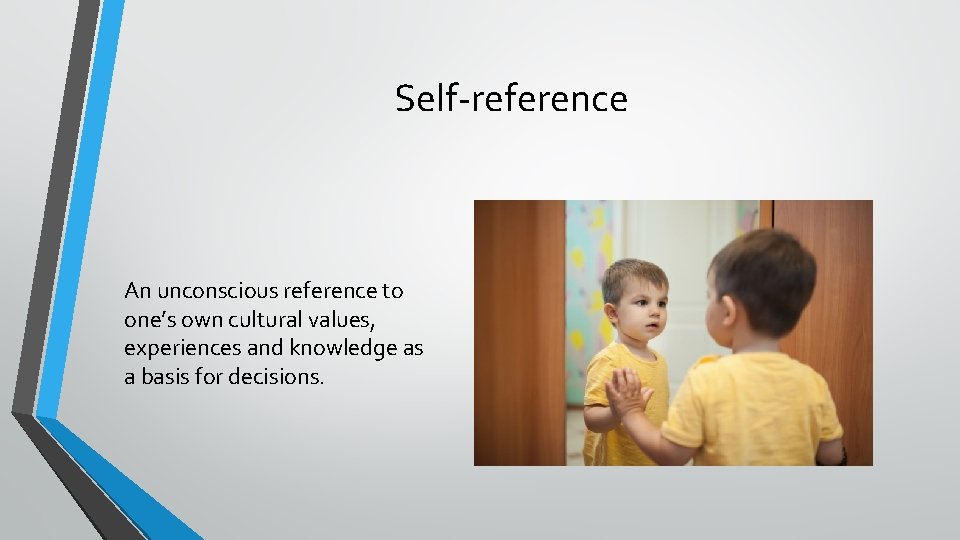
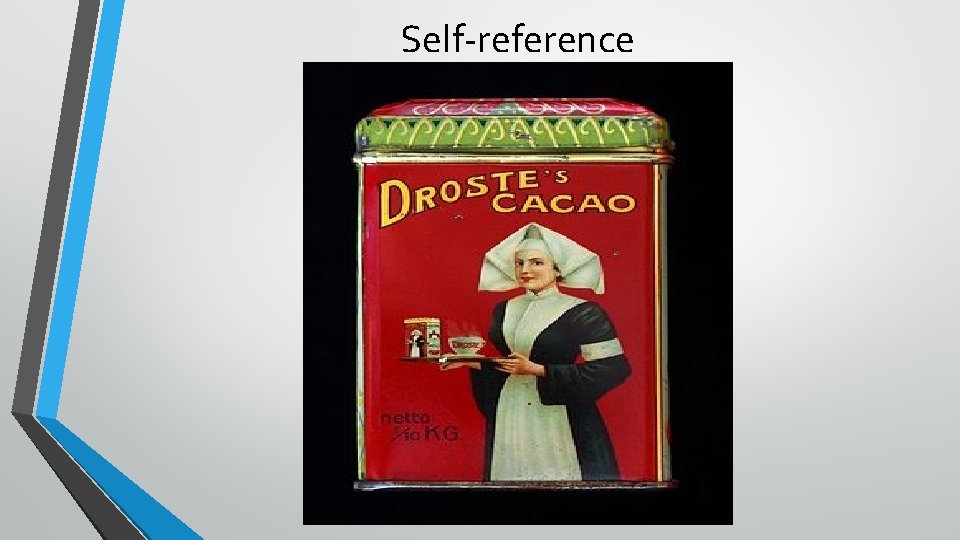
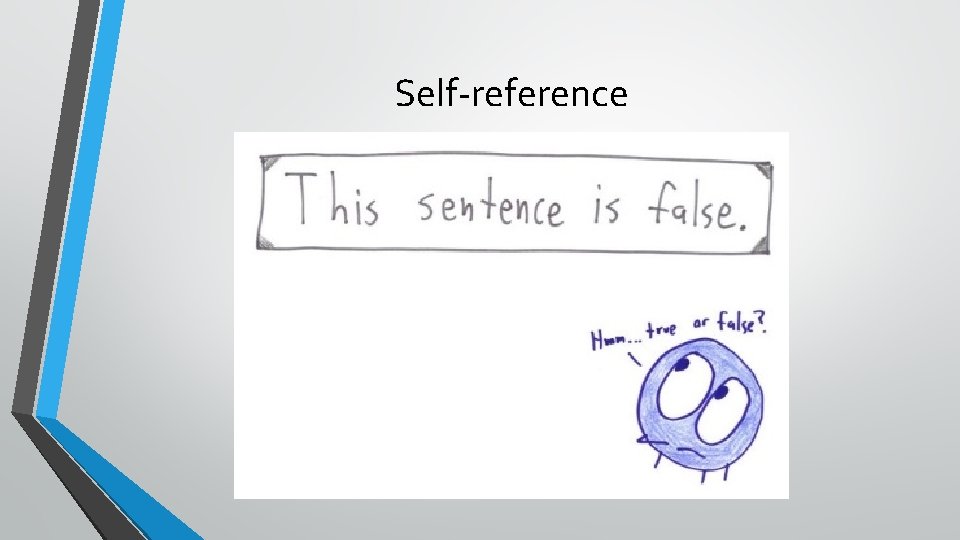
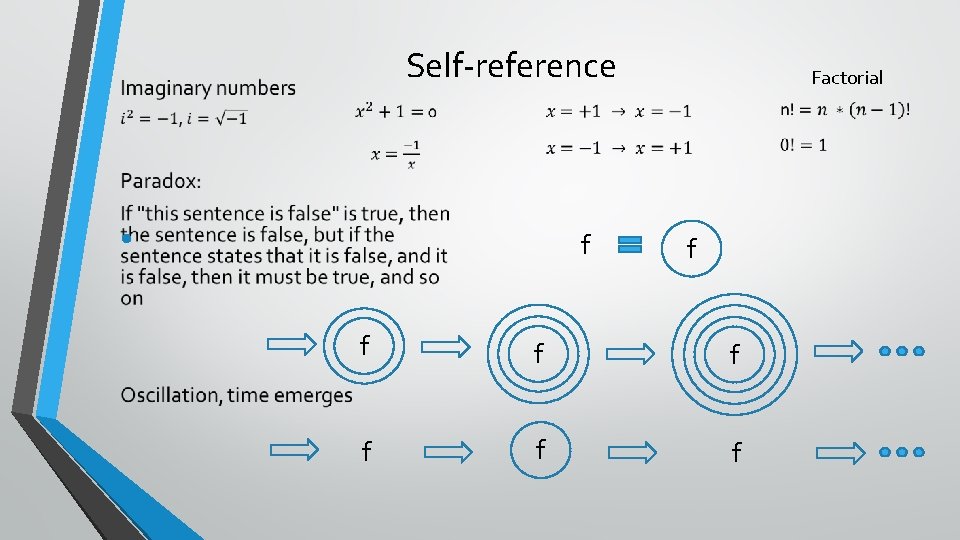
Self-reference An unconscious reference to one’s own cultural values, experiences and knowledge as a basis for decisions.
Self-reference
Self-reference
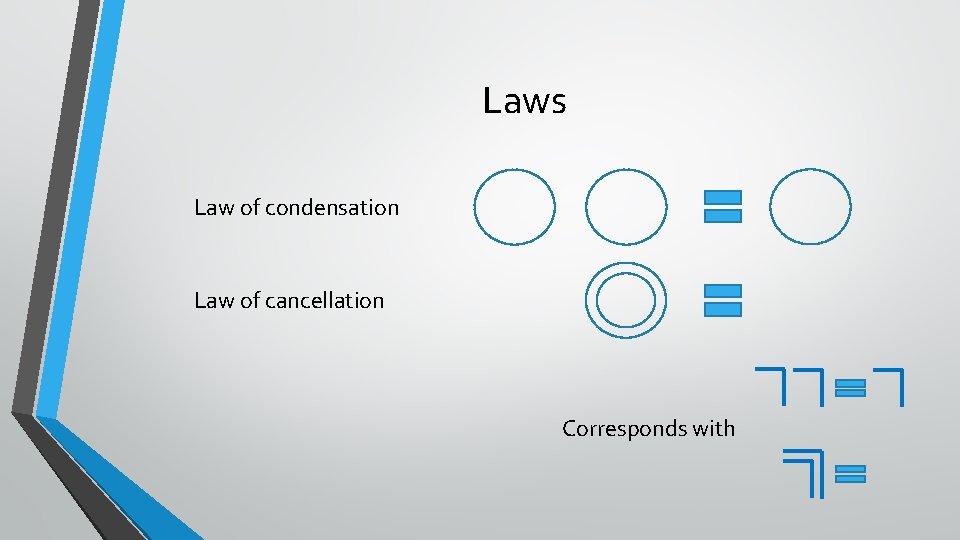
Laws Law of condensation Law of cancellation Corresponds with
Self-reference • f Factorial f f f f
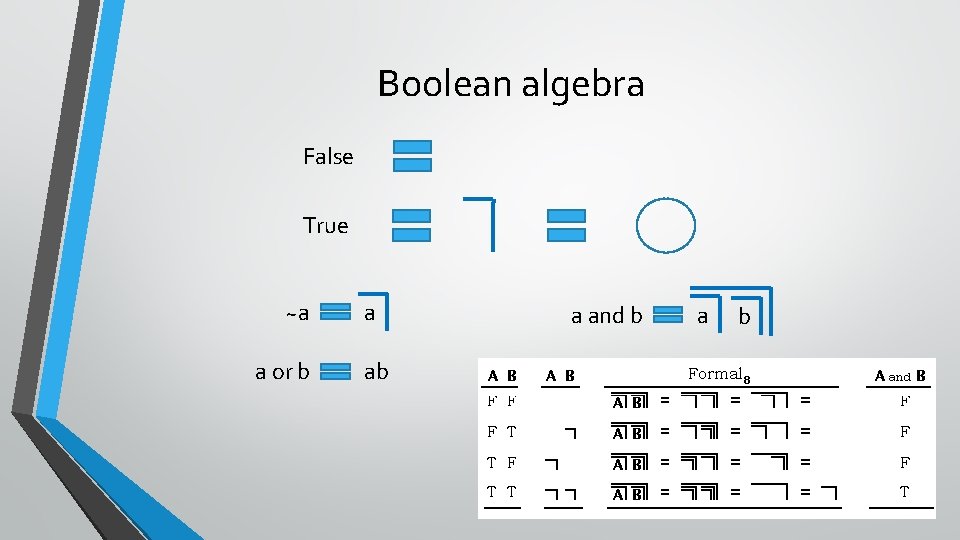
Boolean algebra False True ~a a or b a and b a b
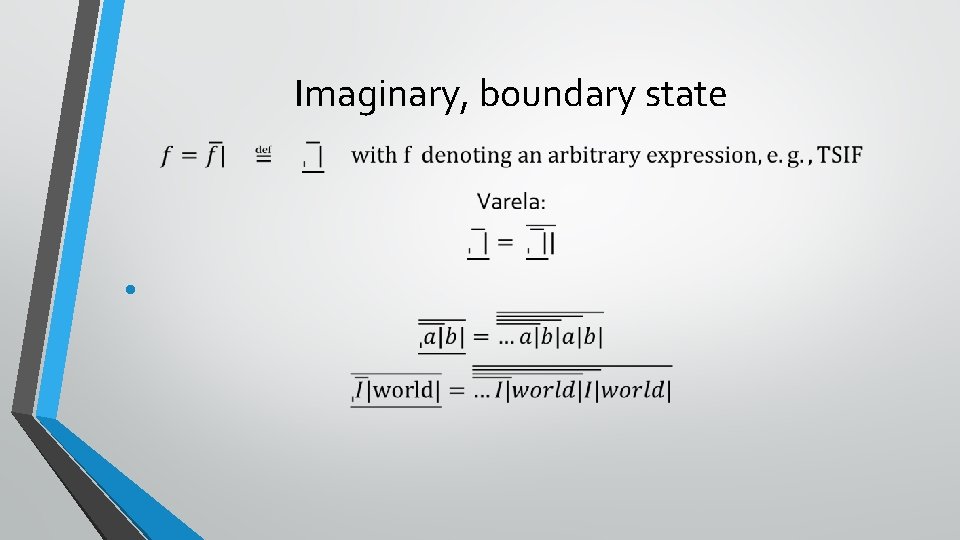
Imaginary, boundary state •
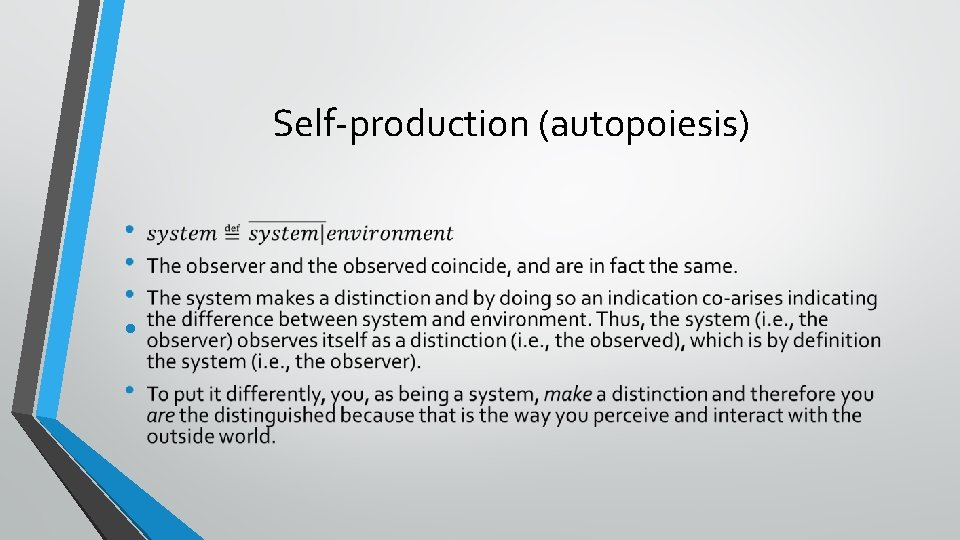
Self-production (autopoiesis) •
System characteristics • Self-referential, self-producing, and autonomous • Organizationally closed, structurally open We have to become what we are not, and yet remain the same.
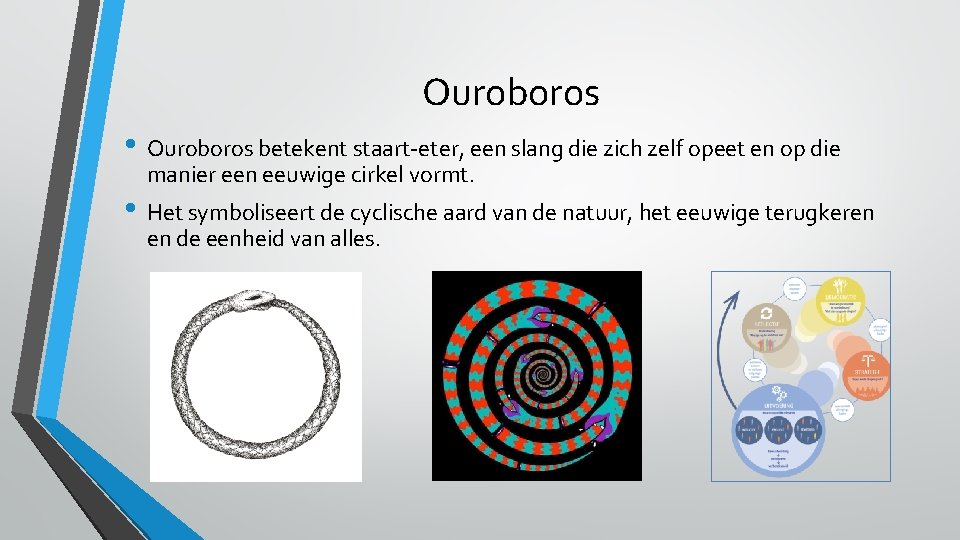
Ouroboros • Ouroboros betekent staart-eter, een slang die zich zelf opeet en op die manier een eeuwige cirkel vormt. • Het symboliseert de cyclische aard van de natuur, het eeuwige terugkeren en de eenheid van alles.
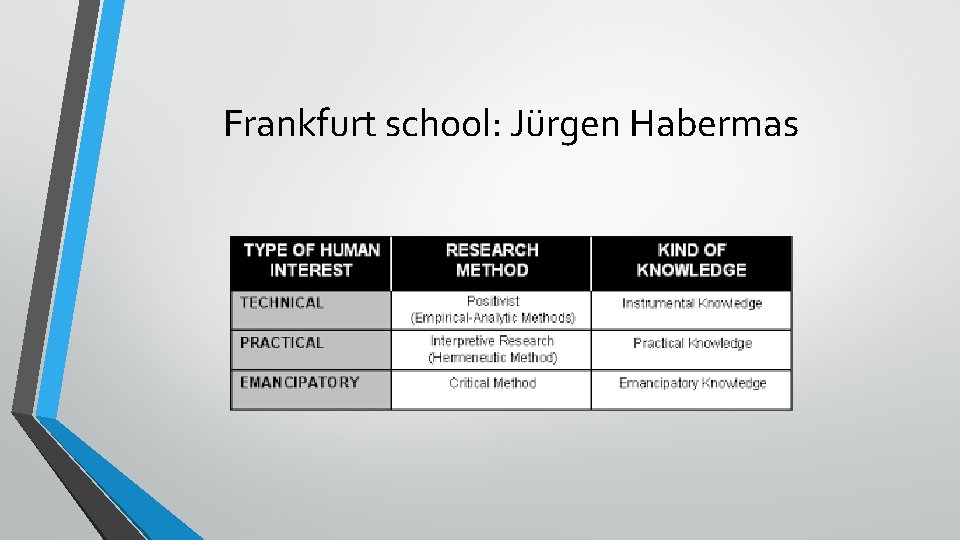
Frankfurt school: Jürgen Habermas • • • Habermas' Three Generic Domains of Human Interest Habermas differentiates three primary generic cognitive areas in which human interest generates knowledge. These areas define cognitive interests or learning domains, and are grounded in different aspects of social existence -- work, interaction and power. Cognitive areas: • • • Work Knowledge Practical Knowledge Emancipatory Knowledge
Frankfurt school: Jürgen Habermas
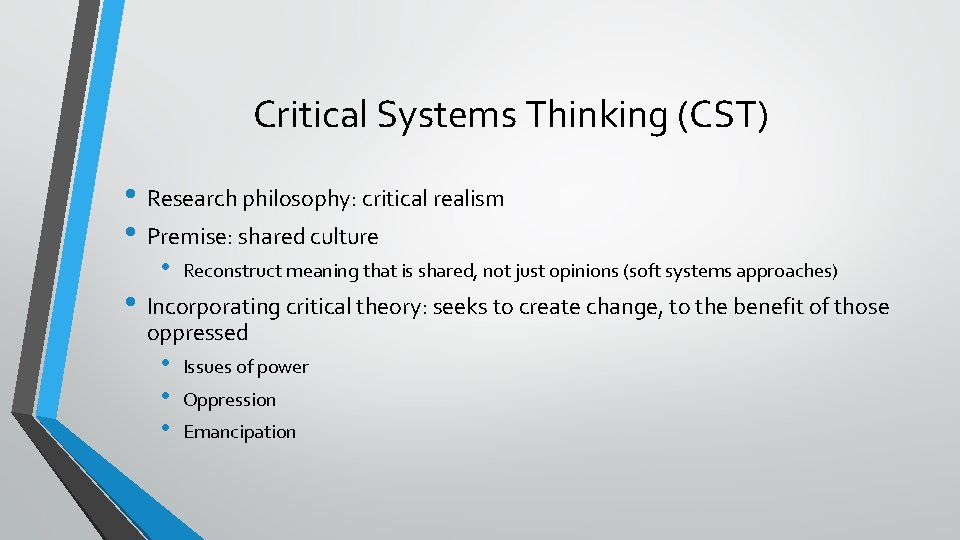
Critical Systems Thinking (CST) • Research philosophy: critical realism • Premise: shared culture • Reconstruct meaning that is shared, not just opinions (soft systems approaches) • Incorporating critical theory: seeks to create change, to the benefit of those oppressed • • • Issues of power Oppression Emancipation
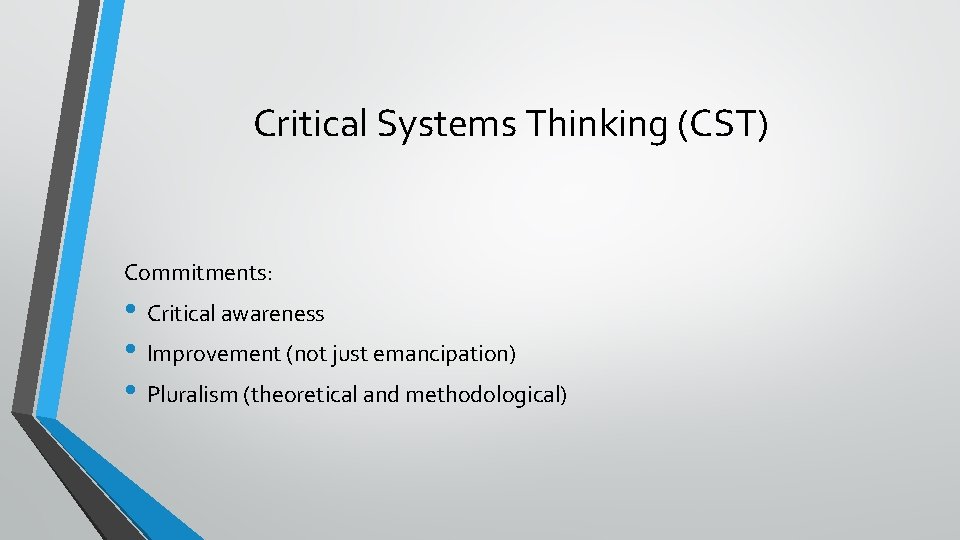
Critical Systems Thinking (CST) Commitments: • Critical awareness • Improvement (not just emancipation) • Pluralism (theoretical and methodological)
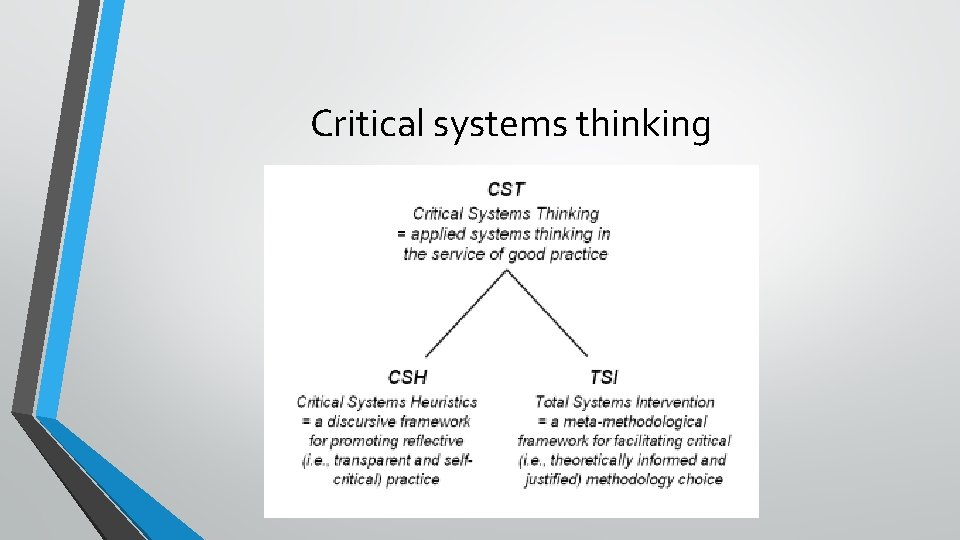
Critical systems thinking
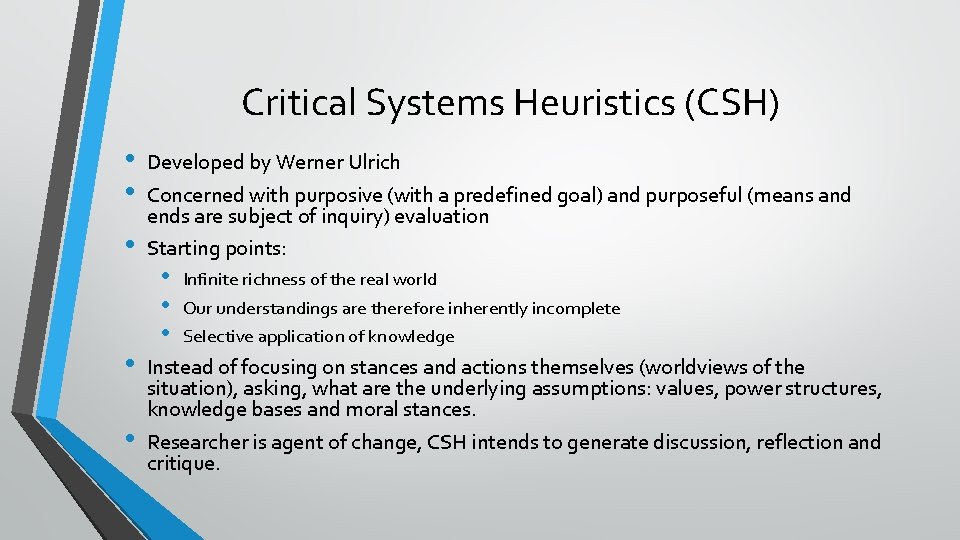
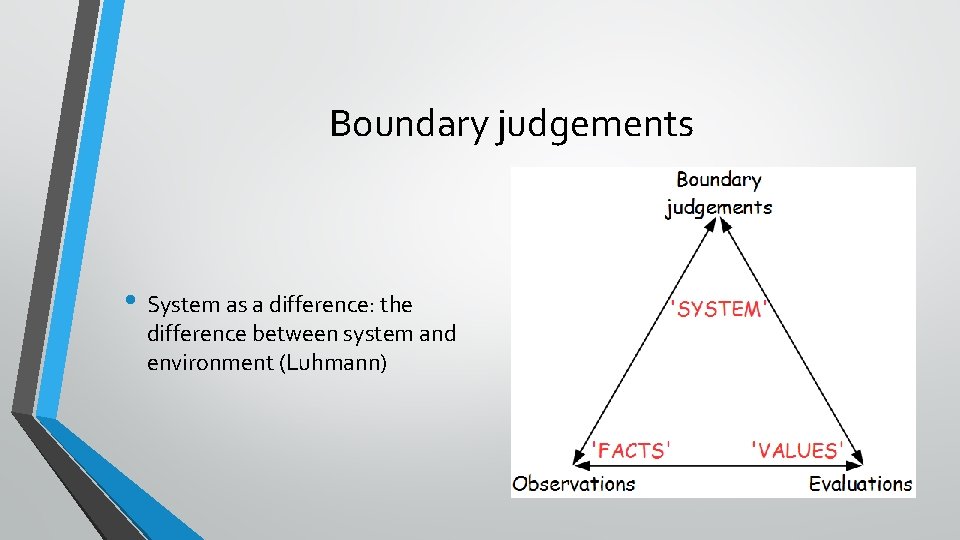
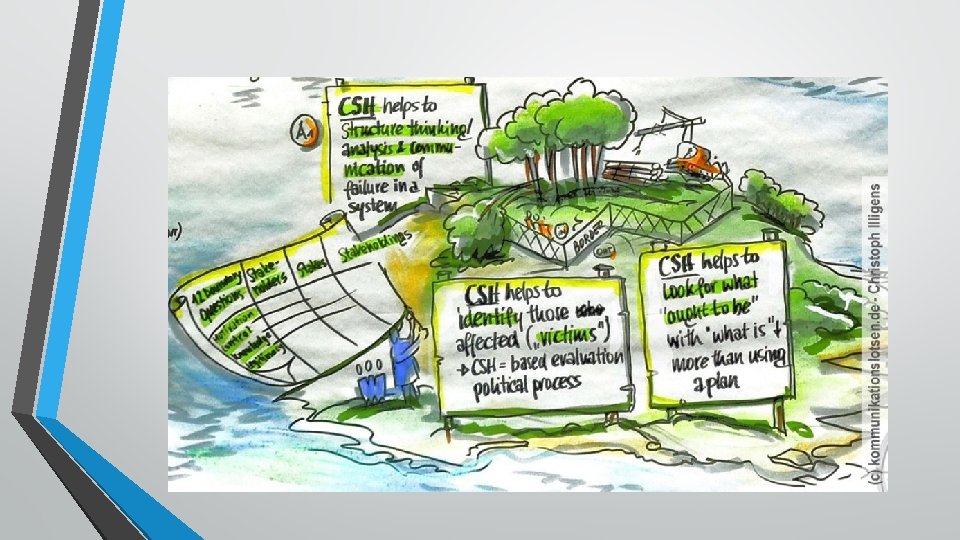
Critical Systems Heuristics (CSH) • • • Developed by Werner Ulrich Concerned with purposive (with a predefined goal) and purposeful (means and ends are subject of inquiry) evaluation Starting points: • • • Infinite richness of the real world Our understandings are therefore inherently incomplete Selective application of knowledge Instead of focusing on stances and actions themselves (worldviews of the situation), asking, what are the underlying assumptions: values, power structures, knowledge bases and moral stances. Researcher is agent of change, CSH intends to generate discussion, reflection and critique.
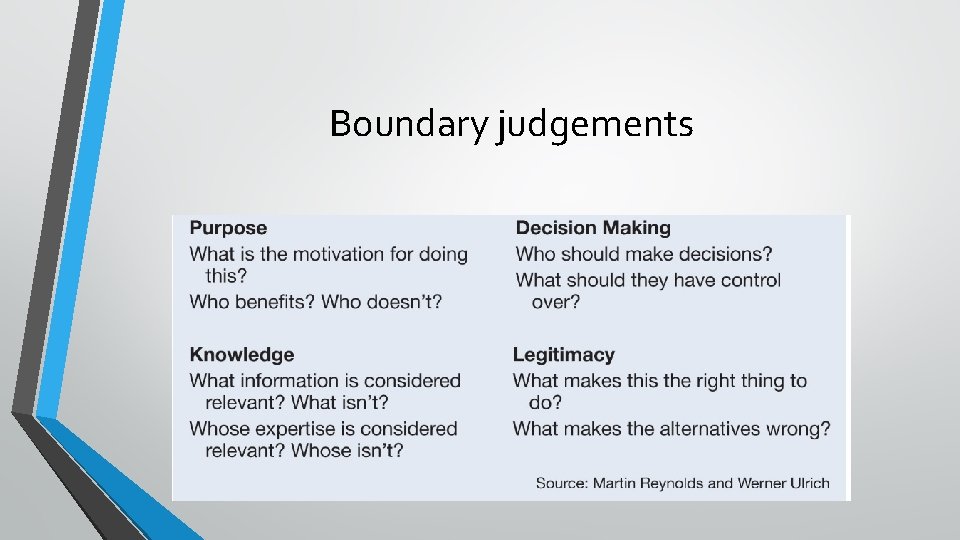
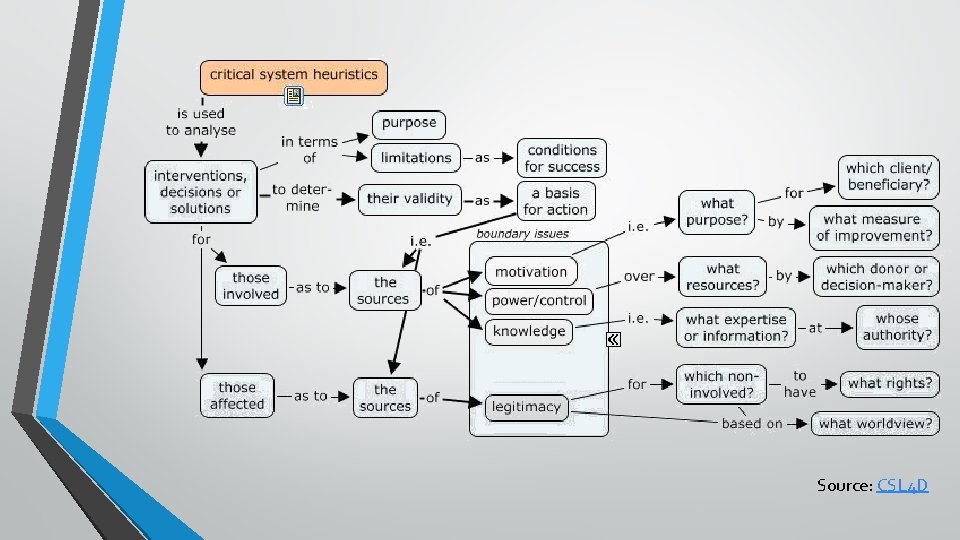
Boundary judgements
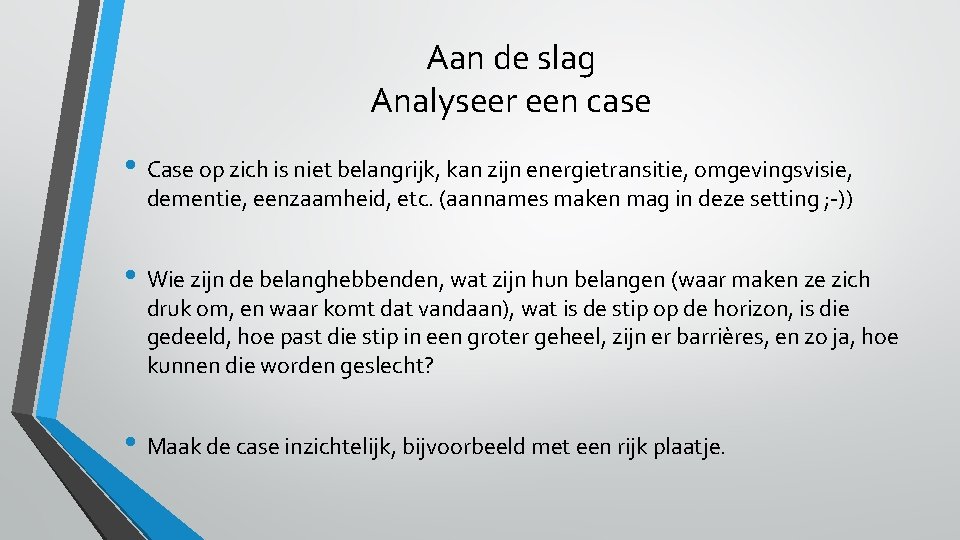
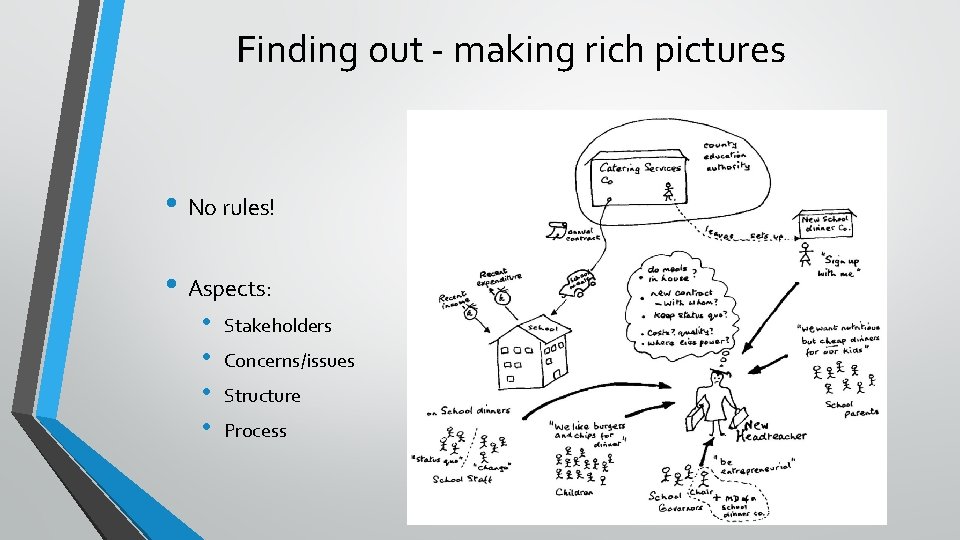
Aan de slag Analyseer een case • Case op zich is niet belangrijk, kan zijn energietransitie, omgevingsvisie, dementie, eenzaamheid, etc. (aannames maken mag in deze setting ; -)) • Wie zijn de belanghebbenden, wat zijn hun belangen (waar maken ze zich druk om, en waar komt dat vandaan), wat is de stip op de horizon, is die gedeeld, hoe past die stip in een groter geheel, zijn er barrières, en zo ja, hoe kunnen die worden geslecht? • Maak de case inzichtelijk, bijvoorbeeld met een rijk plaatje.
Finding out - making rich pictures • No rules! • Aspects: • • Stakeholders Concerns/issues Structure Process
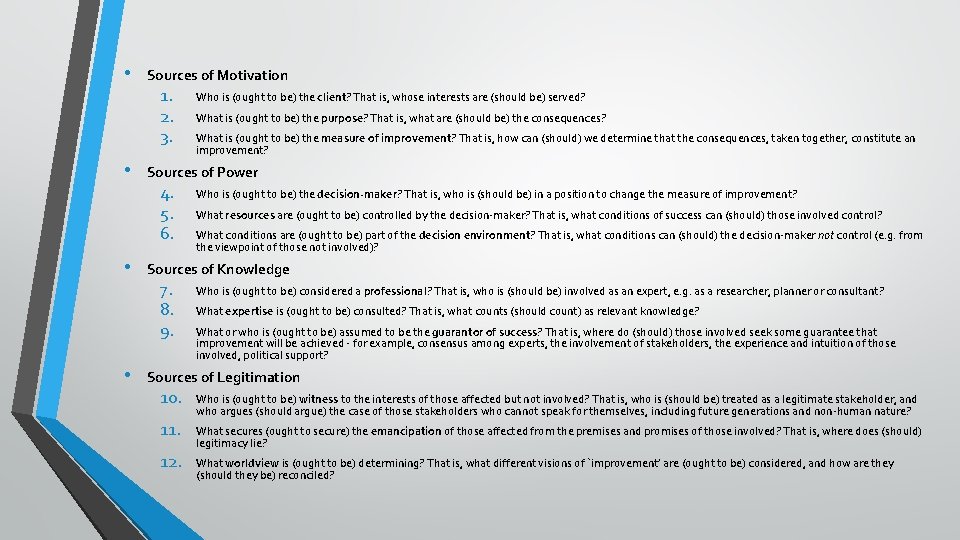
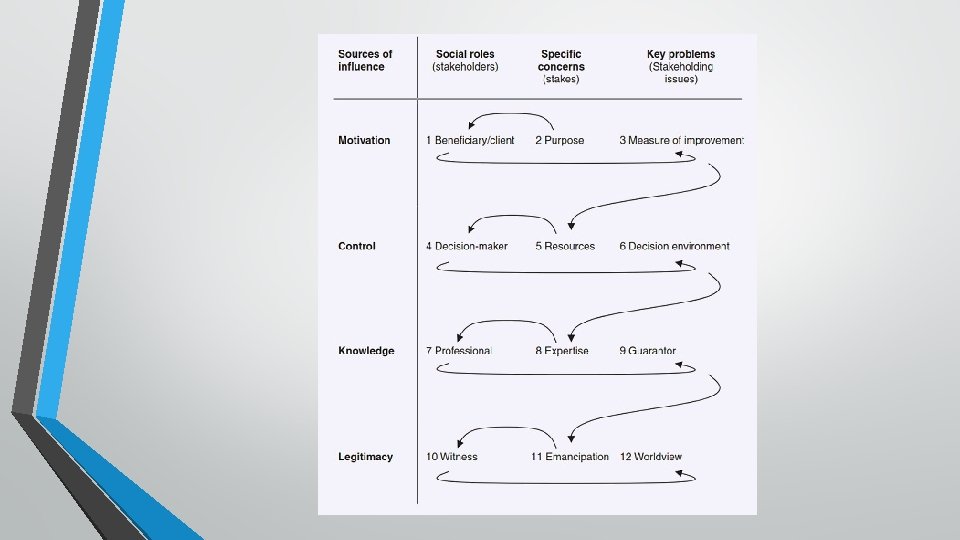
• • Sources of Motivation 1. 2. 3. Who is (ought to be) the client? That is, whose interests are (should be) served? What is (ought to be) the purpose? That is, what are (should be) the consequences? What is (ought to be) the measure of improvement? That is, how can (should) we determine that the consequences, taken together, constitute an improvement? Sources of Power 4. 5. 6. Who is (ought to be) the decision-maker? That is, who is (should be) in a position to change the measure of improvement? What resources are (ought to be) controlled by the decision-maker? That is, what conditions of success can (should) those involved control? What conditions are (ought to be) part of the decision environment? That is, what conditions can (should) the decision-maker not control (e. g. from the viewpoint of those not involved)? Sources of Knowledge 7. 8. 9. Who is (ought to be) considered a professional? That is, who is (should be) involved as an expert, e. g. as a researcher, planner or consultant? What expertise is (ought to be) consulted? That is, what counts (should count) as relevant knowledge? What or who is (ought to be) assumed to be the guarantor of success? That is, where do (should) those involved seek some guarantee that improvement will be achieved - for example, consensus among experts, the involvement of stakeholders, the experience and intuition of those involved, political support? Sources of Legitimation 10. Who is (ought to be) witness to the interests of those affected but not involved? That is, who is (should be) treated as a legitimate stakeholder, and who argues (should argue) the case of those stakeholders who cannot speak for themselves, including future generations and non-human nature? 11. What secures (ought to secure) the emancipation of those affected from the premises and promises of those involved? That is, where does (should) legitimacy lie? 12. What worldview is (ought to be) determining? That is, what different visions of `improvement’ are (ought to be) considered, and how are they (should they be) reconciled?
Boundary judgements • System as a difference: the difference between system and environment (Luhmann)
Aan de slag Vervolg • Wat zijn de boundary judgements die door de diverse belanghebbenden worden gemaakt? (Aannames maken mag in deze setting ; -))
Source: CSL 4 D
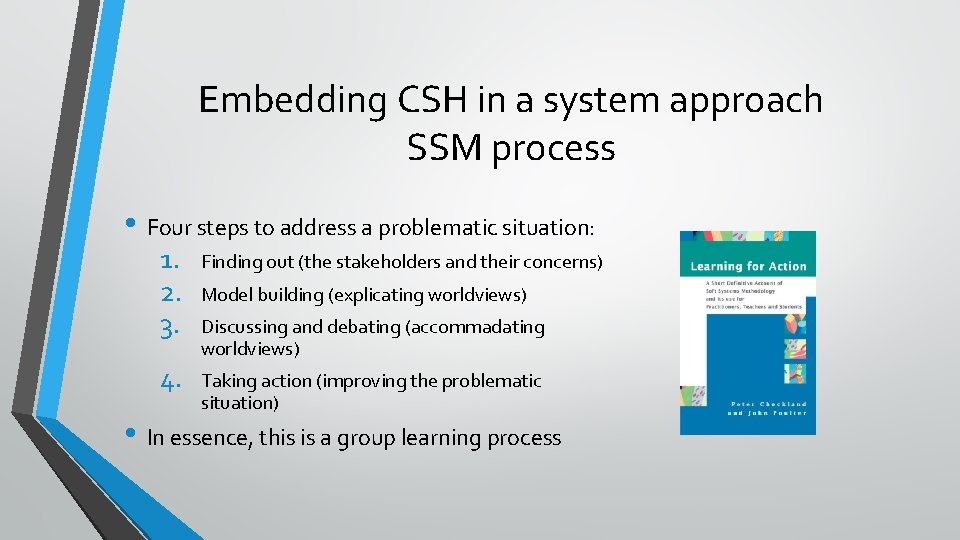
Embedding CSH in a system approach SSM process • Four steps to address a problematic situation: 1. 2. 3. Finding out (the stakeholders and their concerns) 4. Taking action (improving the problematic situation) Model building (explicating worldviews) Discussing and debating (accommadating worldviews) • In essence, this is a group learning process
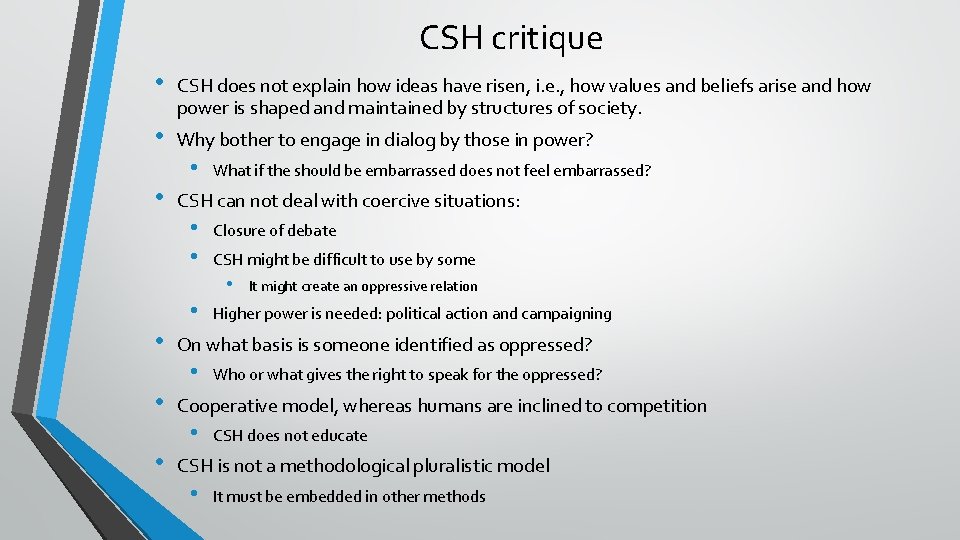
CSH critique • CSH does not explain how ideas have risen, i. e. , how values and beliefs arise and how power is shaped and maintained by structures of society. • Why bother to engage in dialog by those in power? • • What if the should be embarrassed does not feel embarrassed? CSH can not deal with coercive situations: • • Closure of debate CSH might be difficult to use by some • • • It might create an oppressive relation Higher power is needed: political action and campaigning On what basis is someone identified as oppressed? • Who or what gives the right to speak for the oppressed? Cooperative model, whereas humans are inclined to competition • CSH does not educate CSH is not a methodological pluralistic model • It must be embedded in other methods
Research onion (Saunders et al. , 2015)
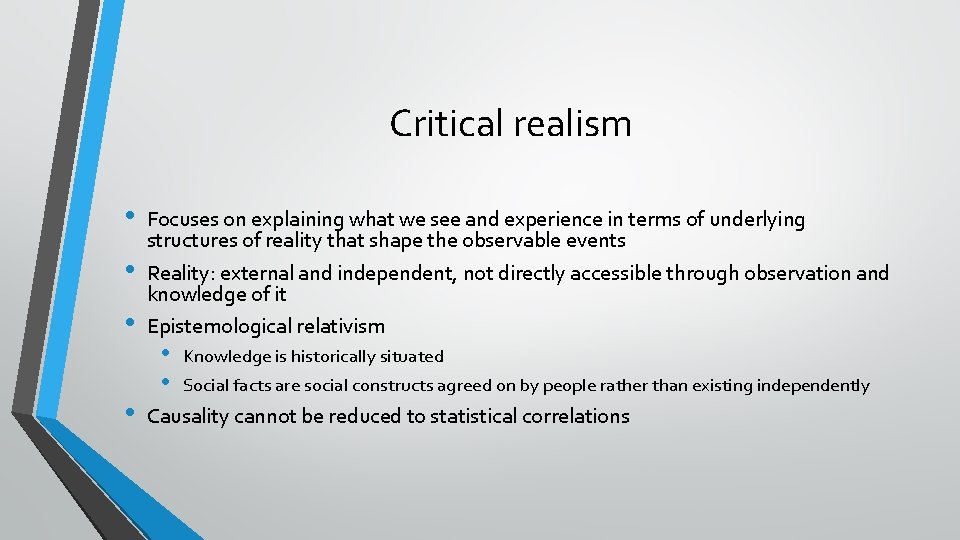
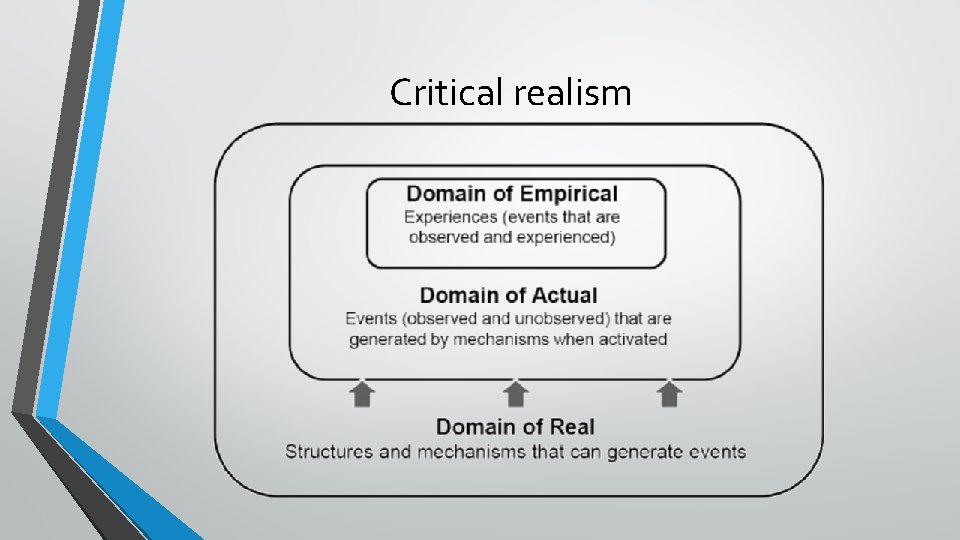
Critical realism • • Focuses on explaining what we see and experience in terms of underlying structures of reality that shape the observable events Reality: external and independent, not directly accessible through observation and knowledge of it Epistemological relativism • • Knowledge is historically situated Social facts are social constructs agreed on by people rather than existing independently Causality cannot be reduced to statistical correlations
Critical realism
Critical realism • No social theory can be purely descriptive: it must be evaluative, and thus there can be no split between facts and values. Following from this is the view that social theory is inevitably transformative, providing an explanatory critique that logically entails action.
Can critical system thinking bring about change?
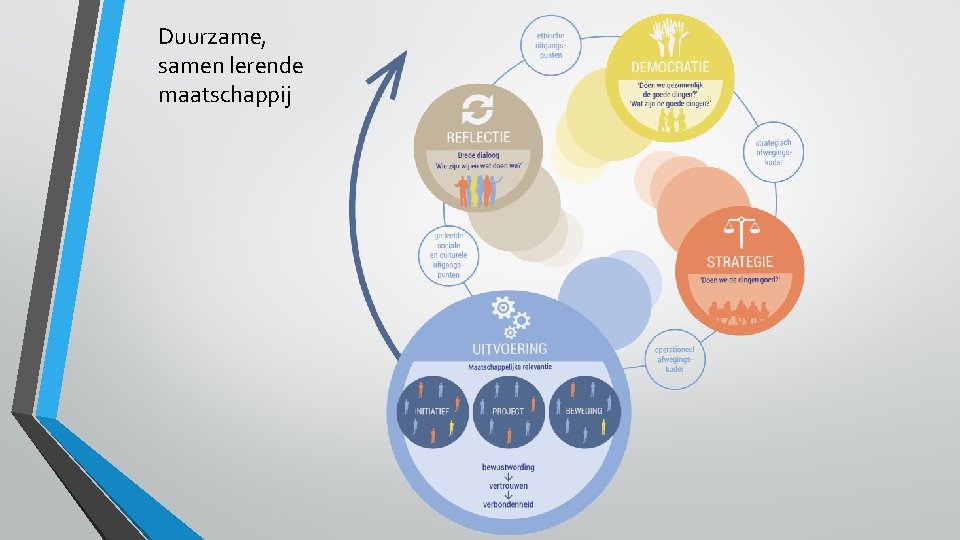
Duurzame, samen lerende maatschappij
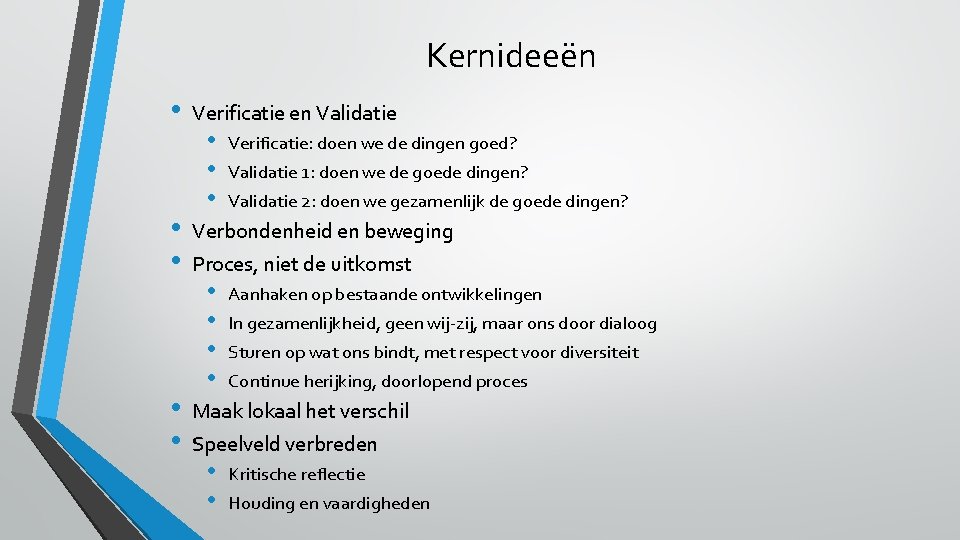
Kernideeën • • • Verificatie en Validatie • • • Verificatie: doen we de dingen goed? Validatie 1: doen we de goede dingen? Validatie 2: doen we gezamenlijk de goede dingen? Verbondenheid en beweging Proces, niet de uitkomst • • Aanhaken op bestaande ontwikkelingen In gezamenlijkheid, geen wij-zij, maar ons door dialoog Sturen op wat ons bindt, met respect voor diversiteit Continue herijking, doorlopend proces Maak lokaal het verschil Speelveld verbreden • • Kritische reflectie Houding en vaardigheden
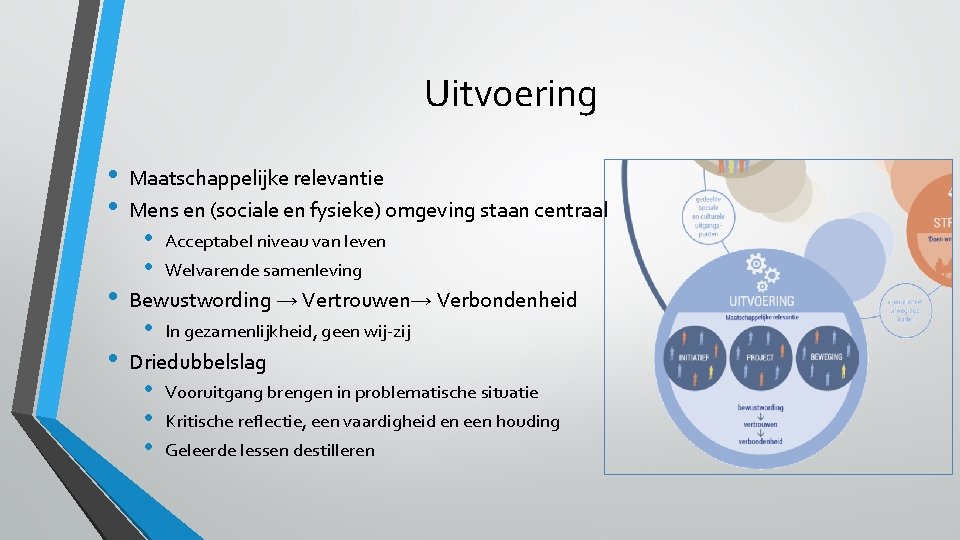
Uitvoering • • Maatschappelijke relevantie Mens en (sociale en fysieke) omgeving staan centraal • • Acceptabel niveau van leven Welvarende samenleving Bewustwording → Vertrouwen→ Verbondenheid • In gezamenlijkheid, geen wij-zij Driedubbelslag • • • Vooruitgang brengen in problematische situatie Kritische reflectie, een vaardigheid en een houding Geleerde lessen destilleren
Final remarks CT and ST is a happy marriage. CST, by incorporating critical and systems theory, ensures an emancipatory and critical approach by the researcher to the system being examined. • Systems thinking without critique is blind with respect to its underpinning [system] boundary judgements and their normative implications. Ulrich, 2003. • When researching a complex system, critical theory without system thinking is likewise limited with respect to understanding the system, its components, boundaries and relations to one another. Watson and Watson, 2011.