
Critical Success Factors of CLTS Gaps and Challenges


- Slides: 40
Critical Success Factors of CLTS, Gaps and Challenges in Quality Scaling Up and Sustainability Dr. Kamal Kar, Chairman, CLTS Foundation, Kolkata, India Presented at the Round Table discussion with the Netherlands Sanitation Experts on 17 th December 2014 Plan Nederland, Stadhouderskade 60 1070 AL Amsterdam 1
The last 15 years since emergence q. CLTS emerges as a ground breaking approach in 2000 (with a radical shift in the focus from SARRAR, PHAST or subsidised toilet construction) q. Major paradigm shifts in approaches to sanitation ²Policy and practice ²Adoption by bi-laterals, multilaterals and INGOs ²Change in national sanitation policy 2
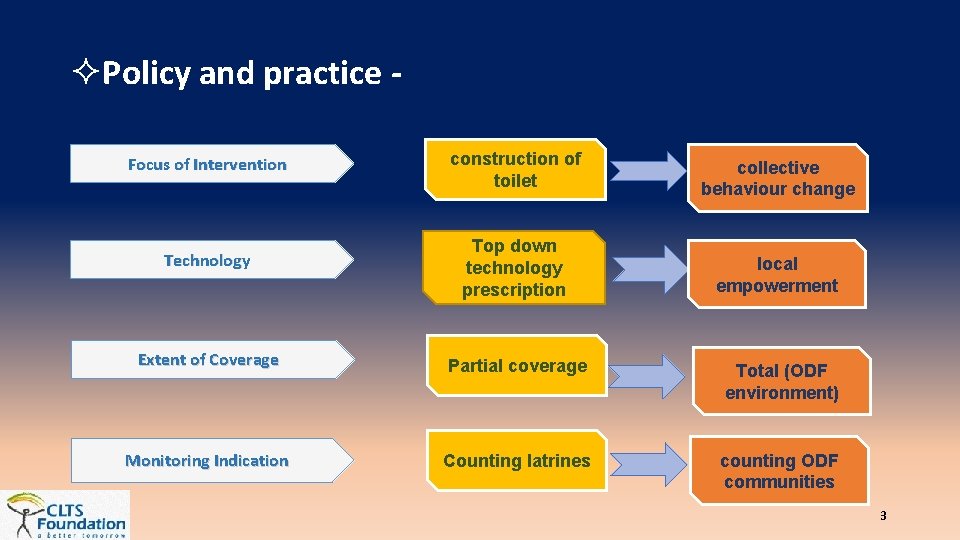
²Policy and practice - Focus of Intervention construction of toilet collective behaviour change Technology Top down technology prescription local empowerment Extent of Coverage Partial coverage Total (ODF environment) Monitoring Indication Counting latrines counting ODF communities 3
The last 15 years since emergence (Contd. . ) q. Geographical Spread and Scale ² 60+ countries in Asia, Africaand Latin America ²Governments of 25 countries with CLTS as national sanitation strategy (10 countries after much struggle) ²Atleast 40 million + people living in ODF environment 4
Outcome and Impact so far 5
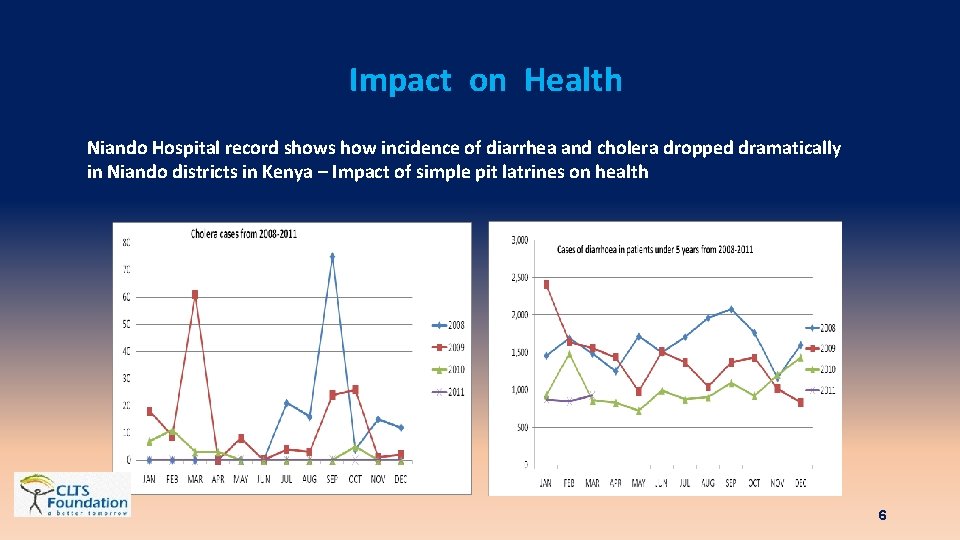
Impact on Health Niando Hospital record shows how incidence of diarrhea and cholera dropped dramatically in Niando districts in Kenya – Impact of simple pit latrines on health 6
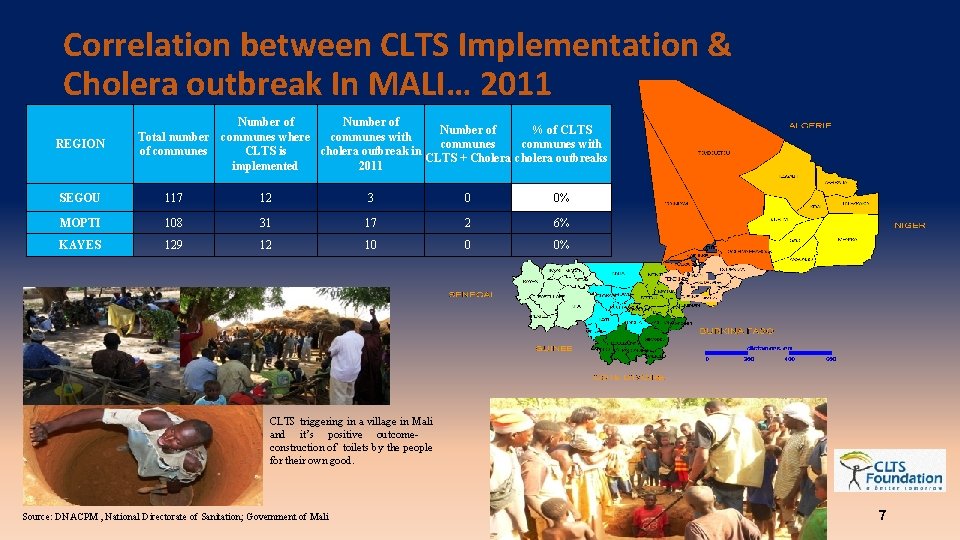
Correlation between CLTS Implementation & Cholera outbreak In MALI… 2011 Number of % of CLTS communes where communes with CLTS is cholera outbreak in CLTS + Cholera cholera outbreaks implemented 2011 REGION Total number of communes SEGOU 117 12 3 0 0% MOPTI 108 31 17 2 6% KAYES 129 12 10 0 0% CLTS triggering in a village in Mali and it’s positive outcomeconstruction of toilets by the people for their own good. Source: DNACPM , National Directorate of Sanitation; Government of Mali 7
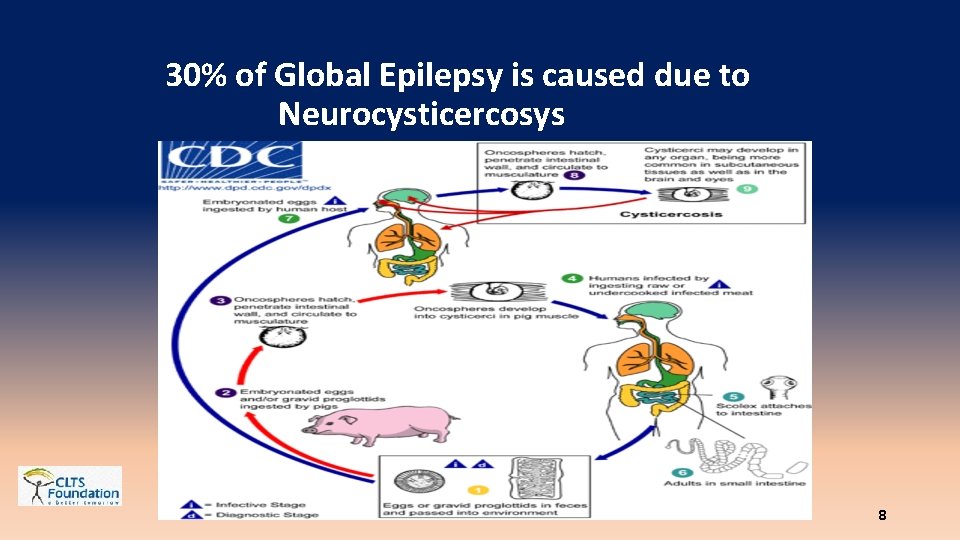
30% of Global Epilepsy is caused due to Neurocysticercosys 8
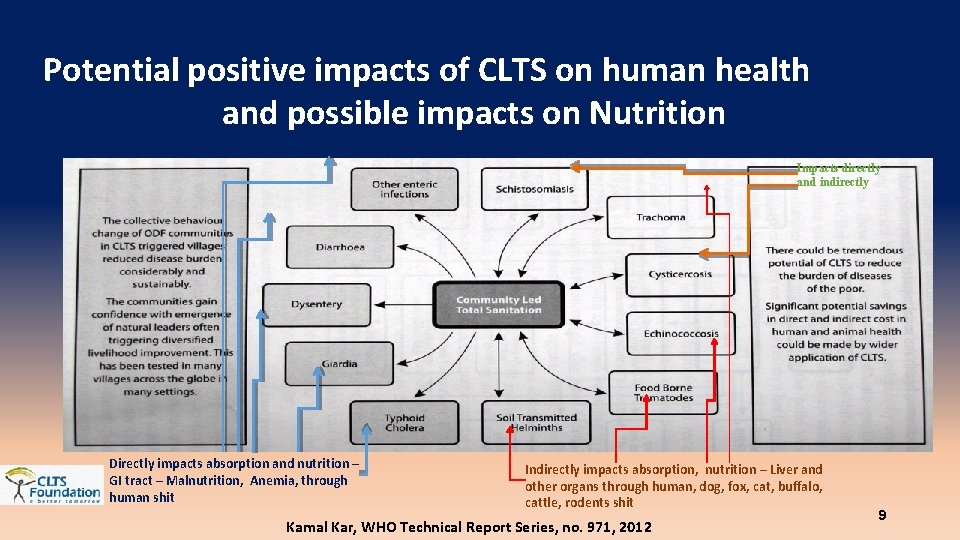
Potential positive impacts of CLTS on human health and possible impacts on Nutrition Impacts directly and indirectly Directly impacts absorption and nutrition – GI tract – Malnutrition, Anemia, through human shit Indirectly impacts absorption, nutrition – Liver and other organs through human, dog, fox, cat, buffalo, cattle, rodents shit Kamal Kar, WHO Technical Report Series, no. 971, 2012 9
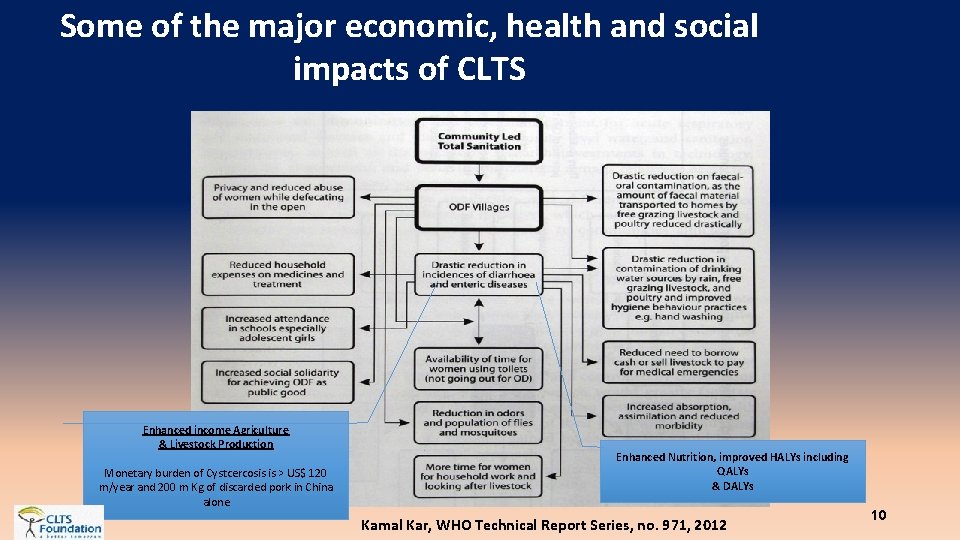
Some of the major economic, health and social impacts of CLTS Enhanced income Agriculture & Livestock Production Monetary burden of Cystcercosis is > US$ 120 m/year and 200 m Kg of discarded pork in China alone Enhanced Nutrition, improved HALYs including QALYs & DALYs Kamal Kar, WHO Technical Report Series, no. 971, 2012 10
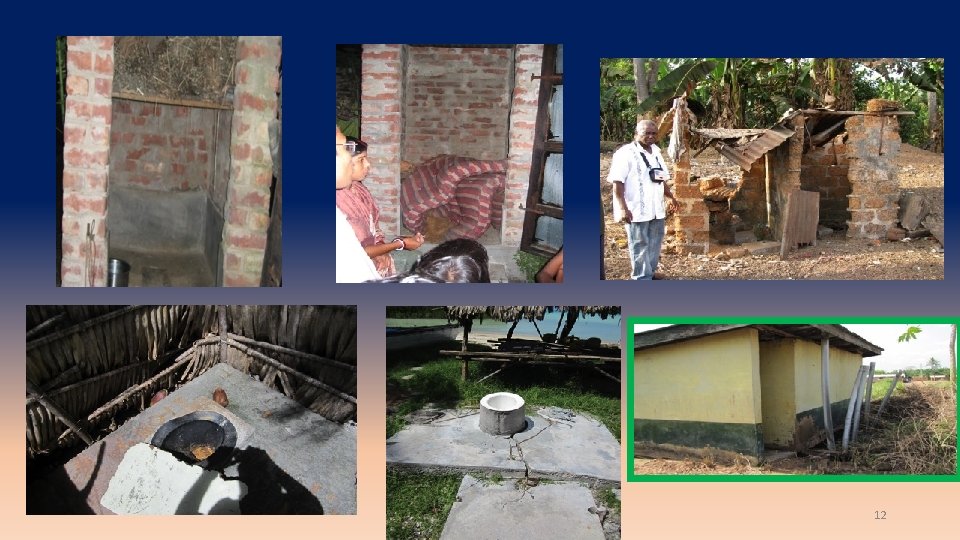
Phenomenal improvement in the utilization efficiency of Aid money ( grant or loan) on sanitation Stunning transformation in collective behaviour change! 11
12
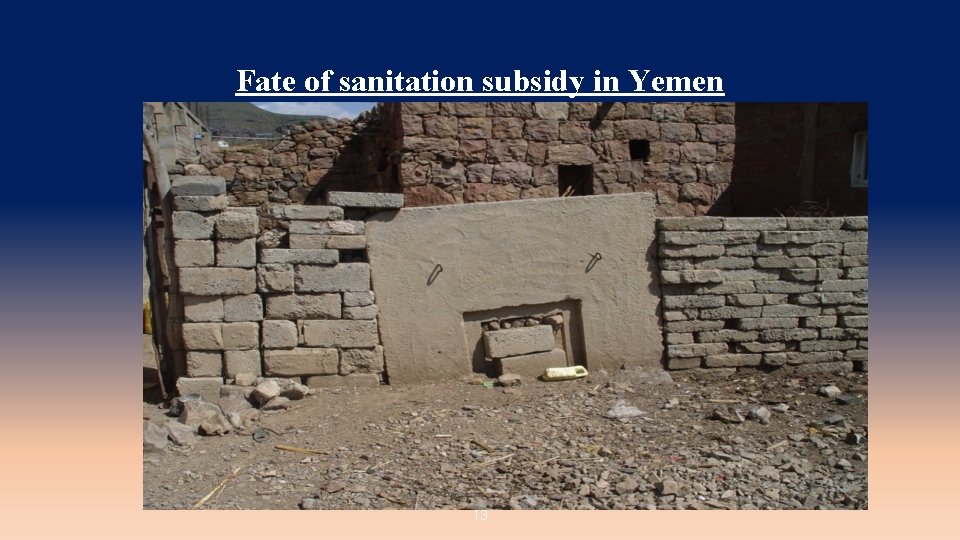
Fate of sanitation subsidy in Yemen 13
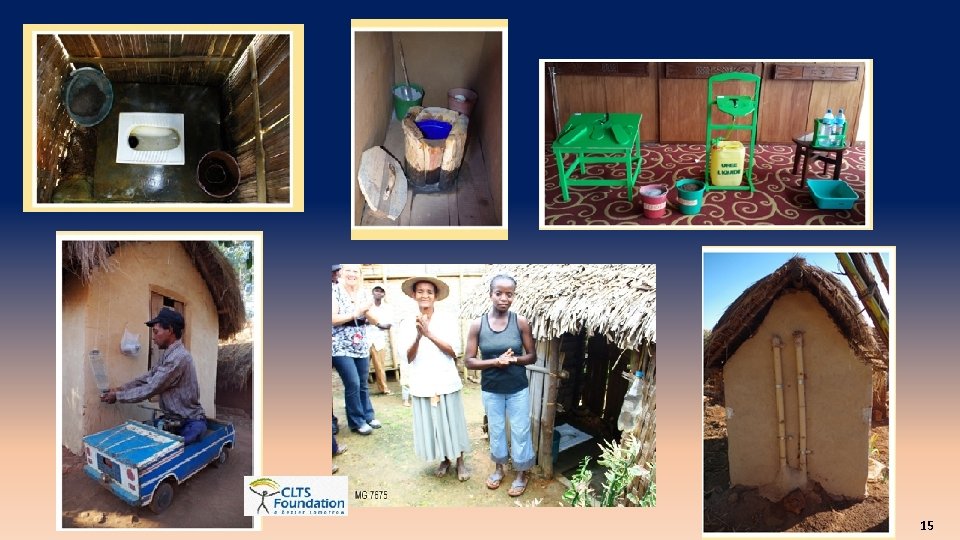
When there was no upfront hardware subsidy but true empowerment was ensured; magnificent transformation began resulting in to splendid show of local innovation and the ability to change 14
15
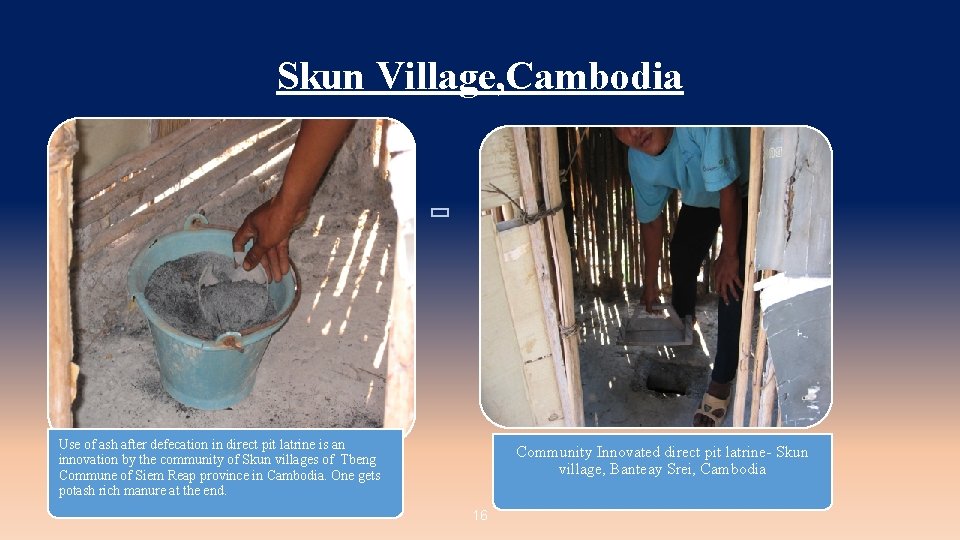
Skun Village, Cambodia Use of ash after defecation in direct pit latrine is an innovation by the community of Skun villages of Tbeng Commune of Siem Reap province in Cambodia. One gets potash rich manure at the end. Community Innovated direct pit latrine- Skun village, Banteay Srei, Cambodia 16
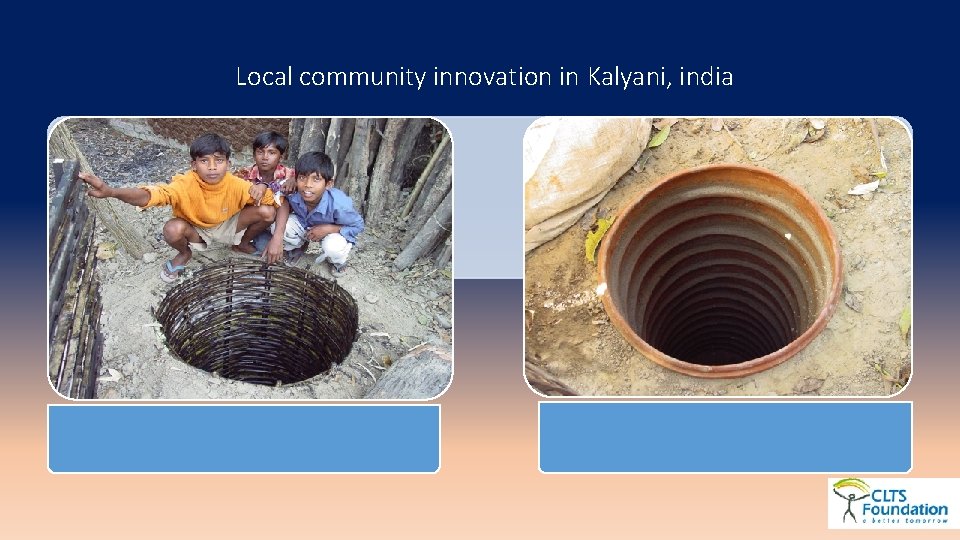
Local community innovation in Kalyani, india
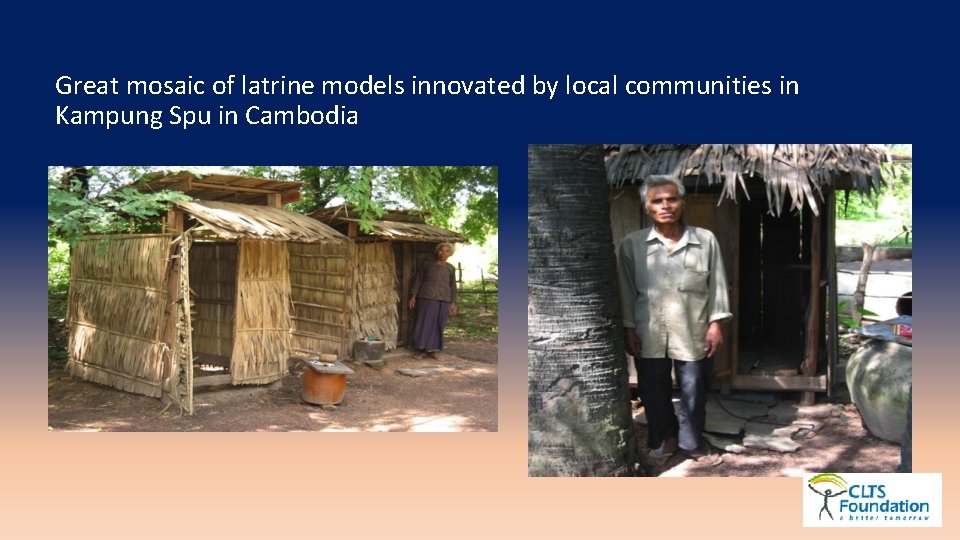
Great mosaic of latrine models innovated by local communities in Kampung Spu in Cambodia
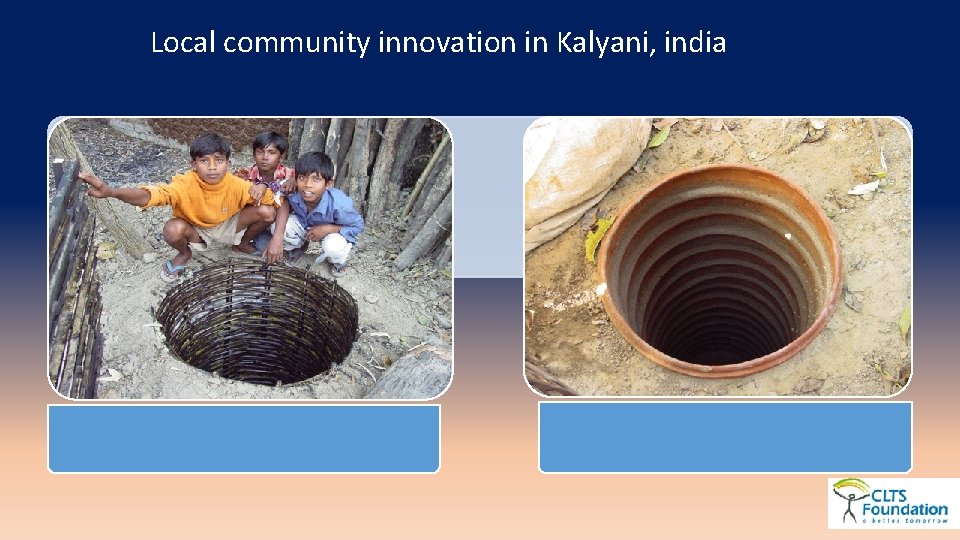
Local community innovation in Kalyani, india
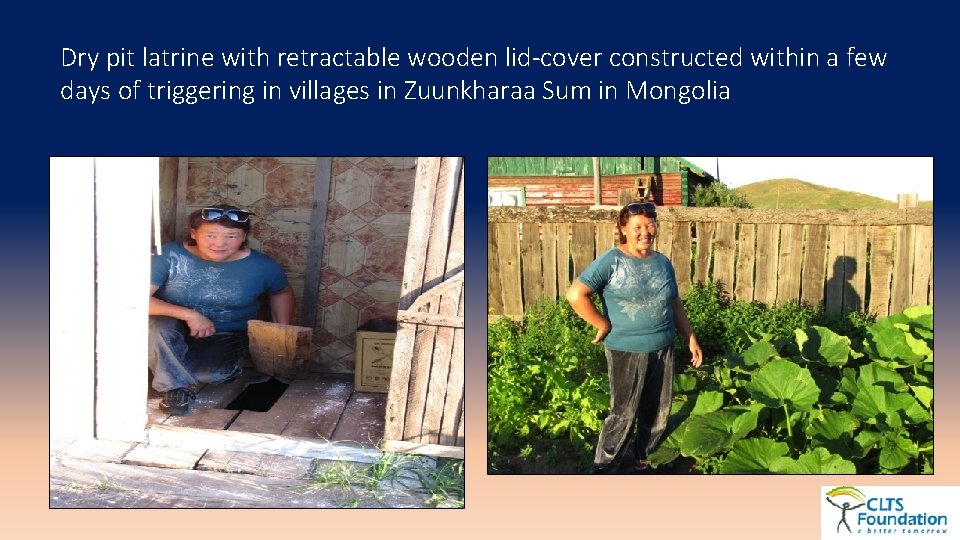
Dry pit latrine with retractable wooden lid-cover constructed within a few days of triggering in villages in Zuunkharaa Sum in Mongolia
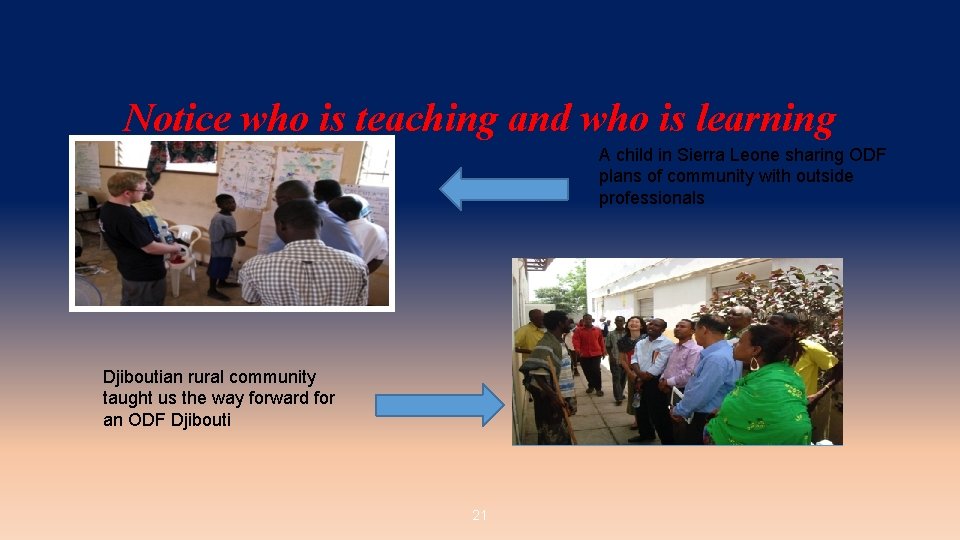
Notice who is teaching and who is learning A child in Sierra Leone sharing ODF plans of community with outside professionals Djiboutian rural community taught us the way forward for an ODF Djibouti 21
Debates and tensions • CLTS as a new development discourse with people’s empowerment at its core vs narrow focus on sanitation alone (e. g. aspect of social solidarity, beyond sanitation) • CLTS philosophy for fostering lasting change vs CLTS as a bunch of triggering tools for demand creation and toilet construction • Sanitation as a public good vs acquisition of HH toilets by some • National sanitation policy ensuing enabling environment vs ad-hoc application of CLTS • Sequencing of flexible technology option and PTD with collective behaviour change vs prescription of technology alone 22
Challenges • Research on community led extension • Mechanism for incentivising NLs/CCs– CLTS as livelihood option for N/L • Political will – yes, but what about political skill? How do we build, develop and nurture this? • Sanitation marketing – What is the right sequencing ? • No answer to the question of how to make golden-stone pot? 23
How do we address the challenges communities face in climbing the sanitation ladder ? 24
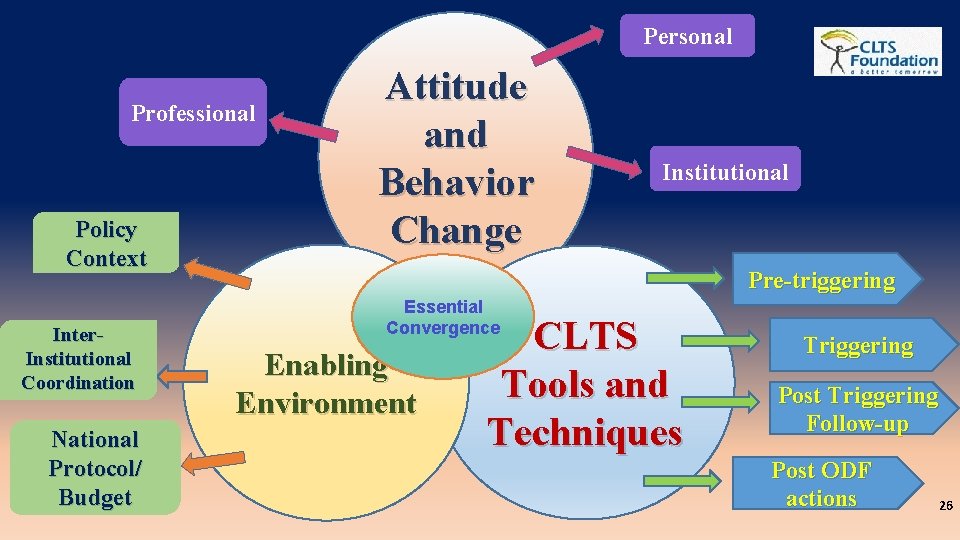
What are the critical factors for success ? 25
Personal Professional Policy Context Inter. Institutional Coordination National Protocol/ Budget Attitude and Behavior Change Institutional Pre-triggering Essential Convergence Enabling Environment CLTS Tools and Techniques Triggering Post Triggering Follow-up Post ODF actions 26
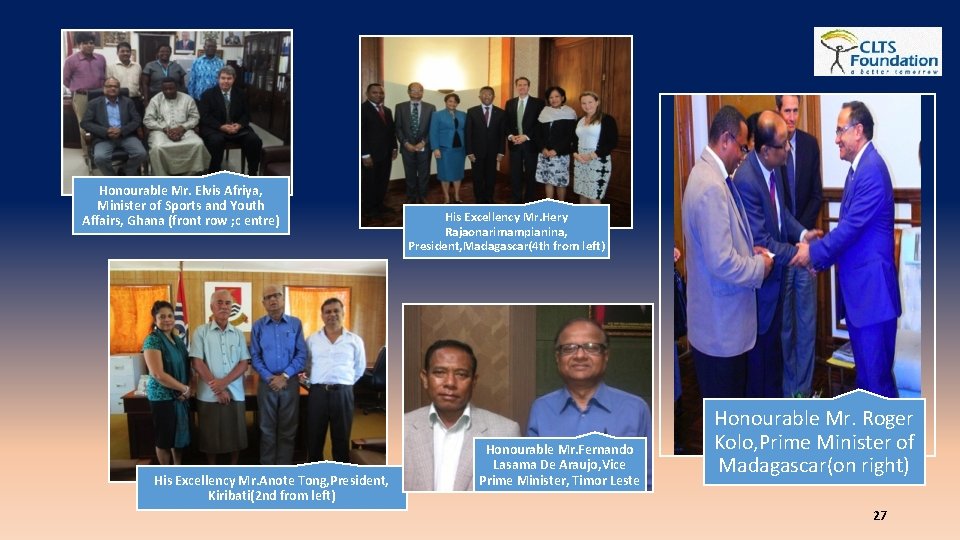
Honourable Mr. Elvis Afriya, Minister of Sports and Youth Affairs, Ghana (front row ; c entre) His Excellency Mr. Anote Tong, President, Kiribati(2 nd from left) His Excellency Mr. Hery Rajaonarimampianina, President, Madagascar(4 th from left) Honourable Mr. Fernando Lasama De Araujo, Vice Prime Minister, Timor Leste Honourable Mr. Roger Kolo, Prime Minister of Madagascar(on right) 27
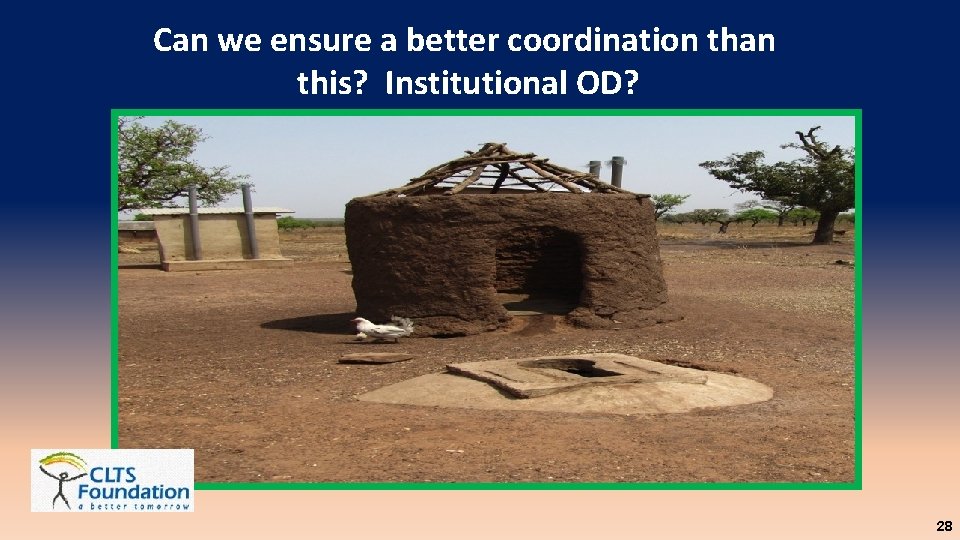
Can we ensure a better coordination than this? Institutional OD? 28
Priorities for Policy & programmatic considerations At the national level • There is a greater Scope for inter-ministerial coordination and collaboration at the national level. • Although in some countries national policy supports CLTS, the mechanism of translating policy into action is inadequate. • There is no clearly laid out and earmarked national budget for CLTS and at the same time no mechanism for surveillance of the action by different ministries and NGOs. • There has to be clear and distinct funding for sanitation and most precisely CLTS promotion and scaling up. • Some actors still provide upfront subsidy in some countries and there needs to be an unified national strategy of CLTS. • Flexible funding 29
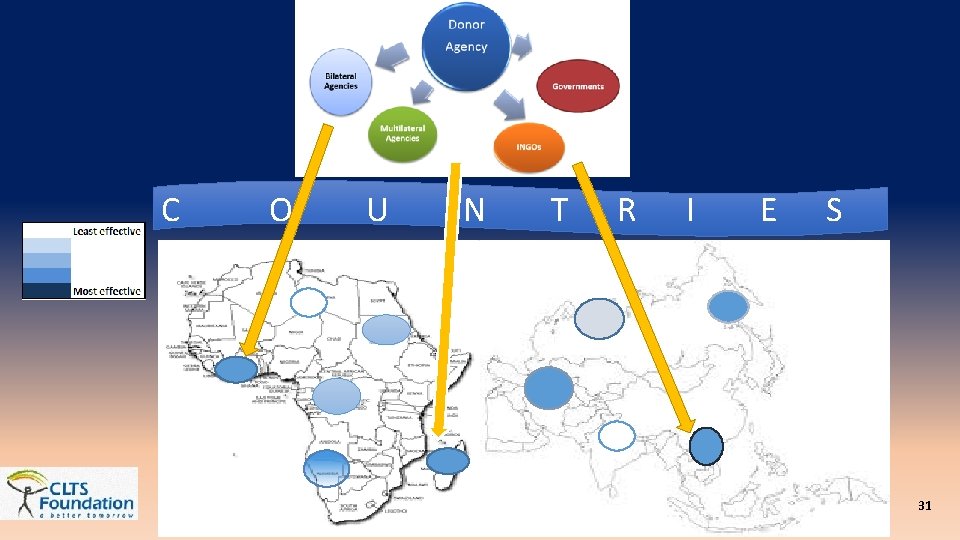
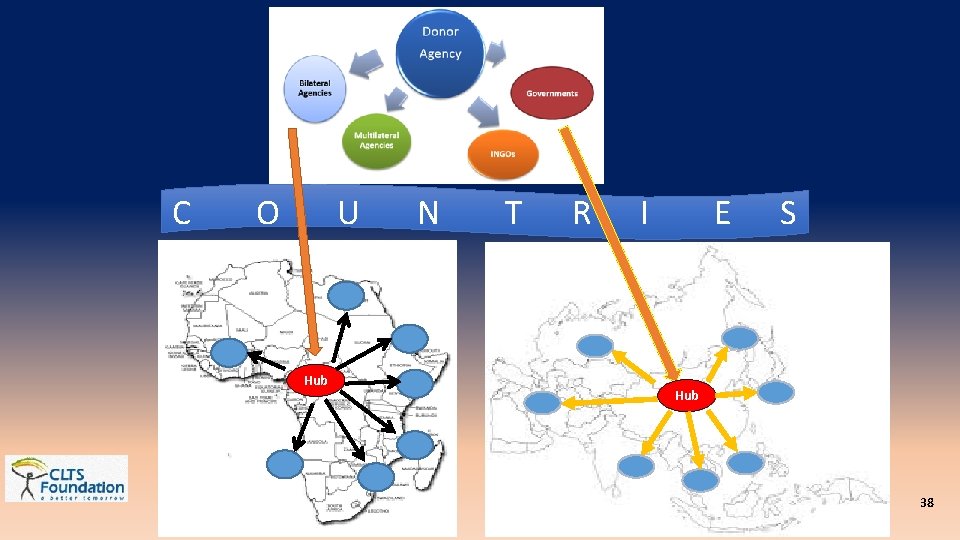
Fund flow from donor agencies to programmes – The Missing link 30
C O U N T R I E S 31
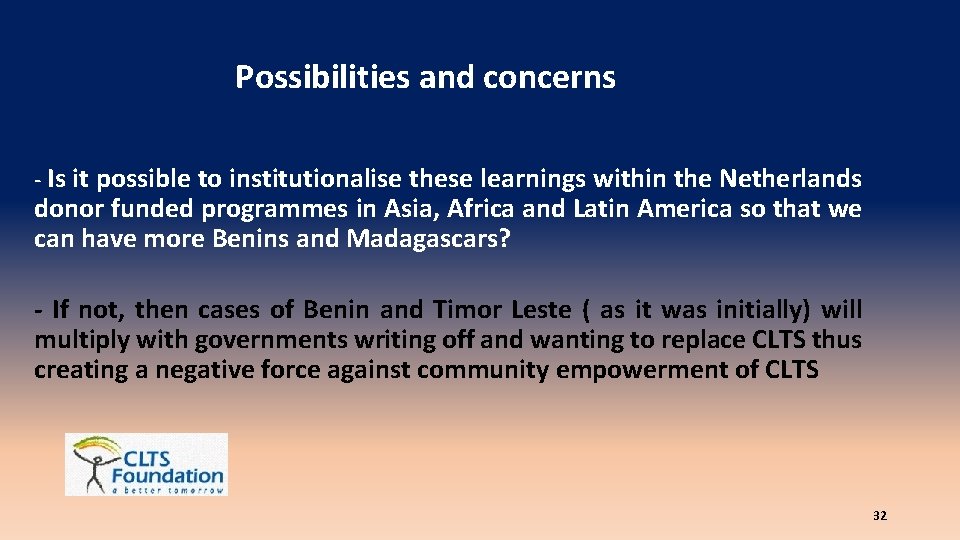
Possibilities and concerns - Is it possible to institutionalise these learnings within the Netherlands donor funded programmes in Asia, Africa and Latin America so that we can have more Benins and Madagascars? - If not, then cases of Benin and Timor Leste ( as it was initially) will multiply with governments writing off and wanting to replace CLTS thus creating a negative force against community empowerment of CLTS 32
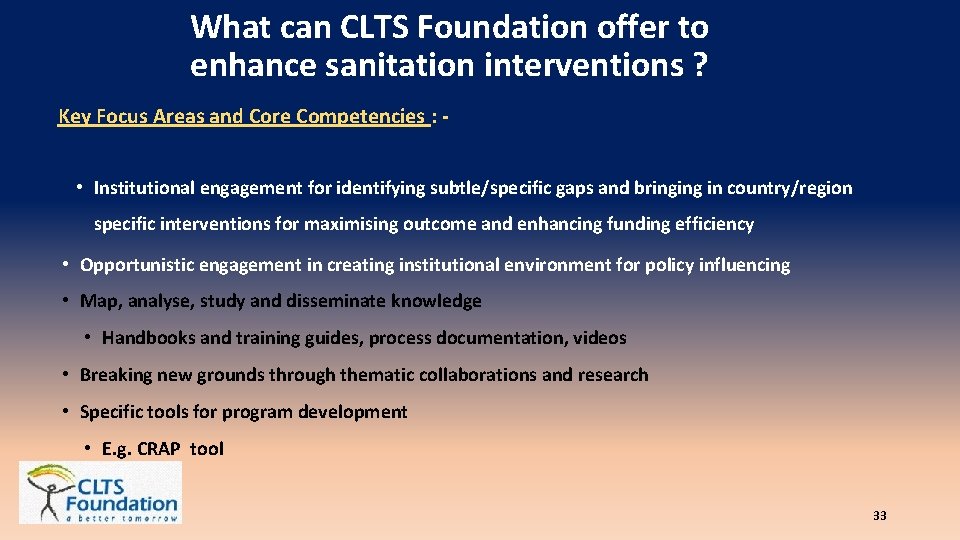
What can CLTS Foundation offer to enhance sanitation interventions ? Key Focus Areas and Core Competencies : • Institutional engagement for identifying subtle/specific gaps and bringing in country/region specific interventions for maximising outcome and enhancing funding efficiency • Opportunistic engagement in creating institutional environment for policy influencing • Map, analyse, study and disseminate knowledge • Handbooks and training guides, process documentation, videos • Breaking new grounds through thematic collaborations and research • Specific tools for program development • E. g. CRAP tool 33
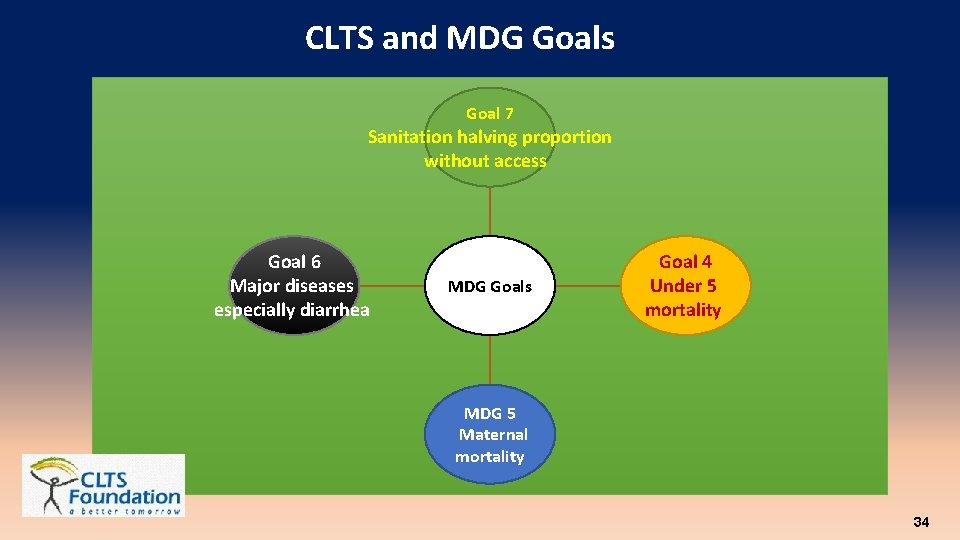
CLTS and MDG Goals Goal 7 Sanitation halving proportion without access Goal 6 Major diseases especially diarrhea MDG Goals Goal 4 Under 5 mortality MDG 5 Maternal mortality 34
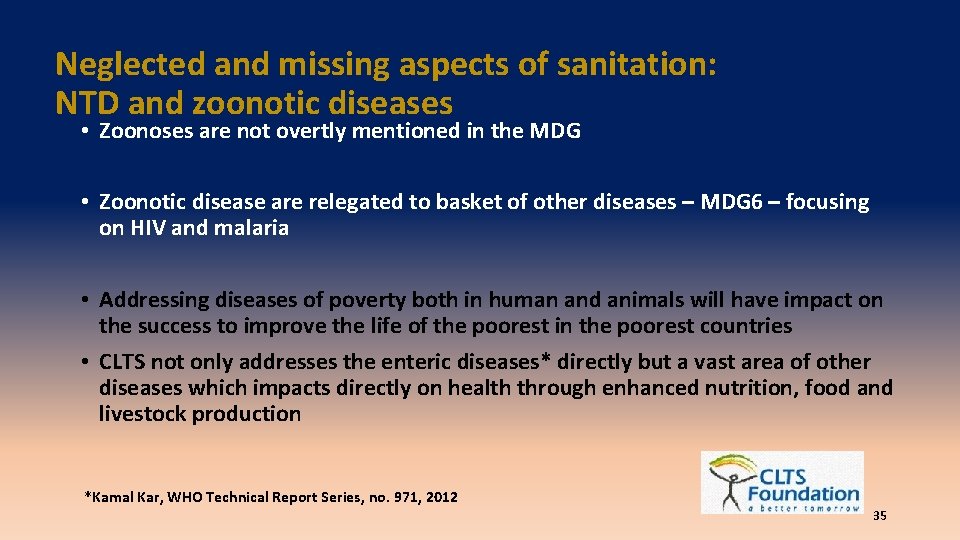
Neglected and missing aspects of sanitation: NTD and zoonotic diseases • Zoonoses are not overtly mentioned in the MDG • Zoonotic disease are relegated to basket of other diseases – MDG 6 – focusing on HIV and malaria • Addressing diseases of poverty both in human and animals will have impact on the success to improve the life of the poorest in the poorest countries • CLTS not only addresses the enteric diseases* directly but a vast area of other diseases which impacts directly on health through enhanced nutrition, food and livestock production *Kamal Kar, WHO Technical Report Series, no. 971, 2012 35
Way forward: - • CLTS and MDGs • CLTS making inroads into SDGs 36
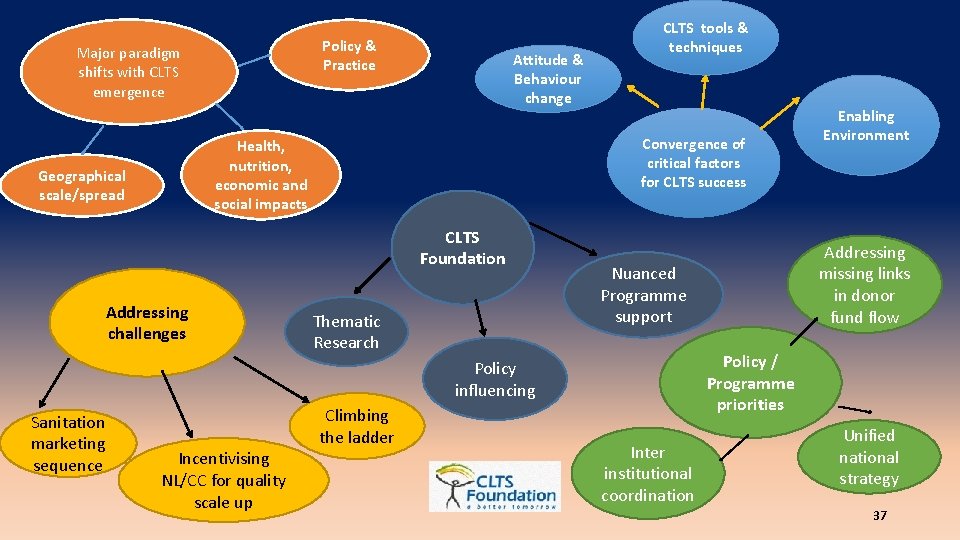
Policy & Practice Major paradigm shifts with CLTS emergence Attitude & Behaviour change Convergence of critical factors for CLTS success Health, nutrition, economic and social impacts Geographical scale/spread CLTS Foundation Addressing challenges CLTS tools & techniques Thematic Research Incentivising NL/CC for quality scale up Climbing the ladder Addressing missing links in donor fund flow Nuanced Programme support Policy / Programme priorities Policy influencing Sanitation marketing sequence Enabling Environment Inter institutional coordination Unified national strategy 37
C O U Hub N T R I E S Hub 38
Joining efforts and walking together towards creating more ODF communities, village, districts, regions, countries and ODF world… 39
THANK YOU FOR YOUR ATTENTION 40