
Critical Sections with lots of Threads Ken Birman

Critical Sections with lots of Threads Ken Birman 1
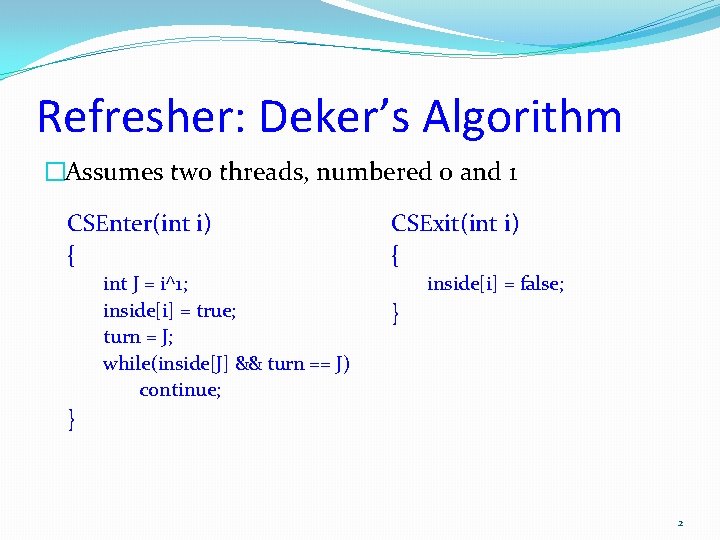
Refresher: Deker’s Algorithm �Assumes two threads, numbered 0 and 1 CSEnter(int i) { int J = i^1; inside[i] = true; turn = J; while(inside[J] && turn == J) continue; CSExit(int i) { inside[i] = false; } } 2
![Can we generalize to many threads? �Obvious approach won’t work: CSEnter(int i) { inside[i]](http://slidetodoc.com/presentation_image_h2/c78ec0dac1aa25d429348a2fc6cd7a54/image-3.jpg "Can we generalize to many threads? �Obvious approach won’t work: CSEnter(int i) { inside[i]")
Can we generalize to many threads? �Obvious approach won’t work: CSEnter(int i) { inside[i] = true; for(J = 0; J < N; J++) while(inside[J] && turn == J) continue; CSExit(int i) { inside[i] = false; } } �Issue: notion of “who’s turn” is next for breaking ties 3
Bakery idea �Think of the (very popular) pastry shop in Montreal’s Marché Atwater �People take a ticket from a machine �If nobody is waiting, tickets don’t matter �When several people are waiting, ticket order determines sequence in which they can place their order 4
![Bakery Algorithm: “Take 1” � int ticket[n]; � int next_ticket; CSEnter(int i) { ticket[i]](http://slidetodoc.com/presentation_image_h2/c78ec0dac1aa25d429348a2fc6cd7a54/image-5.jpg "Bakery Algorithm: “Take 1” � int ticket[n]; � int next_ticket; CSEnter(int i) { ticket[i]")
Bakery Algorithm: “Take 1” � int ticket[n]; � int next_ticket; CSEnter(int i) { ticket[i] = ++next_ticket; for(k = 0; k < N; k++) while(ticket[k] && ticket[k] < ticket[i]) continue; CSExit(int i) { ticket[i] = 0; } } • Oops… access to next_ticket is a problem! 5
![Bakery Algorithm: “Take 2” � int ticket[n]; CSEnter(int i) { ticket[i] = max(ticket[0], …](http://slidetodoc.com/presentation_image_h2/c78ec0dac1aa25d429348a2fc6cd7a54/image-6.jpg "Bakery Algorithm: “Take 2” � int ticket[n]; CSEnter(int i) { ticket[i] = max(ticket[0], …")
Bakery Algorithm: “Take 2” � int ticket[n]; CSEnter(int i) { ticket[i] = max(ticket[0], … ticket[N-1])+1; for(k = 0; k < N; k++) while(ticket[k] != 0 && ticket[k] < ticket[i]) continue; CSExit(int i) { ticket[i] = 0; } } • Clever idea: just add one to the max. • Oops… two could pick the same value! 6
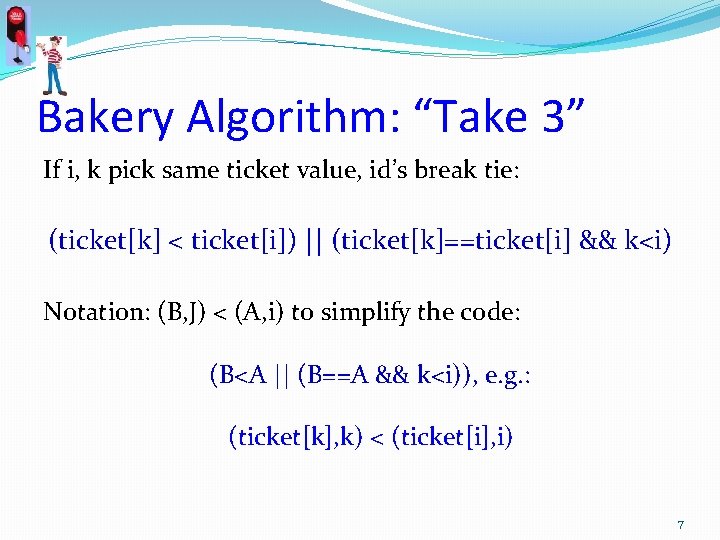
Bakery Algorithm: “Take 3” If i, k pick same ticket value, id’s break tie: (ticket[k] < ticket[i]) || (ticket[k]==ticket[i] && k<i) Notation: (B, J) < (A, i) to simplify the code: (B<A || (B==A && k<i)), e. g. : (ticket[k], k) < (ticket[i], i) 7
![Bakery Algorithm: “Take 4” � int ticket[N]; � boolean picking[N] = false; CSEnter(int i)](http://slidetodoc.com/presentation_image_h2/c78ec0dac1aa25d429348a2fc6cd7a54/image-8.jpg "Bakery Algorithm: “Take 4” � int ticket[N]; � boolean picking[N] = false; CSEnter(int i)")
Bakery Algorithm: “Take 4” � int ticket[N]; � boolean picking[N] = false; CSEnter(int i) { ticket[i] = max(ticket[0], … ticket[N-1])+1; for(k = 0; k < N; k++) while(ticket[k] && (ticket[k], k) < (ticket[i], i)) continue; CSExit(int i) { ticket[i] = 0; } } • Oops… i could look at k when k is still storing its ticket, and yet k could have the lower ticket number! 8
![Bakery Algorithm: Almost final � int ticket[N]; � boolean choosing[N] = false; CSEnter(int i)](http://slidetodoc.com/presentation_image_h2/c78ec0dac1aa25d429348a2fc6cd7a54/image-9.jpg "Bakery Algorithm: Almost final � int ticket[N]; � boolean choosing[N] = false; CSEnter(int i)")
Bakery Algorithm: Almost final � int ticket[N]; � boolean choosing[N] = false; CSEnter(int i) { choosing[i] = true; ticket[i] = max(ticket[0], … ticket[N-1])+1; choosing[i] = false; for(k = 0; k < N; k++) { while(choosing[k]) continue; while(ticket[k] && (ticket[k], k) < (ticket[i], i)) continue; CSExit(int i) { ticket[i] = 0; } } } 9
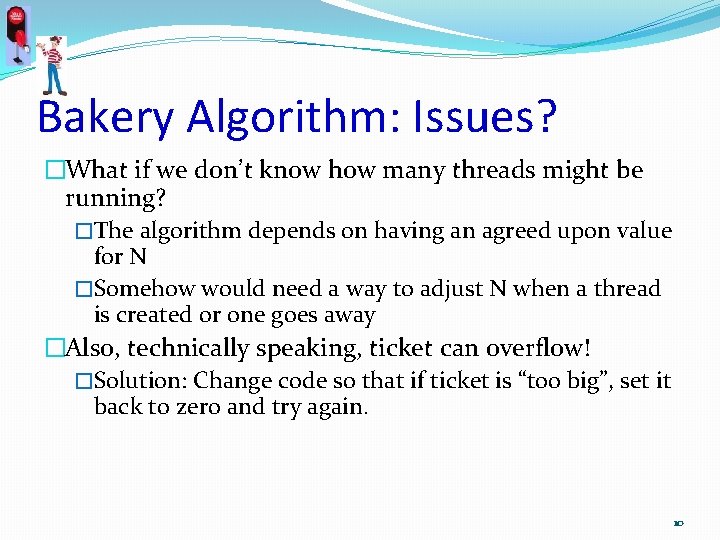
Bakery Algorithm: Issues? �What if we don’t know how many threads might be running? �The algorithm depends on having an agreed upon value for N �Somehow would need a way to adjust N when a thread is created or one goes away �Also, technically speaking, ticket can overflow! �Solution: Change code so that if ticket is “too big”, set it back to zero and try again. 10
![Eliminating overflow do { ticket[i] = 0; choosing[i] = true; ticket[i] = max(ticket[0], …](http://slidetodoc.com/presentation_image_h2/c78ec0dac1aa25d429348a2fc6cd7a54/image-11.jpg "Eliminating overflow do { ticket[i] = 0; choosing[i] = true; ticket[i] = max(ticket[0], …")
Eliminating overflow do { ticket[i] = 0; choosing[i] = true; ticket[i] = max(ticket[0], … ticket[N-1])+1; choosing[i] = false; } while(ticket[i] >= MAXIMUM); 11
Adjusting N �This won’t happen often �Simplest: brute force! �Disable threading temporarily �Then change N, reallocate array of tickets, initialize to 0 �Then restart the threads package �Sometimes a crude solution is the best way to go… 12
![Bakery Algorithm: Final � int ticket[N]; /* Important: Disable thread scheduling when changing N](http://slidetodoc.com/presentation_image_h2/c78ec0dac1aa25d429348a2fc6cd7a54/image-13.jpg "Bakery Algorithm: Final � int ticket[N]; /* Important: Disable thread scheduling when changing N")
Bakery Algorithm: Final � int ticket[N]; /* Important: Disable thread scheduling when changing N */ � boolean choosing[N] = false; CSEnter(int i) { do { ticket[i] = 0; choosing[i] = true; ticket[i] = max(ticket[0], … ticket[N-1])+1; choosing[i] = false; } while(ticket[i] >= MAXIMUM); for(k = 0; k < N; k++) { while(choosing[k]) continue; while(ticket[k] && (ticket[k], k) < (ticket[i], i)) continue; CSExit(int i) { ticket[i] = 0; } } } 13
Getting Real… Bakery Algorithm is really theory. . . A lesson in thinking about concurrency 14
Synchronization in real systems �Few real systems actually use algorithms such as the bakery algorithm �In fact we learned because it helps us “think about” synchronization in a clear way �Real systems avoid that style of “busy waiting” although, with multicore machines, it may be coming back 15
Critical Sections with Hardware �Hardware (multicore) platforms demand some kind of synchronization down in the O/S kernel �Needs to map directly to machine instructions �Usually exploits some form of “test and set” instruction �This kind of instruction is also available in user code, but user-level applications would rarely employ it �In applications user’s build, there is usually some kind of language-level support for synchronization 16
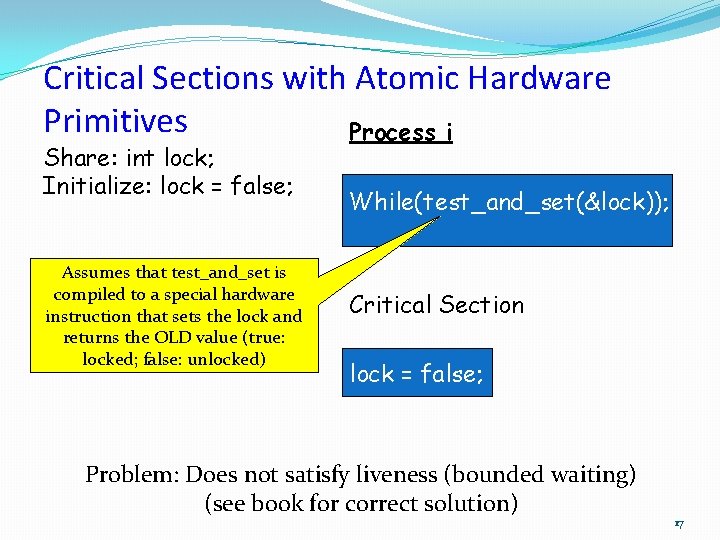
Critical Sections with Atomic Hardware Primitives Process i Share: int lock; Initialize: lock = false; Assumes that test_and_set is compiled to a special hardware instruction that sets the lock and returns the OLD value (true: locked; false: unlocked) While(test_and_set(&lock)); Critical Section lock = false; Problem: Does not satisfy liveness (bounded waiting) (see book for correct solution) 17
Higher level constructs �Even with special instructions available, many O/S designers prefer to implement a synchronization abstraction using the special instructions �Why? �Makes the O/S more portable (not all machines use the same set of instructions) �Help’s us think about synchronization in higer-level terms, rather than needing to think about hardware 18
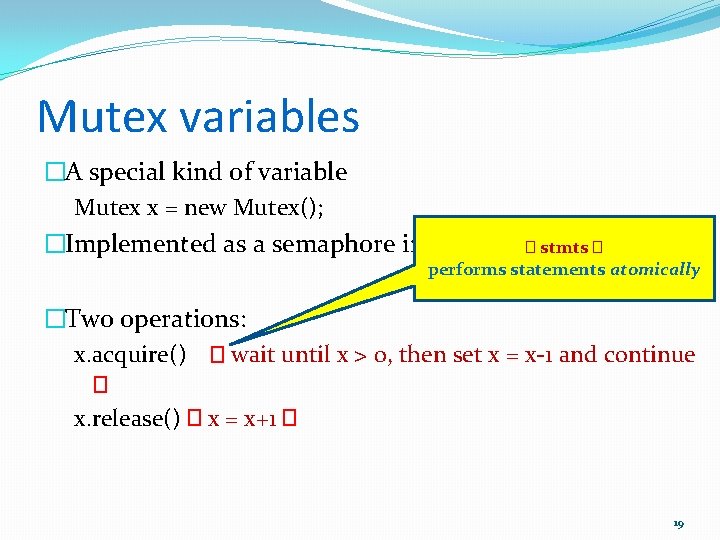
Mutex variables �A special kind of variable Mutex x = new Mutex(); �Implemented as a semaphore initialized to 1 (next slide) � stmts � performs statements atomically �Two operations: x. acquire() � wait until x > 0, then set x = x-1 and continue � x. release() � x = x+1 � 19
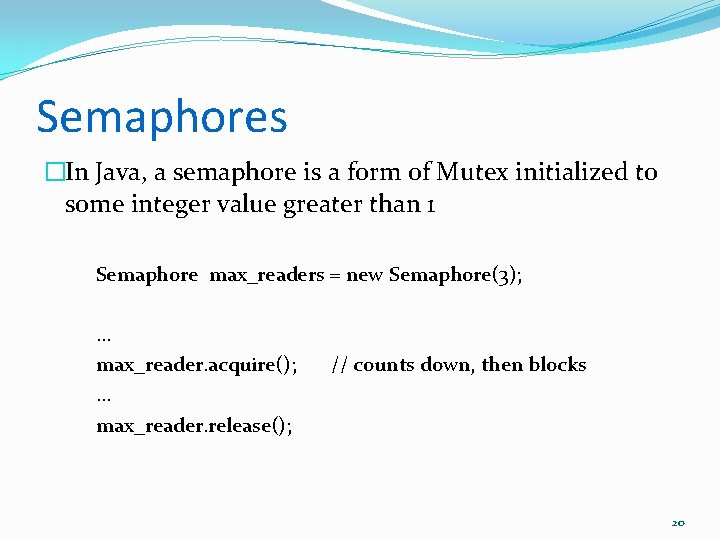
Semaphores �In Java, a semaphore is a form of Mutex initialized to some integer value greater than 1 Semaphore max_readers = new Semaphore(3); … max_reader. acquire(); … max_reader. release(); // counts down, then blocks 20
Side remark �Dijkstra was first to introduce semaphores with operations �P(x) – passeren �V(x) – verhogan �Book calls them �x. wait() �X. signal() �We’re focusing on Java because you are more likely to use Java in your career 21
Definition: atomically �Means “this code must (somehow) execute without interruptions �O/S implementer would need to find a way to implement the atomic portion �Perhaps using special instructions �Perhaps by disabling interrupts (if there is just one core) �Perhaps some other tricky scheme… �Idea is to separate the “behavior” required from the best way of supporting that behavior on a particular CPU 22
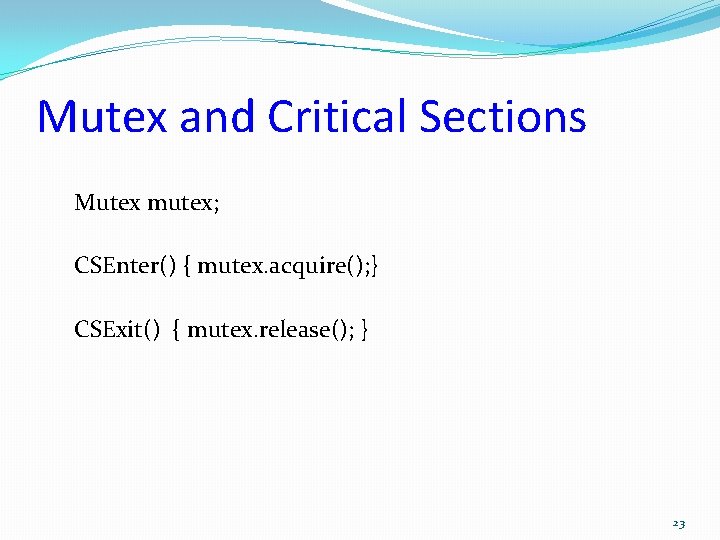
Mutex and Critical Sections Mutex mutex; CSEnter() { mutex. acquire(); } CSExit() { mutex. release(); } 23
Attempt �In Java, you can “attempt” to acquire a mutex or semaphore �With no timeout, either your attempt succeeds, or it throws an exception �There is also a timer variation, where you can specify an amount of time your code is willing to wait �This is used to avoid getting “stuck” waiting forever, in complex programs where many people implemented different parts of the code 24
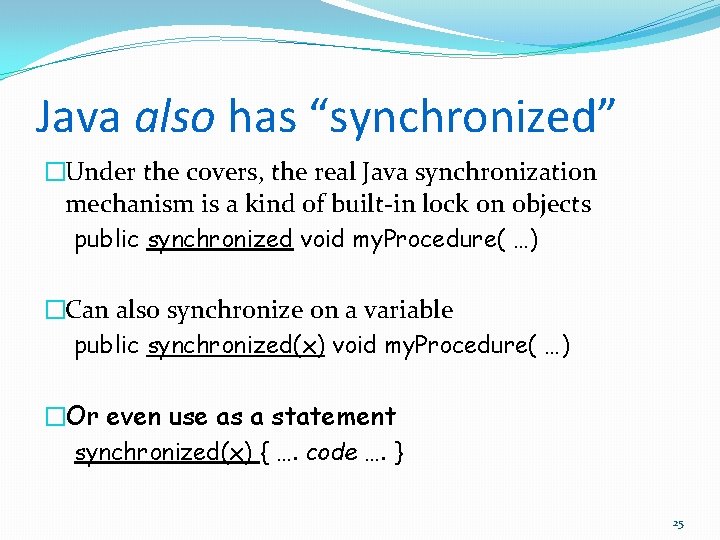
Java also has “synchronized” �Under the covers, the real Java synchronization mechanism is a kind of built-in lock on objects public synchronized void my. Procedure( …) �Can also synchronize on a variable public synchronized(x) void my. Procedure( …) �Or even use as a statement synchronized(x) { …. code …. } 25
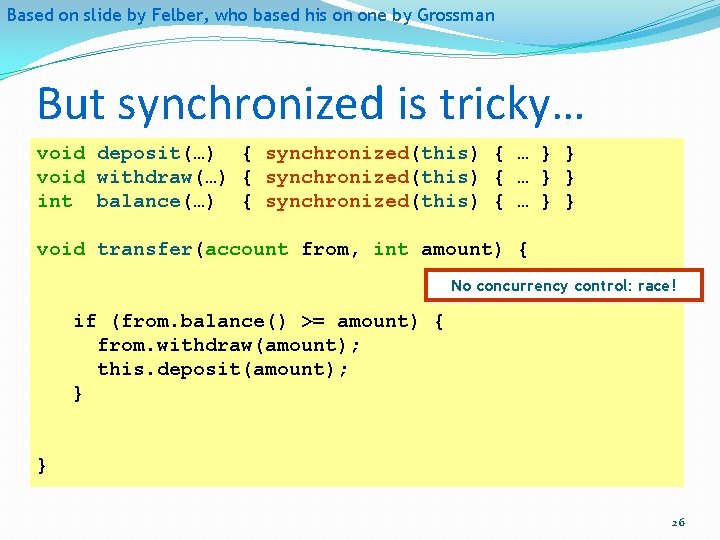
Based on slide by Felber, who based his on one by Grossman But synchronized is tricky… void deposit(…) { synchronized(this) { … } } void withdraw(…) { synchronized(this) { … } } int balance(…) { synchronized(this) { … } } void transfer(account from, int amount) { No concurrency control: race! if (from. balance() >= amount) { from. withdraw(amount); this. deposit(amount); } } 26
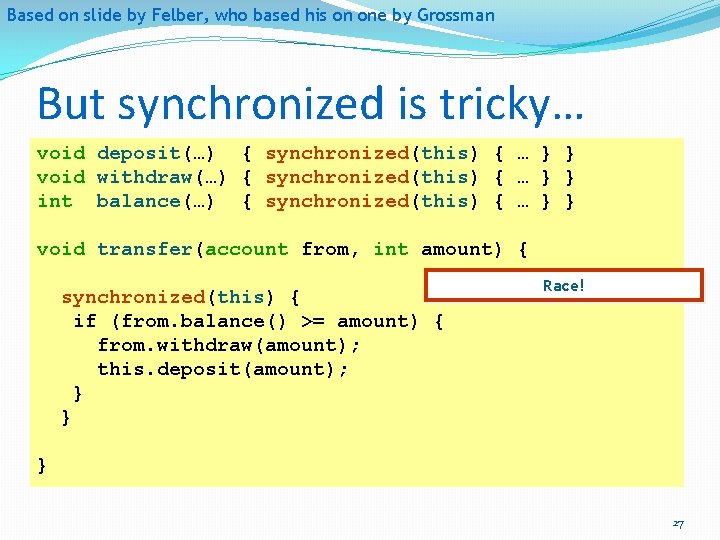
Based on slide by Felber, who based his on one by Grossman But synchronized is tricky… void deposit(…) { synchronized(this) { … } } void withdraw(…) { synchronized(this) { … } } int balance(…) { synchronized(this) { … } } void transfer(account from, int amount) { synchronized(this) { if (from. balance() >= amount) { from. withdraw(amount); this. deposit(amount); } } Race! } 27
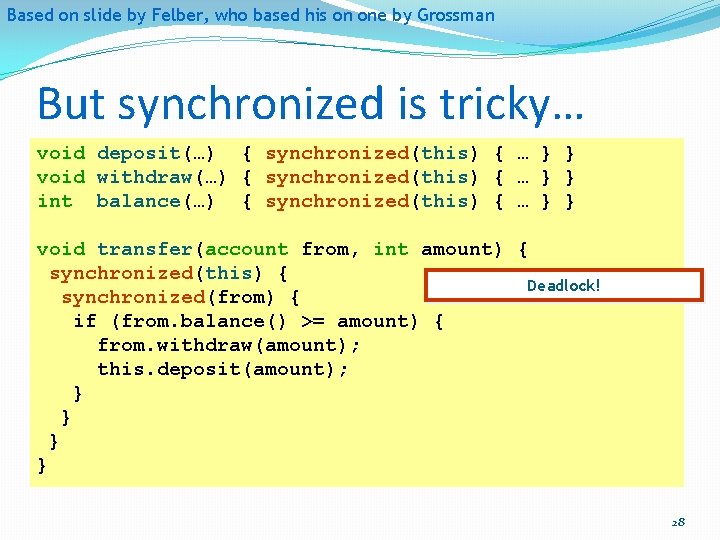
Based on slide by Felber, who based his on one by Grossman But synchronized is tricky… void deposit(…) { synchronized(this) { … } } void withdraw(…) { synchronized(this) { … } } int balance(…) { synchronized(this) { … } } void transfer(account from, int amount) { synchronized(this) { Deadlock! synchronized(from) { if (from. balance() >= amount) { from. withdraw(amount); this. deposit(amount); } } 28
Yet additional options �Every Java object also has built-in methods: �Obj. wait(): not semaphores! Calling thread always blocks �Obj. notify(): wakes up one blocked thread (FIFO) �Obj. notify. All(): wakes up all blocked threads �These are used to support monitors (next lecture) 29
Main “take away” �Java has many options for locking things �Mutex (binary semaphores): like locks �General semaphores �Synchronized classes �Object. wait/notify �Too many choices! �What we really need to understand is how to use these to obtain correct solutions… 30
- Slides: 30