
Critical Reflection Meaning Making in ServiceLearning Servicelearning is
- Slides: 14
Critical Reflection Meaning Making in Service-Learning
Service-learning is a credit-bearing educational experience in which students participate in an organized service activity that meets identified community needs, and reflect on the service activity in such a way as to gain further understanding of course content, a broader appreciation of the discipline, and an enhanced sense of civic responsibility. Bringle & Hatcher, 1996, p. 222
“We don’t learn from experience. We learn from reflecting on experience. ” -John Dewey (Dewey, 1938 p. 13)
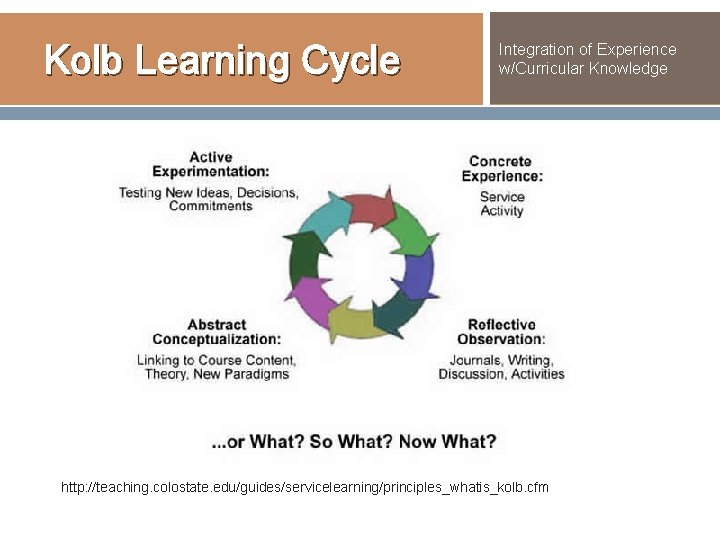
Kolb Learning Cycle Integration of Experience w/Curricular Knowledge http: //teaching. colostate. edu/guides/servicelearning/principles_whatis_kolb. cfm
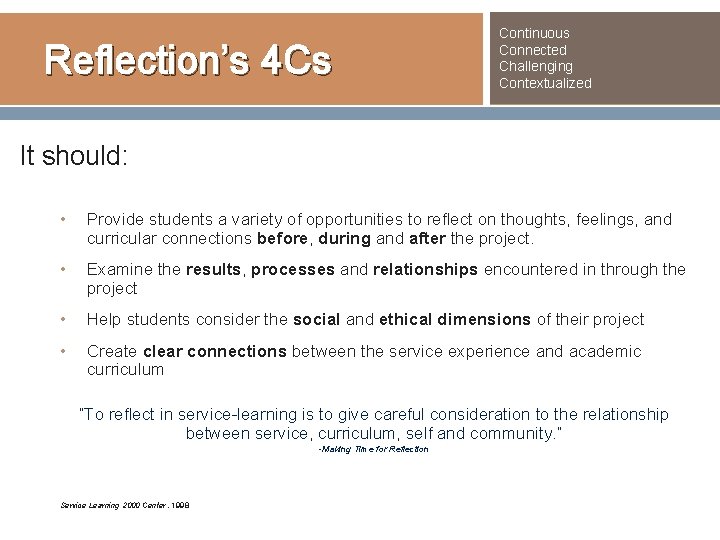
Reflection’s 4 Cs Continuous Connected Challenging Contextualized It should: • Provide students a variety of opportunities to reflect on thoughts, feelings, and curricular connections before, during and after the project. • Examine the results, processes and relationships encountered in through the project • Help students consider the social and ethical dimensions of their project • Create clear connections between the service experience and academic curriculum “To reflect in service-learning is to give careful consideration to the relationship between service, curriculum, self and community. ” -Making Time for Reflection Service Learning 2000 Center, 1998
Reflection Models & Tools
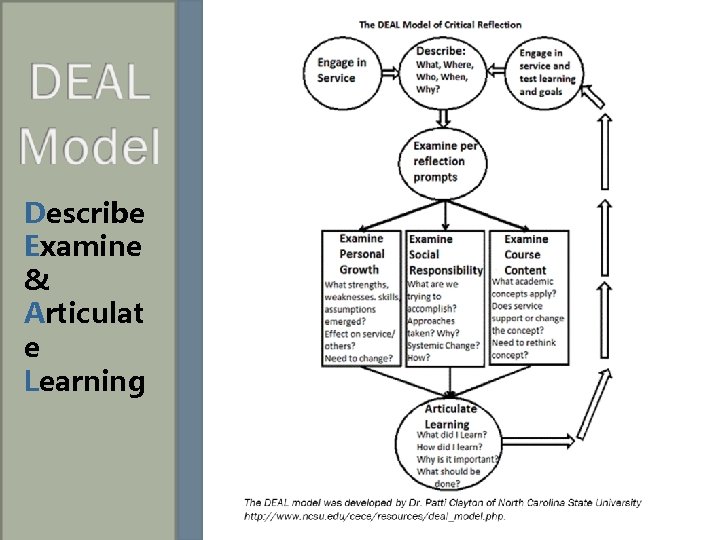
Describe Examine & Articulat e Learning
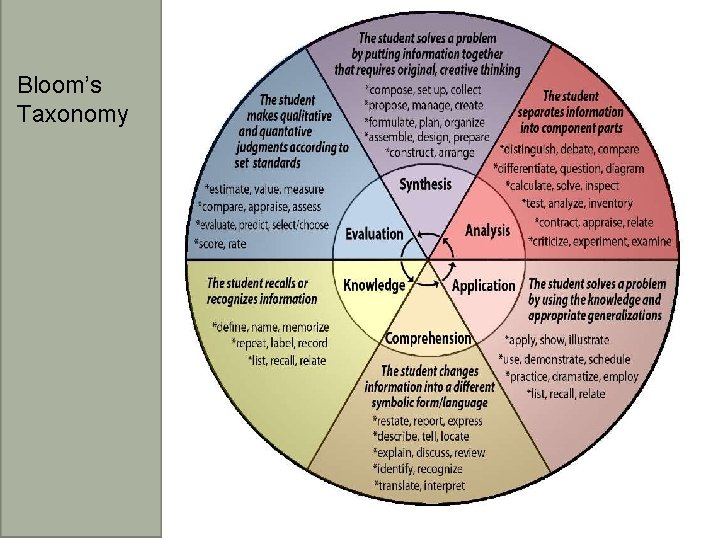
Bloom’s Taxonomy
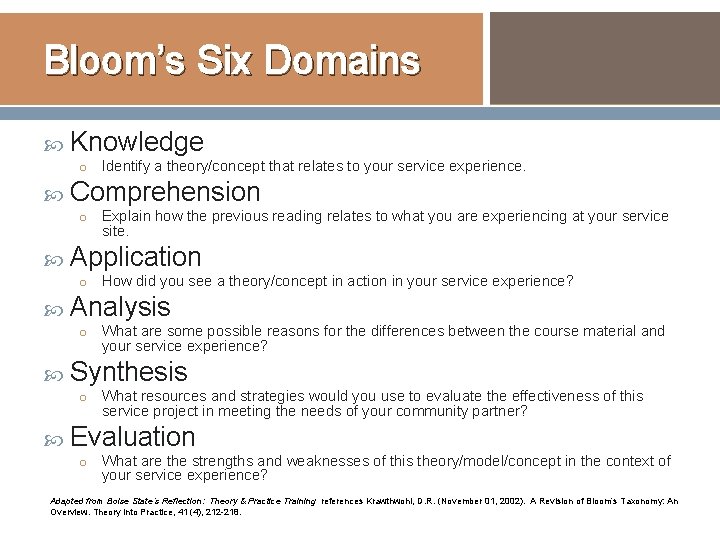
Bloom’s Six Domains Knowledge o Comprehension o What are some possible reasons for the differences between the course material and your service experience? Synthesis o How did you see a theory/concept in action in your service experience? Analysis o Explain how the previous reading relates to what you are experiencing at your service site. Application o Identify a theory/concept that relates to your service experience. What resources and strategies would you use to evaluate the effectiveness of this service project in meeting the needs of your community partner? Evaluation o What are the strengths and weaknesses of this theory/model/concept in the context of your service experience? Adapted from Boise State’s Reflection: Theory & Practice Training references Krawthwohl, D. R. (November 01, 2002). A Revision of Bloom’s Taxonomy: An Overview. Theory into Practice, 41 (4), 212 -218.
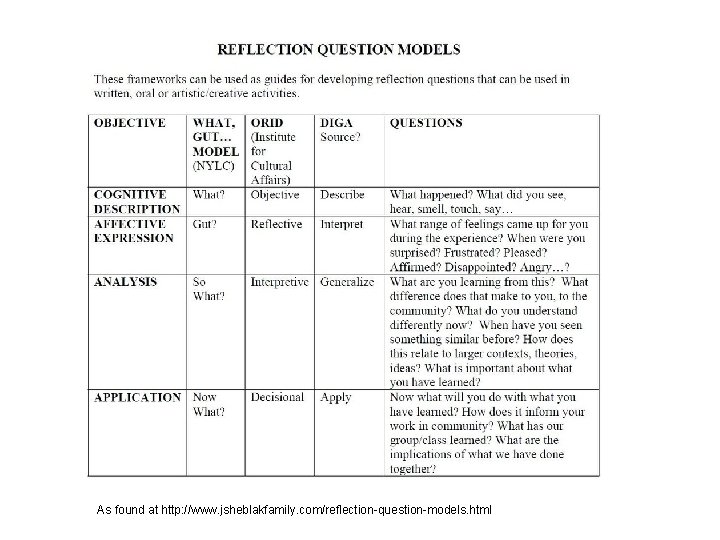
As found at http: //www. jsheblakfamily. com/reflection-question-models. html
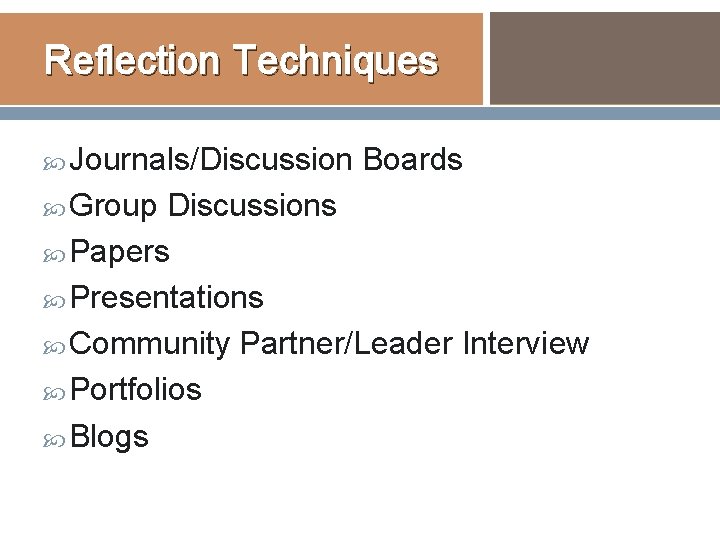
Reflection Techniques Journals/Discussion Group Boards Discussions Papers Presentations Community Partner/Leader Interview Portfolios Blogs
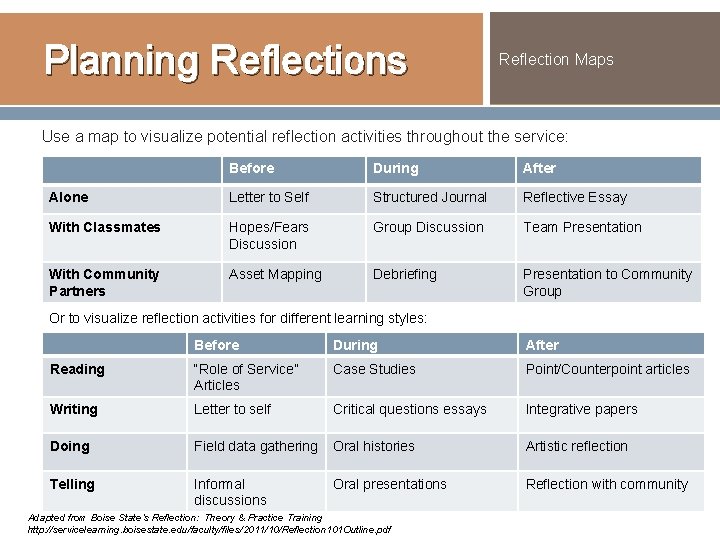
Planning Reflections Reflection Maps Use a map to visualize potential reflection activities throughout the service: Before During After Alone Letter to Self Structured Journal Reflective Essay With Classmates Hopes/Fears Discussion Group Discussion Team Presentation With Community Partners Asset Mapping Debriefing Presentation to Community Group Or to visualize reflection activities for different learning styles: Before During After Reading “Role of Service” Articles Case Studies Point/Counterpoint articles Writing Letter to self Critical questions essays Integrative papers Doing Field data gathering Oral histories Artistic reflection Telling Informal discussions Oral presentations Reflection with community Adapted from Boise State’s Reflection: Theory & Practice Training http: //servicelearning. boisestate. edu/faculty/files/2011/10/Reflection 101 Outline. pdf
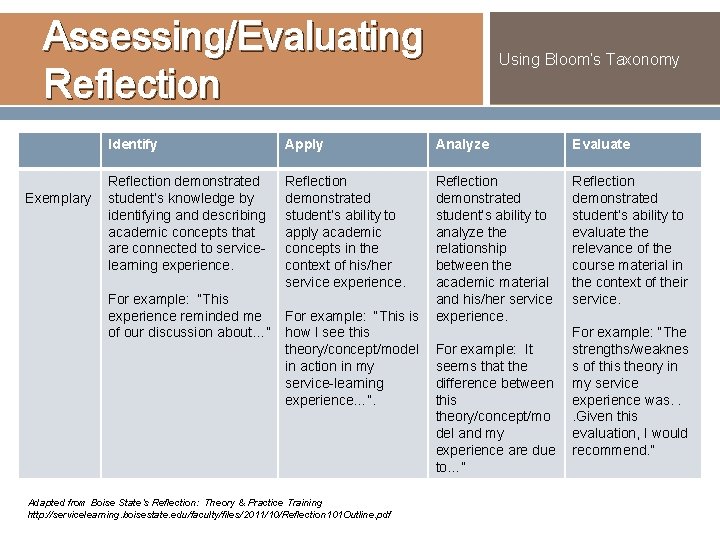
Assessing/Evaluating Reflection Exemplary Using Bloom’s Taxonomy Identify Apply Analyze Evaluate Reflection demonstrated student’s knowledge by identifying and describing academic concepts that are connected to servicelearning experience. Reflection demonstrated student’s ability to apply academic concepts in the context of his/her service experience. Reflection demonstrated student’s ability to analyze the relationship between the academic material and his/her service experience. Reflection demonstrated student’s ability to evaluate the relevance of the course material in the context of their service. For example: “This experience reminded me of our discussion about…” For example: “This is how I see this theory/concept/model in action in my service-learning experience…”. Adapted from Boise State’s Reflection: Theory & Practice Training http: //servicelearning. boisestate. edu/faculty/files/2011/10/Reflection 101 Outline. pdf For example: It seems that the difference between this theory/concept/mo del and my experience are due to…” For example: “The strengths/weaknes s of this theory in my service experience was. . . Given this evaluation, I would recommend. ”
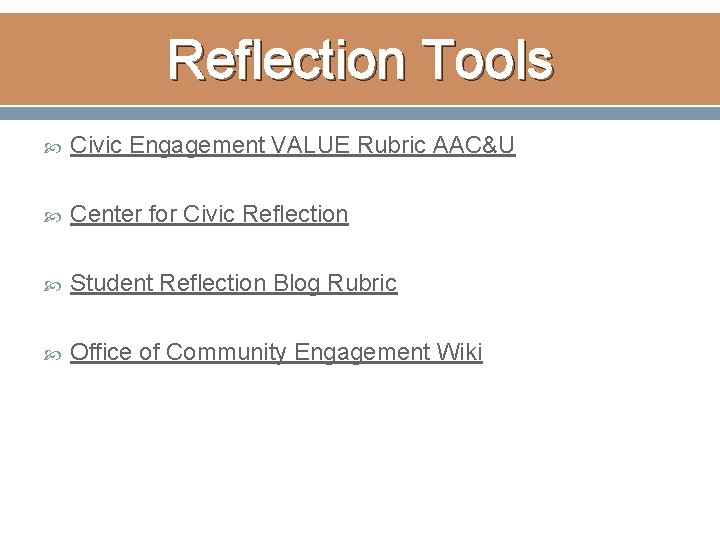
Reflection Tools Civic Engagement VALUE Rubric AAC&U Center for Civic Reflection Student Reflection Blog Rubric Office of Community Engagement Wiki