
Critical Reflection in social work practice My name
- Slides: 9
Critical Reflection in social work practice � � � My name is Adam Birchall I completed the social work programme at the University of Birmingham in 2008. I work now in Solihull as an Advanced Social Work Practitioner in a Children and Families Team. Prior to qualifying, I worked with homeless people with mental health issues and with children and families who were affected by drug use. Today, we will be using a case that I worked on around 2 years ago to complete an exercise that should demonstrate the process of critical reflection, and it’s importance for social work practice. …. . But first…. .
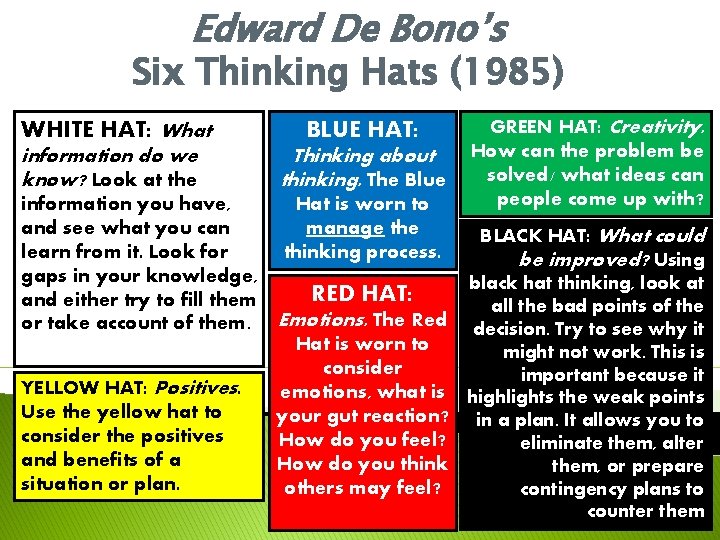
Edward De Bono’s Six Thinking Hats (1985) WHITE HAT: What BLUE HAT: information do we know? Look at the Thinking about thinking. The Blue information you have, and see what you can learn from it. Look for gaps in your knowledge, and either try to fill them or take account of them. Hat is worn to manage thinking process. YELLOW HAT: Positives. Use the yellow hat to consider the positives and benefits of a situation or plan. GREEN HAT: Creativity. How can the problem be solved/ what ideas can people come up with? BLACK HAT: What could be improved? Using black hat thinking, look at all the bad points of the Emotions. The Red decision. Try to see why it Hat is worn to might not work. This is consider important because it emotions, what is highlights the weak points your gut reaction? in a plan. It allows you to How do you feel? eliminate them, alter How do you think them, or prepare others may feel? contingency plans to counter them RED HAT:
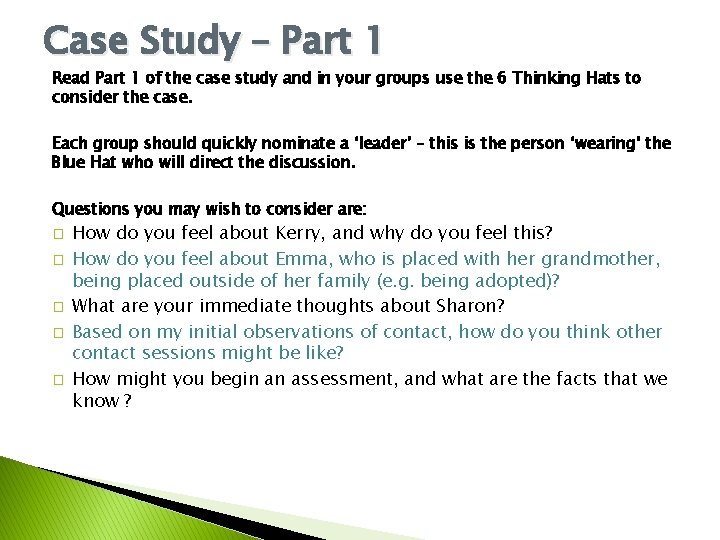
Case Study – Part 1 Read Part 1 of the case study and in your groups use the 6 Thinking Hats to consider the case. Each group should quickly nominate a ‘leader’ – this is the person ‘wearing’ the Blue Hat who will direct the discussion. Questions you may wish to consider are: � � � How do you feel about Kerry, and why do you feel this? How do you feel about Emma, who is placed with her grandmother, being placed outside of her family (e. g. being adopted)? What are your immediate thoughts about Sharon? Based on my initial observations of contact, how do you think other contact sessions might be like? How might you begin an assessment, and what are the facts that we know ?
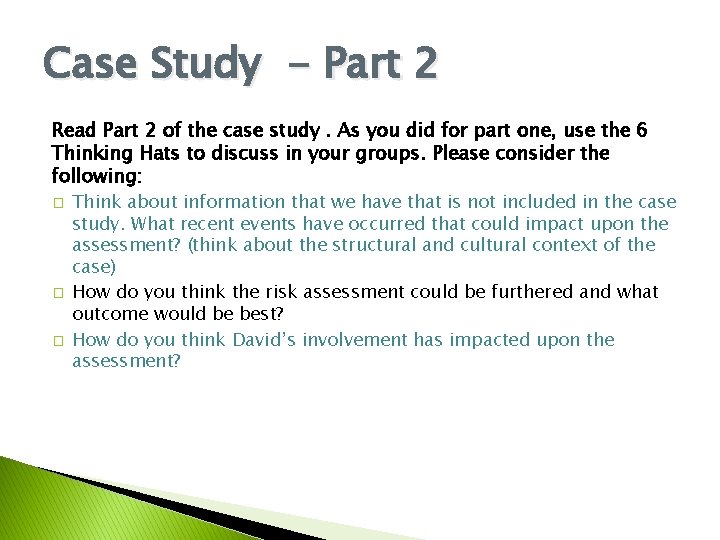
Case Study - Part 2 Read Part 2 of the case study. As you did for part one, use the 6 Thinking Hats to discuss in your groups. Please consider the following: � � � Think about information that we have that is not included in the case study. What recent events have occurred that could impact upon the assessment? (think about the structural and cultural context of the case) How do you think the risk assessment could be furthered and what outcome would be best? How do you think David’s involvement has impacted upon the assessment?
Context of Assessment Environmental and Political context � Economic crisis and austerity measures � Review of child protection � The assessment is completed in the wake of Peter Connolly’s death becoming national news. � Why are these factors important?
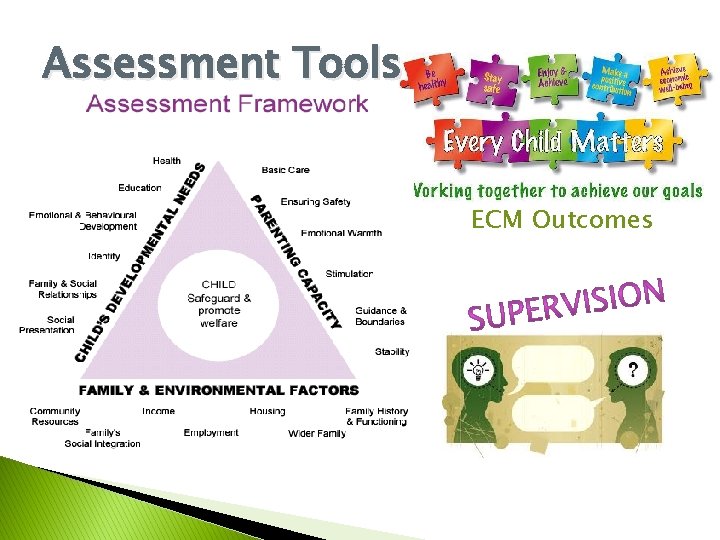
Assessment Tools ECM Outcomes
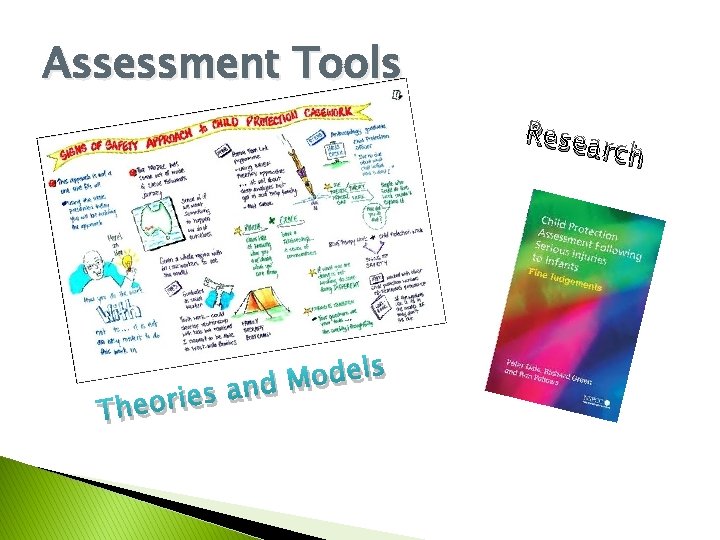
Assessment Tools Resea rch s l e d o M d n a s e i r o e h T
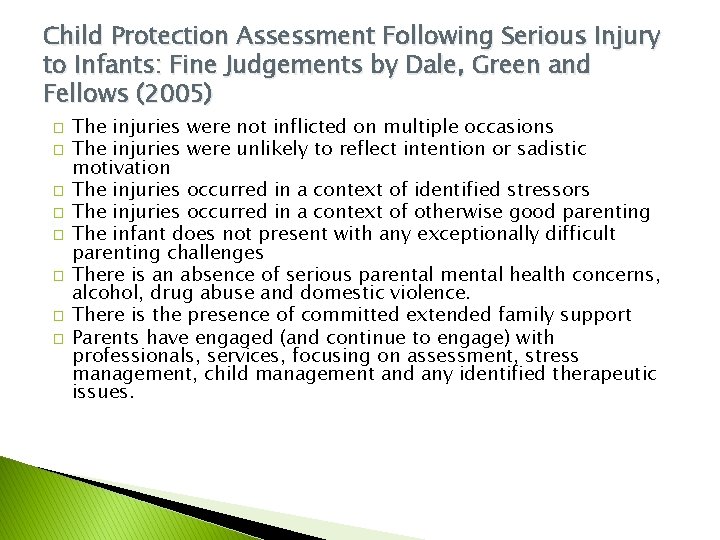
Child Protection Assessment Following Serious Injury to Infants: Fine Judgements by Dale, Green and Fellows (2005) � � � � The injuries were not inflicted on multiple occasions The injuries were unlikely to reflect intention or sadistic motivation The injuries occurred in a context of identified stressors The injuries occurred in a context of otherwise good parenting The infant does not present with any exceptionally difficult parenting challenges There is an absence of serious parental mental health concerns, alcohol, drug abuse and domestic violence. There is the presence of committed extended family support Parents have engaged (and continue to engage) with professionals, services, focusing on assessment, stress management, child management and any identified therapeutic issues.
Final Task - Brainstorm activity � In your groups, think about the barriers and impediments to critical reflection taking place. � Try to consider personal, environmental and structural barriers and what could be done to overcome these barriers