
Critical issues in spoken corpus development the Spoken
- Slides: 27
Critical issues in spoken corpus development: the Spoken BNC 2014 transcription scheme Robbie Love Centre for Corpus Approaches to Social Science, Lancaster University @lovermob
Today’s talk • The Spoken BNC 2014 • Transcription scheme development • Comparison between the original and the new @lovermob http: //cass. lancs. ac. uk 2
Why make a new one now? @lovermob http: //cass. lancs. ac. uk 3
Why make a new one now? • It’s getting old • Can no longer be used as a proxy for present day British English • Nothing since the Spoken BNC (1994): - large size - general coverage of spoken British English - (low or no cost) public access - transcribed @lovermob http: //cass. lancs. ac. uk 4
Why make a new one now? • Language has very likely changed during this time – lexical innovations, etc. • Grammar too - Geoff Leech’s work on modality (2003) shows that change can happen quickly • Two decade comparison (1990 s-2010 s) never been done before • Mystery – we don’t know how else things have changed – let’s find out @lovermob http: //cass. lancs. ac. uk 5
The Spoken BNC 2014 • Cambridge University Press started work • Lancaster joined in and formalised as BNC • 10 million words spontaneous conversation • Smartphones (vs. tape recorders) • Non-surreptitious! @lovermob http: //cass. lancs. ac. uk 6
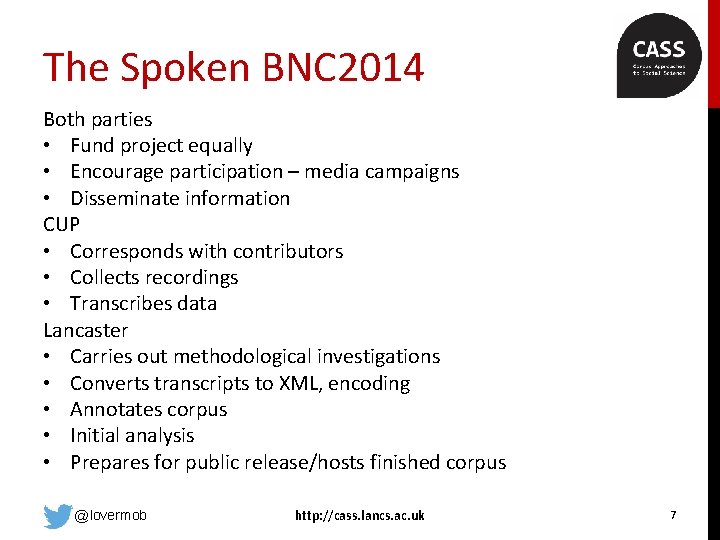
The Spoken BNC 2014 Both parties • Fund project equally • Encourage participation – media campaigns • Disseminate information CUP • Corresponds with contributors • Collects recordings • Transcribes data Lancaster • Carries out methodological investigations • Converts transcripts to XML, encoding • Annotates corpus • Initial analysis • Prepares for public release/hosts finished corpus @lovermob http: //cass. lancs. ac. uk 7
Transcription scheme development • Cambridge already had a scheme for their privately hosted spoken corpora • We worked together to refine and improve this existing work • Reviewed a range of sources, then decided upon crucial investigations to make • Recommendations reviewed and implemented to produce new Spoken BNC 2014 scheme @lovermob http: //cass. lancs. ac. uk 8
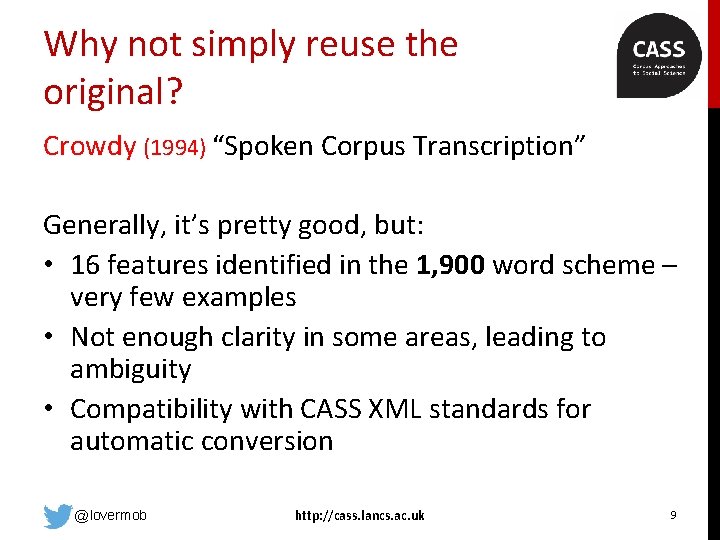
Why not simply reuse the original? Crowdy (1994) “Spoken Corpus Transcription” Generally, it’s pretty good, but: • 16 features identified in the 1, 900 word scheme – very few examples • Not enough clarity in some areas, leading to ambiguity • Compatibility with CASS XML standards for automatic conversion @lovermob http: //cass. lancs. ac. uk 9
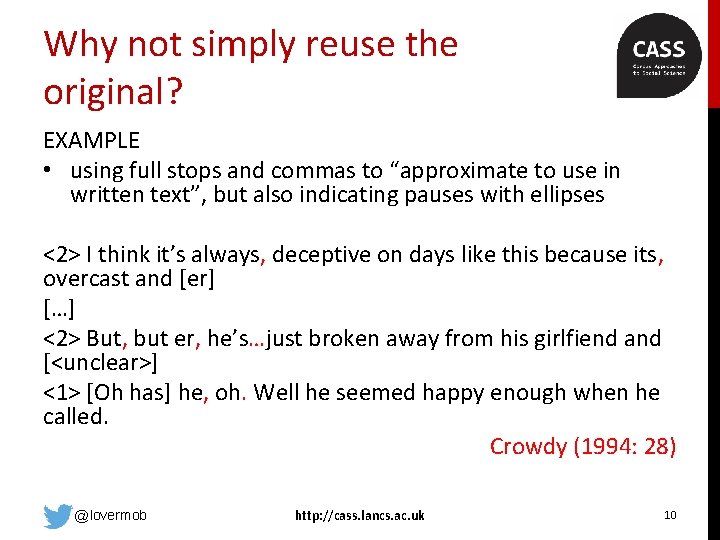
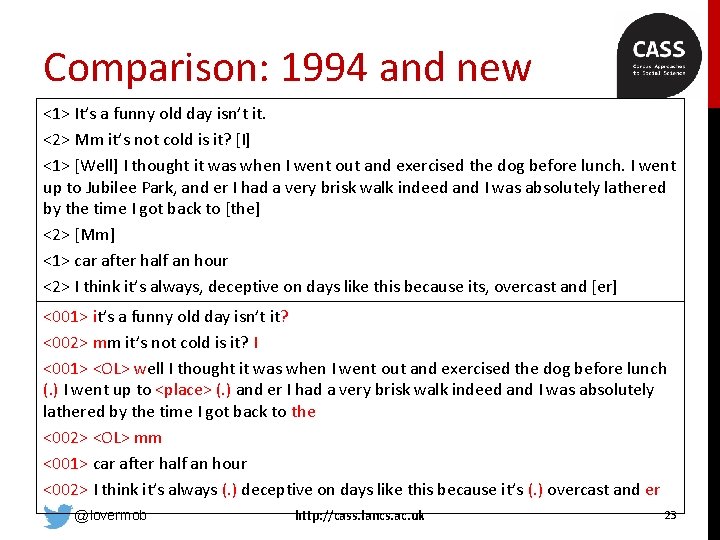
Why not simply reuse the original? EXAMPLE • using full stops and commas to “approximate to use in written text”, but also indicating pauses with ellipses <2> I think it’s always, deceptive on days like this because its, overcast and [er] […] <2> But, but er, he’s…just broken away from his girlfiend and [<unclear>] <1> [Oh has] he, oh. Well he seemed happy enough when he called. Crowdy (1994: 28) @lovermob http: //cass. lancs. ac. uk 10
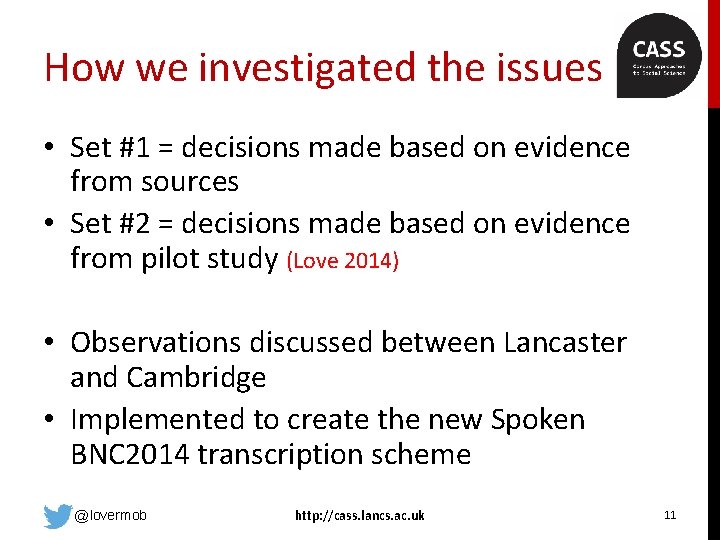
How we investigated the issues • Set #1 = decisions made based on evidence from sources • Set #2 = decisions made based on evidence from pilot study (Love 2014) • Observations discussed between Lancaster and Cambridge • Implemented to create the new Spoken BNC 2014 transcription scheme @lovermob http: //cass. lancs. ac. uk 11
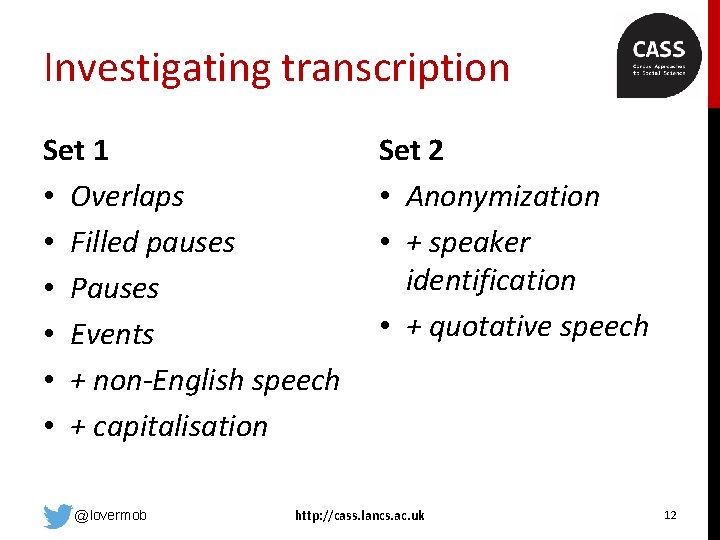
Investigating transcription Set 1 • Overlaps • Filled pauses • Pauses • Events • + non-English speech • + capitalisation @lovermob Set 2 • Anonymization • + speaker identification • + quotative speech http: //cass. lancs. ac. uk 12
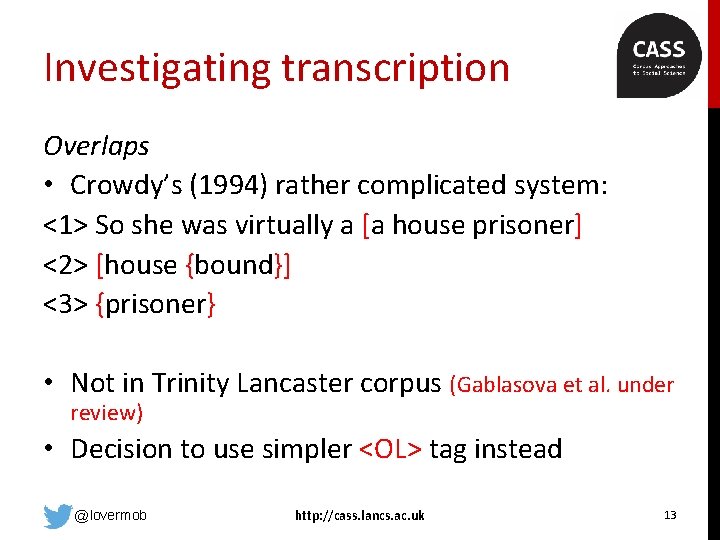
Investigating transcription Overlaps • Crowdy’s (1994) rather complicated system: <1> So she was virtually a [a house prisoner] <2> [house {bound}] <3> {prisoner} • Not in Trinity Lancaster corpus (Gablasova et al. under review) • Decision to use simpler <OL> tag instead @lovermob http: //cass. lancs. ac. uk 13
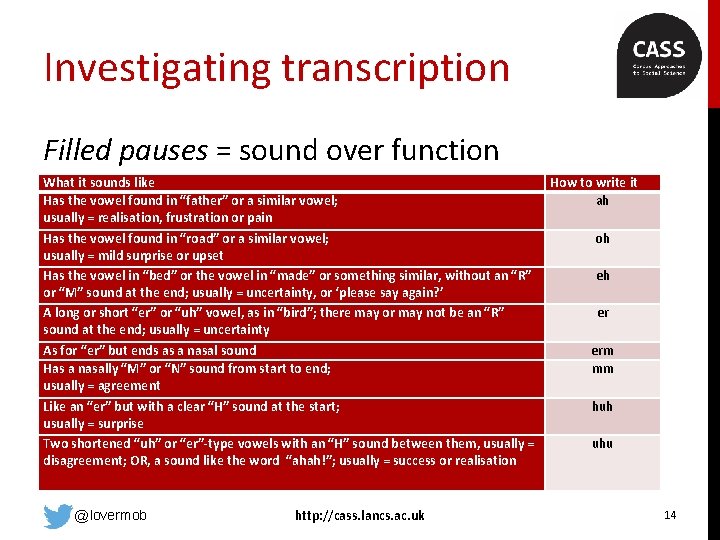
Investigating transcription Filled pauses = sound over function What it sounds like Has the vowel found in “father” or a similar vowel; usually = realisation, frustration or pain Has the vowel found in “road” or a similar vowel; usually = mild surprise or upset Has the vowel in “bed” or the vowel in “made” or something similar, without an “R” or “M” sound at the end; usually = uncertainty, or ‘please say again? ’ A long or short “er” or “uh” vowel, as in “bird”; there may or may not be an “R” sound at the end; usually = uncertainty As for “er” but ends as a nasal sound Has a nasally “M” or “N” sound from start to end; usually = agreement Like an “er” but with a clear “H” sound at the start; usually = surprise Two shortened “uh” or “er”-type vowels with an “H” sound between them, usually = disagreement; OR, a sound like the word “ahah!”; usually = success or realisation @lovermob http: //cass. lancs. ac. uk How to write it ah oh eh er erm mm huh uhu 14
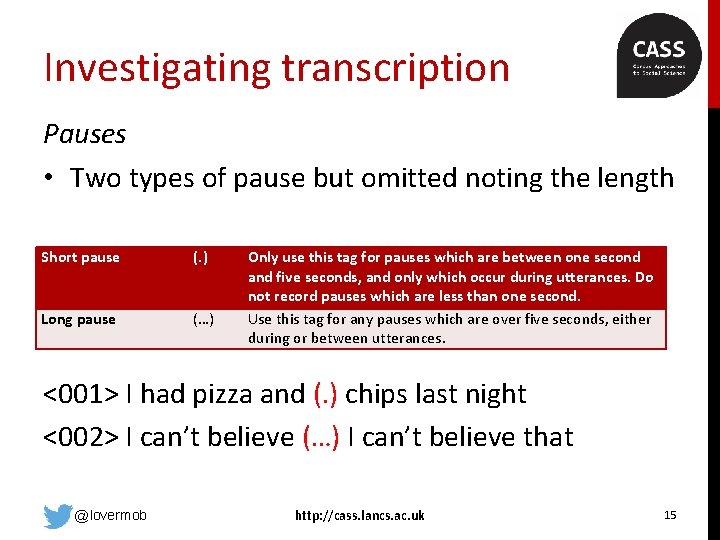
Investigating transcription Pauses • Two types of pause but omitted noting the length Short pause (. ) Long pause (…) Only use this tag for pauses which are between one second and five seconds, and only which occur during utterances. Do not record pauses which are less than one second. Use this tag for any pauses which are over five seconds, either during or between utterances. <001> I had pizza and (. ) chips last night <002> I can’t believe (…) I can’t believe that @lovermob http: //cass. lancs. ac. uk 15
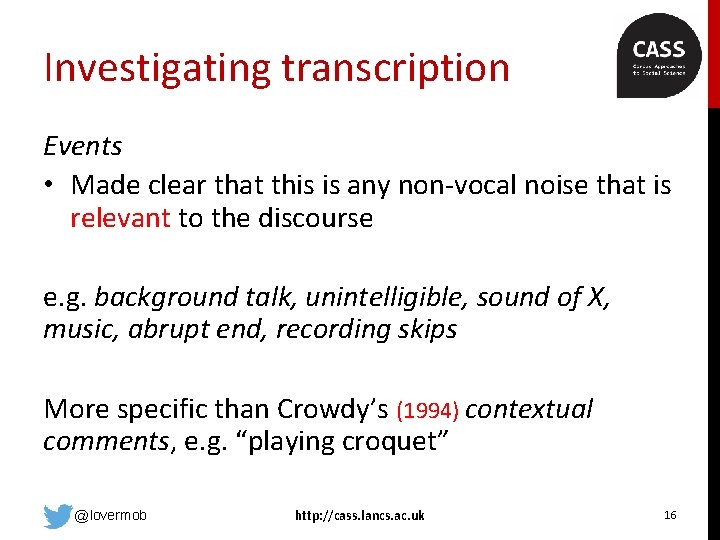
Investigating transcription Events • Made clear that this is any non-vocal noise that is relevant to the discourse e. g. background talk, unintelligible, sound of X, music, abrupt end, recording skips More specific than Crowdy’s (1994) contextual comments, e. g. “playing croquet” @lovermob http: //cass. lancs. ac. uk 16
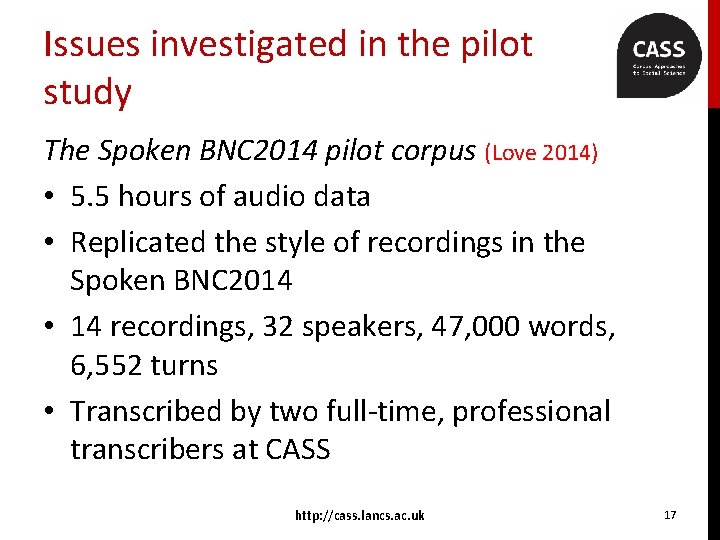
Issues investigated in the pilot study The Spoken BNC 2014 pilot corpus (Love 2014) • 5. 5 hours of audio data • Replicated the style of recordings in the Spoken BNC 2014 • 14 recordings, 32 speakers, 47, 000 words, 6, 552 turns • Transcribed by two full-time, professional transcribers at CASS http: //cass. lancs. ac. uk 17
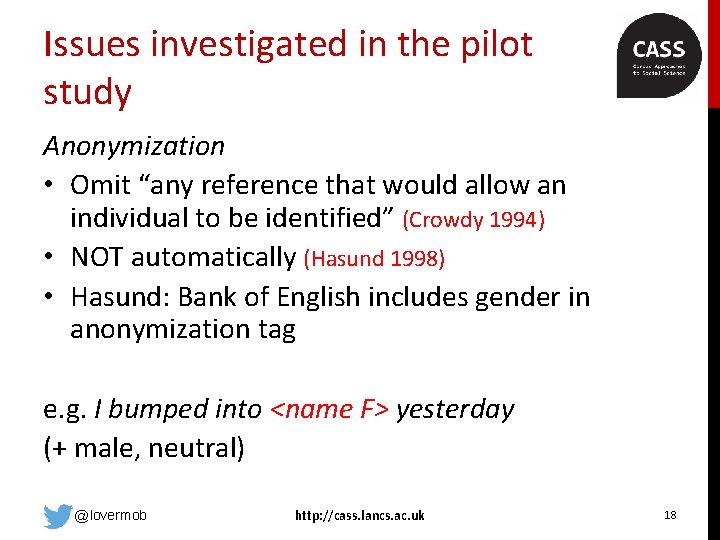
Issues investigated in the pilot study Anonymization • Omit “any reference that would allow an individual to be identified” (Crowdy 1994) • NOT automatically (Hasund 1998) • Hasund: Bank of English includes gender in anonymization tag e. g. I bumped into <name F> yesterday (+ male, neutral) @lovermob http: //cass. lancs. ac. uk 18
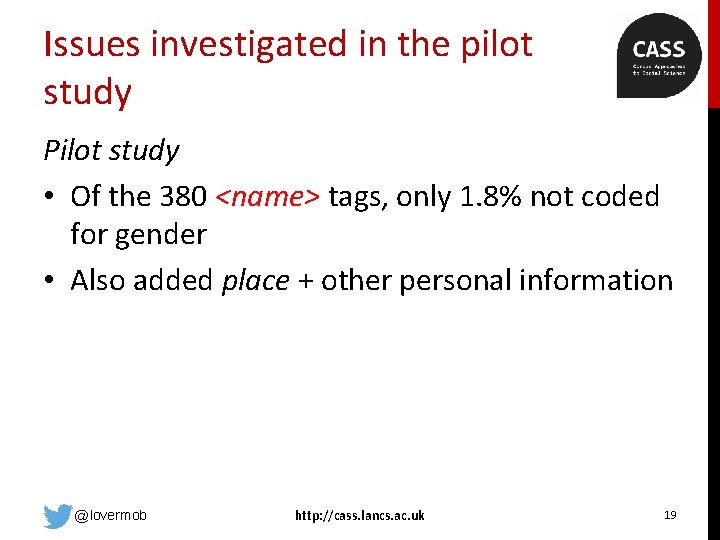
Issues investigated in the pilot study Pilot study • Of the 380 <name> tags, only 1. 8% not coded for gender • Also added place + other personal information @lovermob http: //cass. lancs. ac. uk 19
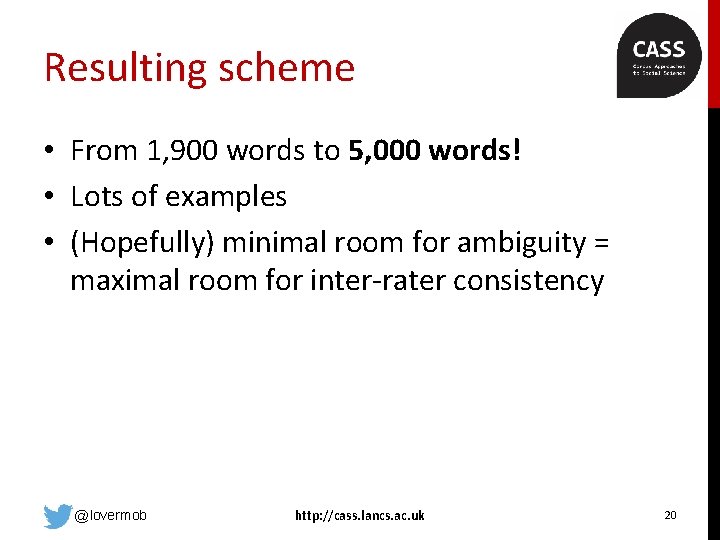
Resulting scheme • From 1, 900 words to 5, 000 words! • Lots of examples • (Hopefully) minimal room for ambiguity = maximal room for inter-rater consistency @lovermob http: //cass. lancs. ac. uk 20
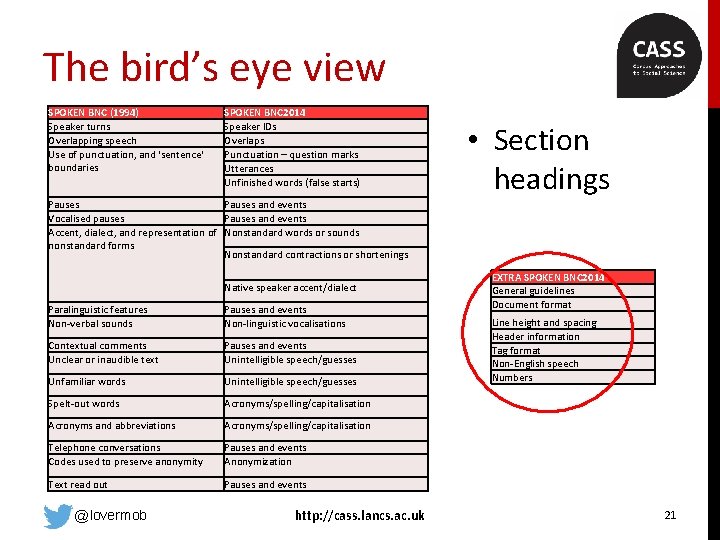
The bird’s eye view SPOKEN BNC (1994) Speaker turns Overlapping speech Use of punctuation, and 'sentence' boundaries SPOKEN BNC 2014 Speaker IDs Overlaps Punctuation – question marks Utterances Unfinished words (false starts) • Section headings Pauses and events Vocalised pauses Pauses and events Accent, dialect, and representation of Nonstandard words or sounds nonstandard forms Nonstandard contractions or shortenings Native speaker accent/dialect Paralinguistic features Non-verbal sounds Pauses and events Non-linguistic vocalisations Contextual comments Unclear or inaudible text Pauses and events Unintelligible speech/guesses Unfamiliar words Unintelligible speech/guesses Spelt-out words Acronyms/spelling/capitalisation Acronyms and abbreviations Acronyms/spelling/capitalisation Telephone conversations Codes used to preserve anonymity Pauses and events Anonymization Text read out Pauses and events @lovermob http: //cass. lancs. ac. uk EXTRA SPOKEN BNC 2014 General guidelines Document format Line height and spacing Header information Tag format Non-English speech Numbers 21
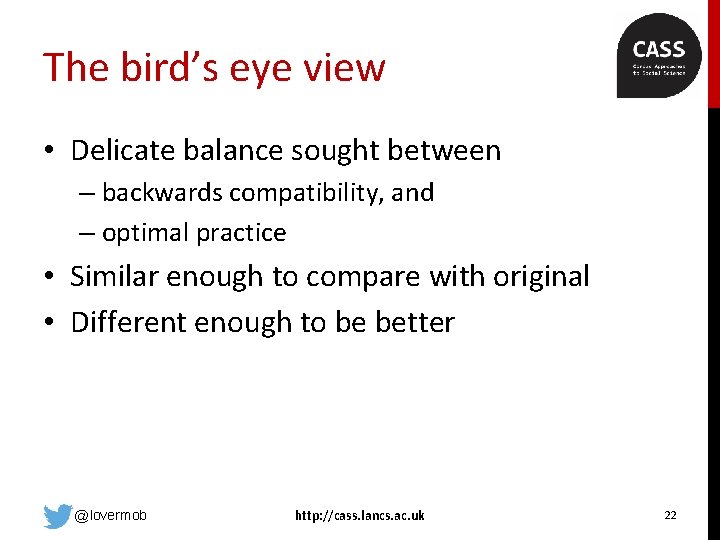
The bird’s eye view • Delicate balance sought between – backwards compatibility, and – optimal practice • Similar enough to compare with original • Different enough to be better @lovermob http: //cass. lancs. ac. uk 22
Comparison: 1994 and new <1> It’s a funny old day isn’t it. <2> Mm it’s not cold is it? [I] <1> [Well] I thought it was when I went out and exercised the dog before lunch. I went up to Jubilee Park, and er I had a very brisk walk indeed and I was absolutely lathered by the time I got back to [the] <2> [Mm] <1> car after half an hour <2> I think it’s always, deceptive on days like this because its, overcast and [er] <001> it’s a funny old day isn’t it? <002> mm it’s not cold is it? I <001> <OL> well I thought it was when I went out and exercised the dog before lunch (. ) I went up to <place> (. ) and er I had a very brisk walk indeed and I was absolutely lathered by the time I got back to the <002> <OL> mm <001> car after half an hour <002> I think it’s always (. ) deceptive on days like this because it’s (. ) overcast and er @lovermob http: //cass. lancs. ac. uk 23
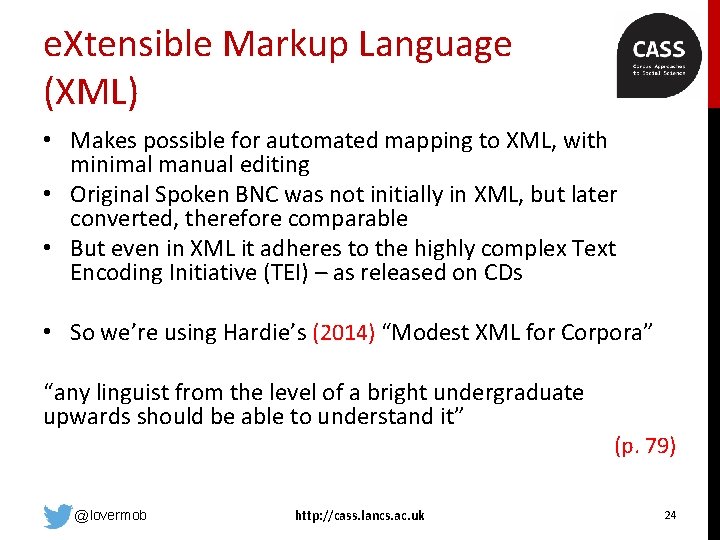
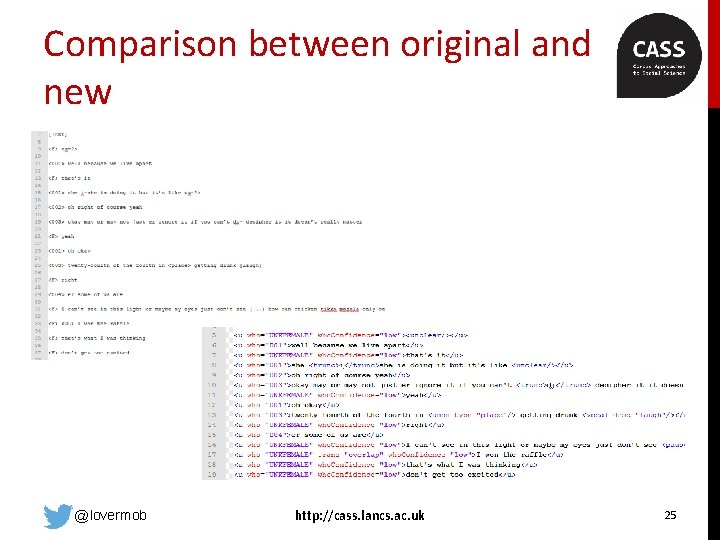
e. Xtensible Markup Language (XML) • Makes possible for automated mapping to XML, with minimal manual editing • Original Spoken BNC was not initially in XML, but later converted, therefore comparable • But even in XML it adheres to the highly complex Text Encoding Initiative (TEI) – as released on CDs • So we’re using Hardie’s (2014) “Modest XML for Corpora” “any linguist from the level of a bright undergraduate upwards should be able to understand it” @lovermob http: //cass. lancs. ac. uk (p. 79) 24
Comparison between original and new @lovermob http: //cass. lancs. ac. uk 25
References • • Crowdy, S. (1994). Spoken Corpus Transcription. Literary and Linguistic Computing, 9(1), 2528. Gablasova, D. , Brezina, V. , Mc. Enery, T. & Boyd, E. (under review) Epistemic stance in spoken L 2 English: The effect of task type and speaker style, submitted to Applied Linguistics. Hardie, A. (2014). Modest XML for corpora: not a standard, but a suggestion. ICAME Journal, 38, 73 -103. Hasund, K. (1998). Protecting the innocent: The issue of informants' anonymity in the COLT corpus. In A. Renouf (Ed. ), Explorations in corpus linguistics (pp. 13 -28). Amsterdam: Rodopi. Leech, G. (1993). 100 million words of English Today, 9 -15. doi: 10. 1017/S 0266078400006854 Leech, G. (2003). Modals on the move: The English modal auxiliaries 1961– 1992. In R. Facchinetti, F. R. Palmer & M. Krug (Eds. ), Modality in Contemporary English. Berlin/New York: Mouton de Gruyter, 223– 240 Love, R. (2014). Methodological issues in the compilation of spoken corpora: the Spoken BNC 2014 pilot study. Lancaster University: unpublished Masters dissertation. @lovermob http: //cass. lancs. ac. uk 26
Thank you r. m. love@lancaster. ac. uk @lovermob http: //cass. lancs. ac. uk 27