
Critical Insects and Conservation Tillage in Oklahoma Conservation
- Slides: 31
Critical Insects and Conservation Tillage in Oklahoma Conservation Tillage 101, Enid, OK. February 8, 2006 Tom A. Royer Department of Entomology & Plant Pathology Oklahoma State University
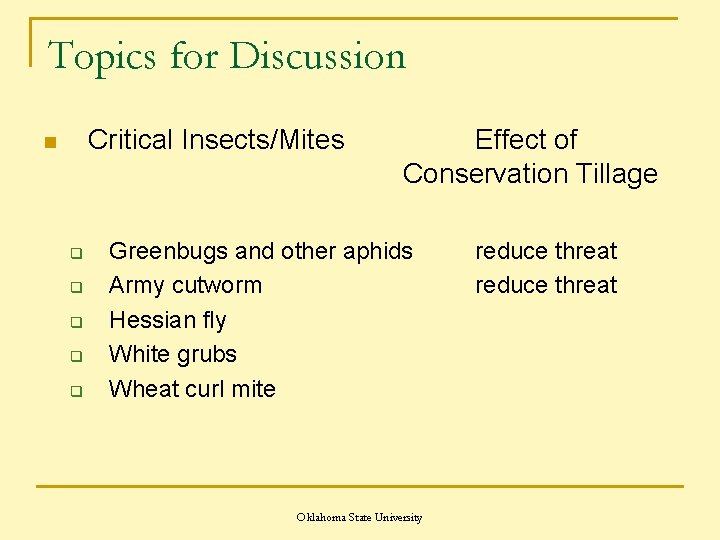
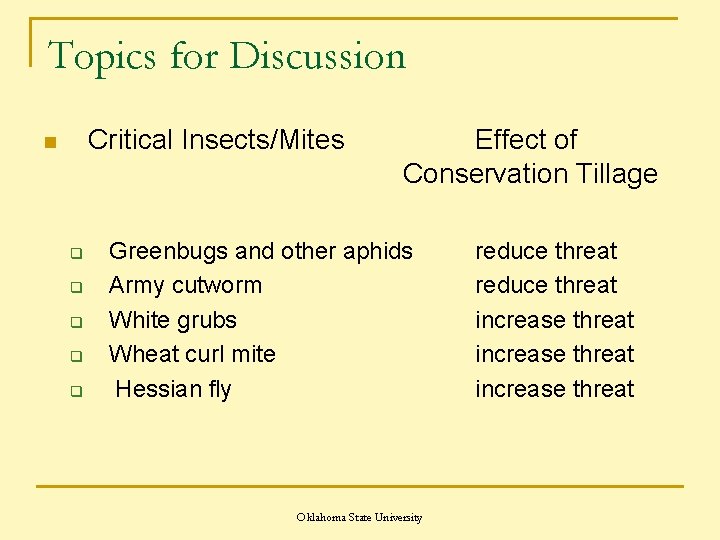
Topics for Discussion Critical Insects/Mites n q q q Effect of Conservation Tillage Greenbugs and other aphids Army cutworm White grubs Wheat curl mite Hessian fly Oklahoma State University
Topics for Discussion General lifecycle Management Tools n n Effects of tillage on pest Cultural Controls q q n n n q Rotations Planting date Resistant varieties Insecticides Oklahoma State University
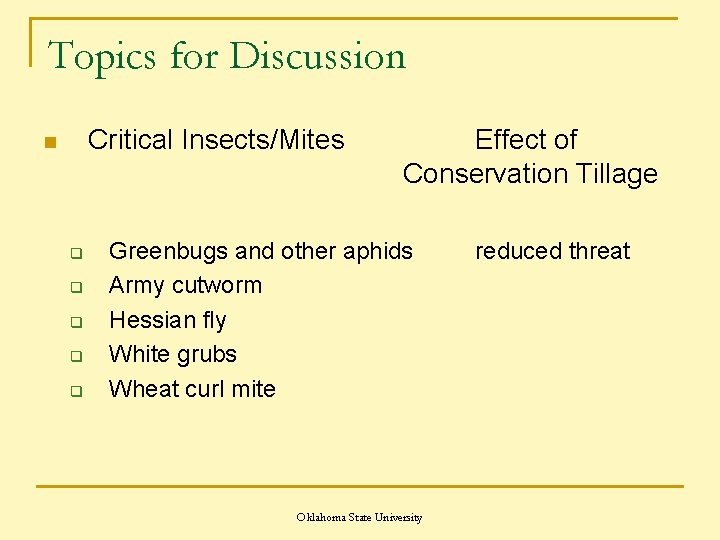
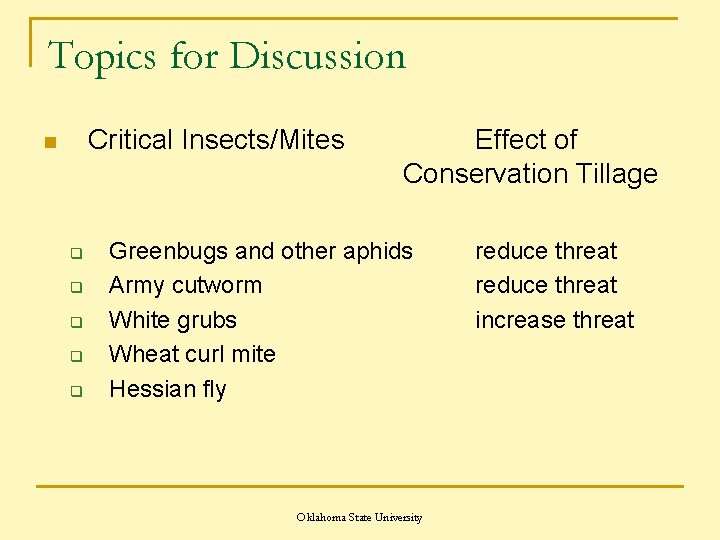
Topics for Discussion Critical Insects/Mites n q q q Effect of Conservation Tillage Greenbugs and other aphids Army cutworm Hessian fly White grubs Wheat curl mite Oklahoma State University reduced threat
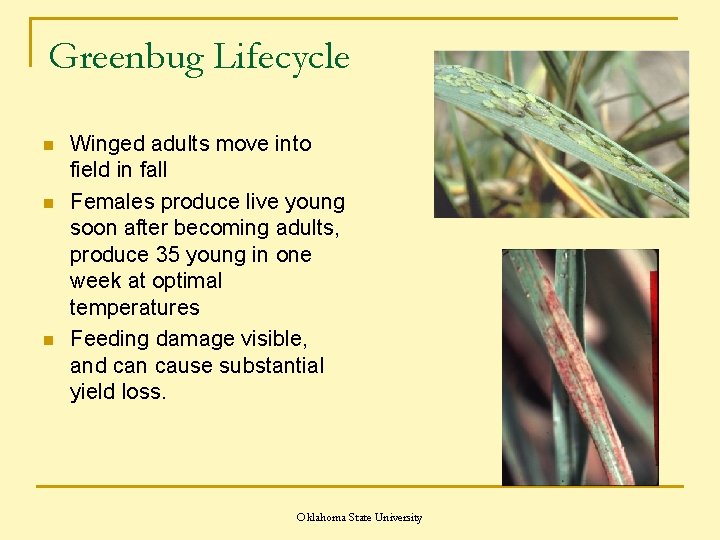
Greenbug Lifecycle n n n Winged adults move into field in fall Females produce live young soon after becoming adults, produce 35 young in one week at optimal temperatures Feeding damage visible, and can cause substantial yield loss. Oklahoma State University
Greenbug Management Tools for Greenbug Management n Tillage q n conservation tillage will likely help reduce colonization and survival of greenbug Crop rotation q n Rotation to non-host crops does not directly affect greenbugs Planting Date q n Has some influence on greenbug outbreaks, limits fall window of migration, however mild falls can “open” window. Resistant varieties q n Greenbug resistance is available Oklahoma State University
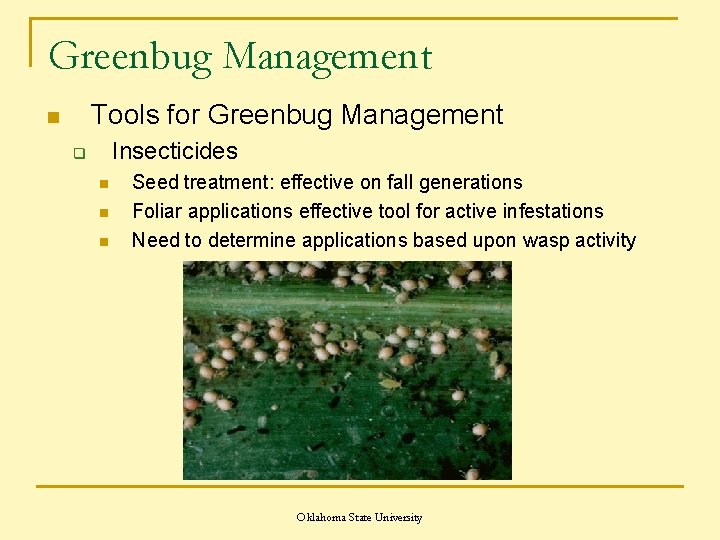
Greenbug Management Tools for Greenbug Management n Insecticides q n n n Seed treatment: effective on fall generations Foliar applications effective tool for active infestations Need to determine applications based upon wasp activity Oklahoma State University
Topics for Discussion Critical Insects/Mites n q q q Effect of Conservation Tillage Greenbugs and other aphids Army cutworm Hessian fly White grubs Wheat curl mite Oklahoma State University reduce threat
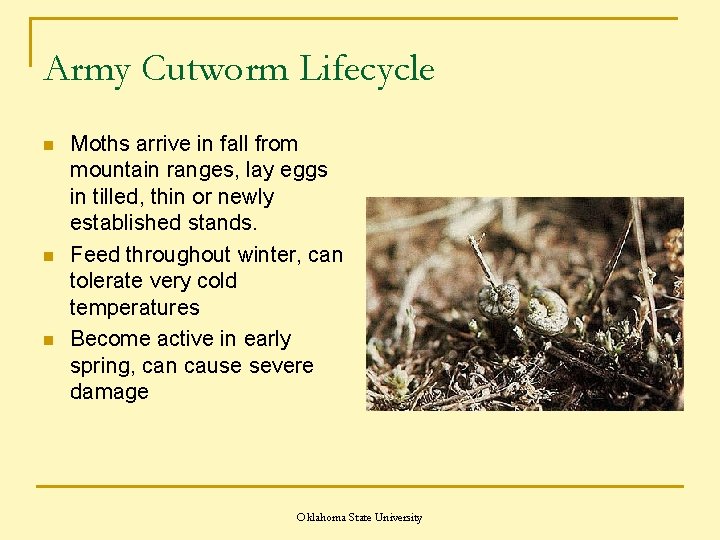
Army Cutworm Lifecycle n n n Moths arrive in fall from mountain ranges, lay eggs in tilled, thin or newly established stands. Feed throughout winter, can tolerate very cold temperatures Become active in early spring, can cause severe damage Oklahoma State University
Army Cutworm Management Tools for Army Cutworm Management n Tillage q n conservation tillage will likely help reduce colonization and survival of army cutworm Crop rotation q n Rotation to non-host crops does not directly affect army cutworm Planting Date q n Won’t greatly influence army cutworm outbreaks Resistant varieties q n Army cutworm resistance is not useful Oklahoma State University
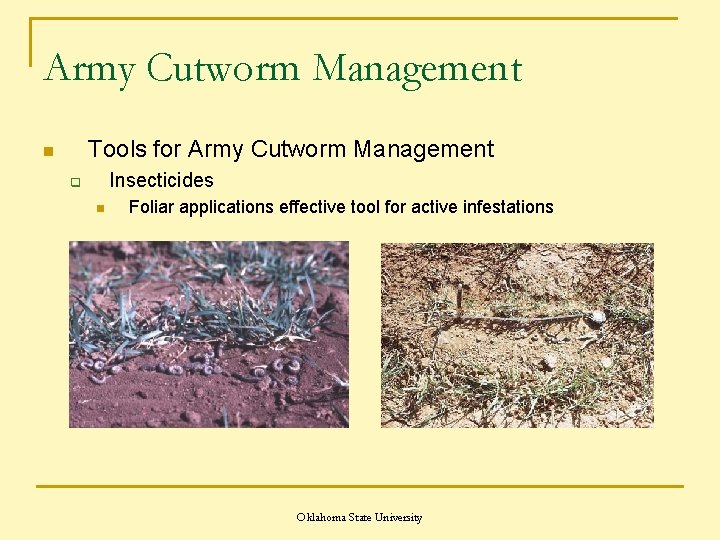
Army Cutworm Management Tools for Army Cutworm Management n Insecticides q n Foliar applications effective tool for active infestations Oklahoma State University
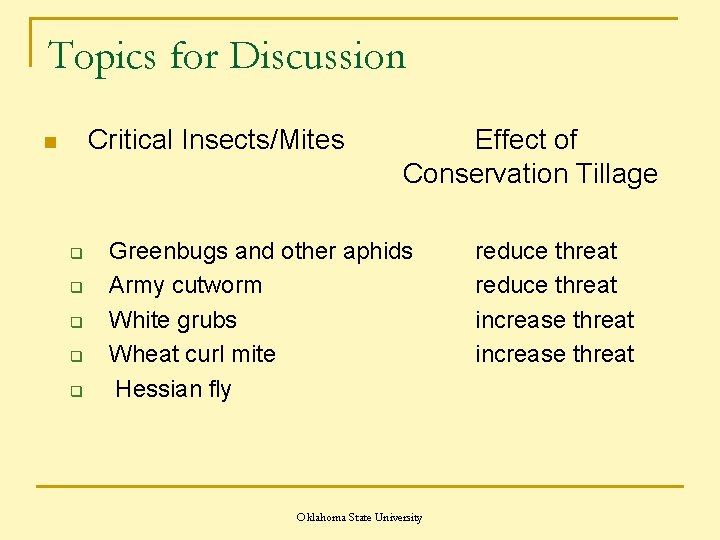
Topics for Discussion Critical Insects/Mites n q q q Effect of Conservation Tillage Greenbugs and other aphids Army cutworm White grubs Wheat curl mite Hessian fly Oklahoma State University reduce threat increase threat
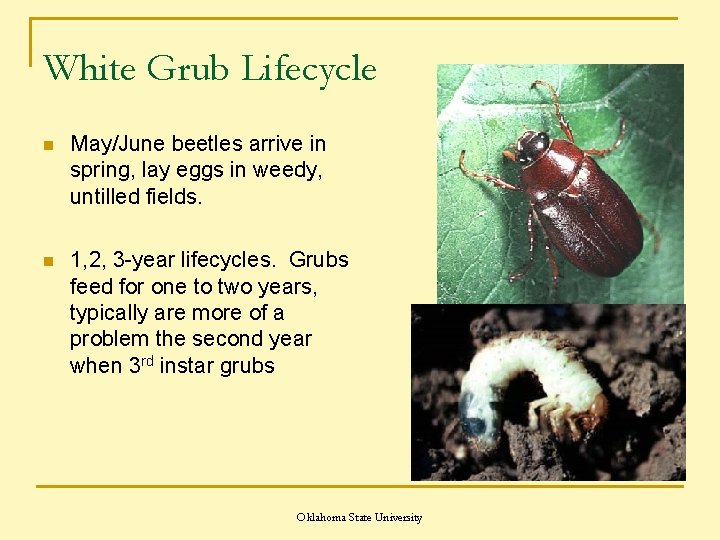
White Grub Lifecycle n May/June beetles arrive in spring, lay eggs in weedy, untilled fields. n 1, 2, 3 -year lifecycles. Grubs feed for one to two years, typically are more of a problem the second year when 3 rd instar grubs Oklahoma State University
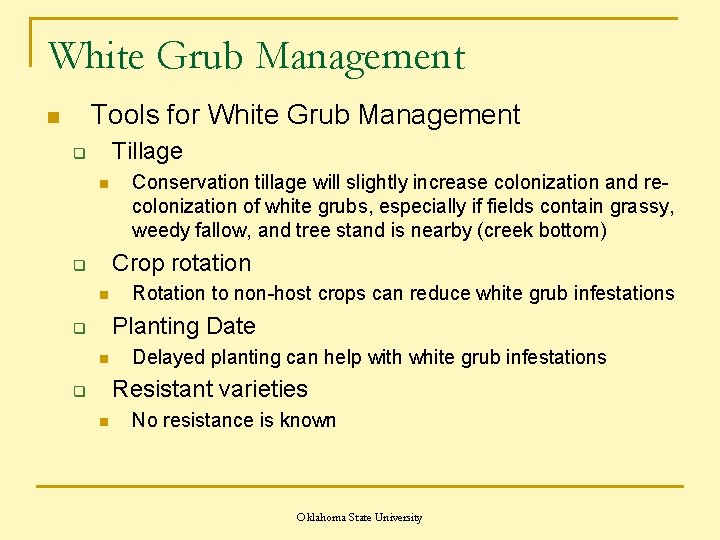
White Grub Management Tools for White Grub Management n Tillage q n Conservation tillage will slightly increase colonization and recolonization of white grubs, especially if fields contain grassy, weedy fallow, and tree stand is nearby (creek bottom) Crop rotation q n Rotation to non-host crops can reduce white grub infestations Planting Date q n Delayed planting can help with white grub infestations Resistant varieties q n No resistance is known Oklahoma State University
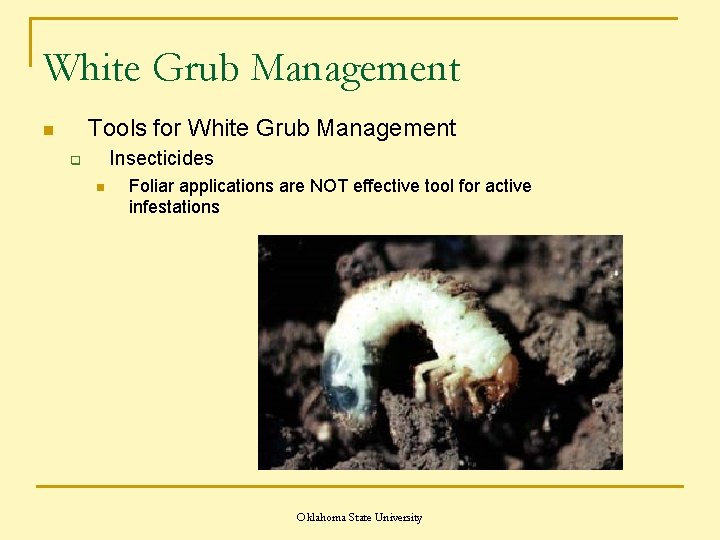
White Grub Management Tools for White Grub Management n Insecticides q n Foliar applications are NOT effective tool for active infestations Oklahoma State University
Topics for Discussion Critical Insects/Mites n q q q Effect of Conservation Tillage Greenbugs and other aphids Army cutworm White grubs Wheat curl mite Hessian fly Oklahoma State University reduce threat increase threat
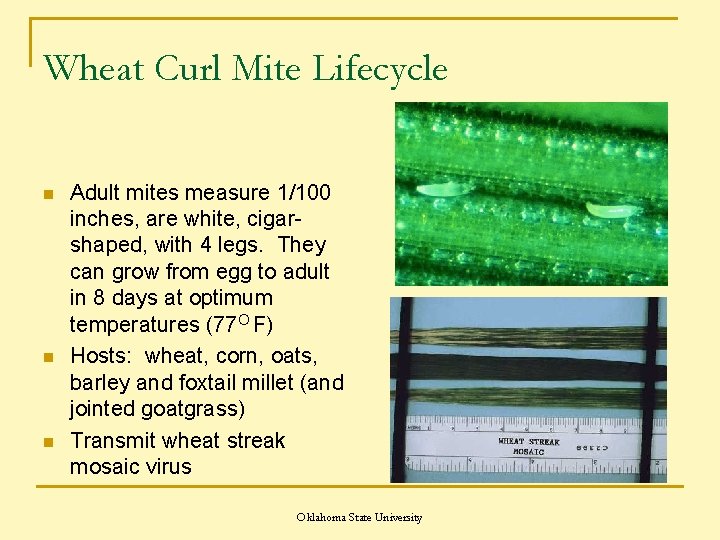
Wheat Curl Mite Lifecycle n n n Adult mites measure 1/100 inches, are white, cigarshaped, with 4 legs. They can grow from egg to adult in 8 days at optimum temperatures (77 O F) Hosts: wheat, corn, oats, barley and foxtail millet (and jointed goatgrass) Transmit wheat streak mosaic virus Oklahoma State University
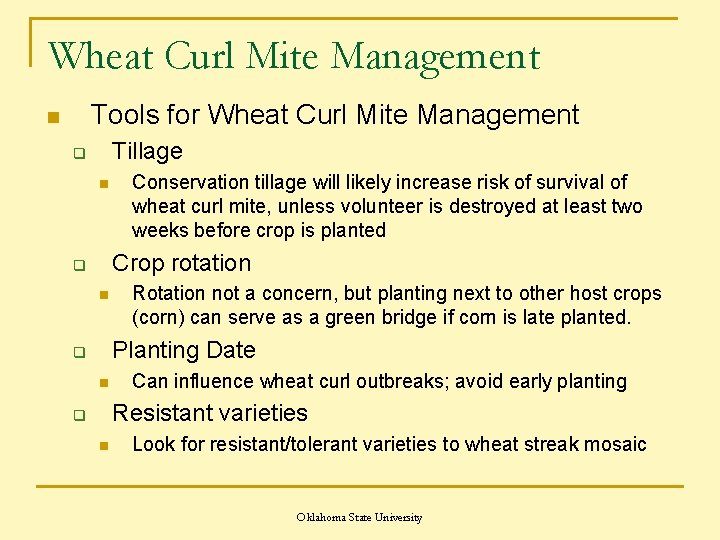
Wheat Curl Mite Management Tools for Wheat Curl Mite Management n Tillage q n Conservation tillage will likely increase risk of survival of wheat curl mite, unless volunteer is destroyed at least two weeks before crop is planted Crop rotation q n Rotation not a concern, but planting next to other host crops (corn) can serve as a green bridge if corn is late planted. Planting Date q n Can influence wheat curl outbreaks; avoid early planting Resistant varieties q n Look for resistant/tolerant varieties to wheat streak mosaic Oklahoma State University
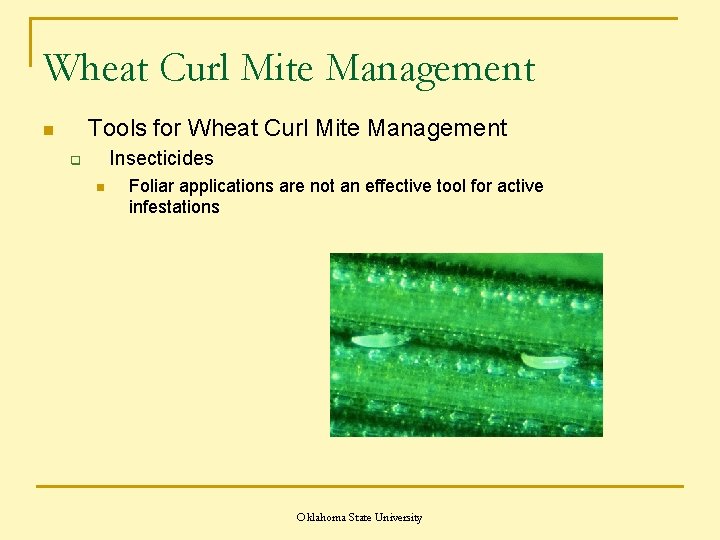
Wheat Curl Mite Management Tools for Wheat Curl Mite Management n Insecticides q n Foliar applications are not an effective tool for active infestations Oklahoma State University
Topics for Discussion Critical Insects/Mites n q q q Effect of Conservation Tillage Greenbugs and other aphids Army cutworm White grubs Wheat curl mite Hessian fly Oklahoma State University reduce threat increase threat
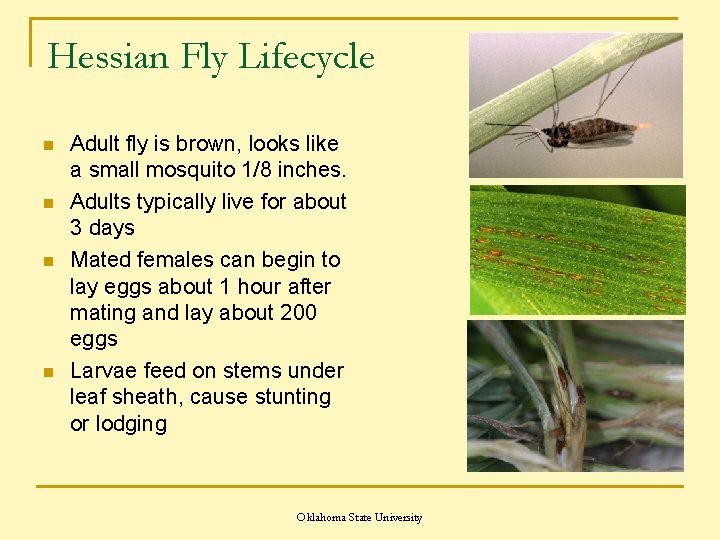
Hessian Fly Lifecycle n n Adult fly is brown, looks like a small mosquito 1/8 inches. Adults typically live for about 3 days Mated females can begin to lay eggs about 1 hour after mating and lay about 200 eggs Larvae feed on stems under leaf sheath, cause stunting or lodging Oklahoma State University
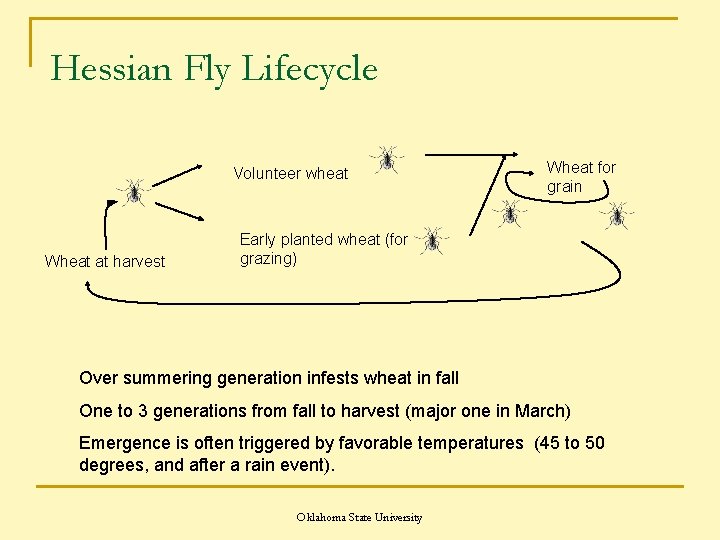
Hessian Fly Lifecycle Volunteer wheat Wheat at harvest Wheat for grain Early planted wheat (for grazing) Over summering generation infests wheat in fall One to 3 generations from fall to harvest (major one in March) Emergence is often triggered by favorable temperatures (45 to 50 degrees, and after a rain event). Oklahoma State University
Hessian Fly Management Tools for Hessian fly Management n Tillage q n conservation tillage will likely allow increased survival of Hessian fly Crop rotation q n Rotation to non-host crops can reduce populations Delayed planting q n important tool for reducing H. fly infestations, especially in north Resistant varieties q n Important, need to know predominant races of H. fly Oklahoma State University
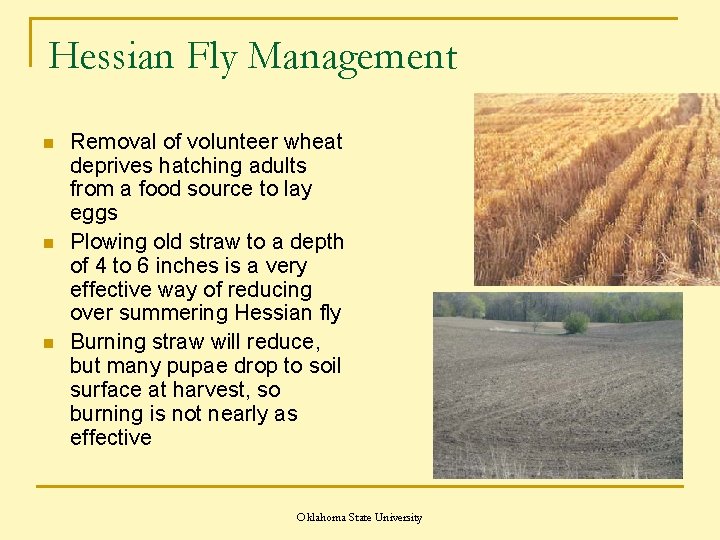
Hessian Fly Management n n n Removal of volunteer wheat deprives hatching adults from a food source to lay eggs Plowing old straw to a depth of 4 to 6 inches is a very effective way of reducing over summering Hessian fly Burning straw will reduce, but many pupae drop to soil surface at harvest, so burning is not nearly as effective Oklahoma State University
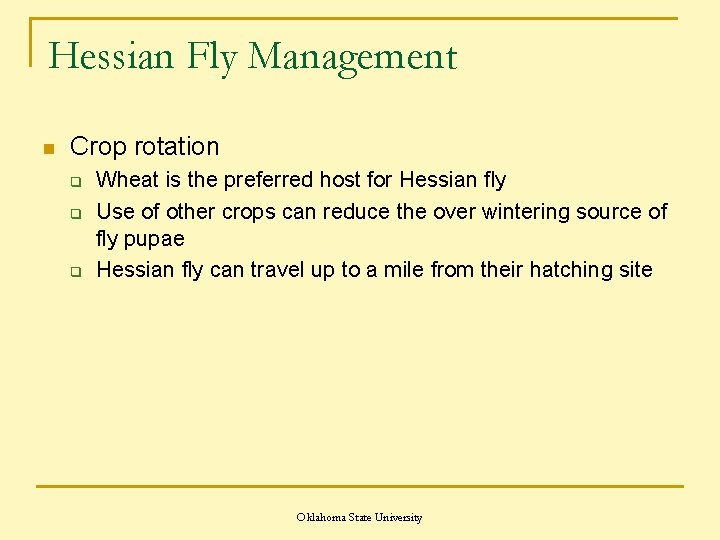
Hessian Fly Management n Crop rotation q q q Wheat is the preferred host for Hessian fly Use of other crops can reduce the over wintering source of fly pupae Hessian fly can travel up to a mile from their hatching site Oklahoma State University
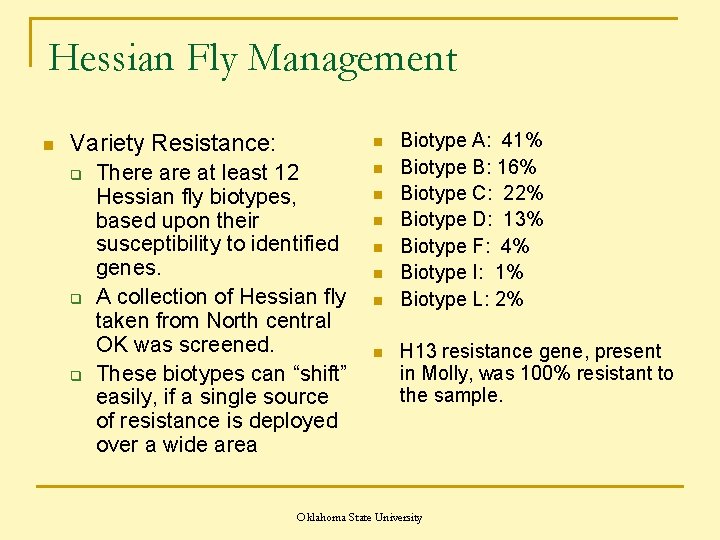
Hessian Fly Management n Variety Resistance: q q q n There at least 12 Hessian fly biotypes, based upon their susceptibility to identified genes. A collection of Hessian fly taken from North central OK was screened. These biotypes can “shift” easily, if a single source of resistance is deployed over a wide area n n n n Biotype A: 41% Biotype B: 16% Biotype C: 22% Biotype D: 13% Biotype F: 4% Biotype I: 1% Biotype L: 2% H 13 resistance gene, present in Molly, was 100% resistant to the sample. Oklahoma State University
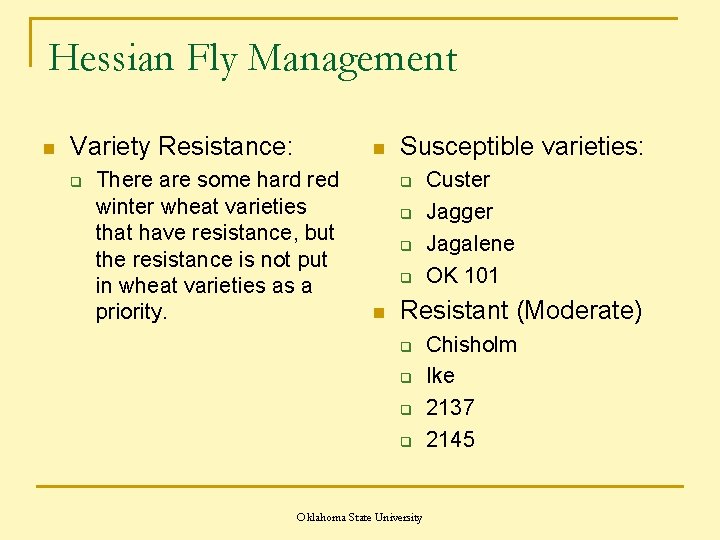
Hessian Fly Management n Variety Resistance: q n There are some hard red winter wheat varieties that have resistance, but the resistance is not put in wheat varieties as a priority. Susceptible varieties: q q n Custer Jagger Jagalene OK 101 Resistant (Moderate) q q Oklahoma State University Chisholm Ike 2137 2145
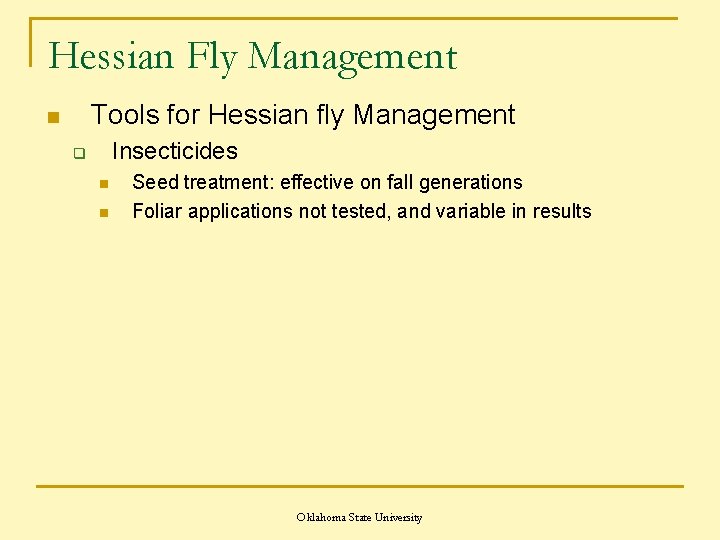
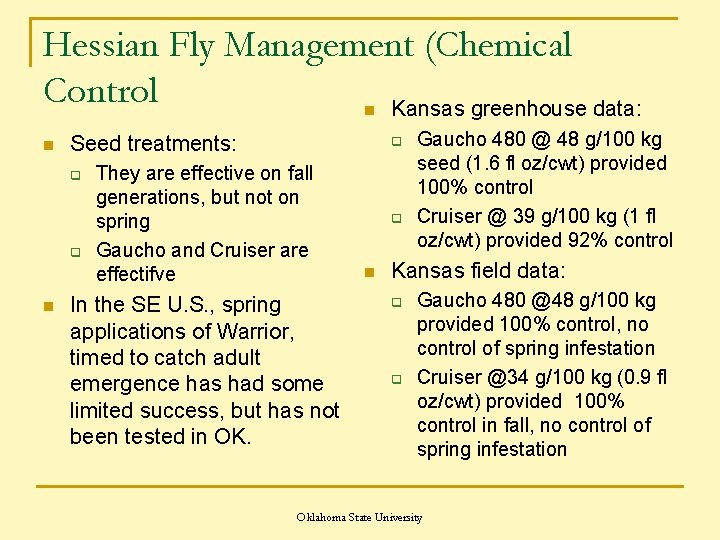
Hessian Fly Management Tools for Hessian fly Management n Insecticides q n n Seed treatment: effective on fall generations Foliar applications not tested, and variable in results Oklahoma State University
Hessian Fly Management (Chemical Control Kansas greenhouse data: n n Seed treatments: q q n q They are effective on fall generations, but not on spring Gaucho and Cruiser are effectifve In the SE U. S. , spring applications of Warrior, timed to catch adult emergence has had some limited success, but has not been tested in OK. q n Gaucho 480 @ 48 g/100 kg seed (1. 6 fl oz/cwt) provided 100% control Cruiser @ 39 g/100 kg (1 fl oz/cwt) provided 92% control Kansas field data: q q Gaucho 480 @48 g/100 kg provided 100% control, no control of spring infestation Cruiser @34 g/100 kg (0. 9 fl oz/cwt) provided 100% control in fall, no control of spring infestation Oklahoma State University
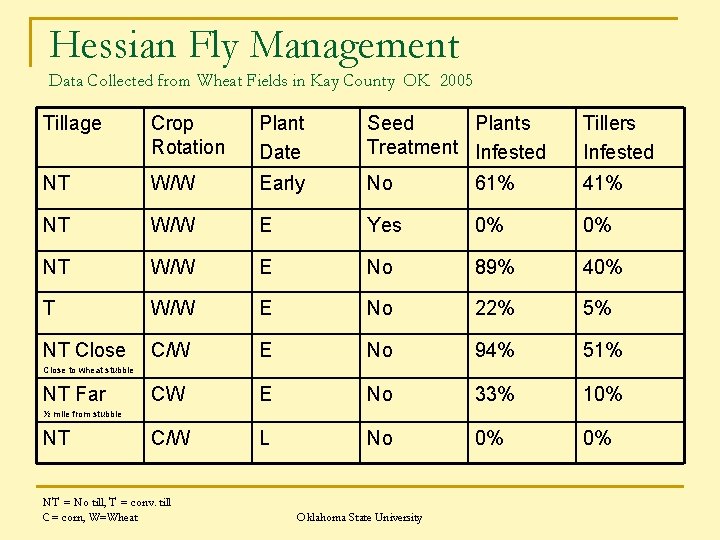
Hessian Fly Management Data Collected from Wheat Fields in Kay County OK 2005 Tillage Crop Rotation Plant Date Seed Plants Treatment Infested Tillers Infested NT W/W Early No 61% 41% NT W/W E Yes 0% 0% NT W/W E No 89% 40% T W/W E No 22% 5% NT Close C/W E No 94% 51% CW E No 33% 10% C/W L No 0% 0% Close to wheat stubble NT Far ½ mile from stubble NT NT = No till, T = conv. till C= corn, W=Wheat Oklahoma State University
Critical Insects and Conservation Tillage in Oklahoma Conservation Tillage 101, Enid, OK. February 8, 2006 Tom A. Royer Department of Entomology & Plant Pathology Oklahoma State University