
CRITICAL INFRASTRUCTURE PROTECTION BILL 2017 PRESENTATION TO THE
CRITICAL INFRASTRUCTURE PROTECTION BILL, 2017 PRESENTATION TO THE PORTFOLIO COMMITTEE 25 October 2017 CIVILIAN SECRETARIAT FOR POLICE 1
INTRODUCTION AND BACKGROUND • The Department of Police initiated the process to review the National Key Points Act, 1980 as far back as 2007. • The Critical Infrastructure Protection Bill(“the Bill”) seeks to bring the legal framework for the protection of critical infrastructure in line with the constitutional imperatives and changing developments. • During the drafting process in 2015, findings and remarks by the High Court of South Africa (Gauteng Local Division) in the matter Right 2 Know Campaign and Others v The Minister of Police and Another that was handed down on 1 December 2014, as well as other proposals were taken into account. CIVILIAN SECRETARIAT FOR POLICE 2
INTRODUCTION AND BACKGROUND • • • The Bill is aimed at ensuring that South Africa maintains a robust and sustainable approach to the protection of South Africa’s critical infrastructure in the interests of the state and all citizens. The Bill is providing a more transparent process of declaring critical infrastructures which involves a variety of departments, the private sector and community bodies. The Bill promotes a spirit of cooperation between various role players in order to provide for a multi-disciplinary approach to deal with critical infrastructure protection. CIVILIAN SECRETARIAT FOR POLICE 3
PROCESS OVERVIEW • The Bill was approved by Cabinet on 13 th April 2016 for publication in the Gazette for public comment. This was done on 13 May 2016 for comments until 15 June 2016. All comments have been considered and the Bill has been amended to incorporate those that were considered useful. • During the months of August and September 2016, the Bill was presented at various DG Cluster meetings for further processing. In November 2016, the Bill was further deliberated on a clause by clause basis at NEDLAC. The NEDLAC report was finalised in July 2017 and has been forwarded to the Minister of Police, Minister of Labour and to the Portfolio Committee on Police. • The Bill was approved by Cabinet in April 2017. CIVILIAN SECRETARIAT FOR POLICE 4
PURPOSE OF THE BILL • Secure critical infrastructure (“CI”) against threats • Objective criteria for identification and declaration • Public-private cooperation for identification and protection of CI • Promote cooperation and a culture of shared responsibility • Enhance capacity to absorb and mitigate security risks • Ensure that CIs comply with regulatory measures • Support integration and coordination of the functions CIVILIAN SECRETARIAT FOR POLICE

NOT ALL “INFRASTRUCTURE” IS “CRITICAL INFRASTRUCTURE” CIVILIAN SECRETARIAT FOR POLICE
DEFINITION OF INFRASTRUCTURE • “infrastructure” means any building, centre, establishment, facility, installation, premises or systems needed for the functioning of the society, government or enterprises of the Republic and includes any transport network or network for the delivery of electricity or water; • “critical infrastructure” – only when formally declared as such CIVILIAN SECRETARIAT FOR POLICE
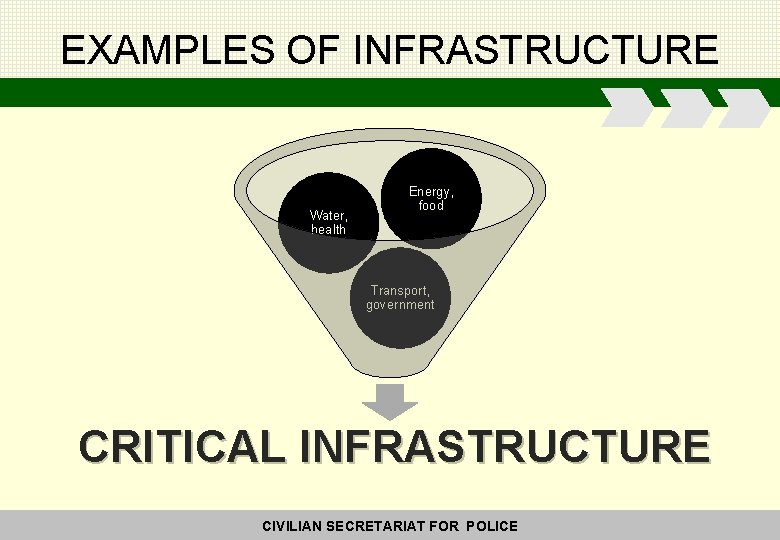
EXAMPLES OF INFRASTRUCTURE Water, health Energy, food Transport, government CRITICAL INFRASTRUCTURE CIVILIAN SECRETARIAT FOR POLICE
PURPOSE OF THE BILL • The Bill takes into account that Critical Infrastructure may fall into various sectors such as water, energy, transport, communication etc. • The Bill seeks to harmonise this with sectoral legislation, with a view to protect the physical integrity of these infrastructures. CIVILIAN SECRETARIAT FOR POLICE 9
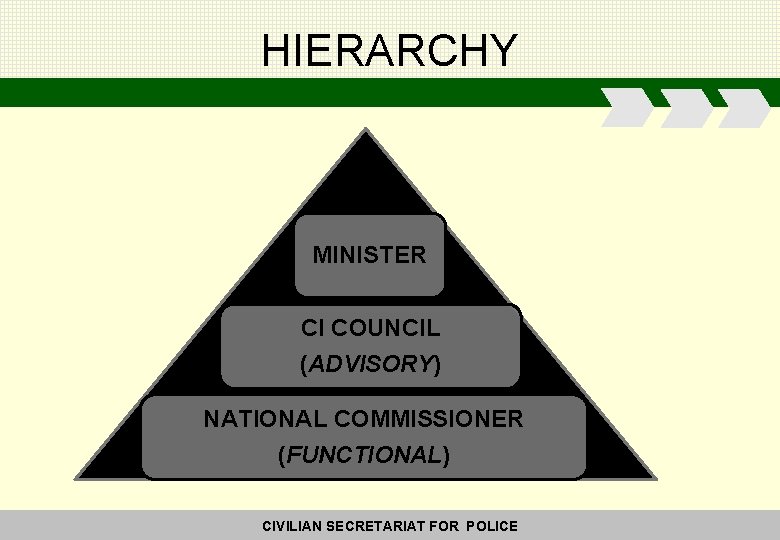
HIERARCHY MINISTER CI COUNCIL (ADVISORY) NATIONAL COMMISSIONER (FUNCTIONAL) CIVILIAN SECRETARIAT FOR POLICE
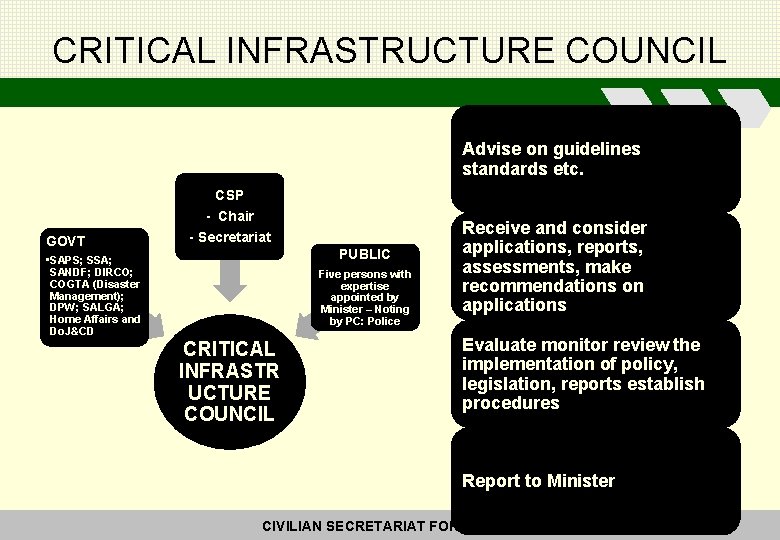
CRITICAL INFRASTRUCTURE COUNCIL Advise on guidelines standards etc. CSP - Chair GOVT - Secretariat PUBLIC • SAPS; SSA; SANDF; DIRCO; COGTA (Disaster Management); DPW; SALGA; Home Affairs and Do. J&CD Five persons with expertise appointed by Minister – Noting by PC: Police CRITICAL INFRASTR UCTURE COUNCIL Receive and consider applications, reports, assessments, make recommendations on applications Evaluate monitor review the implementation of policy, legislation, reports establish procedures Report to Minister CIVILIAN SECRETARIAT FOR POLICE
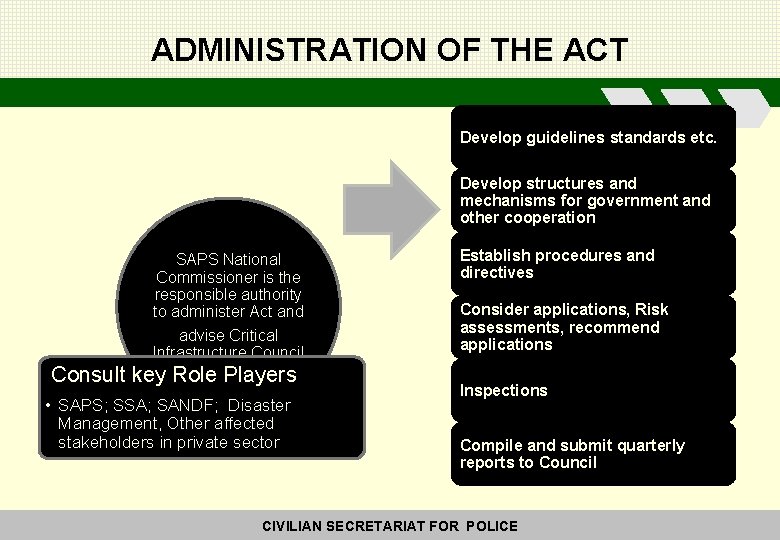
ADMINISTRATION OF THE ACT Develop guidelines standards etc. Develop structures and mechanisms for government and other cooperation SAPS National Commissioner is the responsible authority to administer Act and advise Critical Infrastructure Council Consult key Role Players • SAPS; SSA; SANDF; Disaster Management, Other affected stakeholders in private sector Establish procedures and directives Consider applications, Risk assessments, recommend applications Inspections Compile and submit quarterly reports to Council CIVILIAN SECRETARIAT FOR POLICE
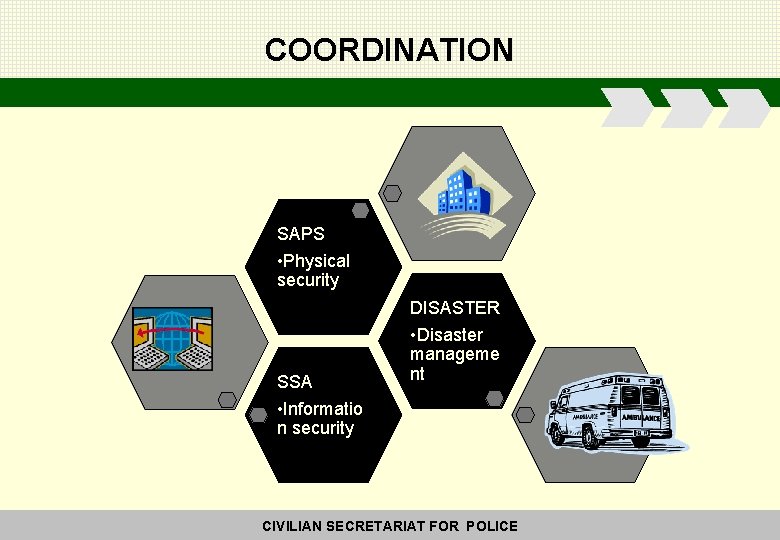
COORDINATION SAPS • Physical security DISASTER SSA • Disaster manageme nt • Informatio n security CIVILIAN SECRETARIAT FOR POLICE
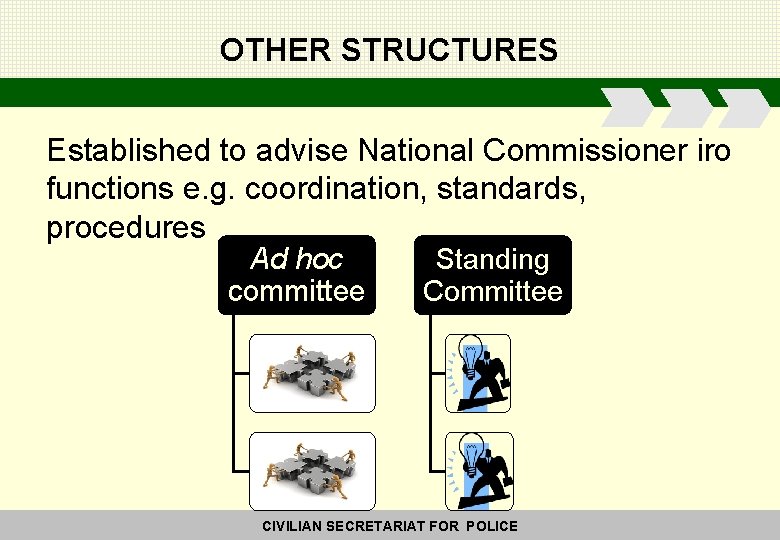
OTHER STRUCTURES Established to advise National Commissioner iro functions e. g. coordination, standards, procedures Ad hoc committee Standing Committee CIVILIAN SECRETARIAT FOR POLICE
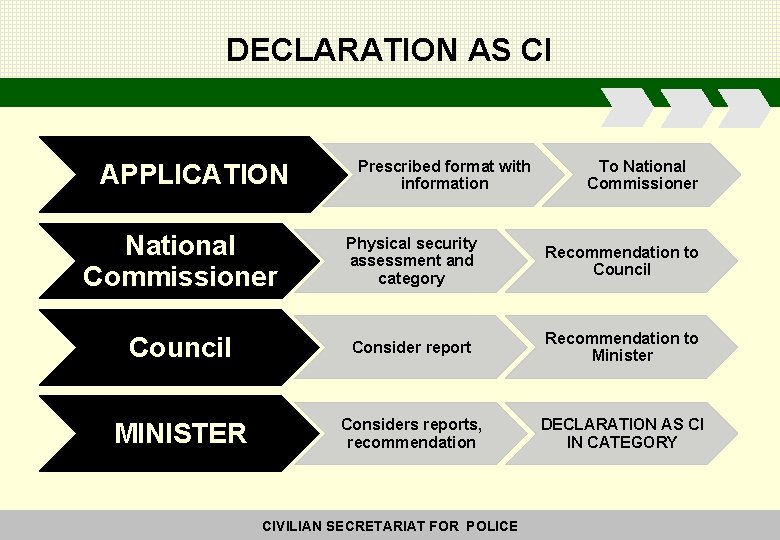
DECLARATION AS CI APPLICATION Prescribed format with information To National Commissioner Physical security assessment and category Recommendation to Council Consider report Recommendation to Minister MINISTER Considers reports, recommendation DECLARATION AS CI IN CATEGORY CIVILIAN SECRETARIAT FOR POLICE
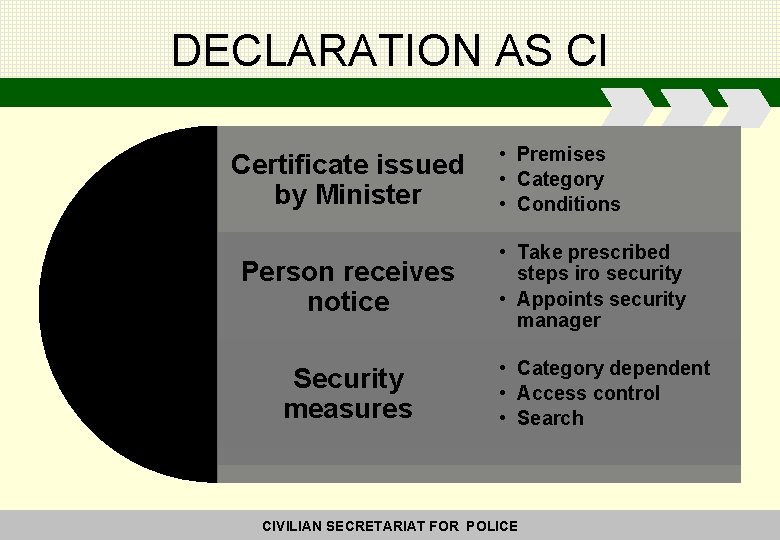
DECLARATION AS CI Certificate issued by Minister Person receives notice Security measures • Premises • Category • Conditions • Take prescribed steps iro security • Appoints security manager • Category dependent • Access control • Search CIVILIAN SECRETARIAT FOR POLICE
POWERS AND DUTIES OF OWNER • Clause 24 now provides that a person in control of critical infrastructure may advance reasons why government should finance or co-finance the costs • The Minister in consultation with Minister of Finance and other affected Minister will make a determination. CIVILIAN SECRETARIAT FOR POLICE 17
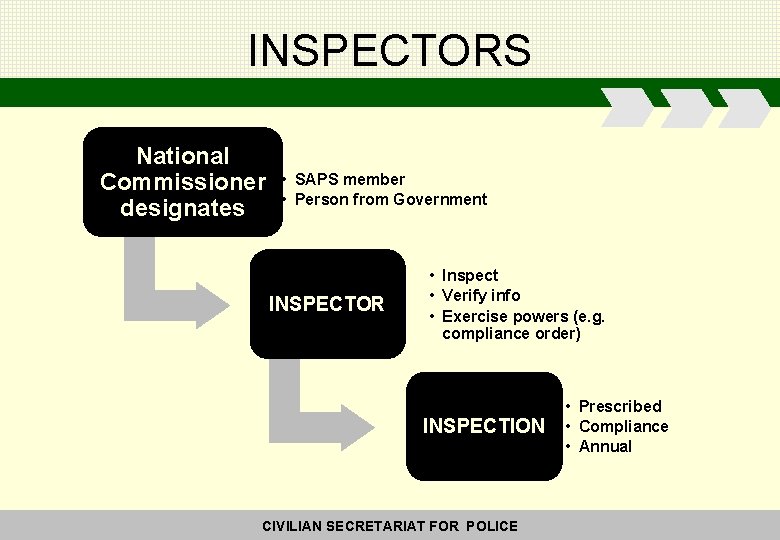
INSPECTORS National Commissioner designates • SAPS member • Person from Government INSPECTOR • Inspect • Verify info • Exercise powers (e. g. compliance order) INSPECTION CIVILIAN SECRETARIAT FOR POLICE • Prescribed • Compliance • Annual
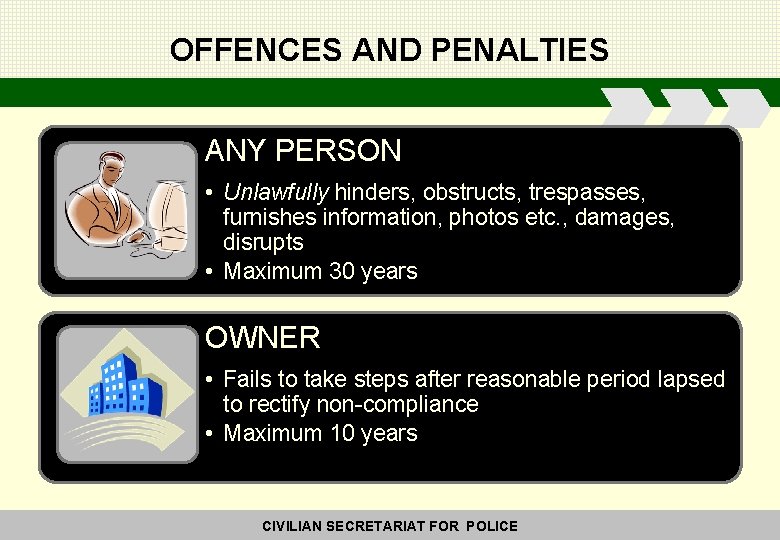
OFFENCES AND PENALTIES ANY PERSON • Unlawfully hinders, obstructs, trespasses, furnishes information, photos etc. , damages, disrupts • Maximum 30 years OWNER • Fails to take steps after reasonable period lapsed to rectify non-compliance • Maximum 10 years CIVILIAN SECRETARIAT FOR POLICE
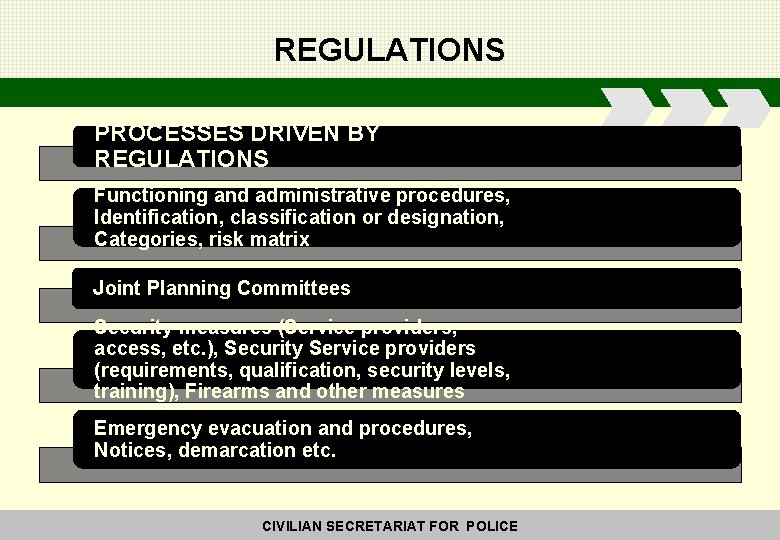
REGULATIONS PROCESSES DRIVEN BY REGULATIONS Functioning and administrative procedures, Identification, classification or designation, Categories, risk matrix Joint Planning Committees Security measures (Service providers, access, etc. ), Security Service providers (requirements, qualification, security levels, training), Firearms and other measures Emergency evacuation and procedures, Notices, demarcation etc. CIVILIAN SECRETARIAT FOR POLICE
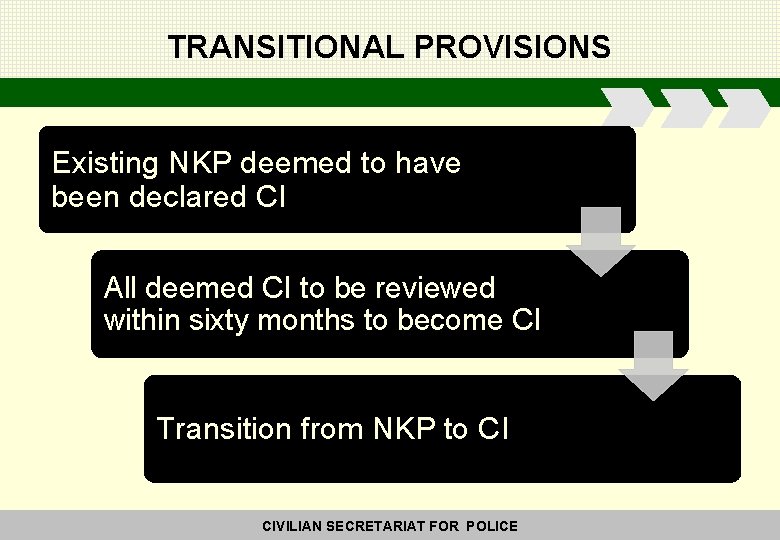
TRANSITIONAL PROVISIONS Existing NKP deemed to have been declared CI All deemed CI to be reviewed within sixty months to become CI Transition from NKP to CI CIVILIAN SECRETARIAT FOR POLICE
CONSTITUTIONAL ISSUES • The Bill improves upon previous drafts in several respects, especially with regards to the publication of Critical Infrastructure and the offences – Promotion of Access to Information Act – Promotion of Administrative Justice Act – All offences now require intent as an element e. g. photographs, pickets, demonstrations that must be unlawful or for an unlawful purpose etc CIVILIAN SECRETARIAT FOR POLICE 22
STAKEHOLDERS INVOLVED IN THE PROCESS Stakeholders that have commented on the Bill: • • National Treasury; Eskom Holdings (Pty); Rand Water; National Disaster Management; State Security Agency; National Prosecuting Authority; South African Police Service; Department of Health; Department of Defence and Military Veterans; Department of Justice and Constitutional Development; Department of Water and Sanitation; Department of Agriculture, Forestry and Fisheries; Office of the Chief State Law Advisers; and Ministers’ advisers Buffalo City Municipality; Transnet; ground. Work; Eskom Holdings (Pty); Western Cape Department of Community Safety; State Security Agency; e. Thekwini Municipality; South African Institute of Security SENTECH; Right 2 Know; Situational Security Training Academy South Durban Community Environmental Alliance; Telkom; ama. Bhungane; SABC; NERSA; Banking Association of South Africa; Southern African Catholic Bishop’s Conference; South African Reserve Bank; SASOL. CIVILIAN SECRETARIAT FOR POLICE 23
END Thank you CIVILIAN SECRETARIAT FOR POLICE 24
- Slides: 24