
Critical Evaluation Wk 12 Lesson 1 Question Four
- Slides: 19
Critical Evaluation Wk 12 Lesson 1
Question Four
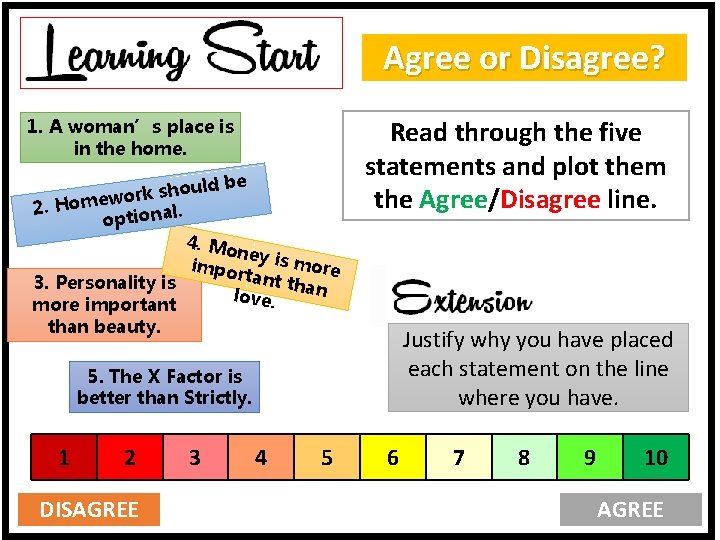
Agree or Disagree? 1. A woman’s place is in the home. Read through the five statements and plot them the Agree/Disagree line. e ould b h s k r o w 2. Home ional. opt 4. Mo ne impor y is more tant t 3. Personality is han love. more important than beauty. Justify why you have placed each statement on the line where you have. 5. The X Factor is better than Strictly. 1 2 DISAGREE 3 4 5 6 7 8 9 10 AGREE
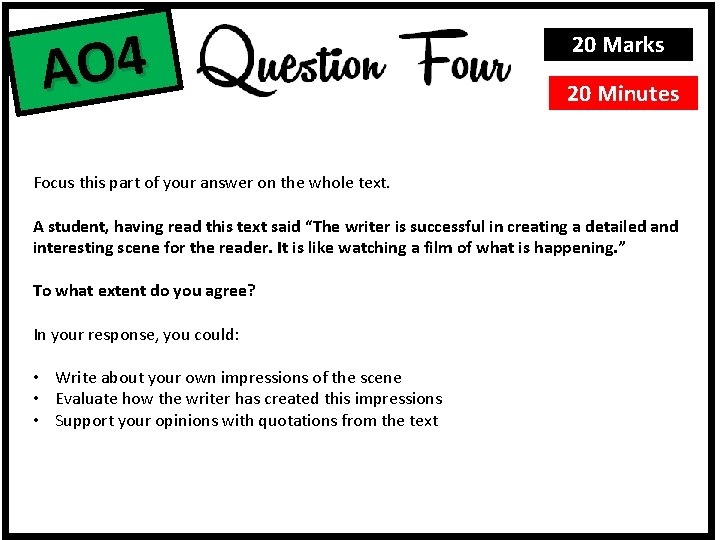
AO 4 20 Marks 20 Minutes Focus this part of your answer on the whole text. A student, having read this text said “The writer is successful in creating a detailed and interesting scene for the reader. It is like watching a film of what is happening. ” To what extent do you agree? In your response, you could: • Write about your own impressions of the scene • Evaluate how the writer has created this impressions • Support your opinions with quotations from the text
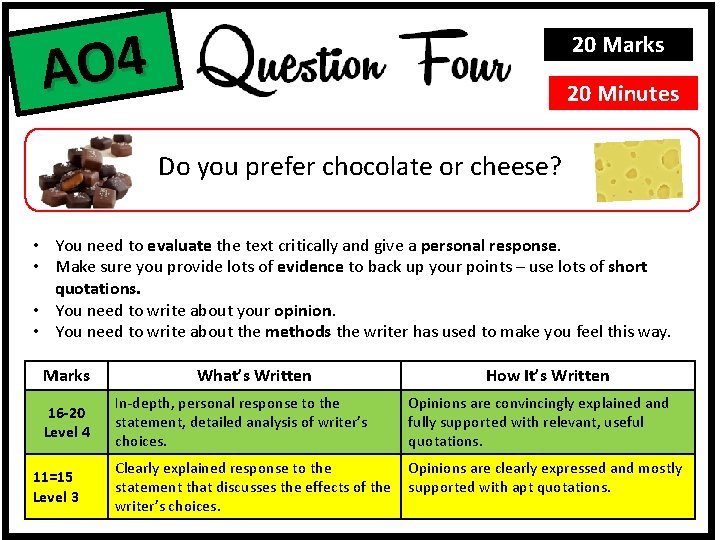
AO 4 20 Marks 20 Minutes Do you prefer chocolate or cheese? • You need to evaluate the text critically and give a personal response. • Make sure you provide lots of evidence to back up your points – use lots of short quotations. • You need to write about your opinion. • You need to write about the methods the writer has used to make you feel this way. Marks 16 -20 Level 4 11=15 Level 3 What’s Written How It’s Written In-depth, personal response to the statement, detailed analysis of writer’s choices. Opinions are convincingly explained and fully supported with relevant, useful quotations. Clearly explained response to the statement that discusses the effects of the writer’s choices. Opinions are clearly expressed and mostly supported with apt quotations.
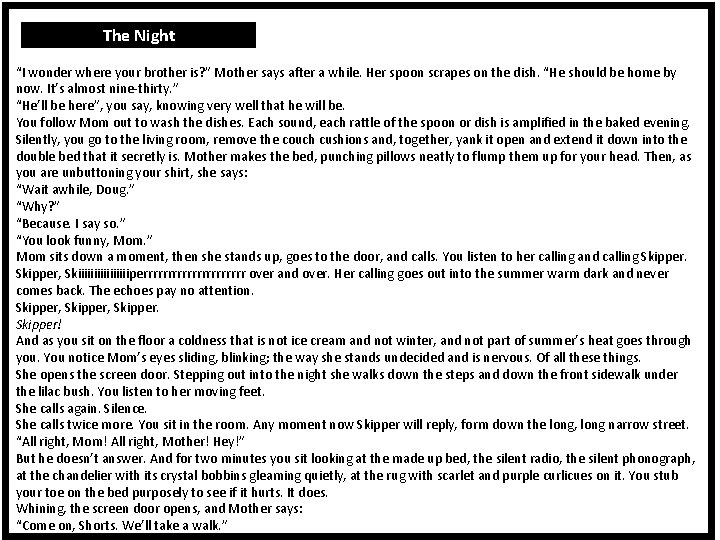
The Night “I wonder where your brother is? ” Mother says after a while. Her spoon scrapes on the dish. “He should be home by now. It’s almost nine-thirty. ” “He’ll be here”, you say, knowing very well that he will be. You follow Mom out to wash the dishes. Each sound, each rattle of the spoon or dish is amplified in the baked evening. Silently, you go to the living room, remove the couch cushions and, together, yank it open and extend it down into the double bed that it secretly is. Mother makes the bed, punching pillows neatly to flump them up for your head. Then, as you are unbuttoning your shirt, she says: “Wait awhile, Doug. ” “Why? ” “Because. I say so. ” “You look funny, Mom. ” Mom sits down a moment, then she stands up, goes to the door, and calls. You listen to her calling and calling Skipper, Skiiiiiiiiperrrrrrrrrrr over and over. Her calling goes out into the summer warm dark and never comes back. The echoes pay no attention. Skipper, Skipper! And as you sit on the floor a coldness that is not ice cream and not winter, and not part of summer’s heat goes through you. You notice Mom’s eyes sliding, blinking; the way she stands undecided and is nervous. Of all these things. She opens the screen door. Stepping out into the night she walks down the steps and down the front sidewalk under the lilac bush. You listen to her moving feet. She calls again. Silence. She calls twice more. You sit in the room. Any moment now Skipper will reply, form down the long, long narrow street. “All right, Mom! All right, Mother! Hey!” But he doesn’t answer. And for two minutes you sit looking at the made up bed, the silent radio, the silent phonograph, at the chandelier with its crystal bobbins gleaming quietly, at the rug with scarlet and purple curlicues on it. You stub your toe on the bed purposely to see if it hurts. It does. Whining, the screen door opens, and Mother says: “Come on, Shorts. We’ll take a walk. ”
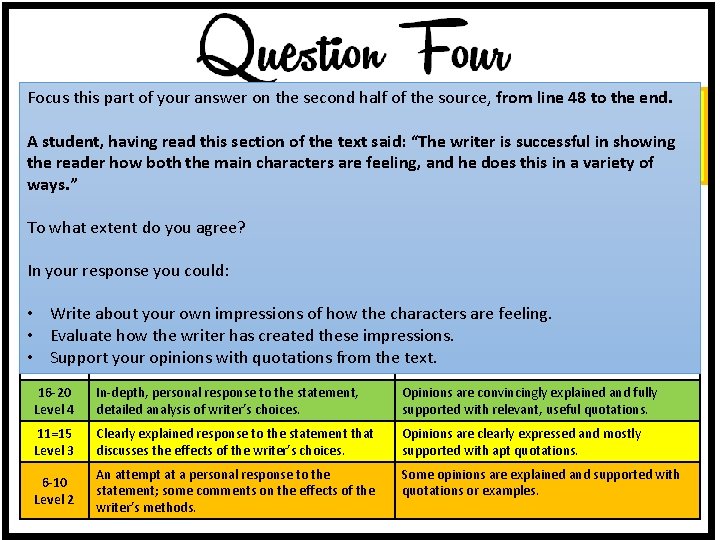
Focus part your answer on the of the source, fromme line 48 to the end. I agreethis with theofstudent, because the second writer ishalf successful in showing Band Three how the young boy (Doug) is feeling. One of the ways in which the A student, read this section person of the text said: “The in showing writer doeshaving this is using the second to address the writer readeris– successful this the how both the main characters feeling, and he doeslike this in a variety of 11/20 putsreader me in Doug’s position showing me hisare perspective in phrases ways. ” “knowing very well that he will be. ” Seeing things through Doug’s eyes helps me to see his confidence in his brother. To what extent youthe agree? I also agreedo with student because I know how the mother is feeling. The writer describes her as “undecided” and “nervous” to make How would In your response you could: the reader see that she’s feeling panicked. In addition, the writer uses you improve an image of her “eyes sliding, blinking” to help me imagine how this answer? • worried Writeshe about your own impressions of how the characters are feeling. must be about her eldest son. • Evaluate how the writer has created these impressions. • Support your opinions with quotations from the text. Marks What’s Written How It’s Written 16 -20 Level 4 In-depth, personal response to the statement, detailed analysis of writer’s choices. Opinions are convincingly explained and fully supported with relevant, useful quotations. 11=15 Level 3 Clearly explained response to the statement that discusses the effects of the writer’s choices. Opinions are clearly expressed and mostly supported with apt quotations. 6 -10 Level 2 An attempt at a personal response to the statement; some comments on the effects of the writer’s methods. Some opinions are explained and supported with quotations or examples.
Question Four
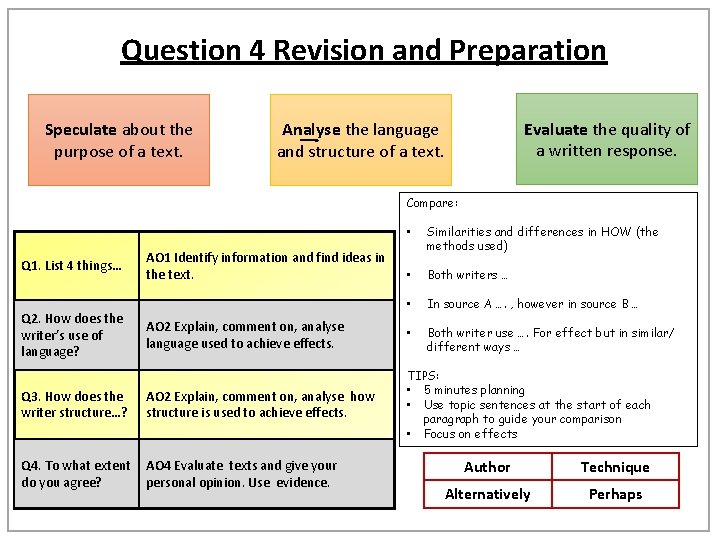
Question 4 Revision and Preparation Speculate about the purpose of a text. Evaluate the quality of a written response. Analyse the language and structure of a text. Compare: • Similarities and differences in HOW (the methods used) • Both writers … • In source A …. , however in source B … AO 2 Explain, comment on, analyse language used to achieve effects. • Both writer use …. For effect but in similar/ different ways … Q 3. How does the writer structure…? AO 2 Explain, comment on, analyse how structure is used to achieve effects. TIPS: • 5 minutes planning • Use topic sentences at the start of each paragraph to guide your comparison • Focus on effects Q 4. To what extent do you agree? AO 4 Evaluate texts and give your personal opinion. Use evidence. Q 1. List 4 things… Q 2. How does the writer’s use of language? AO 1 Identify information and find ideas in the text. Author Technique Alternatively Perhaps
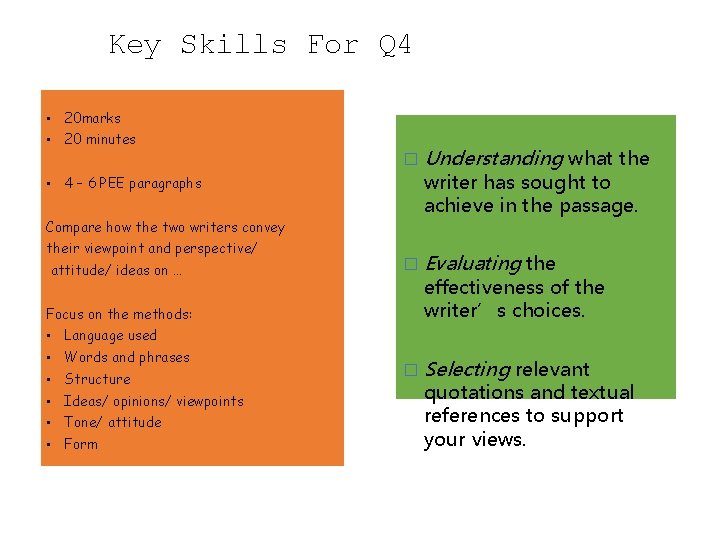
Key Skills For Q 4 • 20 marks • 20 minutes • 4 – 6 PEE paragraphs Compare how the two writers convey their viewpoint and perspective/ attitude/ ideas on … Focus on the methods: � Understanding what the writer has sought to achieve in the passage. � Evaluating the effectiveness of the writer’s choices. • Language used • Words and phrases • Structure • Ideas/ opinions/ viewpoints • Tone/ attitude • Form � Selecting relevant quotations and textual references to support your views.
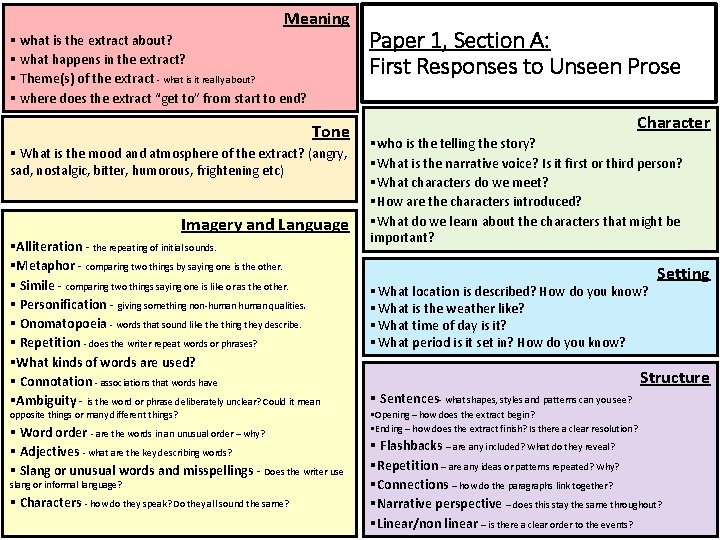
Meaning § what is the extract about? § what happens in the extract? § Theme(s) of the extract - what is it really about? § where does the extract “get to” from start to end? Tone § What is the mood and atmosphere of the extract? (angry, sad, nostalgic, bitter, humorous, frightening etc) Imagery and Language §Alliteration - the repeating of initial sounds. §Metaphor - comparing two things by saying one is the other. § Simile - comparing two things saying one is like or as the other. § Personification - giving something non-human qualities. § Onomatopoeia - words that sound like thing they describe. § Repetition - does the writer repeat words or phrases? §What kinds of words are used? § Connotation - associations that words have §Ambiguity - is the word or phrase deliberately unclear? Could it mean opposite things or many different things? § Word order - are the words in an unusual order – why? § Adjectives - what are the key describing words? § Slang or unusual words and misspellings - Does the writer use slang or informal language? § Characters - how do they speak? Do they all sound the same? Paper 1, Section A: First Responses to Unseen Prose Character §who is the telling the story? §What is the narrative voice? Is it first or third person? §What characters do we meet? §How are the characters introduced? §What do we learn about the characters that might be important? § What location is described? How do you know? § What is the weather like? § What time of day is it? § What period is it set in? How do you know? Setting Structure § Sentences- what shapes, styles and patterns can you see? §Opening – how does the extract begin? §Ending – how does the extract finish? Is there a clear resolution? § Flashbacks – are any included? What do they reveal? §Repetition – are any ideas or patterns repeated? Why? §Connections – how do the paragraphs link together? §Narrative perspective – does this stay the same throughout? §Linear/non linear – is there a clear order to the events?
Meaning Tone Paper 1, Section A: First Responses to Unseen Prose Character Imagery and Language Setting Structure
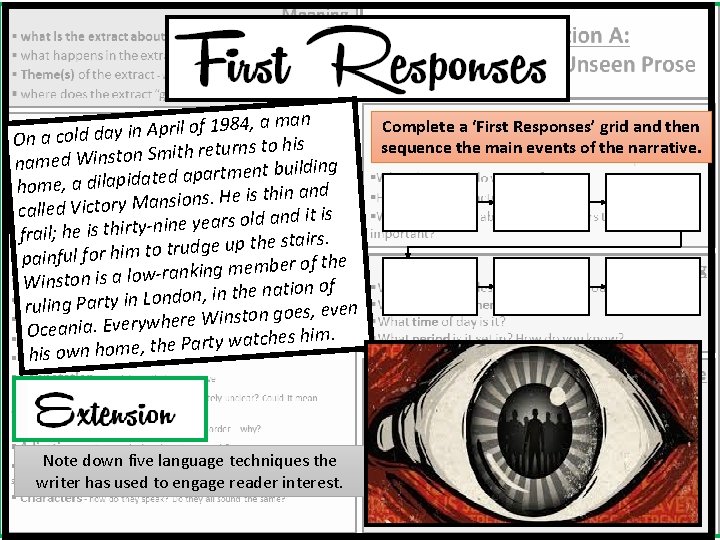
984, a man 1 f o l ri p A in y a d On a cold rns to his tu re h it m S n to s in named W uilding b t n e m rt a p a d te home, a dilapida is thin and e H. s n io s n a M ry called Victo old and it is rs a e y e in -n ty ir th frail; he is tairs. s e th p u e g d u tr painful for him to r of the e b m e m g in k n a -r Winston is a low on of ti a n e th in , n o d n ruling Party in Lo es, even o g n to s in W re e h Oceania. Everyw him. s e h tc a w y rt a P e his own home, th Note down five language techniques the writer has used to engage reader interest. Complete a ‘First Responses’ grid and then sequence the main events of the narrative.
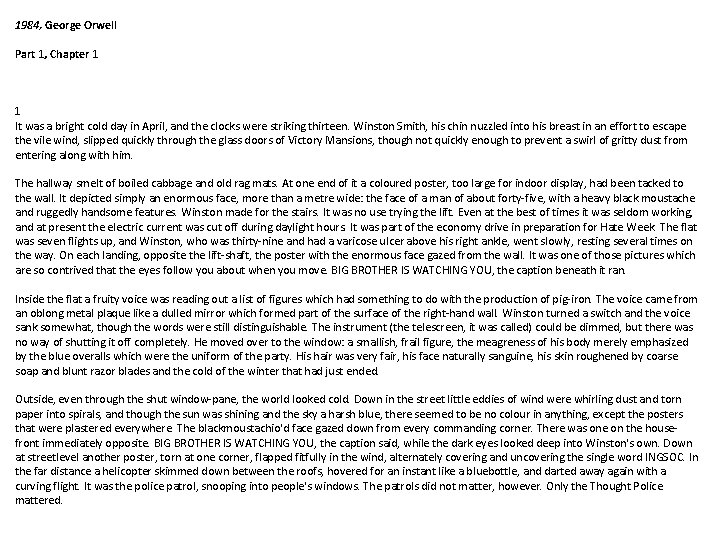
1984, George Orwell Part 1, Chapter 1 1 It was a bright cold day in April, and the clocks were striking thirteen. Winston Smith, his chin nuzzled into his breast in an effort to escape the vile wind, slipped quickly through the glass doors of Victory Mansions, though not quickly enough to prevent a swirl of gritty dust from entering along with him. The hallway smelt of boiled cabbage and old rag mats. At one end of it a coloured poster, too large for indoor display, had been tacked to the wall. It depicted simply an enormous face, more than a metre wide: the face of a man of about forty-five, with a heavy black moustache and ruggedly handsome features. Winston made for the stairs. It was no use trying the lift. Even at the best of times it was seldom working, and at present the electric current was cut off during daylight hours. It was part of the economy drive in preparation for Hate Week. The flat was seven flights up, and Winston, who was thirty-nine and had a varicose ulcer above his right ankle, went slowly, resting several times on the way. On each landing, opposite the lift-shaft, the poster with the enormous face gazed from the wall. It was one of those pictures which are so contrived that the eyes follow you about when you move. BIG BROTHER IS WATCHING YOU, the caption beneath it ran. Inside the flat a fruity voice was reading out a list of figures which had something to do with the production of pig-iron. The voice came from an oblong metal plaque like a dulled mirror which formed part of the surface of the right-hand wall. Winston turned a switch and the voice sank somewhat, though the words were still distinguishable. The instrument (the telescreen, it was called) could be dimmed, but there was no way of shutting it off completely. He moved over to the window: a smallish, frail figure, the meagreness of his body merely emphasized by the blue overalls which were the uniform of the party. His hair was very fair, his face naturally sanguine, his skin roughened by coarse soap and blunt razor blades and the cold of the winter that had just ended. Outside, even through the shut window-pane, the world looked cold. Down in the street little eddies of wind were whirling dust and torn paper into spirals, and though the sun was shining and the sky a harsh blue, there seemed to be no colour in anything, except the posters that were plastered everywhere. The blackmoustachio'd face gazed down from every commanding corner. There was one on the housefront immediately opposite. BIG BROTHER IS WATCHING YOU, the caption said, while the dark eyes looked deep into Winston's own. Down at streetlevel another poster, torn at one corner, flapped fitfully in the wind, alternately covering and uncovering the single word INGSOC. In the far distance a helicopter skimmed down between the roofs, hovered for an instant like a bluebottle, and darted away again with a curving flight. It was the police patrol, snooping into people's windows. The patrols did not matter, however. Only the Thought Police mattered.
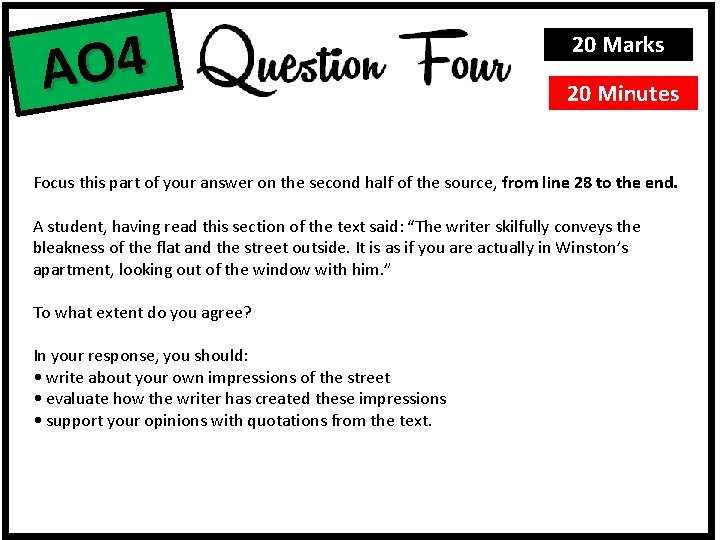
AO 4 20 Marks 20 Minutes Focus this part of your answer on the second half of the source, from line 28 to the end. A student, having read this section of the text said: “The writer skilfully conveys the bleakness of the flat and the street outside. It is as if you are actually in Winston’s apartment, looking out of the window with him. ” To what extent do you agree? In your response, you should: • write about your own impressions of the street • evaluate how the writer has created these impressions • support your opinions with quotations from the text.
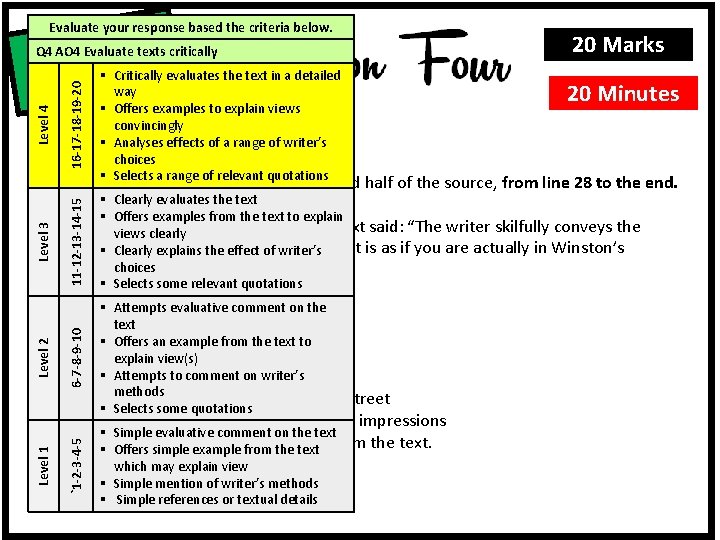
Evaluate your response based the criteria below. AO 4 16 -17 -18 -19 -20 Level 4 Q 4 AO 4 Evaluate texts critically § Critically evaluates the text in a detailed way § Offers examples to explain views convincingly § Analyses effects of a range of writer’s choices § Selects a range of relevant quotations 20 Marks 20 Minutes Focus this part of your answer on the second half of the source, from line 28 to the end. 11 -12 -13 -14 -15 Level 3 § Clearly evaluates the text § Offers examples from the text to explain A student, having read this section of the text said: “The writer skilfully conveys the views clearly bleakness§ of the explains flat andthethestreet outside. It is as if you are actually in Winston’s Clearly effect of writer’s apartment, choices looking § Selects some relevant quotations out of the window with him. ” 6 -7 -8 -9 -10 Level 2 § Attempts evaluative comment on the text To what extent you agree? § Offersdo an example from the text to explain view(s) § Attemptsyou to comment In your response, should: on writer’s methods • write about your own impressions of the street § Selects some quotations `1 -2 -3 -4 -5 Level 1 • evaluate how the writer has created these impressions § Simple evaluative comment on the text • support§your with from quotations Offersopinions simple example the text from the text. which may explain view § Simple mention of writer’s methods § Simple references or textual details
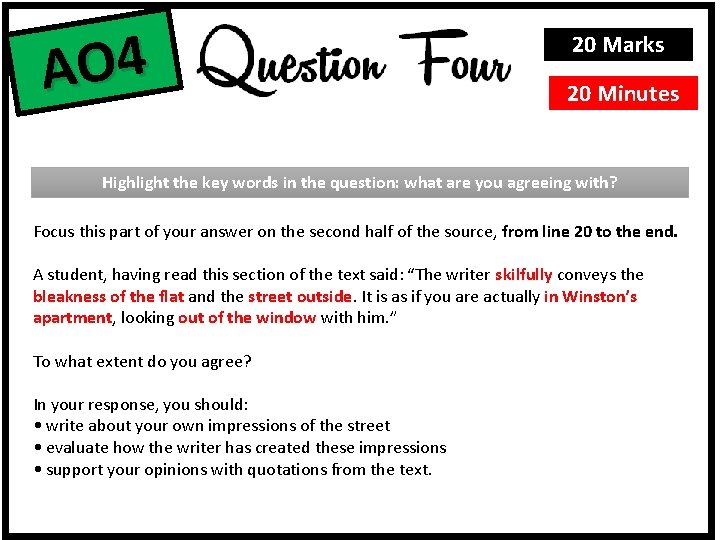
AO 4 20 Marks 20 Minutes Highlight the key words in the question: what are you agreeing with? Focus this part of your answer on the second half of the source, from line 20 to the end. A student, having read this section of the text said: “The writer skilfully conveys the bleakness of the flat and the street outside. It is as if you are actually in Winston’s apartment, looking out of the window with him. ” To what extent do you agree? In your response, you should: • write about your own impressions of the street • evaluate how the writer has created these impressions • support your opinions with quotations from the text.
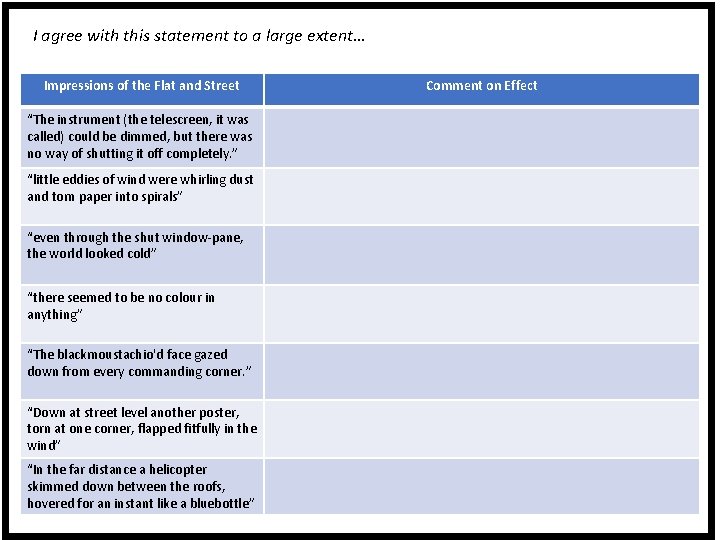
I agree with this statement to a large extent… Impressions of the Flat and Street “The instrument (the telescreen, it was called) could be dimmed, but there was no way of shutting it off completely. ” “little eddies of wind were whirling dust and torn paper into spirals” “even through the shut window-pane, the world looked cold” “there seemed to be no colour in anything” “The blackmoustachio'd face gazed down from every commanding corner. ” “Down at street level another poster, torn at one corner, flapped fitfully in the wind” “In the far distance a helicopter skimmed down between the roofs, hovered for an instant like a bluebottle” Comment on Effect
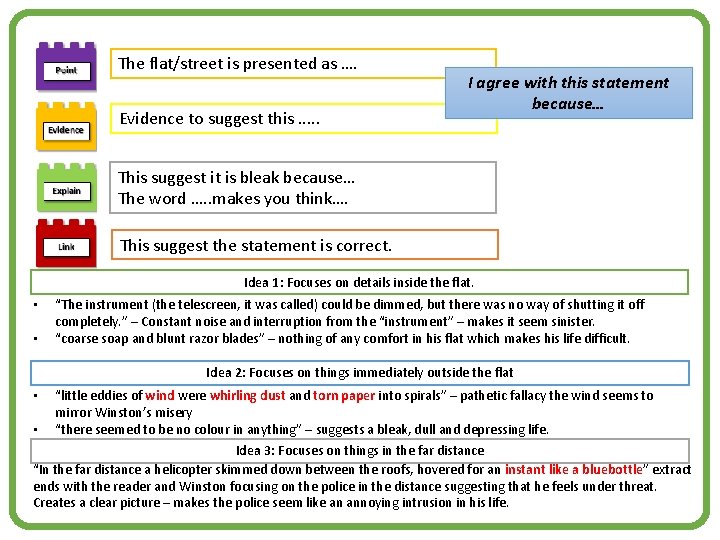
The flat/street is presented as …. Evidence to suggest this. . . I agree with this statement because… This suggest it is bleak because… The word …. . makes you think…. This suggest the statement is correct. Idea 1: Focuses on details inside the flat. • • “The instrument (the telescreen, it was called) could be dimmed, but there was no way of shutting it off completely. ” – Constant noise and interruption from the “instrument” – makes it seem sinister. “coarse soap and blunt razor blades” – nothing of any comfort in his flat which makes his life difficult. Idea 2: Focuses on things immediately outside the flat • • “little eddies of wind were whirling dust and torn paper into spirals” – pathetic fallacy the wind seems to mirror Winston’s misery “there seemed to be no colour in anything” – suggests a bleak, dull and depressing life. Idea 3: Focuses on things in the far distance “In the far distance a helicopter skimmed down between the roofs, hovered for an instant like a bluebottle” extract ends with the reader and Winston focusing on the police in the distance suggesting that he feels under threat. Creates a clear picture – makes the police seem like an annoying intrusion in his life.