
Critical Design Review Presentation Submitted by Boy Scout
Critical Design Review Presentation Submitted by: Boy Scout Troop 143 382 N. Grimes Giddings, Texas 78942

Agenda • Team Introduction • Vehicle Design • Questions
Team Introduction • Members - Preston Pruitt, Cody Alexander, Corbin Dillow, Skyler Newman, Taylor Blakney • Members are from the same Scout Troop and high school • Other activities include band, soccer, basketball & track
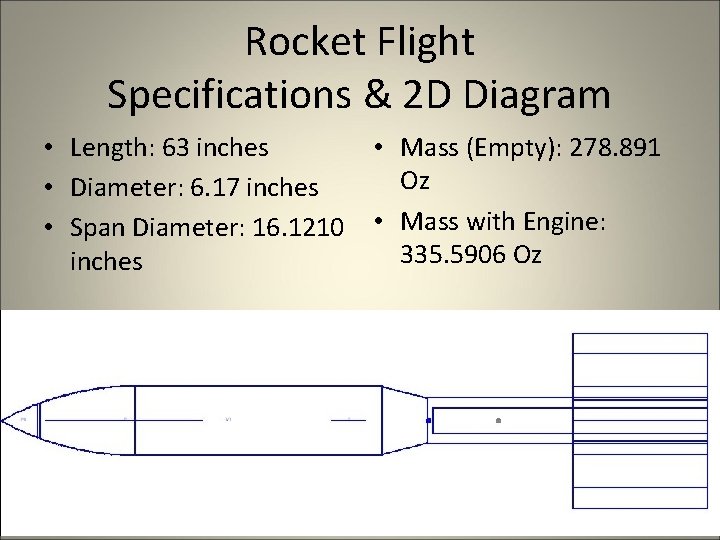
Rocket Flight Specifications & 2 D Diagram • Length: 63 inches • Diameter: 6. 17 inches • Span Diameter: 16. 1210 inches • Mass (Empty): 278. 891 Oz • Mass with Engine: 335. 5906 Oz
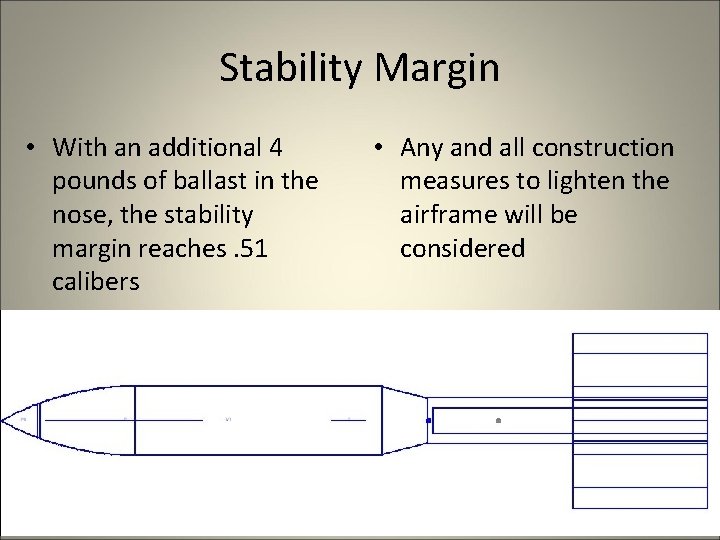
Stability Margin • With an additional 4 pounds of ballast in the nose, the stability margin reaches. 51 calibers • Any and all construction measures to lighten the airframe will be considered
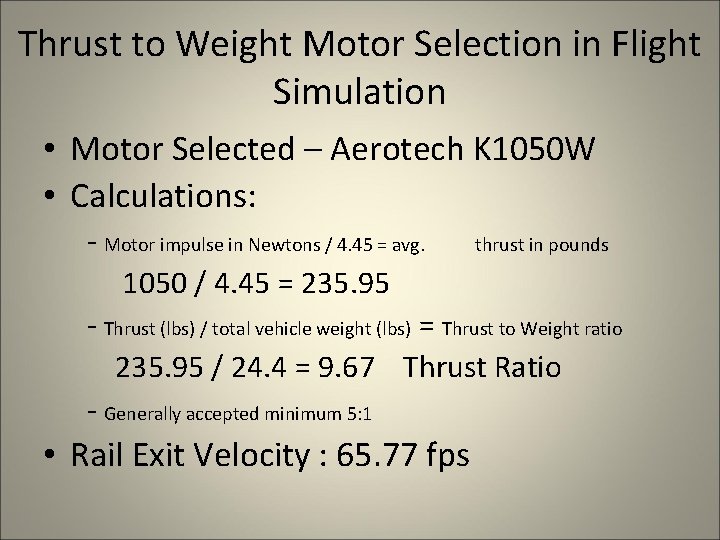
Thrust to Weight Motor Selection in Flight Simulation • Motor Selected – Aerotech K 1050 W • Calculations: - Motor impulse in Newtons / 4. 45 = avg. thrust in pounds 1050 / 4. 45 = 235. 95 - Thrust (lbs) / total vehicle weight (lbs) = Thrust to Weight ratio 235. 95 / 24. 4 = 9. 67 Thrust Ratio - Generally accepted minimum 5: 1 • Rail Exit Velocity : 65. 77 fps
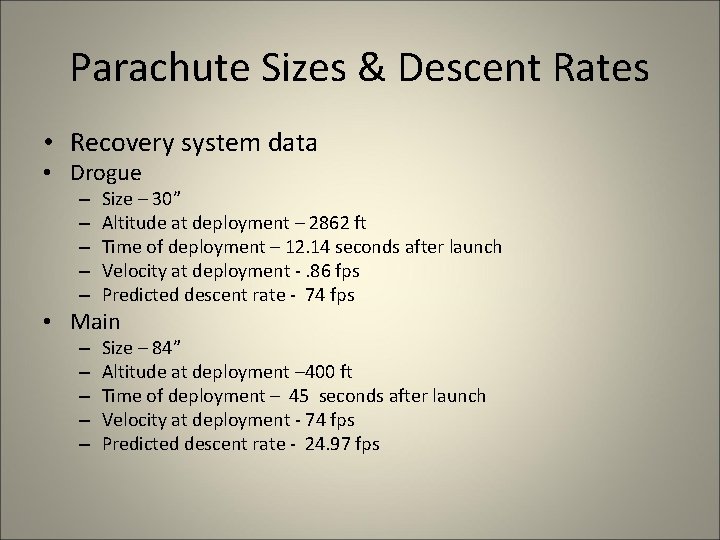
Parachute Sizes & Descent Rates • Recovery system data • Drogue – – – Size – 30” Altitude at deployment – 2862 ft Time of deployment – 12. 14 seconds after launch Velocity at deployment -. 86 fps Predicted descent rate - 74 fps • Main – – – Size – 84” Altitude at deployment – 400 ft Time of deployment – 45 seconds after launch Velocity at deployment - 74 fps Predicted descent rate - 24. 97 fps
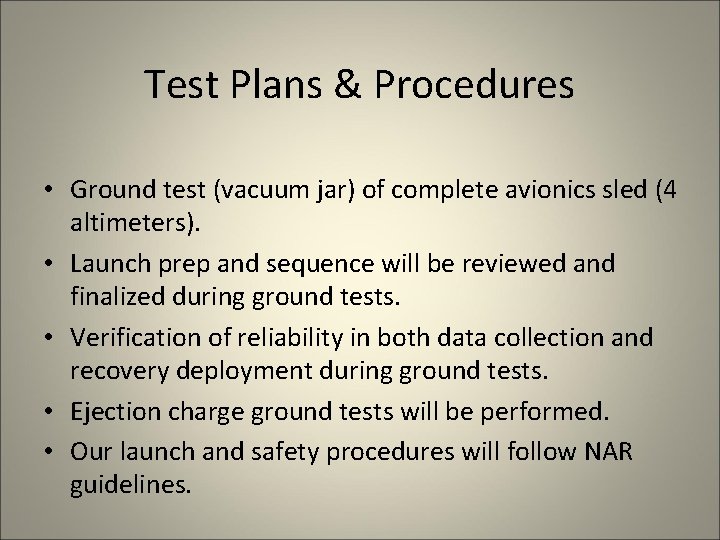
Test Plans & Procedures • Ground test (vacuum jar) of complete avionics sled (4 altimeters). • Launch prep and sequence will be reviewed and finalized during ground tests. • Verification of reliability in both data collection and recovery deployment during ground tests. • Ejection charge ground tests will be performed. • Our launch and safety procedures will follow NAR guidelines.
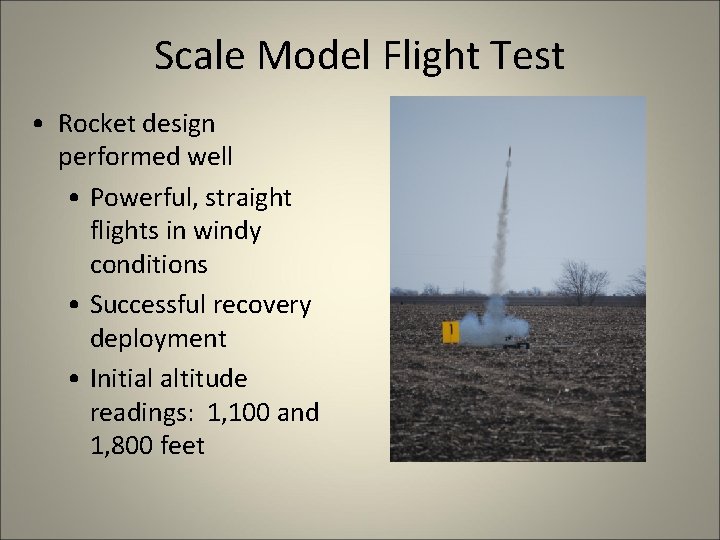
Scale Model Flight Test • Rocket design performed well • Powerful, straight flights in windy conditions • Successful recovery deployment • Initial altitude readings: 1, 100 and 1, 800 feet
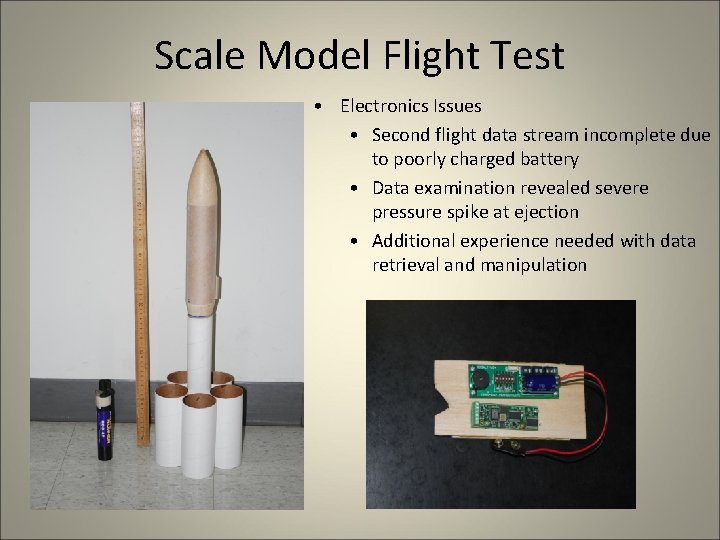
Scale Model Flight Test • Electronics Issues • Second flight data stream incomplete due to poorly charged battery • Data examination revealed severe pressure spike at ejection • Additional experience needed with data retrieval and manipulation
Dual Deployment Avionics Test • Our final ground test plans will merge the preflight procedures from both brands of altimeters. • Simple “vacuum jar” tests will be performed. • Both simple circuit tests (LED) and charge tests will be performed.
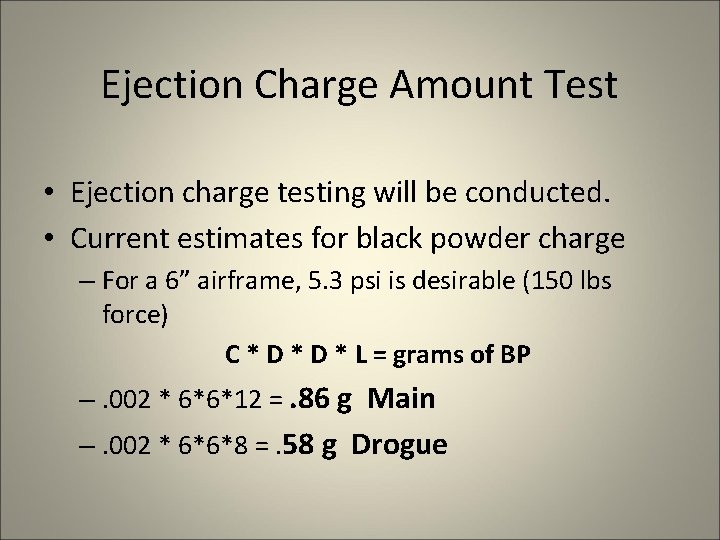
Ejection Charge Amount Test • Ejection charge testing will be conducted. • Current estimates for black powder charge – For a 6” airframe, 5. 3 psi is desirable (150 lbs force) C * D * L = grams of BP –. 002 * 6*6*12 =. 86 g Main –. 002 * 6*6*8 =. 58 g Drogue
Payload Integration Feasibility • The payload is essentially a double-redundant dual deployment system employing high-rate altitude and G-force data recording • Integration appears to be no more complex than a standard dual-deploy avionics configuration

Questions?
- Slides: 14