
Critical Defects in the Texas Performance Plan and
- Slides: 12
Critical Defects in the Texas Performance Plan and PUC Section 271 Analysis September 21, 1999
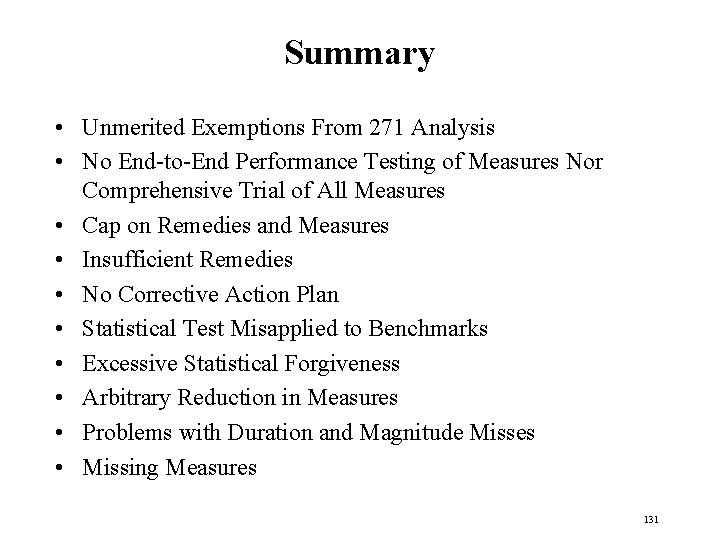
Summary • Unmerited Exemptions From 271 Analysis • No End-to-End Performance Testing of Measures Nor Comprehensive Trial of All Measures • Cap on Remedies and Measures • Insufficient Remedies • No Corrective Action Plan • Statistical Test Misapplied to Benchmarks • Excessive Statistical Forgiveness • Arbitrary Reduction in Measures • Problems with Duration and Magnitude Misses • Missing Measures 131
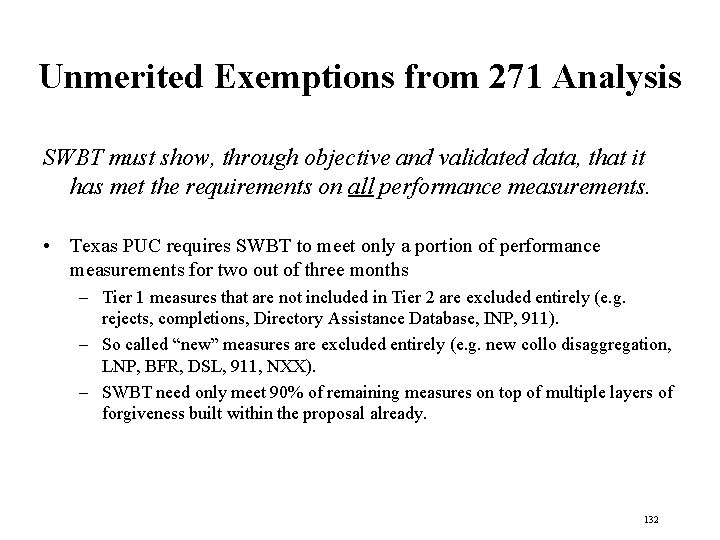
Unmerited Exemptions from 271 Analysis SWBT must show, through objective and validated data, that it has met the requirements on all performance measurements. • Texas PUC requires SWBT to meet only a portion of performance measurements for two out of three months – Tier 1 measures that are not included in Tier 2 are excluded entirely (e. g. rejects, completions, Directory Assistance Database, INP, 911). – So called “new” measures are excluded entirely (e. g. new collo disaggregation, LNP, BFR, DSL, 911, NXX). – SWBT need only meet 90% of remaining measures on top of multiple layers of forgiveness built within the proposal already. 132
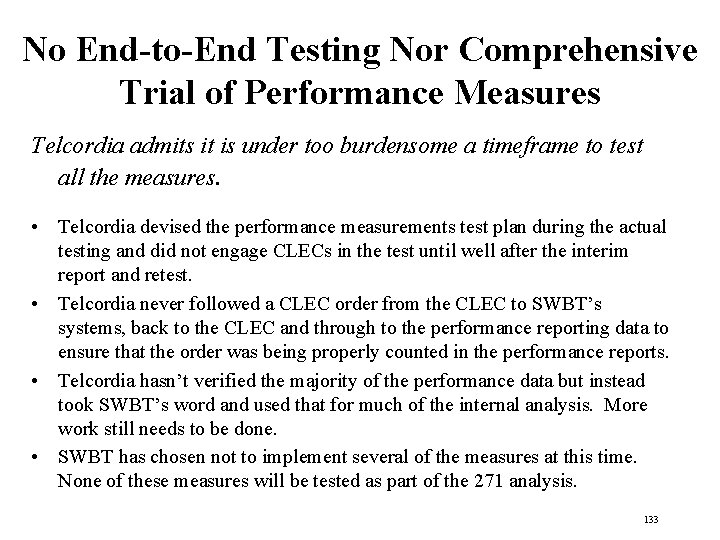
No End-to-End Testing Nor Comprehensive Trial of Performance Measures Telcordia admits it is under too burdensome a timeframe to test all the measures. • Telcordia devised the performance measurements test plan during the actual testing and did not engage CLECs in the test until well after the interim report and retest. • Telcordia never followed a CLEC order from the CLEC to SWBT’s systems, back to the CLEC and through to the performance reporting data to ensure that the order was being properly counted in the performance reports. • Telcordia hasn’t verified the majority of the performance data but instead took SWBT’s word and used that for much of the internal analysis. More work still needs to be done. • SWBT has chosen not to implement several of the measures at this time. None of these measures will be tested as part of the 271 analysis. 133
Cap on Remedies and Measures Remedies exist to encourage SWBT to provide reasonable and nondiscriminatory performance to CLECs. With a cap, SWBT can budget its poor performance as a reasonable cost of doing business. • Texas plan institutes an annual $120 million cap for all remedy amounts which includes: – Tier 1: individual CLEC remedy payments payable directly to CLEC – Tier 2: aggregate of all CLEC payments payable to Texas PUC • Once cap is reached, there is no incentive for SWBT to provide parity service. • MCIW recommended a procedural cap whereby SWBT could request regulatory review for remedy amounts in excess of $10 million in a month. • On crucial measures such as OSS Response Time, FOCs, Billing, NXXs, OSS Availability and Trunk Blockage, SWBT limits payments by creating a remedy cap for each of these measurements. 134
Insufficient Remedies SWBT has a greater economic incentive to pay the low remedy amounts than to provide parity service to CLECs. “. . . [C]onstructing punishment schemes on an occurrence specific basis will most likely be ineffective at deterring the discriminatory conduct of the RBOCs. " See attached, Effective Enforcement of Nondiscriminatory Performance by Incumbent Local Exchange Carriers. • The remedy amounts of $25, $75 and $150 per occurrence do not account for: • – ILEC retention of customer’s business, potentially for many years, if the customer decides against switching to the CLEC due to sub-standard service. – The systematic deterrence of competitive entry in the local exchange market (e. g. , competitors' loss of additional potential customers due to diminished good reputation of competitors). – SBC's gain in market share in the long distance business (after 271 authorization) due to customers' dissatisfaction with competitors' local service resulting from RBOC's poor performance. 135
No Corrective Action Plan The objective of a remedy plan is to deter and correct discriminatory and unreasonable behavior by SWBT. • Without analysis of the problems and plans to implement a corrective course, SWBT can choose to simply pay the nominal remedy amount, continue to harm the CLEC and never repair the problem. • Also, for those measurements without remedy amounts, there is never an incentive for SWBT to correct any faulty service. • CAP in original staff proposal was withdrawn based on misguided thought that escalating remedy amounts would incent SWBT to correct action. 136
Statistical Test Misapplied to Benchmarks Statistical testing should only be used to compare SWBT’s performance to itself versus its performance to the CLECs, when no numerical standard is in place. • The Texas plan wrongly applies a statistical test to the benchmarks. The result is that the standards, which already allow for much leniency, are further weakened. – This dramatically reduces the benchmark by the critical z-value divided by the square root of the CLEC sample size (i. e. , the smaller the CLEC sample size, the greater the percentage point reduction). – This also incorrectly incents the ILEC to provide more variable service, increasing the denominator of the z-statistic, thereby decreasing the zstatistic value (i. e. , a higher variability can produce a lower z-score than a low variability with the same mean). 137
Excessive Statistical Forgiveness By using a 95% confidence level in the modified z-statistical test, SWBT is already being protected substantially more than CLECs -- therefore further leniency is not needed. • No k-value table should be used with 95% confidence level. • No remedies are attached even for perpetual z-scores in the -. 651 to -1. 644 range. • Allowances for random failures are already built into the benchmarks. • Z-Tests on benchmarks lower the benchmarks. • SWBT is allowed to miss one month in three and still pass the 271 test. • The smaller the sample size the greater the Type 2 error. • Non-remedied or diagnostic measures are excluded. 138
Arbitrary Reduction in Measures Texas PUC is considering reducing all performance measurements by 50% in the next two years. • CLECs are gravely concerned about reducing measures when they have not even seen continuous performance results. It is unreasonable to reduce measurements as long as SWBT maintains market power. – If SWBT is able and willing to consistently meet a particular standard, then it will not be paying any remedies. • Texas should focus on the quality of SWBT’s service and the loss of SWBT’s dominant status through competition, not an artificial deadline. 139
Problems with Duration and Magnitude Misses If SWBT’s poor performance to all CLECs continues in both length of time and severity, remedies need to increase accordingly. • Magnitude of poor performance is not addressed at all in the SWBT plan. • Duration of poor performance does not result in increased remedies for Tier 2 measurements. • Monthly escalating poor performance amounts for Tier 1 need to be increased. 140
Missing Measures Average Offered Interval - NY, PA, NJ Jeopardy Notice Interval - CA, MI Percent Jeopardies - CA, MI, NY, PA, NJ Provisioning Troubles Before Order Completion - CA Completions with No Notice or Less than 24 Hours Notice - NY, PA, NJ Average Notification of Interface/OSS Outage - CA, NY, PA, NJ Percent of Change Management Notices Sent On-time - NY, PA, NJ Percent Software Certification Failures - NY, PA, NJ Time to Proof Directories - PA ALJs Recommendation ILEC Response Interval to Trunk Resizing Requests - Reciprocal Trunks - Inbound to CLEC - PA ALJS Recommendation Mean Time to Notify CLEC of Network Disruptions and Restorations - CA Jeopardy Interval for Maintenance and Repair - NY, PA, NJ Percent On-Time Response to Help Desk Queries - CO (Billing) Percent of Requests for Access to Poles/Conduits/ROW Rejected for Lack of Space Percent On-Time Loss Notification Percent Billing Errors Corrected in X Days 141