
Critical Consulting Concepts Consulting Critical Concepts Basic Critical
Critical Consulting Concepts. Consulting Critical. Concepts Basic Critical Incident Stress Management Daniel W. Clark, Ph. D. WSP Department Psychologist
What is Stress? Ø "The nonspecific response of the body to any demand made upon it" (Selye) Critical Concepts Consulting Ø "Demands on the person which tax or exceed his adjustive resources" (Lazarus) Ø "A particular relationship between the person and the environment that is appraised by the person as taxing or exceeding his/her resources and endangering his/her well-being"
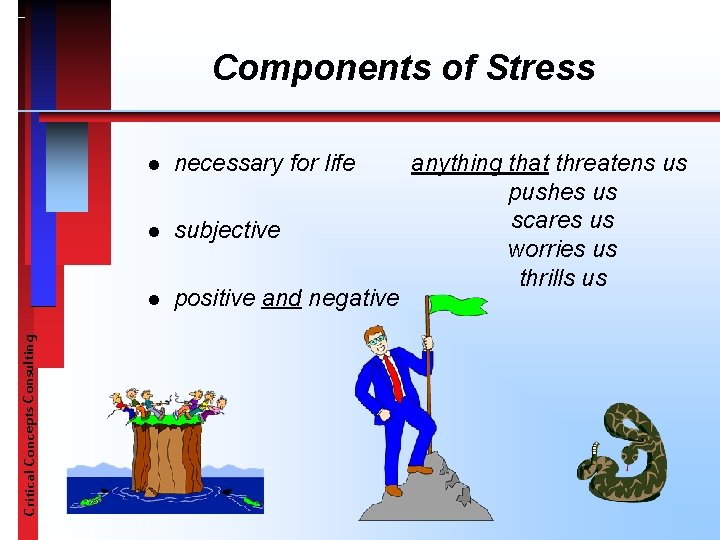
Critical Concepts Consulting Components of Stress l necessary for life l subjective l positive and negative anything that threatens us pushes us scares us worries us thrills us
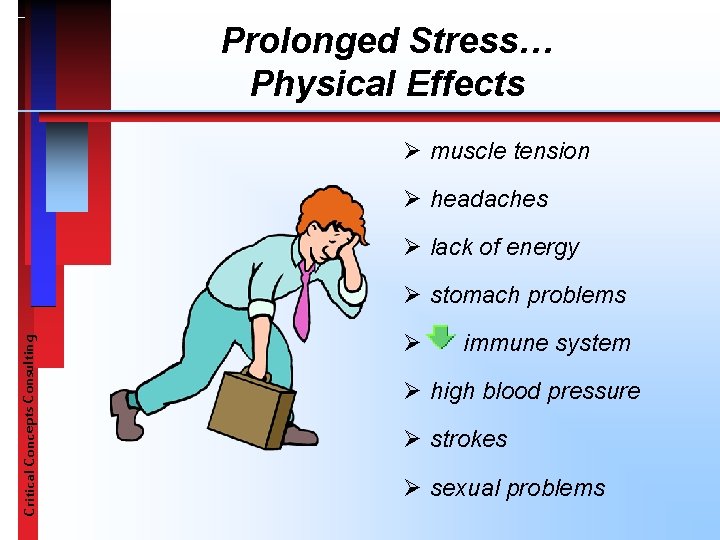
Prolonged Stress… Physical Effects Ø muscle tension Ø headaches Ø lack of energy Critical Concepts Consulting Ø stomach problems Ø immune system Ø high blood pressure Ø strokes Ø sexual problems
Prolonged Stress. . . Critical Concepts Consulting Psychological effects Ø Ø Ø Ø Ø depression anxiety anger confusion irritability impatience fear negativism memory problems helpless/hopeless
Prolonged Stress. . . Critical Concepts Consulting Behavioral effects Ø Alcohol and drug use Ø Change in usual behavior Ø Withdrawal Ø Acting out Ø Silence / talkative Ø Under / Overeating Ø Hypervigilance Ø Impulsive
Stressor Any event acting as a stimulus which places a demand upon a person, a group, or an organization.
What are your stressors? 8 Home 8 Work 8 Environment 8 Biogenic 8 Law Enforcement 8 Psychosocial
Critical Concepts Consulting Home Stressors Ø Spouse/SO Ø Children Ø Family demands Ø Finances Ø Role in the home Ø Family illness Ø Shift changes Ø Relatives
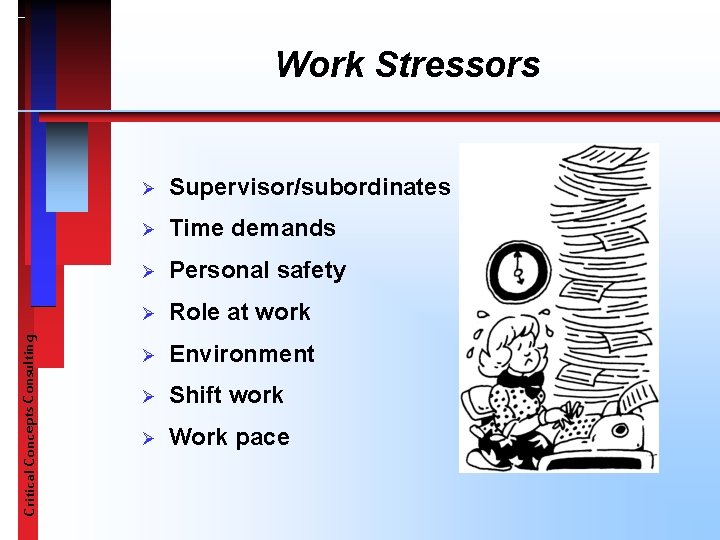
Critical Concepts Consulting Work Stressors Ø Supervisor/subordinates Ø Time demands Ø Personal safety Ø Role at work Ø Environment Ø Shift work Ø Work pace
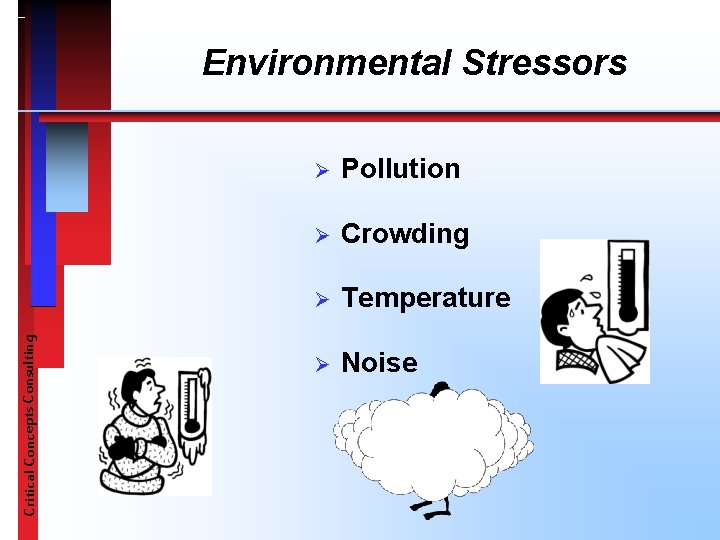
Critical Concepts Consulting Environmental Stressors Ø Pollution Ø Crowding Ø Temperature Ø Noise
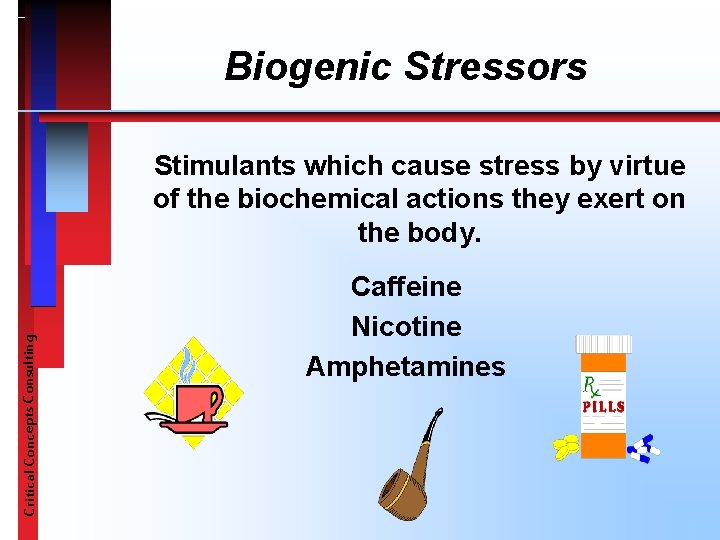
Biogenic Stressors Critical Concepts Consulting Stimulants which cause stress by virtue of the biochemical actions they exert on the body. Caffeine Nicotine Amphetamines
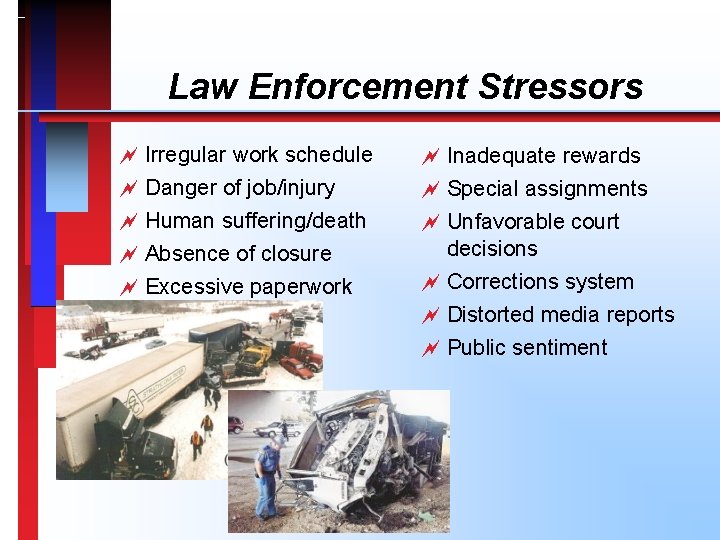
Law Enforcement Stressors ~ Irregular work schedule ~ Danger of job/injury ~ Human suffering/death ~ Absence of closure ~ Excessive paperwork ~ Inadequate rewards ~ Special assignments ~ Unfavorable court decisions ~ Corrections system ~ Distorted media reports ~ Public sentiment
Psychosocial Stressor Critical Concepts Consulting Those events that are interpreted or appraised as being challenging, threatening, or otherwise adverse. Like beauty -They lie in the eye of the beholder.
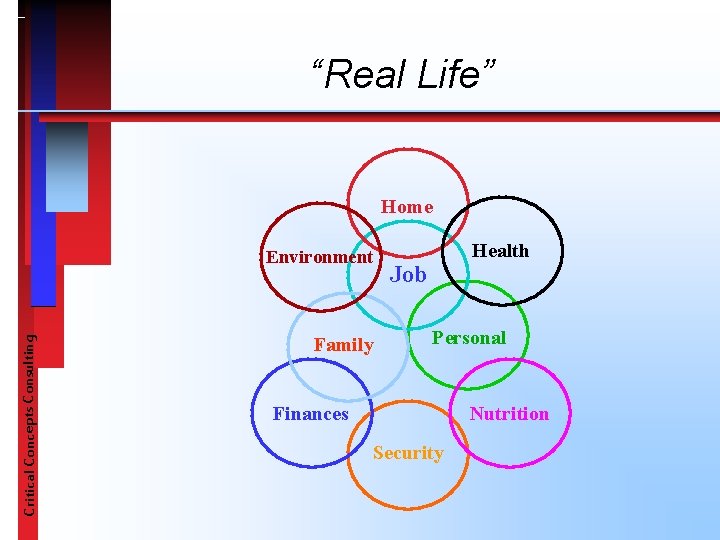
“Real Life” Home Critical Concepts Consulting Environment Family Health Job Personal Finances Nutrition Security
Critical Consulting Concepts. Consulting Critical. Concepts Coping Techniques for Managing Stress
Critical Concepts Consulting Steps in stress management è accept that you are constantly under stress è explore areas causing negative stress è practice effective stress management
Time Management Decide what's important and worth worrying about Critical Concepts Consulting Get organized Schedule time for relaxation and exercise Write it down!
Positive Attitude Know yourself and your "automatic thoughts" Communicate and express your feelings Rally your support system Critical Concepts Consulting Adopt a problem-solving approach
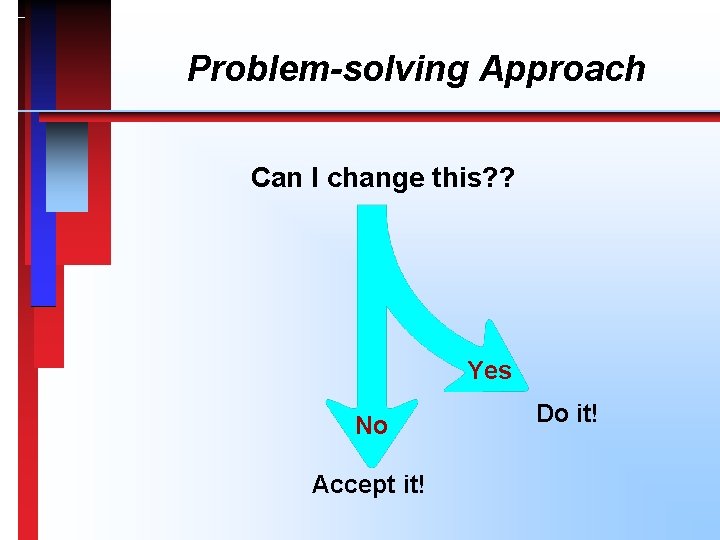
Problem-solving Approach Can I change this? ? Yes No Accept it! Do it!
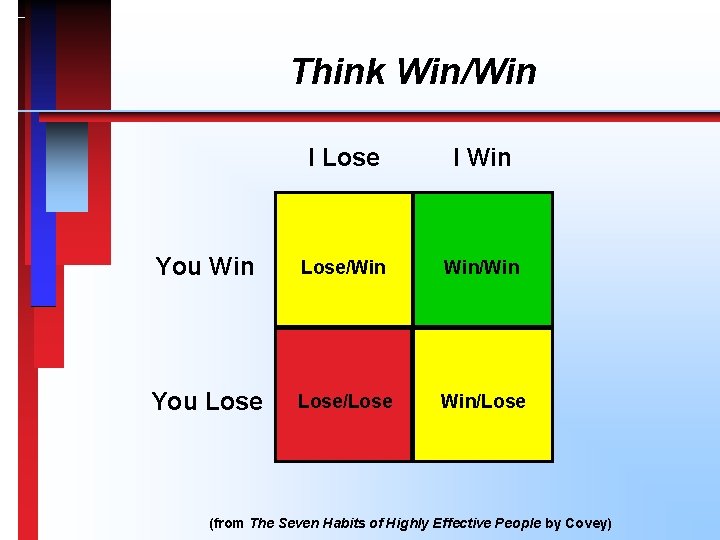
Think Win/Win I Lose I Win You Win Lose/Win Win/Win You Lose/Lose Win/Lose (from The Seven Habits of Highly Effective People by Covey)
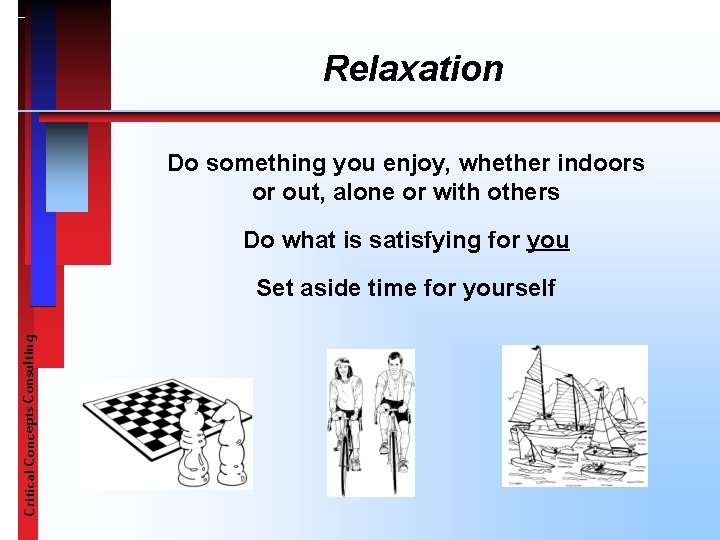
Relaxation Do something you enjoy, whether indoors or out, alone or with others Do what is satisfying for you Critical Concepts Consulting Set aside time for yourself
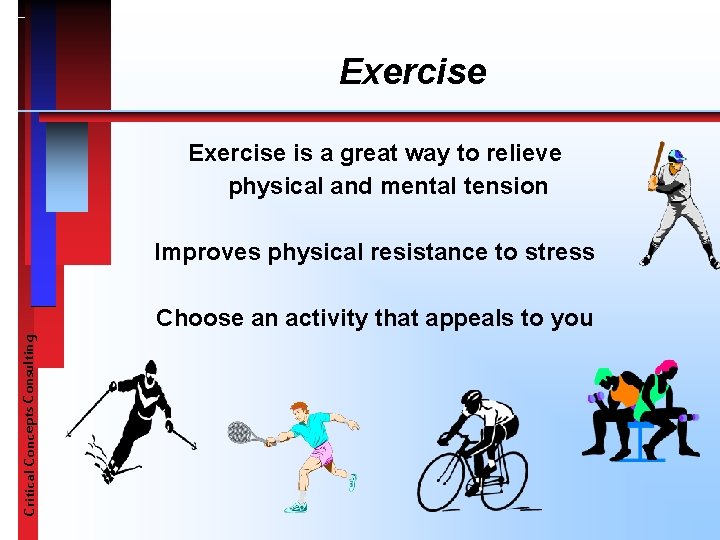
Exercise is a great way to relieve physical and mental tension Improves physical resistance to stress Critical Concepts Consulting Choose an activity that appeals to you
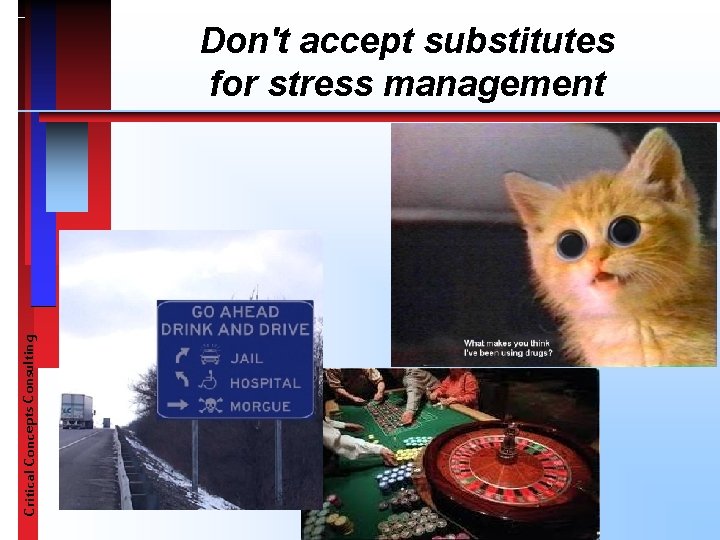
Critical Concepts Consulting Don't accept substitutes for stress management
Crisis Intervention Critical Concepts Consulting Peer Support Critical Incidents
Critical Concepts Consulting Post-Traumatic Stress Post - traumatic stress is a normal reaction, in a normal person, to an abnormal event.
Critical Concepts Consulting Post-Traumatic Stress Post-traumatic stress is a survival mechanism, Post Traumatic Stress Disorder is a pathogenic version of that survival mechanism.
Post Traumatic Stress Disorder Brief History 8 First Named in DSM - III, 1980 8 Military awareness 8 Civil War - nostalgia Critical Concepts Consulting 8 WWI - war neurosis, shellshock 8 WWII - combat fatigue/exhaustion 8 Post Vietnam - PTSD 8 Prevalence 8 General population: 1 -2% 8 Emergency Services: 16 -20%
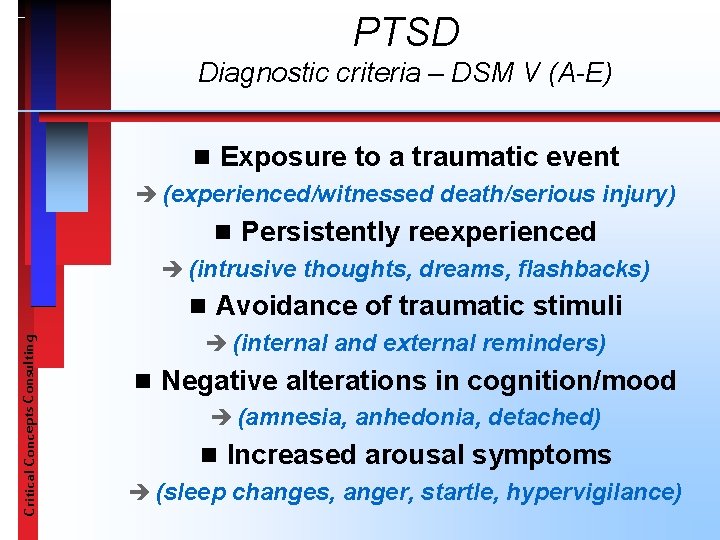
PTSD Diagnostic criteria – DSM V (A-E) n Exposure to a traumatic event è (experienced/witnessed death/serious injury) Critical Concepts Consulting n Persistently reexperienced è (intrusive thoughts, dreams, flashbacks) n Avoidance of traumatic stimuli è (internal and external reminders) n Negative alterations in cognition/mood è (amnesia, anhedonia, detached) n Increased arousal symptoms è (sleep changes, anger, startle, hypervigilance)
Critical Incident Critical Concepts Consulting In a career where day to day you respond to the abnormal events in other people’s lives; A critical incident is the one that, for whatever reason, is abnormal even for experienced personnel.
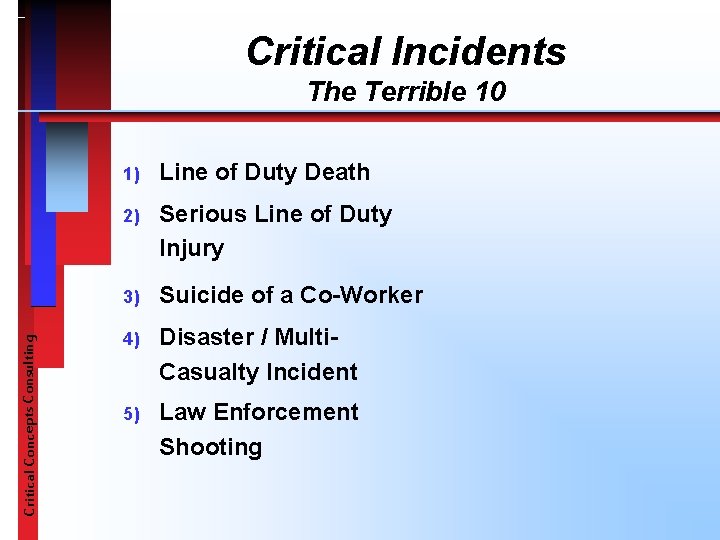
Critical Incidents Critical Concepts Consulting The Terrible 10 1) Line of Duty Death 2) Serious Line of Duty Injury 3) Suicide of a Co-Worker 4) Disaster / Multi. Casualty Incident 5) Law Enforcement Shooting
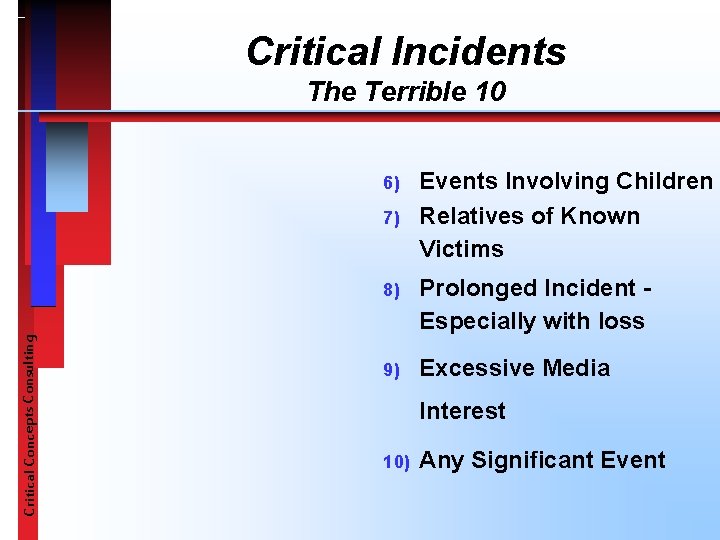
Critical Incidents The Terrible 10 6) Critical Concepts Consulting 7) Events Involving Children Relatives of Known Victims 8) Prolonged Incident Especially with loss 9) Excessive Media Interest 10) Any Significant Event
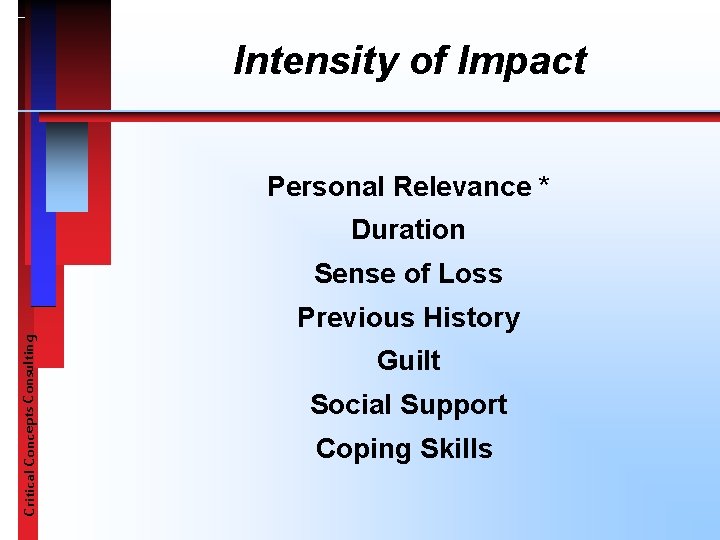
Intensity of Impact Personal Relevance * Duration Sense of Loss Critical Concepts Consulting Previous History Guilt Social Support Coping Skills
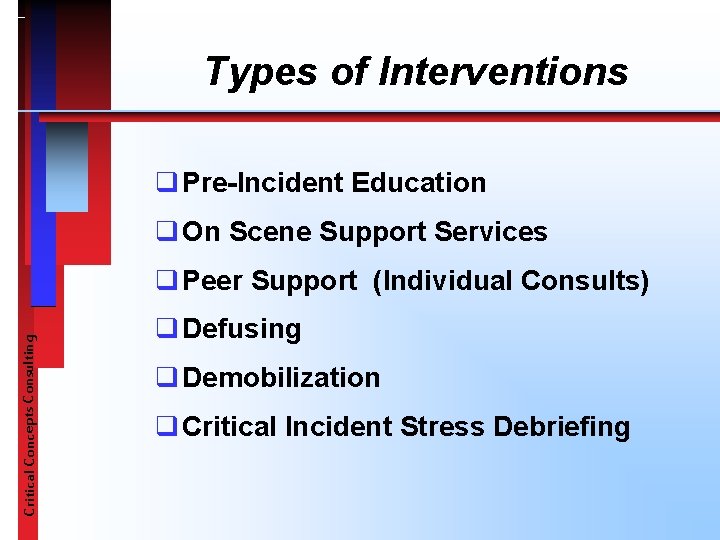
Types of Interventions q Pre-Incident Education q On Scene Support Services Critical Concepts Consulting q Peer Support (Individual Consults) q Defusing q Demobilization q Critical Incident Stress Debriefing
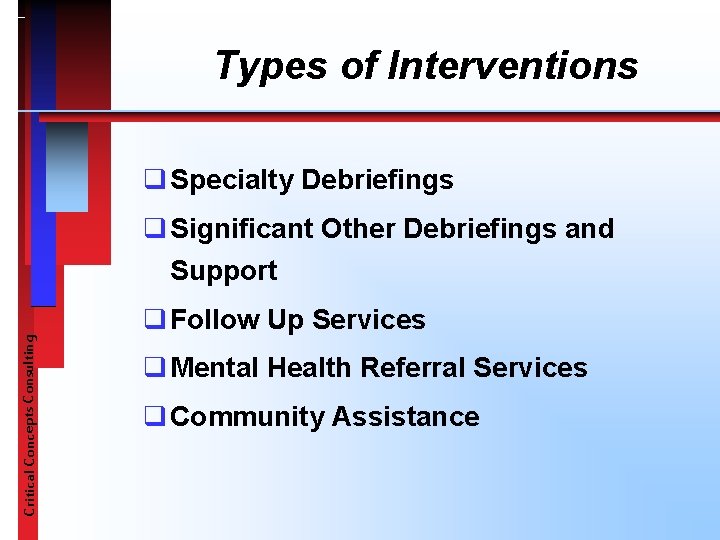
Types of Interventions q Specialty Debriefings q Significant Other Debriefings and Support Critical Concepts Consulting q Follow Up Services q Mental Health Referral Services q Community Assistance
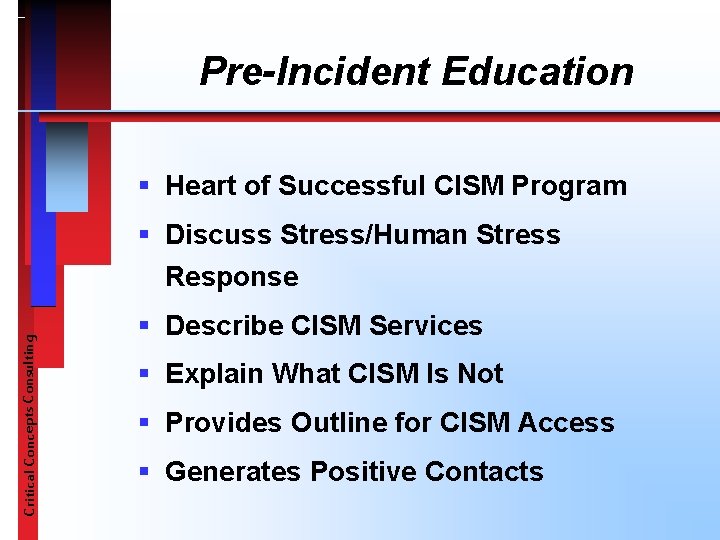
Pre-Incident Education § Heart of Successful CISM Program Critical Concepts Consulting § Discuss Stress/Human Stress Response § Describe CISM Services § Explain What CISM Is Not § Provides Outline for CISM Access § Generates Positive Contacts
Critical Concepts Consulting Peer Support/ Individual Crisis Intervention
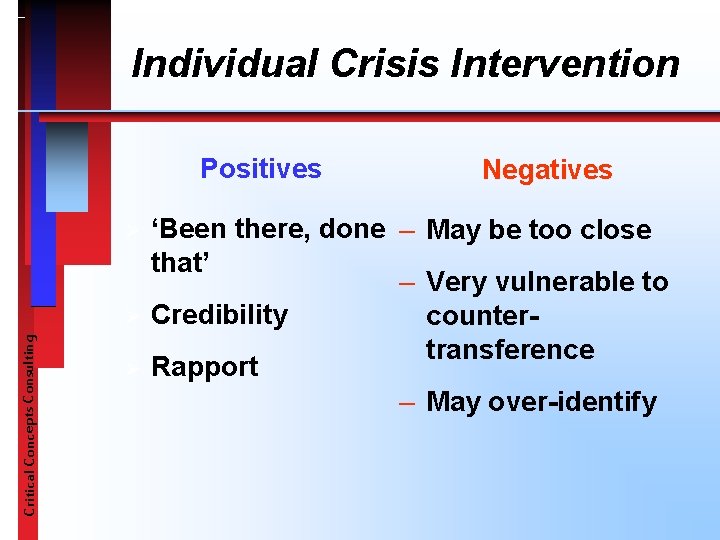
Individual Crisis Intervention Positives Ø Critical Concepts Consulting Ø Ø Negatives ‘Been there, done – May be too close that’ – Very vulnerable to Credibility countertransference Rapport – May over-identify
Critical Concepts Consulting 1: 1 Crisis Intervention § Communication Skills § Awareness of Acute Stress Symptoms § Intervention Protocol § Referral Options
Critical Concepts Consulting Rest Information Transition Services (RITS)
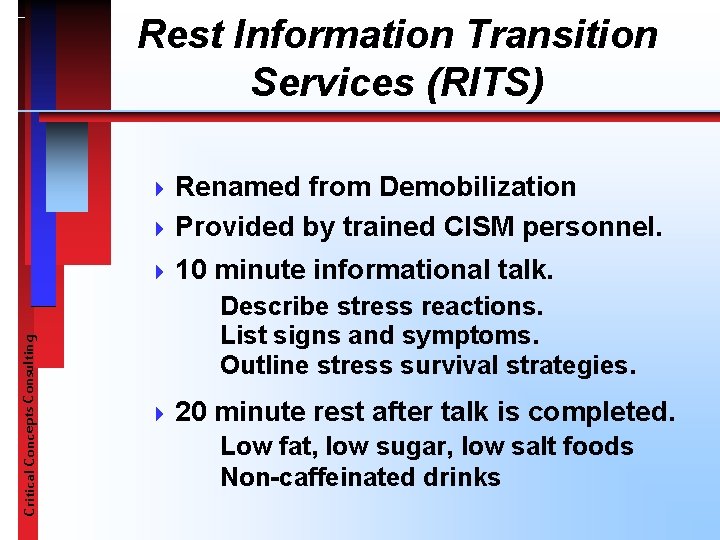
Rest Information Transition Services (RITS) 4 Renamed from Demobilization 4 Provided by trained CISM personnel. Critical Concepts Consulting 4 10 minute informational talk. Describe stress reactions. List signs and symptoms. Outline stress survival strategies. 4 20 minute rest after talk is completed. Low fat, low sugar, low salt foods Non-caffeinated drinks
Critical Concepts Consulting Crisis Management Briefing
Crisis Management Briefing Critical Concepts Consulting “…a group psychological crisis intervention designed to mitigate the levels of felt crisis and traumatic stress in the wake of terrorism, mass disasters, violence, and other “large scale” crises. ” IJEMH v 2(1) p. 53 -57 (2000)
Crisis Management Briefing Goals Inform and consult Allow psychological decompression Critical Concepts Consulting Stress management Similar to Demobilization but for non-operational personnel
Critical Concepts Consulting Defusing
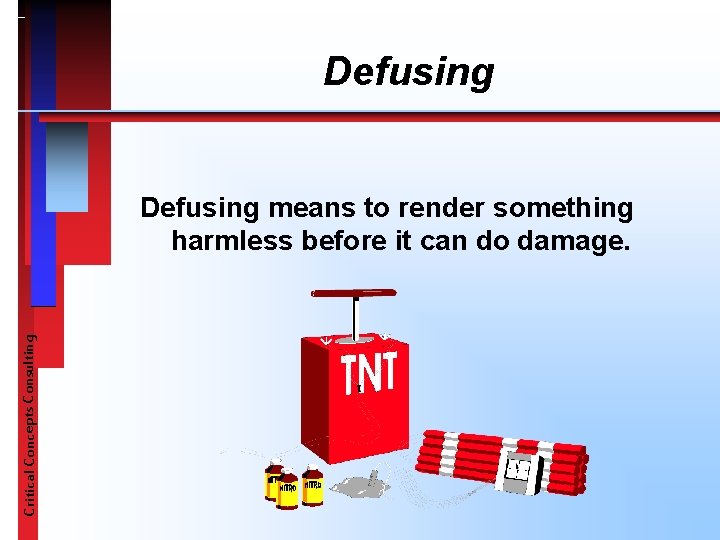
Defusing Critical Concepts Consulting Defusing means to render something harmless before it can do damage.
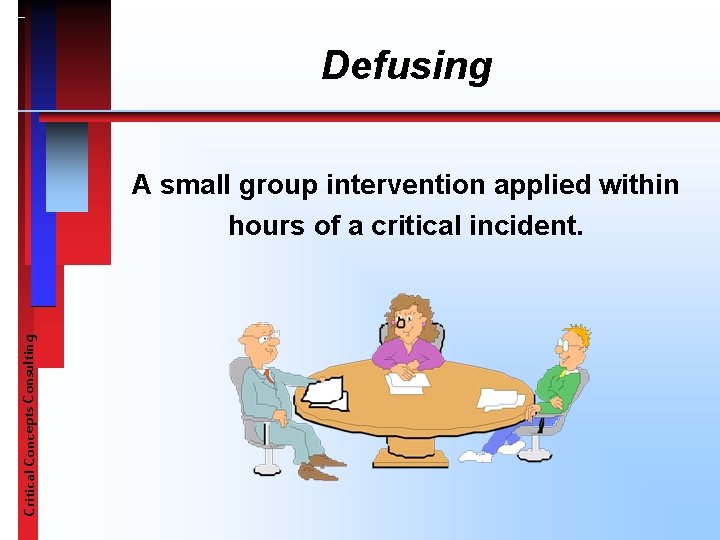
Defusing Critical Concepts Consulting A small group intervention applied within hours of a critical incident.
Defusing 1) Introductio Critical Concepts Consulting n 2) Exploration 3) Information
Critical Concepts Consulting Critical Incident Stress Debriefing
Critical Incident Stress Debriefing Critical Concepts Consulting The goal of a Critical Incident Stress Debriefing is psychological closure.
Debriefing Considerations 8 Large scale incident. 8 Prolonged incident. Critical Concepts Consulting 8 Circumstances out of the ordinary. 8 CISD is not therapy 8 CISD is not a substitute for therapy.
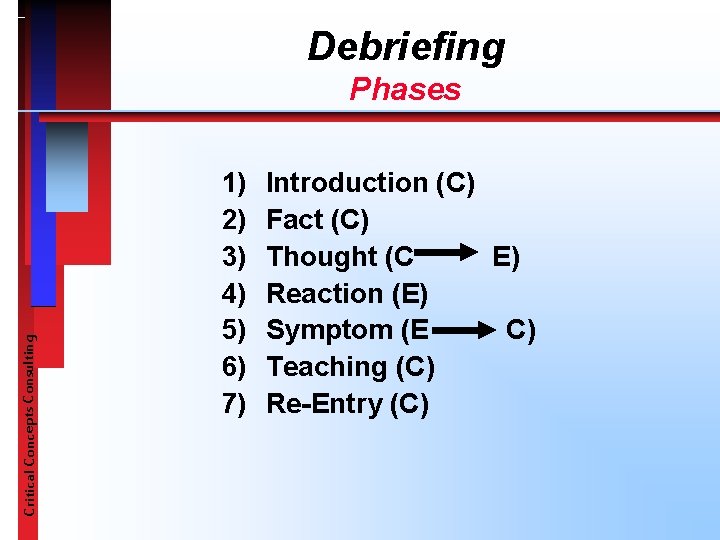
Debriefing Critical Concepts Consulting Phases 1) 2) 3) 4) 5) 6) 7) Introduction (C) Fact (C) Thought (C E) Reaction (E) Symptom (E C) Teaching (C) Re-Entry (C)
Mental Health Services Critical Concepts Consulting Psychotherapy for employees and family members: Individual Marital/couples Group Trooper applicant screening Training/Academy instruction Command consultation
Referrals & Appointments Ø Referrals: Critical Concepts Consulting • Directed • Voluntary Ø Appointments • Days off • Medical leave • Supervisor’s discretion
Confidentiality/ Privileged Communication è Privacy: a personal right which limits the access of others to certain information about one’s self, body, mind, etc. Critical Concepts Consulting è Confidentiality: a professional duty to refrain from speaking about certain matters è Privilege: a legal decision which provides relief from the duty to speak in court proceedings about certain matters
Limits of Confidentiality è RCW 71. 05 è RCW 26. 44 Critical Concepts Consulting è RCW 74. 34 è Danger to self or others è Abuse of children or DD adults è Abuse of vulnerable adults è Case review
Critical Concepts Consulting Questions? ?
Daniel W. Clark, Ph. D. Washington State Patrol 1405 Harrison Avenue NW Suite 205 Olympia, WA 98502 (360)-586 -8492 wsp-psych@att. net
- Slides: 58