
Critical Communication Improving patient communication followup and documentation


![Medical Malpractice • Breach – Deviation from the standard of care [advisory*] • Failure](https://slidetodoc.com/presentation_image/532f9a002389114c6afd3e560e283144/image-13.jpg "Medical Malpractice • Breach – Deviation from the standard of care [advisory*] • Failure")


- Slides: 51
Critical Communication Improving patient communication, follow-up and documentation to enhance care and reduce legal risk Peter I. Bergé, JD, PA Counsellor at Law Bendit Weinstock West Orange, NJ
What I do • Represent patients who were injured by the negligence of healthcare providers • Teach PAs, PA students and others how to avoid having their charts show up on my desk • Volunteer for the Medical Reserve Corps in New York City • A tiny bit of patient care
The Problem • Communication is at the root of many medical malpractice lawsuits, adverse outcomes, and patient complaints • Many of those lawsuits and complaints are justified • Many (not all) communication problems can be prevented by improved practices
The Problem “RTC if sx worsen”
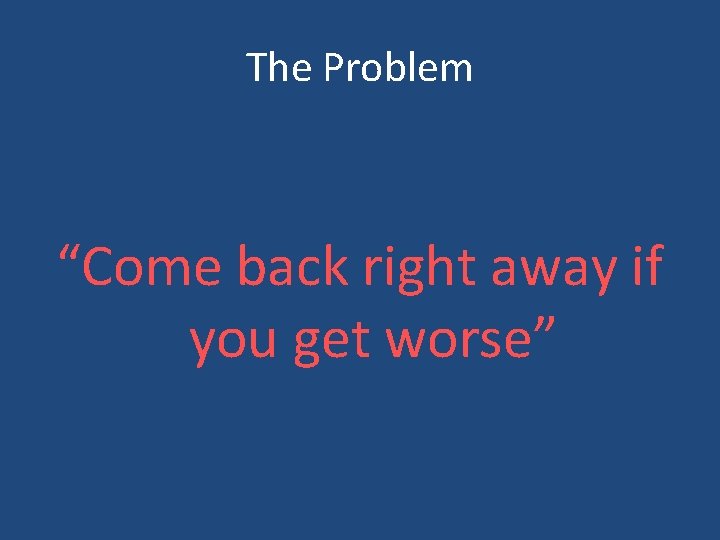
The Problem “Come back right away if you get worse”
Communication • Begins with listening • History taking – The ultimate history taking example • Assessment – Example
Communication • Assessment example – Fresh post-op patient in medical ICU – s/p urgent cervical spinal decompression – Received 0. 2 mg Dilaudid in OR – Awake and talking en route to ICU, denies pain – Awake and talking in ICU – Begins biting oxygen mask – Nurse administers morphine SO 4 2 mg IV and leaves room
Communication • Assessment example – A few minutes later notices bradycardia, desaturation – Bradyasystolic arrest ensues
Communication • Assessment example – What communication was missing? – Why? – What was the consequence?
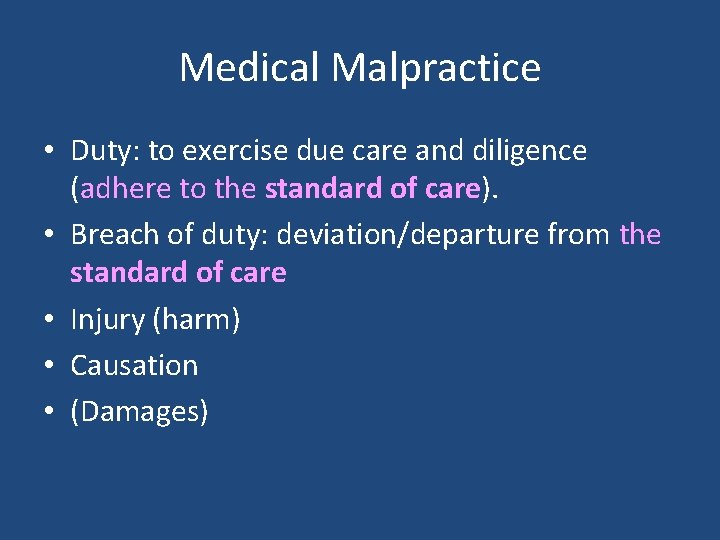
Communication and Medical Malpractice • Medical malpractice = negligence • Elements of negligence – Duty: to exercise due care and diligence – Breach of that duty – Injury (physical, psychological, economic) – Causation
Medical Malpractice • Duty: to exercise due care and diligence (adhere to the standard of care). • Breach of duty: deviation/departure from the standard of care • Injury (harm) • Causation • (Damages)
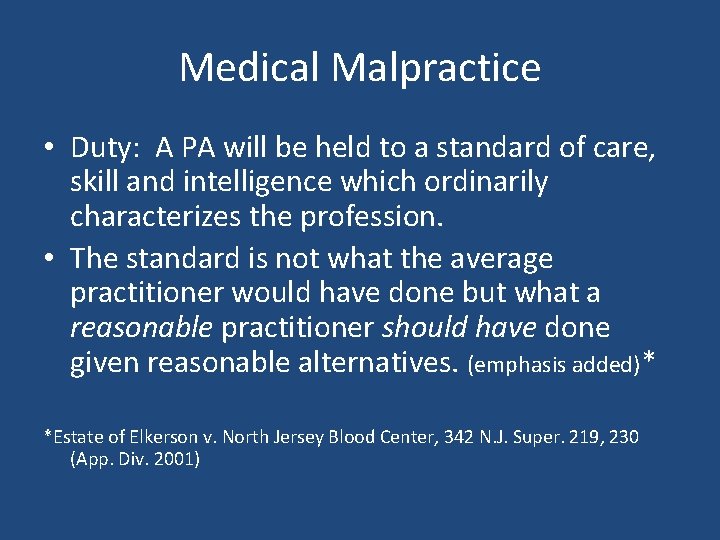
Medical Malpractice • Duty: A PA will be held to a standard of care, skill and intelligence which ordinarily characterizes the profession. • The standard is not what the average practitioner would have done but what a reasonable practitioner should have done given reasonable alternatives. (emphasis added)* *Estate of Elkerson v. North Jersey Blood Center, 342 N. J. Super. 219, 230 (App. Div. 2001)
Medical Malpractice • Breach – Deviation from the standard of care [advisory*] • Failure to obtain informed consent • Failure to properly communicate a diagnosis • Failure to properly communicate results of a diagnostic procedure *deviation is usually determined by the jury after hearing expert testimony
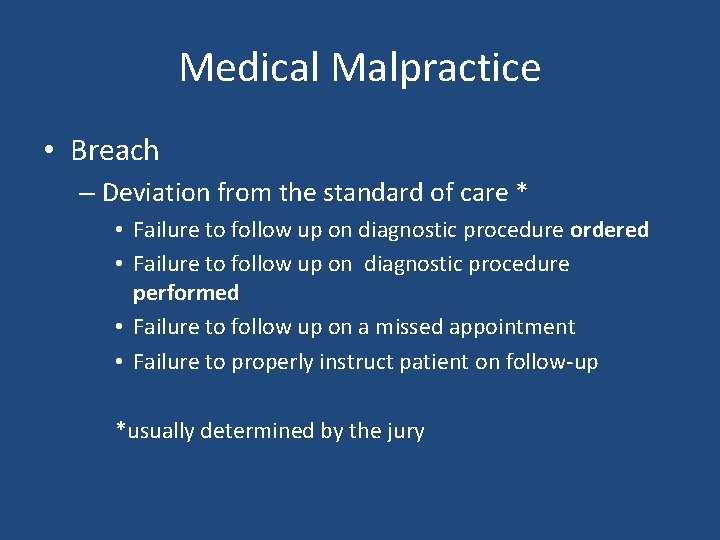
Medical Malpractice • Breach – Deviation from the standard of care * • Failure to follow up on diagnostic procedure ordered • Failure to follow up on diagnostic procedure performed • Failure to follow up on a missed appointment • Failure to properly instruct patient on follow-up *usually determined by the jury
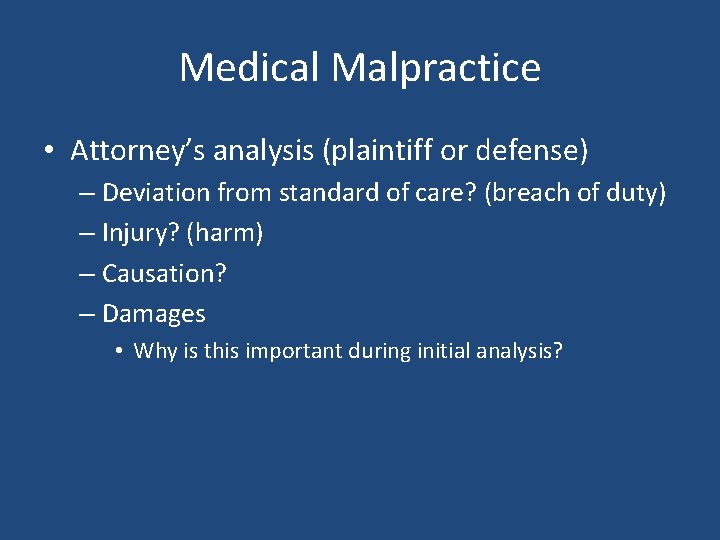
Medical Malpractice • Attorney’s analysis (plaintiff or defense) – Deviation from standard of care? (breach of duty) – Injury? (harm) – Causation? – Damages • Why is this important during initial analysis?
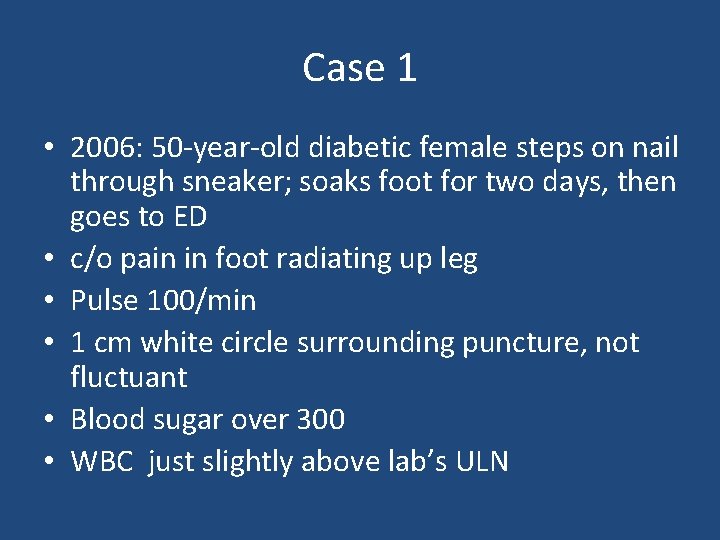
Case 1 • 2006: 50 -year-old diabetic female steps on nail through sneaker; soaks foot for two days, then goes to ED • c/o pain in foot radiating up leg • Pulse 100/min • 1 cm white circle surrounding puncture, not fluctuant • Blood sugar over 300 • WBC just slightly above lab’s ULN
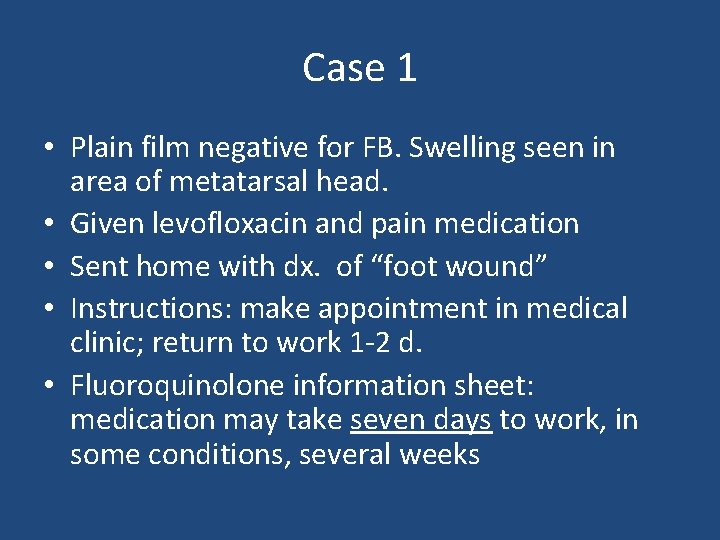
Case 1 • Plain film negative for FB. Swelling seen in area of metatarsal head. • Given levofloxacin and pain medication • Sent home with dx. of “foot wound” • Instructions: make appointment in medical clinic; return to work 1 -2 d. • Fluoroquinolone information sheet: medication may take seven days to work, in some conditions, several weeks
Case 1 • Anything missing here?
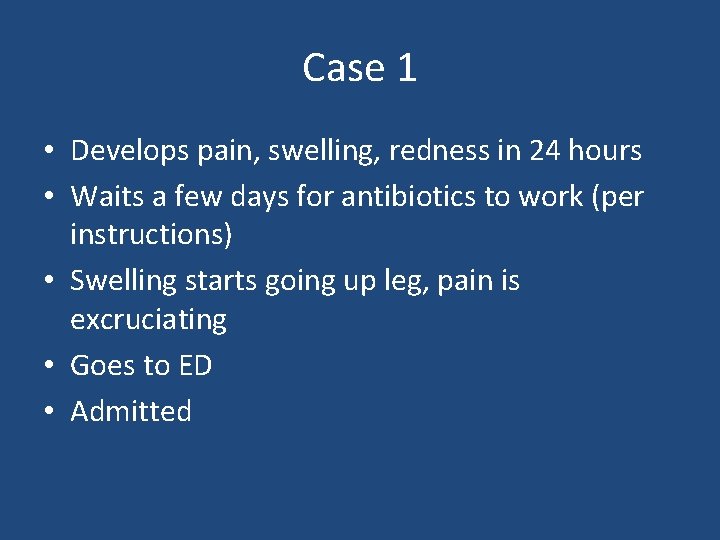
Case 1 • Develops pain, swelling, redness in 24 hours • Waits a few days for antibiotics to work (per instructions) • Swelling starts going up leg, pain is excruciating • Goes to ED • Admitted
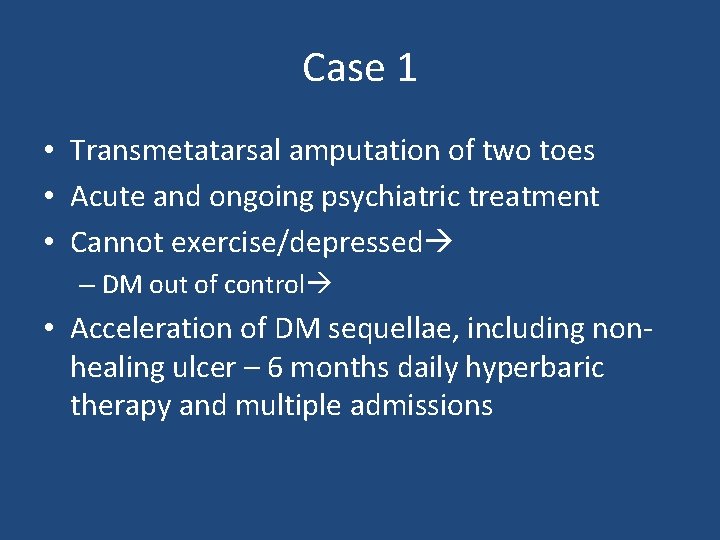
Case 1 • Transmetatarsal amputation of two toes • Acute and ongoing psychiatric treatment • Cannot exercise/depressed – DM out of control • Acceleration of DM sequellae, including nonhealing ulcer – 6 months daily hyperbaric therapy and multiple admissions
Case 1 • Deviations related to communication?
Case 1 • • Injury? Causation? Damages? Outcome?
Case 1 - Lessons • Follow-up instructions must be individualized • Take into account the worst case scenario • Don’t leave room for claim that “they never told me” • If you don’t chart it, you didn’t do it
Case 1 – Lessons • Why does it matter? – Case 1 with proper discharge instructions?
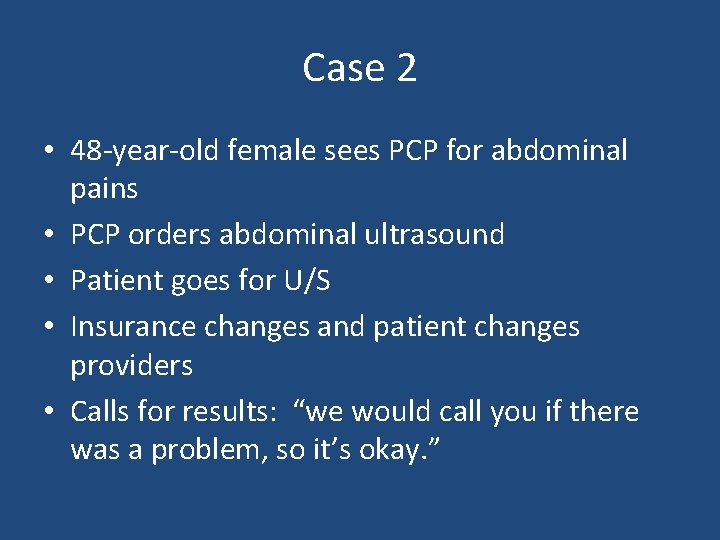
Case 2 • 48 -year-old female sees PCP for abdominal pains • PCP orders abdominal ultrasound • Patient goes for U/S • Insurance changes and patient changes providers • Calls for results: “we would call you if there was a problem, so it’s okay. ”
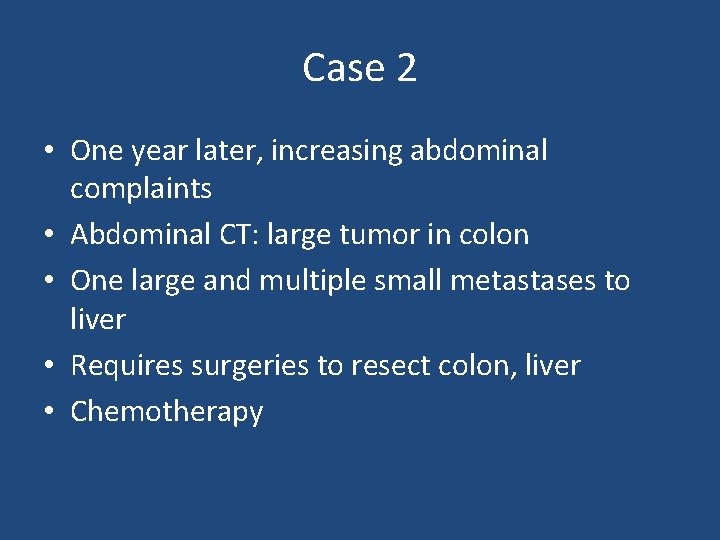
Case 2 • One year later, increasing abdominal complaints • Abdominal CT: large tumor in colon • One large and multiple small metastases to liver • Requires surgeries to resect colon, liver • Chemotherapy
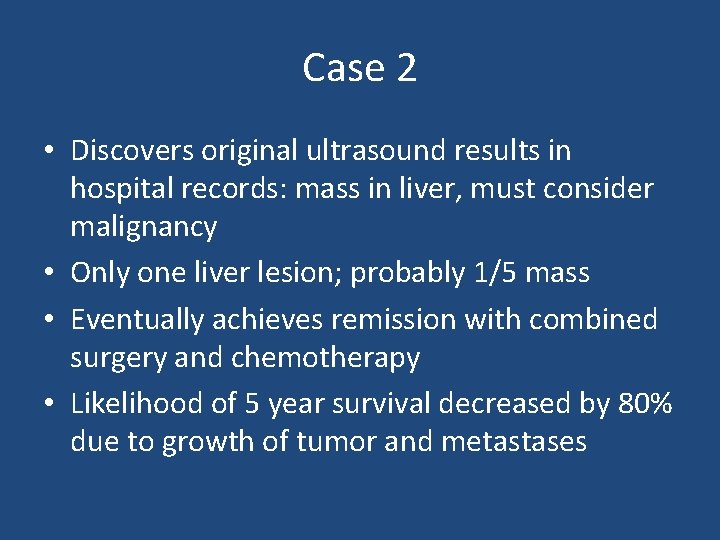
Case 2 • Discovers original ultrasound results in hospital records: mass in liver, must consider malignancy • Only one liver lesion; probably 1/5 mass • Eventually achieves remission with combined surgery and chemotherapy • Likelihood of 5 year survival decreased by 80% due to growth of tumor and metastases
Case 2 - Analysis • Deviation from SOC (breach)? • Injury? • Causation? • Damages?
Case 2 - Analysis • Damages • Outcome:
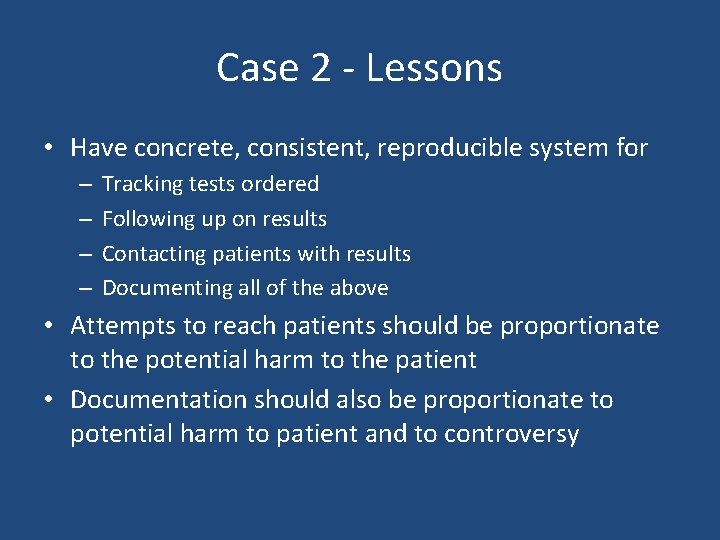
Case 2 - Lessons • Have concrete, consistent, reproducible system for – – Tracking tests ordered Following up on results Contacting patients with results Documenting all of the above • Attempts to reach patients should be proportionate to the potential harm to the patient • Documentation should also be proportionate to potential harm to patient and to controversy
Case 3 • 48 y/o woman sent to surgeon for mass in left axilla • Surgeon sends her to pathologist for FNA of lymph node • Path report: malignant cells consistent with breast carcinoma metastatic to lymph node
Case 3 • MRI: abnormal cluster of calcifications suspicious for cancer in light of positive FNA • Surgeon to patient: you have breast cancer. We must remove your breast or you will die.
Case 3 • In OR, surgeon sends a tissue sample from area where the MRI abnormality was probably located • No tumor found • Performs mastectomy
Case 3 • Deviations? – Pathologist? – Surgeon?
Case 3 • What is INFORMED CONSENT?
Informed Consent • What must be included? • Can a clinician express a preference? • What if the patient doesn’t want what you want? • What if the patient is unreasonable?
Informed consent • What is the role of “consent forms” in obtaining informed consent? • What is the role of charting? • Who can obtain informed consent? • Who is responsible for assuring that informed consent was given?
Informed Consent • When is informed consent required? • Why?
Take home lessons • Tests ordered, tests done must be followed up consistently; document • Never tell patient, “we won’t call you unless there is a problem”. Follow up must be affirmative, i. e. patient should expect/receive a positive or negative result
Take home lessons • Follow-up instructions to patients must be – Clear, appropriate to problem and patient – Well documented – Oral and in writing where practical – Cover contingencies, e. g. – Call if, come back if, to ED if, 911 if… – Specific times (not 48 -72) – Specific events (pain, fever, redness, swelling. streaking. . . )
Take home lessons • Follow up procedures for missed tests or appointments: – The more important, the more you document – The more important, the more you do • • Telephone calls (well-documented) Letters (CM-RRR? Fed. Ex? ) Call emergency contacts? Write to other providers?
Take home lessons OTHER COMMUNICATION POINTS • Tell patient what your concern is – Cancer, losing pregnancy, bleeding, etc. – Use the words and document that you did (do not leave room for patient to say that you didn’t tell her how serious it was) – Follow-up instructions need to be clear, detailed and individualized
Take home lessons OTHER COMMUNICATION POINTS • Use language that patient understands (English or otherwise) – no jargon! • Be aware of the cultural context of your patient populations • Can your patient read?
Examples – Standardized follow-up instructions • Include catch-all instructions – Call office if any problems with medications – Call if not improving in 72 hours or if worse at any time – To hospital if unable to drink liquids or keep liquids down; if light-headed; very high fever despite medication; or other severe problem and unable to reach provider quickly
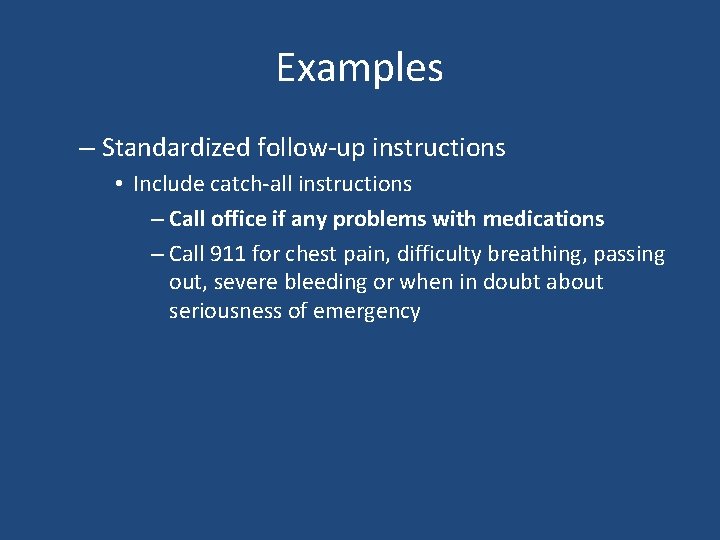
Examples – Standardized follow-up instructions • Include catch-all instructions – Call office if any problems with medications – Call 911 for chest pain, difficulty breathing, passing out, severe bleeding or when in doubt about seriousness of emergency
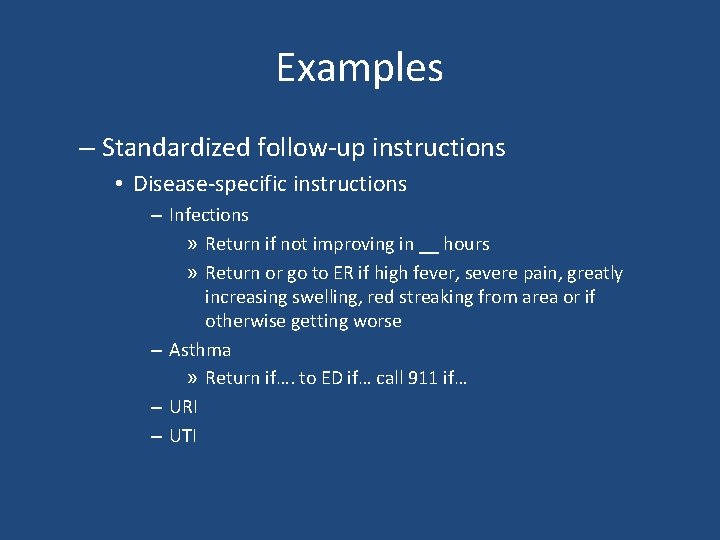
Examples – Standardized follow-up instructions • Disease-specific instructions – Infections » Return if not improving in __ hours » Return or go to ER if high fever, severe pain, greatly increasing swelling, red streaking from area or if otherwise getting worse – Asthma » Return if…. to ED if… call 911 if… – URI – UTI
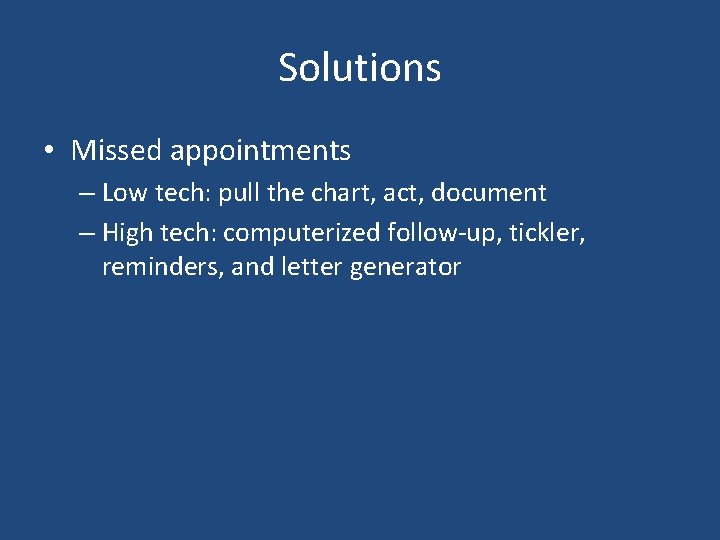
Solutions • Missed appointments – Low tech: pull the chart, act, document – High tech: computerized follow-up, tickler, reminders, and letter generator
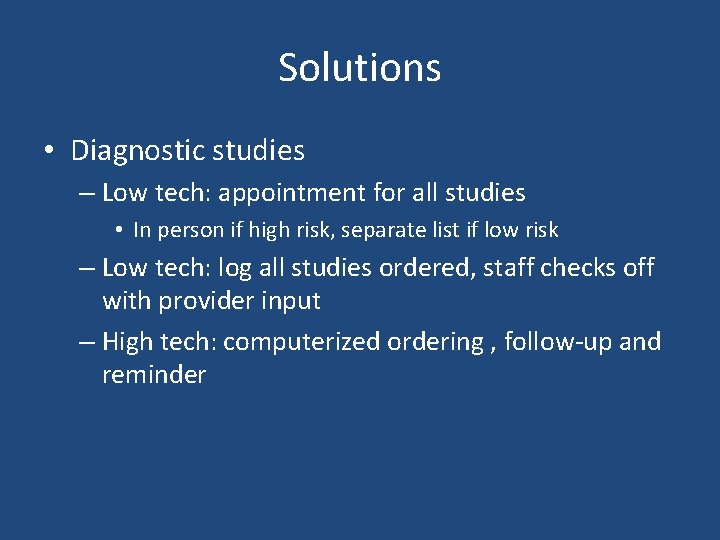
Solutions • Diagnostic studies – Low tech: appointment for all studies • In person if high risk, separate list if low risk – Low tech: log all studies ordered, staff checks off with provider input – High tech: computerized ordering , follow-up and reminder
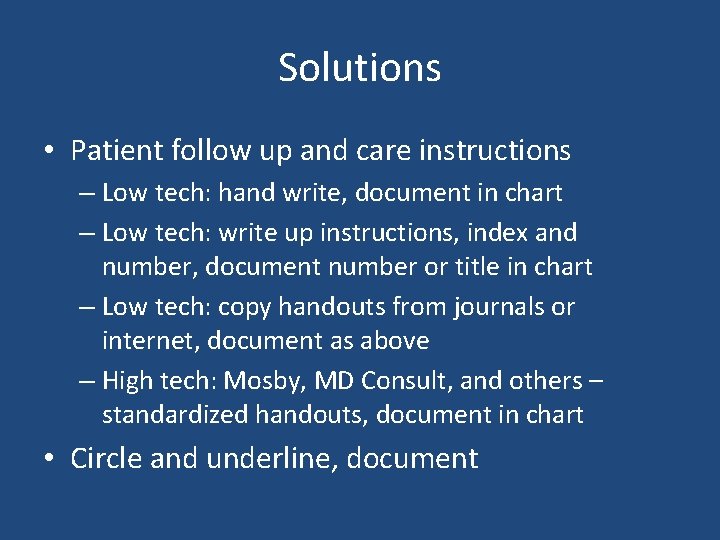
Solutions • Patient follow up and care instructions – Low tech: hand write, document in chart – Low tech: write up instructions, index and number, document number or title in chart – Low tech: copy handouts from journals or internet, document as above – High tech: Mosby, MD Consult, and others – standardized handouts, document in chart • Circle and underline, document
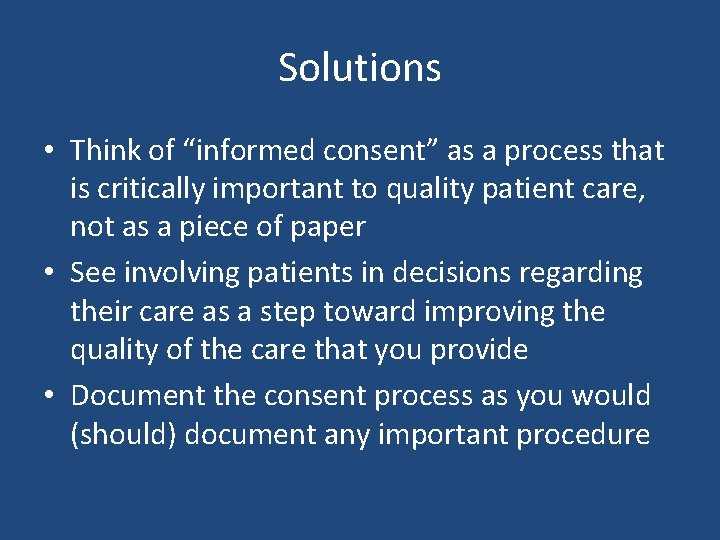
Solutions • Think of “informed consent” as a process that is critically important to quality patient care, not as a piece of paper • See involving patients in decisions regarding their care as a step toward improving the quality of the care that you provide • Document the consent process as you would (should) document any important procedure
Thank You • Please complete evaluations Peter I. Bergé, JD, PA pberge. atty@yahoo. com