
CRITICAL APPRAISAL OF SYSTEMATIC REVIEW Cochrane Database of
CRITICAL APPRAISAL OF SYSTEMATIC REVIEW Cochrane Database of Systematic Reviews 2018, Issue 10 Asha Mathai
Background � Anorexia nervosa shows increase of 50% to 60% in female lifetime prevalence rates in those who met DSM 5 criteria(Mustelin 2016; Smink 2014). � AN is associated with high morbidity and mortality rates compared to other psychiatric disorders (Harris 1998). � In longitudinal follow-up studies of chronically ill adults with AN, mortality rates of between 9% and 20% have been observed over 12 - to 20 -year follow-up periods (Fichter 2006; Sullivan 1995). � The long-term prognosis is poor and high rates of relapse have been reported (Berkman 2007)
� AN is thought to be influenced by environmental factors including the family environment. � The aim of Structural Family Therapy is to alter the family’s processes that contribute to the problem and therefore treat the AN
� Original Cochrane Review investigating family therapy in AN was published in 2010 (Fisher 2010) � The overall conclusion from the original review was that there was some evidence to suggest that family therapy may be effective compared to treatment as usual in the short term. � However, this was based on few trials that included only a small number of participants, all of which had issues about potential bias. � There was insufficient evidence to be able to determine whether family therapy offers any advantage over other types of psychological interventions, or whether one type of family therapy is more effective than another.
�Clinical � To question to be answered : evaluate the efficacy of family therapy approaches compared with standard treatment and other treatments in AN.
�Did the review explicitly address a sensible clinical question? �Yes
�Studies �RCT included :
�P: any age or gender with a primary clinical diagnosis of anorexia nervosa
� Intervention : ‘Family therapy’ as amonotherapy or in conjunction with other interventions � The main types of family therapy : 1. Structural family therapy 2. Systems (systemic) family therapy 3. Strategic family therapy 4. Family-based therapy and its variants (including short-term, long-term, and separated) and behavioural family systems therapy 5. Other (including other approaches that use family involvement in therapy).
� Control : 1. Standard care 2. Biological interventions (antidepressants, antipsychotics, mood stabilisers, anxiolytics) 3. Educational interventions ( nutritional interventions and dietetics) 4. Psychological interventions (cognitive behavioural therapy (CBT) , interpersonal therapy, supportive therapy, psychodynamic therapy, play therapy) 5. Alternative or complementary interventions ( exercise, light therapies).
�Main 1. 2. 3. 4. comparisons Family therapy approaches versus standard care/treatment Family therapy approaches versus psychological interventions Family therapy approaches versus educational interventions Family therapy approach versus other type of family therapy approach

�Search method : � Cochrane Common Mental Disorders Controlled Trials Register (CCMDCTR) and Psyc. INFO (OVID) (all years to. NApril 2016). � Cochrane Central Register for Controlled Trials (CENTRAL), MEDLINE, Ovid Embase, and Psyc. INFO (to 2008 and 2016 to 2018). � World Health Organization (WHO) trials portal (ICTRP) and Clinical. Trials. gov(all years to 2018). � Checked the reference lists of all included studies and relevant systematic reviews. � They included in the analyses only studies from searches conducted to April 2016.
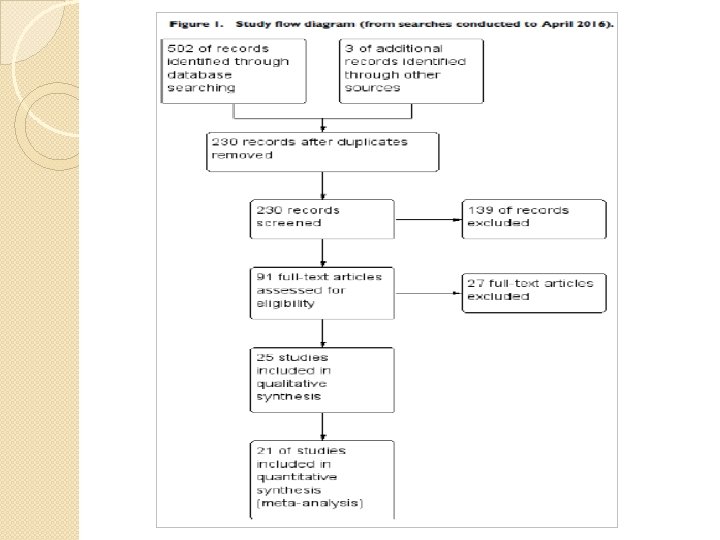
�Was the search for relevant studies exhaustive? Yes � 220 records from the CCMD-CTR � 179 from Pub. Med � total - 505 references � Selected 91 papers from title and abstract screening for fulltext review � Retained a total of 25 studies for inclusion �
SELECTION AND ASSESMENT OF THE STUDIES � 4 review authors independently selected studies for possible inclusion in the review � Independently reviewed the titles and abstracts of trials identified fromthe search. � review authors independently examined the full text of all studies that they considered to be of possible relevance. � Each review author compiled a list of studies that they believed met the inclusion criteria. � compared the contents of each review author’s list, and discussed any discrepancies. � Solved any disagreement by discussion and consensus between all of the review authors.
Were selection and assessment of studies reproducible? � Yes � More than one reviewer � Pre planned formats for data extraction
Did the review present results that are ready for clinical application? � Primary outcomes 1. Remission (by DSM or ICD or trialist-defined cut-off on standardised scale) 2. All-cause mortality � Secondary outcomes 1. Family functioning as measured on standardised, validated and reliable measures 2. General functioning, measured by return to school or work, or by general mental health functioning measures 3. Dropout (by rates per group during treatment) 4. Eating disorder psychopathology (evidence of ongoing preoccupation with weight/shape/food/eating by eating-disorder
5. Weight, 6. Relapse (by DSM or ICD or trialist-defined criteria) Classified outcomes as: 1) immediate post-intervention 2) short-term (< 12 months) follow-up 3) long-term (> 12 months) follow-up.
Did the review provide a rating for confidence in effect estimates or provide the information I need to evaluate confidence? Yes
ASSESMENT OF RISK OF BIAS � Two of four review authors independently assessed the risks of bias of each of the included trials using a descriptive approach of the Cochrane Handbook for Systematic Reviews of Interventions � Graded each criterion as low risk of bias, high risk of bias or unclear risk of bias � Review authors discussed any disagreement in the assessment of risks of bias to reach a consensus.
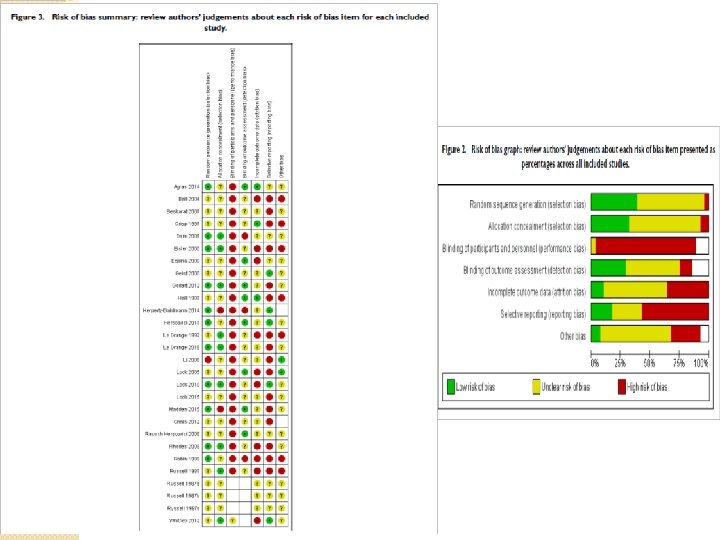
What is the risk of bias across all the studies? � Predominantly unclear and high risk � no or unclear information was provided about whether a random sequence was generated for allocation � Blinding � For of patients – not possible clinician-rated outcomes blinding was not carried out, or was unmasked, in three trials , was unclear 16 trials
�Do the systematic review population, intervention, comparison, and outcomes fit the patient at hand ? Baseline imbalances for particular core characteristics � small sample sizes <30 participants � unspecified treatment dosages/durations � potential contamination from the same therapist conducting both types of therapy �
Are the results inconsistent across studies (i. e. , inconsistency)? � Inconsistencies between the description of the results in the text, and the actual outcome data given in tables (Ball 2004; Crisp 1991; Dare 2001) � Inconsistencies in the participant numbers reported for various outcome measures throughout trials (Besharat 2001; Dare 2001; Robin 1999; Russell 1987).
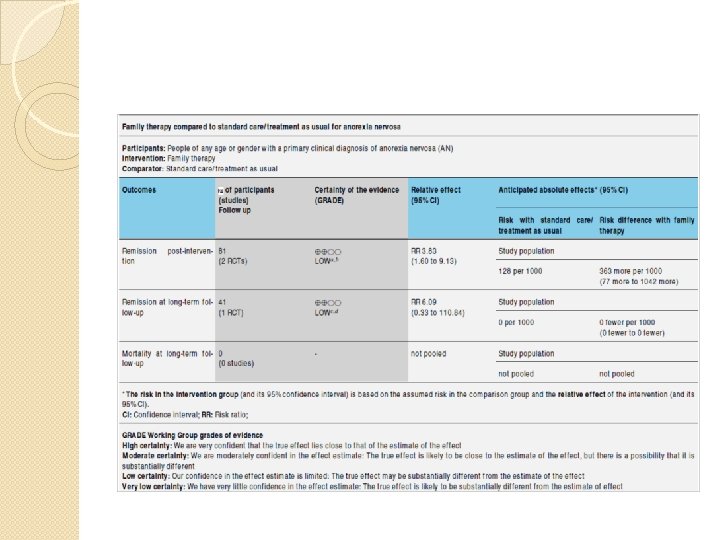
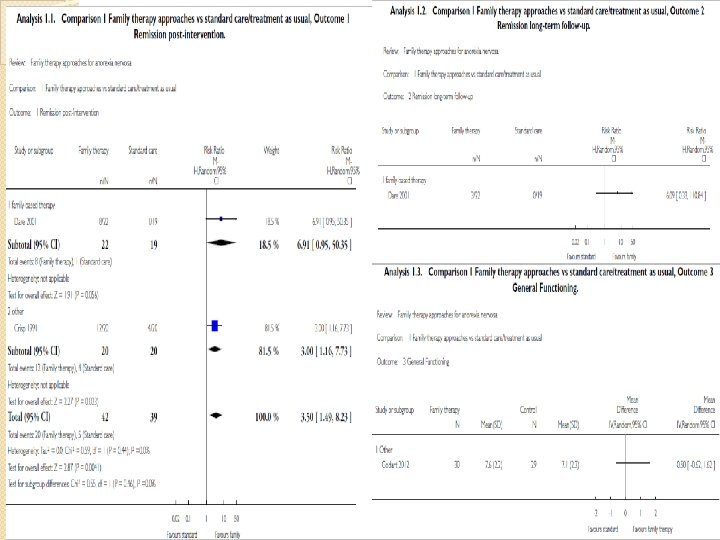
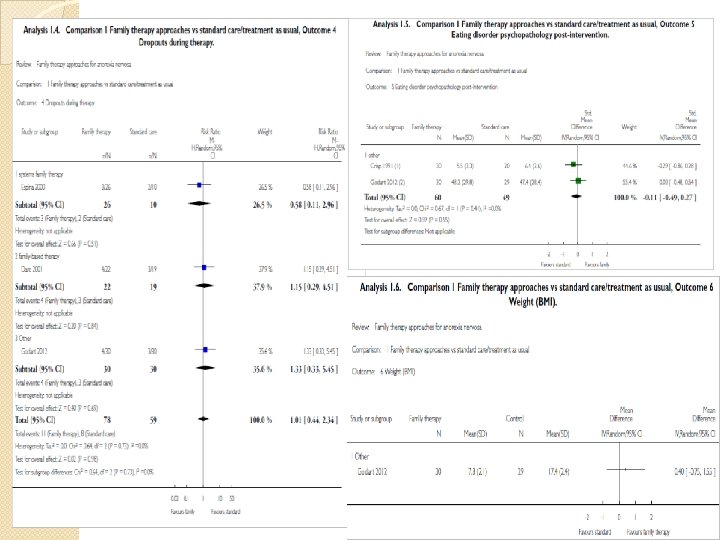
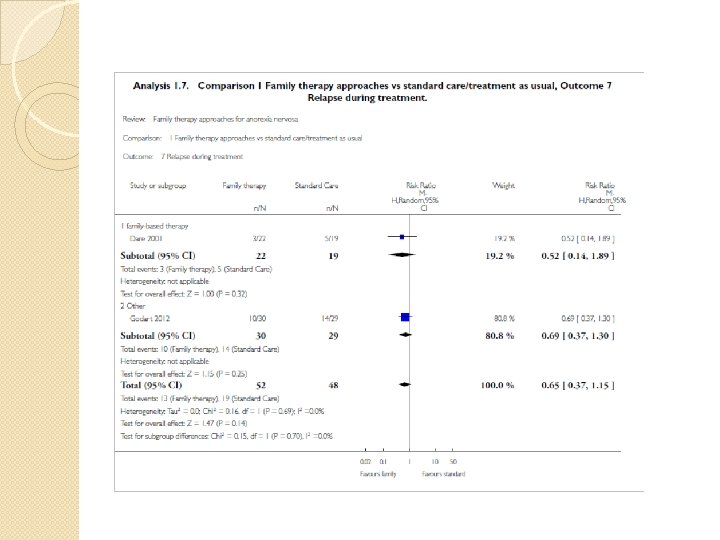
�What are the overall results of the review?
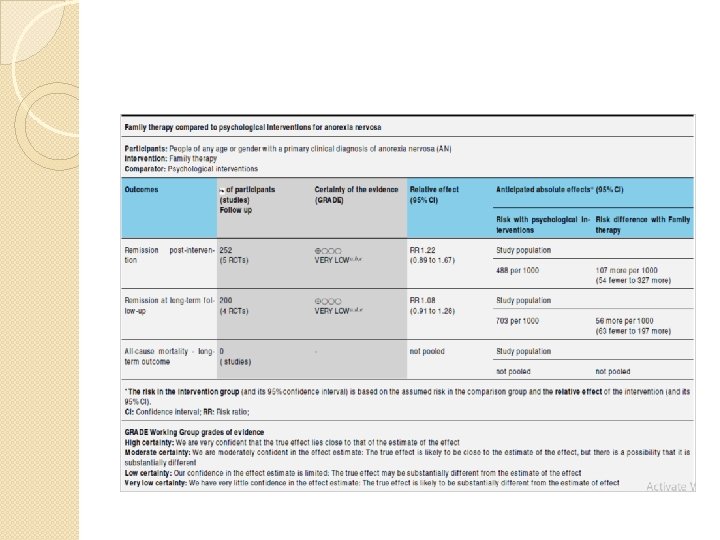
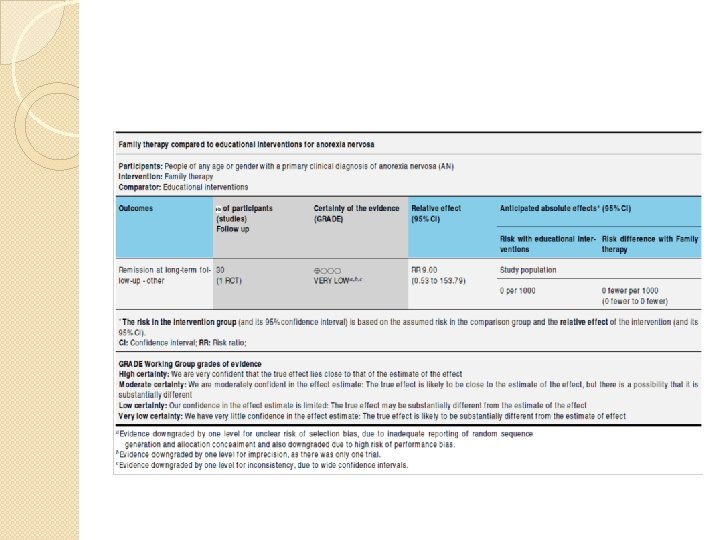
Is there a high likelihood of publication bias?
Do you consider the magnitude of treatment effect large ? � Remission in family therapy versus standard therapy � Risk ratio (RR) 3. 50 � 95% confidence interval 1. 49 to 8. 23
- Slides: 33