
Critical Appraisal of Professionalism Learning Objectives Johanna Shapiro
Critical Appraisal of Professionalism Learning Objectives Johanna Shapiro, Ph. D.
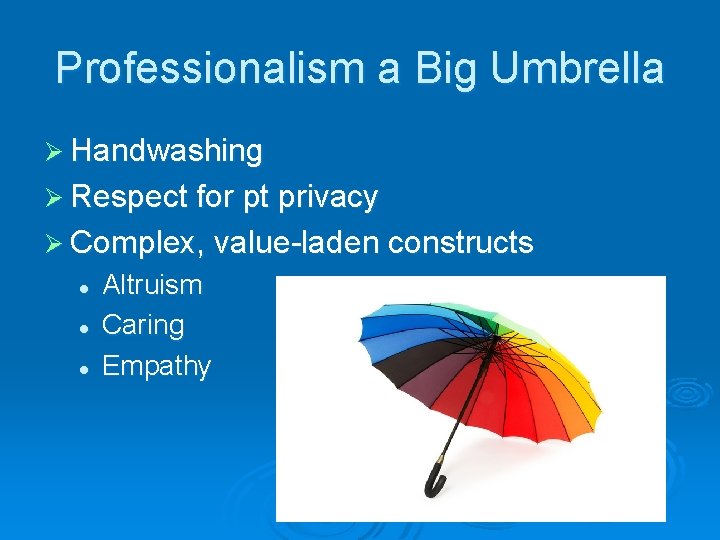
Professionalism a Big Umbrella Ø Handwashing Ø Respect for pt privacy Ø Complex, value-laden constructs l l l Altruism Caring Empathy
All Professionalism Is Not Created Equal Ø Some aspects lend themselves well to targeted learning objectives Ø Trickier when the learning objective touches on who the learner is, as well as what she does l Attitudes/values, as well as behavior Ø Subsequent remarks refer to the more nebulous, but equally important aspects of professionalism
“Good” and “Not so Good” Learning Objectives Ø Good learning objective – l l Concrete, specific, measurable, behavioral Uses words such as “enumerate, ” “demonstrate, ” “list” Ø Bad learning objective l l Vague, difficult to substantiate Uses words like “understands, ” “has greater awareness of, ” “recognizes, ” “desires”
The Way We Frame the Question Shapes the Answer Ø “Measurable outcomes” to assess learning objectives suggests things that can be counted, enumerated, and listed l Ø Behaviors to the exclusion of values, emotions Should we be asking other questions? l l l What are your values? How do you practice your values? How do you implement critical thinking regarding professionalism in the clinical context?
The Illusion of Rigor Ø When misapplied, numerical scores/ quantification can be misleading l l Ø Numbers whose real-world anchors are virtually meaningless (is compassion a 4 or a 5? ) Not everything that counts can be counted (Denis Burke, M. D. ) Concomitant danger of assuming everything (i. e. , one's level of ethicality) can be quantitatively measured l l l Content is fairly easily measured Process is not Yet process is what much of MH and ethics is interested in
Meaningful Evaluation Ø Innovative ideas – l l l Ø Humanism connoisseur (Misch) Quantifying reflective writing (Wald) Portfolios (Fryer-Edwards) Change the culture l l Self-awareness, reflection and critical thinking 360 degree narrative evaluations with active feedback and interaction A culture where the norm is “deep professionalism” will be in less need of measurable outcomes Identification of the absolute worst and best students (the one for intervention, the other for recognition)
What is Professionalism? Ø A professional is one who is “able to make a promise to help, to keep that promise, and to do so in the best interests of the patient. To be a professional is to accept the trust the patient must place in us as a moral imperative…. A true professional is, in sum, an ordinary person called to extraordinary duties by the nature of the activities in which he or she has chosen to engage. ” - Edmund Pellegrino
- Slides: 8