
Critical appraisal of a diagnostic test Dr Jacob
Critical appraisal of a diagnostic test Dr Jacob

Background • Tuberculosis (TB) is theworld’s leading infectious cause of death. • Extrapulmonary TB accounts for 15%of TB cases • Xpert is a World Health Organization (WHO)-recommended, rapid, automated, nucleic acid amplification assay that is used widely for simultaneous detection of Mycobacterium tuberculosis complex and rifampicin resistance in sputum specimens. • This Cochrane Review assessed the accuracy of Xpert in extrapulmonary specimens.
• Population: All ages from all settings and countries who were thought to have extrapulmonary TB. • Randomized controlled trials, cross-sectional studies, and observational cohort studies were included • Searched the Cochrane Infectious Diseases Group Specialized Register, MEDLINE, Embase, Science Citation Index, Web of Science, Latin American Caribbean Health Sciences Literature (LILACS), Scopus, Clinical. Trials. gov, the. WHO International Clinical Trials Registry Platform, the International Standard Randomized Controlled Trial Number (ISRCTN) Registry, and Pro. Quest up to 7 August 2017 without language restriction
Aim • To determine the diagnostic accuracy of Xpert for extrapulmonary TB by site of disease in people presumed to have extrapulmonary TB • • Diagnostic accuracy of Rifampicin resistance in people presumed to have extrapulmonary TB.
How serious was the risk of bias? • Did the participating patients constitute a representative sample of those presenting with a diagnostic dilemma? • Diagnostic accuracy studies of Xpert in people presumed to have extrapulmonary TB were included. • Subjects with TB meningitis and pleural, lymph node, bone or joint, genitourinary, peritoneal, pericardial, and disseminated TB • Consecutive patients were probably not included in the individual studies as some were observational studies
• Did investigators compare the test to an appropriate, independent reference standard? • Culture was taken as the reference standard. • For pleural TB, a composite reference standard was also included, which defined a positive result as the presence of granulomatous inflammation or a positive culture result.
• Were those interpreting the test and the reference standard blind to the other result? • This was a systematic review and so was not blind, but two independent reviewers reviewed the results
• Did all patients receive the same reference standard irrespective of the test result? • Yes, the same reference standard was used in all the patients
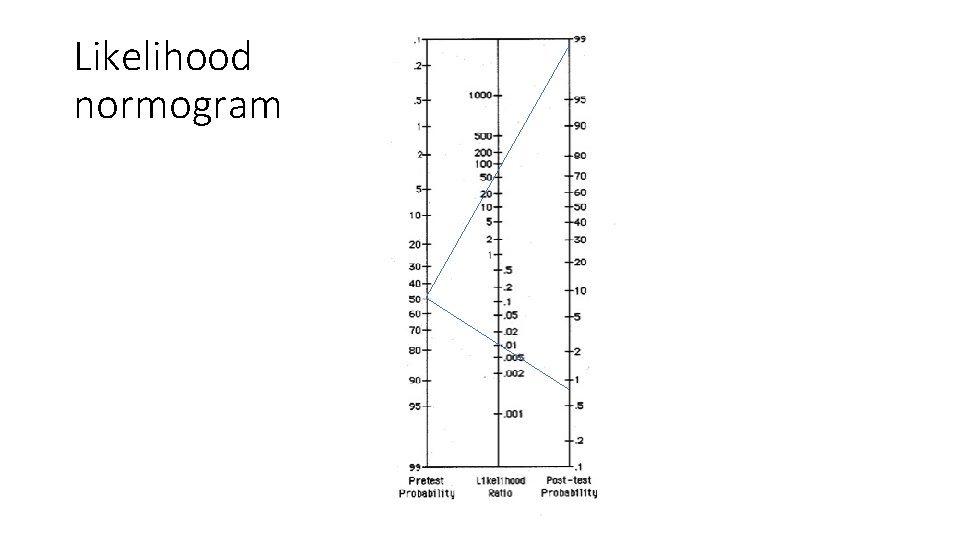
What are the results? • What likelihood ratios were associated with the range of possible test results?
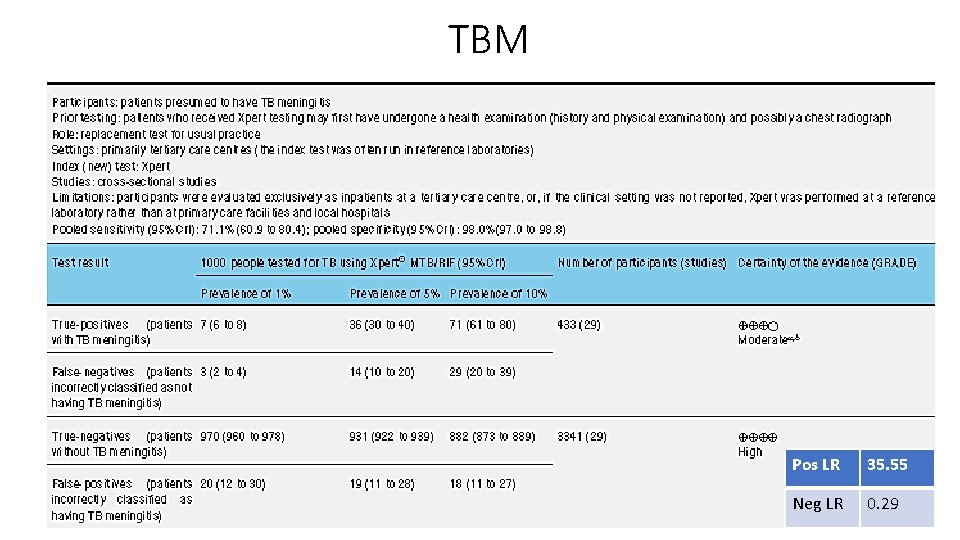
TBM Pos LR 35. 55 Neg LR 0. 29
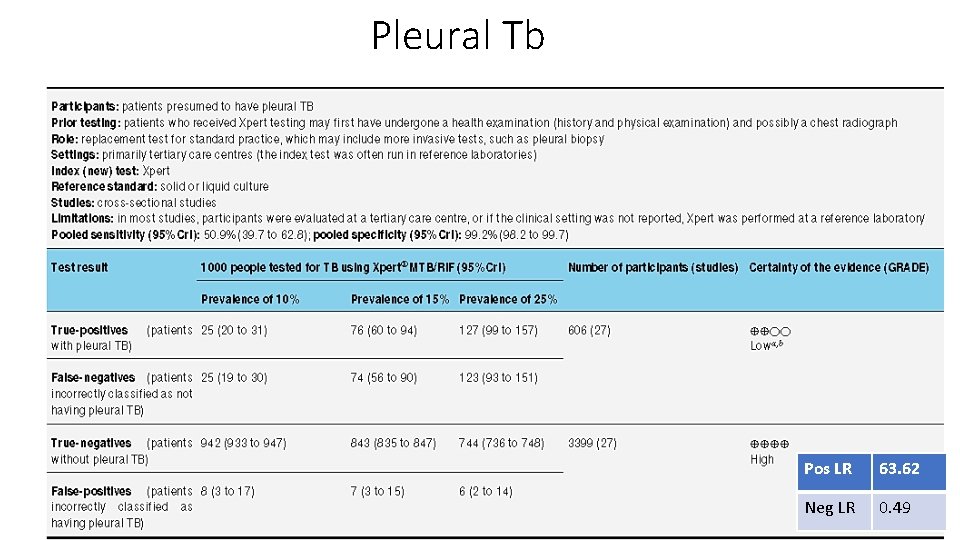
Pleural Tb Pos LR 63. 62 Neg LR 0. 49
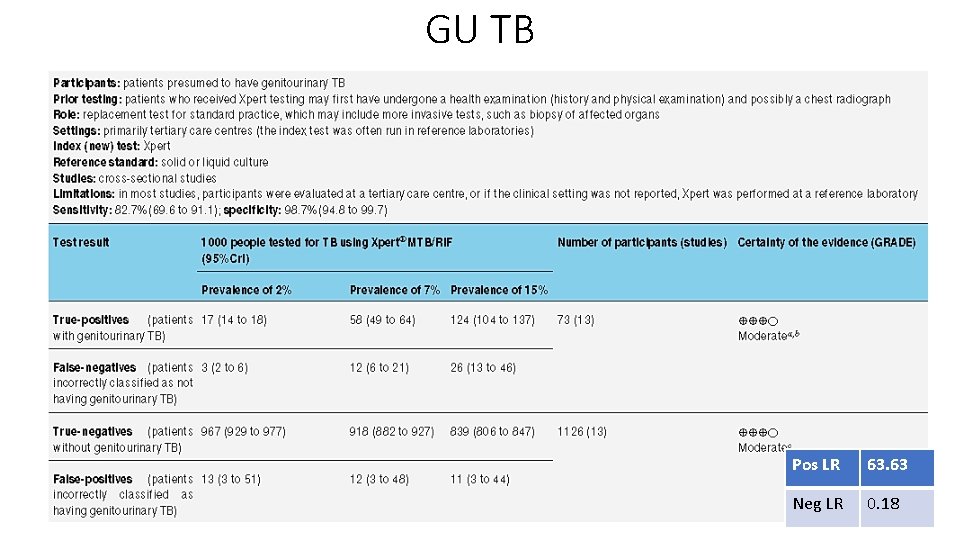
GU TB Pos LR 63. 63 Neg LR 0. 18
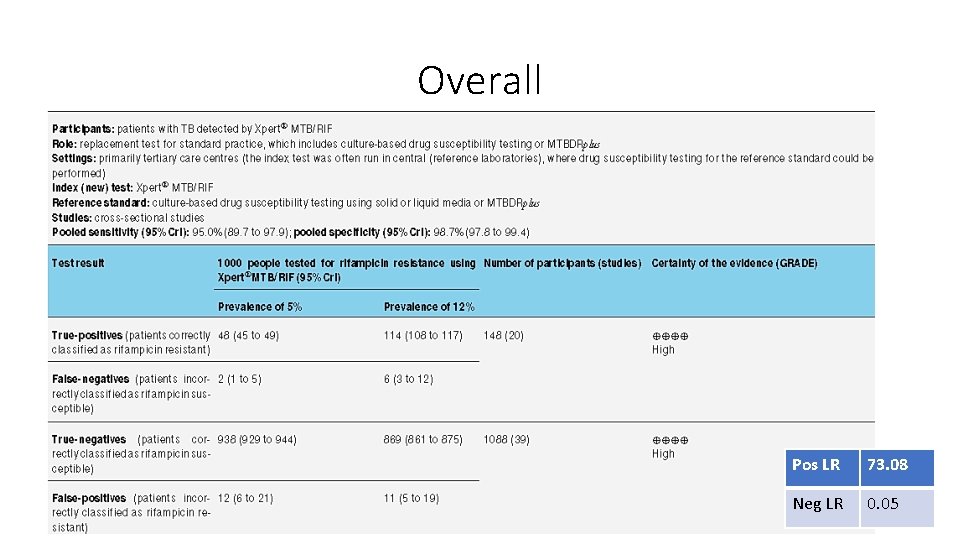
Overall Pos LR 73. 08 Neg LR 0. 05
How can I apply the results to patient care? • Will the reproducibility of the test result and the interpretation be satisfactory in my clinical setting? • Yes Xpert is a standardized test and so can be applied in my setting
• Are the study result applicable to the patient in my practice? Yes, as this is a systematic review it is generalizable and can be applied to the patient of my population
• Will the test result change my management strategy? • Yes, the rate of detection will be high, and the turn around time will be less • Rifampicin resistance can be detected
• Will patients be better off as a result of the test? • This test will be a adjuvant to the gold standard “culture”. • Can lead to useful changes in the management.
Likelihood normogram

• Thank you
- Slides: 20