
Critical Appraisal CARA EFEKTIF BELAJAR SEPANJANG HAYAT DR
Critical Appraisal CARA EFEKTIF BELAJAR SEPANJANG HAYAT DR. ARIANI RD. , SPM. FK UNISMA MALANG. 2011.
The Problem 1 • Vast and expanding literature. • Limited time to read. • Different reasons to read : – – – Keeping up to date. Answering specific clinical questions. Pursuing a research interest. mean different strategies 2
Stages 2 Clarify your reasons for reading. Specify your information need. Identify relevant literature. Critically appraise what you read.
Clarify Your Reasons for Reading 3 Keeping up to date. Skimming the main journals and summary bulletins. Answering specific clinical questions. Finding good quality literature on subject. Pursuing a research interest. Extensive literature searching.
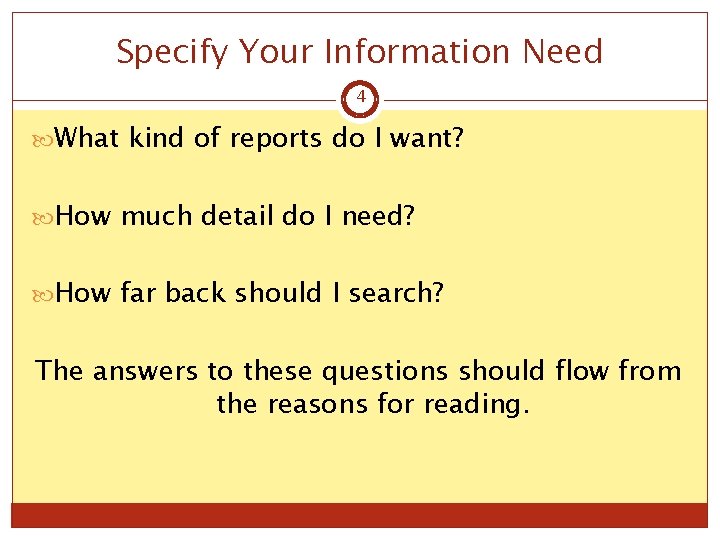
Specify Your Information Need 4 What kind of reports do I want? How much detail do I need? How far back should I search? The answers to these questions should flow from the reasons for reading.
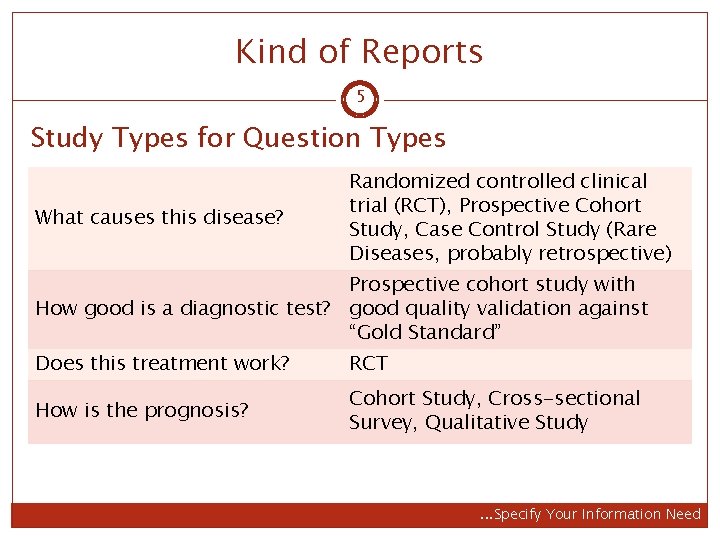
Kind of Reports 5 Study Types for Question Types What causes this disease? Randomized controlled clinical trial (RCT), Prospective Cohort Study, Case Control Study (Rare Diseases, probably retrospective) Prospective cohort study with How good is a diagnostic test? good quality validation against “Gold Standard” Does this treatment work? RCT How is the prognosis? Cohort Study, Cross-sectional Survey, Qualitative Study . . . Specify Your Information Need
. Identify Relevant Literature 6 There are many ways of finding literature. Selectivity is the key to successful critical appraisal.
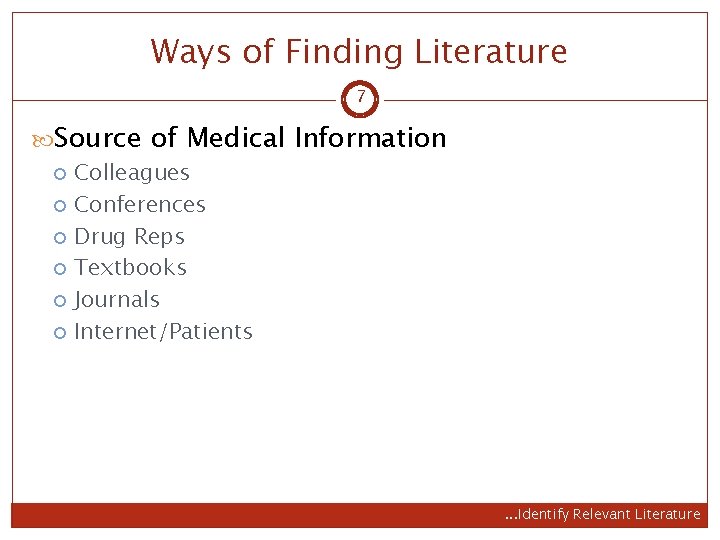
Ways of Finding Literature 7 Source of Medical Information Colleagues Conferences Drug Reps Textbooks Journals Internet/Patients . . . Identify Relevant Literature
Keeping Up to Date 8 Daily Info. POEMs http: //www. infopoems. com/ bmjupdates+ http: //bmjupdates. mcmaster. ca/index. asp Tables of contents of journals (e. g. JAMA) From journal itself My NCBI from PUBMED . . . Identify Relevant Literature
Clinical Question - Research 9 EBM Databases MEDLINE Free online access thru Pub. Med www. ncbi. nlm. nih. gov/entrez/ Search by MESH terms or free text EBM Filters . . . Identify Relevant Literature
Selectivity 10 Filters for Medline Search Diagnosis Sensitivity and Specificity Treatment Randomized controlled trial Blind or Double Blind . . . Identify Relevant Literature
Critically Appraisal What You Read 11 EBM
Evidence-Based Medicine 12 What is EBM ? Why do it ? . . . Critically Appraisal What You Read
What is EBM ? 13 ". . . the conscientious, explicit, and judicious use of current best evidence in making decisions about the care of individual patients. “ from Sackett, DL, et al. "Evidence based medicine: What it is and what it isn't. " (BMJ 1996; 312: 71 -2) . . . Critically Appraisal What You Read
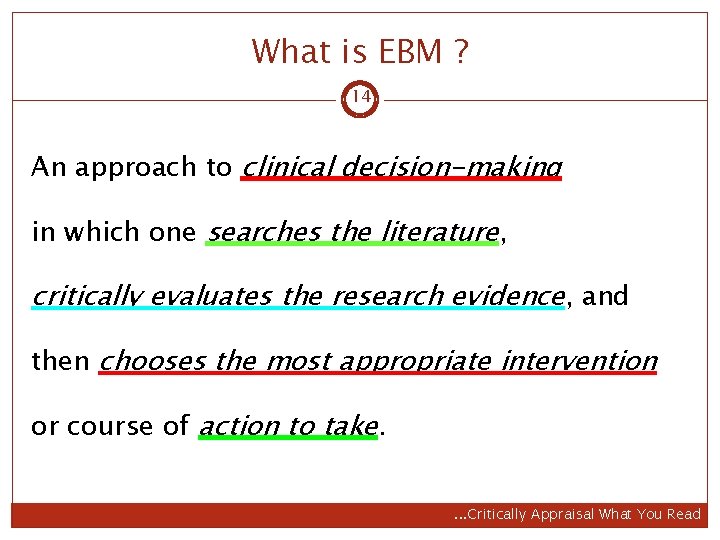
What is EBM ? 14 An approach to clinical decision-making in which one searches the literature, critically evaluates the research evidence, and then chooses the most appropriate intervention or course of action to take. . Critically Appraisal What You Read
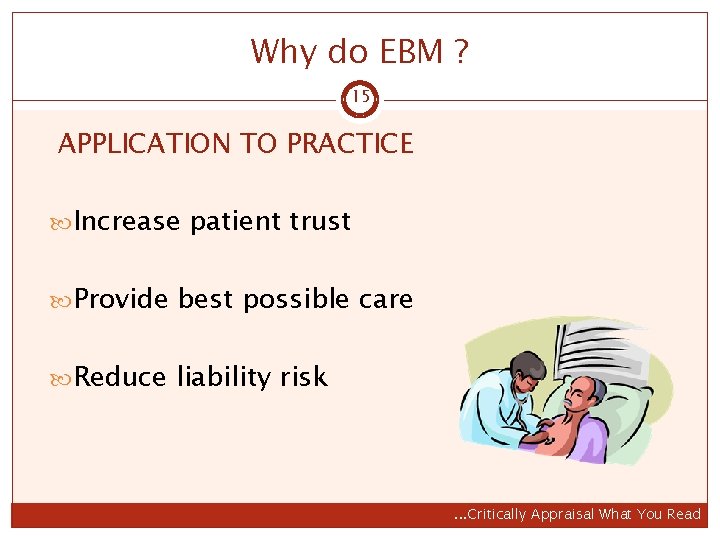
Why do EBM ? 15 APPLICATION TO PRACTICE Increase patient trust Provide best possible care Reduce liability risk . . . Critically Appraisal What You Read
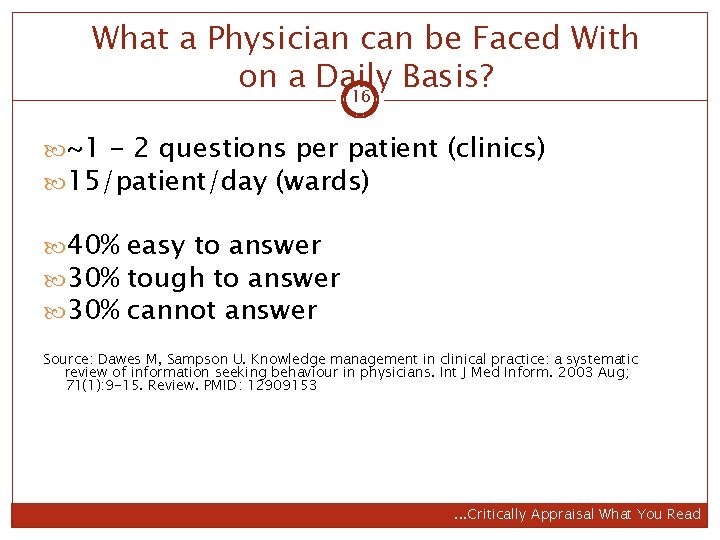
What a Physician can be Faced With on a Daily Basis? 16 ~1 - 2 questions per patient (clinics) 15/patient/day (wards) 40% easy to answer 30% tough to answer 30% cannot answer Source: Dawes M, Sampson U. Knowledge management in clinical practice: a systematic review of information seeking behaviour in physicians. Int J Med Inform. 2003 Aug; 71(1): 9 -15. Review. PMID: 12909153 . . . Critically Appraisal What You Read
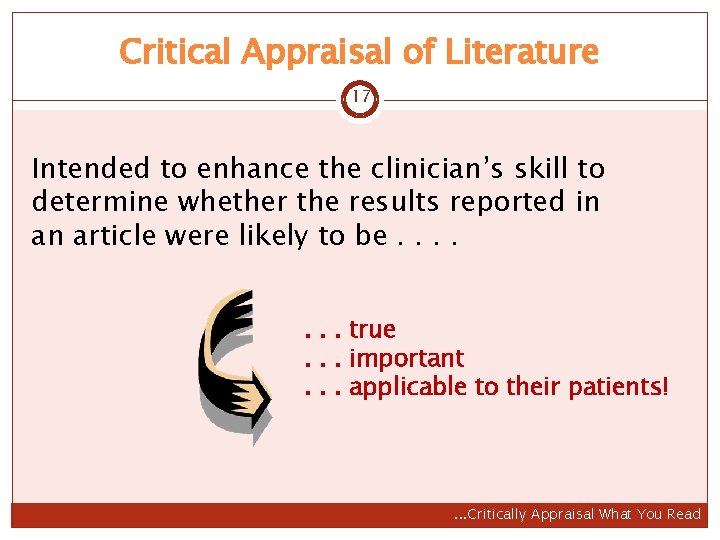
Critical Appraisal of Literature 17 Intended to enhance the clinician’s skill to determine whether the results reported in an article were likely to be. . . . true. . . important. . . applicable to their patients! . . . Critically Appraisal What You Read
Why Should we Critically Appraise? 18 ü Published research is not always reliable ü Published research is not always relevant ü To improve clinical effectiveness, we need a systematic framework to interpret research . . . Critically Appraisal What You Read
Difficulties with Critical Appraisal 19 o Can be time consuming initially o Doesn’t provide an “easy” answer o It could show a lack of good evidence in a particular topic . . . Critically Appraisal What You Read
How can we do Critical Appraisal? 21 Use common sense Use simple checklists Use different checklists depending on the different types of studies (i. e. , RCTS, systematic reviews etc) Checklists help you focus on the important parts of the article . . . Critically Appraisal What You Read
Checklists 22 �Quick and easy � 3 stages: Basic questions. Essential appraisal. Detailed appraisal. . Critically Appraisal 22 What You Read
1 st. Basic Questions. . Critically Appraisal What You Read
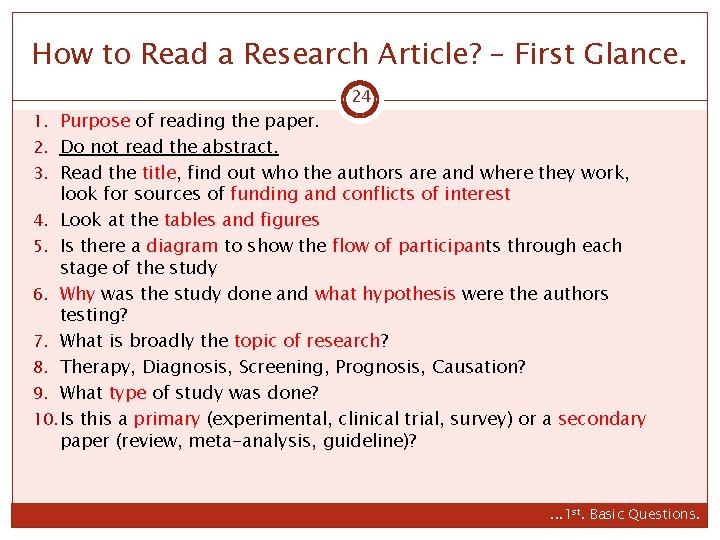
How to Read a Research Article? – First Glance. 1. Purpose of reading the paper. 24 2. Do not read the abstract. 3. Read the title, find out who the authors are and where they work, look for sources of funding and conflicts of interest 4. Look at the tables and figures 5. Is there a diagram to show the flow of participants through each stage of the study 6. Why was the study done and what hypothesis were the authors testing? 7. What is broadly the topic of research? 8. Therapy, Diagnosis, Screening, Prognosis, Causation? 9. What type of study was done? 10. Is this a primary (experimental, clinical trial, survey) or a secondary paper (review, meta-analysis, guideline)? . . . 1 st. Basic Questions.
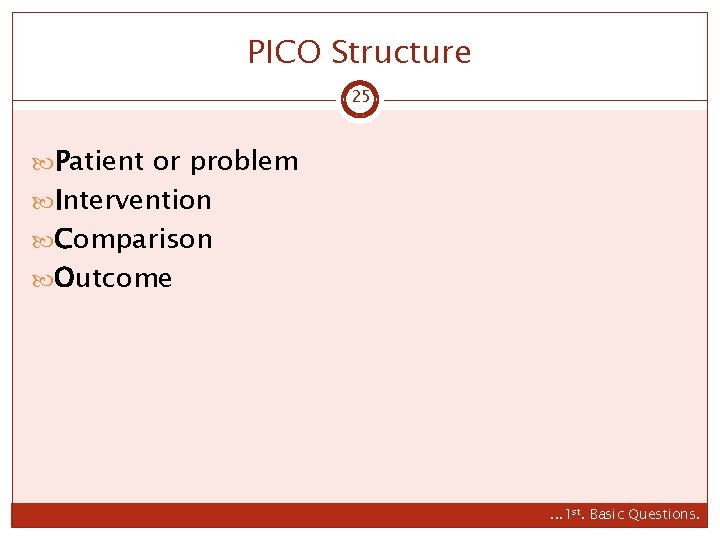
PICO Structure 25 Patient or problem Intervention Comparison Outcome . . . 1 st. Basic Questions.
2 nd. Essential Appraisal. . Critically Appraisal What You Read
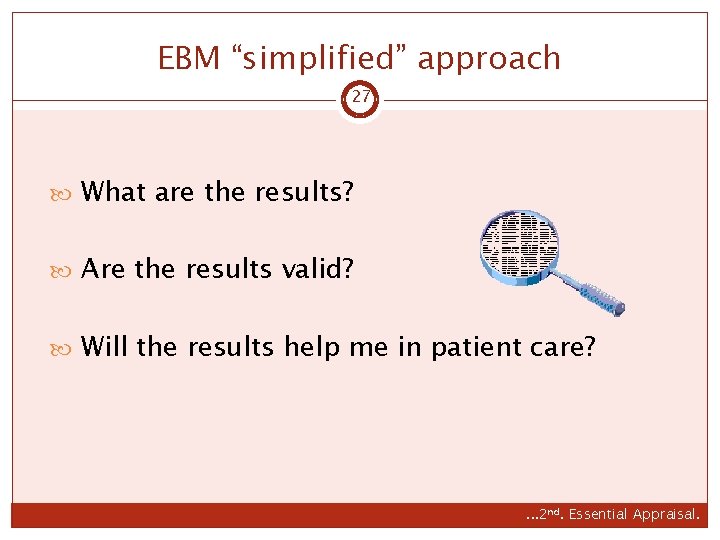
EBM “simplified” approach 27 What are the results? Are the results valid? Will the results help me in patient care? . . . 2 nd. Essential Appraisal.
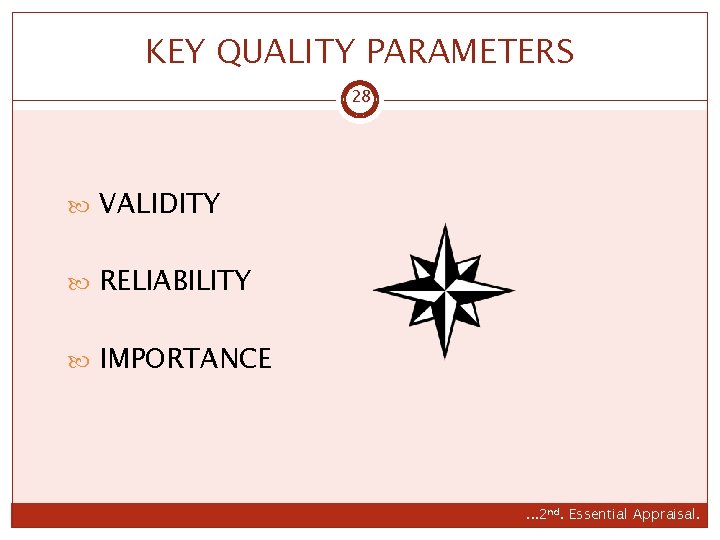
KEY QUALITY PARAMETERS 28 VALIDITY RELIABILITY IMPORTANCE . . . 2 nd. Essential Appraisal.
VALIDITY 29 INTERNAL Is the study designed in such a way that I can trust the findings? EXTERNAL Is the study designed in such a way that I can generalize the findings? . . . 2 nd. Essential Appraisal.
RELIABILITY 30 If the study was conducted again, would the results be the same? Usually interpreted as the accuracy of measurement. . 2 nd. Essential Appraisal.
Validity and Reliability 31 A test is valid when it measures what it’s supposed to. If a test is reliable, it yields consistent results. A test can be both reliable and valid, one or the other, or neither. . 2 nd. Essential Appraisal.
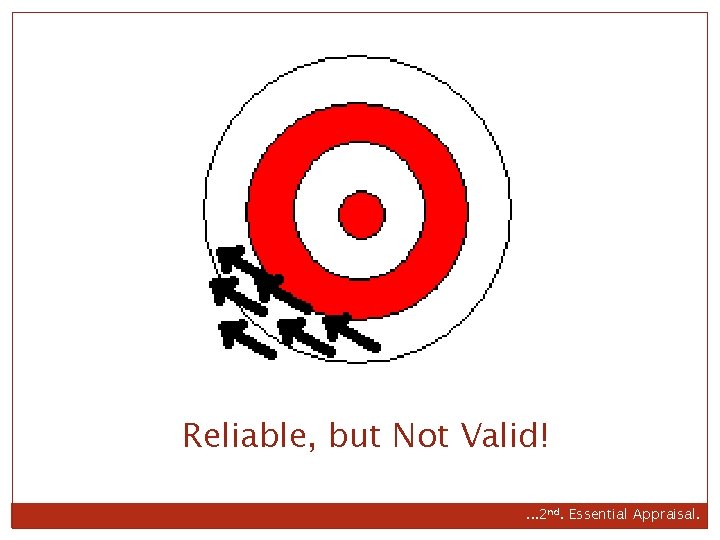
Reliable, but Not Valid!. . . 2 nd. Essential Appraisal.
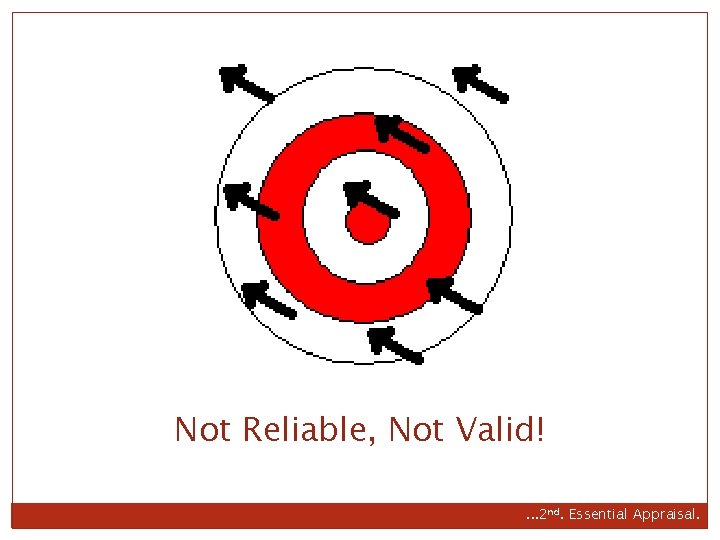
Not Reliable, Not Valid!. . . 2 nd. Essential Appraisal.
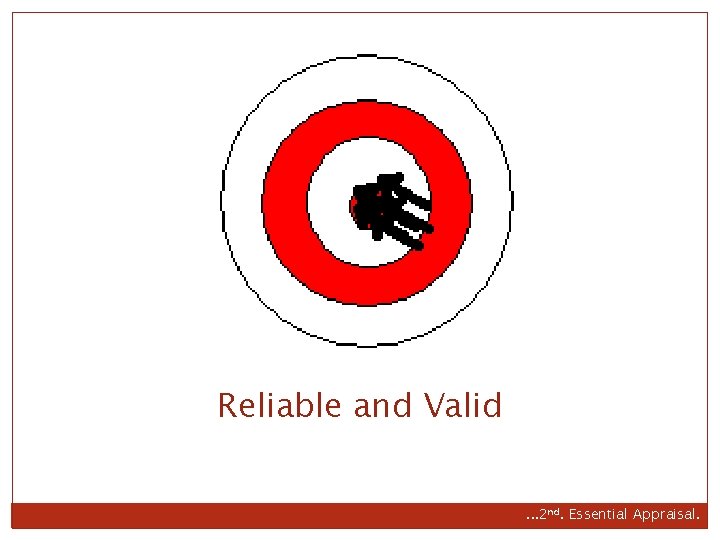
Reliable and Valid. . . 2 nd. Essential Appraisal.
IMPORTANCE 35 What was the effect size or magnitude of effect? Clinical vs. statistical significance. . 2 nd. Essential Appraisal.
3 rd. Detailed Appraisal. . Critically Appraisal What You Read
Dasar-Dasar Metodologi Penelitian Klinis Edisi ke-2 Prof. DR. Dr. Sudigdo Sastroasmoro, Sp. A (K) Prof. Dr. Sofyan Ismael, Sp. A (K) Jakarta 2002
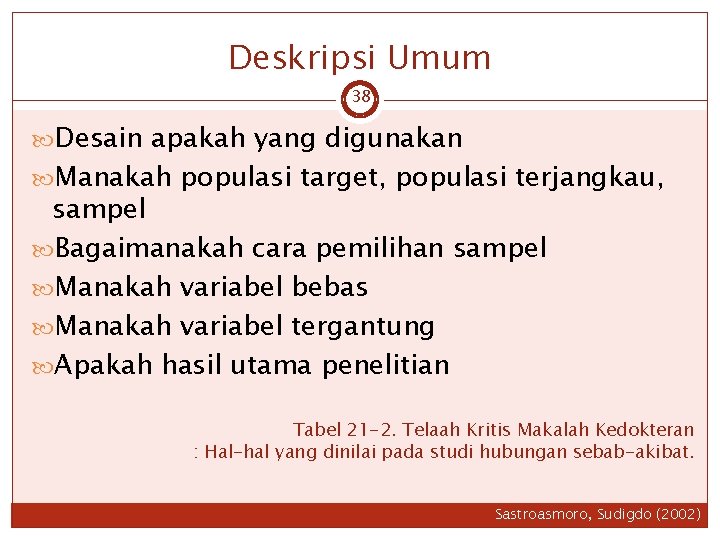
Deskripsi Umum 38 Desain apakah yang digunakan Manakah populasi target, populasi terjangkau, sampel Bagaimanakah cara pemilihan sampel Manakah variabel bebas Manakah variabel tergantung Apakah hasil utama penelitian Tabel 21 -2. Telaah Kritis Makalah Kedokteran : Hal-hal yang dinilai pada studi hubungan sebab-akibat. Sastroasmoro, Sudigdo (2002)
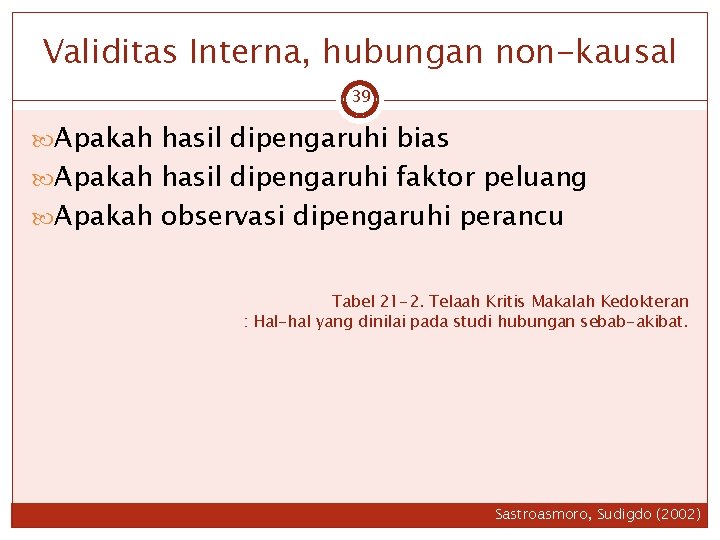
Validitas Interna, hubungan non-kausal 39 Apakah hasil dipengaruhi bias Apakah hasil dipengaruhi faktor peluang Apakah observasi dipengaruhi perancu Tabel 21 -2. Telaah Kritis Makalah Kedokteran : Hal-hal yang dinilai pada studi hubungan sebab-akibat. Sastroasmoro, Sudigdo (2002)
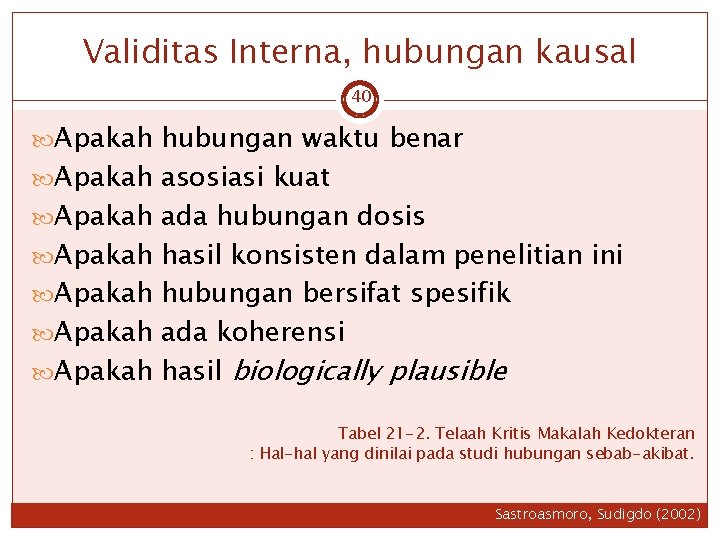
Validitas Interna, hubungan kausal 40 Apakah hubungan waktu benar Apakah asosiasi kuat Apakah ada hubungan dosis Apakah hasil konsisten dalam penelitian ini Apakah hubungan bersifat spesifik Apakah ada koherensi Apakah hasil biologically plausible Tabel 21 -2. Telaah Kritis Makalah Kedokteran : Hal-hal yang dinilai pada studi hubungan sebab-akibat. Sastroasmoro, Sudigdo (2002)
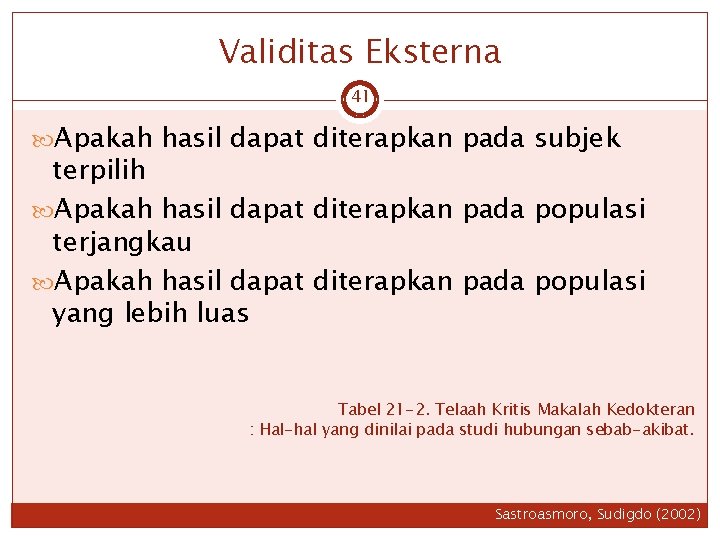
Validitas Eksterna 41 Apakah hasil dapat diterapkan pada subjek terpilih Apakah hasil dapat diterapkan pada populasi terjangkau Apakah hasil dapat diterapkan pada populasi yang lebih luas Tabel 21 -2. Telaah Kritis Makalah Kedokteran : Hal-hal yang dinilai pada studi hubungan sebab-akibat. Sastroasmoro, Sudigdo (2002)
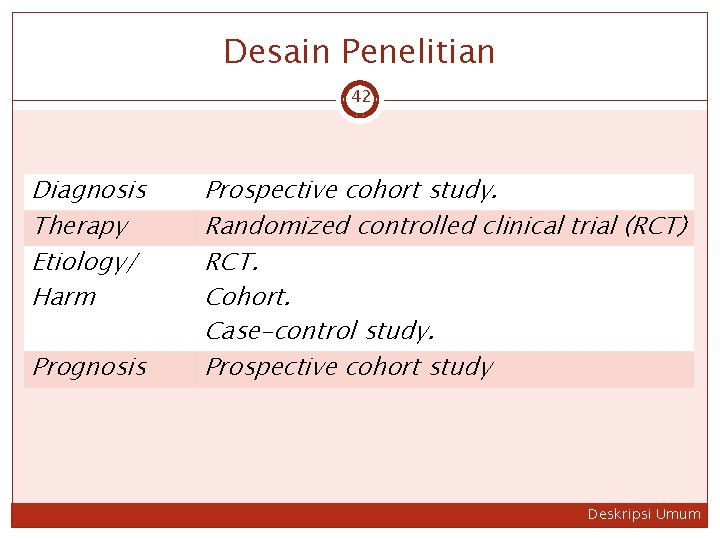
Desain Penelitian 42 Diagnosis Therapy Etiology/ Harm Prognosis Prospective cohort study. Randomized controlled clinical trial (RCT) RCT. Cohort. Case-control study. Prospective cohort study Deskripsi Umum
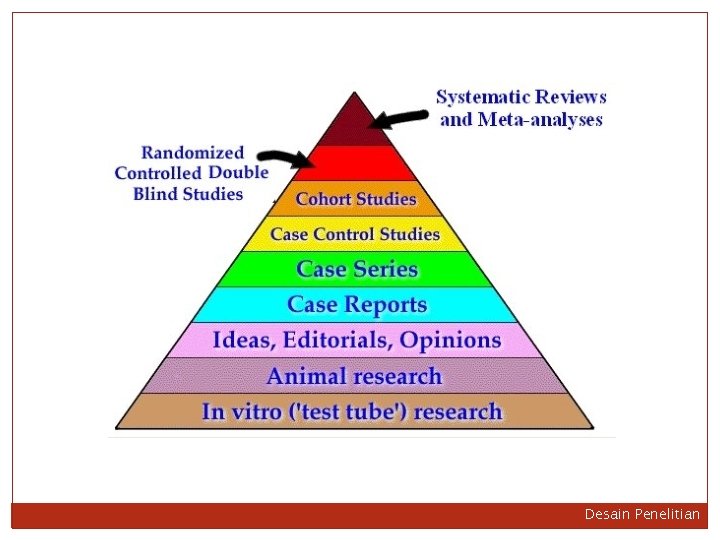
Desain Penelitian
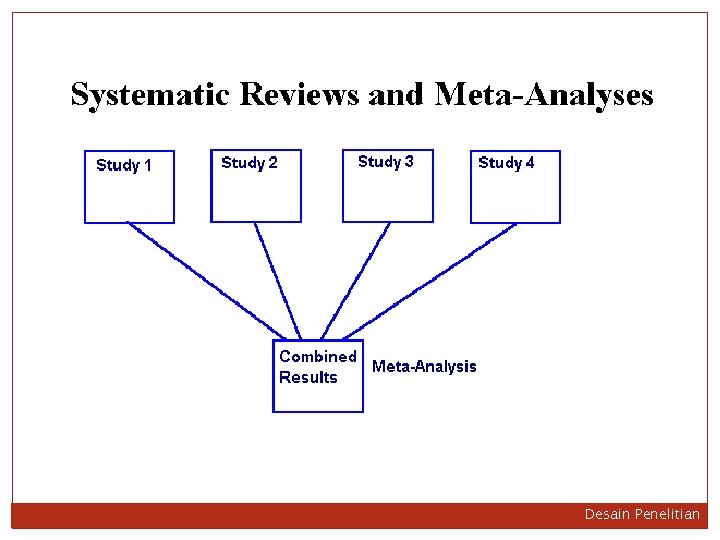
Desain Penelitian
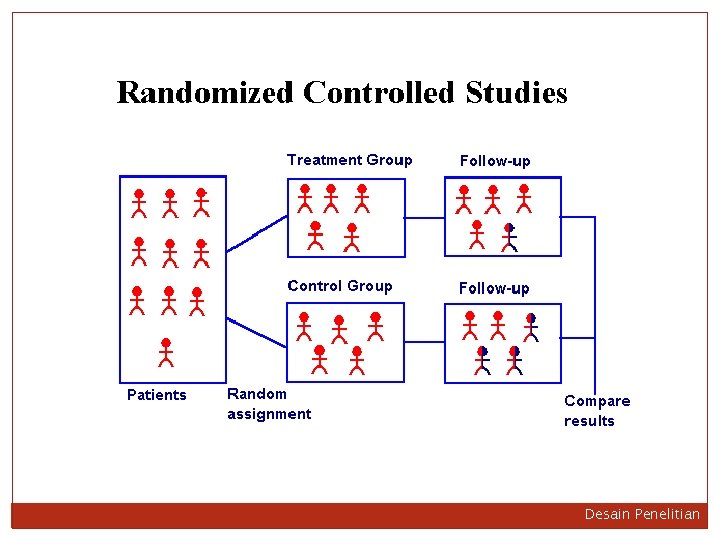
Desain Penelitian
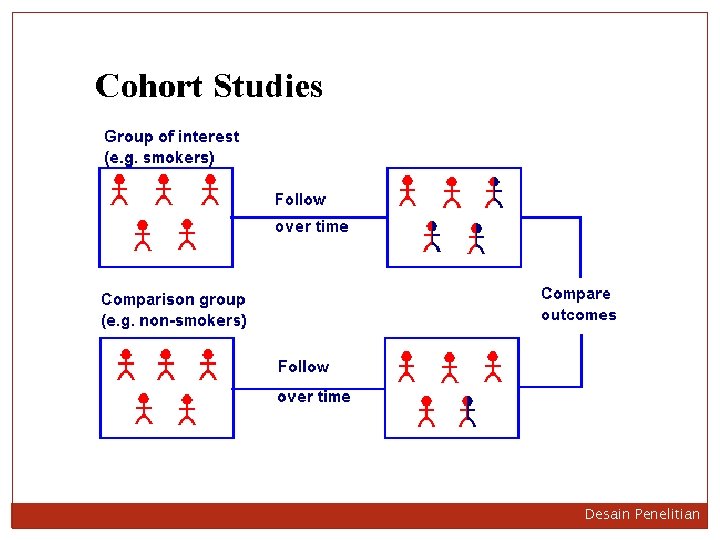
Desain Penelitian
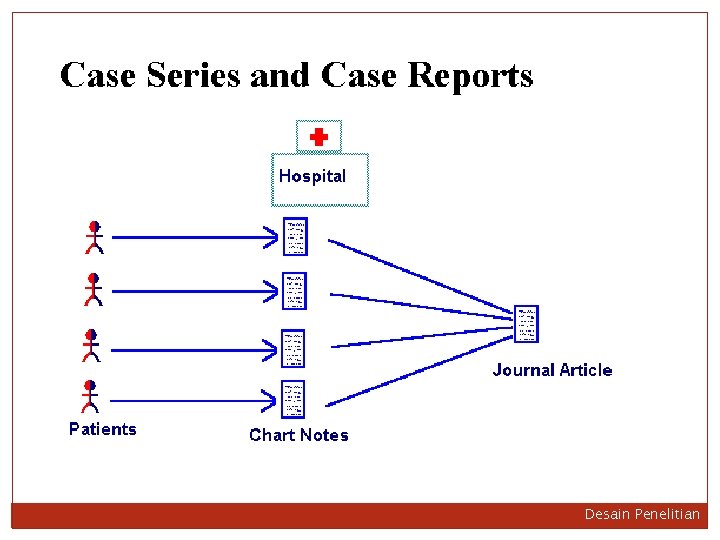
Desain Penelitian
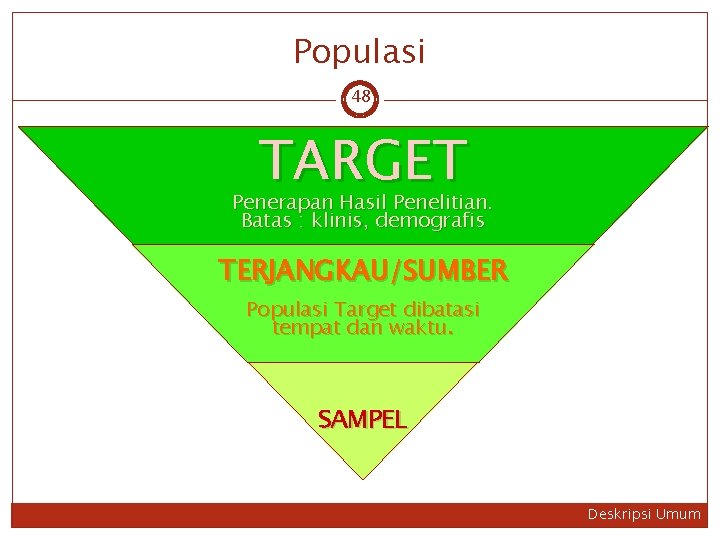
Populasi 48 TARGET Penerapan Hasil Penelitian. Batas : klinis, demografis TERJANGKAU/SUMBER Populasi Target dibatasi tempat dan waktu. SAMPEL Deskripsi Umum
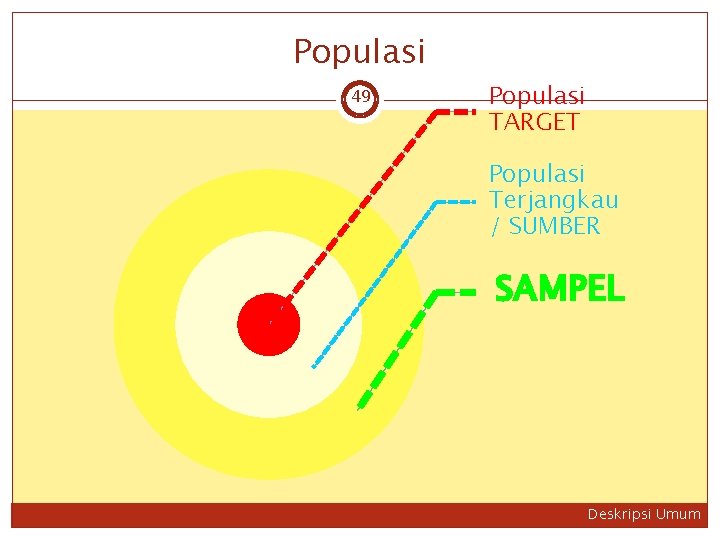
Populasi 49 Populasi TARGET Populasi Terjangkau / SUMBER SAMPEL Deskripsi Umum
Sampel 50 Karakteristik Subjek Penelitian = pasien kita ? Dapat kita terapkan ? Deskripsi Umum
Cara Pemilihan Sampel 51 Probability Sampling Simple Random Sampling Systematic Sampling Stratified Random Sampling Cluster Sampling Non Probability Sampling Consecutive Sampling Convenient Sampling Judgmental / purposive sampling Deskripsi Umum
Variabel 52 BEBAS : faktor resiko, perlakuan (pemeriksaan / terapi medikamentosa / tindakan) TERGANTUNG : dipengaruhi oleh variabel bebas Faktor resiko Kejadian penyakit Pemeriksaan Terdiagnosis Obat / Tindakan Kesembuhan Deskripsi Umum
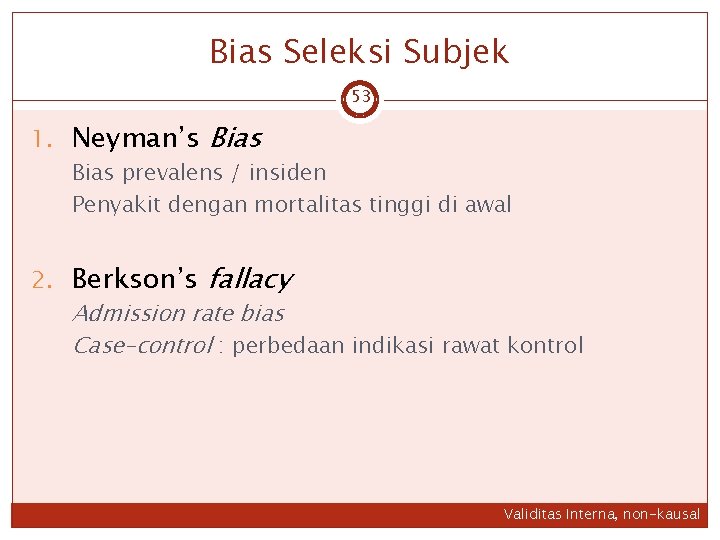
Bias Seleksi Subjek 53 1. Neyman’s Bias prevalens / insiden Penyakit dengan mortalitas tinggi di awal 2. Berkson’s fallacy Admission rate bias Case-control : perbedaan indikasi rawat kontrol Validitas Interna, non-kausal
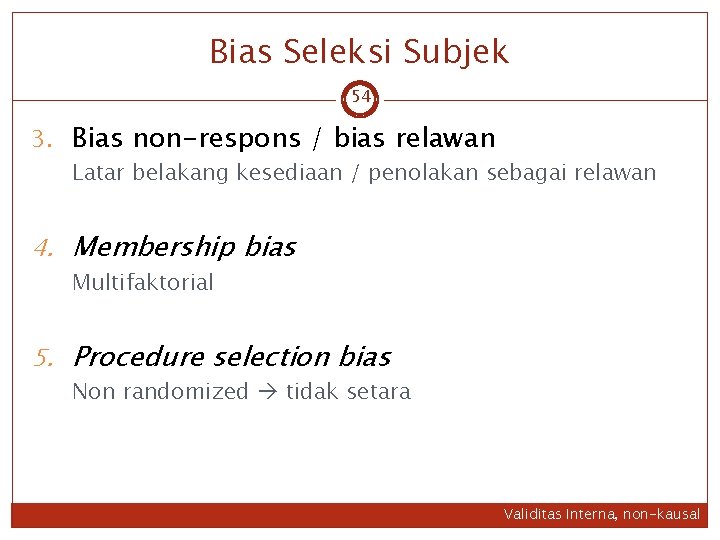
Bias Seleksi Subjek 54 3. Bias non-respons / bias relawan Latar belakang kesediaan / penolakan sebagai relawan 4. Membership bias Multifaktorial 5. Procedure selection bias Non randomized tidak setara Validitas Interna, non-kausal
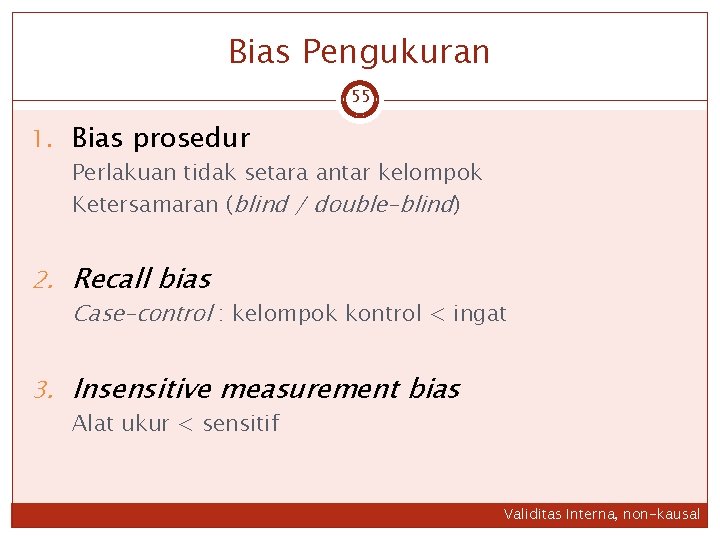
Bias Pengukuran 55 1. Bias prosedur Perlakuan tidak setara antar kelompok Ketersamaran (blind / double-blind) 2. Recall bias Case-control : kelompok kontrol < ingat 3. Insensitive measurement bias Alat ukur < sensitif Validitas Interna, non-kausal
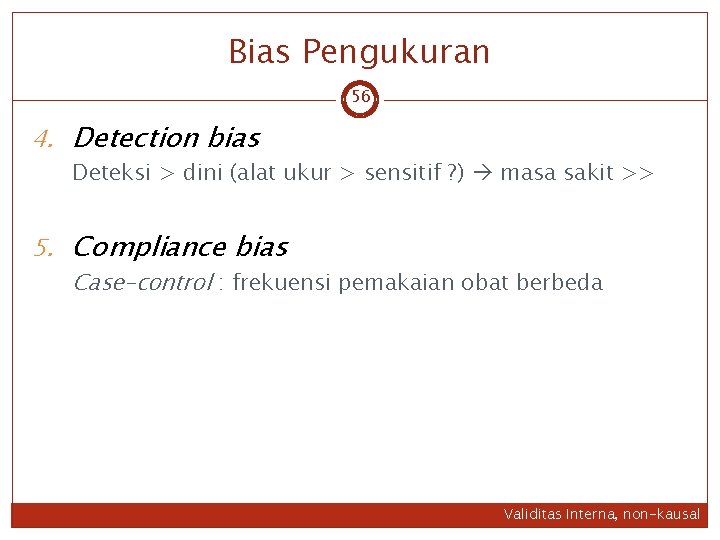
Bias Pengukuran 56 4. Detection bias Deteksi > dini (alat ukur > sensitif ? ) masa sakit >> 5. Compliance bias Case-control : frekuensi pemakaian obat berbeda Validitas Interna, non-kausal
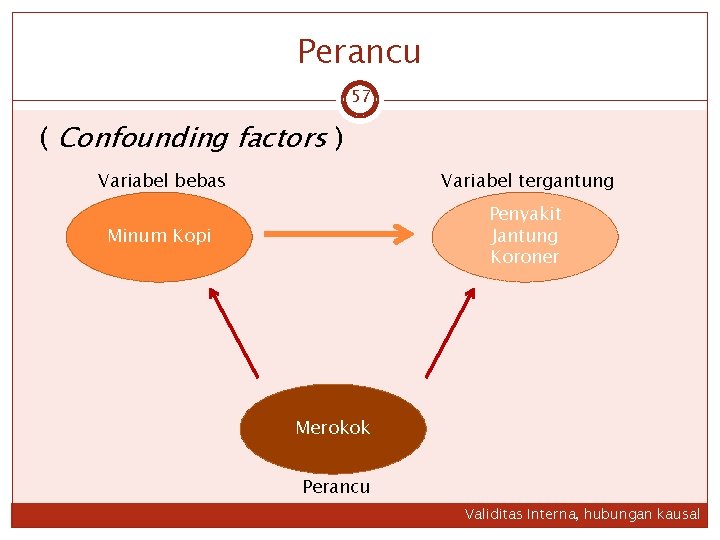
Perancu 57 ( Confounding factors ) Variabel bebas Variabel tergantung Minum Kopi Penyakit Jantung Koroner Merokok Perancu Validitas Interna, hubungan kausal
Peluang 58 Kemungkinan hasil tersebut disebabkan peluang bila hipotesis nol (tidak ada/tidak) P value Nilai P ≤ 0, 05 Confidence CI ≥ 95% interval Validitas Interna, hubungan kausal
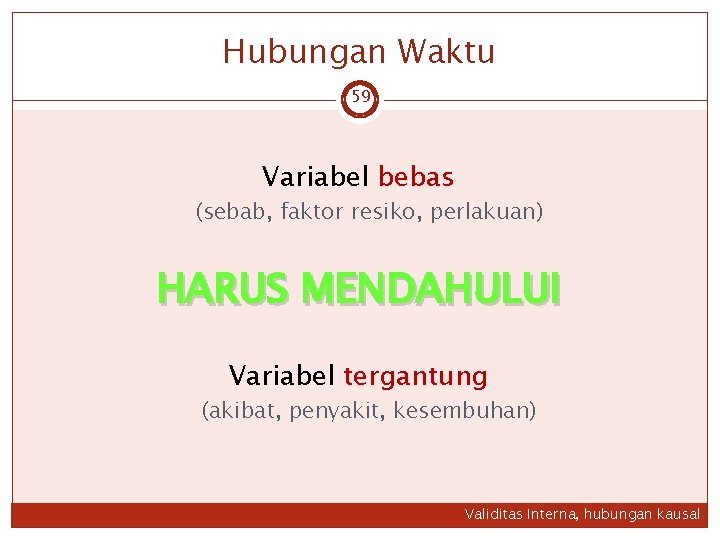
Hubungan Waktu 59 Variabel bebas (sebab, faktor resiko, perlakuan) HARUS MENDAHULUI Variabel tergantung (akibat, penyakit, kesembuhan) Validitas Interna, hubungan kausal
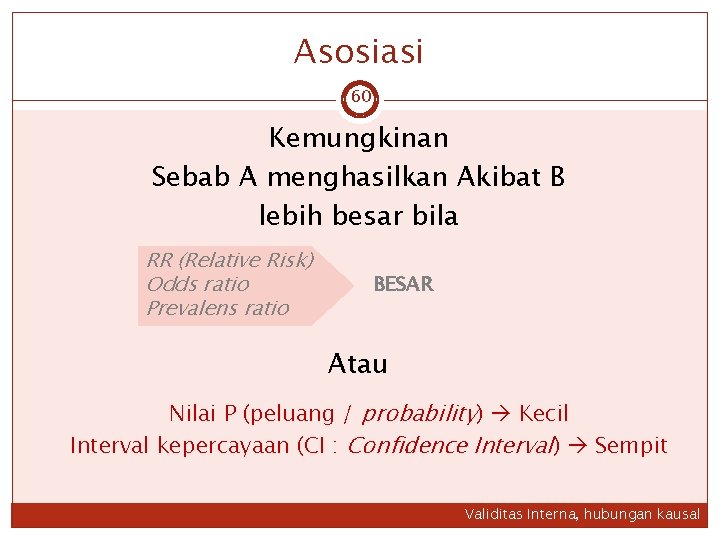
Asosiasi 60 Kemungkinan Sebab A menghasilkan Akibat B lebih besar bila RR (Relative Risk) Odds ratio Prevalens ratio BESAR Atau Nilai P (peluang / probability) Kecil Interval kepercayaan (CI : Confidence Interval) Sempit Validitas Interna, hubungan kausal
hubungan lain 61 Hubungan Dosis Dose dependent Studi menetapkan dosis optimal Konsisten Beberapa kelompok subjek multicenter Koherensi Fenomena / kenyataan dalam masyarakat Validitas Interna, hubungan kausal
…hubungan lain 62 Biological plausibility Hipotetis – spekulatif Perbandingan dengan hasil penelitian lain Beda Mengapa ? Validitas Interna, hubungan kausal
Validitas Eksterna 63 pada Sampel Terpilih Drop out : ≤ 15% pada Populasi Terjangkau Random sampling / Consecutive sampling pada Populasi Target Logika dalam bab Diskusi Karakteristik subjek ~ pasien sehari-hari Validitas Eksterna
Stay up to date with the current literature 64 A clinician needs to read 17 peer reviewed articles per day, every day of the year, to stay current (Haynes 1993). Haynes, R. (1993) Where's the meat in clinical journals? ACP Journal Club, 119: A 23 -4. There are 20 million pieces of 'evidence' of varying quality and sometime of contradictory conclusions.
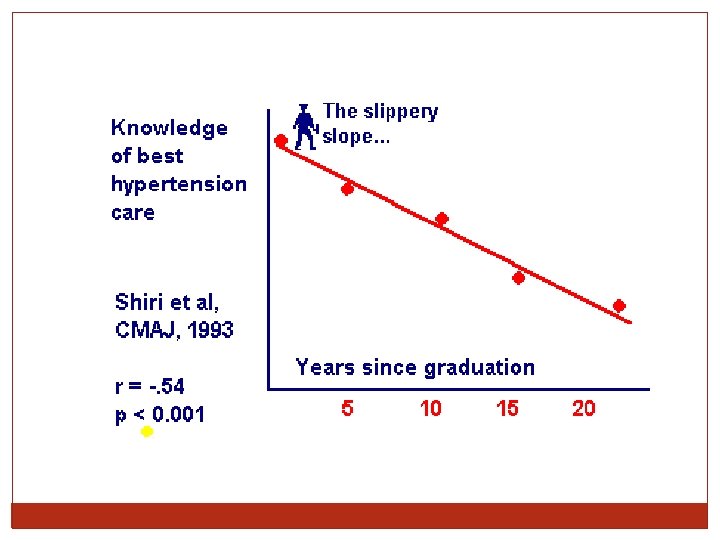
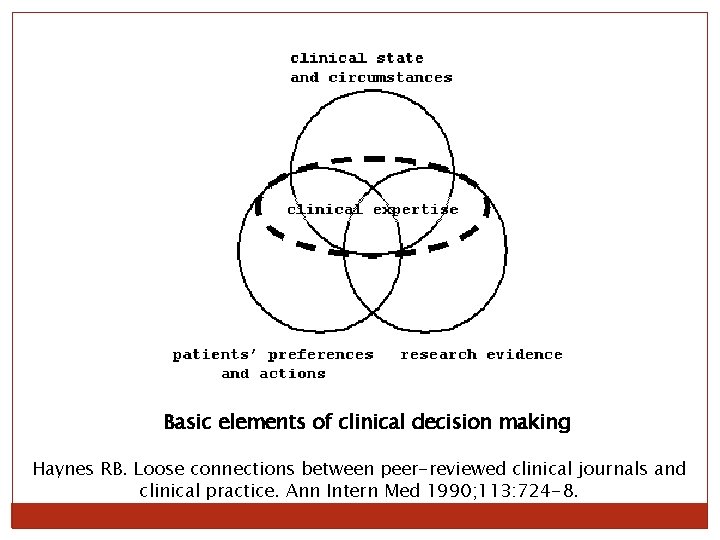
Basic elements of clinical decision making Haynes RB. Loose connections between peer-reviewed clinical journals and clinical practice. Ann Intern Med 1990; 113: 724 -8.
Clinical Expertise & Critical Appraisal 67 "Without clinical expertise, practice risks becoming tyrannized by external evidence, for even excellent external evidence may be inapplicable to or inappropriate for an individual patient. Without current best external evidence, practice risks becoming rapidly out of date, to the detriment of patients. " Haynes RB. Loose connections between peer-reviewed clinical journals and clinical practice. Ann Intern Med 1990; 113: 724 -8.
TERIMA KASIH Critical Appraisal. Cara Efektif Belajar Sepanjang Hayat. Dr. Ariani RD. , Sp. M. FK Unisma Malang. 2011.
- Slides: 68