
Critical and Creative Thinking and Rubric Scoring Calibration
Critical and Creative Thinking and Rubric Scoring Calibration in the School of Advanced Studies (SAS) ACCESS Program
Agenda v Roundtable Overview v Facilitator Introductions v Student Critical and Creative Thinking v Faculty Assessment Calibration v Roundtable Discussion
Workshop Overview � Critical and creative thinking are essential to problem solving, decision making, and effective practice in all education programs. � Development of these skills is foundational to the first four courses of the doctoral programs at SAS--Advancing Community, Critical Thought, Engagement, Scholarship, and Success (ACCESS). � Signature ACCESS assignments are evaluated using the Analysis, Evaluation, Synthesis (AES) rubric — Critical Thinking (60%) comprised of Critical Analysis (25%). Critical Evaluation (20%), Creative Synthesis (15%) Writing Competence (25%) Use of Sources and APA Style/Format (15%)
Facilitator Introduction v Shawn Boone, Ed. D – Associate Dean of Instruction for ACCESS v Stephanie Ferguson, Ph. D – CFAL for ACCESS v Linda de Charon, Ph. D – ACCESS LFAC and CFAL for Dissertations
A Need for Calibration • Student-driven and faculty-centered • Student complaints: “No one ever told me. ” • Inconsistency: Scoring, Among degree levels; Among programs • Different expectations: Content vs format vs grammar • Small cohort of faculty • Calibration focused on using our common AES Rubric • Calibration focused on preparing students to be critical and creative thinkers and researchers
Critical and Creative Thinking v Critical thinking is a process that involves evaluating ideas and identifying optimal solutions and includes developing the ability to separate fact from opinion, recognizing reasoning errors, analyzing arguments, and making ethical judgments. v Creativity involves seeking new, unique, and original ways to resolve problems; creativity accentuates the originality of ideas and use of innovation. v Personality theorists (ie. Jung, 1921; Myers & Briggs, 1962; Keirsey, 1978) contend that individuals are intrinsically either creative or critical thinkers and that the opposite must be developed.
Facilitation Strategies v There is a natural inclination to believe that others process information the same way as you v Avoid the “golden rule” in the classroom v “Treat others as you would have them treat you” v Apply the “platinum rule” in the classroom v “Treat others as they wish to be treated” v So what is your intrinsic strength?
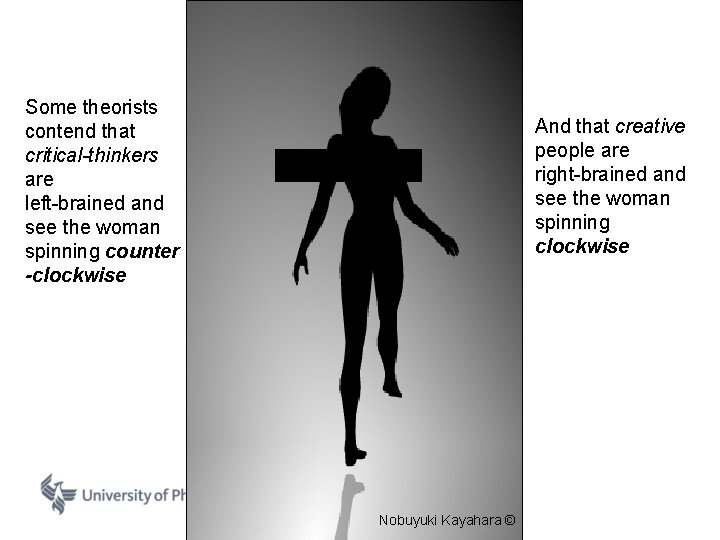
Some theorists contend that critical-thinkers are left-brained and see the woman spinning counter -clockwise And that creative people are right-brained and see the woman spinning clockwise Nobuyuki Kayahara ©
Identifying and Teaching Intrinsically Critical Thinkers • Critical thinkers want evidence: • Facts • Details • Examples • When facilitating critical thinkers: • • • Be practical and realistic; grounded Be direct Show logical sequence of steps Have a well-thought-out plan with details worked out in advance Use concepts and strategies sparingly -- concentrate more on the day-to-day consequences of a plan
Assisting Critical Thinkers Develop Creativity • Use open ended questions to encourage learner curiosity and creativity. • Brainstorming sessions can help students consider visionary goals and creative ideas without judgment. • Practicing visualization and abstract thinking can help students develop creativity. • Help students improve their creativity skills by emphasizing an environment that requires in-depth thinking as opposed to rote responses. • Problems should be relevant and challenging with active student involvement.
Identifying and Teaching Intrinsically Creative Students • Creative students: • Present ideas and global concept first, then draw out the details. • Avoid presenting details unless asked—otherwise, details may be viewed as unnecessary “overload” • When facilitating creative students: • Do not require details; accept their broad conclusions at face value as a working hypothesis to be developed later. • Be patient; work may occur in bursts. • Let them dream; encourage their imagination
Assisting Creative Students Develop Critical Thinking • Students can develop critical thinking skills such as conceptualizing, applying, analyzing, synthesizing, and evaluating through: • • Observation Experience Reflection Communication in classes • Problem solving requires an educational environment in which students can ask questions and identify problems that require in-depth thinking while formulating answers
Calibrating for the ACCESS Rubric • Signature ACCESS assignments are evaluated using the Analysis, Evaluation, Synthesis (AES) rubric — • Critical Thinking (60%) comprised of Critical Analysis (25%). Critical Evaluation (20%), Creative Synthesis (15%) • Writing Competence (25%) • Use of Sources and APA Style/Format (15%) • Calibration creates inter-rater reliability; rating the same performance with the same score from various raters. • Calibrating faculty in a virtual environment is more challenging than in a face-to-face environment. • The ACCESS faculty must be consistent in their ratings to “establish a level playing field” for students during entry courses.
Outcomes of Calibration In addition to higher inter-rater reliability… • Faculty become better acquainted with course assignments and teaching expectations • Calibration discussions help colleges and programs with the validity of the rubrics by addressing alignment issues • The process mitigates grade inflation by standardizing the assessment of student submissions
ACCESS Calibration Training • Uses quarterly CAMs to facilitate the calibration process • Uses the same authentic work sample and focus on one metric of the rubric per meeting • Focuses on the nuances of the selected metric in order to address teaching expectations • Faculty members share their ratings and provide a rationale for their scores • Collegial discussion provides faculty and administration the opportunity to standardize their assessment practice and address any modifications needed
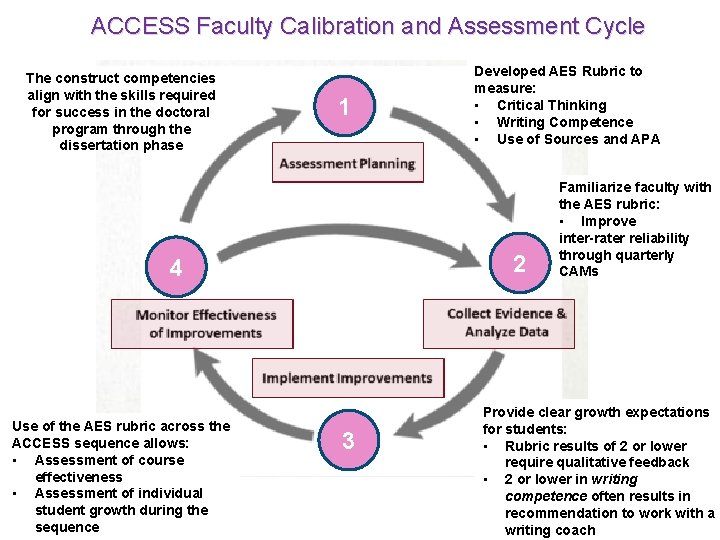
ACCESS Faculty Calibration and Assessment Cycle The construct competencies align with the skills required for success in the doctoral program through the dissertation phase 1 2 4 Use of the AES rubric across the ACCESS sequence allows: • Assessment of course effectiveness • Assessment of individual student growth during the sequence Developed AES Rubric to measure: • Critical Thinking • Writing Competence • Use of Sources and APA 3 Familiarize faculty with the AES rubric: • Improve inter-rater reliability through quarterly CAMs Provide clear growth expectations for students: • Rubric results of 2 or lower require qualitative feedback • 2 or lower in writing competence often results in recommendation to work with a writing coach
Questions, Discussion, and Rubric Calibration Process
Essential Components of Norming • Orientation to the rubric (line-by-line interpretations) • Standardized scoring process • Practice scoring/rating • Discussion of rationale and interpretations • Increasing awareness of potential rater biases
Standardized Scoring Process • Read through the assignment and rubric before scoring • Follow these steps: • Read the performance criterion for score point 1 and determine whether student met the performance criterion If no, then assign the student a score of 1 for this line/row/dimension/metric of the rubric. If yes, move on to score point 2. If score point 2 is not met, the assign a score of 1. 3. Repeat this process for the remaining score points. *The rule is to assign student the score for the highest performance criterion that they fully meet
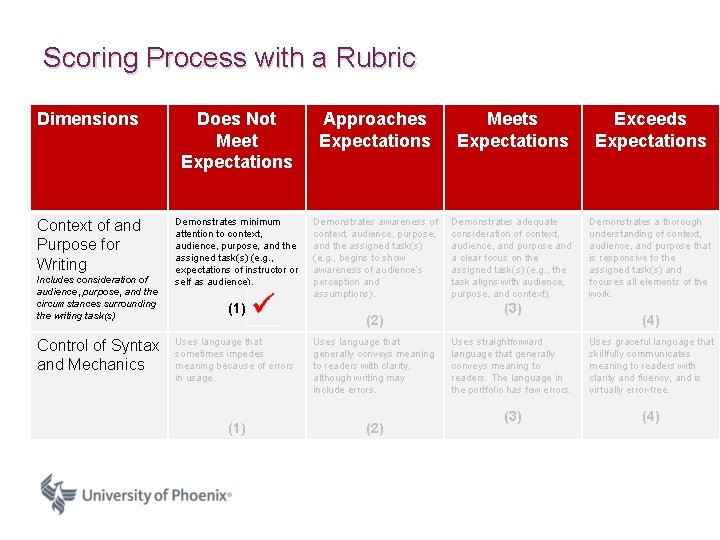
Scoring Process with a Rubric Dimensions Does Not Meet Expectations Approaches Expectations Meets Expectations Exceeds Expectations Context of and Purpose for Writing Demonstrates minimum attention to context, audience, purpose, and the assigned task(s) (e. g. , expectations of instructor or self as audience). Demonstrates awareness of context, audience, purpose, and the assigned task(s) (e. g. , begins to show awareness of audience’s perception and assumptions). Demonstrates adequate consideration of context, audience, and purpose and a clear focus on the assigned task(s) (e. g. , the task aligns with audience, purpose, and context). Demonstrates a thorough understanding of context, audience, and purpose that is responsive to the assigned task(s) and focuses all elements of the work. Includes consideration of audience, purpose, and the circumstances surrounding the writing task(s) Control of Syntax and Mechanics (1) (2) Uses language that sometimes impedes meaning because of errors in usage. Uses language that generally conveys meaning to readers with clarity, although writing may include errors. (1) (2) (3) (4) Uses straightforward language that generally conveys meaning to readers. The language in the portfolio has few errors. Uses graceful language that skillfully communicates meaning to readers with clarity and fluency, and is virtually error-free. (3) (4)
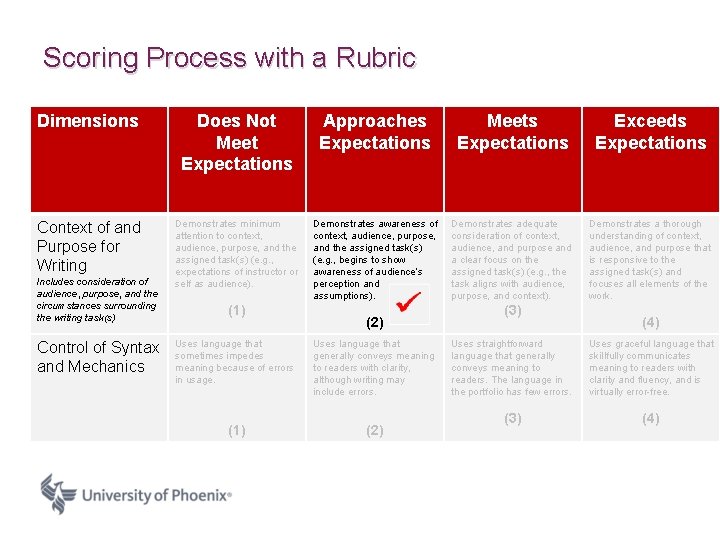
Scoring Process with a Rubric Dimensions Does Not Meet Expectations Approaches Expectations Meets Expectations Exceeds Expectations Context of and Purpose for Writing Demonstrates minimum attention to context, audience, purpose, and the assigned task(s) (e. g. , expectations of instructor or self as audience). Demonstrates awareness of context, audience, purpose, and the assigned task(s) (e. g. , begins to show awareness of audience’s perception and assumptions). Demonstrates adequate consideration of context, audience, and purpose and a clear focus on the assigned task(s) (e. g. , the task aligns with audience, purpose, and context). Demonstrates a thorough understanding of context, audience, and purpose that is responsive to the assigned task(s) and focuses all elements of the work. Includes consideration of audience, purpose, and the circumstances surrounding the writing task(s) Control of Syntax and Mechanics (1) (2) Uses language that sometimes impedes meaning because of errors in usage. Uses language that generally conveys meaning to readers with clarity, although writing may include errors. (1) (2) (3) (4) Uses straightforward language that generally conveys meaning to readers. The language in the portfolio has few errors. Uses graceful language that skillfully communicates meaning to readers with clarity and fluency, and is virtually error-free. (3) (4)
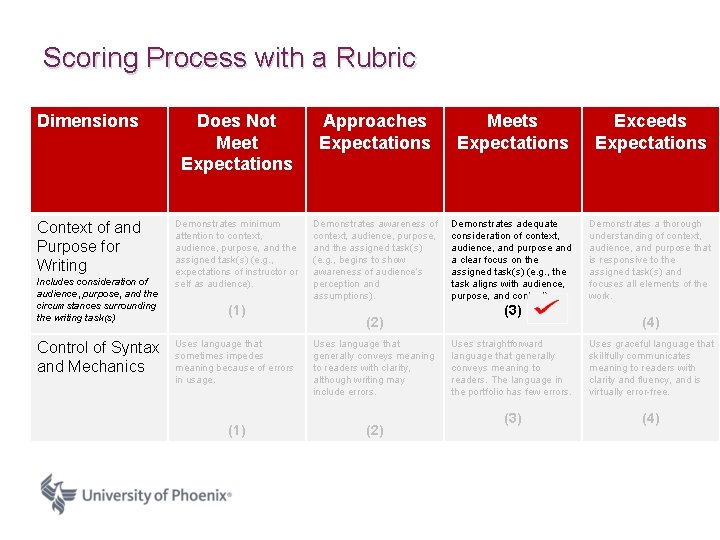
Scoring Process with a Rubric Dimensions Does Not Meet Expectations Approaches Expectations Meets Expectations Exceeds Expectations Context of and Purpose for Writing Demonstrates minimum attention to context, audience, purpose, and the assigned task(s) (e. g. , expectations of instructor or self as audience). Demonstrates awareness of context, audience, purpose, and the assigned task(s) (e. g. , begins to show awareness of audience’s perception and assumptions). Demonstrates adequate consideration of context, audience, and purpose and a clear focus on the assigned task(s) (e. g. , the task aligns with audience, purpose, and context). Demonstrates a thorough understanding of context, audience, and purpose that is responsive to the assigned task(s) and focuses all elements of the work. Includes consideration of audience, purpose, and the circumstances surrounding the writing task(s) Control of Syntax and Mechanics (1) (2) Uses language that sometimes impedes meaning because of errors in usage. Uses language that generally conveys meaning to readers with clarity, although writing may include errors. (1) (2) (3) (4) Uses straightforward language that generally conveys meaning to readers. The language in the portfolio has few errors. Uses graceful language that skillfully communicates meaning to readers with clarity and fluency, and is virtually error-free. (3) (4)
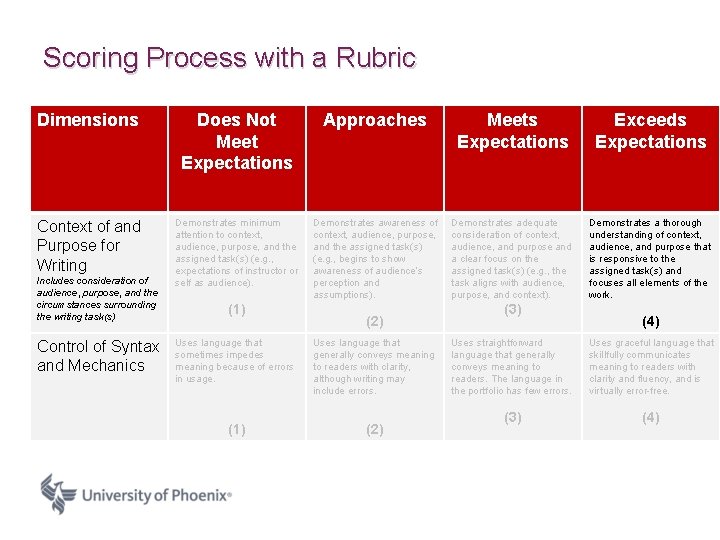
Scoring Process with a Rubric Dimensions Does Not Meet Expectations Approaches Meets Expectations Exceeds Expectations Context of and Purpose for Writing Demonstrates minimum attention to context, audience, purpose, and the assigned task(s) (e. g. , expectations of instructor or self as audience). Demonstrates awareness of context, audience, purpose, and the assigned task(s) (e. g. , begins to show awareness of audience’s perception and assumptions). Demonstrates adequate consideration of context, audience, and purpose and a clear focus on the assigned task(s) (e. g. , the task aligns with audience, purpose, and context). Demonstrates a thorough understanding of context, audience, and purpose that is responsive to the assigned task(s) and focuses all elements of the work. Includes consideration of audience, purpose, and the circumstances surrounding the writing task(s) Control of Syntax and Mechanics (1) (2) Uses language that sometimes impedes meaning because of errors in usage. Uses language that generally conveys meaning to readers with clarity, although writing may include errors. (1) (2) (3) (4) Uses straightforward language that generally conveys meaning to readers. The language in the portfolio has few errors. Uses graceful language that skillfully communicates meaning to readers with clarity and fluency, and is virtually error-free. (3) (4)
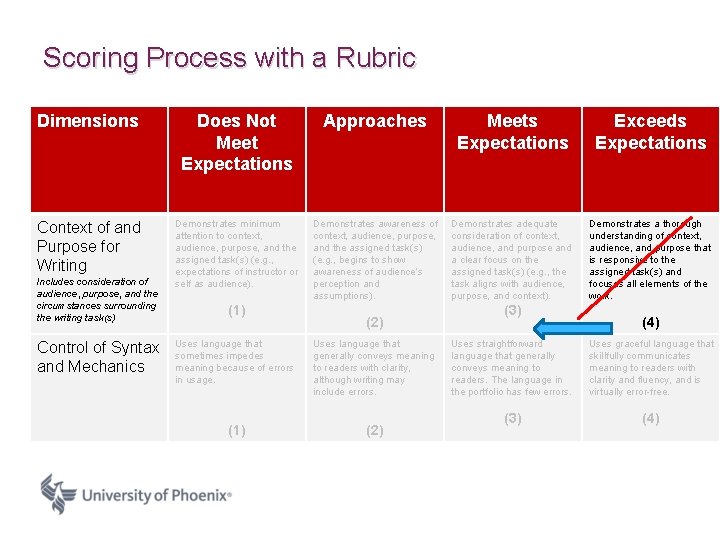
Scoring Process with a Rubric Dimensions Does Not Meet Expectations Approaches Meets Expectations Exceeds Expectations Context of and Purpose for Writing Demonstrates minimum attention to context, audience, purpose, and the assigned task(s) (e. g. , expectations of instructor or self as audience). Demonstrates awareness of context, audience, purpose, and the assigned task(s) (e. g. , begins to show awareness of audience’s perception and assumptions). Demonstrates adequate consideration of context, audience, and purpose and a clear focus on the assigned task(s) (e. g. , the task aligns with audience, purpose, and context). Demonstrates a thorough understanding of context, audience, and purpose that is responsive to the assigned task(s) and focuses all elements of the work. Includes consideration of audience, purpose, and the circumstances surrounding the writing task(s) Control of Syntax and Mechanics (1) (2) Uses language that sometimes impedes meaning because of errors in usage. Uses language that generally conveys meaning to readers with clarity, although writing may include errors. (1) (2) (3) (4) Uses straightforward language that generally conveys meaning to readers. The language in the portfolio has few errors. Uses graceful language that skillfully communicates meaning to readers with clarity and fluency, and is virtually error-free. (3) (4)
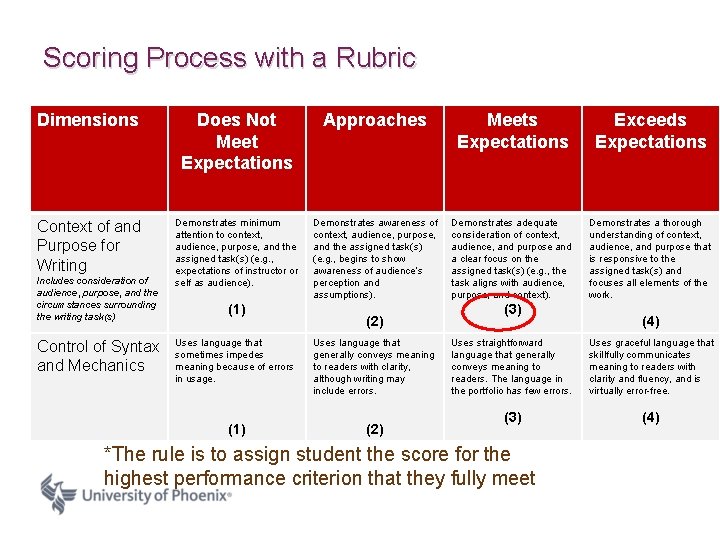
Scoring Process with a Rubric Dimensions Does Not Meet Expectations Approaches Meets Expectations Exceeds Expectations Context of and Purpose for Writing Demonstrates minimum attention to context, audience, purpose, and the assigned task(s) (e. g. , expectations of instructor or self as audience). Demonstrates awareness of context, audience, purpose, and the assigned task(s) (e. g. , begins to show awareness of audience’s perception and assumptions). Demonstrates adequate consideration of context, audience, and purpose and a clear focus on the assigned task(s) (e. g. , the task aligns with audience, purpose, and context). Demonstrates a thorough understanding of context, audience, and purpose that is responsive to the assigned task(s) and focuses all elements of the work. Includes consideration of audience, purpose, and the circumstances surrounding the writing task(s) Control of Syntax and Mechanics (1) (2) Uses language that sometimes impedes meaning because of errors in usage. Uses language that generally conveys meaning to readers with clarity, although writing may include errors. (1) (2) (3) (4) Uses straightforward language that generally conveys meaning to readers. The language in the portfolio has few errors. Uses graceful language that skillfully communicates meaning to readers with clarity and fluency, and is virtually error-free. (3) (4) *The rule is to assign student the score for the highest performance criterion that they fully meet
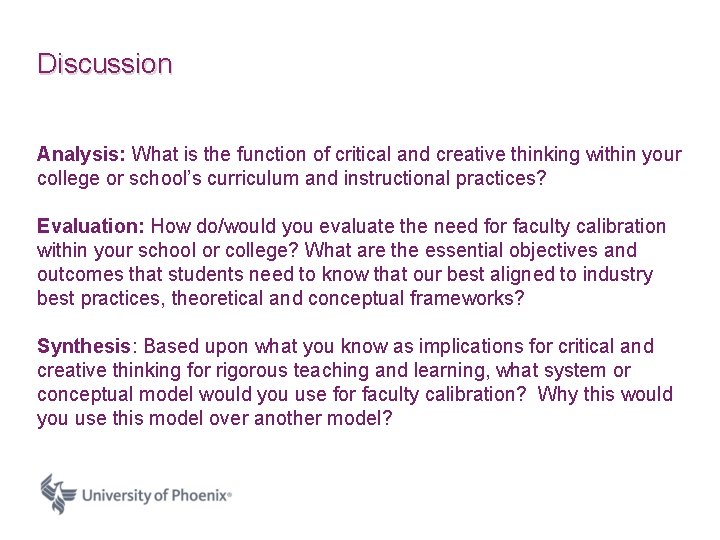
Discussion Analysis: What is the function of critical and creative thinking within your college or school’s curriculum and instructional practices? Evaluation: How do/would you evaluate the need for faculty calibration within your school or college? What are the essential objectives and outcomes that students need to know that our best aligned to industry best practices, theoretical and conceptual frameworks? Synthesis: Based upon what you know as implications for critical and creative thinking for rigorous teaching and learning, what system or conceptual model would you use for faculty calibration? Why this would you use this model over another model?
- Slides: 26