
Critical Analysis of IB 1 Identifying and managing
Critical Analysis of IB 1. Identifying and managing the negative political, economic and social impacts of IB operations 2. Identifying and sustaining the positive political, economic and social impacts of IB operations Identifying the impacts – using several analysis techniques 1. 2. 3. 4. Dependency theory World system theory Critical scenario analysis UN Frameworld
Dependency theory “(D)ependency is maintained through a series of mechanisms, ranging from political and economic policies, to exploitation of cheap natural and labour resources, cultural and intellectual hegemony, and the passing on of obsolete technologies. Moreover, dependency theorists point to the role of elites in the poor nations in maintaining the state of dependency and underdevelopment. ” (Cairns and Śliwa, 2008: 55‐‐‐ 56)
World system theory “In this model, which is defined in terms of power relations – political, economic and military – the nations at the core are those that exercise dominance over others, but are not themselves dominated. Those at the periphery… are subject to domination, but hold no power over others. (The semi‐‐‐periphery) consists of those countries that are both exploiters of… the periphery, but are themselves exploited by the core. ” – Cairns and Śliwa, 2008: 69)

Critical Analysis & Impacts Management in IB Strategy Deployment & Operations The New emerging “Critical Approach” in managing IB IB Strategy Planning Critical Analysis in: • Risk Management, to include stakeholders* Impact Analysis of Strategies * Includes the political, economic, social risks & environmental on stakeholders IB Strategy Deployment Critical Analysis in: • Change Mgt • Risks Monitoring & Control IB Operations Critical Analysis in: • Ops Mgt • Risks Monitoring & Control
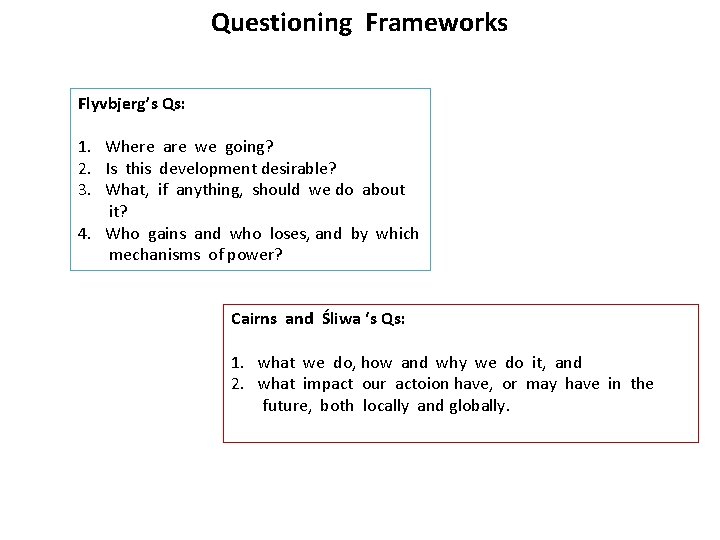
Questioning Frameworks Flyvbjerg’s Qs: 1. Where are we going? 2. Is this development desirable? 3. What, if anything, should we do about it? 4. Who gains and who loses, and by which mechanisms of power? Cairns and Śliwa ‘s Qs: 1. what we do, how and why we do it, and 2. what impact our actoion have, or may have in the future, both locally and globally.
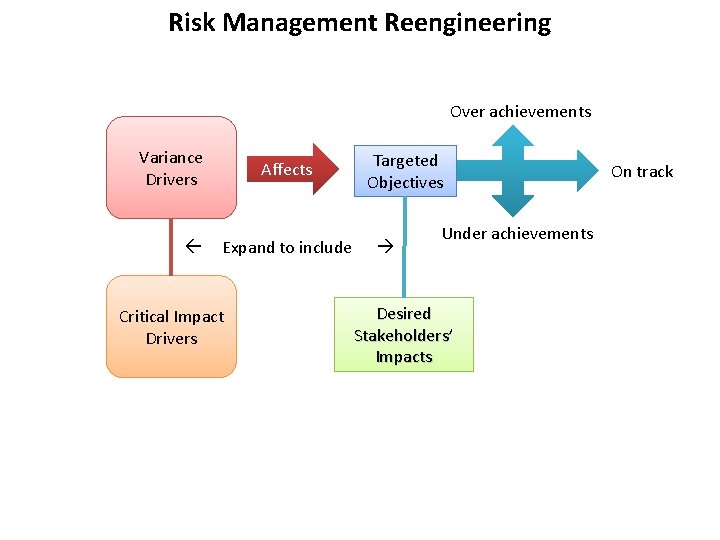
Risk Management Reengineering Over achievements Variance Drivers Affects Expand to include Critical Impact Drivers Targeted Objectives Under achievements Desired Stakeholders’ Impacts On track

Unethical Shopping Criteria Cheap, cheaper, cheapest Wants fulfilment $10 item $5 profit “More for Less” pricing Low cost procurement Buy @ $5 Pay 50 cents To produce product Cheap Labour
Unacceptable practices in supply chain 1. 2. 3. 4. 5. 6. Fraud, Corruption, Modern‐day slavery, Human trafficking and Child labour Toxic or cancer causing materials

Critical Scenario Modelling (CSM) provides a means for allowing students to consider and reflect upon issues of resource depletion, environmental degradation, human exploitation and socio‐‐‐ economic fragmentation, through their own ini. a. ve and by and large in their own terms. It is in this approach that we see the seeds of future change in the practices of IB and international management. ” – Cairns et al. , 2010: 978) Best Case Scenario Likely Case Scenario Worst Case Scenario
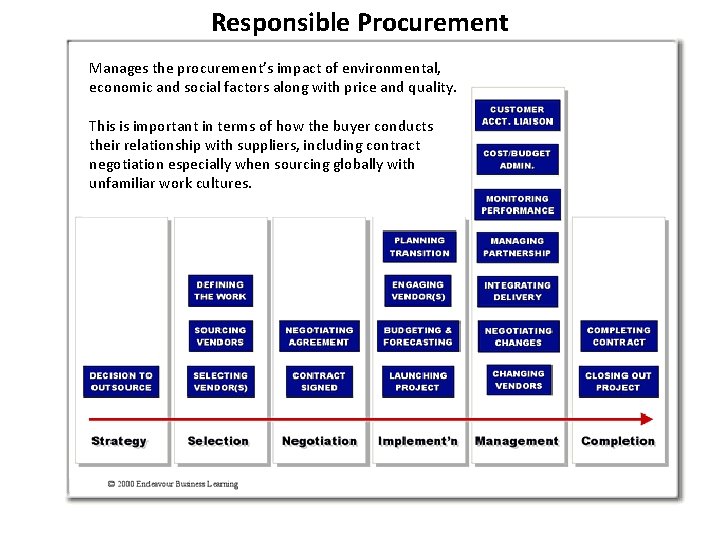
Responsible Procurement Manages the procurement’s impact of environmental, economic and social factors along with price and quality. This is important in terms of how the buyer conducts their relationship with suppliers, including contract negotiation especially when sourcing globally with unfamiliar work cultures.
- Slides: 10