
CRISTAL A Prospective Randomized Trial of SirolimusEluting Stents

- Slides: 24
CRISTAL: A Prospective Randomized Trial of Sirolimus-Eluting Stents Compared to Balloon Angioplasty for Restenosis of Drug-Eluting Coronary Stents Bernard Chevalier, Jean Fajadet on behalf of the CRISTAL investigators TCT 2010, Late Breaking Trials and First Report Investigations; September 25, 2010
• My potential conflict of interest: – I received a modest research grant for the conduct of this trial from Cordis France.
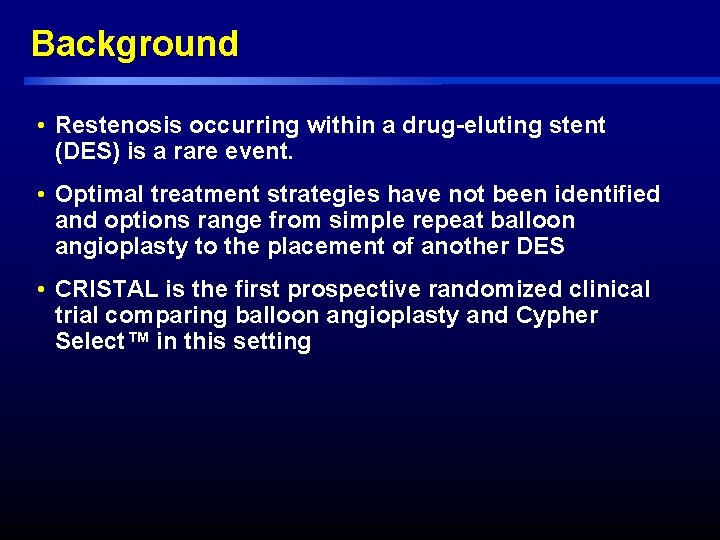
Background • Restenosis occurring within a drug-eluting stent (DES) is a rare event. • Optimal treatment strategies have not been identified and options range from simple repeat balloon angioplasty to the placement of another DES • CRISTAL is the first prospective randomized clinical trial comparing balloon angioplasty and Cypher Select™ in this setting
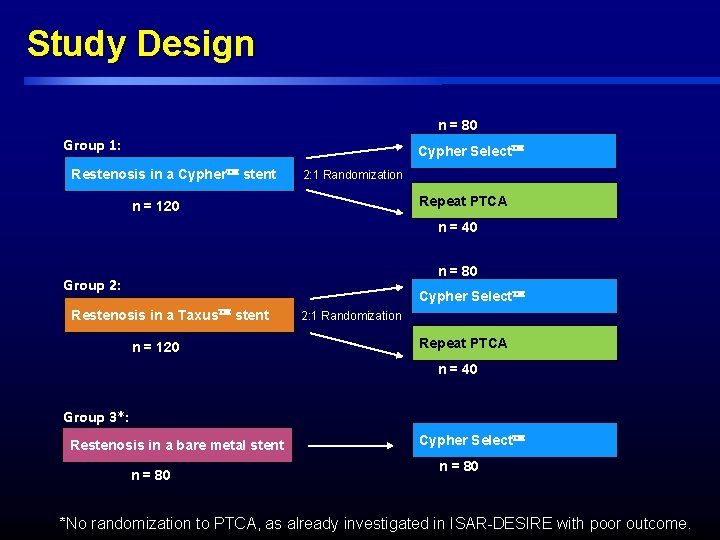
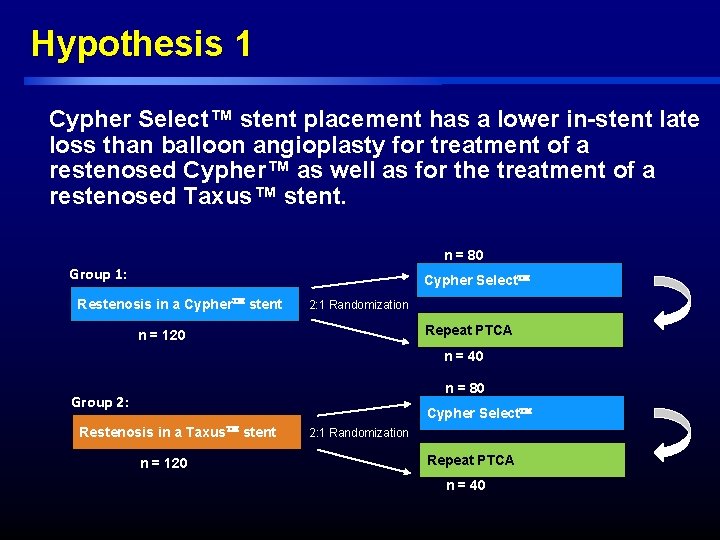
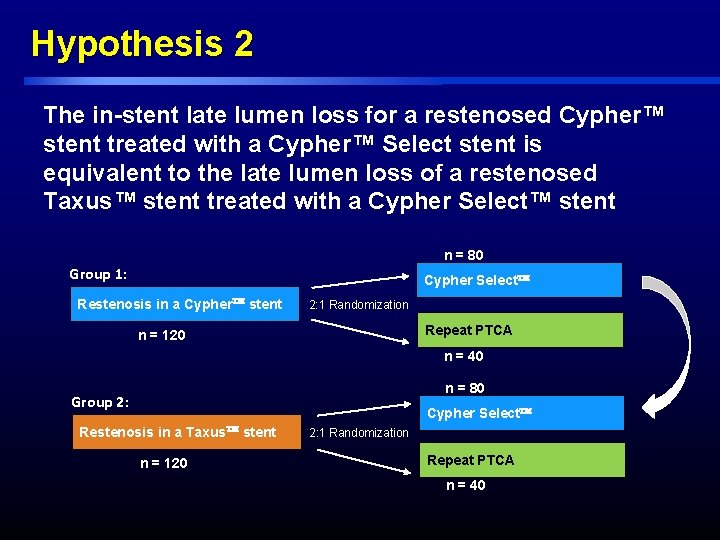
Study Design n = 80 Group 1: Cypher Select Restenosis in a Cypher stent 2: 1 Randomization Repeat PTCA n = 120 n = 40 n = 80 Group 2: Cypher Select Restenosis in a Taxus stent n = 120 2: 1 Randomization Repeat PTCA n = 40 Group 3*: Restenosis in a bare metal stent n = 80 Cypher Select n = 80 *No randomization to PTCA, as already investigated in ISAR-DESIRE with poor outcome.
Hypothesis 1 Cypher Select™ stent placement has a lower in-stent late loss than balloon angioplasty for treatment of a restenosed Cypher™ as well as for the treatment of a restenosed Taxus™ stent. n = 80 Group 1: Cypher Select Restenosis in a Cypher stent 2: 1 Randomization Repeat PTCA n = 120 n = 40 n = 80 Group 2: Cypher Select Restenosis in a Taxus stent n = 120 2: 1 Randomization Repeat PTCA n = 40
Hypothesis 2 The in-stent late lumen loss for a restenosed Cypher™ stent treated with a Cypher™ Select stent is equivalent to the late lumen loss of a restenosed Taxus™ stent treated with a Cypher Select™ stent n = 80 Group 1: Cypher Select Restenosis in a Cypher stent 2: 1 Randomization Repeat PTCA n = 120 n = 40 n = 80 Group 2: Cypher Select Restenosis in a Taxus stent n = 120 2: 1 Randomization Repeat PTCA n = 40
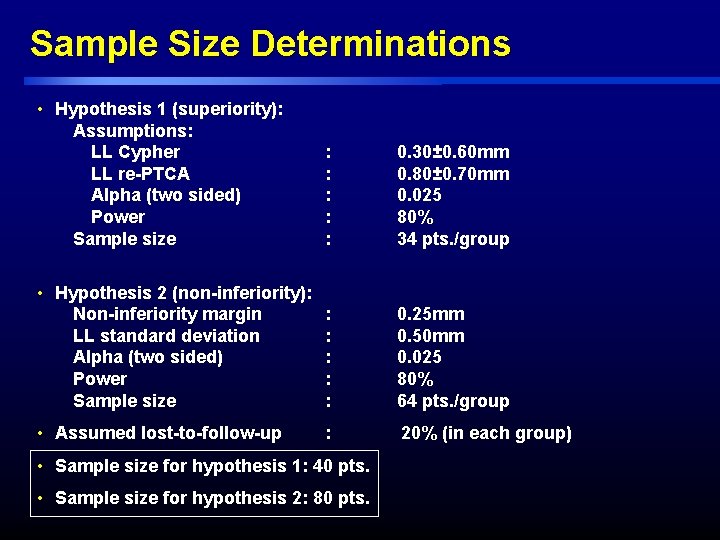
Sample Size Determinations • Hypothesis 1 (superiority): Assumptions: LL Cypher LL re-PTCA Alpha (two sided) Power Sample size : : : 0. 30± 0. 60 mm 0. 80± 0. 70 mm 0. 025 80% 34 pts. /group • Hypothesis 2 (non-inferiority): Non-inferiority margin LL standard deviation Alpha (two sided) Power Sample size : : : 0. 25 mm 0. 50 mm 0. 025 80% 64 pts. /group • Assumed lost-to-follow-up : 20% (in each group) • Sample size for hypothesis 1: 40 pts. • Sample size for hypothesis 2: 80 pts.
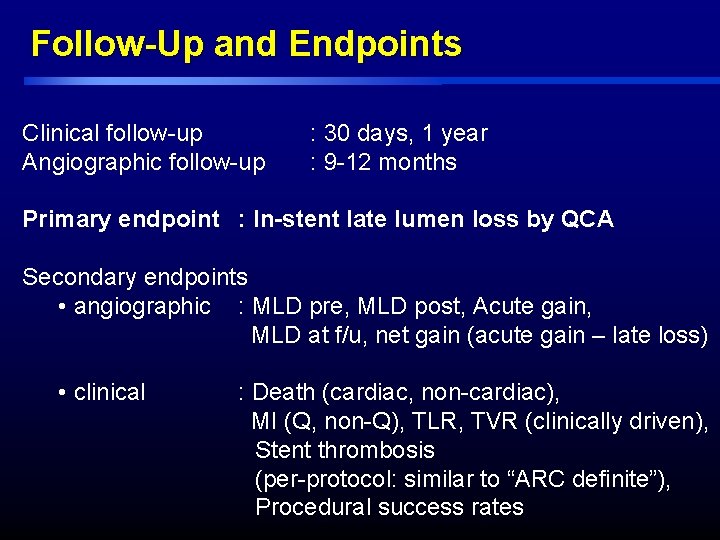
Follow-Up and Endpoints Clinical follow-up Angiographic follow-up : 30 days, 1 year : 9 -12 months Primary endpoint : In-stent late lumen loss by QCA Secondary endpoints • angiographic : MLD pre, MLD post, Acute gain, MLD at f/u, net gain (acute gain – late loss) • clinical : Death (cardiac, non-cardiac), MI (Q, non-Q), TLR, TVR (clinically driven), Stent thrombosis (per-protocol: similar to “ARC definite”), Procedural success rates
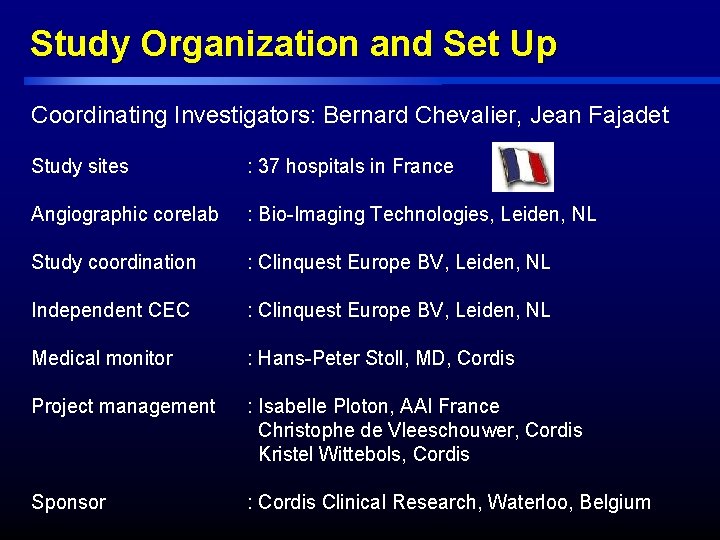
Study Organization and Set Up Coordinating Investigators: Bernard Chevalier, Jean Fajadet Study sites : 37 hospitals in France Angiographic corelab : Bio-Imaging Technologies, Leiden, NL Study coordination : Clinquest Europe BV, Leiden, NL Independent CEC : Clinquest Europe BV, Leiden, NL Medical monitor : Hans-Peter Stoll, MD, Cordis Project management : Isabelle Ploton, AAI France Christophe de Vleeschouwer, Cordis Kristel Wittebols, Cordis Sponsor : Cordis Clinical Research, Waterloo, Belgium
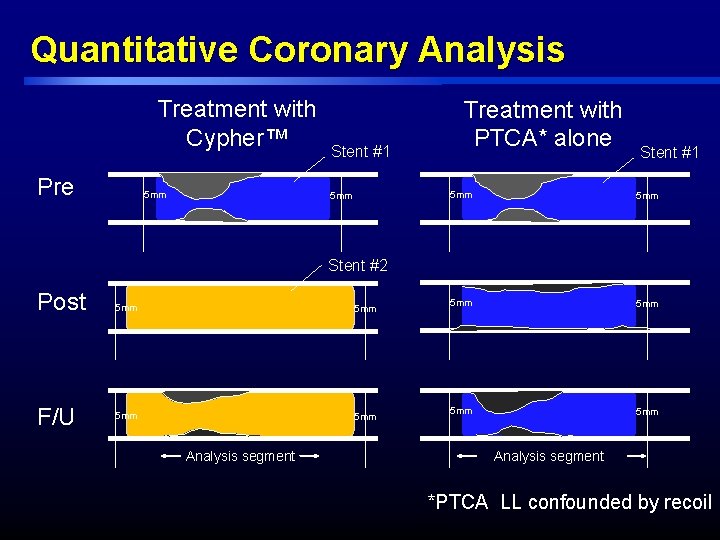
Quantitative Coronary Analysis Treatment with Cypher™ Pre 5 mm Stent #1 5 mm Treatment with PTCA* alone Stent #1 5 mm 5 mm 5 mm Stent #2 Post F/U 5 mm 5 mm Analysis segment *PTCA LL confounded by recoil
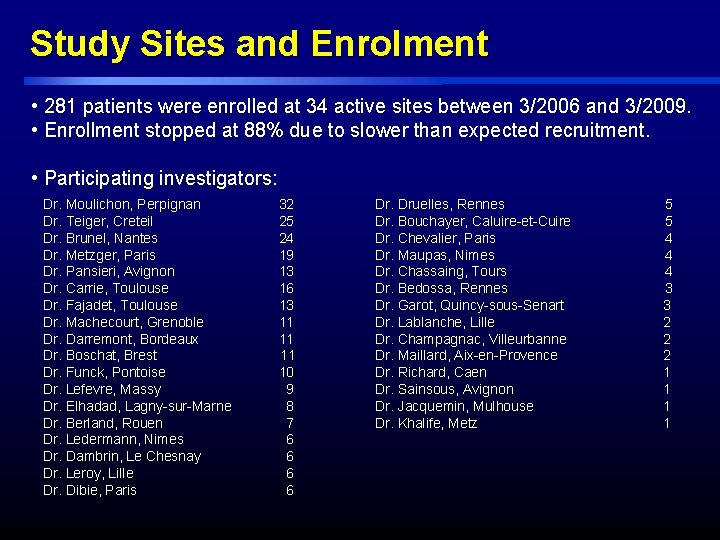
Study Sites and Enrolment • 281 patients were enrolled at 34 active sites between 3/2006 and 3/2009. • Enrollment stopped at 88% due to slower than expected recruitment. • Participating investigators: Dr. Moulichon, Perpignan Dr. Teiger, Creteil Dr. Brunel, Nantes Dr. Metzger, Paris Dr. Pansieri, Avignon Dr. Carrie, Toulouse Dr. Fajadet, Toulouse Dr. Machecourt, Grenoble Dr. Darremont, Bordeaux Dr. Boschat, Brest Dr. Funck, Pontoise Dr. Lefevre, Massy Dr. Elhadad, Lagny-sur-Marne Dr. Berland, Rouen Dr. Ledermann, Nimes Dr. Dambrin, Le Chesnay Dr. Leroy, Lille Dr. Dibie, Paris 32 25 24 19 13 16 13 11 11 11 10 9 8 7 6 6 Dr. Druelles, Rennes Dr. Bouchayer, Caluire-et-Cuire Dr. Chevalier, Paris Dr. Maupas, Nimes Dr. Chassaing, Tours Dr. Bedossa, Rennes Dr. Garot, Quincy-sous-Senart Dr. Lablanche, Lille Dr. Champagnac, Villeurbanne Dr. Maillard, Aix-en-Provence Dr. Richard, Caen Dr. Sainsous, Avignon Dr. Jacquemin, Mulhouse Dr. Khalife, Metz 5 5 4 4 4 3 3 2 2 2 1 1
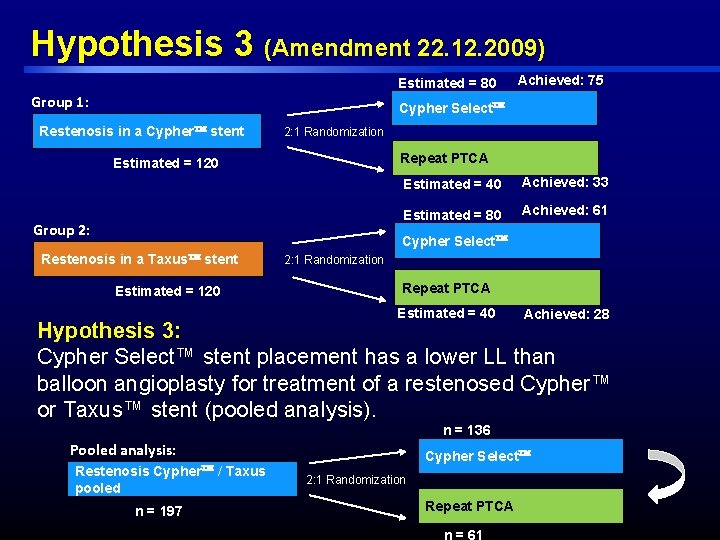
Hypothesis 3 (Amendment 22. 12. 2009) Estimated = 80 Group 1: Achieved: 75 Cypher Select Restenosis in a Cypher stent 2: 1 Randomization Repeat PTCA Estimated = 120 Group 2: Estimated = 40 Achieved: 33 Estimated = 80 Achieved: 61 Cypher Select Restenosis in a Taxus stent Estimated = 120 2: 1 Randomization Repeat PTCA Estimated = 40 Achieved: 28 Hypothesis 3: Cypher Select™ stent placement has a lower LL than balloon angioplasty for treatment of a restenosed Cypher™ or Taxus™ stent (pooled analysis). n = 136 Pooled analysis: Restenosis Cypher / Taxus pooled n = 197 Cypher Select 2: 1 Randomization Repeat PTCA n = 61
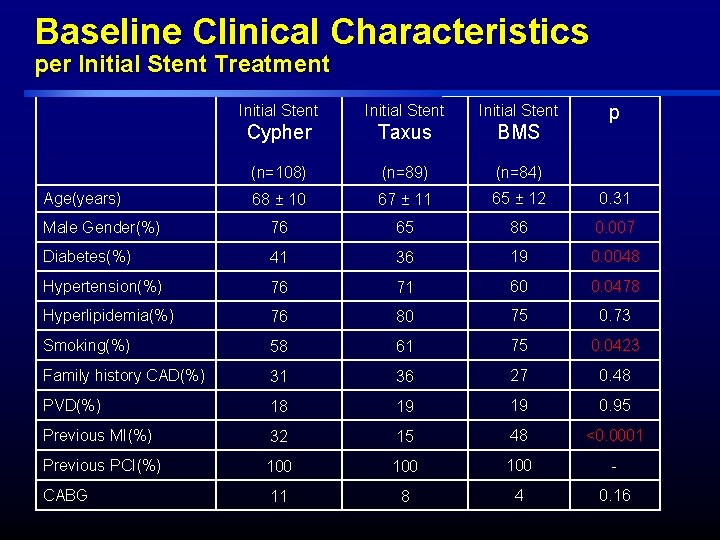
Baseline Clinical Characteristics per Initial Stent Treatment Initial Stent Cypher Taxus BMS (n=108) (n=89) (n=84) 68 ± 10 67 ± 11 65 ± 12 0. 31 Male Gender(%) 76 65 86 0. 007 Diabetes(%) 41 36 19 0. 0048 Hypertension(%) 76 71 60 0. 0478 Hyperlipidemia(%) 76 80 75 0. 73 Smoking(%) 58 61 75 0. 0423 Family history CAD(%) 31 36 27 0. 48 PVD(%) 18 19 19 0. 95 Previous MI(%) 32 15 48 <0. 0001 Previous PCI(%) 100 100 - CABG 11 8 4 0. 16 Age(years) p
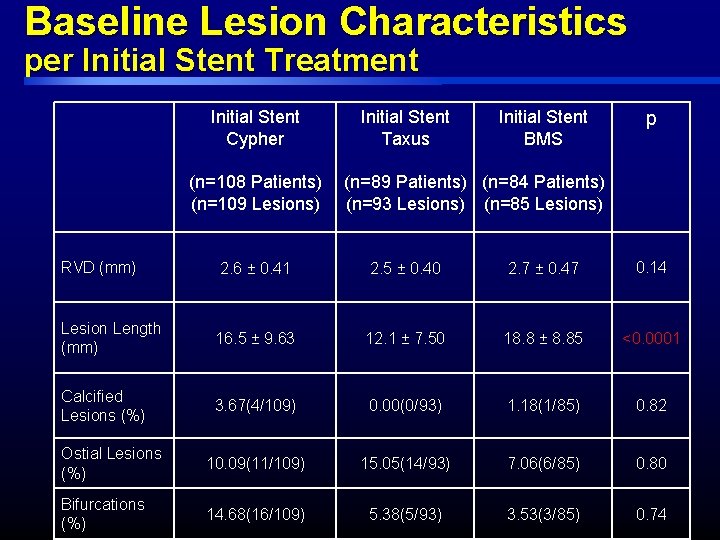
Baseline Lesion Characteristics per Initial Stent Treatment Initial Stent Cypher (n=108 Patients) (n=109 Lesions) Initial Stent Taxus Initial Stent BMS p (n=89 Patients) (n=84 Patients) (n=93 Lesions) (n=85 Lesions) RVD (mm) 2. 6 ± 0. 41 2. 5 ± 0. 40 2. 7 ± 0. 47 0. 14 Lesion Length (mm) 16. 5 ± 9. 63 12. 1 ± 7. 50 18. 8 ± 8. 85 <0. 0001 Calcified Lesions (%) 3. 67(4/109) 0. 00(0/93) 1. 18(1/85) 0. 82 Ostial Lesions (%) 10. 09(11/109) 15. 05(14/93) 7. 06(6/85) 0. 80 Bifurcations (%) 14. 68(16/109) 5. 38(5/93) 3. 53(3/85) 0. 74
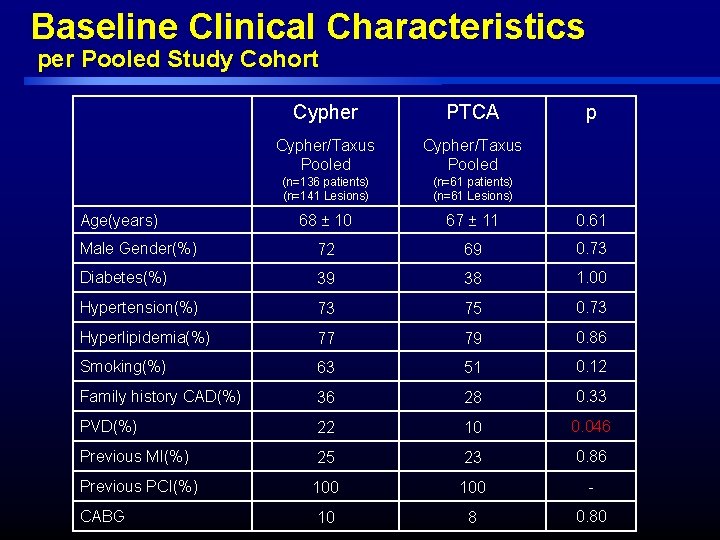
Baseline Clinical Characteristics per Pooled Study Cohort Cypher PTCA Cypher/Taxus Pooled (n=136 patients) (n=141 Lesions) (n=61 patients) (n=61 Lesions) 68 ± 10 67 ± 11 0. 61 Male Gender(%) 72 69 0. 73 Diabetes(%) 39 38 1. 00 Hypertension(%) 73 75 0. 73 Hyperlipidemia(%) 77 79 0. 86 Smoking(%) 63 51 0. 12 Family history CAD(%) 36 28 0. 33 PVD(%) 22 10 0. 046 Previous MI(%) 25 23 0. 86 Previous PCI(%) 100 - CABG 10 8 0. 80 Age(years) p
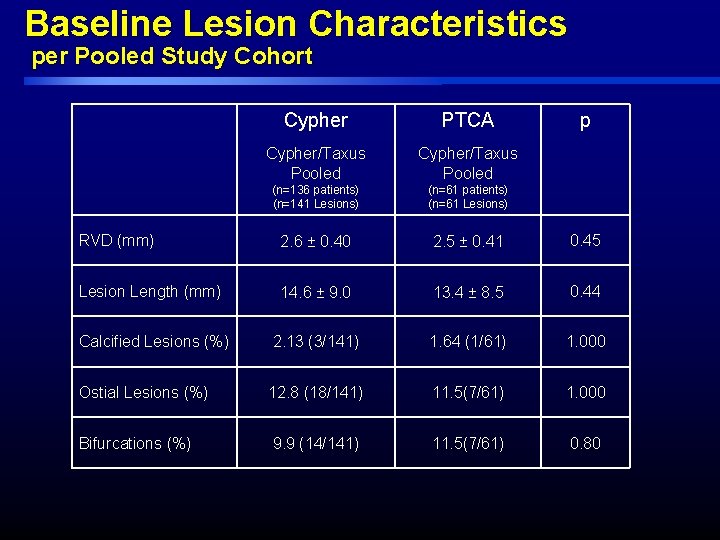
Baseline Lesion Characteristics per Pooled Study Cohort Cypher PTCA p Cypher/Taxus Pooled (n=136 patients) (n=141 Lesions) (n=61 patients) (n=61 Lesions) RVD (mm) 2. 6 ± 0. 40 2. 5 ± 0. 41 0. 45 Lesion Length (mm) 14. 6 ± 9. 0 13. 4 ± 8. 5 0. 44 Calcified Lesions (%) 2. 13 (3/141) 1. 64 (1/61) 1. 000 Ostial Lesions (%) 12. 8 (18/141) 11. 5(7/61) 1. 000 Bifurcations (%) 9. 9 (14/141) 11. 5(7/61) 0. 80
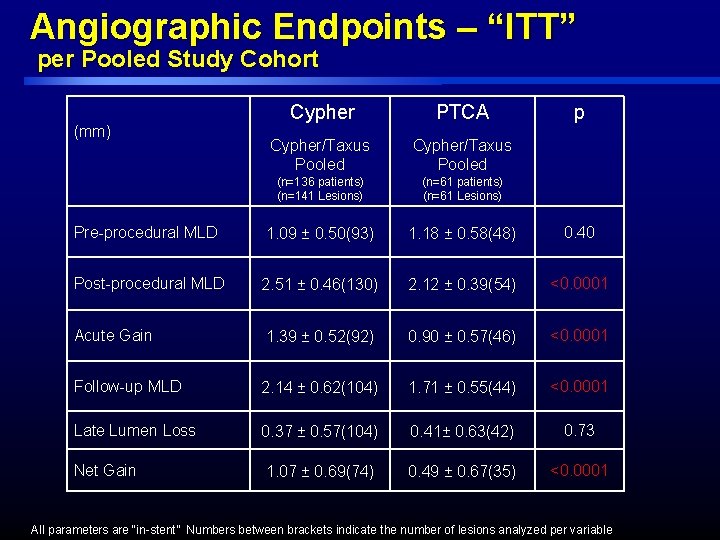
Angiographic Endpoints – “ITT” per Pooled Study Cohort Cypher PTCA Cypher/Taxus Pooled (n=136 patients) (n=141 Lesions) (n=61 patients) (n=61 Lesions) Pre-procedural MLD 1. 09 ± 0. 50(93) 1. 18 ± 0. 58(48) 0. 40 Post-procedural MLD 2. 51 ± 0. 46(130) 2. 12 ± 0. 39(54) <0. 0001 Acute Gain 1. 39 ± 0. 52(92) 0. 90 ± 0. 57(46) <0. 0001 Follow-up MLD 2. 14 ± 0. 62(104) 1. 71 ± 0. 55(44) <0. 0001 Late Lumen Loss 0. 37 ± 0. 57(104) 0. 41± 0. 63(42) 0. 73 Net Gain 1. 07 ± 0. 69(74) 0. 49 ± 0. 67(35) <0. 0001 (mm) p All parameters are “in-stent” Numbers between brackets indicate the number of lesions analyzed per variable
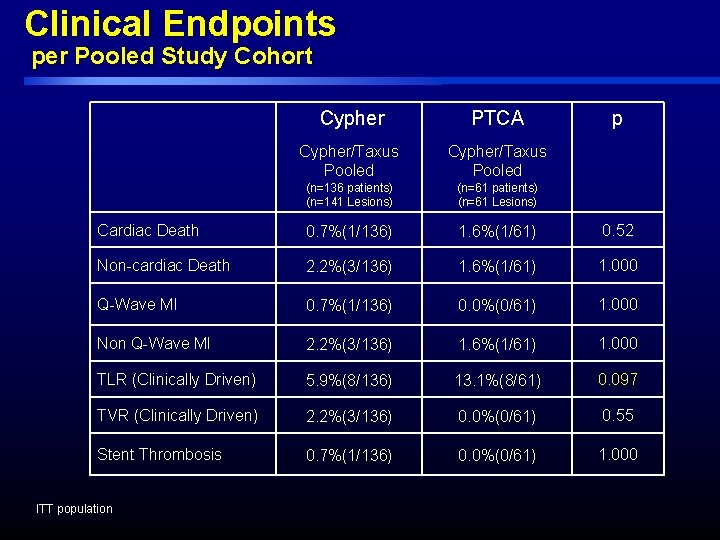
Clinical Endpoints per Pooled Study Cohort Cypher PTCA Cypher/Taxus Pooled (n=136 patients) (n=141 Lesions) (n=61 patients) (n=61 Lesions) Cardiac Death 0. 7%(1/136) 1. 6%(1/61) 0. 52 Non-cardiac Death 2. 2%(3/136) 1. 6%(1/61) 1. 000 Q-Wave MI 0. 7%(1/136) 0. 0%(0/61) 1. 000 Non Q-Wave MI 2. 2%(3/136) 1. 6%(1/61) 1. 000 TLR (Clinically Driven) 5. 9%(8/136) 13. 1%(8/61) 0. 097 TVR (Clinically Driven) 2. 2%(3/136) 0. 0%(0/61) 0. 55 Stent Thrombosis 0. 7%(1/136) 0. 0%(0/61) 1. 000 ITT population p
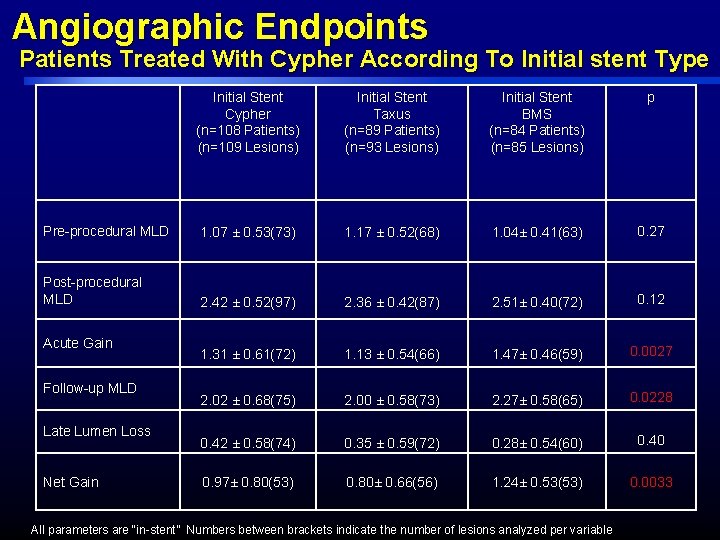
Angiographic Endpoints Patients Treated With Cypher According To Initial stent Type Initial Stent Cypher (n=108 Patients) (n=109 Lesions) Initial Stent Taxus (n=89 Patients) (n=93 Lesions) Initial Stent BMS (n=84 Patients) (n=85 Lesions) p Pre-procedural MLD 1. 07 ± 0. 53(73) 1. 17 ± 0. 52(68) 1. 04± 0. 41(63) 0. 27 Post-procedural MLD 2. 42 ± 0. 52(97) 2. 36 ± 0. 42(87) 2. 51± 0. 40(72) 0. 12 1. 31 ± 0. 61(72) 1. 13 ± 0. 54(66) 1. 47± 0. 46(59) 0. 0027 2. 02 ± 0. 68(75) 2. 00 ± 0. 58(73) 2. 27± 0. 58(65) 0. 0228 0. 42 ± 0. 58(74) 0. 35 ± 0. 59(72) 0. 28± 0. 54(60) 0. 40 0. 97± 0. 80(53) 0. 80± 0. 66(56) 1. 24± 0. 53(53) 0. 0033 Acute Gain Follow-up MLD Late Lumen Loss Net Gain All parameters are “in-stent” Numbers between brackets indicate the number of lesions analyzed per variable
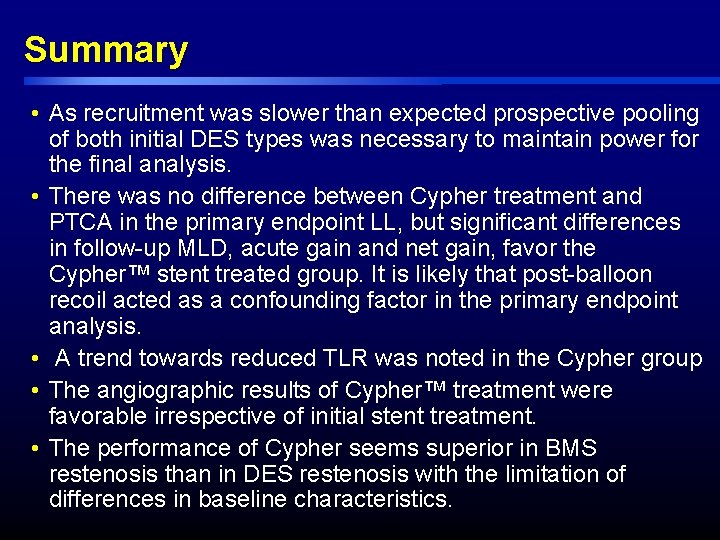
Summary • As recruitment was slower than expected prospective pooling of both initial DES types was necessary to maintain power for the final analysis. • There was no difference between Cypher treatment and PTCA in the primary endpoint LL, but significant differences in follow-up MLD, acute gain and net gain, favor the Cypher™ stent treated group. It is likely that post-balloon recoil acted as a confounding factor in the primary endpoint analysis. • A trend towards reduced TLR was noted in the Cypher group • The angiographic results of Cypher™ treatment were favorable irrespective of initial stent treatment. • The performance of Cypher seems superior in BMS restenosis than in DES restenosis with the limitation of differences in baseline characteristics.
Conclusion For DES restenosis in Cypher™ or Taxus™ stents, repeat treatment with Cypher™ is associated with a better angiographic outcome at 1 year than repeat PTCA.
Thank You !
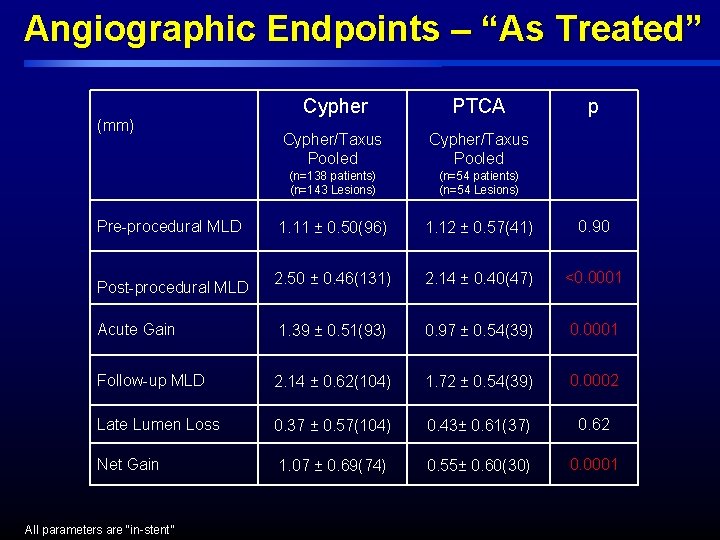
Angiographic Endpoints – “As Treated” Cypher PTCA Cypher/Taxus Pooled (n=138 patients) (n=143 Lesions) (n=54 patients) (n=54 Lesions) 1. 11 ± 0. 50(96) 1. 12 ± 0. 57(41) 0. 90 2. 50 ± 0. 46(131) 2. 14 ± 0. 40(47) <0. 0001 Acute Gain 1. 39 ± 0. 51(93) 0. 97 ± 0. 54(39) 0. 0001 Follow-up MLD 2. 14 ± 0. 62(104) 1. 72 ± 0. 54(39) 0. 0002 Late Lumen Loss 0. 37 ± 0. 57(104) 0. 43± 0. 61(37) 0. 62 Net Gain 1. 07 ± 0. 69(74) 0. 55± 0. 60(30) 0. 0001 (mm) Pre-procedural MLD Post-procedural MLD All parameters are “in-stent” p
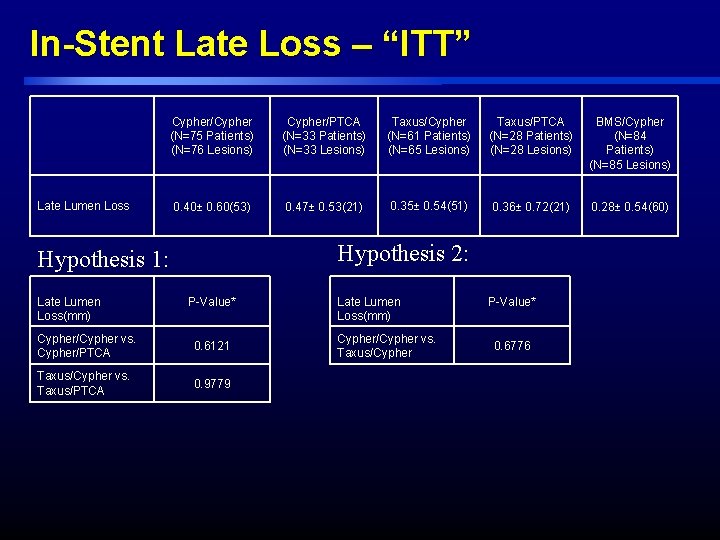
In-Stent Late Loss – “ITT” Late Lumen Loss Cypher/Cypher (N=75 Patients) (N=76 Lesions) Cypher/PTCA (N=33 Patients) (N=33 Lesions) Taxus/Cypher (N=61 Patients) (N=65 Lesions) Taxus/PTCA (N=28 Patients) (N=28 Lesions) BMS/Cypher (N=84 Patients) (N=85 Lesions) 0. 40± 0. 60(53) 0. 47± 0. 53(21) 0. 35± 0. 54(51) 0. 36± 0. 72(21) 0. 28± 0. 54(60) Hypothesis 2: Hypothesis 1: Late Lumen Loss(mm) P-Value* Cypher/Cypher vs. Cypher/PTCA 0. 6121 Taxus/Cypher vs. Taxus/PTCA 0. 9779 Late Lumen Loss(mm) Cypher/Cypher vs. Taxus/Cypher P-Value* 0. 6776