
Crisis Prevention and Intervention Services Individual Support Team
- Slides: 25
Crisis Prevention and Intervention Services Individual Support Team Maine Department of Health and Human Services
Individual Support Team (IST) • • What is it? Why do we use it? What are the benefits? When do we use it? How does it work? Who does what? When does it end? • Technical Guide 11/28/2018 2
Why. Why Have. IST? an IST? The intent of the IST is to support the person and provide services designed to: – Prevent crisis situations – Provide support during a crisis 11/28/2018 3
Benefits? • When a crisis occurs, support of an Individual Support Team (IST) is often invaluable. • Relationships are crucial in an effective crisis response. • The development of a Crisis Prevention Plan will identify who does what to assist in the safety, health and well-being of the individual. 11/28/2018 4
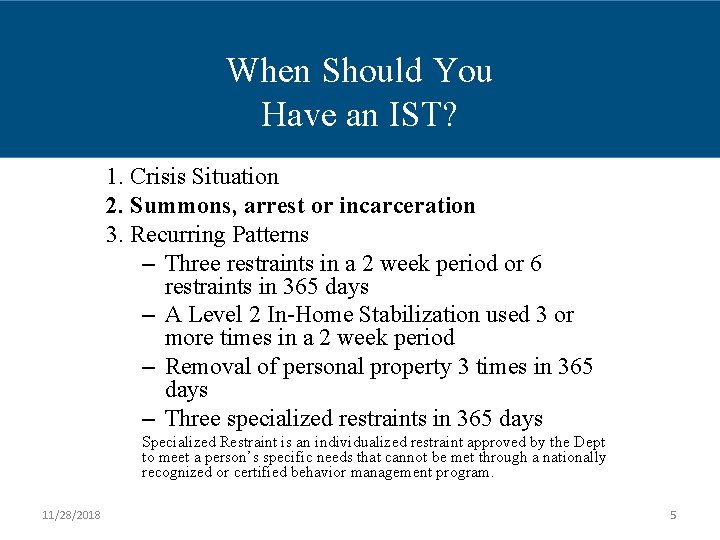
When IST? You When Should Have an IST? 1. Crisis Situation 2. Summons, arrest or incarceration 3. Recurring Patterns – Three restraints in a 2 week period or 6 restraints in 365 days – A Level 2 In-Home Stabilization used 3 or more times in a 2 week period – Removal of personal property 3 times in 365 days – Three specialized restraints in 365 days Specialized Restraint is an individualized restraint approved by the Dept to meet a person’s specific needs that cannot be met through a nationally recognized or certified behavior management program. 11/28/2018 5
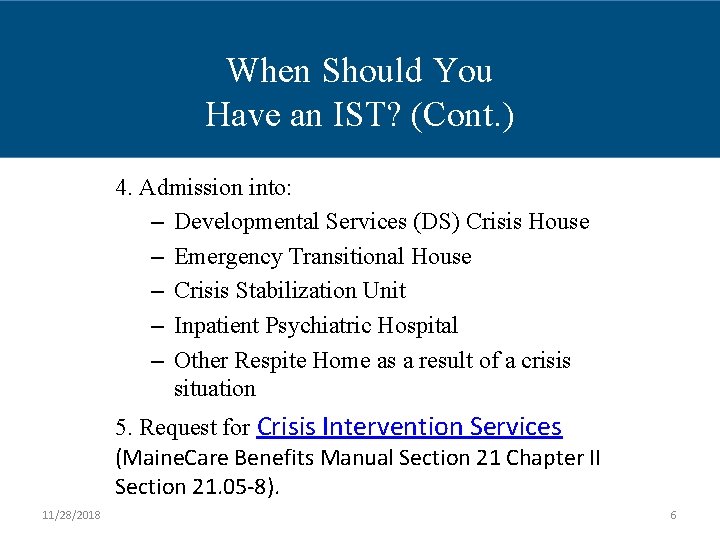
When continued… When. IST? Should You Have an IST? (Cont. ) 4. Admission into: – Developmental Services (DS) Crisis House – Emergency Transitional House – Crisis Stabilization Unit – Inpatient Psychiatric Hospital – Other Respite Home as a result of a crisis situation 5. Request for Crisis Intervention Services (Maine. Care Benefits Manual Section 21 Chapter II Section 21. 05 -8). 11/28/2018 6
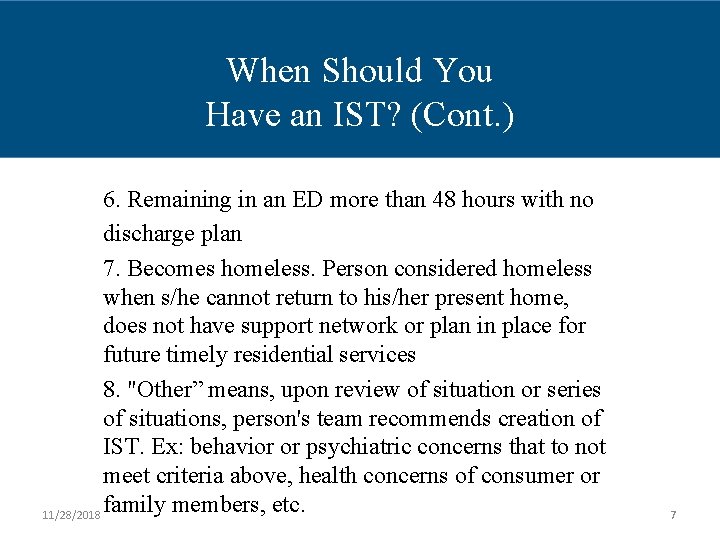
When continued… When. IST? Should You Have an IST? (Cont. ) 6. Remaining in an ED more than 48 hours with no discharge plan 7. Becomes homeless. Person considered homeless when s/he cannot return to his/her present home, does not have support network or plan in place for future timely residential services 8. "Other” means, upon review of situation or series of situations, person's team recommends creation of IST. Ex: behavior or psychiatric concerns that to not meet criteria above, health concerns of consumer or family members, etc. 11/28/2018 7
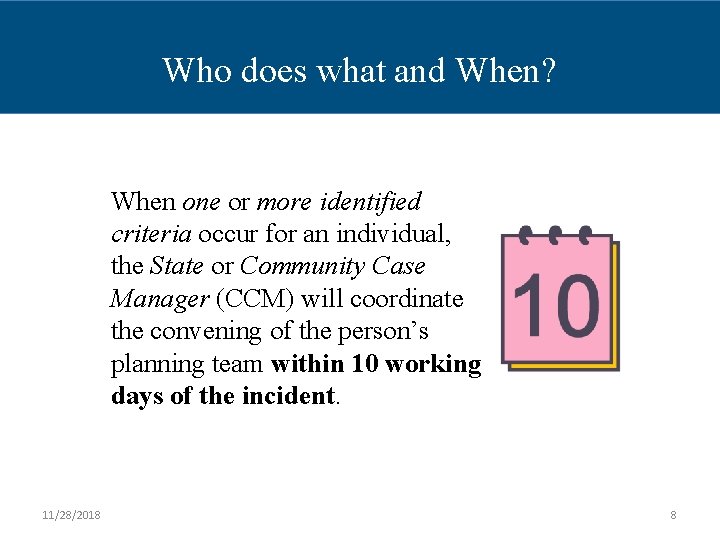
Whodoeswhatand and. When? when? Who When one or more identified criteria occur for an individual, the State or Community Case Manager (CCM) will coordinate the convening of the person’s planning team within 10 working days of the incident. 11/28/2018 8
Who does what and When? (Cont. ) Who does what and when? The case manager is responsible for the scheduling and documentation of the IST meeting in EIS as well as assuring action steps are completed. Crisis is responsible for the documentation of the Crisis Prevention Plan. 11/28/2018 9
Who does what and When? (Cont. ) • IST can be a separate team but is most often the person’s Planning Team. • It should include the Individual and those they find helpful in times of crisis. 11/28/2018 Maine Department of Health and Human Services 10
Who does what and When? (Cont. ) Who does what and when? • If individual is admitted to DS Crisis House, an assessment will be completed at the Crisis House. • The assessment includes review of incident, environment of crisis location, and recommendations for future intervention and support. 11/28/2018 11
and when? Who does what and When? (Cont. ) • IST reviews crisis incident and any documentation provided, such as hospital assessments, restraint information or resource development information. • The Planning team develops or reviews the Functional Assessment and Positive Support Plan for its effectiveness. http: //www. maine. gov/dhhs/oads/provider/developmental-services/behavior-regulations. shtml 11/28/2018 12
Who does what Whoand does. When? what and (Cont. ) when? If there is a Recurring Pattern, a Behavior Management Plan is REQUIRED! The Planning Team Must Develop: o An appropriate Behavior Management Plan and submitted for approval pursuant to this regulation. o Must be developed within 60 days, if not, it must be identified as an Unmet Need. 11/28/2018 13
Who does what Whoand does what (Cont. ) When? and when? If there are Recurring Patterns and a Behavior Management Plan is not Developed The Planning Team Must: o Submit to the Review Team, for approval, a justification explaining why a Behavior Management Plan is not necessary. o Review Team may require that a Behavior Management Plan be developed to address recurring challenging behavior. 11/28/2018 14
whatwhen? Who does what and When? (Cont. ) • The IST meeting will review and document the incident(s), action steps, psychiatric services, need for specific training and identify who is responsible with clear time frames. 11/28/2018 15
Who does what and When? (Cont. ) Who does what and when? • A Crisis Team member and the person’s Case Manager must be part of the IST can occur with or without the guardian present. • Crisis must be invited but an IST can continue in the absence of a Crisis team member. • The Case Manager is the lead coordinator for the planning process and monitoring of the IST. • The Crisis Team maintains 24 hour, 10 day and quarterly follow-up to individuals who have an active IST. This information will be part of the IST assessment in EIS. • Crisis will schedule this internally. 11/28/2018 16
Who does what and When? Who does what(Cont. ) and when? When IST determines need for a new service or goal, the Case Manager is responsible to reversion the plan to include that service or goal. 11/28/2018 17
When does it end? • The IST determines what type of communication and review process is necessary for its role. • The Planning Team determines when the IST has been completed and may be dissolved. 11/28/2018 Maine Department of Health and Human Services 18
What happens after the IST is dissolved? • A new IST is to be called any time there is another incident which meets the criteria. • Individuals within Developmental Services are always eligible for support and intervention from the DS crisis teams. 11/28/2018 19
Technical - Documentation • Create a new Assessment in EIS – DS Individual Support Team (Version 1) • Verify that Crisis has not already created the assessment to enter their documentation. If it has been opened, please complete. • Complete all the boxes in the assessment • If IST is not held within 10 days of the incident, document reason in the review of the incident narrative • DS Crisis will document their attendance of the initial IST meeting and check-ins with the individual as a DS IST note attached to the IST assessment • Follow up IST meetings for the same incident/behaviors • Attach a DS General Note to the same IST assessment • When the IST is dissolved, lock the IST assessment • Open a new IST assessment only when a new IST meeting is initiated 11/28/2018 20
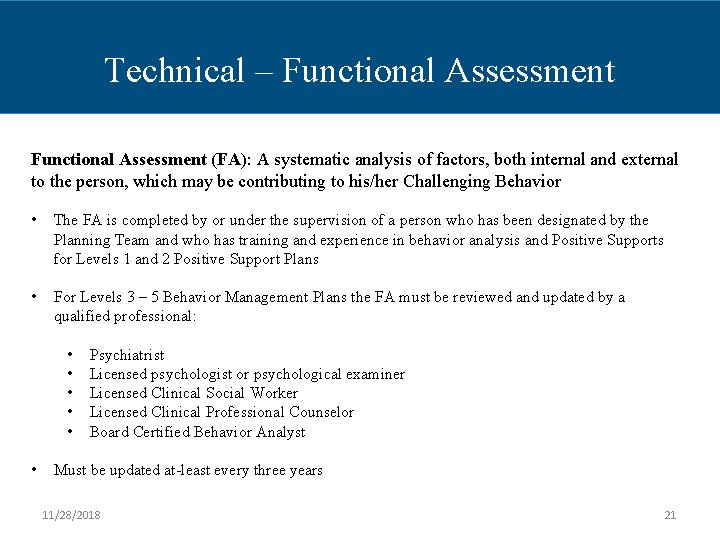
Technical – Functional Assessment (FA): A systematic analysis of factors, both internal and external to the person, which may be contributing to his/her Challenging Behavior • The FA is completed by or under the supervision of a person who has been designated by the Planning Team and who has training and experience in behavior analysis and Positive Supports for Levels 1 and 2 Positive Support Plans • For Levels 3 – 5 Behavior Management Plans the FA must be reviewed and updated by a qualified professional: • • • Psychiatrist Licensed psychologist or psychological examiner Licensed Clinical Social Worker Licensed Clinical Professional Counselor Board Certified Behavior Analyst Must be updated at-least every three years 11/28/2018 21
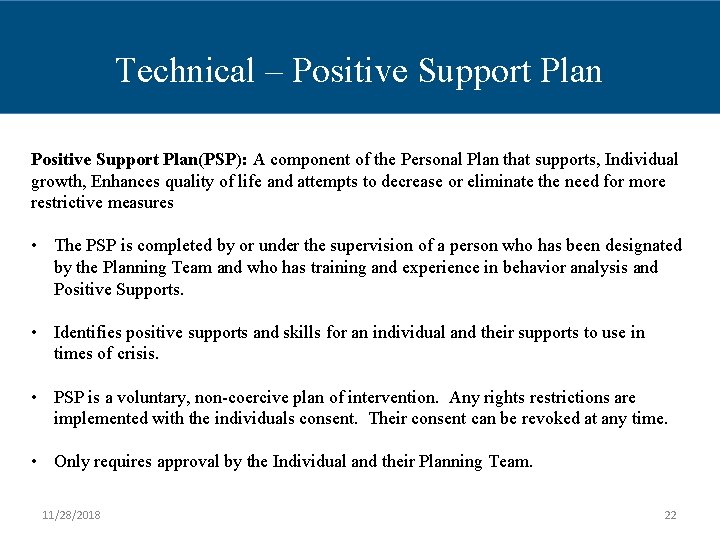
Technical – Positive Support Plan(PSP): A component of the Personal Plan that supports, Individual growth, Enhances quality of life and attempts to decrease or eliminate the need for more restrictive measures • The PSP is completed by or under the supervision of a person who has been designated by the Planning Team and who has training and experience in behavior analysis and Positive Supports. • Identifies positive supports and skills for an individual and their supports to use in times of crisis. • PSP is a voluntary, non-coercive plan of intervention. Any rights restrictions are implemented with the individuals consent. Their consent can be revoked at any time. • Only requires approval by the Individual and their Planning Team. 11/28/2018 22
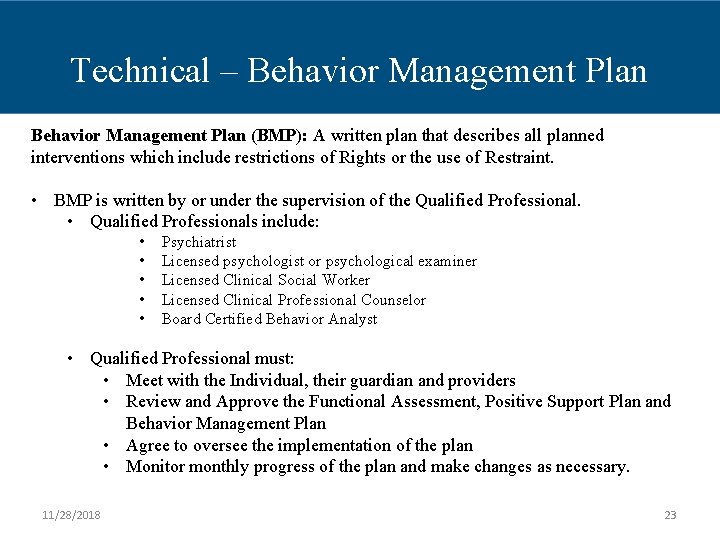
Technical – Behavior Management Plan (BMP): A written plan that describes all planned interventions which include restrictions of Rights or the use of Restraint. • BMP is written by or under the supervision of the Qualified Professional. • Qualified Professionals include: • • • Psychiatrist Licensed psychologist or psychological examiner Licensed Clinical Social Worker Licensed Clinical Professional Counselor Board Certified Behavior Analyst • Qualified Professional must: • Meet with the Individual, their guardian and providers • Review and Approve the Functional Assessment, Positive Support Plan and Behavior Management Plan • Agree to oversee the implementation of the plan • Monitor monthly progress of the plan and make changes as necessary. 11/28/2018 23
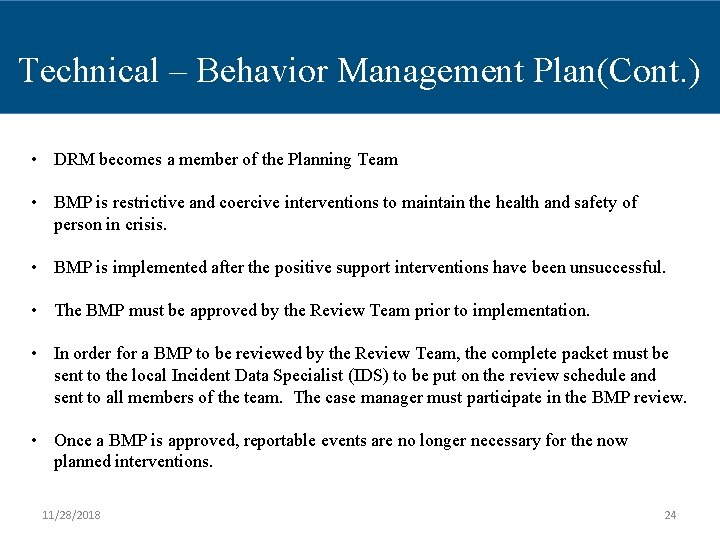
Technical – Behavior Management Plan(Cont. ) • DRM becomes a member of the Planning Team • BMP is restrictive and coercive interventions to maintain the health and safety of person in crisis. • BMP is implemented after the positive support interventions have been unsuccessful. • The BMP must be approved by the Review Team prior to implementation. • In order for a BMP to be reviewed by the Review Team, the complete packet must be sent to the local Incident Data Specialist (IDS) to be put on the review schedule and sent to all members of the team. The case manager must participate in the BMP review. • Once a BMP is approved, reportable events are no longer necessary for the now planned interventions. 11/28/2018 24
Questions? Please review the Regulations Governing Behavioral Support, Modification and Management for People with Intellectual Disabilities and Autism in Maine https: //www. maine. gov/DHHS/oads/provider/developmental-services/behavior-regulations. shtml Lorrie Mitchell Program Administrator Crisis Prevention & Intervention Services OADS, Department of Health & Human Services 41 Anthony Ave, Augusta, Maine 04333 Lorrie. Mitchell@maine. gov 11/28/2018 Maine Department of Health and Human Services 25