
Crisis management during Covid19 Responses of nursing home

- Slides: 11
Crisis management during Covid-19 Responses of nursing home directors Kees Ahaus, Jeroen van Wijngaarden and Marleen de Mul EHMA conference, 19 November 2020
Introduction • The Covid-19 pandemic came as a surprise • Character of a long-shadow crisis (Boin et al, 2017), a low-chance, high-impact crisis (Mc. Kenzie and Lloyd-Smith, 2020): high level of uncertainty, extreme urgency, exceptional magnitude, prolonged impact Morsut, 2020, Boin and ‘t Hart, 2003, Nohrstedt et al. , 2017) • A ‘silent disaster’ in nursing homes Background Methodology Results Discussion/Conclusion (Steen and
Research aims and research questions Research aims • Conceptualize crisis management in nursing homes • Explore the temporal character of responses of the crisis manager Research questions • Which tasks do crisis managers perform in the Covid-19 crisis? • Which goals are pursued? • How do these tasks and goals change during the crisis? Background Methodology Results Discussion/Conclusion
Conceptual model Tasks Goals Phases (1) Diagnosing and deciding, (2) Mobilizing and organizing, (3) Containing and mitigating, (4) Informing and empowering, (5) Coordinating and collaborating, (6) Rendering accountability, (7) Learning (Boin and ‘t Hart, 2010) (1) Save lives, (2) Protect infrastructure, (3) Restore trust (Nohrstedt et al. 2017) (1) Pre-crisis, (2) Crisis, (3) Post-crisis (Steen and Morsut, 2020) (2) Crisis management cycle: prevention, preparedness, response and recovery (Nohrstedt et al. , 2017) Background Methodology Results Discussion/Conclusion
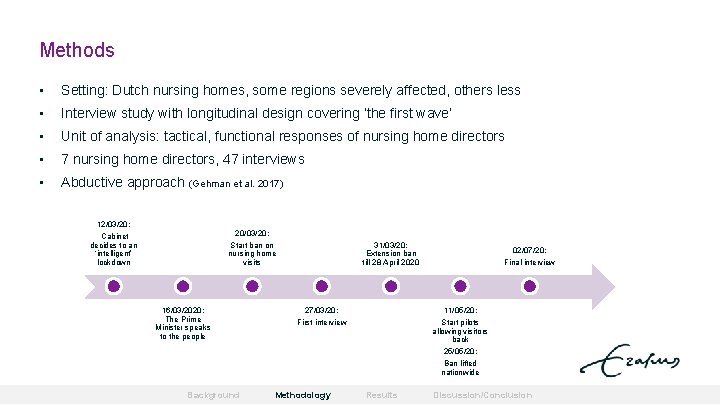
Methods • Setting: Dutch nursing homes, some regions severely affected, others less • Interview study with longitudinal design covering ‘the first wave’ • Unit of analysis: tactical, functional responses of nursing home directors • 7 nursing home directors, 47 interviews • Abductive approach (Gehman et al. 2017) 12/03/20: Cabinet decides to an ‘intelligent’ lockdown 20/03/20: Start ban on nursing home visits 16/03/2020: The Prime Minister speaks to the people Background 31/03/20: Extension ban till 28 April 2020 02/07/20: Final interview 27/03/20: 11/05/20: First interview Start pilots allowing visitors back 25/05/20: Ban lifted nationwide Methodology Results Discussion/Conclusion
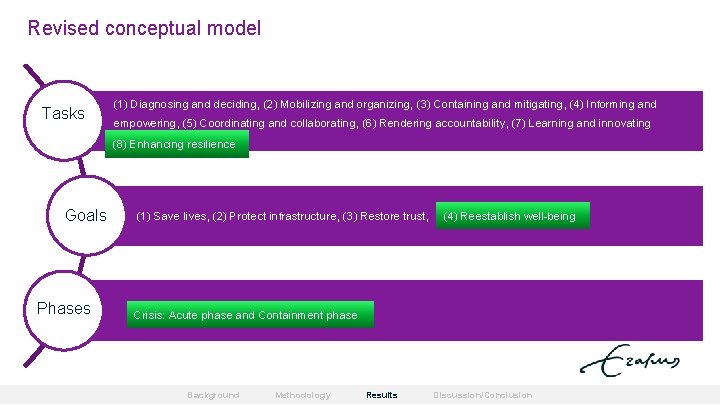
Revised conceptual model Tasks (1) Diagnosing and deciding, (2) Mobilizing and organizing, (3) Containing and mitigating, (4) Informing and empowering, (5) Coordinating and collaborating, (6) Rendering accountability, (7) Learning and innovating (8) Enhancing resilience Goals Phases (1) Save lives, (2) Protect infrastructure, (3) Restore trust, (4) Reestablish well-being Crisis: Acute phase and Containment phase Background Methodology Results Discussion/Conclusion
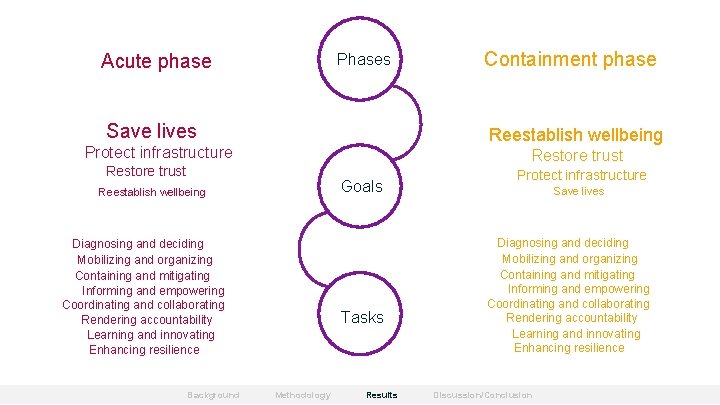
Acute phase Phases Save lives Reestablish wellbeing Protect infrastructure Restore trust Goals Reestablish wellbeing Diagnosing and deciding Mobilizing and organizing Containing and mitigating Informing and empowering Coordinating and collaborating Rendering accountability Learning and innovating Enhancing resilience Background Containment phase Tasks Methodology Results Protect infrastructure Save lives Diagnosing and deciding Mobilizing and organizing Containing and mitigating Informing and empowering Coordinating and collaborating Rendering accountability Learning and innovating Enhancing resilience Discussion/Conclusion
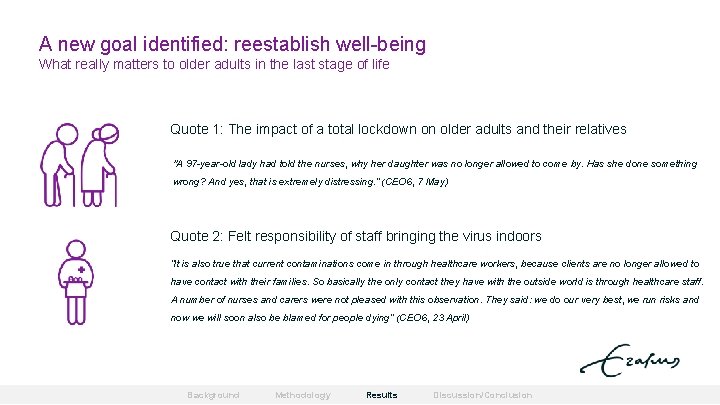
A new goal identified: reestablish well-being What really matters to older adults in the last stage of life Quote 1: The impact of a total lockdown on older adults and their relatives "A 97 -year-old lady had told the nurses, why her daughter was no longer allowed to come by. Has she done something wrong? And yes, that is extremely distressing. “ (CEO 6, 7 May) Quote 2: Felt responsibility of staff bringing the virus indoors “It is also true that current contaminations come in through healthcare workers, because clients are no longer allowed to have contact with their families. So basically the only contact they have with the outside world is through healthcare staff. A number of nurses and carers were not pleased with this observation. They said: we do our very best, we run risks and now we will soon also be blamed for people dying” (CEO 6, 23 April) Background Methodology Results Discussion/Conclusion
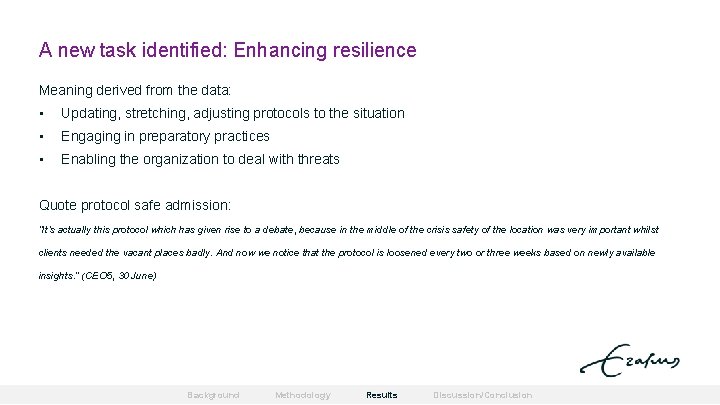
A new task identified: Enhancing resilience Meaning derived from the data: • Updating, stretching, adjusting protocols to the situation • Engaging in preparatory practices • Enabling the organization to deal with threats Quote protocol safe admission: “It’s actually this protocol which has given rise to a debate, because in the middle of the crisis safety of the location was very important whilst clients needed the vacant places badly. And now we notice that the protocol is loosened every two or three weeks based on newly available insights. ” (CEO 5, 30 June) Background Methodology Results Discussion/Conclusion
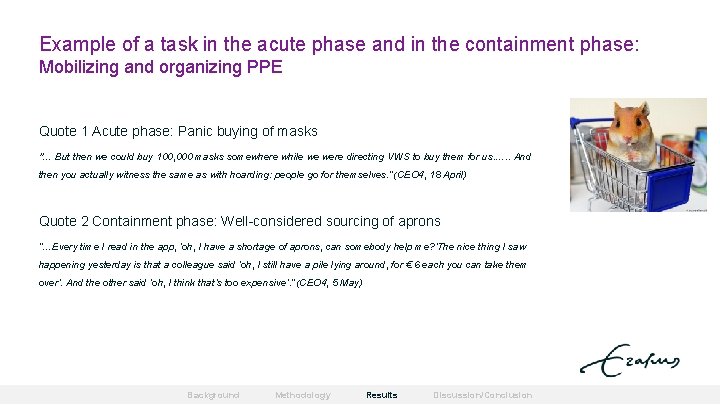
Example of a task in the acute phase and in the containment phase: Mobilizing and organizing PPE Quote 1 Acute phase: Panic buying of masks "… But then we could buy 100, 000 masks somewhere while we were directing VWS to buy them for us. …. . And then you actually witness the same as with hoarding: people go for themselves. “ (CEO 4, 18 April) Quote 2 Containment phase: Well-considered sourcing of aprons “…Every time I read in the app, ‘oh, I have a shortage of aprons, can somebody help me? ’ The nice thing I saw happening yesterday is that a colleague said ‘oh, I still have a pile lying around, for € 6 each you can take them over’. And the other said ‘oh, I think that’s too expensive’. ” (CEO 4, 5 May) Background Methodology Results Discussion/Conclusion
Tentative conclusions 1. We identified two phases in crisis management: (1) acute phase, (2) containment phase. 2. In the acute phase the crisismanager relies on improvising (Mc. Kenzie and Lloyd-Smith, 2020), in the containment phase on adapting. 3. In the acute phase it’s act, act (Mc. Kenzie and Lloyd-Smith, 2020), in the containment phase it is act & reflect. 4. The crisis manager faces moral dilemmas in cases of conflicting goals. 5. Enhancing resilience is the overarching task of the crisis manager. Background Methodology Results Discussion/Conclusion