
Crisis Emergency Risk Communication Barbara Reynolds Ph D
Crisis & Emergency Risk Communication Barbara Reynolds, Ph. D.
Communicating in a crisis is different § In a serious crisis, all affected people. . . – Take in information differently – Process information differently – Act on information differently § In a catastrophic event: communication is different § Be first, be right, be credible
The Risk of Disasters Is Increasing § § § Increased terrorism Population density Aging U. S. population International travel speed Emerging diseases
What the public seeks from your communication 5 public concerns. . . 1. Gain wanted facts 2. Empower decisionmaking 3. Involved as a participant, not spectator 4. Provide watchguard over resource allocation 5. Recover or preserve well-being and normalcy
Crisis and Emergency Risk Communication impacts 5 organizational concerns -- you need to. . . 1. Execute response and recovery efforts 2. Decrease illness, injury, and deaths 3. Avoid misallocation of limited resources 4. Reduce rumors surrounding recovery 5. Avoid wasting resources
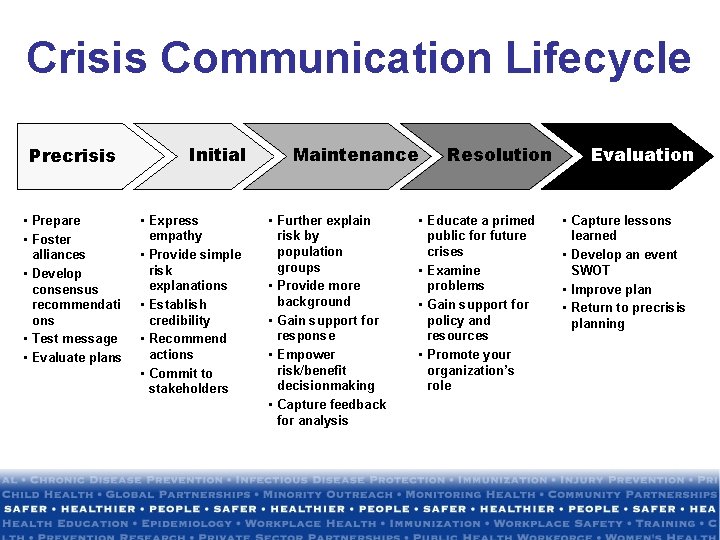
Crisis Communication Lifecycle Precrisis • Prepare • Foster alliances • Develop consensus recommendati ons • Test message • Evaluate plans Initial • Express empathy • Provide simple risk explanations • Establish credibility • Recommend actions • Commit to stakeholders Maintenance • Further explain risk by population groups • Provide more background • Gain support for response • Empower risk/benefit decisionmaking • Capture feedback for analysis Resolution • Educate a primed public for future crises • Examine problems • Gain support for policy and resources • Promote your organization’s role Evaluation • Capture lessons learned • Develop an event SWOT • Improve plan • Return to precrisis planning
Precrisis Phase § § § Prepare Foster alliances Develop consensus recommendations Test message Evaluate plans
Initial Phase § § § Express empathy Provide simple risk explanations Establish credibility Recommend actions Commit to stakeholders
Maintenance § § § Further explain risk by population groups Provide more background Gain support for response Empower risk/benefit decisionmaking Capture feedback for analysis
Resolution § § Educate “primed” public for future crises Examine problems Gain support for policy and resources Promote your organization’s role
5 communication failures that kill operational success 1. 2. 3. 4. 5. Mixed messages from multiple experts Information released late Paternalistic attitudes Not countering rumors and myths in real-time Public power struggles and confusion
5 communication steps that boost operational success 1. 2. 3. 4. 5. Execute a solid communication plan Be the first source for information Express empathy early Show competence and expertise Remain honest and open
Psychology of a Crisis
What Do People Feel Inside When a Disaster Looms or Occurs? Psychological barriers: 1. Denial 2. Fear, anxiety, confusion, dread 3. Hopelessness or helplessness 4. Seldom panic 5. Vicarious rehearsal
What Is Vicarious Rehearsal? § The communication age gives national audiences the experience of local crises. § These “armchair victims” mentally rehearse recommended courses of actions. § Recommendations are easier to reject the farther removed the audience is from real threat.
Individuals at risk—the cost? § Demands for unneeded treatment § Dependence on special relationships (bribery) § MUPS—Multiple Unexplained Physical Symptoms § Self-destructive behaviors § Stigmatization
Community at risk—the cost? § Disorganized group behavior (unreasonable demands, stealing) § Rumors, hoaxes, fraud, stigmatization § Trade/industry liabilities/losses § Diplomacy § Civil actions
Communicating in a Crisis Is Different § Public must feel empowered – reduce fear and victimization § Mental preparation reduces anxiety § Taking action reduces anxiety § Uncertainty must be addressed
Decisionmaking in a Crisis Is Different § People simplify § Cling to current beliefs § We remember what we see or previously experience (first messages carry more weight) § People limit intake of new information (3 -7 bits)
How Do We Communicate About Risk in an Emergency? All risks are not accepted equally § Voluntary vs. involuntary § Controlled personally vs. controlled by others § Familiar vs. exotic § Natural vs. manmade § Reversible vs. permanent § Statistical vs. anecdotal § Fairly vs. unfairly distributed § Affecting adults vs. affecting children
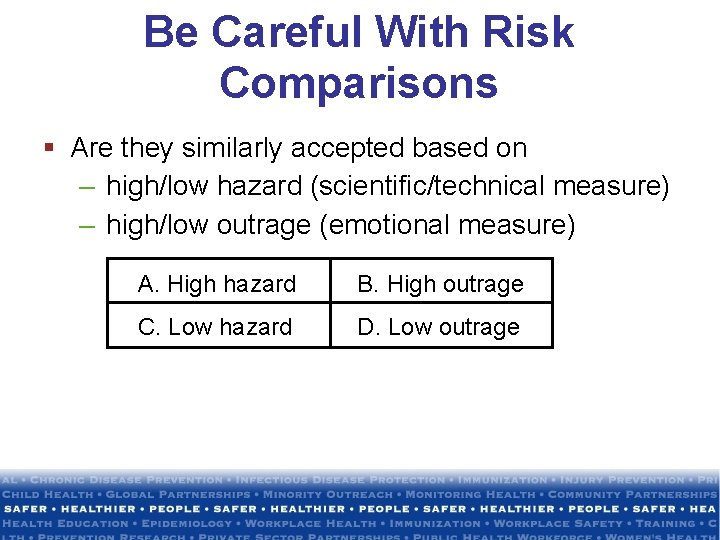
Be Careful With Risk Comparisons § Are they similarly accepted based on – high/low hazard (scientific/technical measure) – high/low outrage (emotional measure) A. High hazard B. High outrage C. Low hazard D. Low outrage
Risk Acceptance Examples § Dying by falling coconut or dying by shark – Natural vs. manmade – Fairly vs. unfairly distributed – Familiar vs. exotic – Controlled by self vs. outside control of self
Risk Communication Principles for Emergencies Don’t overreassure § Considered controversial by some. § A high estimate of harm modified downward is much more acceptable to the public than a low estimate of harm modified upward.
Risk Communication Principles for Emergencies When the news is good, state continued concern before stating reassuring updates “Although we’re not out of the woods yet, we have seen a declining number of cases each day this week. ” “Although the fires could still be a threat, we have them 85% contained. ”
Risk Communication Principles for Emergencies Under promise and over deliver. . . Instead of making promises about outcomes, express the uncertainty of the situation and a confident belief in the “process” to fix the problem and address public safety concerns.
Risk Communication Principles for Emergencies Give people things to do - Anxiety is reduced by action and a restored sense of control § Symbolic behaviors § Preparatory behaviors § Contingent “if, then” behaviors § 3 -part action plan - Must do X - Should do Y - Can do Z
Risk Communication Principles for Emergencies Allow people the right to feel fear § Don’t pretend they’re not afraid, and don’t tell them they shouldn’t be. § Acknowledge the fear, and give contextual information.
Messages and Audiences
Judging the Message § Speed counts – marker for preparedness § Facts – consistency is vital § Trusted source – can’t fake these
Public Information Release § § § What to release When to release How to release Where to release Who to release Why release
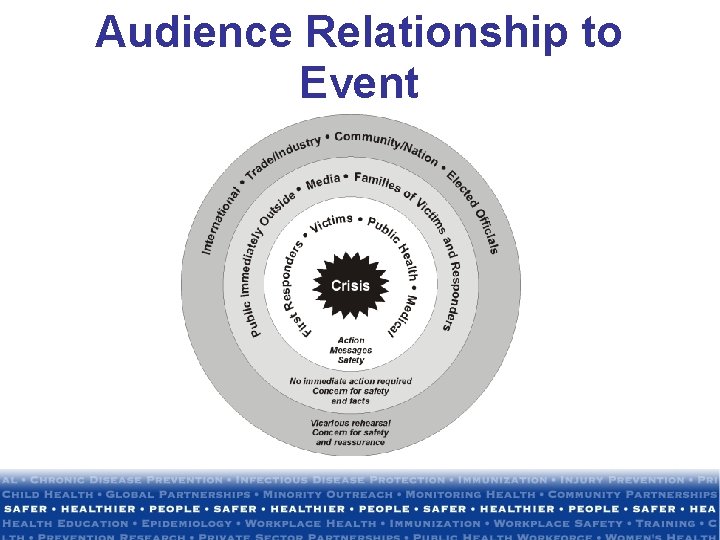
Audience Relationship to Event
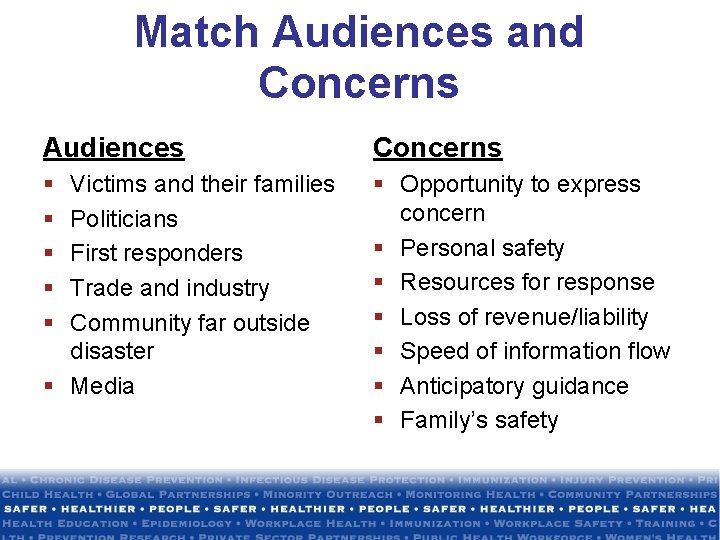
Match Audiences and Concerns Audiences Concerns § § § Opportunity to express concern § Personal safety § Resources for response § Loss of revenue/liability § Speed of information flow § Anticipatory guidance § Family’s safety Victims and their families Politicians First responders Trade and industry Community far outside disaster § Media
5 Key Elements To Build Trust 1. 2. 3. 4. 5. Expressed empathy Competence Honesty Commitment Accountability
Emergency Information § § § Any information is empowering Benefit from substantive action steps Plain English Illustrations and color Source identification
What does the public want to know? § Can you tell me more about the attack – “What caused it, why, what is the reason behind it? ” – “Will there be more attacks? ” § How long is the emergency – “How long is the event going to last? ” – “How long is this ‘radiation’ going to last? ”
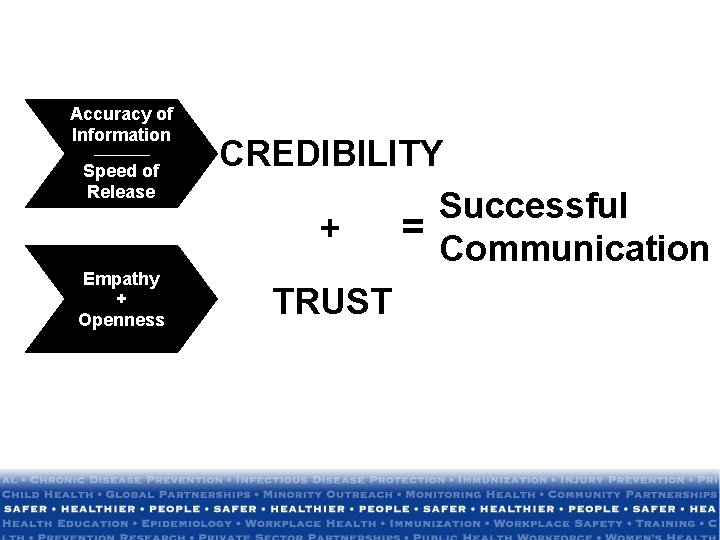
Accuracy of Information _____ Speed of Release Empathy + Openness CREDIBILITY Successful = + Communication TRUST
Initial Message Must § Be short § Be relevant § Give positive action steps § Be repeated
Initial Message Must Not § Use jargon § Be judgmental § Make promises that can’t be kept § Include humor
Sources of Social Pressure § § What will I gain? What will it cost me? What do those important to me want me to do? Can I actually carry it out?
The STARCC Principle Your public messages in a crisis must be: Simple Timely Accurate Relevant Credible Consistent
Crisis Communication Plan
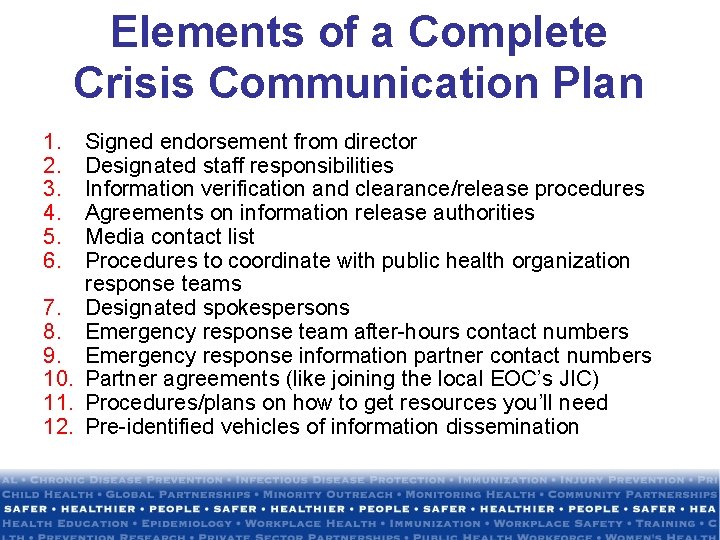
Elements of a Complete Crisis Communication Plan 1. 2. 3. 4. 5. 6. Signed endorsement from director Designated staff responsibilities Information verification and clearance/release procedures Agreements on information release authorities Media contact list Procedures to coordinate with public health organization response teams 7. Designated spokespersons 8. Emergency response team after-hours contact numbers 9. Emergency response information partner contact numbers 10. Partner agreements (like joining the local EOC’s JIC) 11. Procedures/plans on how to get resources you’ll need 12. Pre-identified vehicles of information dissemination
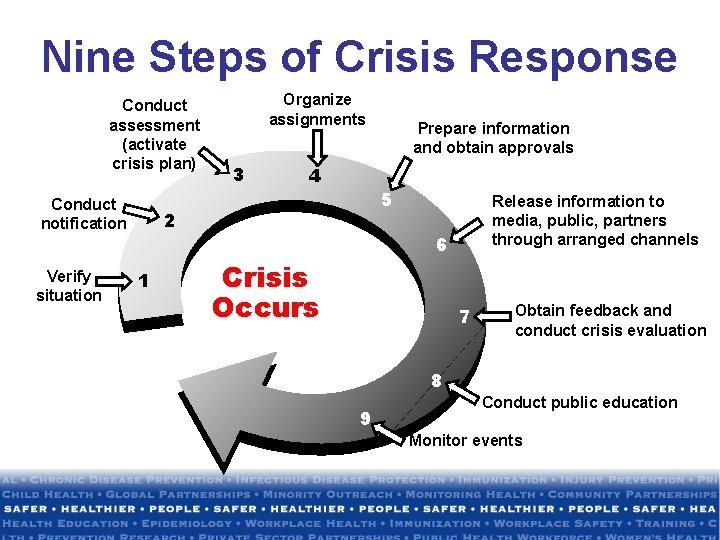
Nine Steps of Crisis Response Conduct assessment (activate crisis plan) Conduct notification Verify situation Organize assignments 3 4 5 2 1 Prepare information and obtain approvals Release information to media, public, partners through arranged channels 6 Crisis Occurs 7 Obtain feedback and conduct crisis evaluation 8 9 Conduct public education Monitor events
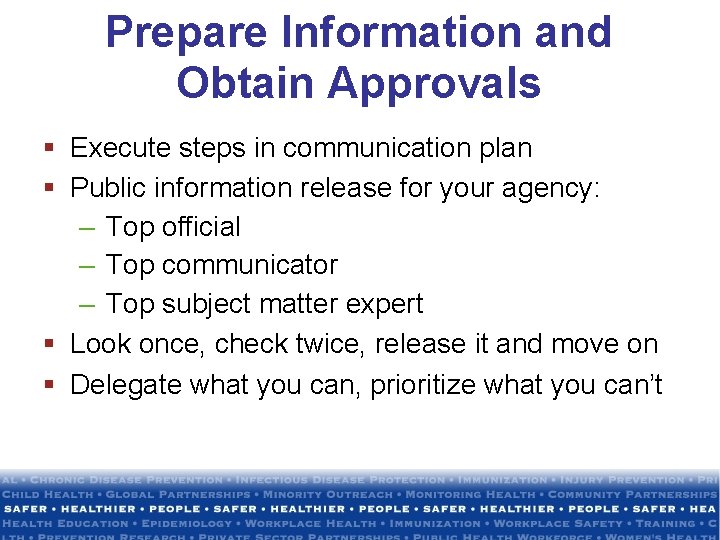
Prepare Information and Obtain Approvals § Execute steps in communication plan § Public information release for your agency: – Top official – Top communicator – Top subject matter expert § Look once, check twice, release it and move on § Delegate what you can, prioritize what you can’t
First 48 Hours - Tools § § § Critical first steps checklist Message template for news release Press availability at site template Public call tracking sheet Media call triage sheet Risk assessment for communication

Stakeholder/ Partner Communication
Stakeholder/Partner Communication § Stakeholders have a special connection to you and your involvement in the emergency. § They are interested in how the incident will impact them. § Partners have a working relationship to you and collaborate in an official capacity on the emergency issue or other issues. § They are interested in fulfilling their role in the incident and staying informed.
5 Mistakes With Stakeholders § § § Inadequate access Lack of clarity No energy for response Too little, too late Perception of arrogance
Stakeholders can be. . . § Advocate–maintain loyalty § Adversary–discourage negative action § Ambivalent–keep neutral or move to advocate
3 Reasons to expend energy on stakeholders during an emergency They may. . . § Know what you need to know § Have points of view outside your organization’s § Communicate your message for you
5 steps in stakeholder preplanning 1. 2. 3. 4. 5. Identify stakeholders Do an assessment Query stakeholders Prioritize by relationship to incident Determine level of “touch”
Community Relations! Why? § Community acceptance through community involvement § Resource multiplier for volunteer “door to door” communication § Involving stakeholders is a way to advance trust through transparency § Our communities, our social capital, are a critical element of our nation's security
Dealing With Angry People Anger arises when people. . . § Have been hurt § Feel threatened by risks out of their control § Are not respected § Have their fundamental beliefs challenged Sometimes, anger arises when. . . § Media arrive § Damages may be in play
High-Outrage Public Meetings “Do’s” § The best way to deal with criticism and outrage by an audience is to acknowledge that it exists. (Don’t say, “I know how you feel. ”) § Practice active listening and try to avoid interrupting. § State the problem and then the recommendation.
High-Outrage Public Meetings “Don’ts” § Verbal abuse! Don’t blow your stack. – Try to bring along a neutral third party who can step in and diffuse the situation. § Don’t look for one answer that fits all. § Don’t promise what you can’t deliver.
Don’t lecture at the Townhall § § Easy but not effective Doesn’t change thoughts/behaviors Instead, ask questions Key: don’t give a solution, rather help audience discover solution
4 Questions to help people persuade themselves 1. Start with broad open-ended historical questions 2. Ask questions about wants and needs 3. Ask about specifics being faced now 4. Ask in a way to encourage a statement of benefits
2 simple tips to gain acceptance 1. Accumulate “yeses” 2. Don’t say “yes, but”—say “yes, and”
Six Principles of CERC § Be First: If the information is yours to provide by organizational authority—do so as soon as possible. If you can’t—then explain how you are working to get it. § Be Right: Give facts in increments. Tell people what you know when you know it, tell them what you don’t know, and tell them if you will know relevant information later. § Be Credible: Tell the truth. Do not withhold to avoid embarrassment or the possible “panic” that seldom happens. Uncertainty is worse than not knowing—rumors are more damaging than hard truths.
Six Principles of CERC § Express Empathy: Acknowledge in words what people are feeling—it builds trust. § Promote Action: Give people things to do. It calms anxiety and helps restore order. § Show Respect: Treat people the way you want to be treated—the way you want your loved ones treated—always—even when hard decisions must be communicated.
Terrorism and Bioterrorism Communication Challenges
What’s Different in a Terrorism Response? § Stronger reaction from § Detection is delayed the public § Responders are at § Multiple events occur higher risk § Incident location is a § Response assets are crime scene targets
Terrorism and Risk Communication § § § Outside control of individual or community Unfairly distributed From untrusted source Man-made Exotic Catastrophic
Federal Response Plan § FBI leads on information release in crisis management § FEMA leads on information release in consequence management § Transfer lead from the FBI to FEMA by Attorney General § Core federal response: DOJ/FBI DOE FEMA DOD EPA HHS
Joint Information Center § § FBI public information officer and staff FEMA public information officer and staff Other federal agencies’ PI staff State and local PIOs
Bioterrorism Is Different § Medical and public health systems are usually the first to detect bioterrorism. § A delay is likely between the release of the agent and the knowledge that the occurrence is a bioterrorist act. § A short window of opportunity exists between the first cases and the second wave.
Natural Emerging Infectious Disease or Bioterrorism? § § § § Encephalitis Hemorrhagic mediastinitis Hemorrhagic fever Pneumonia with abnormal liver function Papulopustular rash (e. g. , smallpox) Descending paralysis Nausea, vomiting, diarrhea
Media Are Sure To Ask: § Is this bioterrorism? § Could this be bioterrorism? § Are you investigating this situation as possible bioterrorism? § Is the FBI involved in this investigation? § When will you be able to tell us whether or not this situation is bioterrorism?
Is It an Emerging Disease or Undeclared Bioterrorism? A possible response to media from public health officials is: “We’re all understandably concerned about the uncertainty surrounding this outbreak, and we wish we could easily answer that question today. ” (continued on next slide)
Is It an Emerging Disease or Undeclared Bioterrorism? “For the sake of those who are ill or may become ill, our medical epidemiologists (professional disease detectives) are going to first try to answer the following critical questions: (1) Who is becoming ill? (2) What organism is causing the illness? (3) How should it be treated? (4) How can it be controlled to stop the spread? ” (continued on next slide)
Is It an Emerging Disease or Undeclared Bioterrorism? “One question that disease investigators routinely ask is, “Could this outbreak have been caused intentionally? ” “We [organization name] must keep an open mind as data in this investigation are collected analyzed. ” (continued on next slide)
Is It an Emerging Disease or Undeclared Bioterrorism? “Any specific questions about the FBI’s involvement regarding this outbreak investigation should be referred to them. However, the FBI and [your organization] have a strong partnership regarding the investigation of unusual disease outbreaks and have worked comfortably together in the past in our parallel investigations. ” (Note: Don’t forget to coordinate this answer with the FBI. )
Strategic National Stockpile (SNS) § 12 -hour Push Pack – 100 cargo containers § Air or ground ship § 50 tons of medicine, medical supplies, equipment § Nerve agents, anthrax, plague, tularemia § Treat thousands of symptomatic and protect hundreds of thousands
Tale of Two Cities: Smallpox § Milwaukee, Wisconsin, experienced a Smallpox outbreak in 1894 of fairly major proportions, and caused urban rioting for about a month in the city streets—why? § New York City experienced the last Smallpox outbreak in this country in 1947. People stayed in line for hours, full days, and came back the next day in some cases with no unrest—why? – Judith W. Leavitt, Ph. D, University of Wisconsin
SNS Communication Plan § Multi-language text § Methods for reproducing materials § Communication channels - Volunteers - Contractors - On-site interpreters § Not all SNS events the same § SNS communication assessment checklist

Working With the Media
Disasters Are Media Events § We need the media to be there. § Give important protective actions for the public. § Know how to reach their audiences and what their audiences need.
Response Officials Should § Understand that their job is not the media’s job § Know that they can’t dismiss media when they’re inconvenient § Accept that the media will be involved in the response, and plan accordingly
Response Officials Should § Attempt to provide all media equal access § Use technology to fairly distribute information § Plan to precredential media for access to EOC/JOC or JIC § Think consistent messages
Response Officials Should Not § Hold grudges § Discount local media § Tell the media what to do
How To Work With Reporters § Reporters want a front seat to the action and all information NOW. § Preparation will save relationships. § If you don’t have the facts, tell them the process. § Reality Check: 70, 000 media outlets in U. S. Media cover the news 24/7.
Media, Too, Are Affected by Crises § § Verification Adversarial role National dominance Lack of scientific expertise
Media and Crisis Coverage § Evidence strongly suggests that coverage is more factual when reporters have more information. They become more interpretative when they have less information. § What should we conclude?
Command Post § Media will expect a command post. Official channels that work well will discourage reliance on nonofficial channels. § Be media-friendly at the command post— prepare for them to be on site.
Media Beating on Your Door § Alternatives to “no comment” that give you breathing room: – “We’ve just learned about this and are trying to get more information. ” – “I’m not the authority on this, let me have XXXX call you right back. ” – “We’re preparing a statement on that now. Can I fax it to you in about 2 hours? ”
Media Availability or Press Conferences “In Person” Tips § Determine in advance who will answer questions about specific subject matters § Keep answers short and focused—nothing longer than 2 minutes § Assume that every mike is “alive” the entire time § Sitting or standing?
Two press conference killers § Have “hangers on” from your organization circling the room § Being visible to the media/public while waiting to begin the press conference
Television Interview Tips § Don’t look at yourself on the TV monitor. § Look at the reporter, not the camera, unless directed otherwise. § Do an earphone check. Ask what to do if it pops out of your ear.
Writing for the Media During a Crisis § The pressure will be tremendous from all quarters. § It must be fast and accurate. § It’s like cooking a turkey when people are starving. § If information isn’t finalized, explain the process.
Emergency Press Releases § One page with attached factsheet (can clear quicker) § Think of them as press updates, and prime media when to expect them § Should answer 5 Ws and H for the time it covers
Press Statements Are Not Press Releases § § They are the official position. May be used to counter a contrary view. Not used for peer-review debate. Offer encouragement to the public and responders.

Spokesperson
What the Public Will Ask First § § § Are my family and I safe? What have you found that may affect me? What can I do to protect myself and my family? Who caused this? Can you fix it?
What the Media Will Ask First § § § § What happened? Who is in charge? Has this been contained? Are victims being helped? What can we expect? What should we do? Why did this happen? Did you have forewarning?
Spokesperson Qualities § What makes a good spokesperson? § What doesn’t make a good spokesperson?
Role of a Spokesperson in an Emergency § Take your organization from an “it” to a “we” § Build trust and credibility for the organization § Remove the psychological barriers within the audience § Ultimately, reduce the incidence of illness, injury, and death by getting it right
Spokesperson Qualities § Be your organization; then be yourself. § What’s your organization’s identity?
Spokesperson Qualities § It’s more than “acting natural. ” Every organization has an identity. Try to embody that identity. § Example: CDC has a history of going into harm’s way to help people. We humbly go where we are asked. We value our partners and won’t steal the show. Therefore, a spokesperson would express a desire to help, show courage, and express the value of partners. “Committed but not showy. ”
Emergency Risk Communication Principles § § § Don’t overreassure Acknowledge that there is a process in place Express wishes Give people things to do Ask more of people
Emergency Risk Communication Principles § Consider the “what if” questions.
Spokesperson Recommendations § § Stay within the scope of your responsibility Tell the truth Follow up on issues Expect criticism
Your Interview Rights § § § Know who will do the interview Know and limit the interview to agreed subjects Set limits on time and format Ask who else will be or has been interviewed Decline to be interviewed Decline to answer a question
You Do Not Have the Right To: § § § § Embarrass or argue with a reporter Demand that your remarks not be edited Demand the opportunity to edit the piece Insist that an adversary not be interviewed Lie Demand that an answer you’ve given not be used State what you are about to say is “off the record” or not attributable to you
Sensational or Unrelated Questions “Bridges” back to what you want to say: § “What I think you are really asking is. . . ” § “The overall issue is. . . ” § “What’s important to remember is. . . ” § “It’s our policy to not discuss [topic], but what I can tell you. . . ”
Watch Out For . . . § Machine gun questioning. Reporter fires rapid questions at you. You respond, “Please let me answer this question. ” § Feeding the mike and the pause. Seldom will dead air make scintillating viewing, unless you’re reacting nonverbally. Relax. § Hot mike. It’s always on—always—including during “testing. ”
Watch Out For . . . § Reporter asks a sensational question and gives you an A or B dilemma. Use positive words, correct the inaccuracies without repeating the negative, and reject A or B if neither is valid. (e. g. , corn versus produce) § Explain, “There’s actually another alternative you may not have considered, ” and give your message point.
Watch Out For . . . § Surprise prop. The reporter attempts to hand you a report or supposedly contaminated item. § If you take it, you own it. § React by saying, “I’m familiar with that report and what I can say is” or “I’m not familiar with the report, but what is important” and then go to key message.
Effective Nonverbal Communication § Do maintain eye contact § Do maintain an open posture § Do not retreat behind physical barriers such as podiums or tables § Do not frown or show anger or disbelief through facial expression § Do not dress in a way that emphasizes the differences between you and your audience
Grief in context § § Circumstances of the death Nature of the relationship Experienced loss before Any secondary losses
Communicating about loss § § Ask clarifying questions When possible, use the words the person uses Say “you’re crying” instead of “you’re sad. ” Short statements of condolences (e. g. , “this is a sad time, ” or “you’re in my prayers”) § Use “death” or “dying, ” not softer euphemisms like “expired, ” or “heavenly reward”

Media and Public Health Law
Model Emergency Health Powers Act § Model public health law for states § Protection of civil liberties balanced with need to stop transmission of disease § Explain what law covers and why § Laws address: quarantine, vaccination, property issues, access to medical records § Model law draft – court order to quarantine someone, unless delay could pose an immediate threat
Protecting the Public from Infectious Diseases § Detention – temporary hold § Isolation – separation from others for period of communicability § Quarantine – restricts activities of well persons exposed
First Amendment § “In the First Amendment the founding fathers gave the free press protection it must have to fulfill its essential role in our democracy. The press was to serve the governed, not the governors. ” – New York Times Co. v U. S. , 403 U. S. 713 (1971)
Media’s right to acquire news § Press has right to acquire news from any source by any lawful means § No Constitutional right to special access § Information not available to the public: – Crime scene – Disasters – Police station – Hospital lab – Other places
Access may be restricted § Interference with legitimate law enforcement action § Law enforcement perimeter § Crime scene § Disaster scene
Right to acquire information § Available or open to the public § Place or process historically open to the public: – Hospitals? – Jails? – Courtrooms? – Meeting/conference rooms?
Media’s right of publication § Once information is acquired § Ability to restrict information; – Severely limited – Heavy burden to prevent or prohibit – Minneapolis Star Tribune v. U. S. , 713 F Supp. 1308 (S. Minn, 1988)
Assisting the media § Inviting media on search or arrest in private citizen’s home is not protected by 1 st Amendment and may result in civil liability – Violation of 4 th Amendment Rights
Employees access to media § Freedom of speech may be Constitutionally protected: if public value outweighs detrimental impact § May be required to follow chain of command § Ability to choose spokesperson: – Police officer has no 1 st Amendment right to speak or act on behalf of department when not authorized to do so. – Koch v. City of Portland, 766 P. 2 d 405 (Ore. App. 1988)
CDC’s principles of communication for public § Communication will be open, honest, and based on sound science, conveying accurate information § Information will not be withheld solely to protect CDC or the government from criticism or embarrassment § Information will be released consistent with the Freedom of Information Act
Freedom of Information Act § FOIA does not apply to state and local governments (most jurisdictions have a FOIAlike laws) § Principle of democracy is that citizens be informed about their government. § FOIA ensures that the federal government provides public maximum possible information
- Slides: 122