
Crisis Counseling Assistance and Training Program Regular Services
- Slides: 49
Crisis Counseling Assistance and Training Program Regular Services Program Midprogram Training
Objectives After training, participants will be able to: • Identify the continued needs of survivors, the community, and staff. • Revise outreach strategies. • Review effective crisis counseling skills. • Recognize program successes and challenges. • Apply techniques for managing staff stress. • Identify effective approaches to program management, legacy, and phasedown.
Table of Contents • • • Section 1—Individual, Community, and Staff Needs Section 2—Program Assessment Section 3—Crisis Counseling Section 4—Program Management Section 5—Stress Management
Section 1—Individual, Community, and Staff Needs • Current and Upcoming Phases of the Disaster • Needs of Individual Survivors • Needs of the Community • Needs of Crisis Counseling Staff
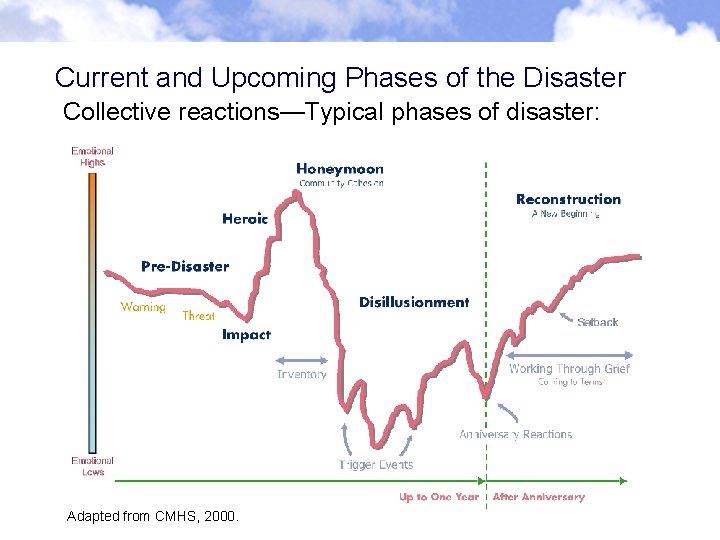
Current and Upcoming Phases of the Disaster Collective reactions—Typical phases of disaster: Adapted from CMHS, 2000.
Current and Upcoming Phases of the Disaster (cont. ) • Disillusionment phase: – Stress and fatigue take a toll. – Optimism turns into discouragement. – There may be an increased need for substance abuse services. – The larger community returns to business as usual. – The CCP may have an increased demand for services, as individuals and communities become ready to accept support. • Reconstruction phase: – Individuals and communities begin to assume responsibility for rebuilding their lives. – People begin to adjust to new circumstances. – There is a recognition of growth and opportunity.
Needs of Individual Survivors Questions: • Whom has the program served? • What is the status of the survivors who have received services? • What survivors still need to be reached? • What services are still needed? • What other community or individual supports can meet these needs?
Needs of the Community Questions: • • What communities has the CCP served? What is the status of community recovery? What populations still need to be targeted? Who are the community gatekeepers and cultural brokers? • What community organizations have been contacted? • What resources still need to be identified? • What still needs to be accomplished in the community?
Needs of Crisis Counseling Staff • What will help staff members address identified individual and community needs?
Section 2—Program Assessment • Program Successes • Program Challenges
Program Successes • What are some successful outreach and engagement strategies? • What interventions and crisis counseling techniques have worked well? • What are some tangible resources developed by the program? • What are some successful community approaches? • What are other program successes?
Program Challenges • What are some ongoing programmatic challenges related to each of the following: – Survivors – Community – Staff • Does the program have the tangible resources it needs? If not, what else is needed?
Section 3—Crisis Counseling • Crisis Counseling Services at Midprogram • Crisis Counseling Skills • Ethical Considerations
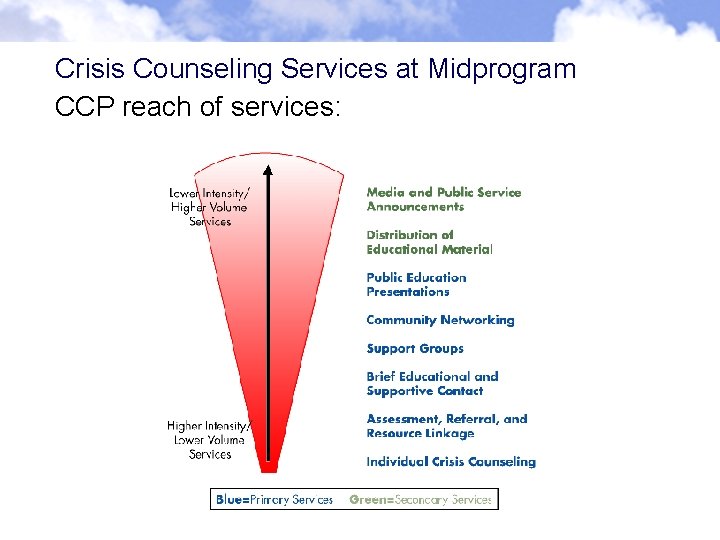
Crisis Counseling Services at Midprogram CCP reach of services:
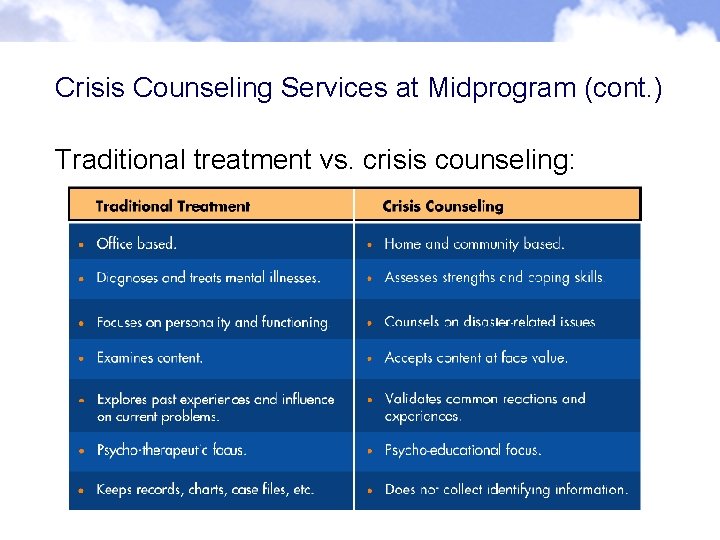
Crisis Counseling Services at Midprogram (cont. ) Traditional treatment vs. crisis counseling:
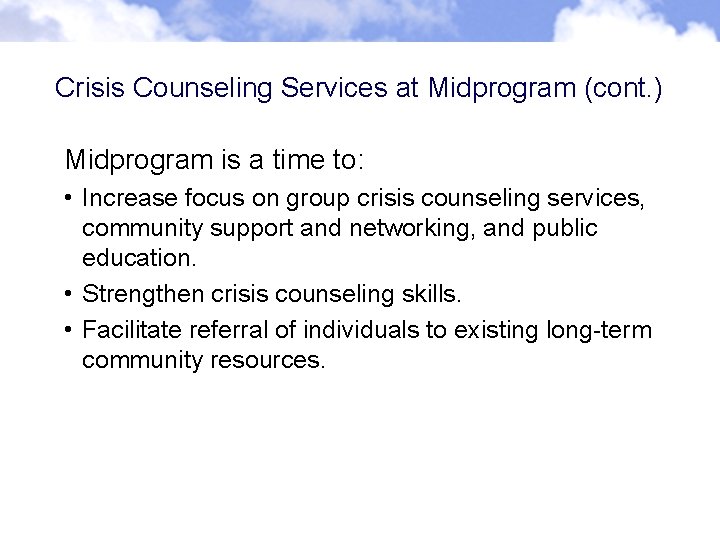
Crisis Counseling Services at Midprogram (cont. ) Midprogram is a time to: • Increase focus on group crisis counseling services, community support and networking, and public education. • Strengthen crisis counseling skills. • Facilitate referral of individuals to existing long-term community resources.
Crisis Counseling Services at Midprogram (cont. ) Group crisis counseling is characterized by: • Services that help group members understand their current situations and reactions to the disaster. • A need that may increase later in the CCP as people are ready to connect with others. • Group members who should have had similar levels of exposure. • Participants gaining mutual support from other group members. • Psycho-education areas that include stress management, coping with triggers, expressing emotions, and problem solving.
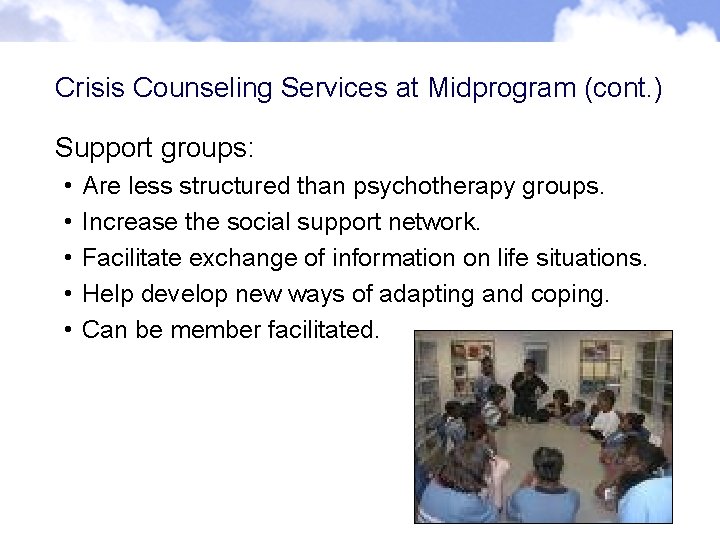
Crisis Counseling Services at Midprogram (cont. ) Support groups: • • • Are less structured than psychotherapy groups. Increase the social support network. Facilitate exchange of information on life situations. Help develop new ways of adapting and coping. Can be member facilitated.
Crisis Counseling Services at Midprogram (cont. ) Self-help groups: • Are appropriately facilitated by a professional or paraprofessional crisis counselor. • Can be cofacilitated by a group member to encourage transition to a member-facilitated process. • Are no longer a CCP service once the group has transitioned to a member-facilitated process.
Crisis Counseling Services at Midprogram (cont. ) Psycho-educational groups: • • Provide tools to obtain and process new information. Usually have limited duration and scope. Provide practical and concrete assistance. Use handouts and factual information relevant to the group’s discussion. • Use speakers relevant to the content area and group members’ needs.
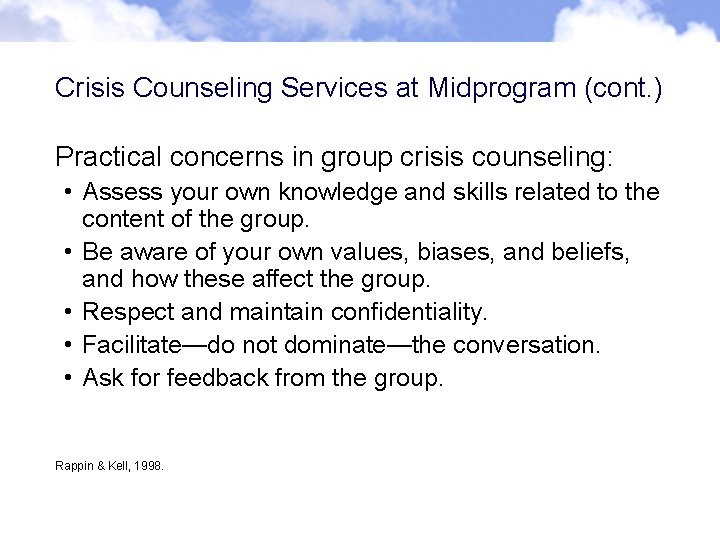
Crisis Counseling Services at Midprogram (cont. ) Practical concerns in group crisis counseling: • Assess your own knowledge and skills related to the content of the group. • Be aware of your own values, biases, and beliefs, and how these affect the group. • Respect and maintain confidentiality. • Facilitate—do not dominate—the conversation. • Ask for feedback from the group. Rappin & Kell, 1998.
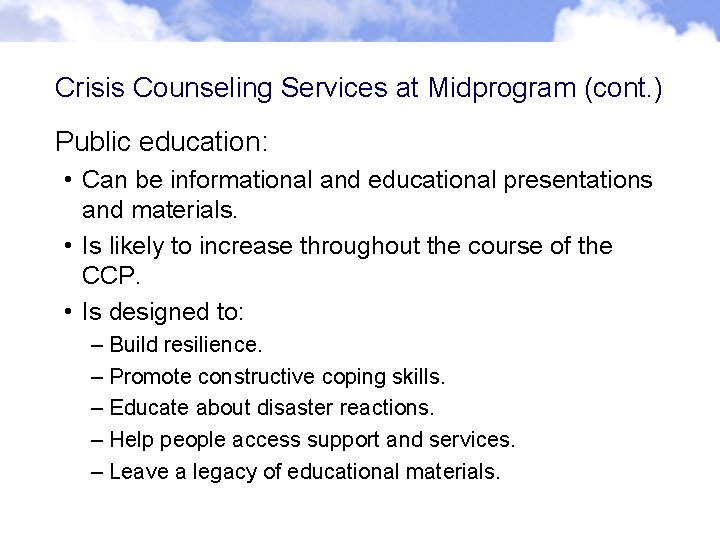
Crisis Counseling Services at Midprogram (cont. ) Public education: • Can be informational and educational presentations and materials. • Is likely to increase throughout the course of the CCP. • Is designed to: – Build resilience. – Promote constructive coping skills. – Educate about disaster reactions. – Help people access support and services. – Leave a legacy of educational materials.
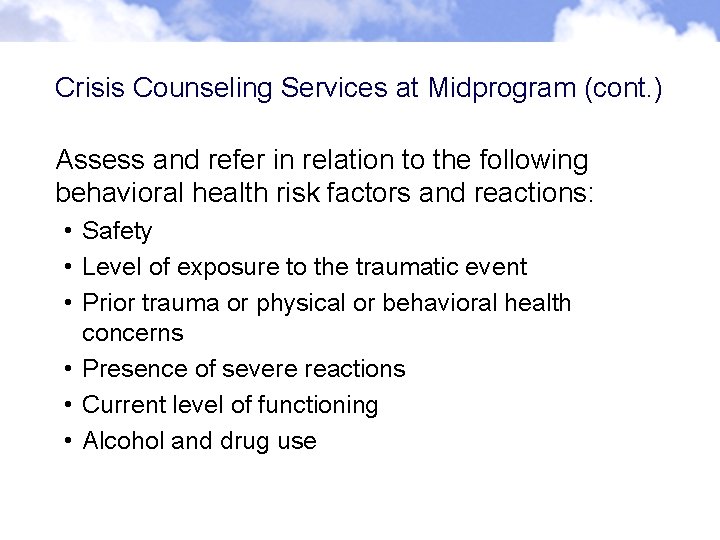
Crisis Counseling Services at Midprogram (cont. ) Assess and refer in relation to the following behavioral health risk factors and reactions: • Safety • Level of exposure to the traumatic event • Prior trauma or physical or behavioral health concerns • Presence of severe reactions • Current level of functioning • Alcohol and drug use
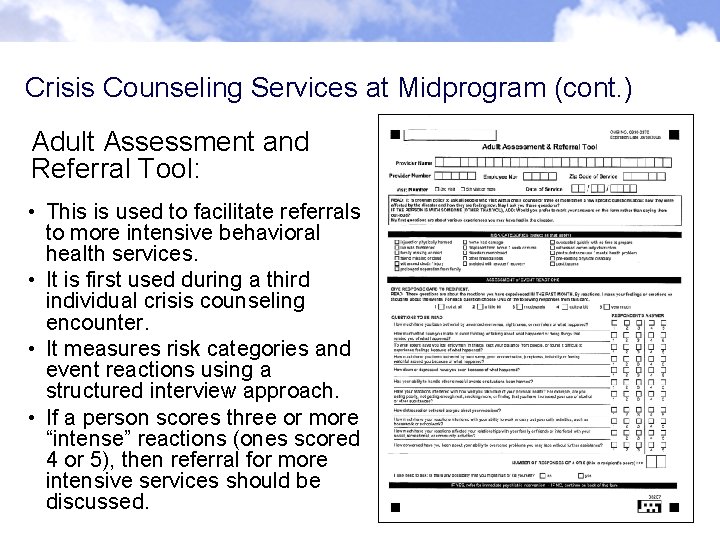
Crisis Counseling Services at Midprogram (cont. ) Adult Assessment and Referral Tool: • This is used to facilitate referrals to more intensive behavioral health services. • It is first used during a third individual crisis counseling encounter. • It measures risk categories and event reactions using a structured interview approach. • If a person scores three or more “intense” reactions (ones scored 4 or 5), then referral for more intensive services should be discussed.
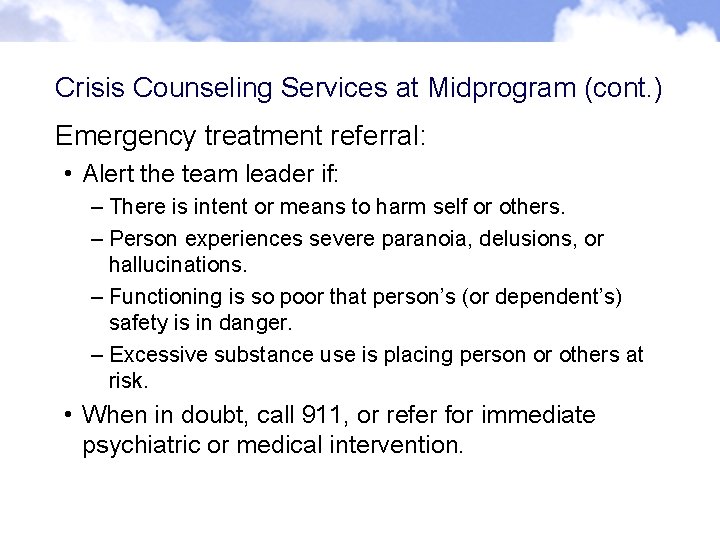
Crisis Counseling Services at Midprogram (cont. ) Emergency treatment referral: • Alert the team leader if: – There is intent or means to harm self or others. – Person experiences severe paranoia, delusions, or hallucinations. – Functioning is so poor that person’s (or dependent’s) safety is in danger. – Excessive substance use is placing person or others at risk. • When in doubt, call 911, or refer for immediate psychiatric or medical intervention.
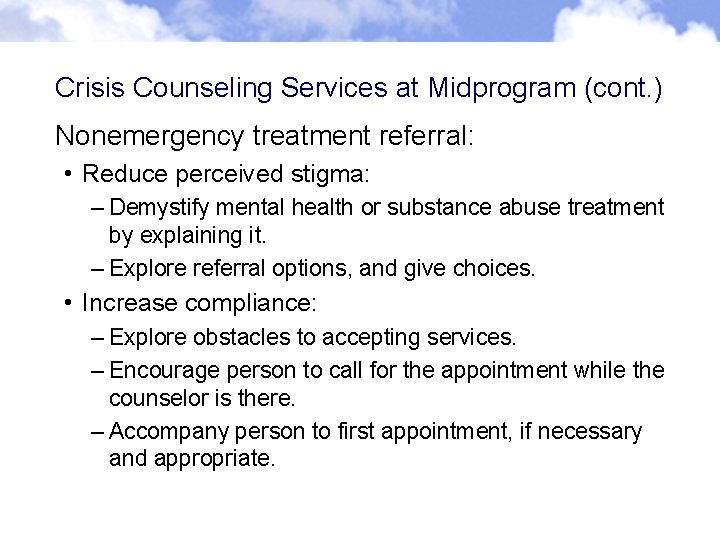
Crisis Counseling Services at Midprogram (cont. ) Nonemergency treatment referral: • Reduce perceived stigma: – Demystify mental health or substance abuse treatment by explaining it. – Explore referral options, and give choices. • Increase compliance: – Explore obstacles to accepting services. – Encourage person to call for the appointment while the counselor is there. – Accompany person to first appointment, if necessary and appropriate.
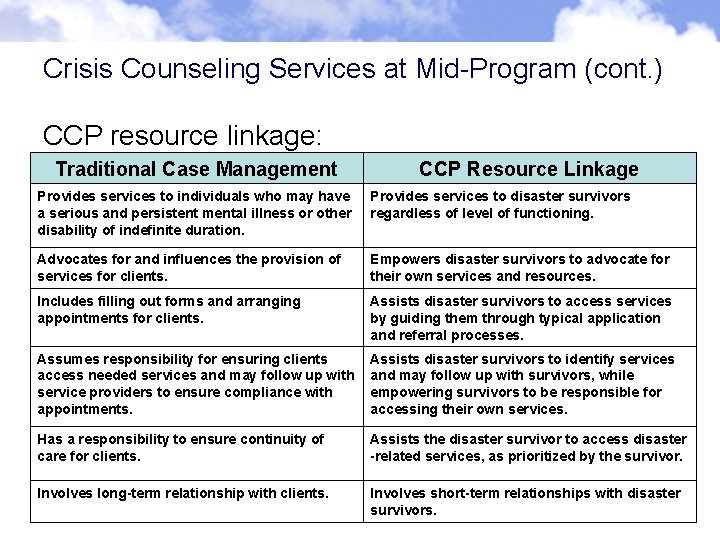
Crisis Counseling Services at Mid-Program (cont. ) CCP resource linkage: Traditional Case Management CCP Resource Linkage Provides services to individuals who may have a serious and persistent mental illness or other disability of indefinite duration. Provides services to disaster survivors regardless of level of functioning. Advocates for and influences the provision of services for clients. Empowers disaster survivors to advocate for their own services and resources. Includes filling out forms and arranging appointments for clients. Assists disaster survivors to access services by guiding them through typical application and referral processes. Assumes responsibility for ensuring clients access needed services and may follow up with service providers to ensure compliance with appointments. Assists disaster survivors to identify services and may follow up with survivors, while empowering survivors to be responsible for accessing their own services. Has a responsibility to ensure continuity of care for clients. Assists the disaster survivor to access disaster -related services, as prioritized by the survivor. Involves long-term relationship with clients. Involves short-term relationships with disaster survivors.
Crisis Counseling Skills What do we want to accomplish during crisis counseling? • Assist survivors to: – Identify and prioritize needs. – Identify previous and current constructive coping strategies. – Develop a plan to enhance coping strategies and skills.
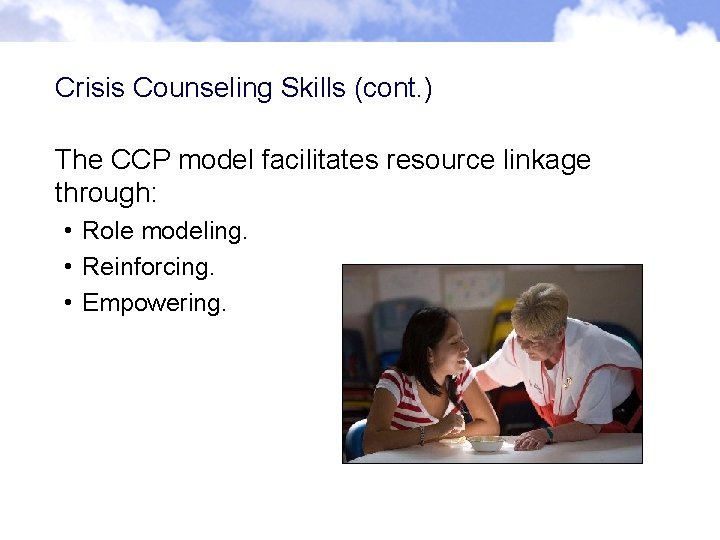
Crisis Counseling Skills (cont. ) The CCP model facilitates resource linkage through: • Role modeling. • Reinforcing. • Empowering.
Ethical Considerations • Maintain confidentiality. • Follow State and local reporting regulations in cases of suicidal or homicidal intent. • Follow the State and local regulations on mandatory reporting for child or elder abuse and neglect. • Safeguard interests and rights of individuals who lack decisionmaking abilities. • Treat all individuals in a nonbiased manner with regard to race, ethnicity, gender, religion, sexual orientation, and age.
Ethical Considerations (cont. ) • Do no harm. • Participation is voluntary. • Consider reactions in relation to the disaster phase and context. • Individual coping styles should be respected. • Immediate interventions are supportive. • Talking with a person in crisis does not always mean talking about the crisis. • Be aware of the situational and cultural contexts of the survivor and the intervention itself.
Section 4—Program Management • Revising Program Strategies • Quality Assurance • Data Collection and Program Evaluation • Supervision • Training • Preparing for Phasedown
Revising Program Strategies • How will the program continue to deliver CCP services to meet identified individual and community needs? • How will the CCP overcome the identified programmatic challenges? • How will the CCP begin to prepare for eventual phasedown?
Quality Assurance Ensures staff follow the CCP model through: • Regular onsite supervision and training. • Consistent communication among CCP management and workers. • Weekly meetings and submission and review of data collection forms. • Collection and organization of program materials and data. • Identifying problems and gaps in service. • Redirecting resources and modifying the service plan to close gaps. • Ongoing needs assessment.
Data Collection and Program Evaluation • Data collection and program evaluation are systematic efforts to collect, analyze, and interpret information. • We do it to understand improve services based on observable and verifiable data.
Supervision • Conduct group meetings to discuss staff needs. • Conduct regularly scheduled individual supervision sessions. • Ensure availability of needed supplies and equipment. • Provide ongoing training opportunities on CCPspecific topics.
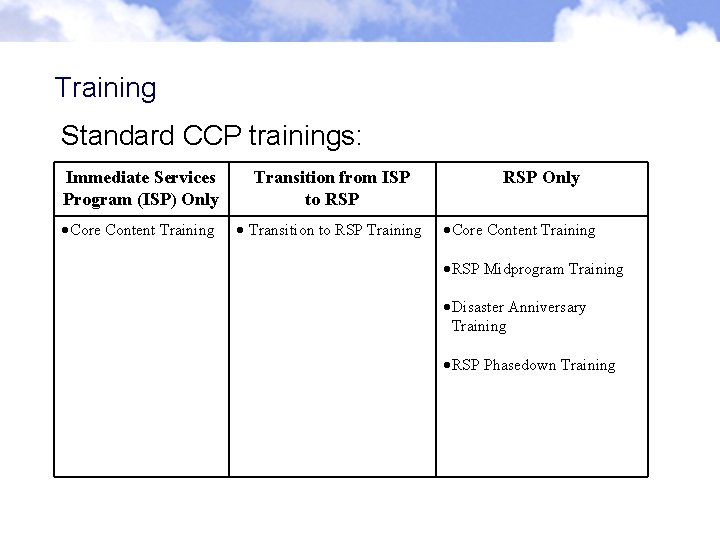
Training Standard CCP trainings: Immediate Services Program (ISP) Only Transition from ISP to RSP Core Content Training Transition to RSP Training RSP Only Core Content Training RSP Midprogram Training Disaster Anniversary Training RSP Phasedown Training
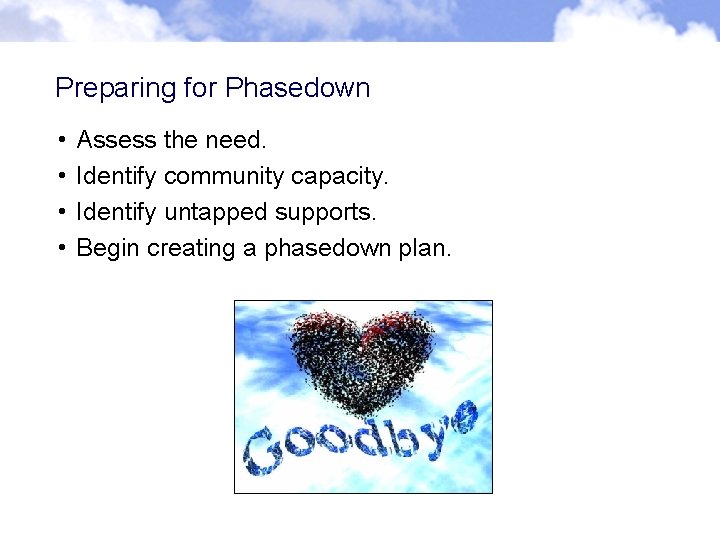
Preparing for Phasedown • • Assess the need. Identify community capacity. Identify untapped supports. Begin creating a phasedown plan.
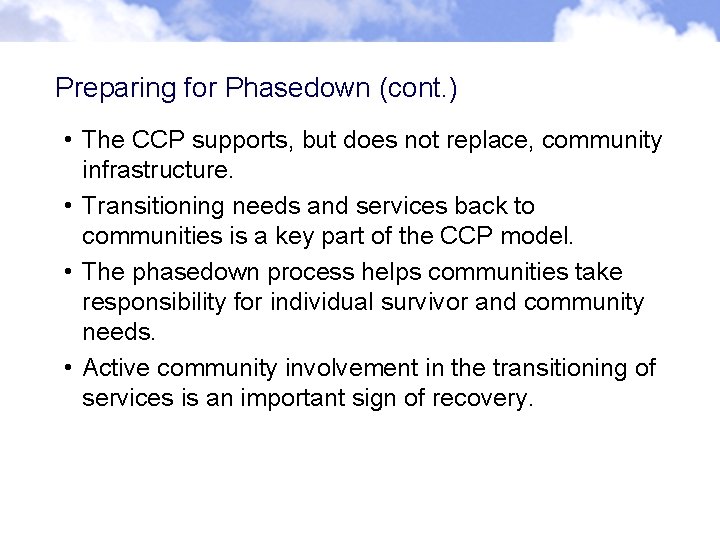
Preparing for Phasedown (cont. ) • The CCP supports, but does not replace, community infrastructure. • Transitioning needs and services back to communities is a key part of the CCP model. • The phasedown process helps communities take responsibility for individual survivor and community needs. • Active community involvement in the transitioning of services is an important sign of recovery.
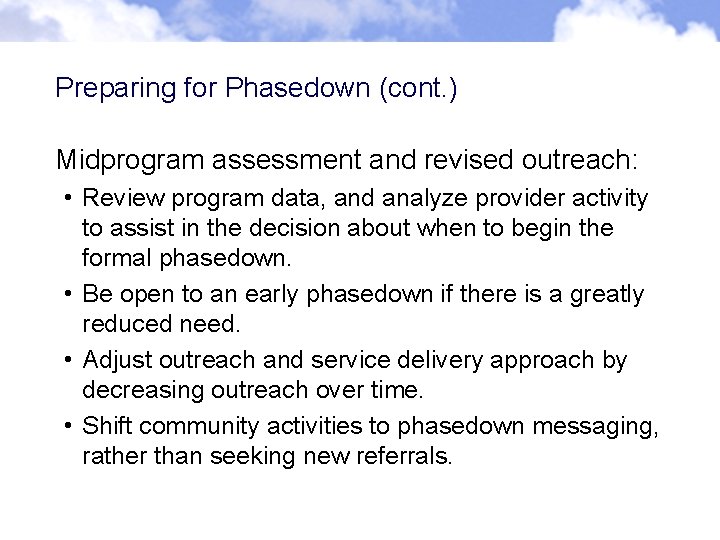
Preparing for Phasedown (cont. ) Midprogram assessment and revised outreach: • Review program data, and analyze provider activity to assist in the decision about when to begin the formal phasedown. • Be open to an early phasedown if there is a greatly reduced need. • Adjust outreach and service delivery approach by decreasing outreach over time. • Shift community activities to phasedown messaging, rather than seeking new referrals.
Section 5—Stress Management • Typical Stressors • Warning Signs of Excessive Stress • Organizational Approaches to Stress Management • Individual Approaches to Stress Management
Typical Stressors How stressful are these for you? • • • Repeatedly hearing survivors’ distressing stories Approaching survivors who may reject help Feeling overwhelmed by the sadness of others Feeling helpless to alleviate the pain of others Working long hours Personal experience with the disaster
Warning Signs of Excessive Stress How do you know when you are experiencing excessive stress? • You cannot shake distressing images from your mind. • Work consumes you at the expense of family and friends. • You experience an increase in substance use or abuse. • You are excessively irritable and impatient. • You exhibit other serious or severe reactions.
Organizational Approaches to Stress Management Elements of organizational stress management: • A clearly defined management and supervision structure • Clearly defined purpose and goals that are articulated frequently • Functionally defined roles that are reinforced through effective supervision • Sound clinical consultation, support, and supervision • Supportive peer relationships • An active stress management program • A comprehensive training plan
Organizational Approaches to Stress Management (cont. ) Management responsibilities: • Clearly articulate and often repeat the purpose, goals, scope, and limits of the program. • Articulate and enforce policies related to work hours, holidays, supervision, and attendance at staff meetings and training events. • Develop criteria for who is served and for how long, and require justification for continued counseling. • Enforce safety policies, and enforce ethical conduct.
Organizational Approaches to Stress Management (cont. ) Adequately prepare counselors for their tasks: • Use simulation exercises to practice responses to highly distraught people. • Develop a repertoire of introductory statements that are free of mental health references. • Practice how to conclude a counseling relationship. • Provide examples of signals that indicate whether talking about problems is bringing relief to the consumer; employ buddy systems. • Educate about the differences between helping and “rescuing. ”
Organizational Approaches to Stress Management (cont. ) Adequately prepare counselors for their tasks: • Address disillusionment and other midprogram stressors. • Provide careful supervision. • Enforce reasonable work hours and shifts. • Monitor time off, and mandate, if necessary. • Develop and enforce safety policies.
Individual Approaches to Stress Management What have you been doing to manage stress? Activity: • Update your personal stress management plan.
SAMHSA Disaster Technical Assistance Center SAMHSA DTAC supports SAMHSA’s efforts to prepare States, Territories, and local entities to deliver an effective behavioral health response during disasters. Toll-Free: 1 -800 -308 -3515 E-Mail: dtac@esi-dc. com Web: www. mentalhealth. samhsa. gov/dtac