
Crisis Communications and Working with the Media Frontline
- Slides: 29
Crisis Communications and Working with the Media Frontline Staff Training
Objectives • Learn how reporters do their jobs and what that means for the Church • Understand your role in crisis communications • Know what to do if you receive calls or questions from the news media
Agenda • Media Overview • Crisis Communications Basics • Practice • Crisis Communications Planning
Crisis Communications Quick Quiz – Take 3 minutes to work in table groups or pairs to determine your response. What do you do and say in this situation? – Select a “spokesperson” for your group. – Some of the spokespersons will role play the response with instructor (who plays reporter)
What would you like to ‘take away’ from the session today?
Video: Why charting a clear course is important
Definition of a Crisis “A situation that puts your organization’s values on trial in the court of public opinion” - William N. Curry, Public Relations Society of America
Crisis, Disaster, Controversy • Crisis is different than disaster • A controversy can become a crisis • A crisis may start small…. . and grow…. When do you contact the DS about it?
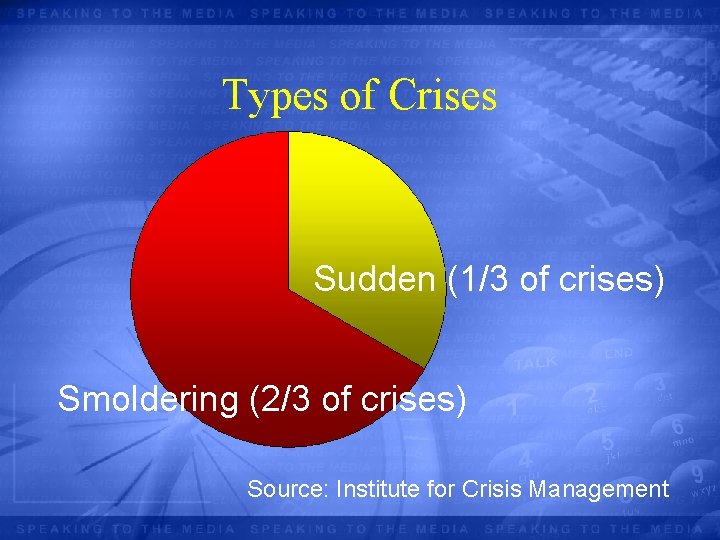
Types of Crises Sudden (1/3 of crises) Smoldering (2/3 of crises) Source: Institute for Crisis Management
What are examples of smoldering & sudden crises you could face and which ones should you report to the District Superintendent or the Conference Communications office?
What’s News • Conflict and controversy • Issues of public safety, unethical conduct, etc. • Appearance of cover-up or widespread problem • Emotion / Personal impact • Visuals
A Reporter’s Perspective • A reporter’s job is to cover the story— reporters are usually NOT “out to get you, ” but they aren’t out to make you “look good” either. • Want fast, accurate information • A reporter will want to talk with the person in charge • They have deadlines they will meet with or without the facts from the church.
A Reporter’s Perspective • A reporter is more likely to give the church the benefit of the doubt if he/she has a previous relationship with the church. • Media relations pay off!
Role of a Spokesperson • Spokesperson is the reliable, consistent and credible source of information • Spokesperson’s responsibility is to get the facts and to develop a message and plan that responds to the public’s information needs • Spokesperson tells the church’s story through the media
Pastor’s Role • The pastor is the ‘face’ of the church in the community • Pastor is likely to be the first responder in a crisis • The pastor will lead the church’s response throughout the public attention
Frontline Staff Role in Crisis Communications • Handle media phone calls • Interact with media on-site • You will connect the reporter with the pastor (or other official spokesperson)
Handling Media Phone Calls • Use a ‘Hold Response’ to allow time for the spokesperson to gather the necessary information. • Ask for the reporter’s: – Name – Media Outlet – Direct Phone Number – Deadline – Topic of story or reason for call
Telephone “Hold” Response “I want to make sure we give you the most accurate and up-to-date information. Our pastor (or appropriate person) can best help you. If you give me your contact information and deadline, I’ll have that person return your call as soon as possible. ”
Media Guidelines for Staff • Be polite, but firm • Don’t answer questions • Use a ‘Hold Response to refer reporters to the appropriate spokesperson • Take a written message
Media Guidelines for Staff (continued) • Don’t be hostile • Don’t give your personal opinion • Don’t speak “off the record” • Don’t use the term “no comment”
What Would You Do If…. You role play media phone calls and media on-site with “reporter”
Anatomy of a Crisis • • • Event Investigative Reporting Blame-fixing Public Reaction Reminders Disinterest -William Curry, Accredited Public Relations
Working Through Crises • Each stage requires accurate, consistent communication • The public and media will reach ‘positive disinterest’ when they trust that the church: – Cares and is concerned – The church is doing the ‘right’ thing – Steps are being taken to reduce the risk of it happening again
Handling Casual Conversations or Questions about a Crisis ü Don’t speculate, repeat unconfirmed information or express personal opinions ü Don’t feel like you have to answer questions – instead, stick to your script ü Do respond with a brief, positive, general statement
General Supportive Statement “We’re very concerned about what happened. Our priority is the safety and well-being of everyone. The staff is working with the Health Department to learn all the facts. We’re going to do everything we can to reduce the risk of this happening again. ”
Key Elements of a Crisis Plan • A crisis plan is the church’s blueprint for action when a crisis occurs. (It’s not the same as a disaster plan. ) • Identifies members of crisis communications team • Outlines actions and roles • Provides plans for specific scenarios
Effective Crisis Communications Response • Be ready to respond quickly & consistently • Work with the selected spokesperson on procedures and appropriate ‘hold response’ • Help brief the entire staff • Help pull together the crisis team • Realize perception is reality
Moving Forward What will you take away from today’s session?
Thank you! For more information, contact DSC Communications at 602 -266 -6956 or communications@dscumc. org