
Criminology Fourth Edition Chapter 2 Classical and Neoclassical
- Slides: 47
Criminology Fourth Edition Chapter 2 Classical and Neoclassical Criminology—Choice and Consequences Copyright © 2018, 2016, 2014 Pearson Education, Inc. All Rights Reserved
Principles of Classical and Neoclassical Criminology (1 of 2) • The Enlightenment was based on the idea of rational thought and the application of reasoned scientific principles. • Within criminology, the Enlightenment led to the development of the Classical School of criminological thought. Copyright © 2018, 2016, 2014 Pearson Education, Inc. All Rights Reserved
Principles of Classical and Neoclassical Criminology (2 of 2) • Crime and deviance came to be understood as products of the exercise of free will. • The Classical School of criminology became the first modern approach to making sense of crime and criminal behavior. Copyright © 2018, 2016, 2014 Pearson Education, Inc. All Rights Reserved
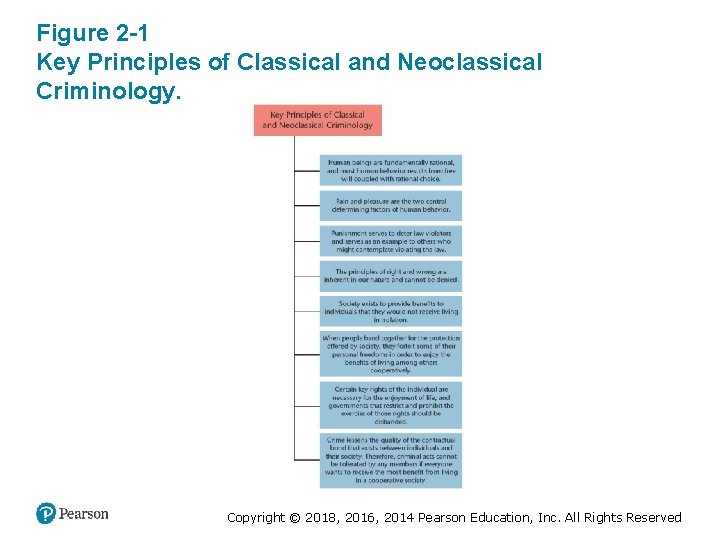
Figure 2 -1 Key Principles of Classical and Neoclassical Criminology. Copyright © 2018, 2016, 2014 Pearson Education, Inc. All Rights Reserved
Cesare Beccaria (1738 -1794) (1 of 2) • Published Essays on Crimes and Punishments in 1764 – Observations on laws and justice system of the time • Beccaria claimed punishment should be based on the degree of injury caused by the offender. • The purpose of punishment should be deterrence, not retribution Copyright © 2018, 2016, 2014 Pearson Education, Inc. All Rights Reserved
Cesare Beccaria (1738 -1794) (2 of 2) • Trial and punishment should be swift and punishment should be certain • Punishment should be only severe enough to outweigh the benefits of the crime • Punishment must be public, prompt, necessary, the least possible in the circumstances, proportionate to the crime, and dictated by the laws Copyright © 2018, 2016, 2014 Pearson Education, Inc. All Rights Reserved
Jeremy Bentham (1748 -1832) (1 of 3) • Published Introduction to the Principles of Morals and Legislation in 1789 • Argued that the pain associated with crime commission must outweigh the pleasure derived from criminal activity. • Believed humans are fundamentally rational Copyright © 2018, 2016, 2014 Pearson Education, Inc. All Rights Reserved
Jeremy Bentham (1748 -1832) (2 of 3) • Bentham's approach has been termed hedonistic calculus or utilitarianism – Emphasizes the worth an action holds for an individual undertaking it • Bentham included practical suggestions for crime prevention and recommended the creation of a centralized police force focused on crime prevention and control Copyright © 2018, 2016, 2014 Pearson Education, Inc. All Rights Reserved
Jeremy Bentham (1748 -1832) (3 of 3) • Panopticon – A prison design suggested by Bentham that was to be a circular building with cells along the circumference, each clearly visible from a central location – Bentham recommended Panopticons be constructed near or within cities, serving as examples to others who may commit crimes. Copyright © 2018, 2016, 2014 Pearson Education, Inc. All Rights Reserved
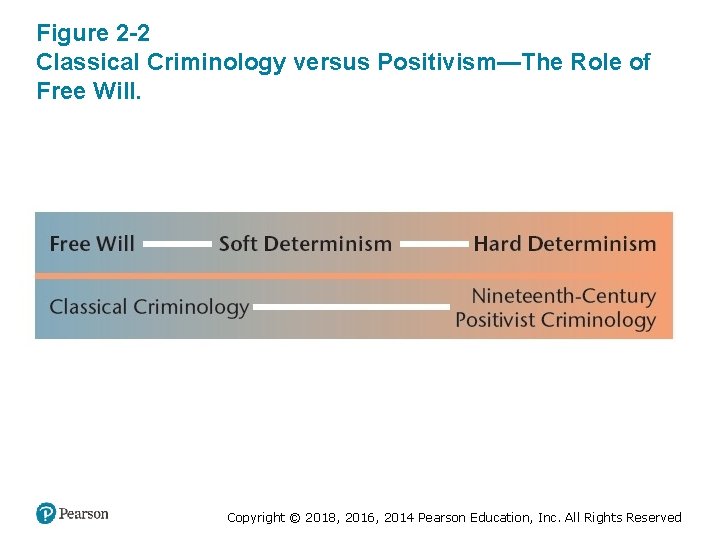
Neoclassical Criminology (1 of 7) • By the end of the 1800 s, classical criminology was replaced by positivism • Positivism – Used the scientific method in studying criminality – Based upon an acceptance of hard determinism Copyright © 2018, 2016, 2014 Pearson Education, Inc. All Rights Reserved
Neoclassical Criminology (2 of 7) • Hard determinism – The belief that much human behavior, including crime, results from forces beyond the individual's control – Implied that offenders were not responsible for their crimes, suggested crime could be prevented by changing the conditions that produce criminality. Copyright © 2018, 2016, 2014 Pearson Education, Inc. All Rights Reserved
Figure 2 -2 Classical Criminology versus Positivism—The Role of Free Will. Copyright © 2018, 2016, 2014 Pearson Education, Inc. All Rights Reserved
Neoclassical Criminology (3 of 7) • Assumptions of positivism challenged in the 1970 s • Several studies showed offenders could not be rehabilitated • Led to widespread public fear of crime and "get tough on crime" policies • Resulted in resurgence of classical ideals known as neoclassical criminology Copyright © 2018, 2016, 2014 Pearson Education, Inc. All Rights Reserved
Neoclassical Criminology (4 of 7) • Neoclassical criminology focused on the importance of character, the dynamics of character development, and the rational choices that people make as they are face with opportunities for crime. • Influenced by several key publications in the 1970 s Copyright © 2018, 2016, 2014 Pearson Education, Inc. All Rights Reserved
Neoclassical Criminology (5 of 7) • Robert Martinson - "Nothing works" doctrine – National survey of rehabilitation programs in the 1970 s – Found that correctional treatment programs have little success in rehabilitating offenders. Copyright © 2018, 2016, 2014 Pearson Education, Inc. All Rights Reserved
Neoclassical Criminology (6 of 7) • James Q. Wilson – Thinking about Crime (1975) – Crime is not a result of poverty or social conditions and cannot be affected by social programs. – Argued for lengthy incarceration of offenders and for the elimination of criminal opportunity. • Led to development of justice model Copyright © 2018, 2016, 2014 Pearson Education, Inc. All Rights Reserved
Neoclassical Criminology (7 of 7) • The Justice Model – A contemporary model of imprisonment based on the principle of just deserts – Criminals deserve punishment because of the choices they make • Get tough on crime campaigns adapted the justice model to crime-control legislation – Three-strikes laws Copyright © 2018, 2016, 2014 Pearson Education, Inc. All Rights Reserved
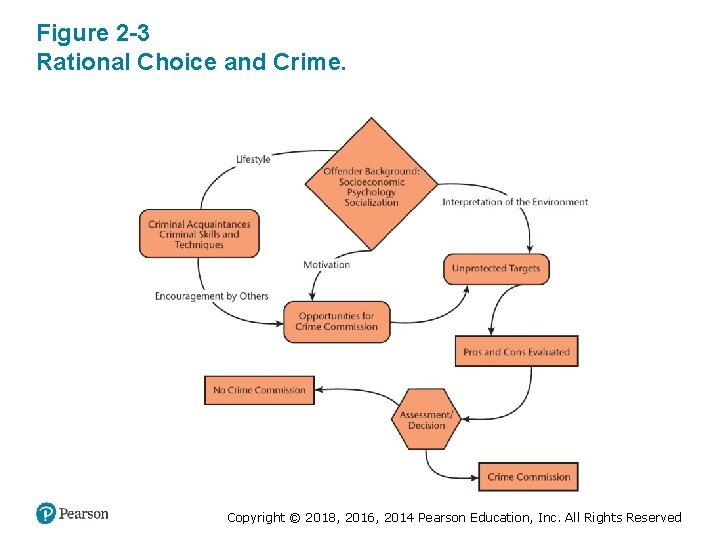
Rational Choice Theory (1 of 4) • Criminals make a conscious, rational, and at least partially informed choice to commit crime. • Individuals choose to commit crime when the benefits outweigh the costs of disobeying the law. • Crime will decrease when opportunities are limited, benefits reduced, costs increased Copyright © 2018, 2016, 2014 Pearson Education, Inc. All Rights Reserved
Figure 2 -3 Rational Choice and Crime. Copyright © 2018, 2016, 2014 Pearson Education, Inc. All Rights Reserved
Rational Choice Theory (2 of 4) • Situational choice theory is an extension of rational choice theory • Example of soft determinism • Views criminal behavior as a function of choices and decisions made within a context of situational constraints and opportunities. • Crime is a matter of motivation and opportunity Copyright © 2018, 2016, 2014 Pearson Education, Inc. All Rights Reserved
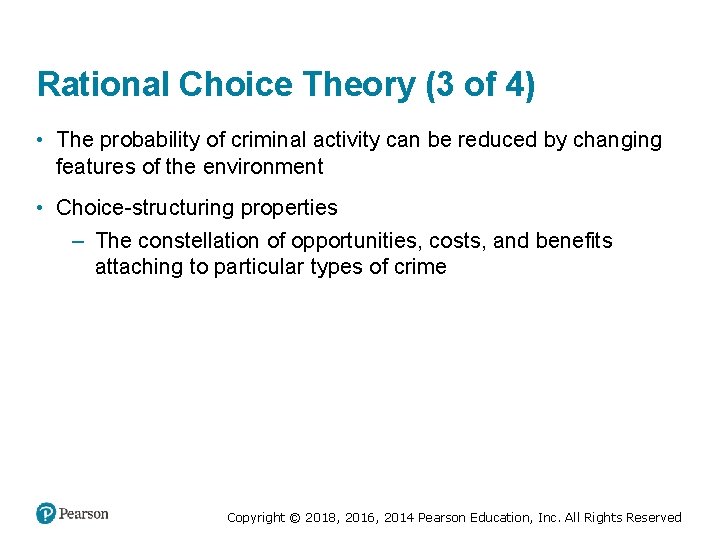
Rational Choice Theory (3 of 4) • The probability of criminal activity can be reduced by changing features of the environment • Choice-structuring properties – The constellation of opportunities, costs, and benefits attaching to particular types of crime Copyright © 2018, 2016, 2014 Pearson Education, Inc. All Rights Reserved
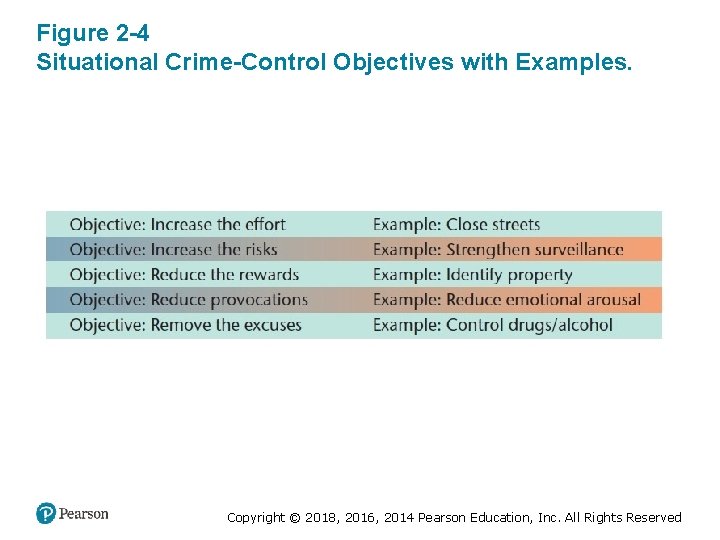
Figure 2 -4 Situational Crime-Control Objectives with Examples. Copyright © 2018, 2016, 2014 Pearson Education, Inc. All Rights Reserved
Rational Choice Theory (4 of 4) • Rational choice theory is similar to classical deterrence theory • Places less emphasis on pleasure and emotionality, more on rationality and cognition Copyright © 2018, 2016, 2014 Pearson Education, Inc. All Rights Reserved
The Seductions of Crime • The idea that crime is often pleasurable for those committing it and pleasure is the major motivation behind crime. • The pleasures derived from crime are not always immediately obvious. • For many criminals, crime is rewarding. Copyright © 2018, 2016, 2014 Pearson Education, Inc. All Rights Reserved
Situational Crime-Control Policy • Focuses on the context in which crime occurs rather than on people who commit crimes • Shifting from a concern with why people commit crime to one asking why crime occurs in specific settings • Reduce opportunities for crime in specifically identified situations – Target hardening Copyright © 2018, 2016, 2014 Pearson Education, Inc. All Rights Reserved
Punishment and Neoclassical Thought • Punishment is a central feature of both classical and neoclassical thoughts. – Classical – punishment as deterrent – Neoclassical § Punishment supports retribution § Someone who is attracted to crime and chooses to violate the law deserves to be punished. Copyright © 2018, 2016, 2014 Pearson Education, Inc. All Rights Reserved
Just Deserts • A concept inherent in the justice model • Offenders deserve the punishment they receive at the hands of the law • Punishment should be appropriate to the type and severity of the crime • Neoclassical perspective – Justice is what the individual deserves after careful consideration of the circumstances Copyright © 2018, 2016, 2014 Pearson Education, Inc. All Rights Reserved
Deterrence (1 of 3) • Specific Deterrence – A goal of criminal sentencing that seeks to prevent a particular offender from repeating criminality. • General Deterrence – A goal of criminal sentencing that seeks to prevent others from committing crimes similar to the one for which a particular offender is being sentenced. Copyright © 2018, 2016, 2014 Pearson Education, Inc. All Rights Reserved
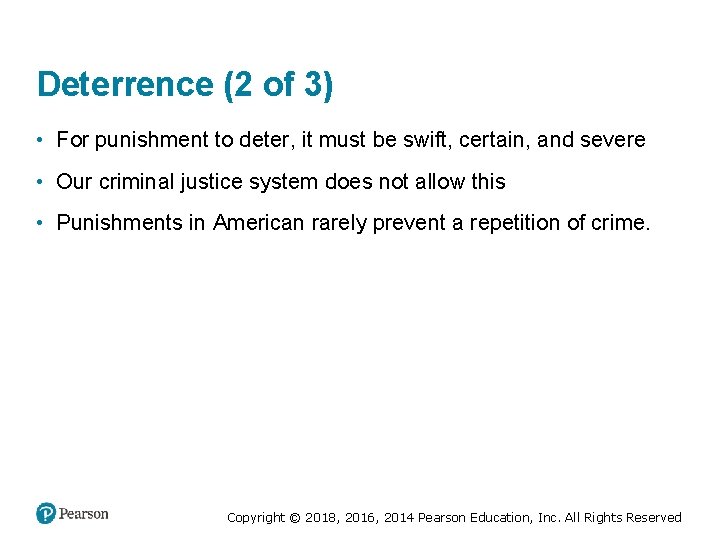
Deterrence (2 of 3) • For punishment to deter, it must be swift, certain, and severe • Our criminal justice system does not allow this • Punishments in American rarely prevent a repetition of crime. Copyright © 2018, 2016, 2014 Pearson Education, Inc. All Rights Reserved
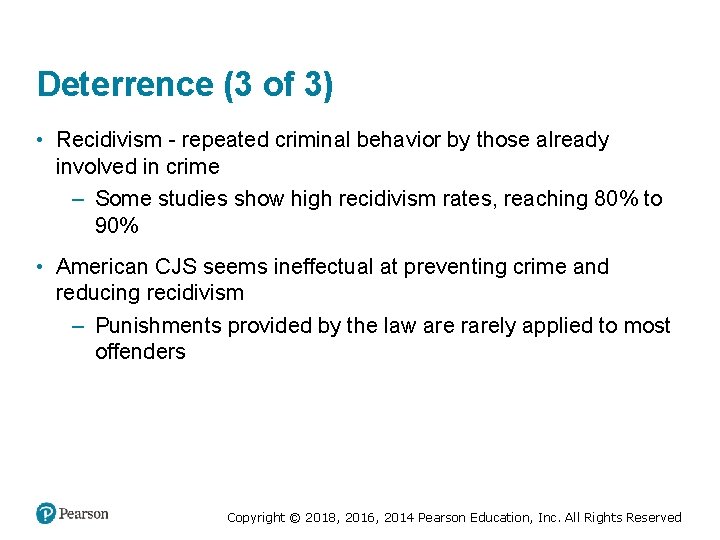
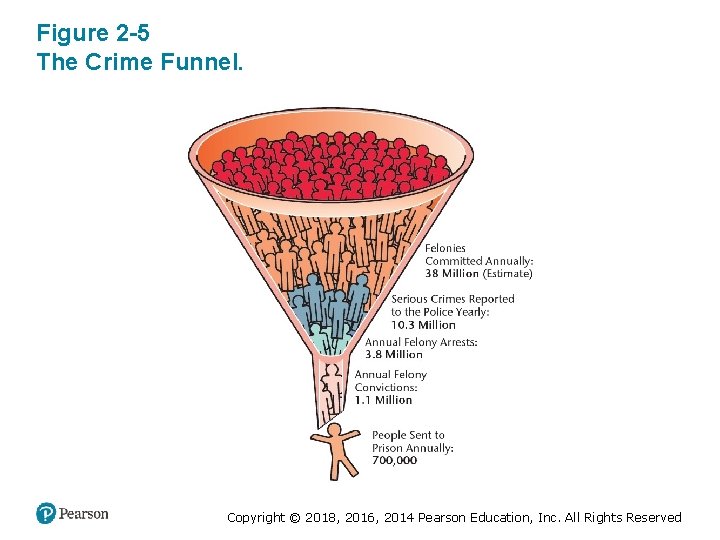
Deterrence (3 of 3) • Recidivism - repeated criminal behavior by those already involved in crime – Some studies show high recidivism rates, reaching 80% to 90% • American CJS seems ineffectual at preventing crime and reducing recidivism – Punishments provided by the law are rarely applied to most offenders Copyright © 2018, 2016, 2014 Pearson Education, Inc. All Rights Reserved
Figure 2 -5 The Crime Funnel. Copyright © 2018, 2016, 2014 Pearson Education, Inc. All Rights Reserved
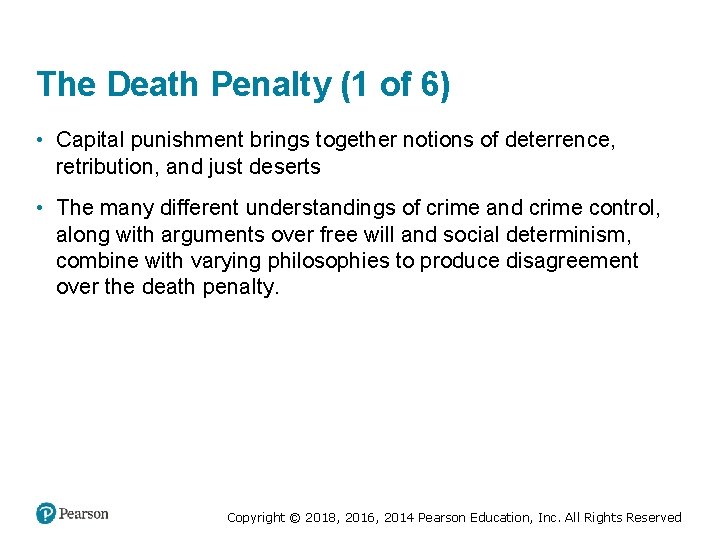
The Death Penalty (1 of 6) • Capital punishment brings together notions of deterrence, retribution, and just deserts • The many different understandings of crime and crime control, along with arguments over free will and social determinism, combine with varying philosophies to produce disagreement over the death penalty. Copyright © 2018, 2016, 2014 Pearson Education, Inc. All Rights Reserved
The Death Penalty (2 of 6) • Claims by opponents of the death penalty: – Capital punishment does not deter crime. – The death penalty has, at times, been imposed on innocent people. – Human life is sacred. – State-imposed death lowers society to the same moral level as the murderer. Copyright © 2018, 2016, 2014 Pearson Education, Inc. All Rights Reserved
The Death Penalty (3 of 6) • Claims by opponents of the death penalty: – The death penalty has been haphazardly imposed in seemingly random fashion. – The death penalty is imposed disproportionately on minority offenders. – Capital punishment goes against most fundamental precepts of organized religions. Copyright © 2018, 2016, 2014 Pearson Education, Inc. All Rights Reserved
The Death Penalty (4 of 6) • Claims by opponents of the death penalty: – The death penalty is more expensive than imprisonment. – Internationally, capital punishment is widely viewed as inhumane and barbaric. – A viable alternative exists in life imprisonment without the possibility of parole. Copyright © 2018, 2016, 2014 Pearson Education, Inc. All Rights Reserved
The Death Penalty (5 of 6) • Advocates of capital punishment counter abolitionist arguments of injustice with the proposition that death is deserved by those who commit especially heinous acts. • Some argue people deserve to die as retribution for their crime. Copyright © 2018, 2016, 2014 Pearson Education, Inc. All Rights Reserved
The Death Penalty (6 of 6) • Studies into the effectiveness and fairness of capital punishment have created more controversy • Research has not found much support for the deterrent effect capital punishment • Advocates argue that it ensures those put to death will never commit more crimes Copyright © 2018, 2016, 2014 Pearson Education, Inc. All Rights Reserved
Capital Punishment and Ethnicity (1 of 2) • The death penalty has been imposed disproportionately on racial minorities throughout American history. • Currently, about 50% of those on death row are from minority populations representing 20% of the US population. • Blacks represent about 12% of the US population but 35% of those executed since 1976 Copyright © 2018, 2016, 2014 Pearson Education, Inc. All Rights Reserved
Capital Punishment and Ethnicity (2 of 2) • Advocates focus not on differences in the rate of imposition among ethnic populations but on whether the penalty is fairly imposed • Present evidence on racial disproportionality is not so clear Copyright © 2018, 2016, 2014 Pearson Education, Inc. All Rights Reserved
A Flawed System? • Recent studies focus on claimed injustices inherent in the sentencing process, leading to the seemingly unfair application of capital punishment • Recent moratorium movement is focused on reforming capital punishment laws • 2004 Innocent Protection Act focuses on DNA testing Copyright © 2018, 2016, 2014 Pearson Education, Inc. All Rights Reserved
Policy Implications of the Classical School • Determinate Sentencing – Mandates a specified fixed amount of time to be served for every offense category – Based on notions of classical thought: § The pleasure of a given crime can be somewhat accurately assessed. § A fixed amount of punishment necessary for deterrence can be calculated and specified. Copyright © 2018, 2016, 2014 Pearson Education, Inc. All Rights Reserved
The Classical School and Policy (1 of 3) • Truth in Sentencing – Requires judges to asses and publish the actual time an offender will serve once sentenced to prison – Many require offenders serve a large portion of their sentence (often 80%) before their release. Copyright © 2018, 2016, 2014 Pearson Education, Inc. All Rights Reserved
The Classical School and Policy (2 of 3) • Incapacitation – The use of imprisonment or other means to reduce the likelihood that an offender will be capable of committing future offenses Copyright © 2018, 2016, 2014 Pearson Education, Inc. All Rights Reserved
The Classical School and Policy (3 of 3) • Selective Incapacitation – Crime is controlled via the imprisonment of specific individuals. • Collective Incapacitation – Changes in legislation and/or sentencing patterns lead to removing dangerous individuals from society. Copyright © 2018, 2016, 2014 Pearson Education, Inc. All Rights Reserved
A Critique of Classical and Neoclassical Theories • Critics claim that classical thought: – Doesn't fully explain criminal motivation – No meaningful explanation of how a choice for/against crime is made – Lacks any appreciation for the deeper sources of personal motivation – Lacks scientific backing and grounding in practical social research Copyright © 2018, 2016, 2014 Pearson Education, Inc. All Rights Reserved
A Critique of Neoclassical Thought (1 of 2) • Crime has decreased in communities without get-tough policies • They have made little scientific progress beyond armchair theorizing Copyright © 2018, 2016, 2014 Pearson Education, Inc. All Rights Reserved
A Critique of Rational Choice Theory (2 of 2) • Overemphasizes the importance of individual choice while disregarding the role of social forces • Assumes everyone is equally capable of making rational decisions • Emphasis on changing the situation to reduce crime may result in crime displacement Copyright © 2018, 2016, 2014 Pearson Education, Inc. All Rights Reserved