
Criminogenic Risk and Treatment Planning 1 Disclosures The



















- Slides: 61
Criminogenic Risk and Treatment Planning 1
Disclosures The development of these training materials were supported by grant H 79 TI 080209 (PI: S. Becker) from the Center for Substance Abuse Treatment, Substance Abuse and Mental Health Services Administration, United States Department of Health and Human Services. The views and opinions contained within this document do not necessarily reflect those of the US Department of Health and Human Services, and should not be construed as such. 2
Objectives • Participants will explore the use of evidence- based practices and validated risk assessments in targeted supervision strategies that deal with the critical needs and behavioral health of clients. • Participants will identify the 8 Core Principles and practices of Criminogenic Risk Factors. • The participant will understand the components of risk assessments used to identify recidivism and risk potential for clients. • Participants will demonstrate the skills associated with completing a criminogenic risk assessment and treatment planning utilizing case studies. 3
Research Findings Supervision approaches that engage the offender in a collaborative change process and provides evidence-based treatment have been correlated with recidivism reduction. (Taxman, 2006. ) 4
What is EBP? • Evidence-based practice (EBP) is a process in which the practitioner combines well-researched interventions with clinical experience and ethics, and client preferences and culture to guide and inform the delivery of treatments and services. • An evidence-based approach involves an ongoing, critical review of research literature to determine what information is credible, and what policies and practices would be most effective given the best available evidence. It also involves rigorous quality assurance and evaluation to ensure that evidence-based practices are replicated with fidelity, and that new practices are evaluated to determine their effectiveness. • EBP is more appropriate for outcome-focused human service disciplines. (NICIC. gov) 5
Risk Need Responsivity Model • The Risk, Need and Responsivity (RNR) model (Andrews & Bonta, 2010) has been the prominent approach to the treatment of offenders in Canada, as well as other parts of the world for three decades. • The RNR approach and theoretical model on which it is based have resulted in measurable gains in terms of the reliable assessment of offenders, as well as significant reductions in rates of recidivism among offenders treated in programs that have adopted this perspective. 6
RNR The risk-need-responsivity model states that the risk and needs of an offender should determine the strategies appropriate for addressing the individual’s criminogenic factors. 7
Question What does it mean to recidivate? What is Recidivism? 8
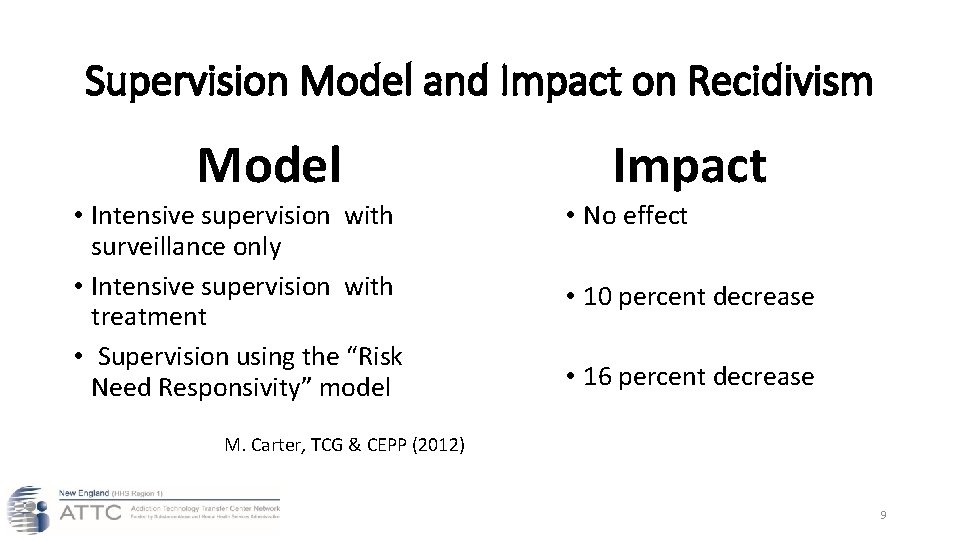
Supervision Model and Impact on Recidivism Model • Intensive supervision with surveillance only • Intensive supervision with treatment • Supervision using the “Risk Need Responsivity” model Impact • No effect • 10 percent decrease • 16 percent decrease M. Carter, TCG & CEPP (2012) 9
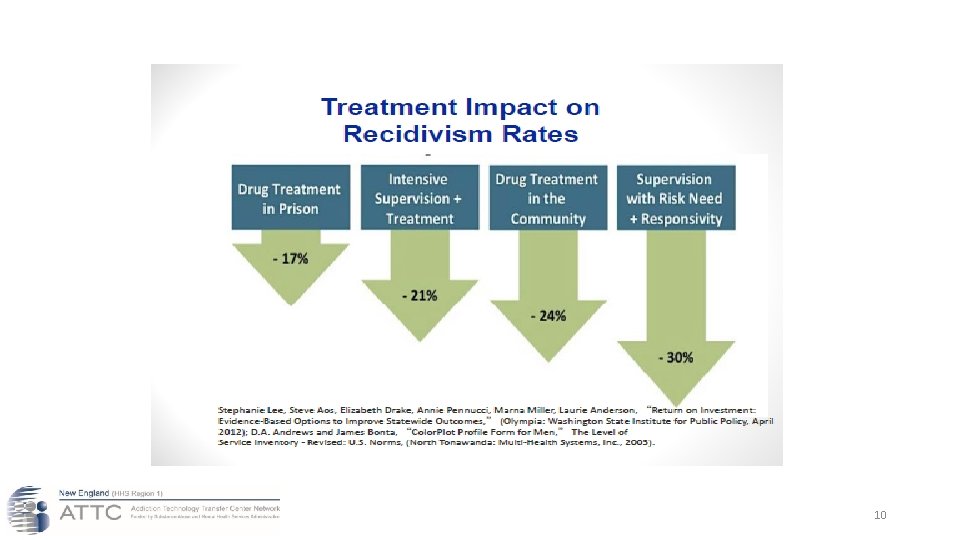
10
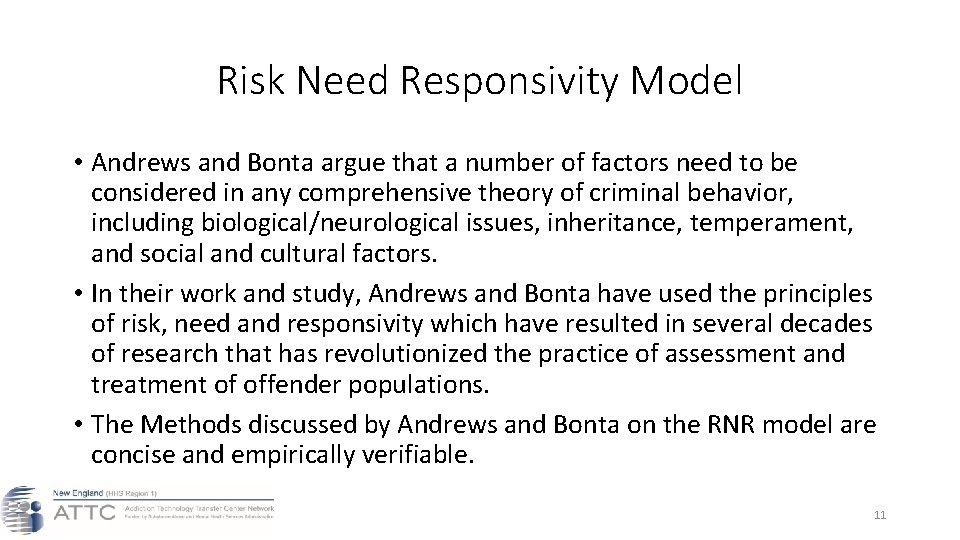
Risk Need Responsivity Model • Andrews and Bonta argue that a number of factors need to be considered in any comprehensive theory of criminal behavior, including biological/neurological issues, inheritance, temperament, and social and cultural factors. • In their work and study, Andrews and Bonta have used the principles of risk, need and responsivity which have resulted in several decades of research that has revolutionized the practice of assessment and treatment of offender populations. • The Methods discussed by Andrews and Bonta on the RNR model are concise and empirically verifiable. 11
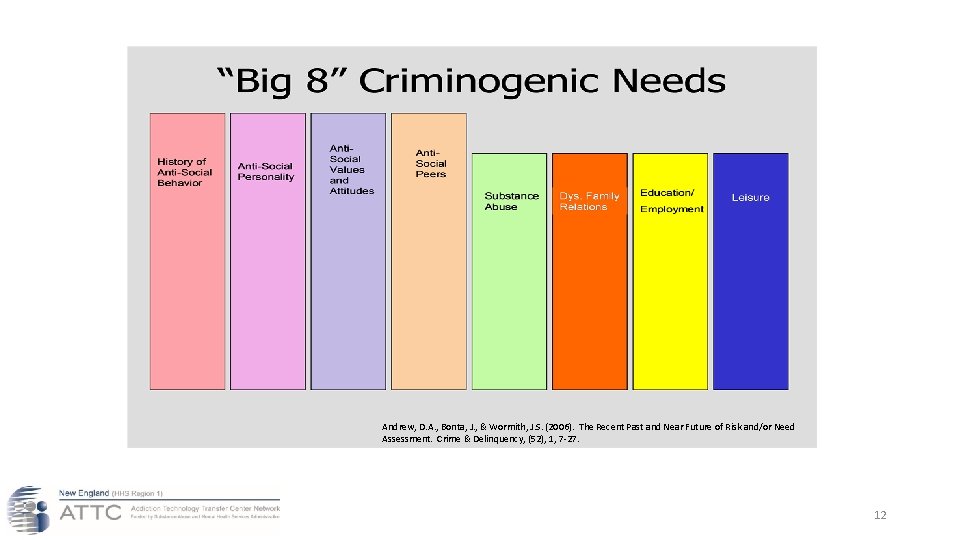
Andrew, D. A. , Bonta, J. , & Wormith, J. S. (2006). The Recent Past and Near Future of Risk and/or Need Assessment. Crime & Delinquency, (52), 1, 7 -27. 12
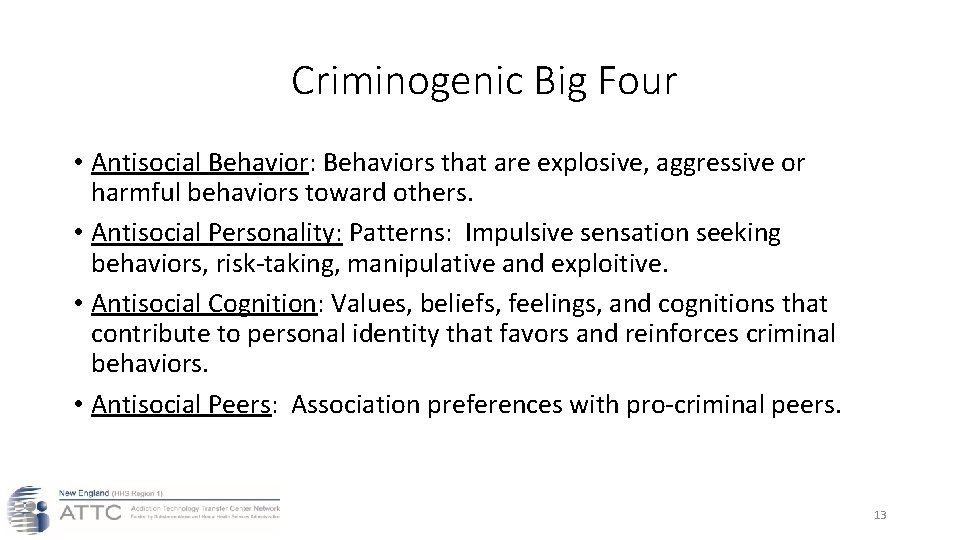
Criminogenic Big Four • Antisocial Behavior: Behaviors that are explosive, aggressive or harmful behaviors toward others. • Antisocial Personality: Patterns: Impulsive sensation seeking behaviors, risk-taking, manipulative and exploitive. • Antisocial Cognition: Values, beliefs, feelings, and cognitions that contribute to personal identity that favors and reinforces criminal behaviors. • Antisocial Peers: Association preferences with pro-criminal peers. 13
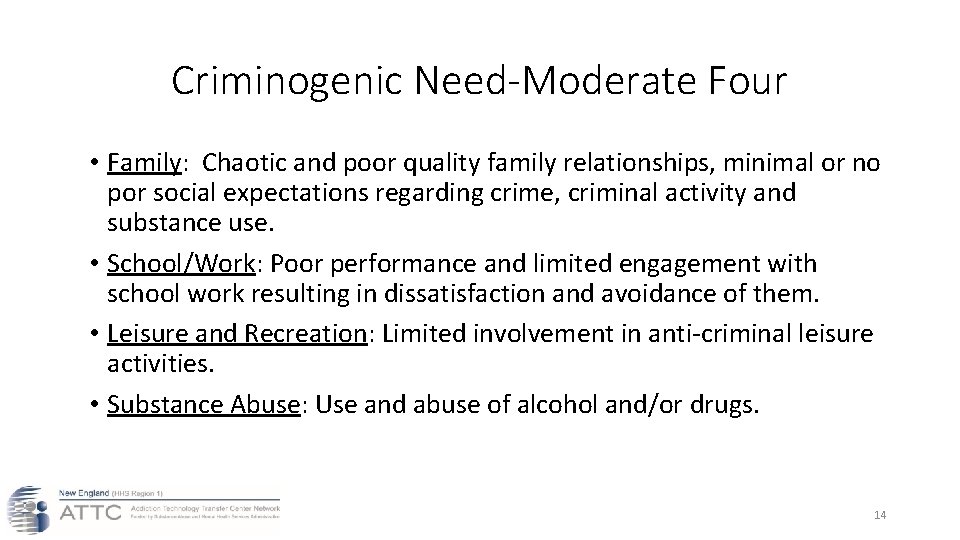
Criminogenic Need-Moderate Four • Family: Chaotic and poor quality family relationships, minimal or no por social expectations regarding crime, criminal activity and substance use. • School/Work: Poor performance and limited engagement with school work resulting in dissatisfaction and avoidance of them. • Leisure and Recreation: Limited involvement in anti-criminal leisure activities. • Substance Abuse: Use and abuse of alcohol and/or drugs. 14
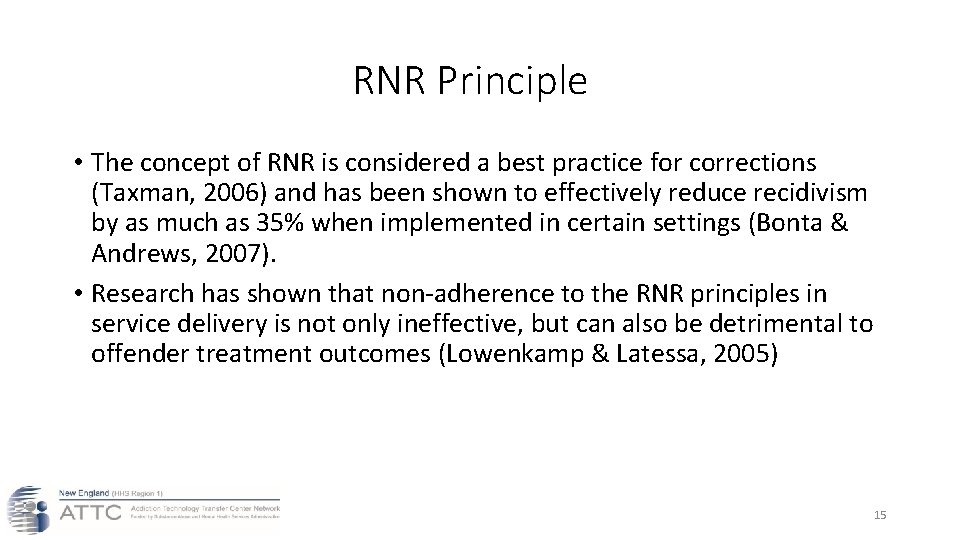
RNR Principle • The concept of RNR is considered a best practice for corrections (Taxman, 2006) and has been shown to effectively reduce recidivism by as much as 35% when implemented in certain settings (Bonta & Andrews, 2007). • Research has shown that non-adherence to the RNR principles in service delivery is not only ineffective, but can also be detrimental to offender treatment outcomes (Lowenkamp & Latessa, 2005) 15
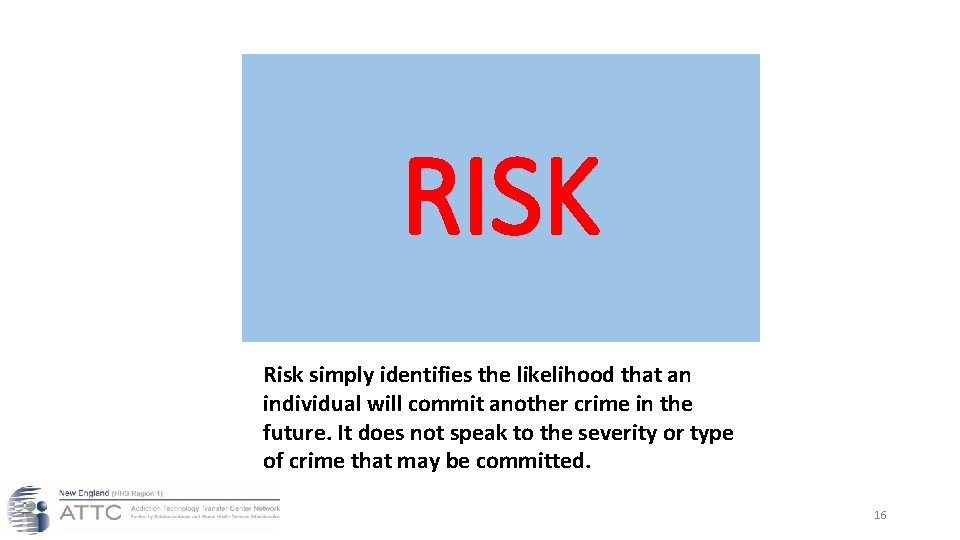
RISK Risk simply identifies the likelihood that an individual will commit another crime in the future. It does not speak to the severity or type of crime that may be committed. 16
Question? • Why can an intervention have the intended consequences for a highrisk offender but have undesired and unintended consequences for a low-risk offender? 17
Answer • The reviews on the risk predictors consistently tell us that antisocial personality, attitudes, associates, and a history of antisocial behavior are the strongest predictors of risk factors for offending behaviors. ( Andrews, D. A. & Bonta, J. (1998). The Psychology of Criminal Conduct. Cincinnati, OH: Anderson Publishing Co. 1998) Other risk factors include substance abuse and alcohol problems, family characteristics, education, and employment. (Gendreau, Little, and Goggin, 1996). 18
Risk Continued Static risk factors are features of the offenders' histories that predict recidivism but are not amenable to deliberate intervention, such as prior offences. Dynamic risk factors are potentially changeable factors, such as substance abuse and negative peer associations. If we intend to reduce recidivism, then it is critical to focus on the offenders who are most likely to re-offend! Assess and identify higher risk offenders. 19
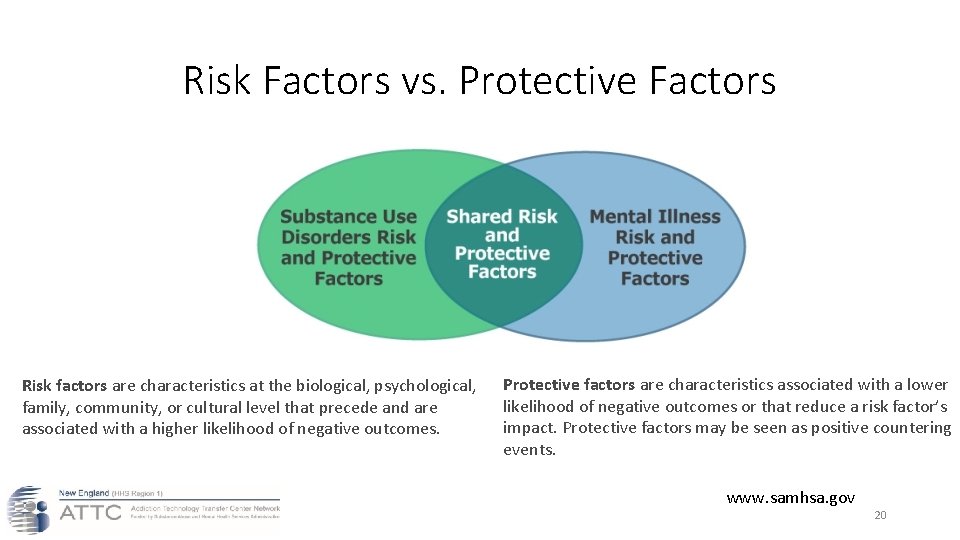
Risk Factors vs. Protective Factors Risk factors are characteristics at the biological, psychological, family, community, or cultural level that precede and are associated with a higher likelihood of negative outcomes. Protective factors are characteristics associated with a lower likelihood of negative outcomes or that reduce a risk factor’s impact. Protective factors may be seen as positive countering events. www. samhsa. gov 20
NEED Offenders have a variety of needs, some of which are directly linked to criminal behavior. These criminogenic needs are dynamic risk factors that, when addressed or changed, affect the offender’s risk for recidivism. 21
Criminogenic Needs • These criminogenic needs are dynamic risk factors that, when addressed or changed, affect the offender’s risk for recidivism. According to meta-analytic research, the eight most significant criminogenic needs are: antisocial behavior; antisocial personality; criminal thinking; criminal associates; dysfunctional family; employment and education; leisure and recreation; and substance abuse. Based on an assessment of the offender, these criminogenic needs can be prioritized so that services are focused on the greatest criminogenic needs. • (Andrews & Bonta, 2006; Harland, 1996; Ward & Stewart, 2003) 22
RESPONSIVITY Responsivity principle—utilize interventions geared toward the offender’s abilities and motivation (generally cognitive behavioral or social learning interventions 23
Treatment Providers • In working with clients, the responsivity model encourages treatment providers to first deal with an individual’s debilitating anxiety or mental disorder in order to free the individual to attend and participate fully in a program targeting criminogenic needs. • If the offender has limited verbal skills and a concrete thinking style then the program must ensure that abstract concepts are kept to a minimum and there is more behavioral practice than talking. • Reducing barriers to attending and participating in treatment must be well thought out and increase motivation to change. 24
Clinical Application Patients whose problems are identified at admission; and then receive services that are matched to those problems, stay in treatment longer. ” (Carise et al. , 2004; Hser et al. , 1999; Kosten et al. , 1987; Mc. Lellan et al. , 1999) Using assessments to match services to client problems improves retention. 25
Responsivity Principle • Maximize the offender’s ability to learn from a rehabilitative intervention by providing cognitive behavioral treatment and tailoring the intervention to the learning style, motivation, abilities and strengths of the offender. • There are two parts to the responsivity principle: general and specific responsivity. • General responsivity calls for the use of cognitive social learning methods to influence behavior. Cognitive social learning strategies are the most effective regardless of the type of offender. 26
Specific Responsivity • Specific responsivity calls for treatment interventions to consider personal strengths and socio-biological personality factors. Treatment should then be tailored to these factors, as they have the potential to facilitate or hinder treatment. It should take into account strengths, learning style, personality, motivation and bio-social factors such as race and gender. 27
Responsivity • Match the presenting problems with appropriate interventions and treatment services. Matching based on the specific problem areas and the level of severity of the problem. • Evaluate both the treatment progress and behavior outcomes. 28
History/Overview of Risk Assessments • First Generation- The assessment of risk was a matter of professional judgement. • Second Generation-Research showed that actuarial instruments performed better than clinical or professional judgement when making predictions of human behavior. • Third Generation- Became sensitive to changes in an offender’s circumstances and also provided correctional staff with information as to what needs should be targeted in their interventions. • Fourth Generation- Incorporated systematic intervention and monitoring with the assessment of a wider range of offender risk factors that were not previously considered and other personal factors important to treatment. 29
Screening vs. Assessment Screening: Process for evaluating the possible presence of a disorder. Assessment: Process for defining the nature of a problem, determining diagnosis, and developing a treatment plan. 30
Types of Offender Assessments There are basically five types of assessments that are used by most mental health professionals that specialize in treating criminal justice clients regardless of their offense which include: § A basic evaluation used to collect historical data. § Risk Assessment used to identify the risk potential for the client to reoffend. § Treatment needs assessment. § Treatment progress assessment. § Recovery assessment plan. 31
Sample Assessment in Working with the Criminal Justice Population • LSI-R Level of Service Inventory Revised • PCRA Federal Post Conviction Risk Assessment • COVR Classification of Violence Risks • PAI Personality Assessment Inventory • MMPI Minnesota Multiphasic Personality Inv. • TPAI Treatment and Program Assessment Inst • ORAS Ohio Risk Assessment • HCR 20 Historical Clinical Risk Management • ARRA Adult Re-offense Risk Instrument • TESIA Traumatic Events Screening Inventory (Women) • SPIN-W Service and Planning Inventory (Women) 32
LSI-R: Level of Service Inventory Revised Domains Assessed: 1. Criminal History 2. Education/Employment 3. Financial 4. Family/Marital 5. Accommodation 6. Leisure/Recreation 7. Companions 8. Alcohol/Drug Problems 9. Emotional/Personal 10. ttitude/Orientation 33
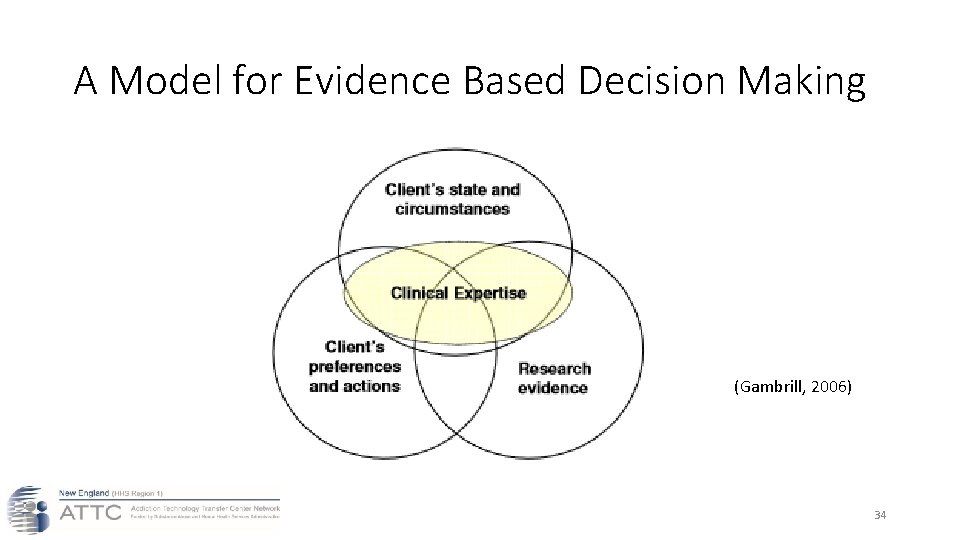
A Model for Evidence Based Decision Making (Gambrill, 2006) 34
6 Steps Supervision Planning Step 1: Assessment-Data Gathering Step 2: Communication Keys Step 3: Build A Trusting Relationship Step 4: Design a Case Plan Step 5: Match Interventions Step 6: Evaluate the Outcomes 35
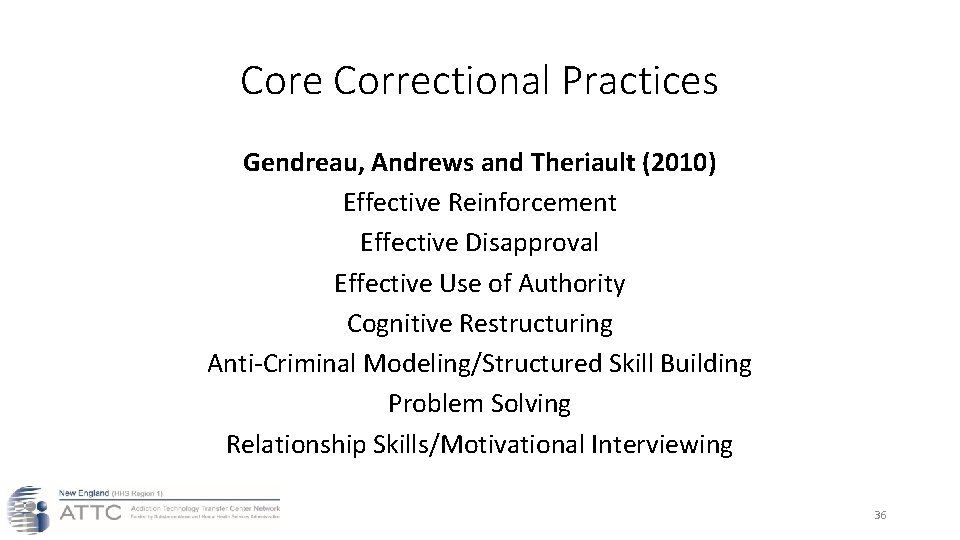
Core Correctional Practices Gendreau, Andrews and Theriault (2010) Effective Reinforcement Effective Disapproval Effective Use of Authority Cognitive Restructuring Anti-Criminal Modeling/Structured Skill Building Problem Solving Relationship Skills/Motivational Interviewing 36
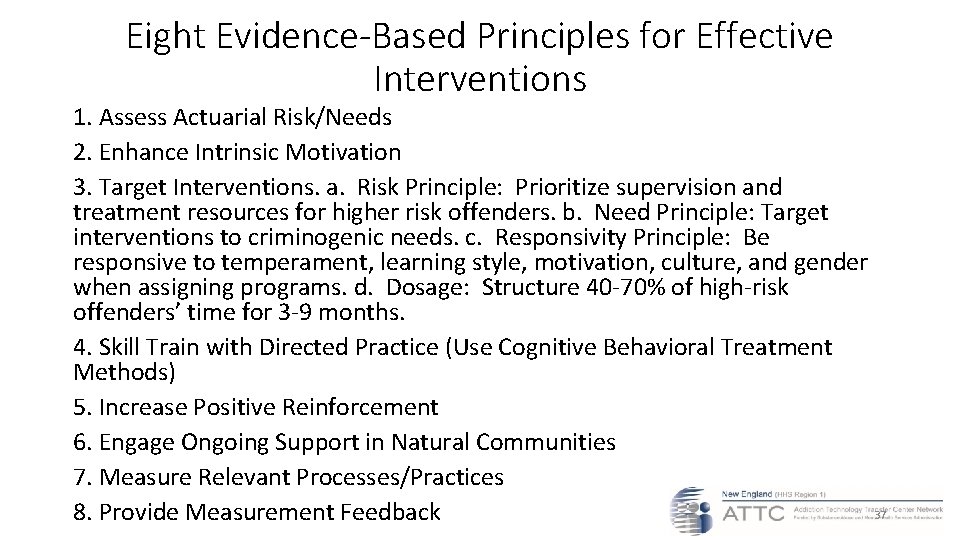
Eight Evidence-Based Principles for Effective Interventions 1. Assess Actuarial Risk/Needs 2. Enhance Intrinsic Motivation 3. Target Interventions. a. Risk Principle: Prioritize supervision and treatment resources for higher risk offenders. b. Need Principle: Target interventions to criminogenic needs. c. Responsivity Principle: Be responsive to temperament, learning style, motivation, culture, and gender when assigning programs. d. Dosage: Structure 40 -70% of high-risk offenders’ time for 3 -9 months. 4. Skill Train with Directed Practice (Use Cognitive Behavioral Treatment Methods) 5. Increase Positive Reinforcement 6. Engage Ongoing Support in Natural Communities 7. Measure Relevant Processes/Practices 37 8. Provide Measurement Feedback
Components of a Treatment Plan • Problem Statement • Goal Statement • Objectives • Interventions M. A. T. R. S. • Measurable –Attainable-Time Limited- Specific-Realistic 38
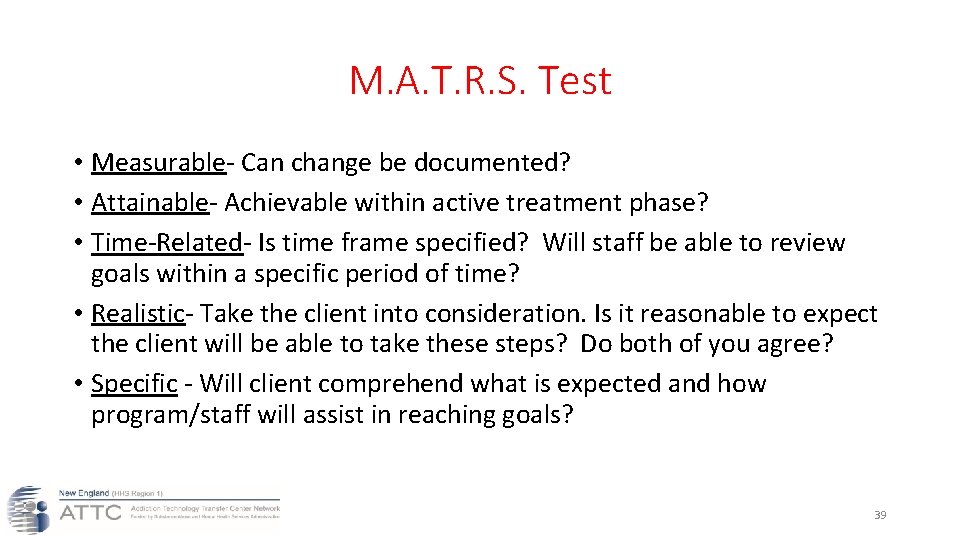
M. A. T. R. S. Test • Measurable- Can change be documented? • Attainable- Achievable within active treatment phase? • Time-Related- Is time frame specified? Will staff be able to review goals within a specific period of time? • Realistic- Take the client into consideration. Is it reasonable to expect the client will be able to take these steps? Do both of you agree? • Specific - Will client comprehend what is expected and how program/staff will assist in reaching goals? 39
#1 ASSESS RISK, NEEDS, & STRENGTHS Complete a validated risk, needs, and strengths assessment with the client. 40
Assessment Process • Use a validated instrument • Assemble collateral information • Conduct a thorough interview • Engage the client 41
#2 BUILD A SUPERVISION ALLIANCE Establish a positive working relationship with the client. 42
Ingredients of a Supervision Alliance • A mutual understanding between staff and the client concerning the nature and purpose of supervision. • An approach that is optimistic, client focused, supportive, and flexible. An approach that provides clear expectations and structure and uses a consistent, and respectful manner. 43
#3 ENHANCE MOTIVATION Gauge and enhance the client’s motivation to change. 44
#4 DEVELOP A CASE PLAN Collaborate with the client in developing a supervision plan. 45
Case Plan Principles • Piling on too many obligations leads to frustration and failure. • Beginning with the client’s issues helps to create “buy-in” and trust. 46
#5 TARGET CRIMINOGENIC NEEDS Refer the client to programs based upon their assessed criminogenic needs and/or the issues they want to work on. 47
Determining the Appropriate Intervention(s) • Risk Principle • Need Principle • Responsivity Principle • Dosage • Treatment 48
#6 ESTABLISH BEHAVIORAL REINFORCEMENTS Apply behavioral reinforcements to increase or decrease any current client behaviors. 49
#7 FOCUS ON BEHAVIOR CHANGE Facilitate behavior change and work with the client to start, benefit from and complete treatment. 50
#8 Pro-Social Modeling • Model anti-criminal behavior and thinking. • Positively reinforce anti-criminal behavior and verbalizations. • Express disapproval of pro-criminal or antisocial expressions, thinking, and behavior while demonstrating alternatives. 51
Facilitating Pro-Social Networks • Help the client to examine with whom they spend time and that individual’s influence on their criminal behavior. • Directly introduce them to organizations and activities that can provide pro-social, ongoing support and reinforcement. 52
Pro-Social Modeling • Model anti-criminal behavior and thinking. • Positively reinforce anti-criminal behavior and verbalizations. • Express disapproval of pro-criminal or antisocial expressions, thinking, and behavior while demonstrating alternatives. 53
Eight Core Practices 1. 2. 3. 4. 5. 6. 7. 8. Assess Risk, Needs and Strengths Build a Supervision Alliance Enhance Motivation Develop a Case Plan Target Criminogenic Needs Establish Behavioral Reinforcements Focus on Behavior Change Demonstrate Pro-Social Modeling and Develop Pro-Social Networks 54
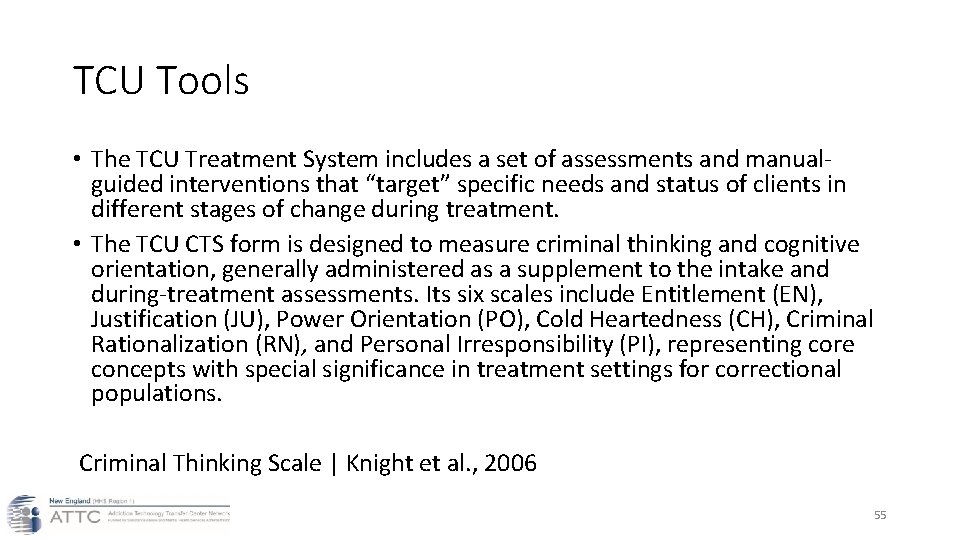
TCU Tools • The TCU Treatment System includes a set of assessments and manualguided interventions that “target” specific needs and status of clients in different stages of change during treatment. • The TCU CTS form is designed to measure criminal thinking and cognitive orientation, generally administered as a supplement to the intake and during-treatment assessments. Its six scales include Entitlement (EN), Justification (JU), Power Orientation (PO), Cold Heartedness (CH), Criminal Rationalization (RN), and Personal Irresponsibility (PI), representing core concepts with special significance in treatment settings for correctional populations. Criminal Thinking Scale | Knight et al. , 2006 55
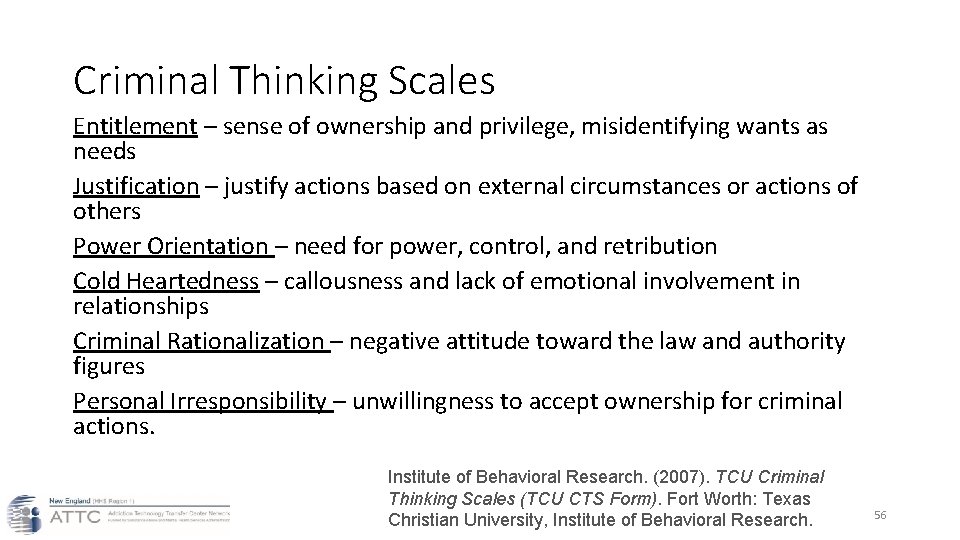
Criminal Thinking Scales Entitlement – sense of ownership and privilege, misidentifying wants as needs Justification – justify actions based on external circumstances or actions of others Power Orientation – need for power, control, and retribution Cold Heartedness – callousness and lack of emotional involvement in relationships Criminal Rationalization – negative attitude toward the law and authority figures Personal Irresponsibility – unwillingness to accept ownership for criminal actions. Institute of Behavioral Research. (2007). TCU Criminal Thinking Scales (TCU CTS Form). Fort Worth: Texas Christian University, Institute of Behavioral Research. 56
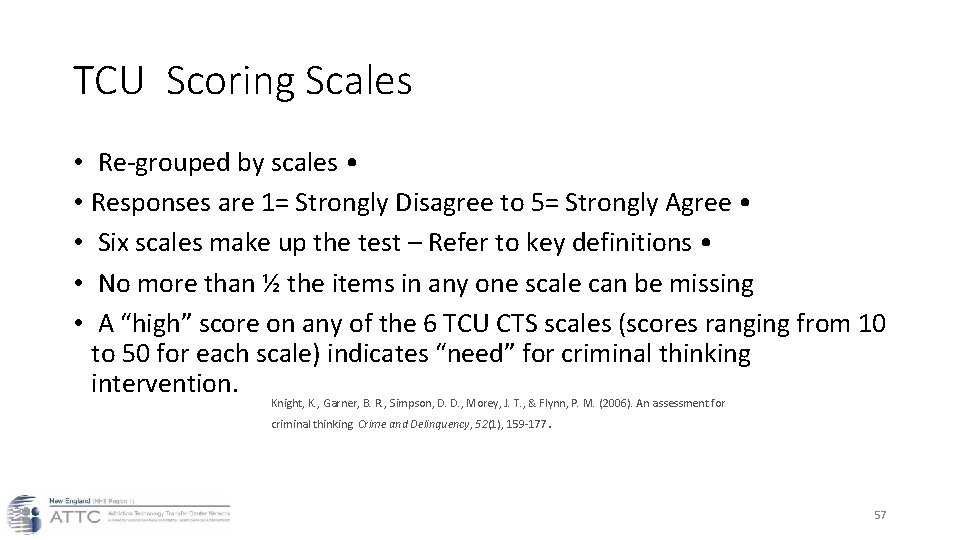
TCU Scoring Scales • Re-grouped by scales • • Responses are 1= Strongly Disagree to 5= Strongly Agree • • Six scales make up the test – Refer to key definitions • • No more than ½ the items in any one scale can be missing • A “high” score on any of the 6 TCU CTS scales (scores ranging from 10 to 50 for each scale) indicates “need” for criminal thinking intervention. Knight, K. , Garner, B. R. , Simpson, D. D. , Morey, J. T. , & Flynn, P. M. (2006). An assessment for criminal thinking. Crime and Delinquency, 52(1), 159 -177. 57
Benefits of Coordinated Care • Behavioral health integration encompasses the management and delivery of health services so that individuals receive a continuum of preventive and restorative mental health and addiction services, according to their needs over time, and across different levels of the health system. • Integrated care involves a patient-centered care team providing evidence-based treatments for a defined population using a measurement-based treat-to-target approach. • www. samhsa. gov 58
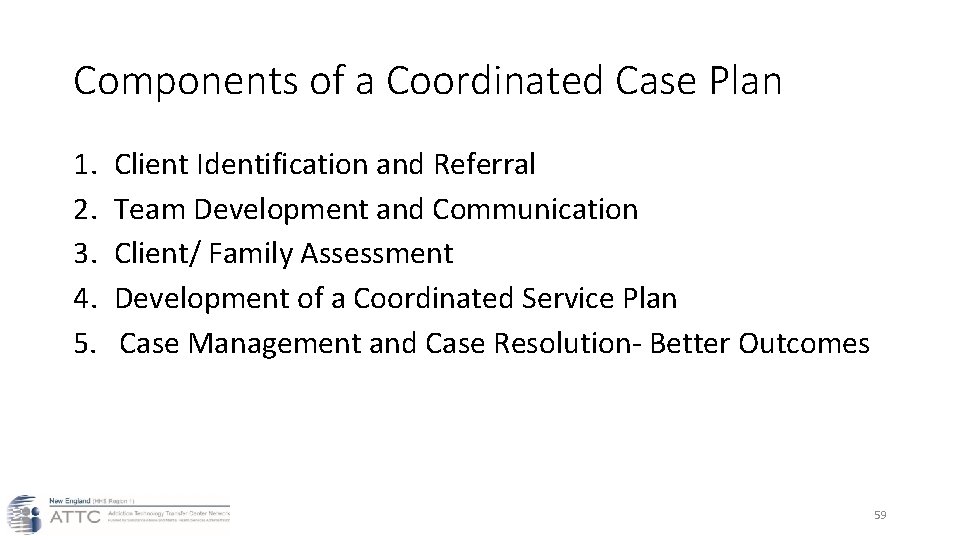
Components of a Coordinated Case Plan 1. Client Identification and Referral 2. Team Development and Communication 3. Client/ Family Assessment 4. Development of a Coordinated Service Plan 5. Case Management and Case Resolution- Better Outcomes 59
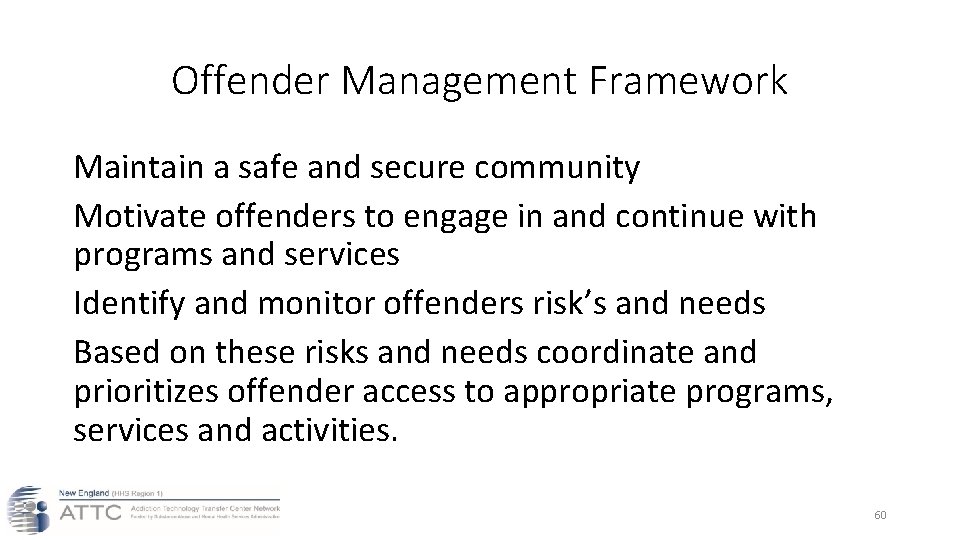
Offender Management Framework Maintain a safe and secure community Motivate offenders to engage in and continue with programs and services Identify and monitor offenders risk’s and needs Based on these risks and needs coordinate and prioritizes offender access to appropriate programs, services and activities. 60
Resources • D. A. Andrews and Craig Dowden, The Risk–Need--Responsivity Model of Assessment and Human Service in Prevention and Corrections: Crime-Prevention Jurisprudence, ” 49 Can. J. Criminology & Crim. Just. 439 -464 (2007). • Bogue, B. , Campbell, N. , Carey, M. , Clawson, E. , Faust, D. , Florio, K. , Joplin, L. , Keiser, G. , Wasson, B. , & Woodward, W. (2003). Implementing evidence-based practice in community corrections: The principles of effective intervention. Washington, DC: National Institute of Corrections. • Dowling, N. A. & Cosic, S. (2011). Client engagement characteristics. International journal of mental health addiction, 9, 656 -671. • Gendreau, P. , Little, T. , & Goggin, C. (1996). A meta-analysis of the predictors of adult offender recidivism: What works! Criminology, 34, 575 -607. • Institute of Behavioral Research. (2007). TCU Criminal Thinking Scales (TCU CTS Form). Fort Worth: Texas Christian University, Institute of Behavioral Research. • Knight, K. , Garner, B. R. , Simpson, D. D. , Morey, J. T. , & Flynn, P. M. (2006). An assessment for criminal thinking. Crime and Delinquency, 52(1), 159 -177 • Modeling Health Behavior Change: How to Predict and Modify the Adoption and Maintenance of Health Behaviors, Ralf Schwarzer Pages: 1 -29. First Published: 30 January 2008. • Faye S. Taxman, Anne Giuranna Rhodes, and Levent Dumenci, Criminal Justice and Behavior Vol 38, Issue 2, pp. 174 - 187 First Published January 4, 2011. • Taxman, F. S. , Sheperdson, E. , & Byrne, J. M. (2004). Tools of the Trade: A Guide to Incorporating Science into Practice. Washington, DC: National Institute of Corrections. • The Good Lives Model and the Risk Need Responsivity Model: A Critical Response to Andrews, Bonta, and Wormith (2011) Tony Ward, Pamela M. Yates, and Gwenda M. Willis. Criminal Justice and Behavior Vol 39, Issue 1, pp. 94 - 110 First Published December 27, 2011. • • 61