
Criminal Misappropriation of Property Dishonest Misappropriation of Property
- Slides: 12
Criminal Misappropriation of Property Dishonest Misappropriation of Property Section 403 IPC By Prof. Shakeel Ahmad Faculty of Law, AMU
INTRODUCTION: Criminal misappropriation takes place not when the possession has been innocently come by, but when, by a subsequent change of intention or from the knowledge of some new facts with which the party was not previously acquainted, the retaining becomes wrongful and fraudulent. The offence consists in the dishonest misappropriation or conversion, either permanently or for a time being, of property which is already in the possession of the offender. See illustrations (a), (b) and (C) which show that the original innocent taking amounts to criminal misappropriation by subsequent acts. The offence is completed by a mental act.
Section 403 IPC. Dishonest misappropriation of property Whoever dishonestly misappropriates or converts to his own use any movable property, shall be punished with imprisonment of either description for a term which may extend to two years, or with fine, or with both. Illustrations (a) A takes property belonging to Z out of Z's possession, in good faith, believing, at any time when he takes it, that the property belongs to himself. A is not guilty of theft; but if A, after discovering his mistake, dishonestly appropriates the property to his own use, he is guilty of an offence under this section. (b) A, being on friendly terms with Z, goes into Z's library in Z's absence, and takes away a book without Z's express consent. Here, if A was under the impression that he had Z's implied consent to take the book for the purpose of reading it, A has not committed theft. But, if A afterwards sells the book for his own benefit, he is guilty of an offence under this section. (c) A and B, being joint owners of a horse, A takes the horse out of B's possession, intending, to use it. Here, as A has a right to use the horse, he does not dishonestly misappropriate it. But, if A sells the horse and appropriates the whole proceeds to his own use, he is guilty of an offence under this section. Contd……. .
Explanation 1 - A dishonest misappropriation for a time only is a misappropriation with the meaning of this section. Illustration A finds a Government promissory note belonging to Z, bearing a blank endorsement. A, knowing that the note belongs to Z, pledges it with a banker as a security for a loan, intending. at a future time to restore it to Z. A has committed an offence under this section. Explanation 2 - A person who finds property not in the possession of any other person, and takes such property for the purpose of protecting if for, or of restoring it to, the owner does not take or misappropriate it dishonestly, and is not guilty of an offence; but he is guilty of the offence above defined, if he appropriates it to his own use, when he knows or has the means of discovering the owner, or before he has used reasonable means to discover and give notice to the owner and has kept the property a reasonable time to enable the owner to claim it. What are reasonable means or what is a reasonable time in such a case, is a question of fact. It is not necessary that the finder should know who is the owner of the property, or that any particular person is the owner of it; it is sufficient if, at the time of appropriately it, lie does not believe it to be his own property, or in good faith believe that the real owner cannot be found. Illustrations (a) A finds a rupee on the high road, not knowing to whom the rupee belongs. A picks up the rupee. Here A has not committed the offence defined in this section. (b) A finds a letter on the road, containing a bank note. From the direction and contents of the letter he learns to whom the note belongs. He appropriates the note. He is guilty of an offence under this section. (c) A finds a cheque payable to bearer. He can form no conjecture as to the person who has lost the cheque. But the name of the person, who has drawn the cheque, appears. A knows that this person can direct him to the person in whose favour the cheque was drawn. A appropriates the cheque without attempting to discover the owner. He is guilty of an offence under this section. Contd….
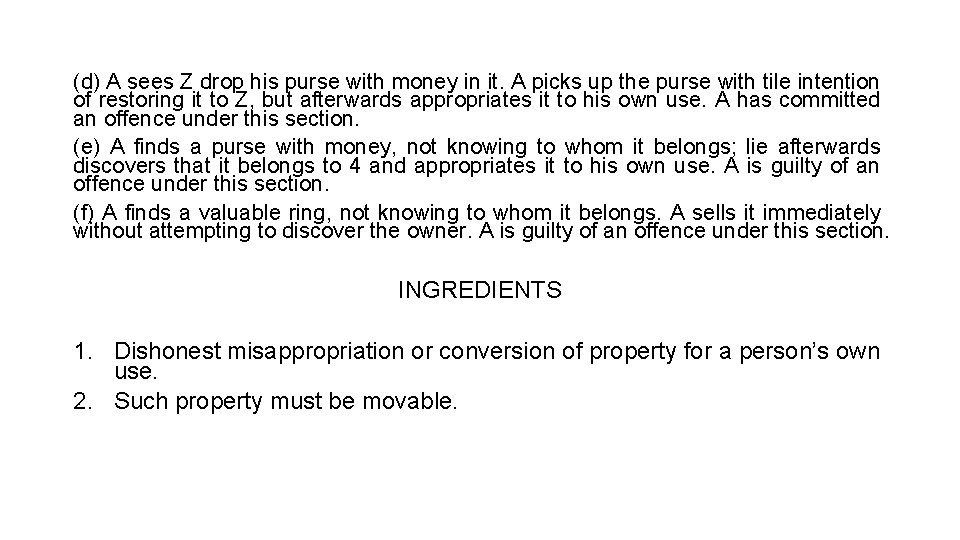
(d) A sees Z drop his purse with money in it. A picks up the purse with tile intention of restoring it to Z, but afterwards appropriates it to his own use. A has committed an offence under this section. (e) A finds a purse with money, not knowing to whom it belongs; lie afterwards discovers that it belongs to 4 and appropriates it to his own use. A is guilty of an offence under this section. (f) A finds a valuable ring, not knowing to whom it belongs. A sells it immediately without attempting to discover the owner. A is guilty of an offence under this section. INGREDIENTS 1. Dishonest misappropriation or conversion of property for a person’s own use. 2. Such property must be movable.
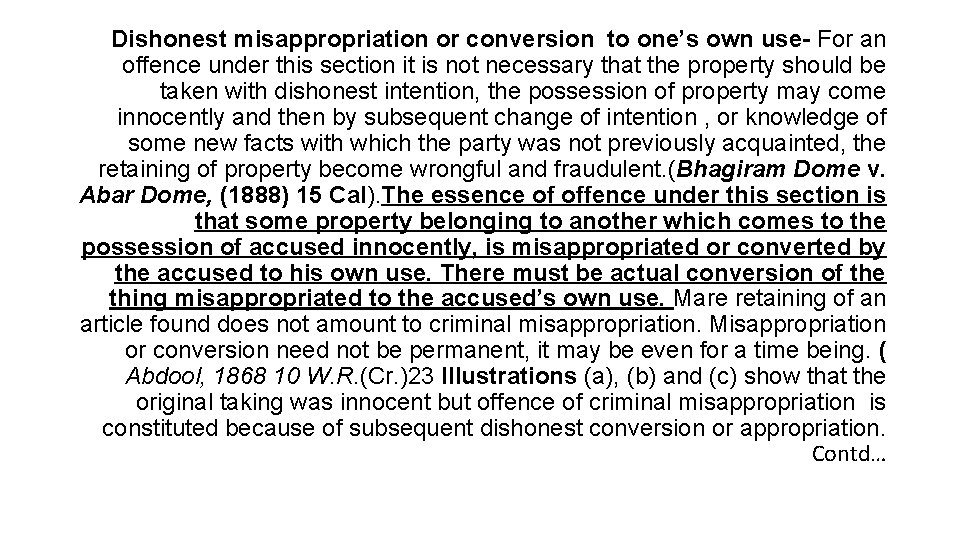
Dishonest misappropriation or conversion to one’s own use- For an offence under this section it is not necessary that the property should be taken with dishonest intention, the possession of property may come innocently and then by subsequent change of intention , or knowledge of some new facts with which the party was not previously acquainted, the retaining of property become wrongful and fraudulent. (Bhagiram Dome v. Abar Dome, (1888) 15 Cal). The essence of offence under this section is that some property belonging to another which comes to the possession of accused innocently, is misappropriated or converted by the accused to his own use. There must be actual conversion of the thing misappropriated to the accused’s own use. Mare retaining of an article found does not amount to criminal misappropriation. Misappropriation or conversion need not be permanent, it may be even for a time being. ( Abdool, 1868 10 W. R. (Cr. )23 Illustrations (a), (b) and (c) show that the original taking was innocent but offence of criminal misappropriation is constituted because of subsequent dishonest conversion or appropriation. Contd…
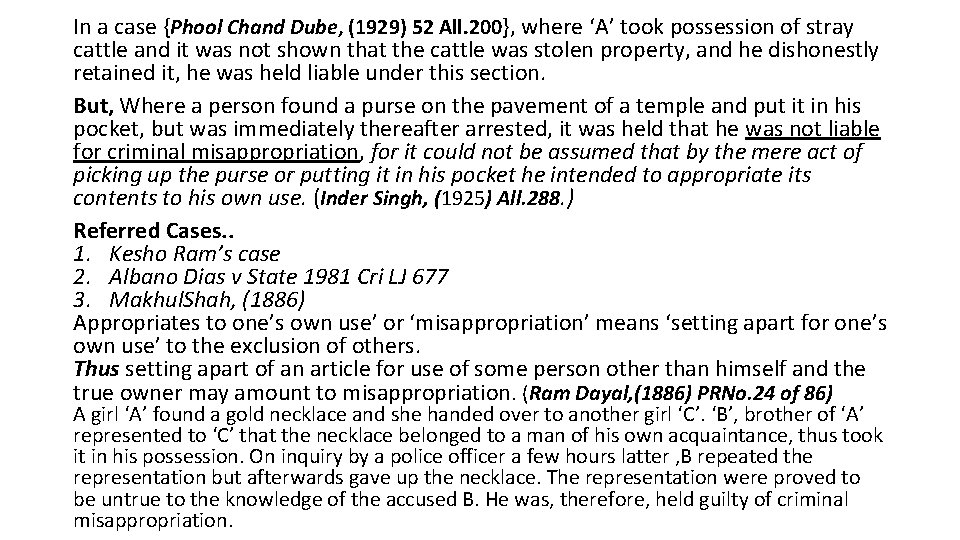
In a case {Phool Chand Dube, (1929) 52 All. 200}, where ‘A’ took possession of stray cattle and it was not shown that the cattle was stolen property, and he dishonestly retained it, he was held liable under this section. But, Where a person found a purse on the pavement of a temple and put it in his pocket, but was immediately thereafter arrested, it was held that he was not liable for criminal misappropriation, for it could not be assumed that by the mere act of picking up the purse or putting it in his pocket he intended to appropriate its contents to his own use. (Inder Singh, (1925) All. 288. ) Referred Cases. . 1. Kesho Ram’s case 2. Albano Dias v State 1981 Cri LJ 677 3. Makhul. Shah, (1886) Appropriates to one’s own use’ or ‘misappropriation’ means ‘setting apart for one’s own use’ to the exclusion of others. Thus setting apart of an article for use of some person other than himself and the true owner may amount to misappropriation. (Ram Dayal, (1886) PRNo. 24 of 86) A girl ‘A’ found a gold necklace and she handed over to another girl ‘C’. ‘B’, brother of ‘A’ represented to ‘C’ that the necklace belonged to a man of his own acquaintance, thus took it in his possession. On inquiry by a police officer a few hours latter , B repeated the representation but afterwards gave up the necklace. The representation were proved to be untrue to the knowledge of the accused B. He was, therefore, held guilty of criminal misappropriation.
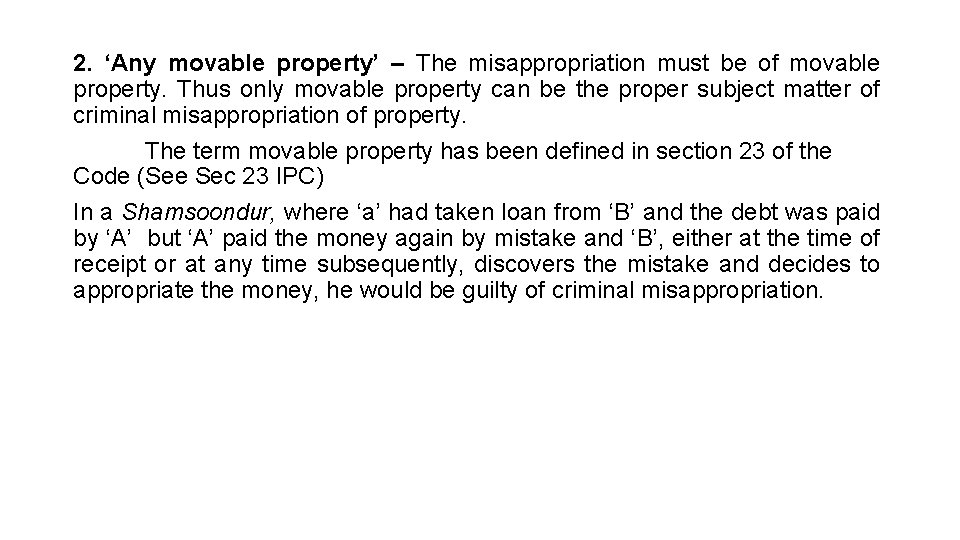
2. ‘Any movable property’ – The misappropriation must be of movable property. Thus only movable property can be the proper subject matter of criminal misappropriation of property. The term movable property has been defined in section 23 of the Code (See Sec 23 IPC) In a Shamsoondur, where ‘a’ had taken loan from ‘B’ and the debt was paid by ‘A’ but ‘A’ paid the money again by mistake and ‘B’, either at the time of receipt or at any time subsequently, discovers the mistake and decides to appropriate the money, he would be guilty of criminal misappropriation.
Joint Property. Where the accused is interested in the property jointly owned with others, he is not necessarily guilty of a criminal act if he takes possession of it, and disposes of it. [ illustration (c) to the section 403]. ‘A’ and ‘B’ , being joint owner of a horse, A, takes the horse out of B’s possession, intending to use it. Here, as A has the right to use the horse, he does not dishonestly misappropriate it. But, if A sells the horse and appropriates the whole proceeds to his own use, he is guilty of an offence under the section.
Temporary Misappropriation. Explanation I to Section 403, IPC, makes it clear that even dishonest misappropriation for a time being only is a misappropriation within the meaning of this section. The words ‘ for a time only’ means temporary misappropriation. (Khandu Sonu Dhobi v State of Maharashtra, AIR 1972 SC 958). Finder of Lost Goods. Expln. 2 makes it clear that thing abandoned cannot form a proper subject of an offence under the section. For constituting an offence under this section property appropriated must be owned by somebody. This explanation requires finder of goods, before appropriating the property found, to make attempt to find the owner, if they have means of doing so. The finder must wait up to a reasonable time to allow the owner to claim the property, before he appropriates it. The question as to what are reasonable means and what is reasonable time would depend upon the facts of the case. Illustration (a) to the Expln. 2 shows that the picking of a rupee whose owner is not known is not an offence. Similarly ills. (e) to the Expln. 2 shows that the finding of a purse with money belonging to an unknown owner is not an offence, but the appropriation of it to the finder’s own use is necessary to complete it.
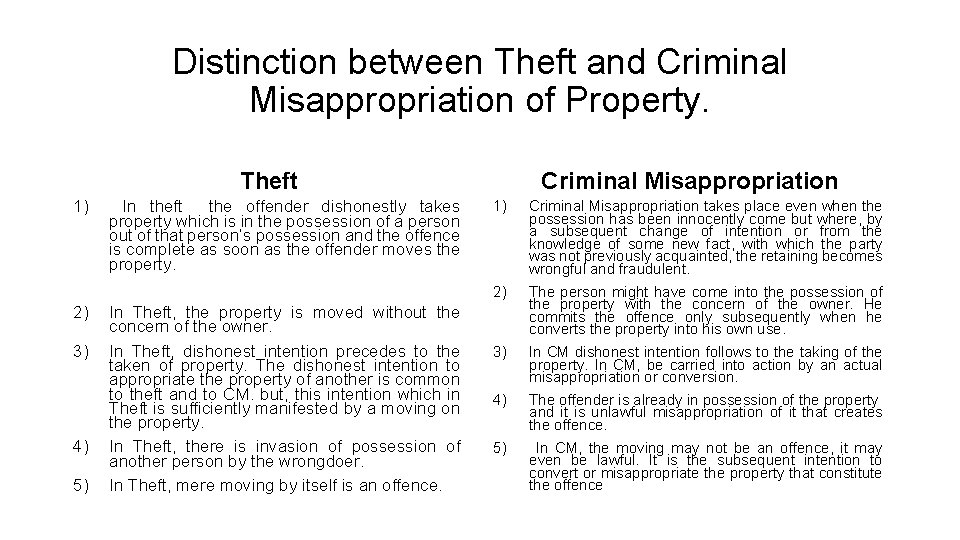
Distinction between Theft and Criminal Misappropriation of Property. Theft 1) 2) 3) 4) 5) In theft the offender dishonestly takes property which is in the possession of a person out of that person’s possession and the offence is complete as soon as the offender moves the property. In Theft, the property is moved without the concern of the owner. In Theft, dishonest intention precedes to the taken of property. The dishonest intention to appropriate the property of another is common to theft and to CM. but, this intention which in Theft is sufficiently manifested by a moving on the property. In Theft, there is invasion of possession of another person by the wrongdoer. In Theft, mere moving by itself is an offence. Criminal Misappropriation 1) Criminal Misappropriation takes place even when the possession has been innocently come but where, by a subsequent change of intention or from the knowledge of some new fact, with which the party was not previously acquainted, the retaining becomes wrongful and fraudulent. 2) The person might have come into the possession of the property with the concern of the owner. He commits the offence only subsequently when he converts the property into his own use. 3) In CM dishonest intention follows to the taking of the property. In CM, be carried into action by an actual misappropriation or conversion. 4) The offender is already in possession of the property and it is unlawful misappropriation of it that creates the offence. 5) In CM, the moving may not be an offence, it may even be lawful. It is the subsequent intention to convert or misappropriate the property that constitute the offence
Section 404 is an aggravated form of criminal misappropriation. It relates to dishonest misappropriation of property possessed by deceased person at the time of his death. This section relates to a description of property peculiarly needing protection. The offence consists in the pillaging of movable property during the interval which elapses between the time when the possessor of the property dies, and the time when it comes into the possession of some person or officer authorized to take charge of it. The section deals with misappropriation by two classes of persons. The first class is strangers who may take advantage of the death of a person and misappropriate property. In such a case, the accused is liable to imprisonment upto three years and fine. If the accused is a clerk or a servant then it is taken more seriously by the legislature and the maximum punishment provided therein is imprisonment upto seven years. It is similar to Sec. 381, which treats offence of theft by clerk or servants as an aggravated form of theft.