
Criminal Law Part 8 Assault and Battery Lectures
Criminal Law Part 8: Assault and Battery Lectures 1 -2: Assault, Battery
Assault and Battery • Assault and Battery are the two most common crimes-against-persons which are not homicide – Other non-homicide crimes-against-persons include (non-exclusive list): • (Assaultative) Rape – not discussed in this class • Robbery – discussed under property crimes • Menacing – variation on assault, not discussed in this class • Child Endangerment/Abuse Offenses – vary substantially by jurisdiction, uncommon on bar exam, not discussed in this class Criminal Law – Professor David Thaw Part 8, Lectures 1 -2 Slide 2
Assault and Battery • As with all crimes, assault and battery are defined by statute – Jurisdictional variations are small in effect of what conduct they criminalize, but confusing in terminology that is “all over the map” • We focus exclusively on the CL and MPC definitions Criminal Law – Professor David Thaw Part 8, Lectures 1 -2 Slide 3
Assault • CL (two varieties): – (1) apprehension of harm – the threat or use of force on another that causes that person to experience a reasonable apprehension of imminent harmful or offensive contact • General intent crime – lacks a specific intent element – (2) failed battery – attempted battery • Specific intent crime – because it is an attempt crime Criminal Law – Professor David Thaw Part 8, Lectures 1 -2 Slide 4
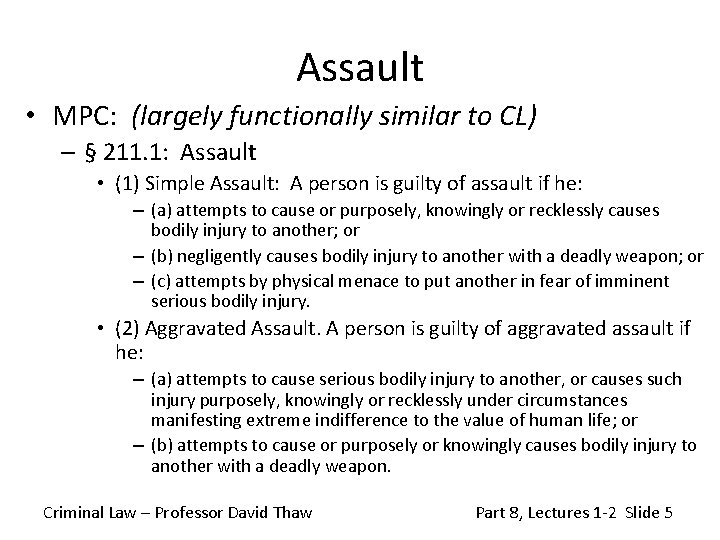
Assault • MPC: (largely functionally similar to CL) – § 211. 1: Assault • (1) Simple Assault: A person is guilty of assault if he: – (a) attempts to cause or purposely, knowingly or recklessly causes bodily injury to another; or – (b) negligently causes bodily injury to another with a deadly weapon; or – (c) attempts by physical menace to put another in fear of imminent serious bodily injury. • (2) Aggravated Assault. A person is guilty of aggravated assault if he: – (a) attempts to cause serious bodily injury to another, or causes such injury purposely, knowingly or recklessly under circumstances manifesting extreme indifference to the value of human life; or – (b) attempts to cause or purposely or knowingly causes bodily injury to another with a deadly weapon. Criminal Law – Professor David Thaw Part 8, Lectures 1 -2 Slide 5
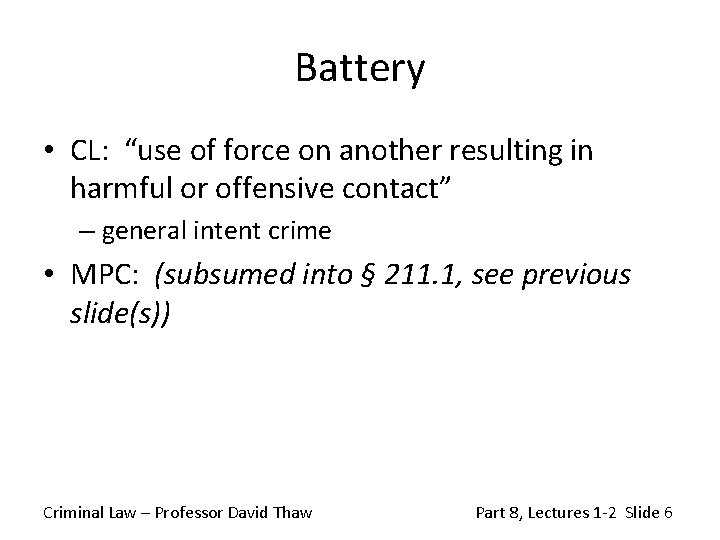
Battery • CL: “use of force on another resulting in harmful or offensive contact” – general intent crime • MPC: (subsumed into § 211. 1, see previous slide(s)) Criminal Law – Professor David Thaw Part 8, Lectures 1 -2 Slide 6
- Slides: 6