
Criminal Law Part 3 Basics of Criminal Law
Criminal Law Part 3: Basics of Criminal Law Lecture 1: Nature, Sources, Limits
What is the “Criminal Law”? • First: what is the method of the criminal law, or more specifically, how does it operate? • Criminal Law comprises a series of commands – Most are prohibitive (“must not”) commands: • “you must not murder” • “you must not steal” – Some are affirmative (“must”) requirements: • “you must support your (minor) children” • “you must file (and pay) your income taxes” Criminal Law – Professor David Thaw Part 3, Lecture 1 Slide 2
What is the “Criminal Law”? • Second: to whom does the method apply? • Commands are valid and binding on all persons within their terms at the time of compliance – Generally speak to (all) members of the community – Generally are applicable at all times after enactment • Some limited exceptions (e. g. , delayed effective date) • Some affirmative defenses (discussed in Part 6) Criminal Law – Professor David Thaw Part 3, Lecture 1 Slide 3
What is the “Criminal Law”? • Third: how is the method enforced? – These commands are subject to sanctions for noncompliance which the community (generally the Government) is prepared to enforce • So what makes this different from any other area of law (e. g. , torts, contracts, etc. )? – Probably not sufficient to describe “crimes” as “societal wrongs sought to be prevented” – “community (criminal) condemnation” is one distinguishing factor Criminal Law – Professor David Thaw Part 3, Lecture 1 Slide 4
What is the “Criminal Law”? • Criminal Condemnation (“Punishment”) – More than just a mere consequence of an action – Involves a judgment of community condemnation – “The essence of moral delinquency lies in the criminal conviction itself. . It is the expression of the community’s hatred, fear, or contempt for the convict which alone characterizes physical hardship as punishment. ” (CB 52) • This aspect of punishment is inherent, however criminal conviction usually is accompanied by physical punishment (e. g. , coercion-backed fines, imprisonment, etc. ) – Criminal law (generally) has the monopoly on the imposition of physical punishment in U. S. law Criminal Law – Professor David Thaw Part 3, Lecture 1 Slide 5
Sources of Criminal Law • Remember: each jurisdiction (all 50+) has a different, separate criminal code – However, nearly all of these share one or both of two common ancestors/sources of influence: – (1) the “Common Law” (CL) – (2) the Model Penal Code (MPC) • This course will examine doctrines of the Common Law (as adopted by a majority of jurisdictions) and the MPC (as codified by the American Law Institute) Criminal Law – Professor David Thaw Part 3, Lecture 1 Slide 6
Sources of Criminal Law • The “Common Law” – There is no single criminal code in the U. S. – However, much of U. S. criminal law finds its roots in the British common law tradition • This tradition was one of “judge made” law in the British courts – i. e. , law that evolved as (British) courts considered various criminal matters not specifically part of a codified statutory system – The founding colonists brought aspects of this “common law” tradition with them, however over time it evolved in the American tradition Criminal Law – Professor David Thaw Part 3, Lecture 1 Slide 7
Sources of Criminal Law • The “Common Law” – Legislatures began (first) to “supplement” the common law – Over time, (imported) common law was replaced by full legislative enactment • This practice was consistent with the no “ex post facto” provisions of the Constitution • Many State legislatures, however, did enact variations of the existing common law into statutory law – why? Criminal Law – Professor David Thaw Part 3, Lecture 1 Slide 8
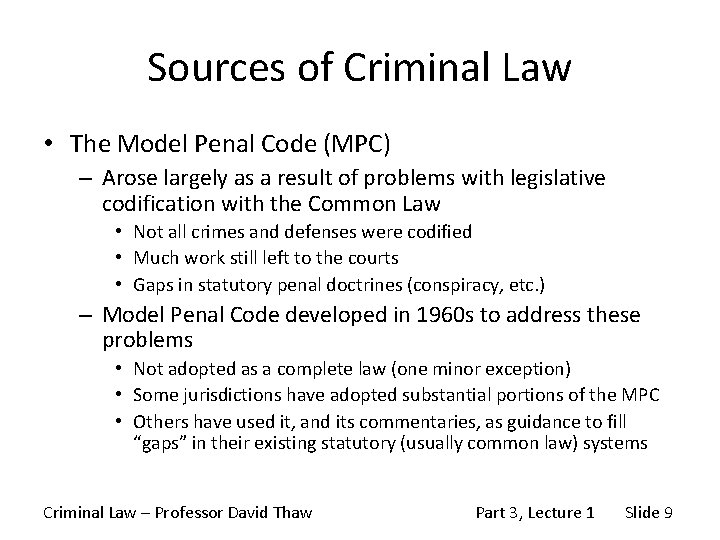
Sources of Criminal Law • The Model Penal Code (MPC) – Arose largely as a result of problems with legislative codification with the Common Law • Not all crimes and defenses were codified • Much work still left to the courts • Gaps in statutory penal doctrines (conspiracy, etc. ) – Model Penal Code developed in 1960 s to address these problems • Not adopted as a complete law (one minor exception) • Some jurisdictions have adopted substantial portions of the MPC • Others have used it, and its commentaries, as guidance to fill “gaps” in their existing statutory (usually common law) systems Criminal Law – Professor David Thaw Part 3, Lecture 1 Slide 9
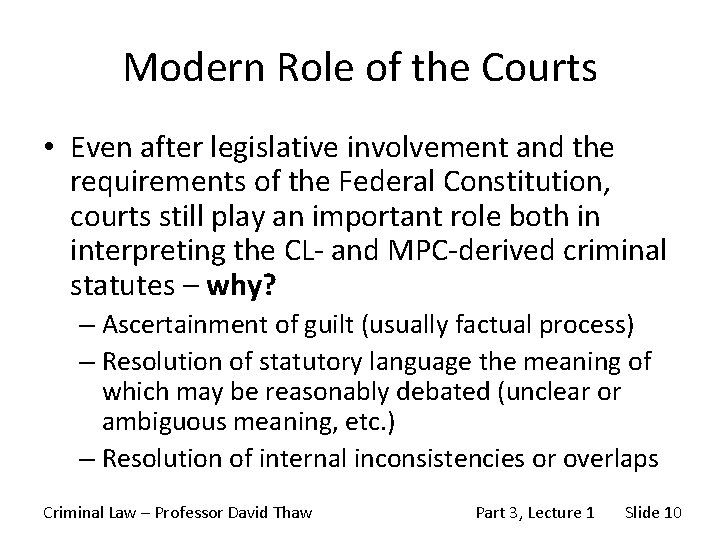
Modern Role of the Courts • Even after legislative involvement and the requirements of the Federal Constitution, courts still play an important role both in interpreting the CL- and MPC-derived criminal statutes – why? – Ascertainment of guilt (usually factual process) – Resolution of statutory language the meaning of which may be reasonably debated (unclear or ambiguous meaning, etc. ) – Resolution of internal inconsistencies or overlaps Criminal Law – Professor David Thaw Part 3, Lecture 1 Slide 10
- Slides: 10