
Criminal Justice Process Types of Crime A Most




- Slides: 9
Criminal Justice Process
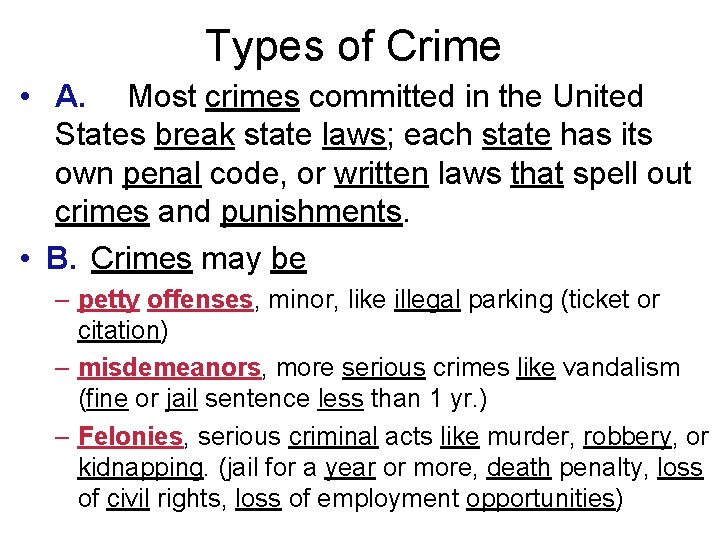
Types of Crime • A. Most crimes committed in the United States break state laws; each state has its own penal code, or written laws that spell out crimes and punishments. • B. Crimes may be – petty offenses, minor, like illegal parking (ticket or citation) – misdemeanors, more serious crimes like vandalism (fine or jail sentence less than 1 yr. ) – Felonies, serious criminal acts like murder, robbery, or kidnapping. (jail for a year or more, death penalty, loss of civil rights, loss of employment opportunities)
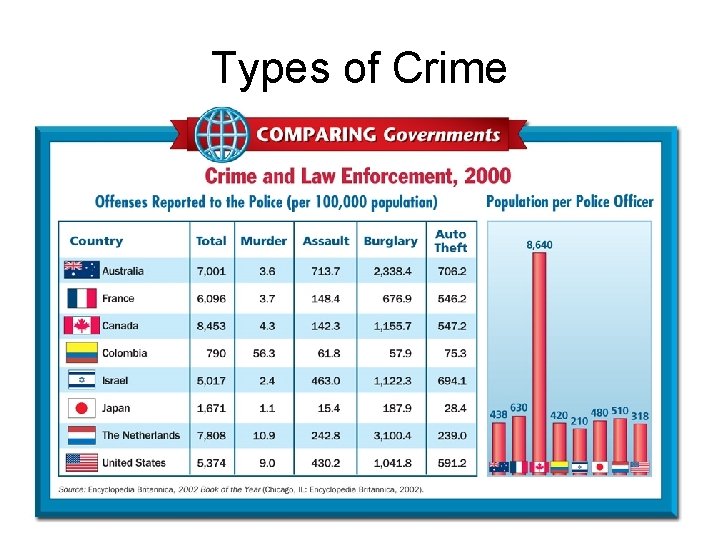
Types of Crime
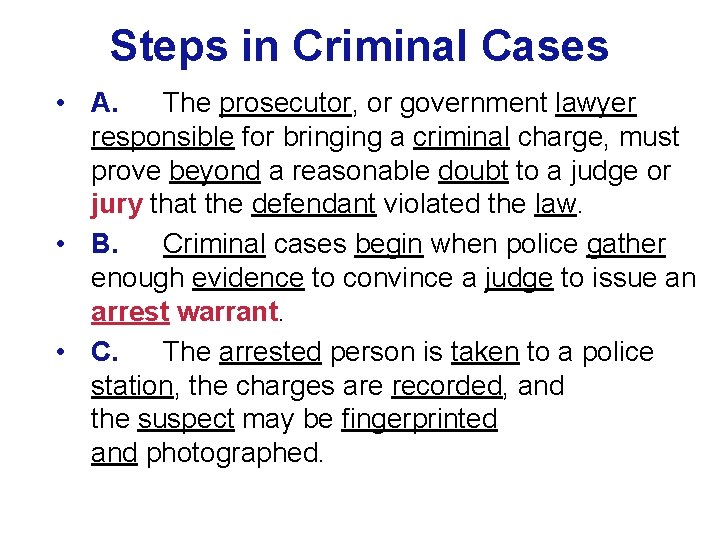
Steps in Criminal Cases • A. The prosecutor, or government lawyer responsible for bringing a criminal charge, must prove beyond a reasonable doubt to a judge or jury that the defendant violated the law. • B. Criminal cases begin when police gather enough evidence to convince a judge to issue an arrest warrant. • C. The arrested person is taken to a police station, the charges are recorded, and the suspect may be fingerprinted and photographed.
Steps in Criminal Cases • D. The arrested person is brought before a judge as quickly as possible to be formally charged with a crime; if the case is a misdemeanor, the person may plead guilty or not guilty. • E. Cases may then go to a grand jury, which determines whethere is enough evidence to put the accused person on trial, or to a preliminary hearing before a judge for the same purpose.
Steps in Criminal Cases • F. At this point, about 90 percent of criminal cases end in a guilty plea in which the accused pleads guilty to a lesser crime in return for the government’s not prosecuting the more serious original crime (plea bargaining). • G. After a grand jury indictment or a preliminary hearing, a judge reads the formal charge at an arraignment held in an open courtroom; the defendant may plead not guilty, not guilty by reason of insanity, guilty, or no contest.
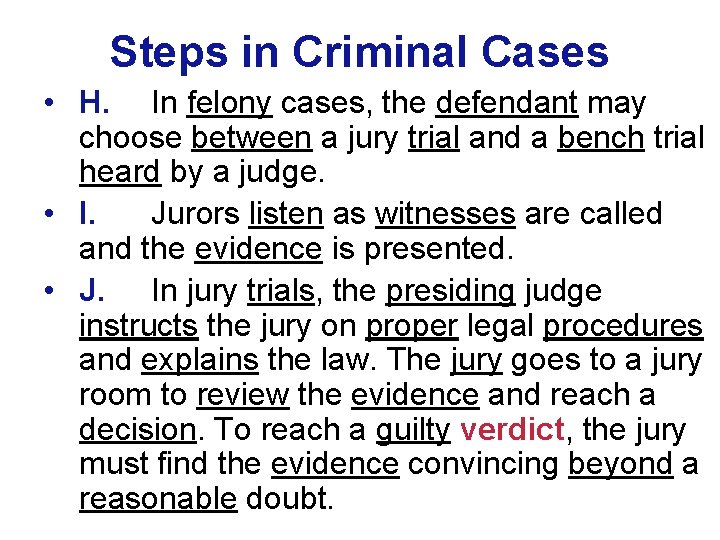
Steps in Criminal Cases • H. In felony cases, the defendant may choose between a jury trial and a bench trial heard by a judge. • I. Jurors listen as witnesses are called and the evidence is presented. • J. In jury trials, the presiding judge instructs the jury on proper legal procedures and explains the law. The jury goes to a jury room to review the evidence and reach a decision. To reach a guilty verdict, the jury must find the evidence convincing beyond a reasonable doubt.
Steps in Criminal Cases • K. If the jury’s verdict is “not guilty, ” the defendant is released immediately. If the jury’s verdict is “guilty, ” the judge usually determines the sentence.
Checking for Understanding • 3. Identify Sixth Amendment, Fifth Amendment. • The Sixth Amendment guarantees that defendants should not have to wait a long time before their trial starts. • The Fifth Amendment guarantees that defendants do not have to testify, and refusal to testify cannot be taken as an admission of guilt.