
CRIMINAL INVESTIGATIONS AMMUNITION BALLISTICS AMMUNITION n Cartridge Structure
CRIMINAL INVESTIGATIONS AMMUNITION/ BALLISTICS
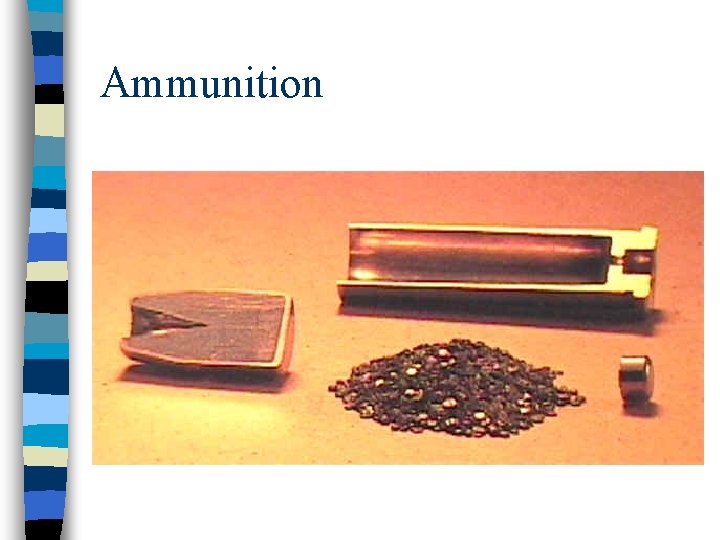
AMMUNITION n Cartridge Structure – Cartridge Case – Primer – Head – Propellant – Bullet – Blanks- No Bullet


Metal Jacket


Ammunition

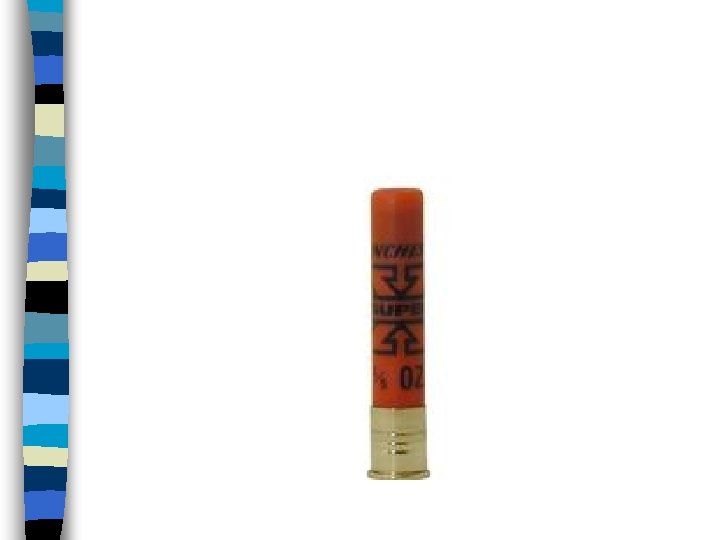
AMMUNITION n Cartridge Cases – Made of Brass • 30% Copper • 30% Zinc – Aluminum – Brass, Plastic and Paper for shotguns
AMMUNITION n Function of Cartridge – Expand seal chamber – Increase Gas Pressure – Press the case up against barrel – Seals – Springs back to almost same size – Aids extraction
AMMUNITION n Shapes – Straight – Bottle neck • Permits more powder – Tapered • Not in use
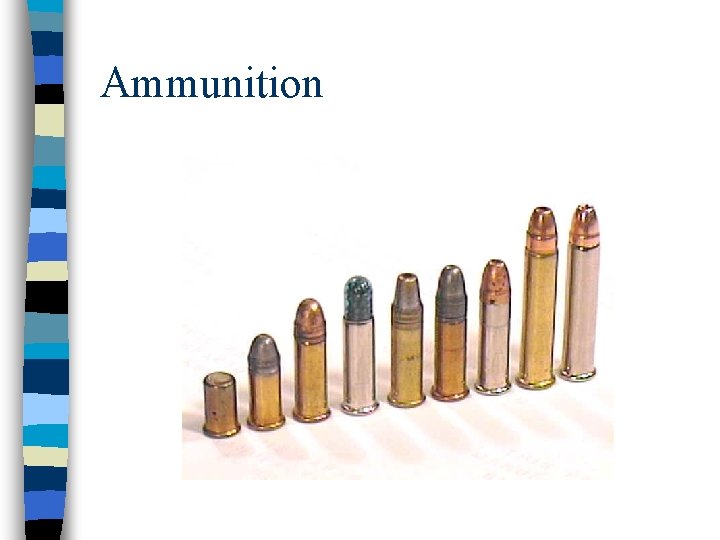
Ammunition
AMMUNITION n Case Head Designs – Rimmed – Semi-rimmed – Rimless – Rebated – Belted
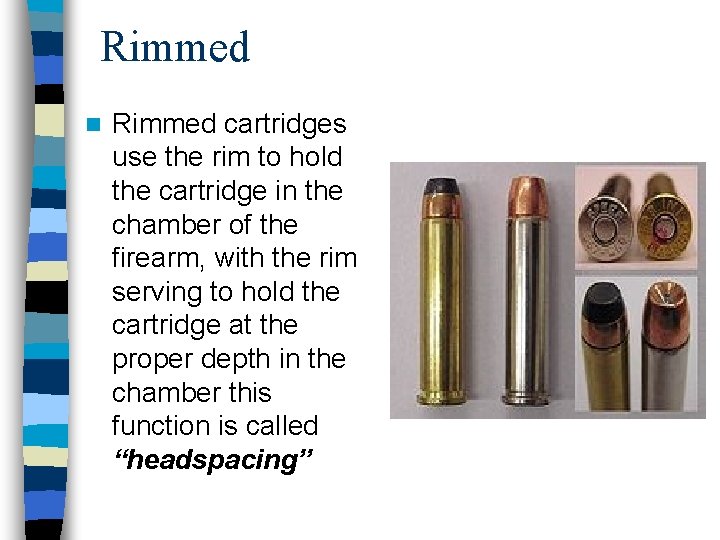
Rimmed n Rimmed cartridges use the rim to hold the cartridge in the chamber of the firearm, with the rim serving to hold the cartridge at the proper depth in the chamber this function is called “headspacing”

Semi-Rimmed n On a semi-rimmed case the rim projects slightly beyond the base of the case, though not as much as a rimmed cartridge.
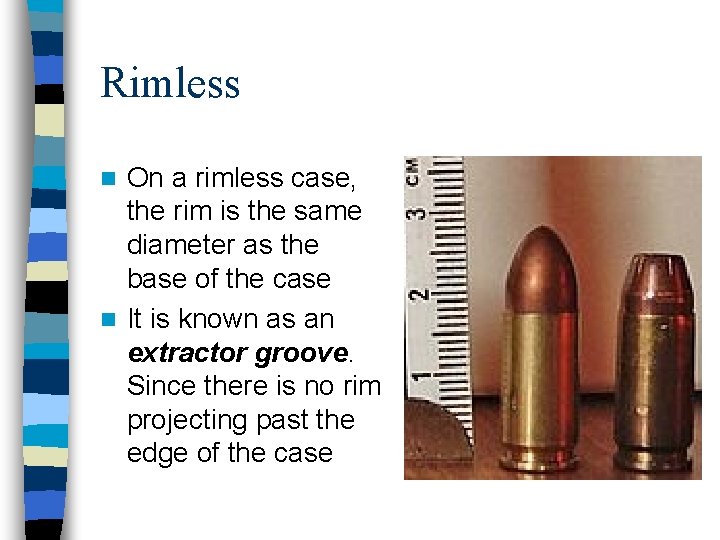
Rimless On a rimless case, the rim is the same diameter as the base of the case n It is known as an extractor groove. Since there is no rim projecting past the edge of the case n
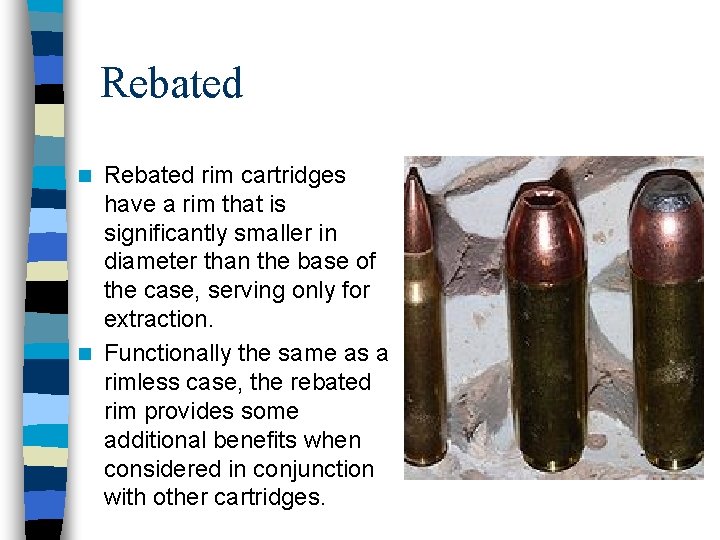
Rebated rim cartridges have a rim that is significantly smaller in diameter than the base of the case, serving only for extraction. n Functionally the same as a rimless case, the rebated rim provides some additional benefits when considered in conjunction with other cartridges. n
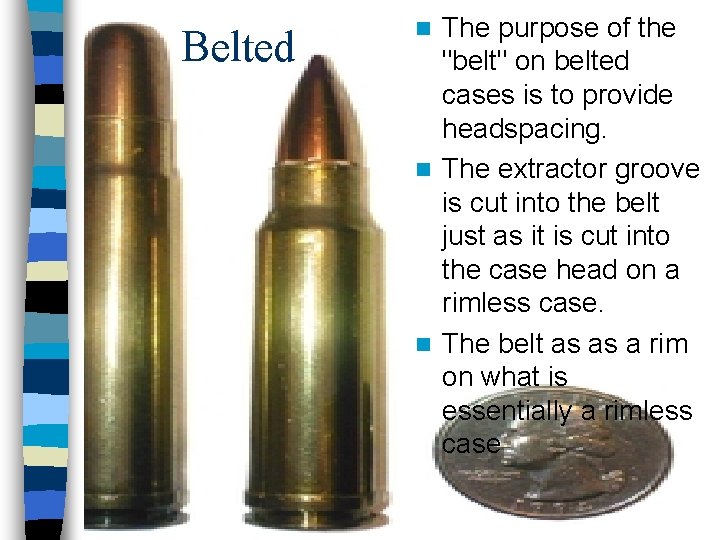
Belted The purpose of the "belt" on belted cases is to provide headspacing. n The extractor groove is cut into the belt just as it is cut into the case head on a rimless case. n The belt as as a rim on what is essentially a rimless case n
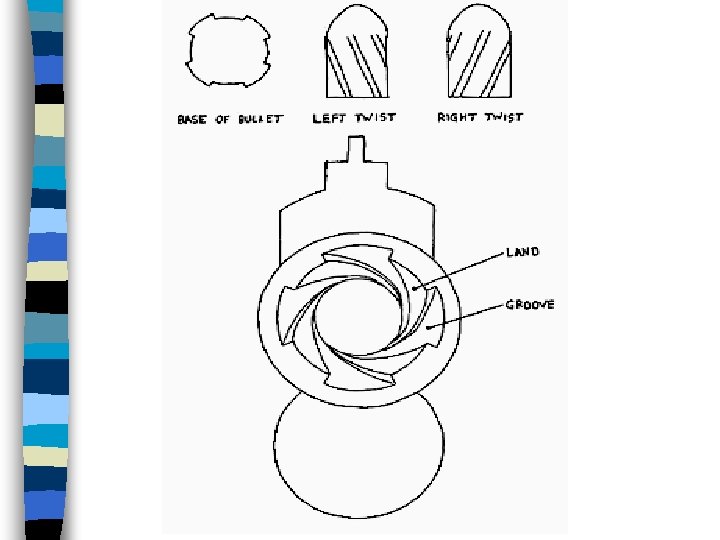
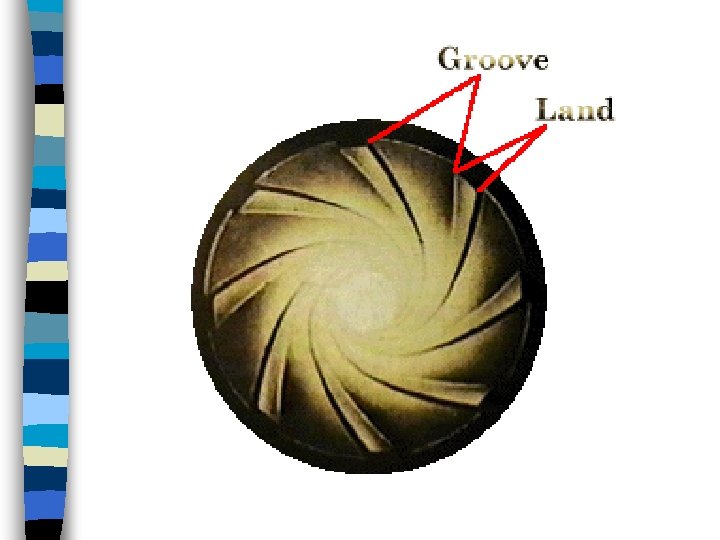
AMMUNITION n Caliber Nomenclature – Rifled barrels • Lands and grooves – Diameter of bore from land to land – Sometimes groove to groove diameter – Bullet diameter
AMMUNITION n Types of Cartridge – R = Rimmed – SR = Semi-Rimmed – RB = Rebated – B = Belted – No letter for rimless
AMMUNITION n Additional Terms – Magnum = Higher velocity than standard – Wildcat = Nonstandard, produced by small entity
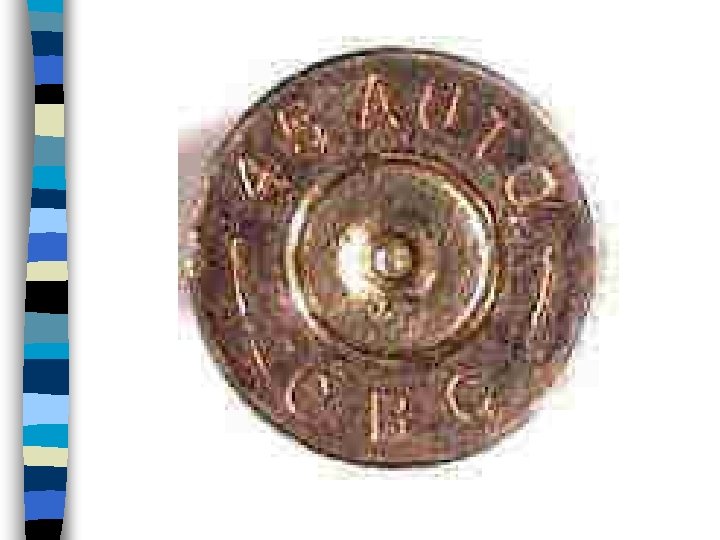
AMMUNITION n Head Stamps (Cont. ) – Civilian made with manufacturers symbol – Military made with initials or codes • • Year of manufacturing Match/nm = military match grade ammo + = NATO +P or +P+ = High Pressure
AMMUNITION n Caliber Specification – U. S. System not consistent or accurate –. 303 Savage =. 308 bullet –. 303 British =. 312 bullet –. 30 -06 and. 308 both fire a. 308 bullet –. 06 refers to year made
AMMUNITION n U. S. Caliber Designation – Confusing – Not accurate –. 38 and. 357 – Difference is length of case and grains of powder
AMMUNITION n Black Powder Cartridges – Designated by: • Caliber • Black powder charge • Bullet weight – Examples: » 45 -70 -405 » Some smokeless powder cartridges used this designation » . 30 -30
AMMUNITION n Metric Designation – Bullet diameter – Case length – Type of cartridge
AMMUNITION n Head Stamps – All cases have stamps on bases – Imprinted for Identification Purposes • • Letters Numbers Symbols Trade names
AMMUNITION n Bullet Powder Weights – Grain = weight not granules – 1 oz. = 437. 5 grains – 1 grain =. 0648 grams – Bullet and powder weights measured in grains
AMMUNITION n Primer (Cont. ) – Non-corrosive/Non-mercuric – Lead Styphnate – Barium Nitrate – Antimony Sulfide – Most U. S. primers contain all three • *Detection of these compounds provides bases for GSR
AMMUNITION n Primers (Cont. ) – Rimfire Ammo • No primer assembly • Primer chemical is in rim
AMMUNITION n Propellants – Black Powder • Charcoal • Sulfur • Potassium Nitrate – Charcoal is fuel – Nitrate supplies oxygen – Sulfur creates density
AMMUNITION n Propellants – Black Powder – When powder burns • Gas = 44% • Residue= 56% – Residue appears as dense white smoke
AMMUNITION n Smokeless Powder – 1884 Vieille – French Chemist – Nitrocellulose – Used Et. OH/Ether – Rolled into sheets – Cut into flakes – Single base
AMMUNITION n Smokeless Powder (Cont. ) – 1887 – Alfred Noble – Nitrocellulose and Nitroglycerine – Rolled and cut into flakes – Double base
AMMUNITION n Ball Powder Winchester – – – – 1933 Nitrocellulose dissolved Formed into balls Different diameters Appears uniform round, black spheres or ovals Reflective surface Flattened round • Irregular • Flattened chips – Wide variation between round and flat
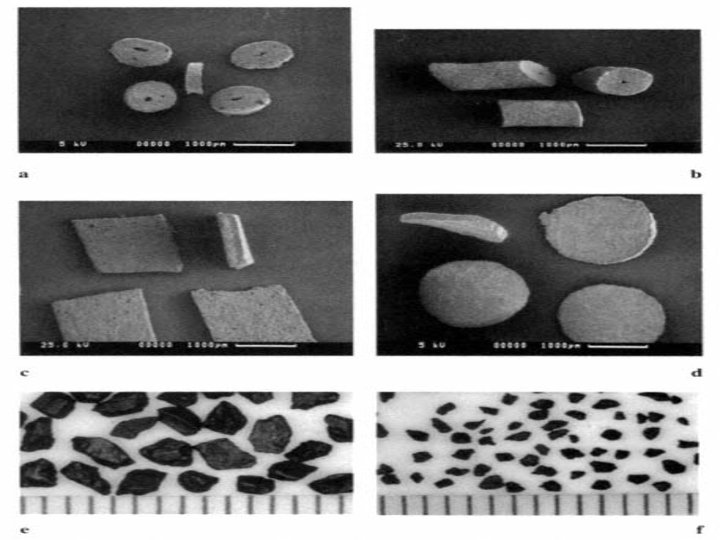
AMMUNITION n Powder Grains – Disk – Flake – Cylinder – Uncoated (Greenish color) – Coated w/Graphite (shiny black)
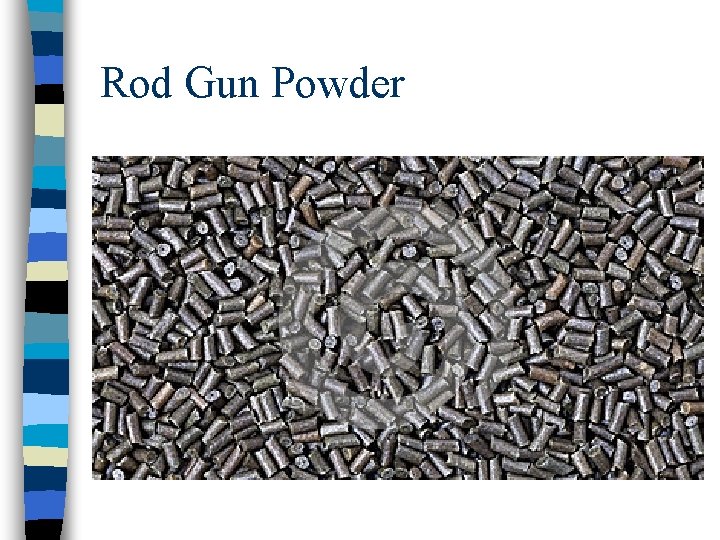
Rod Gun Powder
Ammunition n Powder (continued) – Powders burn at different rates – Gases and unburned grains are discharged upon firing – Grains can be found in clothing and skin
Ammunition Bullet – Originally lead spheres – Musket vs. . Rifle – Minnie ball (Capt. . Minnie, French Army) – Modern bullets • Lead • Metal-jacketed
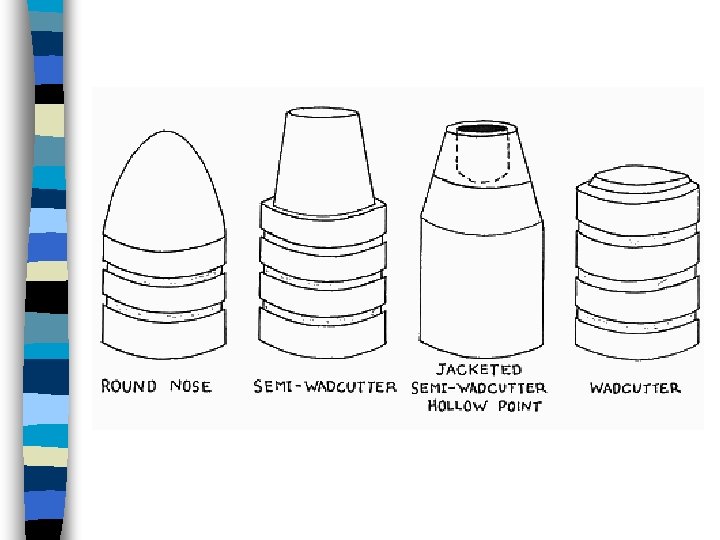
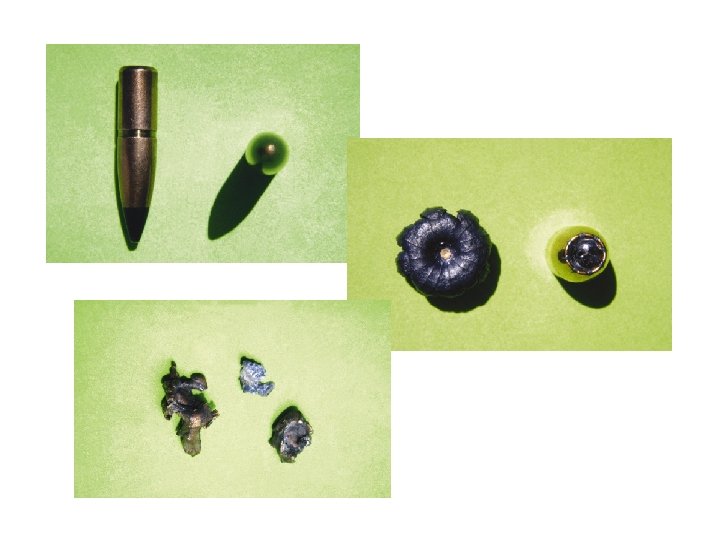
Ammunition n Bullets – Various shapes • • Round Hollow point Semi-wadcutter Wadcutter
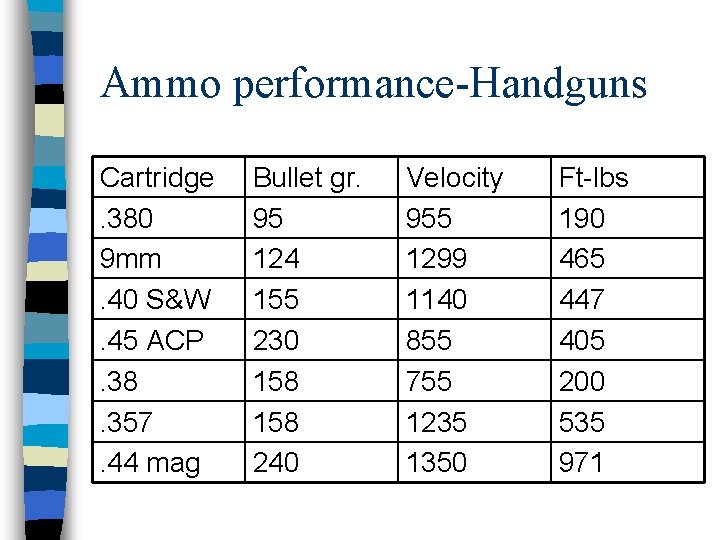
Ammo performance-Handguns Cartridge. 380 9 mm. 40 S&W. 45 ACP. 38. 357. 44 mag Bullet gr. 95 124 155 230 158 240 Velocity 955 1299 1140 855 755 1235 1350 Ft-lbs 190 465 447 405 200 535 971
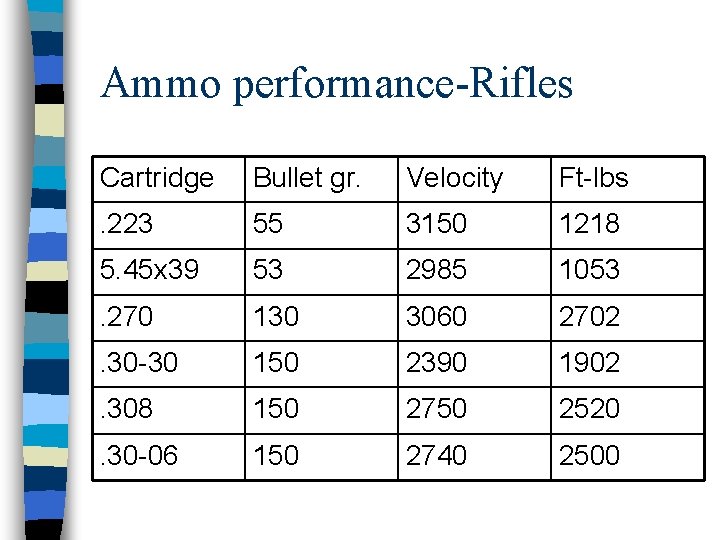
Ammo performance-Rifles Cartridge Bullet gr. Velocity Ft-lbs . 223 55 3150 1218 5. 45 x 39 53 2985 1053 . 270 130 3060 2702 . 30 -30 150 2390 1902 . 308 150 2750 2520 . 30 -06 150 2740 2500
Bullet Comparison n Class characteristics – Number of lands and grooves – Diameter of lands and grooves – Width of lands and grooves – Depth of lands and grooves – Direction of rifling twist – Degree of twist
Bullet Comparison n Individual Characteristics – Imperfections on lands/grooves – Score the bullets – Jacketed bullets, more pronounced – Are peculiar to each firearm
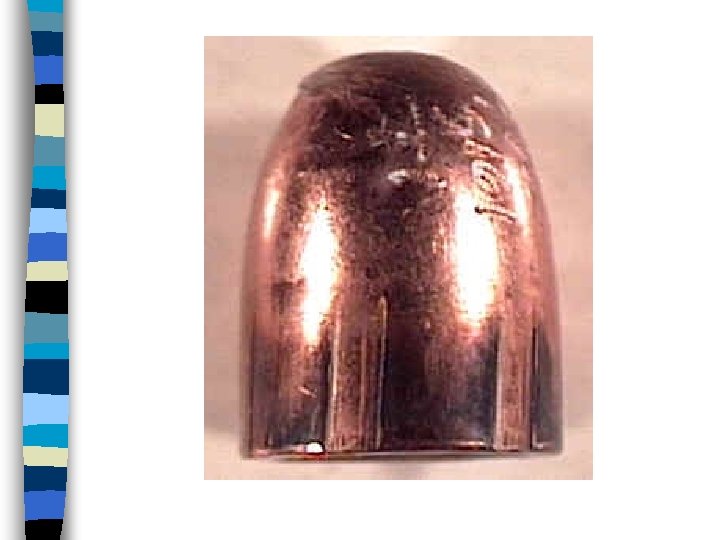
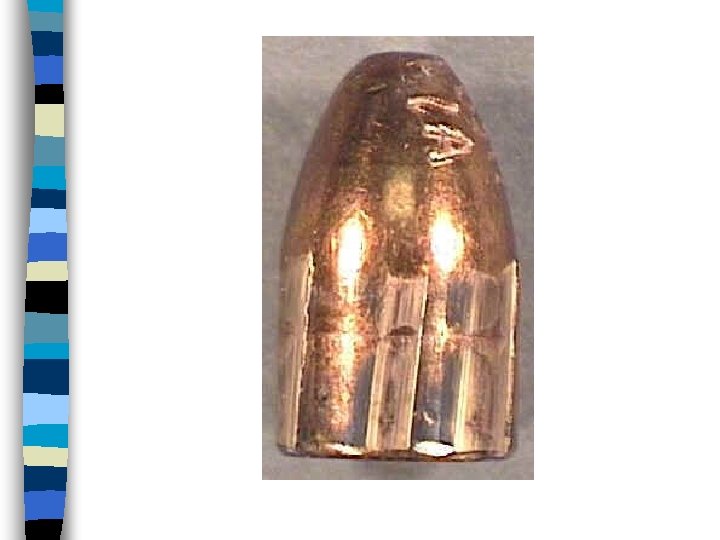
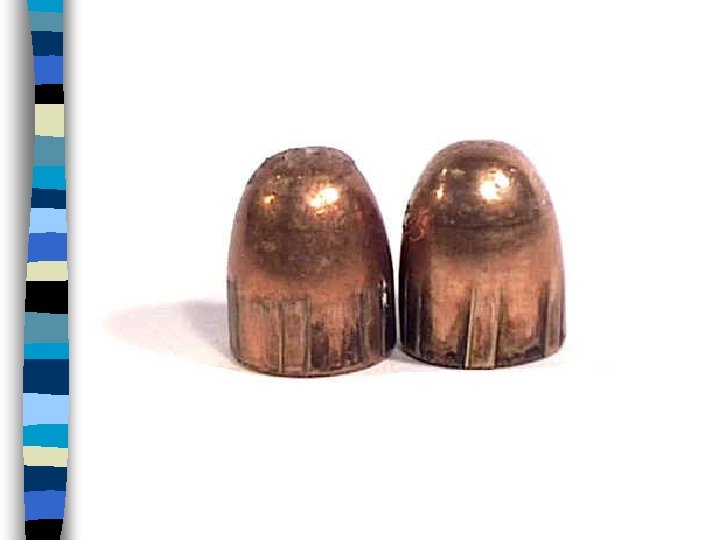
Bullet Comparison n Factors impacting Ind. Characteristics – Rusted barrel – Jacketed/unjacketed – Velocity/pressure – Bullets vary from lot to lot
Bullet Comparison n Additional markings – Skid marks – Shaving n Compositional Analysis – Fragments are recovered – SEM-EDX – Comparison between suspected guns bullets and recovered fragments
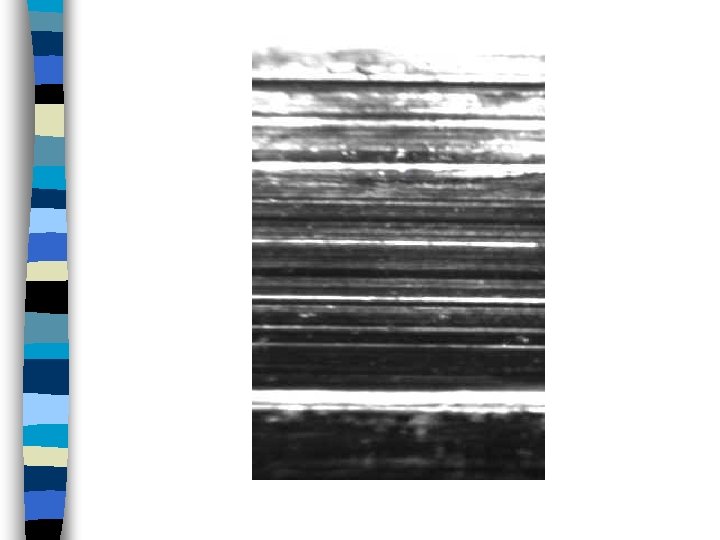
Bullet Comparison n Base markings – Imprinted from propelled powder grains – Most evident in bullets w/lead base – Shorter barrel, deeper marks – Different forms produce different marks • Spherical=circular pits • Disk=circular imprints • Black powder=peppered
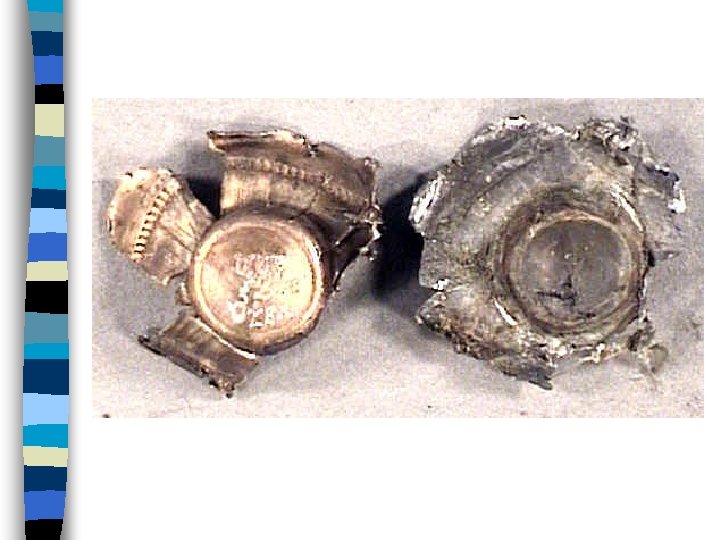
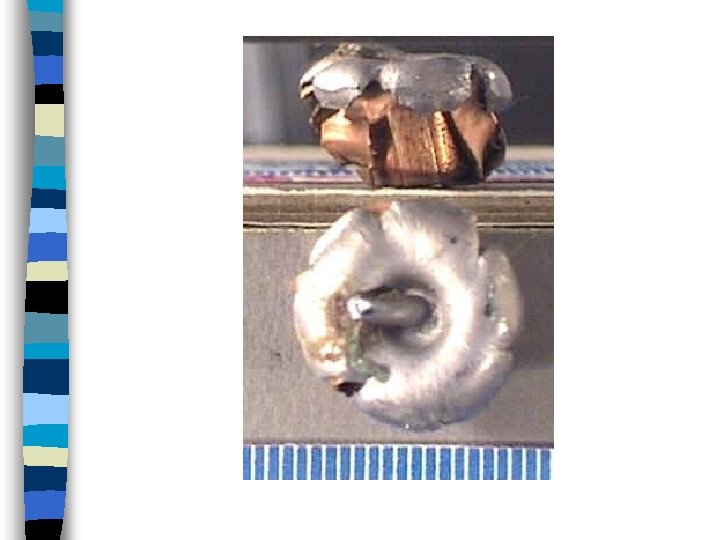
Bullet Comparison n Additional factors – Bullets fired in wrong caliber weapon – Decomposed bodies (Study after 66 days) • Nylon clad-unaffected • Aluminum-mildly affected • Lead bullets, recovered from – Brain, chest cavity, abdomen-mild tarnish – Fat, muscle-severe oxidation-impaired match • Copper alloy-severe degradation
Bullet Comparison n Surface analysis of bullet – Non-organic material – Tissue analysis n DNA typing
Cartridge Case Comparison n Comparison “MAY” make ID possible – Type – Make – Model n Test and evidence cartridges compared – Use same brand lot n Ammo consistency
Cartridge Case Comparison n Markings=imprints or scratches – Magazine marks – Breech block marks – Firing pin marks – Size, shape, and location of; • Extractor and ejector marks – Flute marks
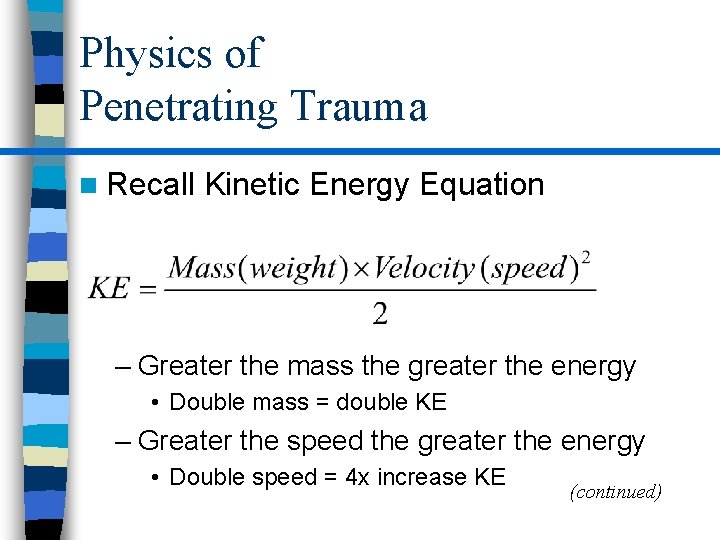
Physics of Penetrating Trauma n Recall Kinetic Energy Equation – Greater the mass the greater the energy • Double mass = double KE – Greater the speed the greater the energy • Double speed = 4 x increase KE (continued)
Physics of Penetrating Trauma n Small & Fast bullet can cause greater damage than large and slow. – Different bullets of different weights traveling at different speeds cause • Low Energy/Low Velocity – Knives and arrows • Medium Energy/Medium Velocity Weapons – Handguns, shotguns, low-powered rifles – 250 -400 mps • High Energy/High Velocity – Assault Rifles – 600 -1, 000 mps (continued)
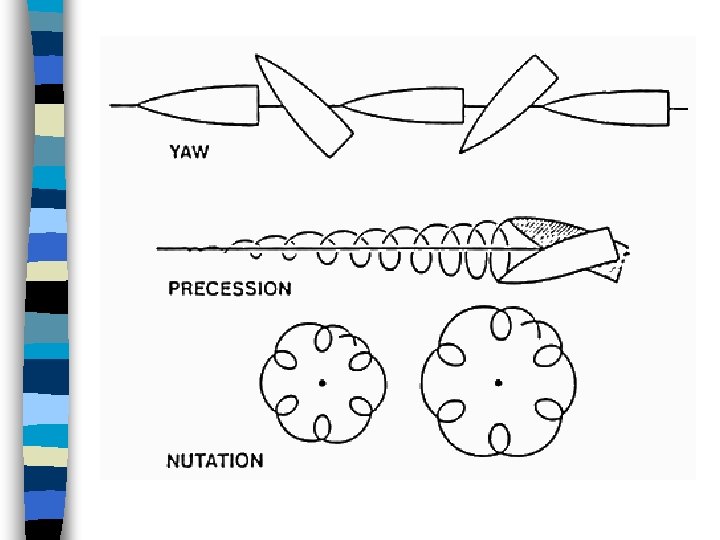
Physics of Penetrating Trauma n Bullet spins as it travels down barrel – Rifling in barrel – Allows bullet to travel straight with slight yaw n Bullet departs barrel, spinning with a slight wobble or yaw n Weapon forced backward and absorbs energy – Recoil (continued)
Physics of Penetrating Trauma n Remainder of energy propels bullet forward at a high rate of speed. n Trajectory is curved due to gravity n As bullet strikes object, it slows and energy is transferred to object. – Law of Conservation of Energy
Energy Dissipation n Drag: – wind resistance n Cavitation: – formation of a partial vacuum and cavity within a semi-fluid medium n Profile: – Size and shape of a projectile as it contacts a target – Larger the profile=greater energy exchange – Expansion and fragmentation results in damage n Stability – Allows for straighter trajectory – Decreases after striking object results in tumbling
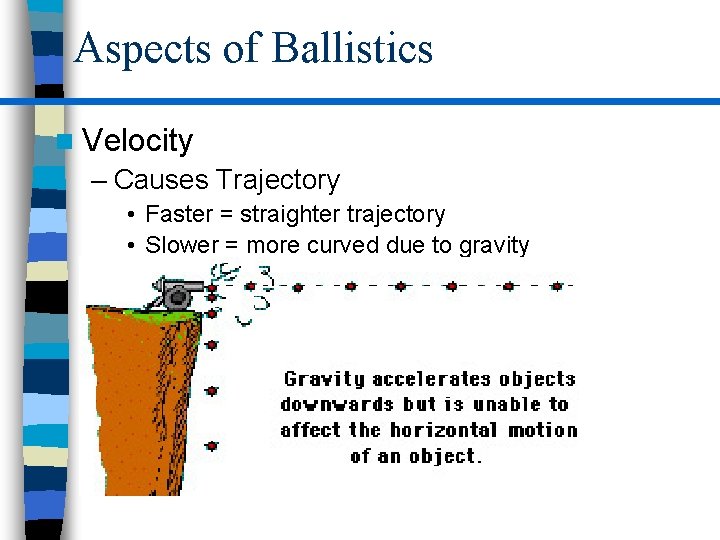
Aspects of Ballistics n Velocity – Causes Trajectory • Faster = straighter trajectory • Slower = more curved due to gravity
Aspects of Ballistics n Profile – Portion of bullet you see as it travels towards you • Larger profile = greater energy exchange – Caliber • Diameter of a bullet (ID of gun) – 0. 22 caliber = 0. 22 inches – Bullets become unstable as they pass from one medium to another.
Aspects of Ballistics n Expansion & Fragmentation – Results in increased profile – Mushrooming – Initial impact forces may result in fragmenting – Greater tissue damage
Aspects of Ballistics n Secondary Impacts – Bullet striking other objects can cause yaw and tumble – Body Armor (Kevlar) • Transmits energy throughout entire vest resulting in blunt trauma – Myocardial Contusion – Pulmonary Contusion – Rib Fractures n Shape – Handgun Ammunition = Blunt = Tumble – Rifle Ammunition = Pointed = Piercing
Specific Weapon Characteristics n Handguns – Small caliber, short barrel, medium-velocity – Effective at close range – Severity of injury based upon organs damaged n Rifle – High-velocity, longer barrel, large caliber – Increased accuracy at far distances n Assault Rifles – Large magazine, semi- or full-automatic – Similar injury to hunting rifles – Multiple wounds
Ballistics n Ballistics=Study of motion of projectiles – Internal – External – Terminal • Wound ballistics
Specific Weapon Characteristics n Shotgun – Slug or pellets at medium velocity • 00 (1/3”) to #9 (pin head sized) • Larger the load, the smaller the number of projectiles • Deadly at close range
Damage Pathway n Projectile Injury Process – Tip impacts tissue – Tissue pushed forward and to the side – Tissue collides with adjacent tissue • Shock wave of pressure forward and lateral – Moves perpendicular to bullet path – Rapid compression, crushes and tears tissue – Cavity forms behind bullet pulling in debris with suction.
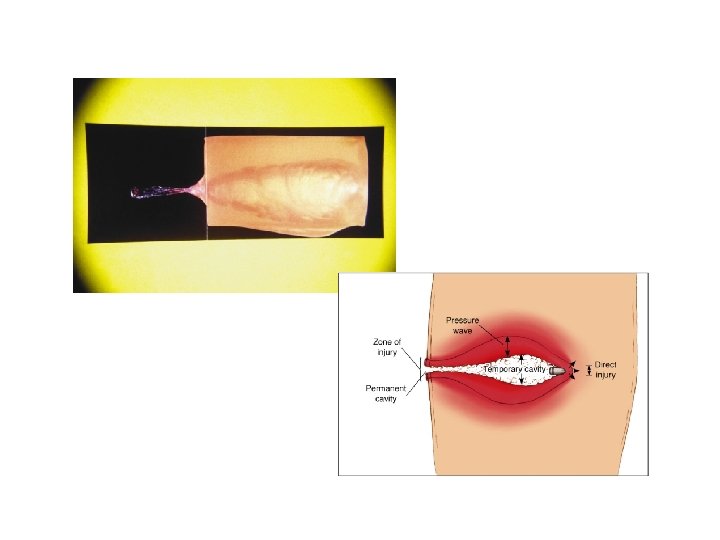
Damage Pathway n Direct Injury – Damage done as the projectile strikes tissue n Pressure Shock Wave – Human tissue is semi-fluid – Solid and dense organs are damaged greatly n Temporary Cavity – Due to cavitation n Permanent Cavity – Due to seriously damaged tissue n Zone of Injury – Area that extends beyond the area of permanent injury
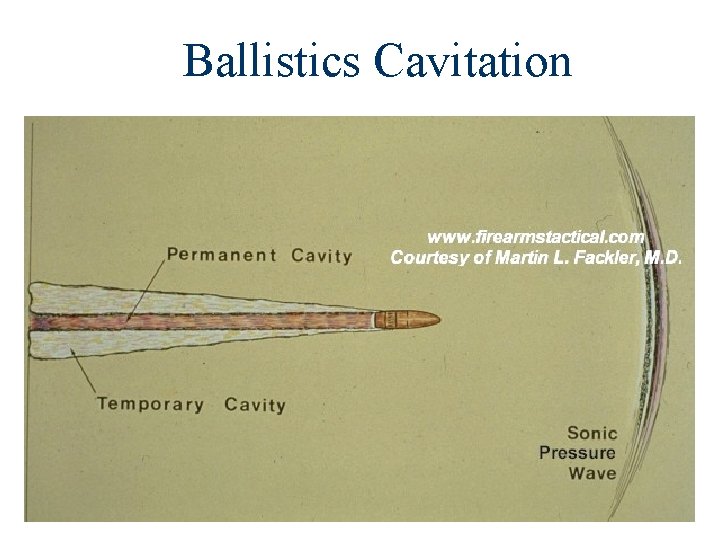
Ballistics Cavitation
Specific Tissue & Organ Injuries n Density of tissue affects the efficiency of energy transmission – Resiliency • Strength and elasticity of an object n Connective Tissue – Absorbs energy and limits tissue damage n Organs – Solid Organs • Dense and low resilience – Hollow Organs • Fluid filled: transmit energy = increased damage • Air filled: absorbs energy = less damage
Specific Tissue & Organ Injuries n Lungs – Air in lung absorbs energy – Parenchyma is compressed and rebounds – Pneumothorax or hemothorax can result n Bone – Resists displacement until it shatters – Alters projectile path
General Body Regions n Extremities – Injury limited to resiliency of tissue – 60 -80% of injuries with <10% mortality n Abdomen (Includes Pelvis) – Highly susceptible to injury and hemorrhage – Bowel perforation: 12 -24 hrs peritoneal irritation n Thorax – Rib impact results in explosive energy – Heart & great vessels have extensive damage due to lack of fluid compression – Any large chest wound compromises breathing
Ballistics
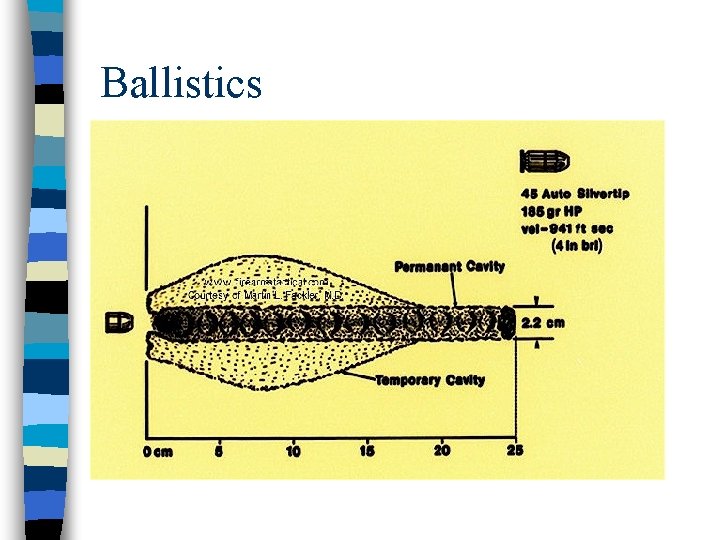
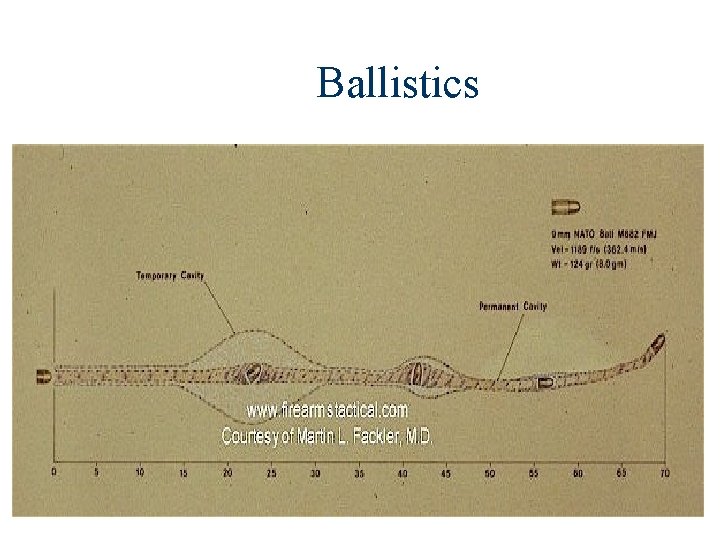
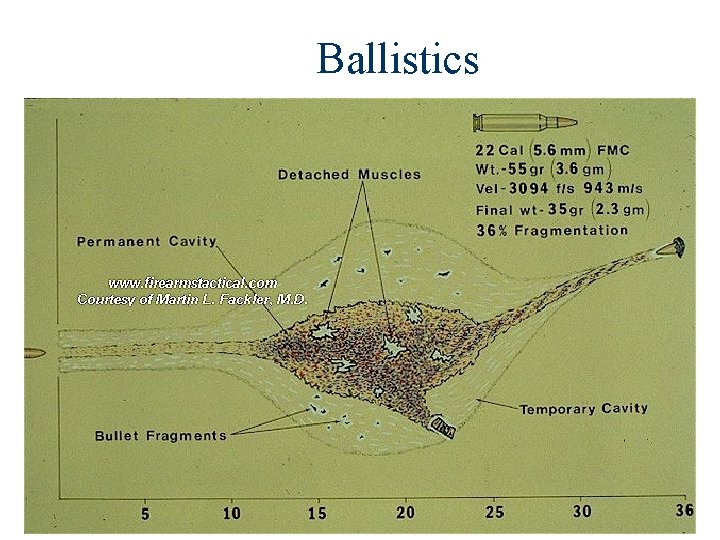
Ballistics n Temporary/Permanent Cavity – Max diameter of temp cavity is proportional to amount of kinetic energy lost – Occurs at maximum yaw or fragments – Yaw continues until Cg is forward or approx 180 degrees rotation – Size of cavity is determined by amount of K. E. lost by bullet – Size of cavity is determined to a degree by cross section of round
Ballistics n Temporary/Permanent Cavity (cont. ) – Compression, stretching, tearing of tissue – Handguns-Damage to area hit by bullet, very little collateral damage – Rifles-Radial damage to nerves, tissue, vessels, organs not struck by bullet – Damage related to density, elasticity and cohesiveness of tissue – Muscle vs. Liver vs. Lung
General Body Regions n Neck – Damages Trachea and Blood Vessels – Neurological problems – Sucking neck wound n Head – Cavitational energy trapped inside skull – Serious bleeding and lethal
Ballistics
Ballistics n Energy loss along wound track – Not uniform – Changes and variations occur due to; • Angle of yaw • Change in density of tissue • Change in structural dimension of bullet (mushrooms) – Fragmentation amplifies effect • . 223 marked yaw at 12 cm • Major frag/tissue disruption at 15 -25 cm
Ballistics
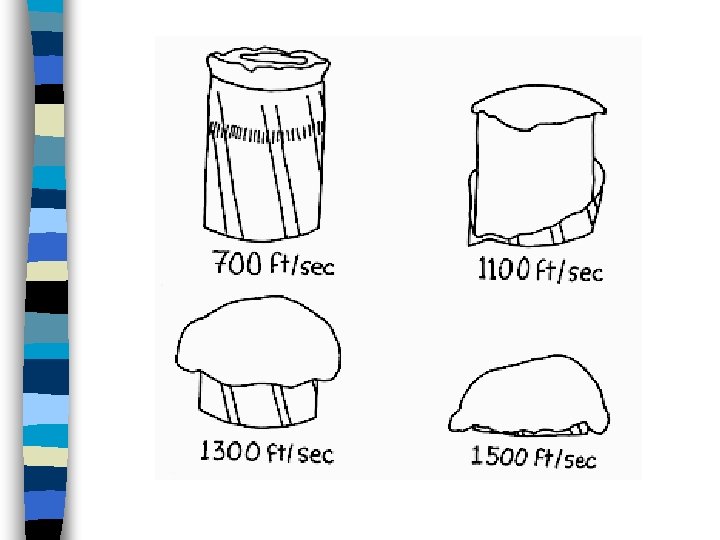
Ballistics n Critical velocity – – – – At or above 2625 -2953 ft/sec (FMJ) At or above 1500 -2000 ft/sec (expanding ammo) Tissue damage more severe Supersonic flow = strong shockwaves Shockwaves travel through body Damage is 20 -30 times larger Due to higher amount of K. E. loss
Ballistics n Critical amount of K. E. loss – Wounds are more severe – Exceeds elastic limits – Organ bursts – Projectile does not have to be near organ
Ballistics n Critical amount of K. E. loss-Head – Special case – Cranial cavity is a closed, rigid structure – 1% elasticity – No place for energy to disperse – Results in bursting injuries (high velocity)
Ballistics n Temporary cavity structure – FMJ – Hunting rifle round – Shotgun pellet
Ballistics n Temporary cavity size – 10 -12 times diameter of bullet – High K. E. loss-20 -30 times bullet n Permanent Cavity size • Handgun=smaller than round diameter • High velocity=size of bullet • Unless Elastic limit of tissue is reached=large irregular tearing wound track.
Case Study n This case involved a barroom shooting. The incident went something like this:
Case Study n Guy No. 1 - "Hey man, my quarters were up next!! I've got the next game on that pool table!!"
Case Study n Guy No. 2 - "Man you’re crazy! I've had my quarters up there for over an hour!"
Case Study n Guy No. 1 - "Oh yeah? Well not only are my quarters up next but your breath stinks too!!!"
Case Study n Guy No. 2 - "You son-of-a. XXXXX!!!!! I'm gunna kill you!!!"
Case Study n Me- "Now guys, calm down it's only a pool game; it's only a quarter. "
Case Study n Guy No. 1 pulls out the Llama 45 auto below and points it at Guy No. 2.
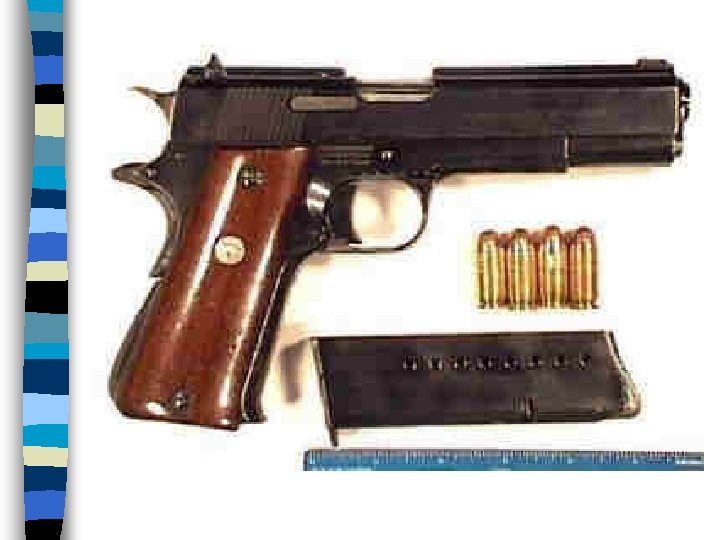
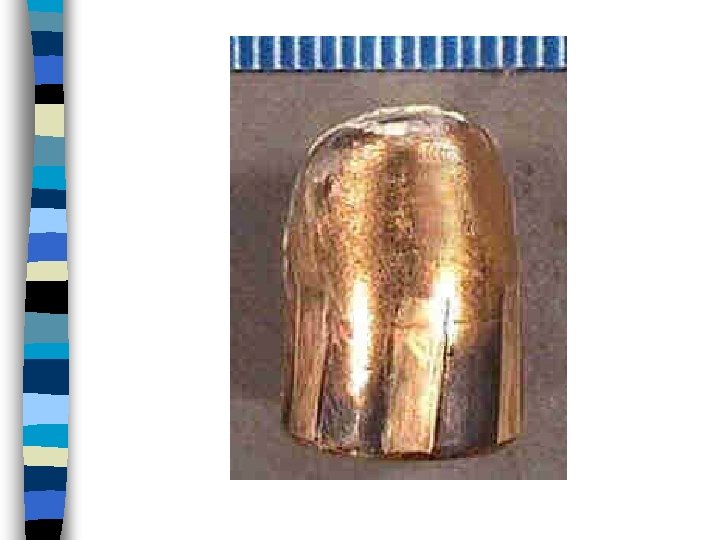
Case Study n In a drunken stupor he fires a single shot at Guy No. 2, missing him and hitting me right between the eye's with this 45 AUTO, 230 grain full-metal-jacketed bullet.
Case Study n At the same time the pistol ejects the 45 AUTO cartridge case below into the corner pocket of the pool table.
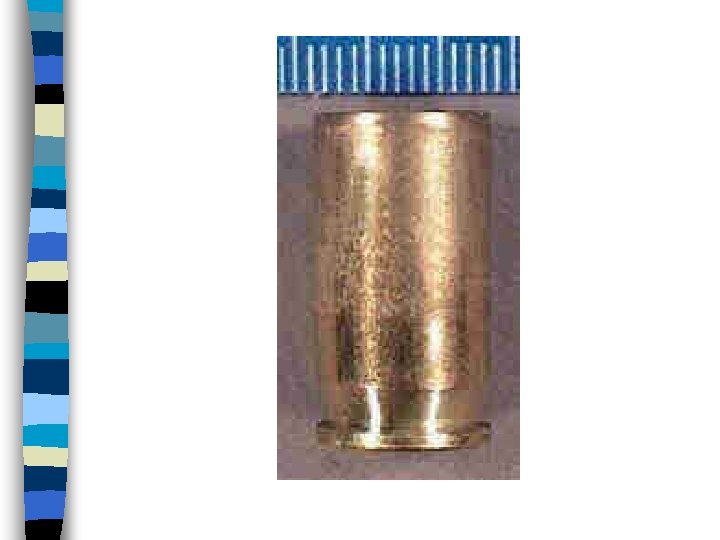
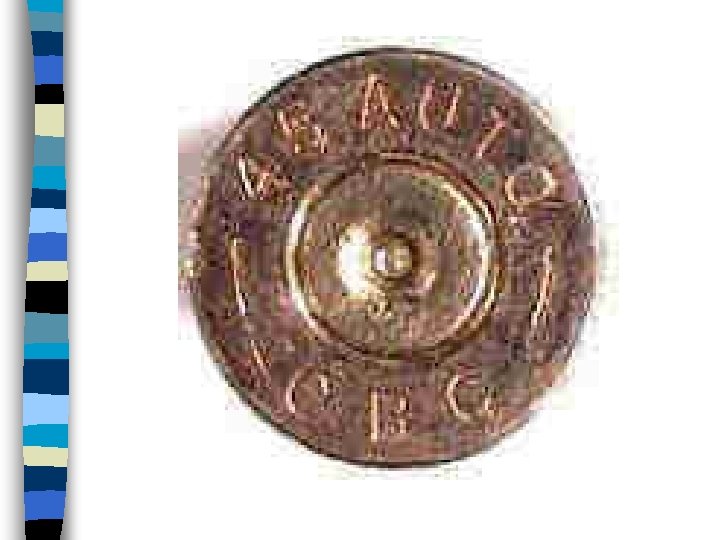
Case Study n Guy No. 1 and Guy No. 2 run out of the bar get in a car and go home. They tell mom they have been to the movies, hide the gun under their bunk bed and go to sleep.
Case Study n Meanwhile back at the bar, a riot has ensued because the other guys with quarters on the table are really p------ off because the spent case has jammed the pool table. Order is finally restored when county police detectives clear the table.
Case Study n My cold lifeless body is taken to the Medical Examiners Office for the 9 AM autopsy.
Case Study n Guy's No. 1 and 2 are later roused from bed by Detectives and the pistol, it's magazine, and four 45 AUTO cartridges are recovered from under the bed.
Case Study n The pistol, magazine, live ammunition, spent case, and bullet are later submitted to the lab for analysis.
Case Study n Although my ex-coworker is all but overcome with grief, he manages to set aside his personal ties to the case and conducts the required analysis in a totally professional and unbiased fashion.
Case Study n First course of business is to examine the pistol, which is found to be in perfect working condition. The pistol is test fired in the water tank and standards from the pistol are compared to the spent case from the pool table and bullet from my head.
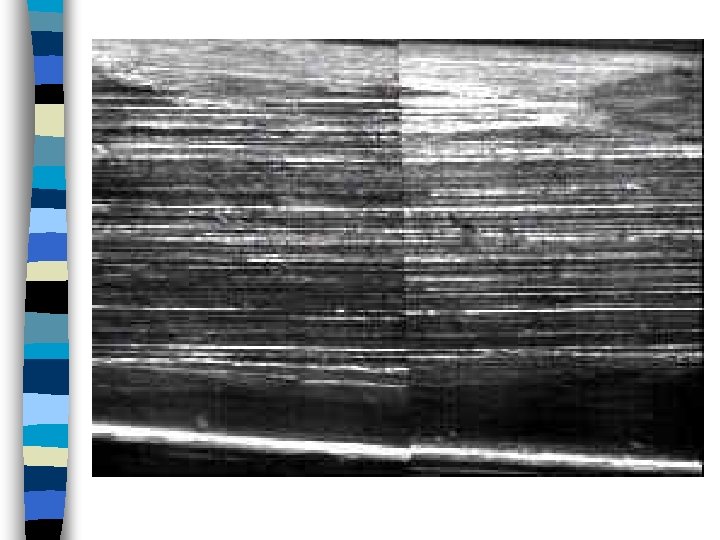
Case Study n The results of which are the match seen below.
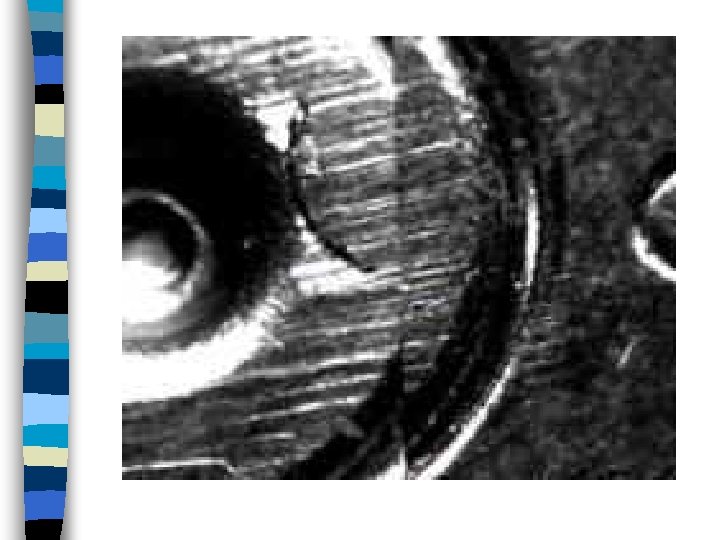
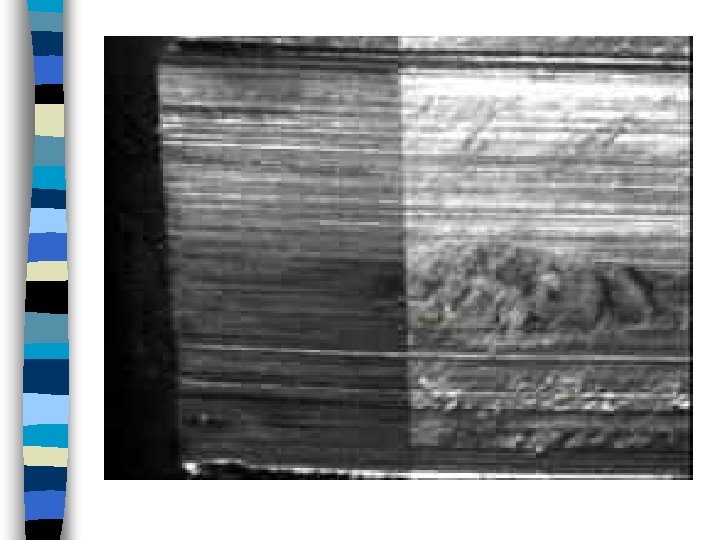
Case Study n Breech Marks: Standard from pistol (left) compared to the spent case from the bar (right).
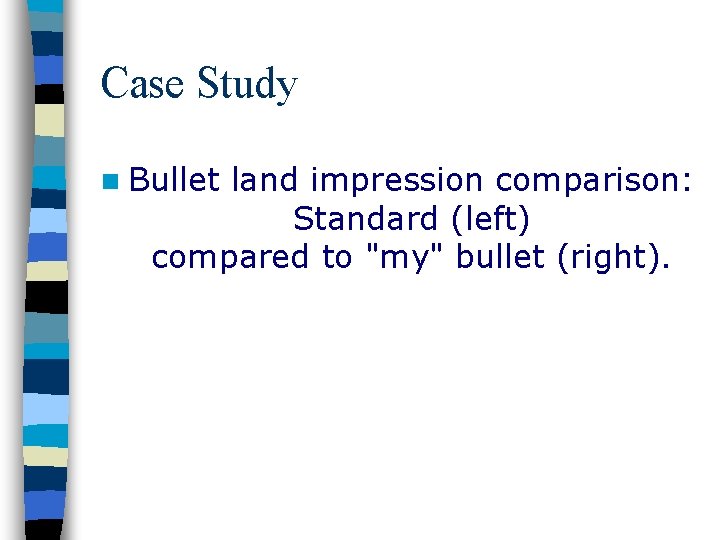
Case Study n Bullet land impression comparison: Standard (left) compared to "my" bullet (right).
Case Study n By the way, Guy 1 "walks" when his brother testifies that I started the fight by stealing his brother's hot wings.
Case Study n They really do have the best hot wings in town!!!
5. 56 Centerfire vs. Rimfire
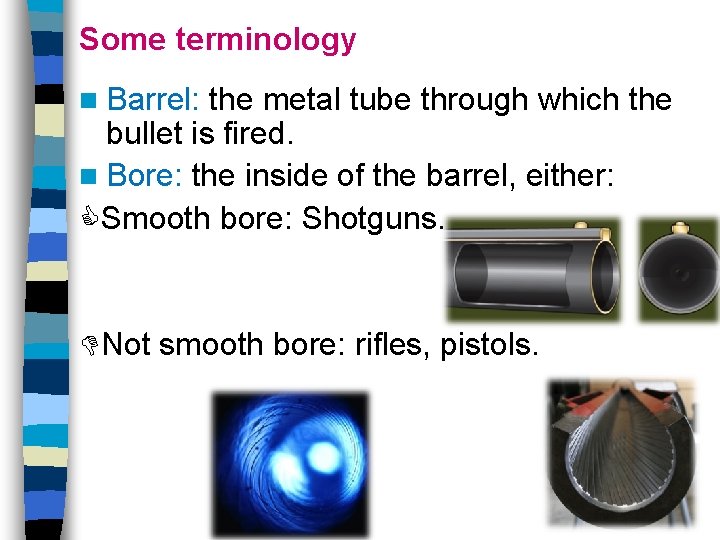
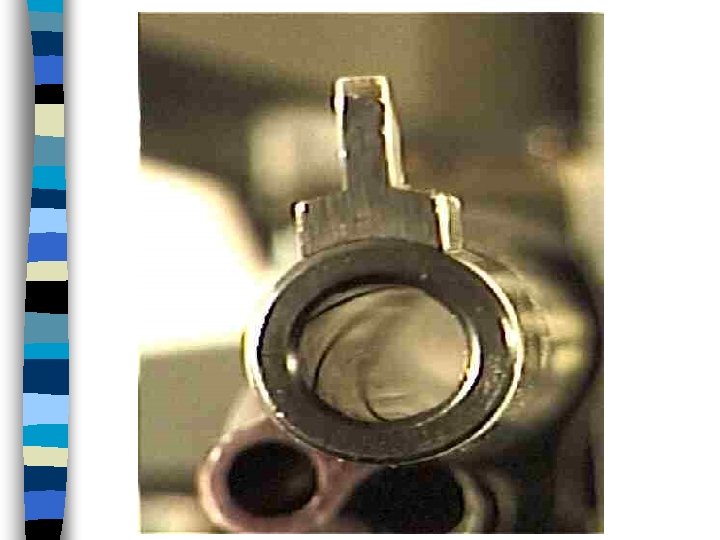
Some terminology n Barrel: the metal tube through which the bullet is fired. n Bore: the inside of the barrel, either: Smooth bore: Shotguns. Not smooth bore: rifles, pistols.
n Muzzle: the end of the barrel out of which the bullet comes out. n Primer: volatile substance that ignites when struck to detonate the powder in a cartridge.
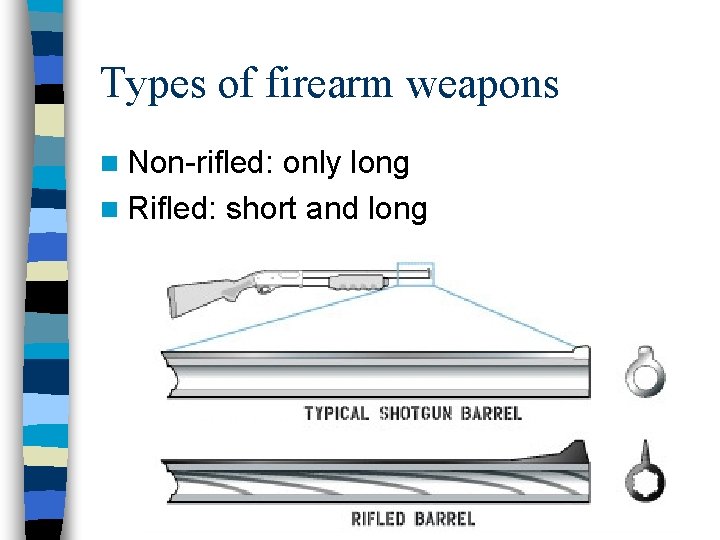
Types of firearm weapons n Non-rifled: only long n Rifled: short and long
What happens? The holder presses the firing pin which in turn strikes the primer which ignites the powder and produces large amount of hot gas. Produces very high pressure that fires the bullet forcefully through the barrel leaving the muzzle, and onto the target.
Mechanism of injury: As the missile traverses the body it causes injury by: 1. Basic contact of bullet and it’s fragments with the tissue, so larger bullets create bigger damage at the same velocity. 2. Transferring some of its available kinetic energy to the tissue around it, so increasing velocity greatly increases damage. 3. It also causes cavitations in the tissue it passes as it accelerates molecules → makes them move centrifugally away from the axis of the bullet. Bullets do not typically follow a straight line to the target. Rotational forces are in effect that keep the bullet off a straight axis of flight. n
SO… Mode of injury depends on the velocity of the missile -Slow velocity (<340 m/s) speed of sound in air or less -High velocity (1500 m/s) faster! High velocity missile causes a shockwave around it’s track → severe disruption → ↑tissue pressure and more damage. So a 10 mm wide bullet may cause a 15 mm wide track of damage…
Smooth bore weapon (Shotgun): n. A gun with a smoothbore that shoots cartridges that contain "shot" or small metal pellets (of lead or steel) as the projectiles. n Ammunition: A shotgun shell(cartridge) may contain one large projectile (called a slug), a few pellets of large shot, or many tiny pellets. Cartridge made of a cylinder fitted into a metal base contains charge of propellant, wads, and shots. n Range is the most important factor, and can be estimated in over half of cases… Close range wounds are severe, but at even relatively short distances, wounding may be minimal.
The rifle weapon: Rifles differ from shotguns in the length of the barrel and the presence of a butt stock. n They fire one projectile at a time through a thicker barrel that has spiral grooves on its inner surface → rotational movement. n They are much more accurate and shoot more powerful cartridges than handguns. n Ammunition: metal cylinder loaded with explosive propellant and bullet. n
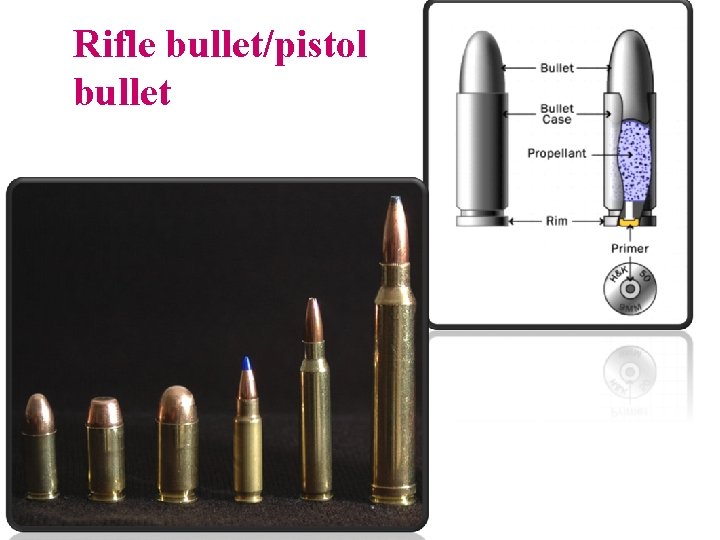
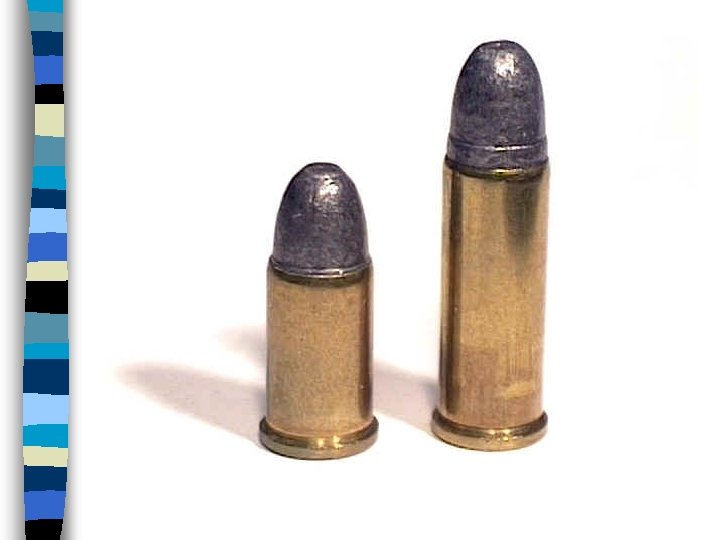
Rifle bullet/pistol bullet
Ballistics n Forces – K. E. =1/2 mv 2 – Velocity place larger role in force – Doubling mass, doubles force – Doubling velocity quadruples force – Energy transfer/loss
Ballistics n Energy Loss/transfer – Amount of K. E. upon impact – Angle of yaw upon impact – Caliber, construction, shape – Density, strength, elasticity of tissue
Ballistics-Structural Mechanics n Elasticity (Stretching) n Shearing n Compression n Cohesiveness n Tensile n Density strength
Ballistics Movement through body – – – Crushes/shred tissue in path Flinging, radially, surrounding tissue Temp. cavity several times (12) size of bullet Lasts 5 -10 msec Pulsates, contractions and collapse +/- pressure sucks in bacteria/foreign materials
- Slides: 141