
CRIMINAL HISTORY IN ADMISSIONS DISCIPLINARY NOTATIONS ON TRANSCRIPTS
- Slides: 34
CRIMINAL HISTORY IN ADMISSIONS & DISCIPLINARY NOTATIONS ON TRANSCRIPTS Tammy Aagard, Associate VP for Enrollment Management, University of Florida Elizabeth Mc. Veigh, Director of Admissions Operations & System Integrations, CU Boulder Kristi Wold-Mc. Cormick, University Registrar, CU Boulder
SESSION OBJECTIVES • Review AACRAO guidance related to disciplinary notations on transcripts; • Provide an update on the AACRAO working group focused on Ban-the-Box, and criminal background questions on admissions applications; • Learn how one campus is responding to recently passed legislation (SB 19 -170, “Ensuring Access to Higher Education Act”) to ensure compliance, transparency and campus safety; • Open discussion and Q&A
DISCIPLINARY NOTATION ON TRANSCRIPTS • This issue emerged (again) after AACRAO changed its stance in the 2016 AACRAO Academic Record and Transcript Guide • AACRAO. org > Signature Initiatives > Criminal and Disciplinary History in College Admissions
AACRAO WORK GROUP CHARGE • Determine whethere is consensus regarding placing such notations on transcripts; • Identify pros/cons for institutions to consider when deciding about such placement; • Consider institutional policies and practices, regardless of the decision to post or not post such notations; • Identify the types of disciplinary infractions that might be noted and the wording of disciplinary notations; • Determine best practices for the retention and removal of transcript notations; • List alternatives for providing notifications of disciplinary misconduct or other safety concerns to transfer institutions without the use of transcript notations; • Ensure FERPA, legal considerations related to disclosures are included in
RECOMMENDATION #1 • Recognizing that the most egregious acts of misconduct may result in the involuntary separation of the student from an institution, and may indicate a pattern of behavior that might be repeated at a subsequent institution, some form of notice should be provided to a receiving institution when a student has committed serious behavioral misconduct (e. g. including, but not limited to, that defined by the Clery Act).
RECOMMENDATION #2 • The academic transcript is an appropriate means to support communication about serious student misconduct, but may not be the only means of notification. • A student’s standing that impacts his or her eligibility to continuously enroll at an institution affects academic progress and, for this reason, is deemed transcript-appropriate.
RECOMMENDATION #3 • If a college or university decides not to record disciplinary notations on official transcripts, the following alternatives might be considered by an institution: • Student Conduct Transcript • Dean’s Certification Letter • Transcript Insert
RECOMMENDATION #4 • As with academic probations and warnings, disciplinary probations and warnings for minor violations that do not result in a mandatory separation from an institution should not be noted on official transcripts or otherwise disclosed to another institution.
RECOMMENDATION #5 • Institutions should align as closely as possible in their use of standardized terms and definitions for various student sanctions or penalties for misconduct: • Expulsion or Dismissal – a permanent separation from the institution. • Suspension – a temporary separation, often for a specific period of time, from the institution with the option of a possible future return.
RECOMMENDATION #6 • In cases of suspension, dismissal and expulsion (or equivalent), transcript notations should include: • General type of infraction -- academic or behavioral (e. g. disciplinary) • Department responsible for issuing the student separation from the institution (e. g. Office of Student Conduct) • Effective dates or date/term ranges of student separation from institution, if applicable
RECOMMENDATION #7 • Institutions may record a “Pending Conduct” statement on transcripts while an investigation or hearing is planned or underway. • The use of a hold to block the release of an official transcript until the investigation concludes may be preferable, but may also impact service to students.
RECOMMENDATION #8 • A special notation may be placed on the transcript when a student is permitted to withdraw while an investigation is underway. • Standard suspension/expulsion notation should replace special notation if student is found in violation of the code and that special notation should be removed if the student is found to not be in violation. • The use of a hold to block the release of a transcript until the investigation concludes may be preferable, but may also impact service to students.
RECOMMENDATION #9 • Transcript notations should be placed at the end of the semester/term in which the sanction occurs. • Transcript legends (keys) should offer further explanation, as needed, and provide the reader with instructions on how/where to obtain additional information.
RECOMMENDATION #10 • All institutions should have comprehensive policies and business processes that clearly document expected codes of student conduct, infractions, institutional review panels, sanctions, due process (appeal hearings), recordation and disclosure practices, and specific verbiage related to the retention and removal of transcript notations.
RECOMMENDATION #11 • Educational institutions that receive transcripts with disciplinary notations should have comprehensive and consistent admissions procedures in place to handle applicants with active sanctions at other institutions. • No institution should apply negative consequences to a student whose record includes a disciplinary notation on his/her transcript without seeking or considering additional information.
CAMPUS ACTION • Registrars and admissions officers are key campus partners with student affairs/Title IX personnel to ensure comprehensive, consistent and transparent policies. • If campuses don’t demonstrate proactive accountability, lawsuits or legislation may dictate our business operations. • Standardized ‘best’ practices across campuses helps ensure consistency and fairness in the treatment of all students. • Institutions are responsible for the safety on their own campuses, but also bear a responsible for helping ensure
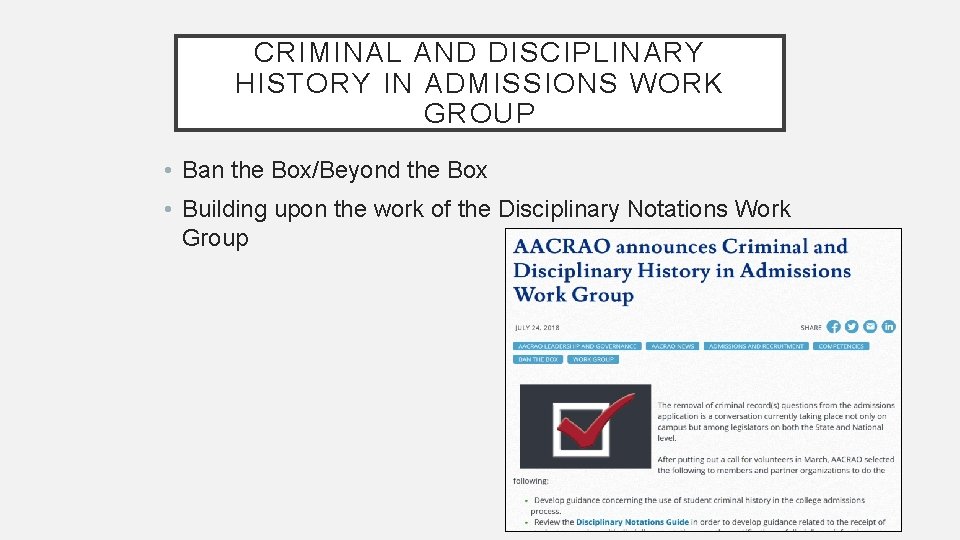
CRIMINAL AND DISCIPLINARY HISTORY IN ADMISSIONS WORK GROUP • Ban the Box/Beyond the Box • Building upon the work of the Disciplinary Notations Work Group
AACRAO WORK GROUP CHARGE • Develop guidance concerning use of student criminal history in the college admissions process; • Review AACRAO Disciplinary Notations report to develop guidance related to receipt of student transcripts with disciplinary or other notifications of disciplinary infractions at previous institutions; • Generate a set of recommendations for use of the disciplinary notations in the admissions process; • Generate recommendations regarding criminal history questions in admissions applications or other forms of screening criminal history, including placement of questions, timing of collection of relevant info (prior to admission or after); • Generate guiding principles for the development of institutional policy
RECOMMENDATION #1 • If your institution has a choice, consider not asking for disclosure of criminal history on the application for admission. • If you are required or chooses to ask about criminal history, consider CJI collection until after an admission decision is made to avoid the chilling effect on potential applicants.
RECOMMENDATION #2 • Have a clear and informed reason for asking or not asking criminal history questions at any phase of the admission process. If they do not already exist, create and implement written policies on review and use of criminal history in your admissions process. • Note: Criminal history related policies and processes should be transparent, readily accessible and explained.
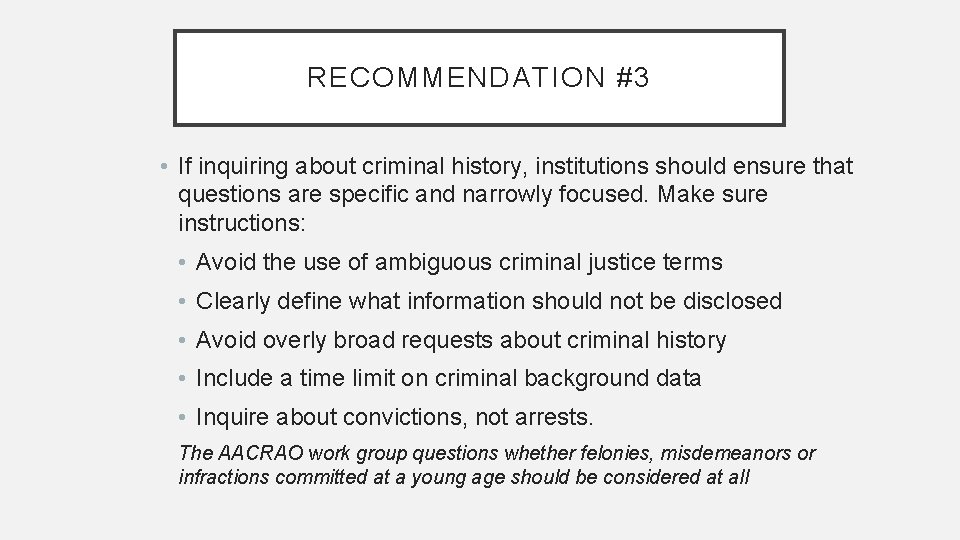
RECOMMENDATION #3 • If inquiring about criminal history, institutions should ensure that questions are specific and narrowly focused. Make sure instructions: • Avoid the use of ambiguous criminal justice terms • Clearly define what information should not be disclosed • Avoid overly broad requests about criminal history • Include a time limit on criminal background data • Inquire about convictions, not arrests. The AACRAO work group questions whether felonies, misdemeanors or infractions committed at a young age should be considered at all
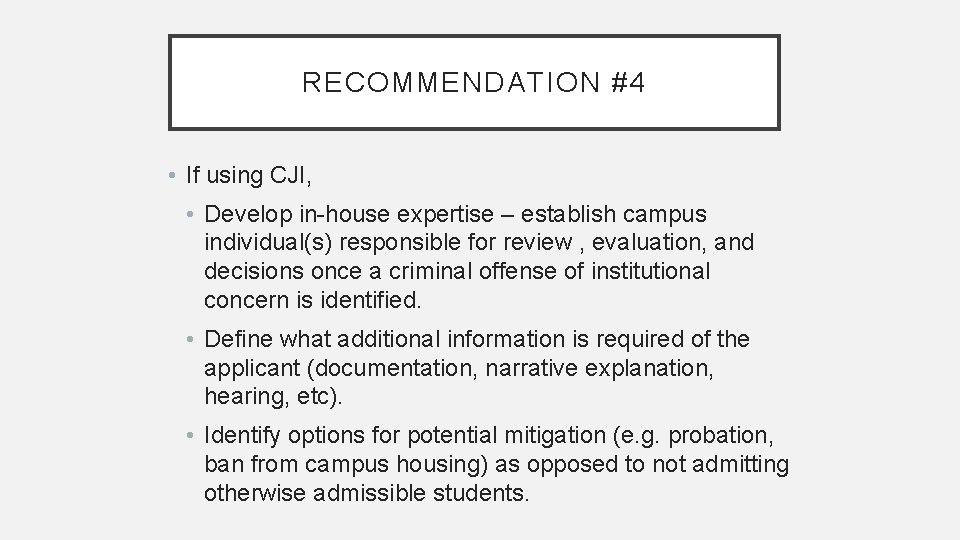
RECOMMENDATION #4 • If using CJI, • Develop in-house expertise – establish campus individual(s) responsible for review , evaluation, and decisions once a criminal offense of institutional concern is identified. • Define what additional information is required of the applicant (documentation, narrative explanation, hearing, etc). • Identify options for potential mitigation (e. g. probation, ban from campus housing) as opposed to not admitting otherwise admissible students.
RECOMMENDATION #5 • Institutions using criminal history as a reason for denial or withdrawal of an offer of admission should inform the applicant of the reason. They should also have an established appeal process that can be clearly communicated to such applicants.
RECOMMENDATION #6 • When a school receives a transcript for an applicant that includes a disciplinary notation, the school needs to have an established process for response.
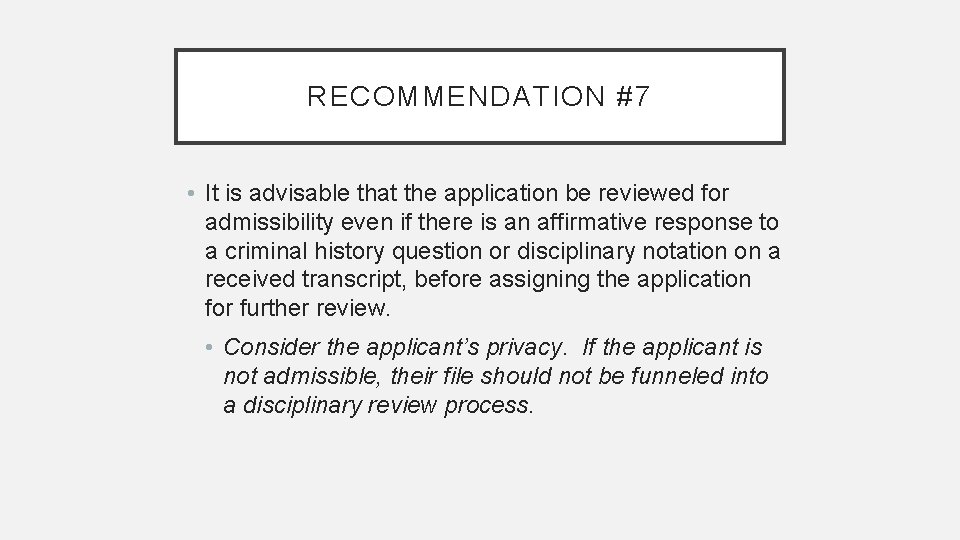
RECOMMENDATION #7 • It is advisable that the application be reviewed for admissibility even if there is an affirmative response to a criminal history question or disciplinary notation on a received transcript, before assigning the application for further review. • Consider the applicant’s privacy. If the applicant is not admissible, their file should not be funneled into a disciplinary review process.
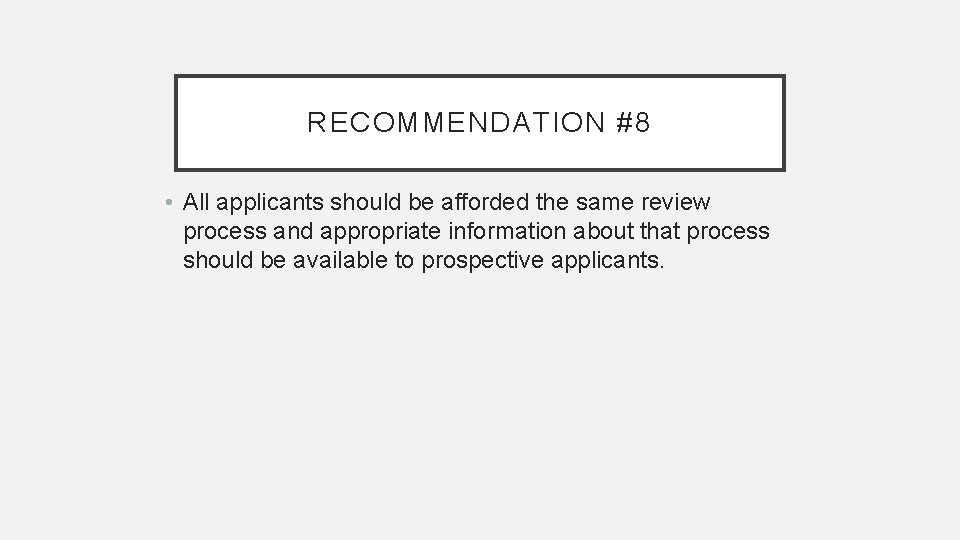
RECOMMENDATION #8 • All applicants should be afforded the same review process and appropriate information about that process should be available to prospective applicants.
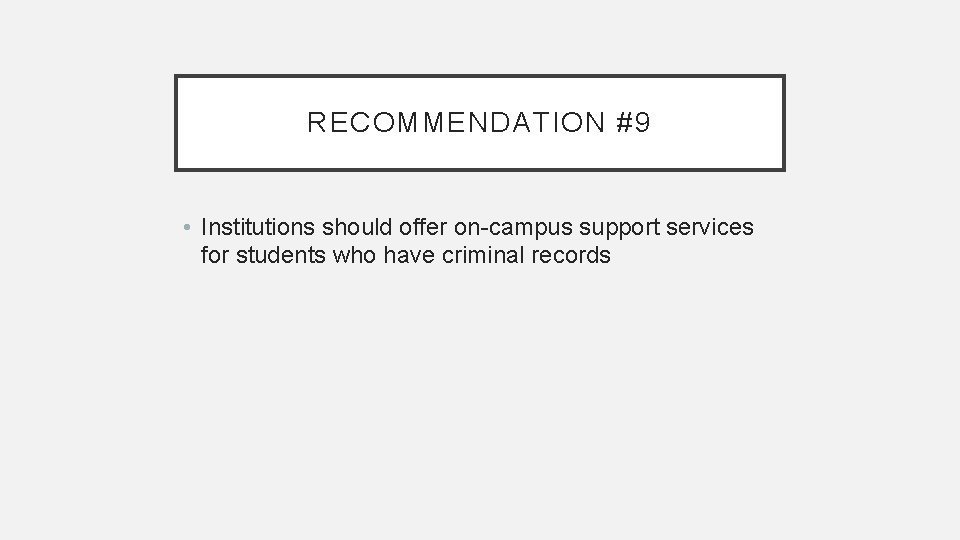
RECOMMENDATION #9 • Institutions should offer on-campus support services for students who have criminal records
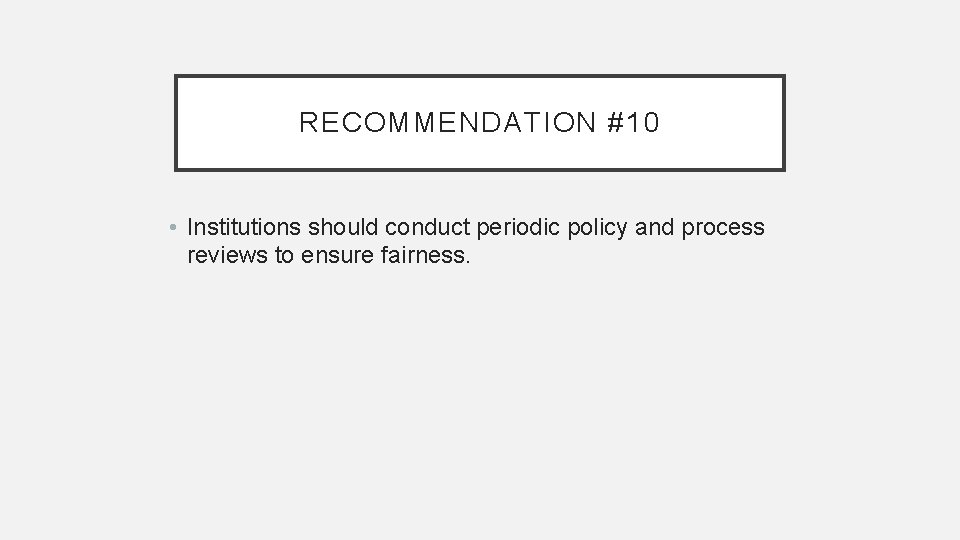
RECOMMENDATION #10 • Institutions should conduct periodic policy and process reviews to ensure fairness.
CAMPUS ACTION • Review your application for admission. • Engage campus leadership and partners in a discussion about CJI questions on applications at all levels (freshman, transfer, graduate, professional, non -degree, and certificate). • Know the laws in your state. Work with your Office of General Counsel. • Keep an eye on legislation working its way through Congress.
ENSURING ACCESS TO HIGHER EDUCATION ACT (COLORADO) • Effective May 1, 2020 • Restricts the kind of criminal history and disciplinary information that can be collected on the admission application • Allows for an additional review after admission as it pertains to participation in campus life or student housing • Must include an appeals process • Policy or procedures must be publicly available on the institution’s website and provided to CDHE
CU BOULDER’S RESPONSE • Created a campus-wide working group of stakeholders, including legal counsel • Tasked with interpreting the legislation and adapting our current criminal history and disciplinary review process • Met several times beginning in mid-May
UPDATED REVIEW PROCESS FOR 2020 • Adapting a pilot program for the 2020 admission cycle • Taking full advantage of the review process allowed in the legislation • Will ask for the allowable criminal history and disciplinary history information on the application for admission • Will also conduct a 2 nd review after admission • Includes an appeals process • Currently updating online procedures • Goes into effect when 2020 applications go-live this July and August
OPEN DISCUSSION Q&A • What is happening on your campuses regarding disciplinary notations? • What institutional challenges/concerns have you encountered? • What are current practices or considerations related to criminal background/disciplinary history on admissions applications?
THANK YOU!! • Tammy Aagard (University of Florida Enrollment Management) • taagard@ufl. edu • Elizabeth Mc. Veigh (University of Colorado Boulder Admissions) • elizabeth. mcveigh@colorado. edu • Kristi Wold-Mc. Cormick (University of Colorado Boulder Registrar) • kristi. woldmccormick@Colorado. edu