
Criminal Damage Overview Statutory offence Criminal Damage Act
![Actus Reus #1 Damage/destruction Damage [2] A v R (1978) – Spittle on a](https://slidetodoc.com/presentation_image_h2/72fd9f6160c68592bd38ebc087495ee9/image-7.jpg "Actus Reus #1 Damage/destruction Damage [2] A v R (1978) – Spittle on a")
- Slides: 23
Criminal Damage
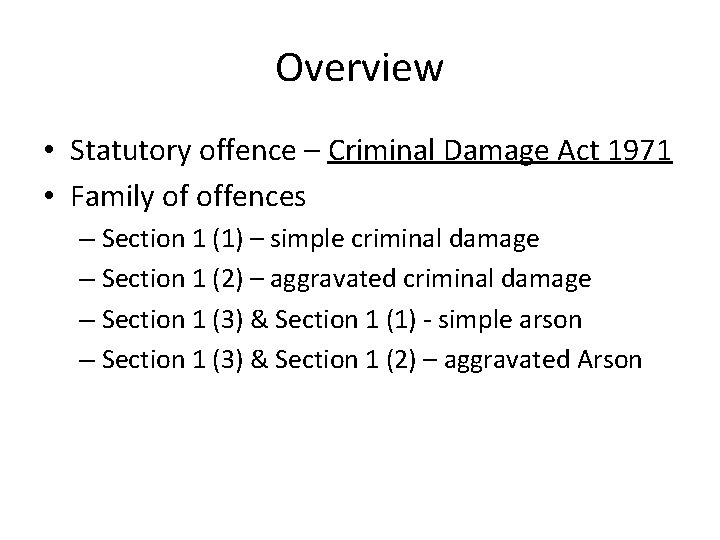
Overview • Statutory offence – Criminal Damage Act 1971 • Family of offences – Section 1 (1) – simple criminal damage – Section 1 (2) – aggravated criminal damage – Section 1 (3) & Section 1 (1) - simple arson – Section 1 (3) & Section 1 (2) – aggravated Arson
Simple criminal damage/ simple arson
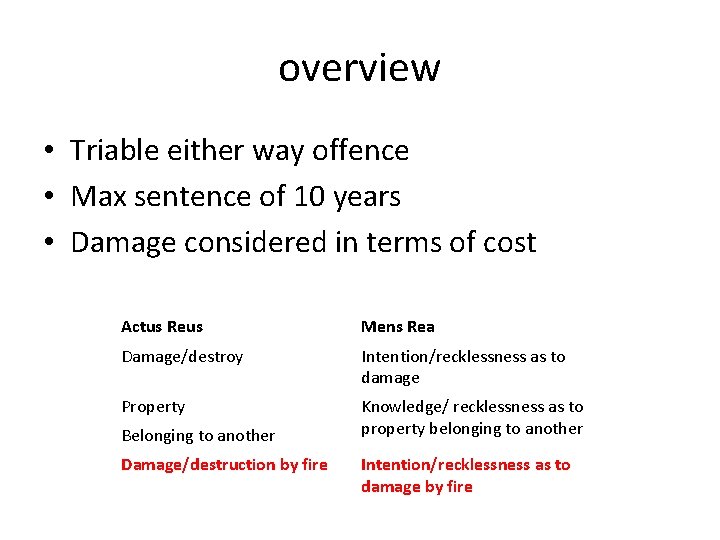
overview • Triable either way offence • Max sentence of 10 years • Damage considered in terms of cost Actus Reus Mens Rea Damage/destroy Intention/recklessness as to damage Property Knowledge/ recklessness as to property belonging to another Belonging to another Damage/destruction by fire Intention/recklessness as to damage by fire
Actus Reus #1 Damage/destruction • No statute definition • Damage = broad meaning – Gayford (1898) • Question of fact and degree Roe v Kingerlee (1986)
Actus Reus #1 Damage/destruction Damage – If rectification involves time, effort or money then it is damage – Effects can be temporary – Type should be taken into account Hardman v c. c of Avon (1986) • Chalk on pavement = damage as council paid for it to be jet washed even though it would have washed away Fiak (2005) • D damaged police cells by temporary impairing the usefulness of a cell by flooding them
Actus Reus #1 Damage/destruction Damage [2] A v R (1978) – Spittle on a uniform is not damage as effort required = minimal Morphitis v Salmon (1990) – Scratch on scaffolding could not amount to criminal damage because damage did not impair its usefulness or value
Actus Reus #1 Damage/destruction Destroy – Stronger than damage – Property made useless even if it is not 100% destroyed – E. g. • • Demolishing a building Breaking a machine Killing animals Mowing crops
Actus Reus #2 property • Defined S. 10 (1) of CDA 1971 • Similar to theft but cases are non applicable • 2 key differences 1. Land can be damaged but not stolen 2. Intangible rights can not be damaged but can be stolen
Actus Reus #3 belonging to another • Defined s. 10 (2) of CDA 1971 • Similar to S 5 TA 1968 Smith (1974) • D cant be guilty of simple criminal damage, if he damages his own property • Property must be solely owned if it is a joint enterprise then the offence is committed
Mens Rea #1 Intent reckless as to damage/destruction • Mere damage/destruction of property is insufficient for conviction • Prosecutor must show that D intended or was reckless to damage Pembilton (1874) – Not guilty of causing damage as he had no intention to damage the window even though he intended to throw the stone G and R (2003) – D has to realise the risk
Mens Rea #1 Intent reckless as to damage/destruction • G and R (Cont) – D acts Reckless within the act in respect to 1. A circumstance when he is aware of a risk that does or will exist 2. A result he is aware that a risk will occur and in the circumstances known to him it is unreasonable for him to take the risk
Mens Rea #2 Knowledge/ reckless as to property belonging to another • Smith – Honest belief that the property is D’s own negates this element of mens rea
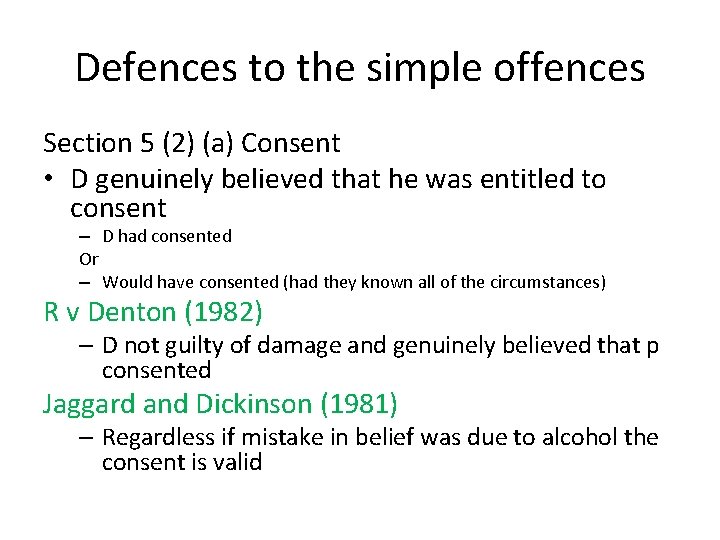
Defences to the simple offences Section 5 (2) (a) Consent • D genuinely believed that he was entitled to consent – D had consented Or – Would have consented (had they known all of the circumstances) R v Denton (1982) – D not guilty of damage and genuinely believed that p consented Jaggard and Dickinson (1981) – Regardless if mistake in belief was due to alcohol the consent is valid
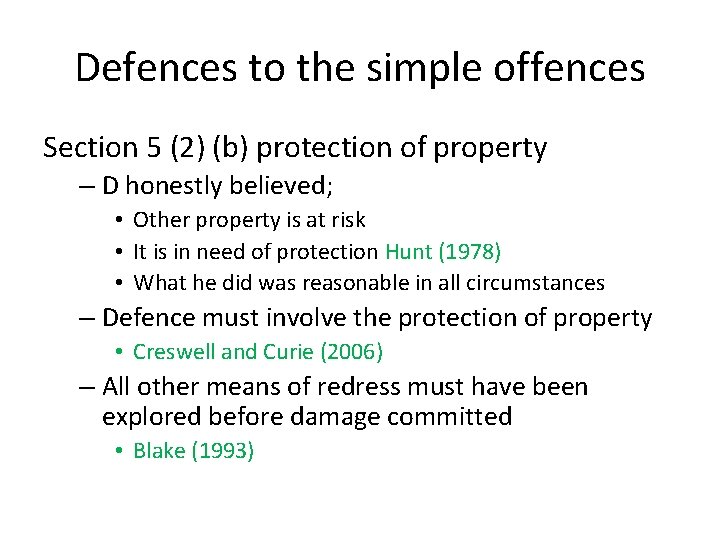
Defences to the simple offences Section 5 (2) (b) protection of property – D honestly believed; • Other property is at risk • It is in need of protection Hunt (1978) • What he did was reasonable in all circumstances – Defence must involve the protection of property • Creswell and Curie (2006) – All other means of redress must have been explored before damage committed • Blake (1993)
Aggravated criminal damage/ Arson
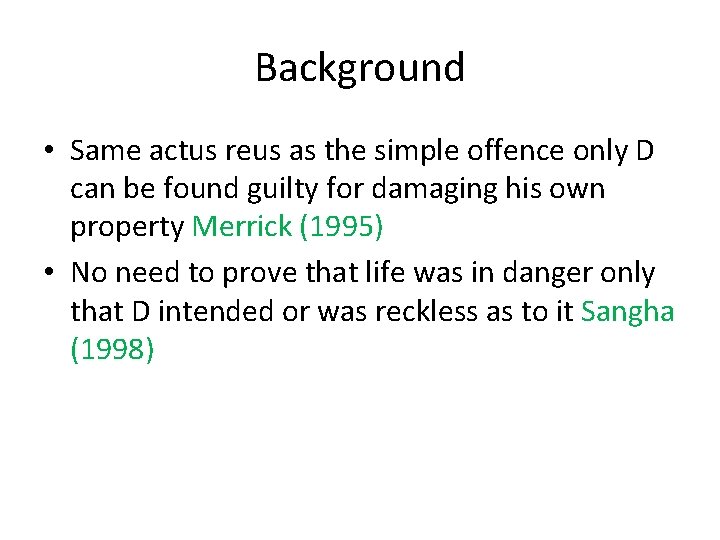
Background • Same actus reus as the simple offence only D can be found guilty for damaging his own property Merrick (1995) • No need to prove that life was in danger only that D intended or was reckless as to it Sangha (1998)
Mens Rea #1; Intent/reckless to damage/destroy • Same as basic • Mere damage/destroy of property is insufficient for conviction • Prosecutor must show that in doing so intended to or was reckless as to damage
Mens rea #2 Endangering life through damage/destroy Steer (1987) – Section 1 (2) requires life to be endangered through the damage and not the act that caused it Dudley (1989) – At the time of the act he either intended to or was reckless as to endangering life through the damage
Arson
Arson Actus Reus#1 Damage/destruction by fire • Same as Damage and destruction only it is caused by fire • Actus Reus for simple Arson continues the same as simple criminal damage • Same Defences available as criminal damage for the simple offence
Simple Arson Mens Rea #1 Intent reckless as to damage/destruction by fire • Same as mens rea #1 only it is intention or recklessness to cause damage or destroy by fire
Aggravated Arson Mens Rea #1 • Endangering life through damage or destruction through fire Miller (1983) – Arson can be committed by an omission where D accidently started a fire and failed