
Crime Victim Compensation Program and the SAFE Fund
- Slides: 52
Crime Victim Compensation Program and the SAFE Fund OCVS Training 2017
The Crime Victim Compensation Program The concept of crime victim compensation is a time – honored one: that of making up for wrong. However, the most compelling reason for crime victim compensation programs is that they are a simple humanitarian response to a pressing human need. An additional goal is that assistance for victims of crime will encourage greater public cooperation in the successful apprehension and prosecution of criminal offenders. Wis. Stat. Ch. 949
CVC Overview Programs in every state and many countries but all differ somewhat Approx. 2700 claims are received per year Average paid per claim: $2, 870 in FY 16 Estimated annual cost of all CVC claims: $4. 1 million Funding sources: State appropriations Federal grant Restitution
Why Should Victims of Compensable Crimes Apply? � Insurance/collateral sources may be lost or benefits may run out � Restitution may not be paid or received in a timely manner � Victim/applicant may not realize the extent of assistance needed
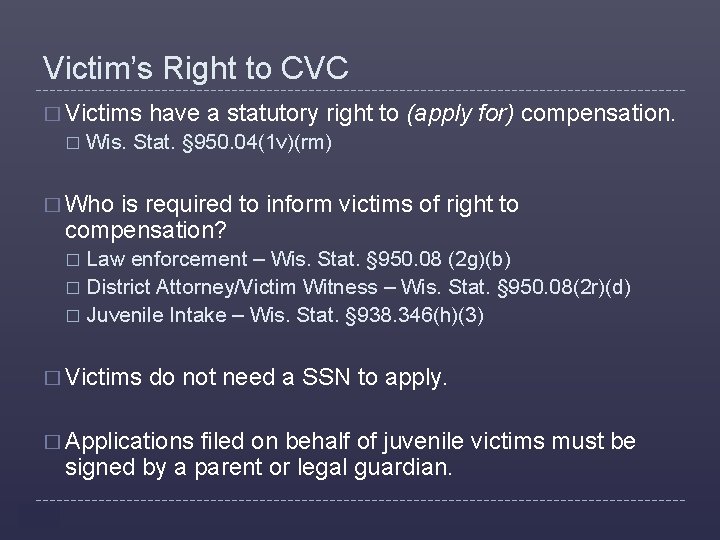
Victim’s Right to CVC � Victims � have a statutory right to (apply for) compensation. Wis. Stat. § 950. 04(1 v)(rm) � Who is required to inform victims of right to compensation? Law enforcement – Wis. Stat. § 950. 08 (2 g)(b) � District Attorney/Victim Witness – Wis. Stat. § 950. 08(2 r)(d) � Juvenile Intake – Wis. Stat. § 938. 346(h)(3) � � Victims do not need a SSN to apply. � Applications filed on behalf of juvenile victims must be signed by a parent or legal guardian.
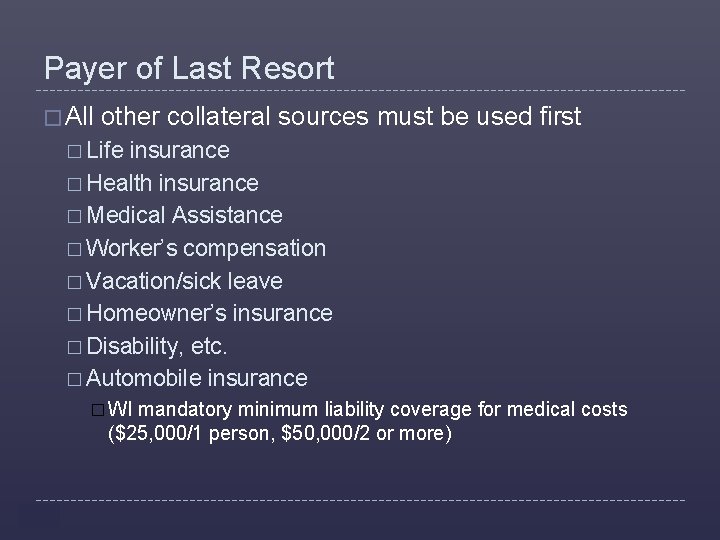
Payer of Last Resort � All other collateral sources must be used first � Life insurance � Health insurance � Medical Assistance � Worker’s compensation � Vacation/sick leave � Homeowner’s insurance � Disability, etc. � Automobile insurance � WI mandatory minimum liability coverage for medical costs ($25, 000/1 person, $50, 000/2 or more)
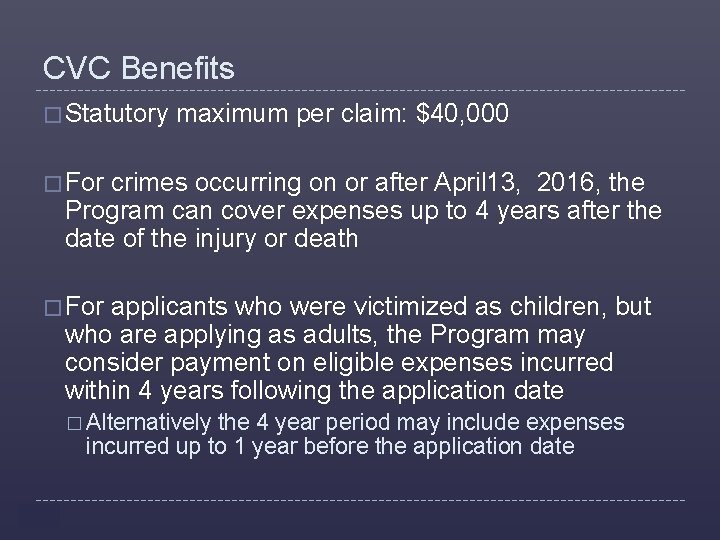
CVC Benefits � Statutory maximum per claim: $40, 000 � For crimes occurring on or after April 13, 2016, the Program can cover expenses up to 4 years after the date of the injury or death � For applicants who were victimized as children, but who are applying as adults, the Program may consider payment on eligible expenses incurred within 4 years following the application date � Alternatively the 4 year period may include expenses incurred up to 1 year before the application date
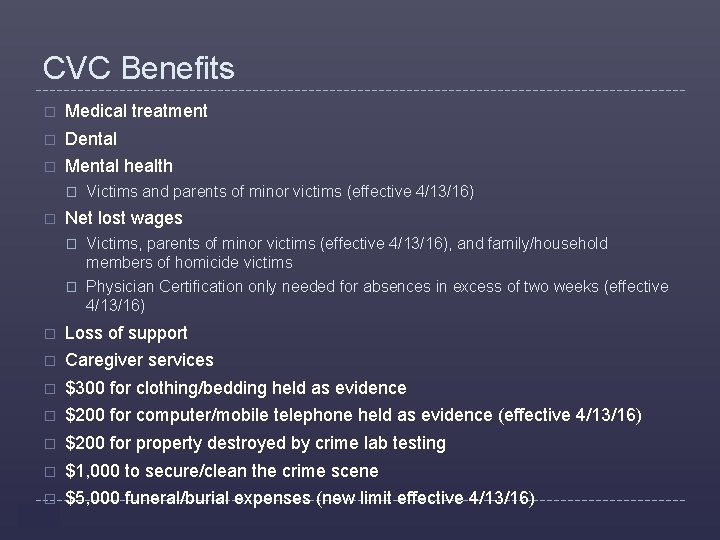
CVC Benefits � Medical treatment � Dental � Mental health � � Victims and parents of minor victims (effective 4/13/16) Net lost wages � Victims, parents of minor victims (effective 4/13/16), and family/household members of homicide victims � Physician Certification only needed for absences in excess of two weeks (effective 4/13/16) � Loss of support � Caregiver services � $300 for clothing/bedding held as evidence � $200 for computer/mobile telephone held as evidence (effective 4/13/16) � $200 for property destroyed by crime lab testing � $1, 000 to secure/clean the crime scene � $5, 000 funeral/burial expenses (new limit effective 4/13/16)
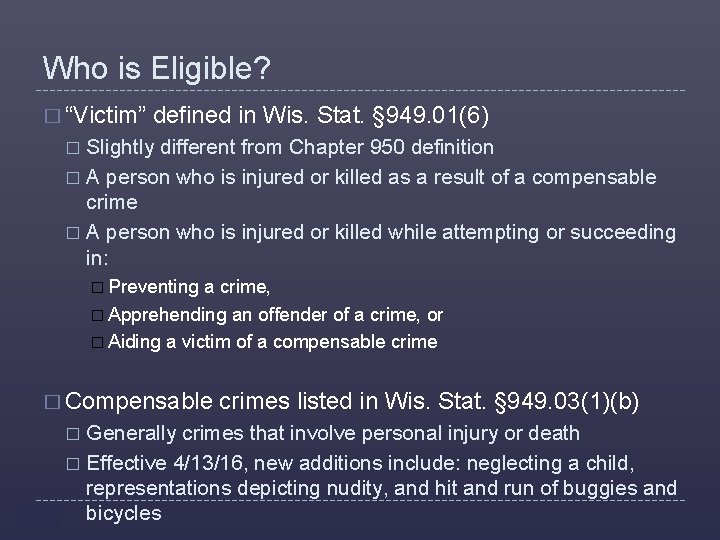
Who is Eligible? � “Victim” defined in Wis. Stat. § 949. 01(6) Slightly different from Chapter 950 definition � A person who is injured or killed as a result of a compensable crime � A person who is injured or killed while attempting or succeeding in: � � Preventing a crime, � Apprehending an offender of a crime, or � Aiding a victim of a compensable crime � Compensable crimes listed in Wis. Stat. § 949. 03(1)(b) Generally crimes that involve personal injury or death � Effective 4/13/16, new additions include: neglecting a child, representations depicting nudity, and hit and run of buggies and bicycles �
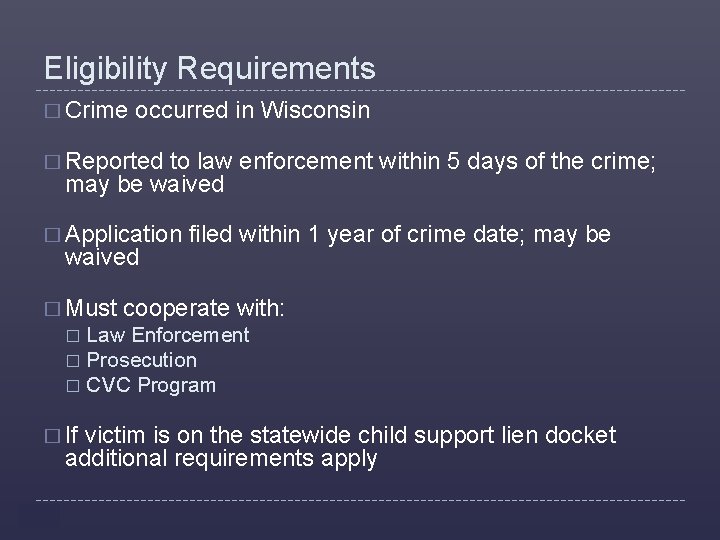
Eligibility Requirements � Crime occurred in Wisconsin � Reported to law enforcement within 5 days of the crime; may be waived � Application waived � Must filed within 1 year of crime date; may be cooperate with: Law Enforcement � Prosecution � CVC Program � � If victim is on the statewide child support lien docket additional requirements apply
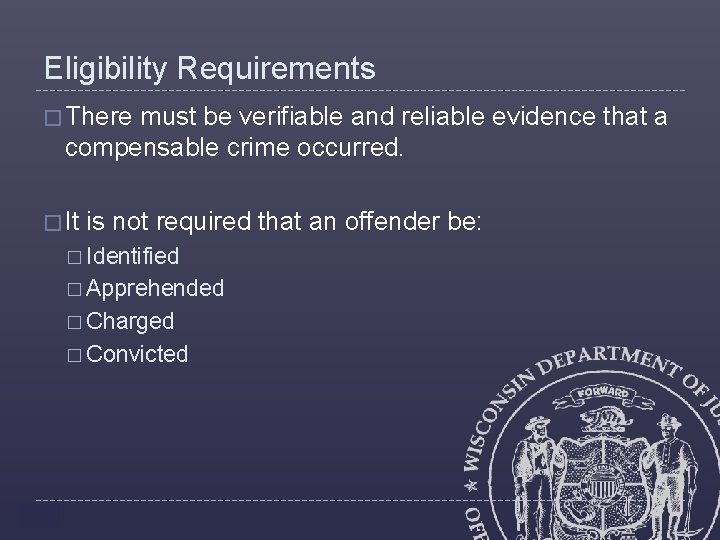
Eligibility Requirements � There must be verifiable and reliable evidence that a compensable crime occurred. � It is not required that an offender be: � Identified � Apprehended � Charged � Convicted
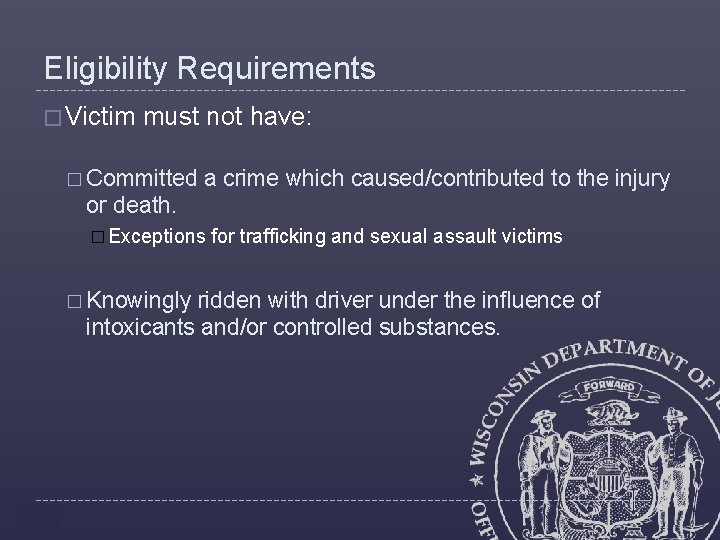
Eligibility Requirements � Victim must not have: � Committed a crime which caused/contributed to the injury or death. � Exceptions � Knowingly for trafficking and sexual assault victims ridden with driver under the influence of intoxicants and/or controlled substances.
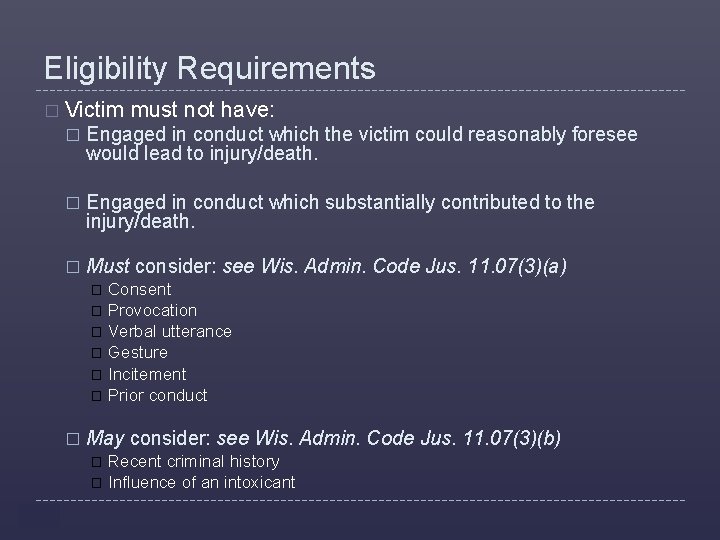
Eligibility Requirements � Victim must not have: � Engaged in conduct which the victim could reasonably foresee would lead to injury/death. � Engaged in conduct which substantially contributed to the injury/death. � Must consider: see Wis. Admin. Code Jus. 11. 07(3)(a) Consent � Provocation � Verbal utterance � Gesture � Incitement � Prior conduct � � May consider: see Wis. Admin. Code Jus. 11. 07(3)(b) Recent criminal history � Influence of an intoxicant �
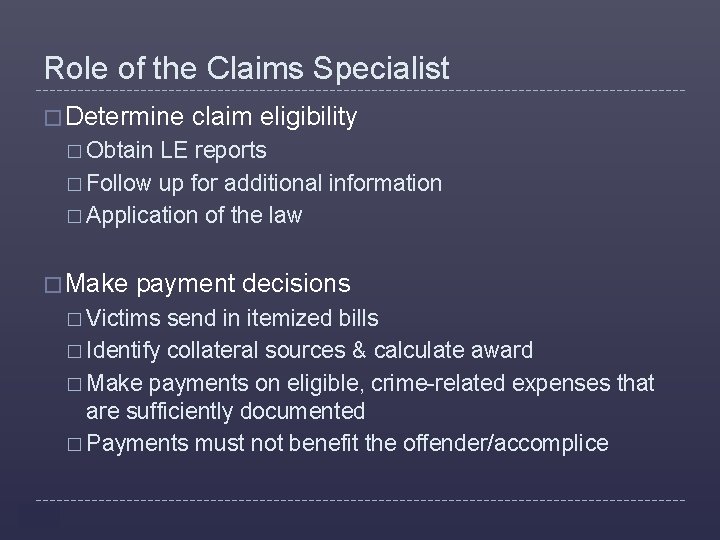
Role of the Claims Specialist � Determine claim eligibility � Obtain LE reports � Follow up for additional information � Application of the law � Make payment decisions � Victims send in itemized bills � Identify collateral sources & calculate award � Make payments on eligible, crime-related expenses that are sufficiently documented � Payments must not benefit the offender/accomplice
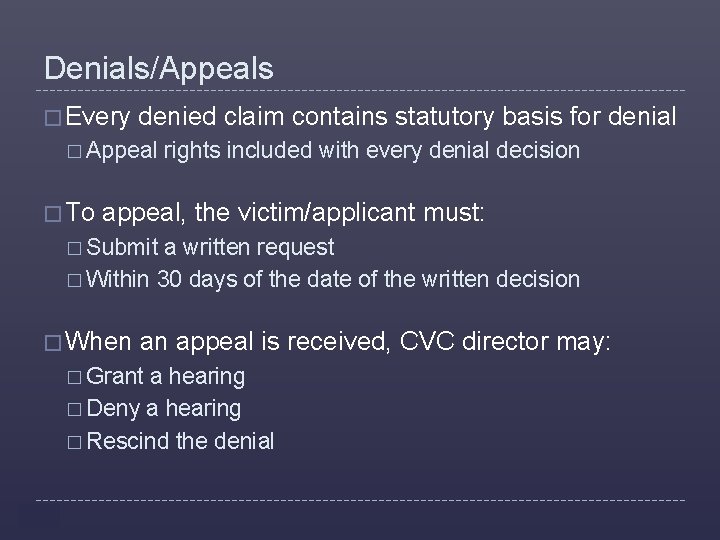
Denials/Appeals � Every denied claim contains statutory basis for denial � Appeal � To rights included with every denial decision appeal, the victim/applicant must: � Submit a written request � Within 30 days of the date of the written decision � When an appeal is received, CVC director may: � Grant a hearing � Deny a hearing � Rescind the denial
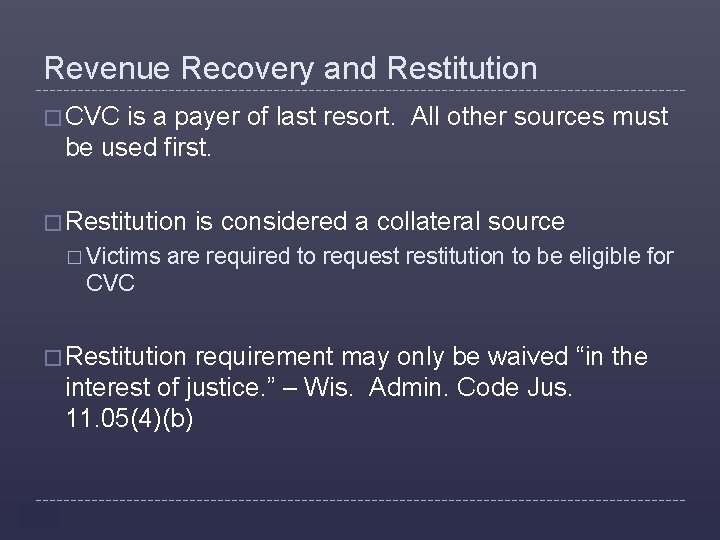
Revenue Recovery and Restitution � CVC is a payer of last resort. All other sources must be used first. � Restitution � Victims is considered a collateral source are required to request restitution to be eligible for CVC � Restitution requirement may only be waived “in the interest of justice. ” – Wis. Admin. Code Jus. 11. 05(4)(b)
Restitution Processes Between CVC and V/W or DOC � Claims specialists: � Communicate with victim/witness staff regarding payments made by CVC � Request restitution ordered back to CVC at sentencing � Seek updated restitution orders from V/W or from DOC to obtain full restitution � Unpaid restitution is converted to a civil judgment upon discharge from supervision � Wis. Stat. § 890. 035 � Judgment may be against juvenile and custodial parent.
Revenue Recovery Initiative � Identify � Obtain outstanding debts owed to CVC a copy of the civil judgment for restitution � Provide notice to the offender with request to set up a payment plan � Refer unpaid restitution debt to the Dept. of Revenue for collection on behalf of CVC � On juvenile orders, parents may be listed as debtor
How can you help? � Provide and help complete the CVC application � Multiple ways to apply � Encourage the victim to keep contact information current with CVC � Note any additional information that CVC may need on the application � Provide CVC with your information
Claims Specialists Janine Frank Melinda Knuth Rhonda Mitchell Sherri Stark Hollie Sumrall Jodi Tessmann (608) 264 -6361 (608) 267 -7958 (608) 267 -9757 (608) 266 -7877 (608) 261 -5804 (608) 261 -8139 frankjm@doj. state. wi. us knuthmk@doj. state. wi. us mitchellrr@doj. state. wi. us starkse@doj. state. wi. us sumrallhn@doj. state. wi. us tessmannjl@doj. state. wi. us Tom Arden Program Assistant Kim Swanston Program Assistant Kathy Zupan Director (414) 227 -1804 ardentw@doj. state. wi. us (608) 266 -6470 swanstonkk@doj. state. wi. us (608) 264 -9484 zupankj@doj. state. wi. us
SAFE* Fund *Sexual Assault Forensic Exam
SAFE FUND (Sexual Assault Forensic Exam) � The SAFE Fund is a program that will pay for the cost of a forensic medical exam for victims of sexual assault � Administered by the Office of Crime Victim Services – State Program � Separate Program from the Crime Victim Compensation
What is a “Forensic Medical Exam”? � The term “forensic medical exam” means an examination provided to a sexual assault victim by medical personnel trained to gather evidence of a sexual assault in a manner suitable for use in a court of law. � The examination should include at a minimum: � Examination of physical trauma � Determination of physical trauma � Patient history, and � Collection and evaluation of evidence
SAFE Fund History � In 1994 the Violence Against Women Act (VAWA) addressed the problem of sexual assault victims being charged for the cost of a forensic medical examination � If a state receives VAWA funding, it must incur the full cost of the forensic medical exam � In 2007 WI Act 20 created statutory language for administration of the SAFE fund
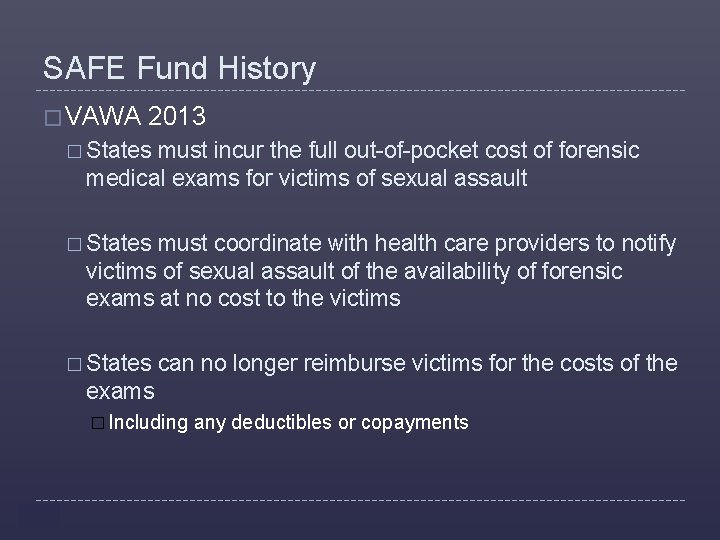
SAFE Fund History � VAWA 2013 � States must incur the full out-of-pocket cost of forensic medical exams for victims of sexual assault � States must coordinate with health care providers to notify victims of sexual assault of the availability of forensic exams at no cost to the victims � States can no longer reimburse victims for the costs of the exams � Including any deductibles or copayments
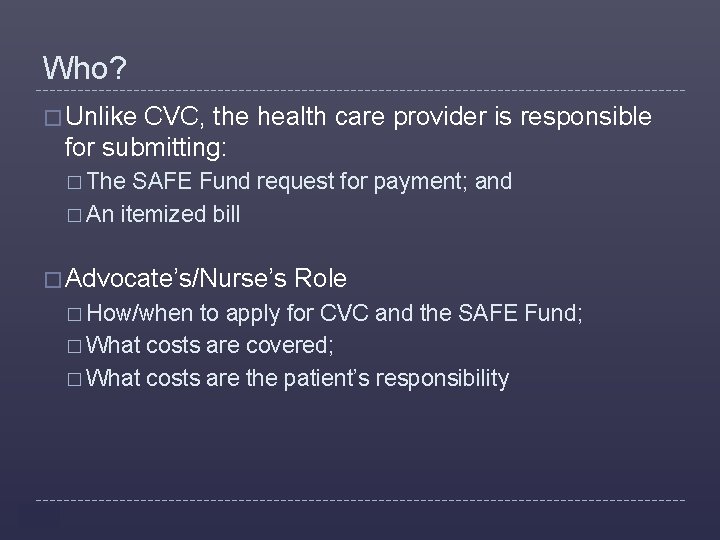
Who? � Unlike CVC, the health care provider is responsible for submitting: � The SAFE Fund request for payment; and � An itemized bill � Advocate’s/Nurse’s � How/when Role to apply for CVC and the SAFE Fund; � What costs are covered; � What costs are the patient’s responsibility
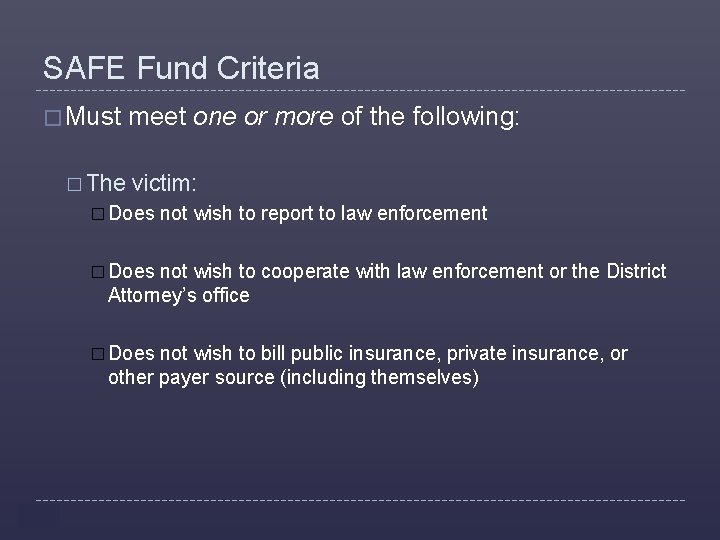
SAFE Fund Criteria � Must � The meet one or more of the following: victim: � Does not wish to report to law enforcement � Does not wish to cooperate with law enforcement or the District Attorney’s office � Does not wish to bill public insurance, private insurance, or other payer source (including themselves)
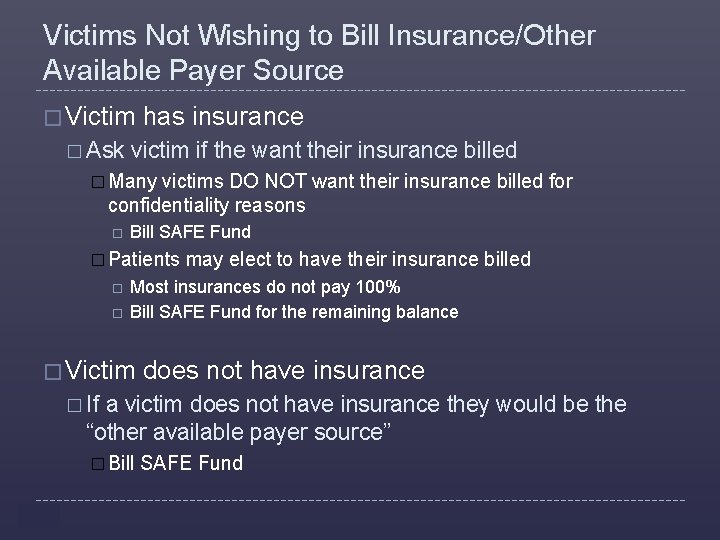
Victims Not Wishing to Bill Insurance/Other Available Payer Source � Victim � Ask has insurance victim if the want their insurance billed � Many victims DO NOT want their insurance billed for confidentiality reasons Bill SAFE Fund � Patients may elect to have their insurance billed Most insurances do not pay 100% Bill SAFE Fund for the remaining balance � Victim does not have insurance � If a victim does not have insurance they would be the “other available payer source” � Bill SAFE Fund
SAFE Fund Eligibility � Application must be filed by the medical facility within one year after the date of the exam � Sexual � Billing assault must have occurred in Wisconsin cover sheet filled out by medical provider and submitted directly to the SAFE Fund with a copy of the itemized bill
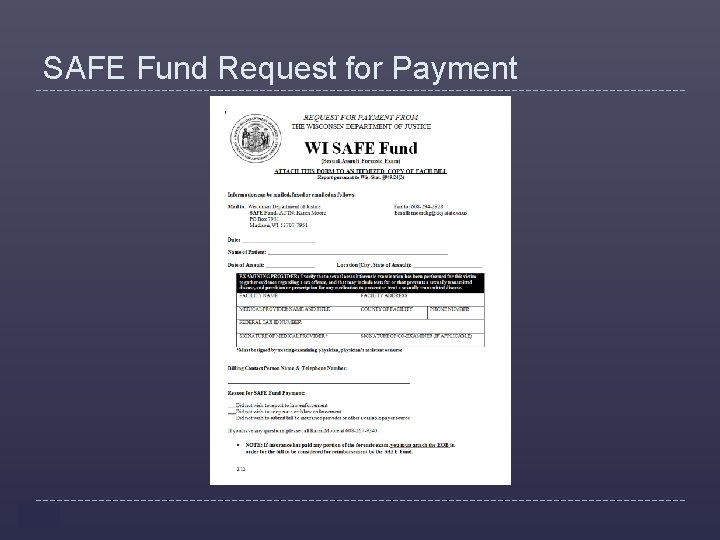
SAFE Fund Request for Payment
What Costs are Covered by the SAFE Fund? � Collection of the victim’s medical history � Collection of a forensic history of the events of the assault � Physical examination of the victim for evidence of the assault � Photographs of the physical evidence of the sex offense, if the health care provider conducting the examination has been trained to take photographs for use as evidence � Evaluation, testing, and prophylaxis for STDs � Evaluation of the risk of pregnancy � Collection of blood & urine using the collection kit provided by law enforcement � Cost for the use of the medical facility for the examination
Costs Not Covered � Medical treatment � Plan B emergency contraception � Drug testing � Procedures, tests, services not within the scope of the SANE Nurse or their examination protocol � Follow up visits
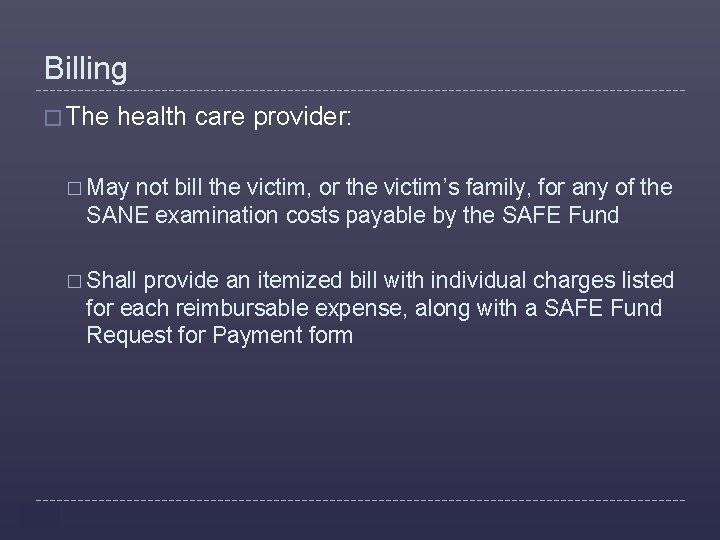
Billing � The health care provider: � May not bill the victim, or the victim’s family, for any of the SANE examination costs payable by the SAFE Fund � Shall provide an itemized bill with individual charges listed for each reimbursable expense, along with a SAFE Fund Request for Payment form
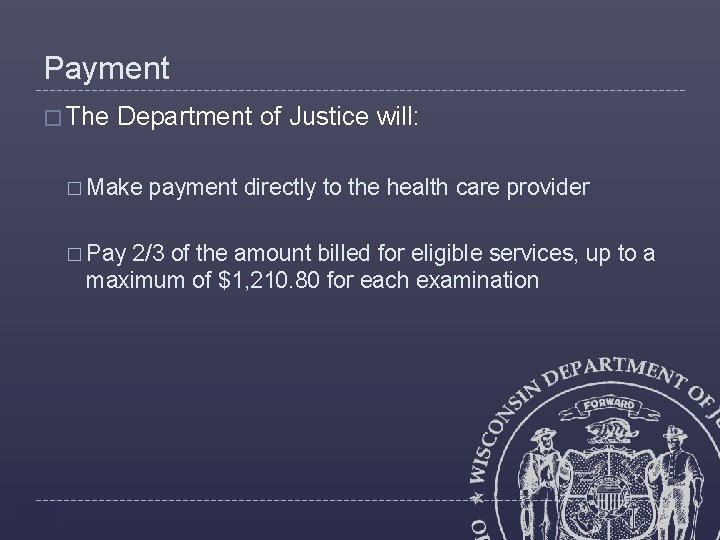
Payment � The Department of Justice will: � Make � Pay payment directly to the health care provider 2/3 of the amount billed for eligible services, up to a maximum of $1, 210. 80 for each examination
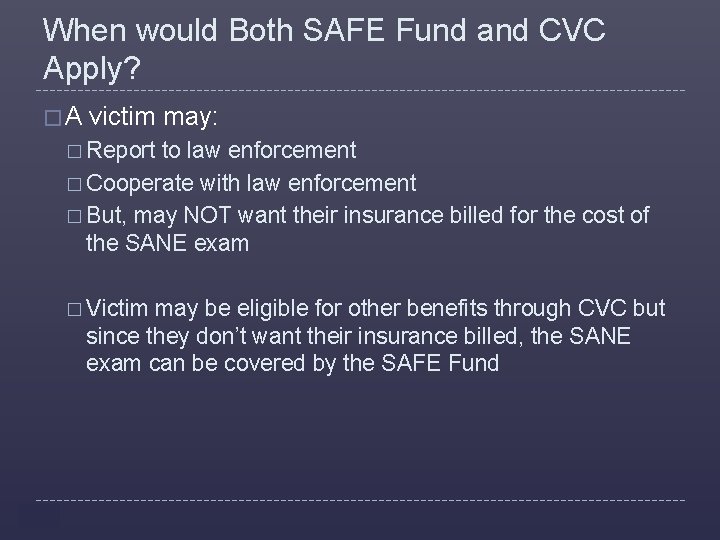
When would Both SAFE Fund and CVC Apply? �A victim may: � Report to law enforcement � Cooperate with law enforcement � But, may NOT want their insurance billed for the cost of the SANE exam � Victim may be eligible for other benefits through CVC but since they don’t want their insurance billed, the SANE exam can be covered by the SAFE Fund
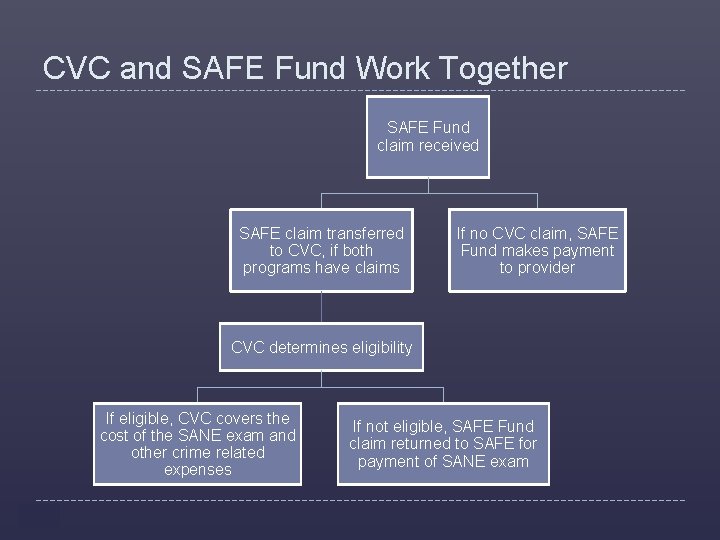
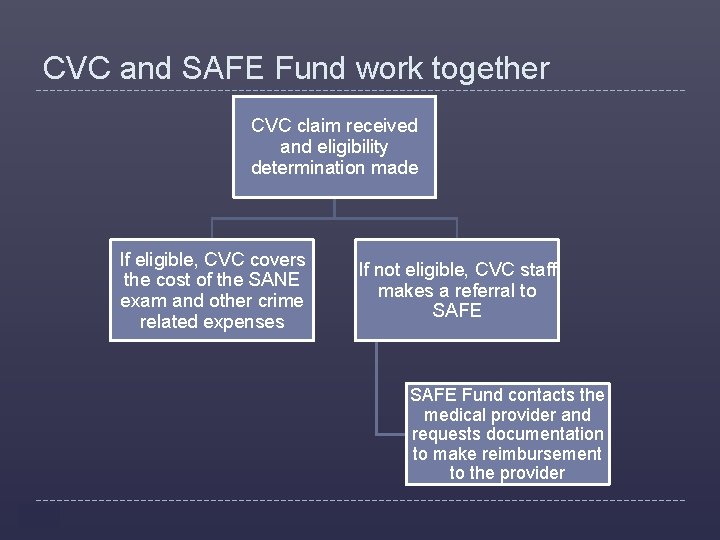
CVC and SAFE Fund Work Together SAFE Fund claim received SAFE claim transferred to CVC, if both programs have claims If no CVC claim, SAFE Fund makes payment to provider CVC determines eligibility If eligible, CVC covers the cost of the SANE exam and other crime related expenses If not eligible, SAFE Fund claim returned to SAFE for payment of SANE exam
CVC and SAFE Fund work together CVC claim received and eligibility determination made If eligible, CVC covers the cost of the SANE exam and other crime related expenses If not eligible, CVC staff makes a referral to SAFE Fund contacts the medical provider and requests documentation to make reimbursement to the provider
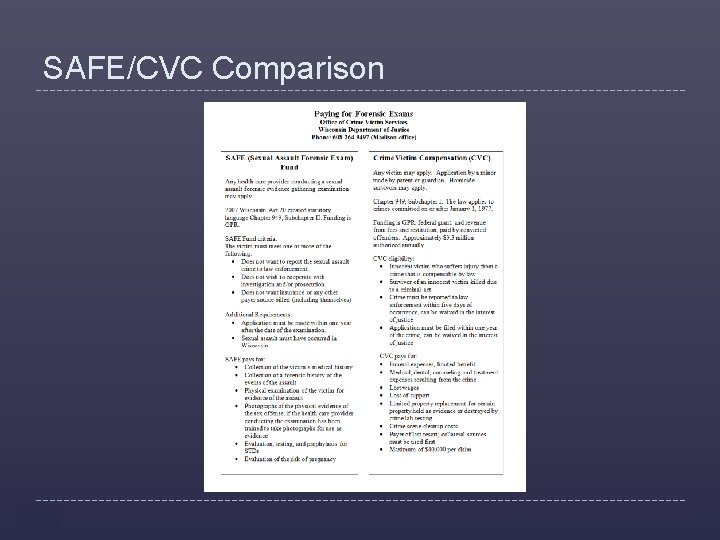
SAFE/CVC Comparison
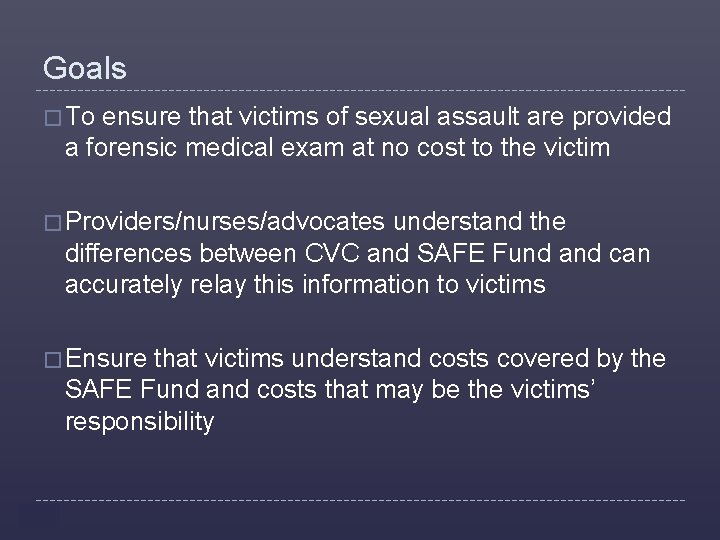
Goals � To ensure that victims of sexual assault are provided a forensic medical exam at no cost to the victim � Providers/nurses/advocates understand the differences between CVC and SAFE Fund and can accurately relay this information to victims � Ensure that victims understand costs covered by the SAFE Fund and costs that may be the victims’ responsibility
Contact Information � SAFE Fund � Administrator: Karen Moore � (608) 267 -9340 � moorekg@doj. state. wi. us � https: //www. doj. state. wi. us/ocvs/not-crime-victim/sexual- assault-forensic-exam
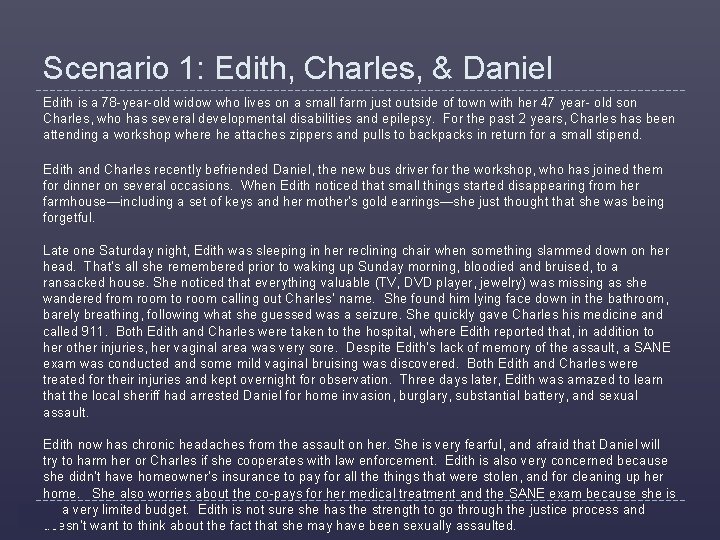
Scenario 1: Edith, Charles, & Daniel Edith is a 78 -year-old widow who lives on a small farm just outside of town with her 47 year- old son Charles, who has several developmental disabilities and epilepsy. For the past 2 years, Charles has been attending a workshop where he attaches zippers and pulls to backpacks in return for a small stipend. Edith and Charles recently befriended Daniel, the new bus driver for the workshop, who has joined them for dinner on several occasions. When Edith noticed that small things started disappearing from her farmhouse—including a set of keys and her mother’s gold earrings—she just thought that she was being forgetful. Late one Saturday night, Edith was sleeping in her reclining chair when something slammed down on her head. That’s all she remembered prior to waking up Sunday morning, bloodied and bruised, to a ransacked house. She noticed that everything valuable (TV, DVD player, jewelry) was missing as she wandered from room to room calling out Charles’ name. She found him lying face down in the bathroom, barely breathing, following what she guessed was a seizure. She quickly gave Charles his medicine and called 911. Both Edith and Charles were taken to the hospital, where Edith reported that, in addition to her other injuries, her vaginal area was very sore. Despite Edith’s lack of memory of the assault, a SANE exam was conducted and some mild vaginal bruising was discovered. Both Edith and Charles were treated for their injuries and kept overnight for observation. Three days later, Edith was amazed to learn that the local sheriff had arrested Daniel for home invasion, burglary, substantial battery, and sexual assault. Edith now has chronic headaches from the assault on her. She is very fearful, and afraid that Daniel will try to harm her or Charles if she cooperates with law enforcement. Edith is also very concerned because she didn’t have homeowner’s insurance to pay for all the things that were stolen, and for cleaning up her home. She also worries about the co-pays for her medical treatment and the SANE exam because she is on a very limited budget. Edith is not sure she has the strength to go through the justice process and doesn’t want to think about the fact that she may have been sexually assaulted.
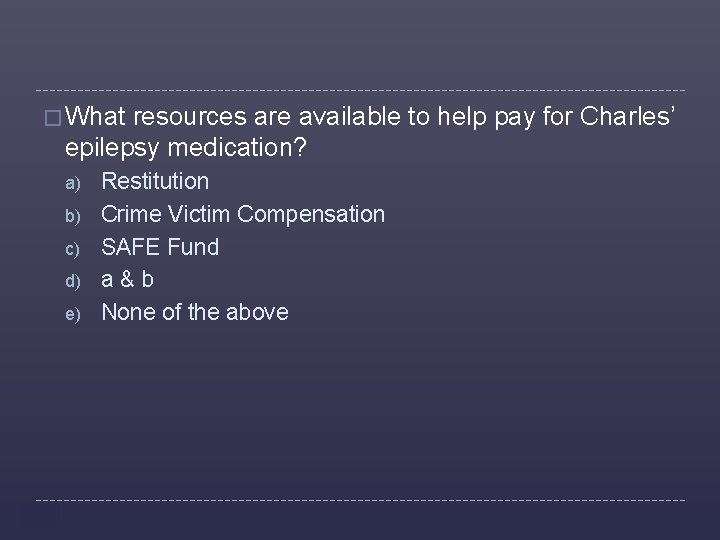
� What resources are available to help pay for Charles’ epilepsy medication? a) b) c) d) e) Restitution Crime Victim Compensation SAFE Fund a&b None of the above
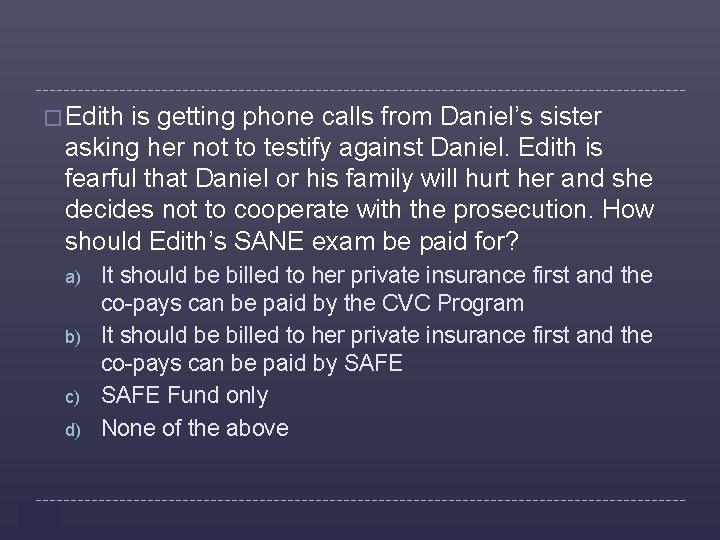
� Edith is getting phone calls from Daniel’s sister asking her not to testify against Daniel. Edith is fearful that Daniel or his family will hurt her and she decides not to cooperate with the prosecution. How should Edith’s SANE exam be paid for? a) b) c) d) It should be billed to her private insurance first and the co-pays can be paid by the CVC Program It should be billed to her private insurance first and the co-pays can be paid by SAFE Fund only None of the above
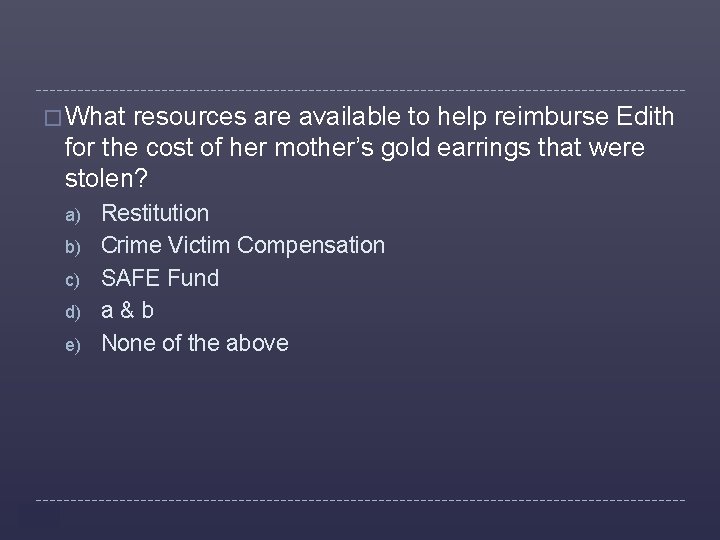
� What resources are available to help reimburse Edith for the cost of her mother’s gold earrings that were stolen? a) b) c) d) e) Restitution Crime Victim Compensation SAFE Fund a&b None of the above
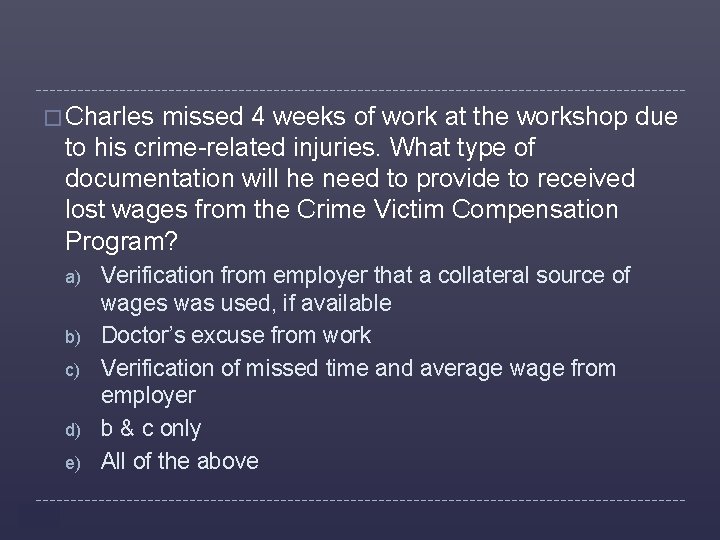
� Charles missed 4 weeks of work at the workshop due to his crime-related injuries. What type of documentation will he need to provide to received lost wages from the Crime Victim Compensation Program? a) b) c) d) e) Verification from employer that a collateral source of wages was used, if available Doctor’s excuse from work Verification of missed time and average wage from employer b & c only All of the above
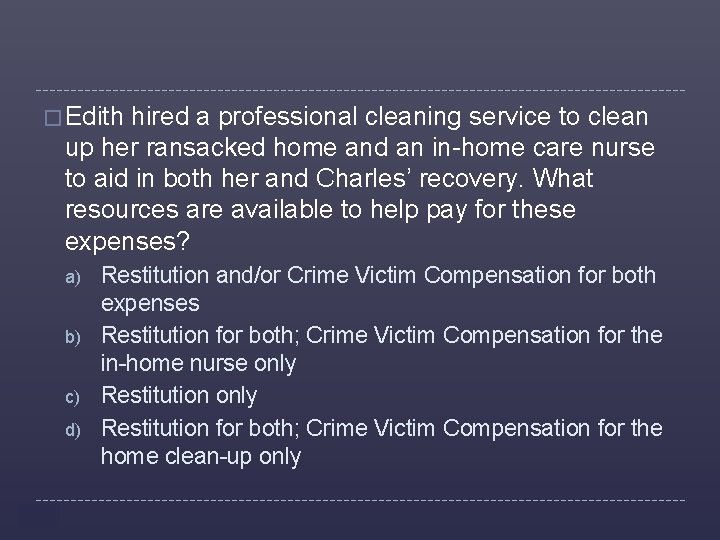
� Edith hired a professional cleaning service to clean up her ransacked home and an in-home care nurse to aid in both her and Charles’ recovery. What resources are available to help pay for these expenses? a) b) c) d) Restitution and/or Crime Victim Compensation for both expenses Restitution for both; Crime Victim Compensation for the in-home nurse only Restitution for both; Crime Victim Compensation for the home clean-up only
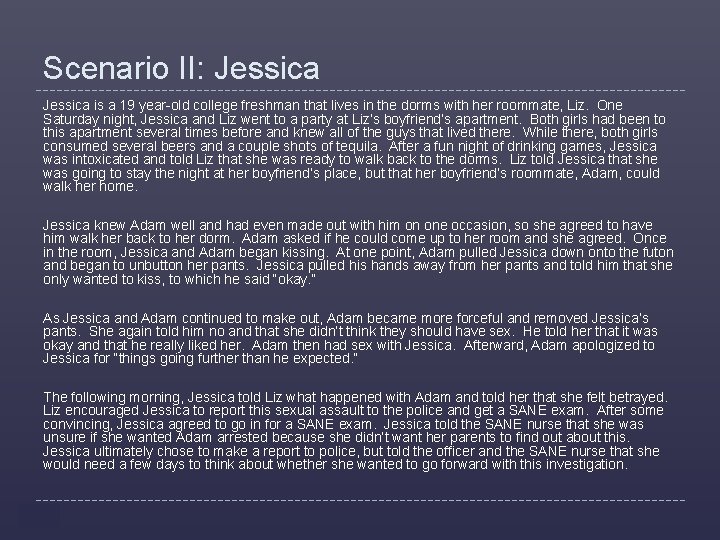
Scenario II: Jessica is a 19 year-old college freshman that lives in the dorms with her roommate, Liz. One Saturday night, Jessica and Liz went to a party at Liz’s boyfriend’s apartment. Both girls had been to this apartment several times before and knew all of the guys that lived there. While there, both girls consumed several beers and a couple shots of tequila. After a fun night of drinking games, Jessica was intoxicated and told Liz that she was ready to walk back to the dorms. Liz told Jessica that she was going to stay the night at her boyfriend’s place, but that her boyfriend’s roommate, Adam, could walk her home. Jessica knew Adam well and had even made out with him on one occasion, so she agreed to have him walk her back to her dorm. Adam asked if he could come up to her room and she agreed. Once in the room, Jessica and Adam began kissing. At one point, Adam pulled Jessica down onto the futon and began to unbutton her pants. Jessica pulled his hands away from her pants and told him that she only wanted to kiss, to which he said “okay. ” As Jessica and Adam continued to make out, Adam became more forceful and removed Jessica’s pants. She again told him no and that she didn’t think they should have sex. He told her that it was okay and that he really liked her. Adam then had sex with Jessica. Afterward, Adam apologized to Jessica for “things going further than he expected. ” The following morning, Jessica told Liz what happened with Adam and told her that she felt betrayed. Liz encouraged Jessica to report this sexual assault to the police and get a SANE exam. After some convincing, Jessica agreed to go in for a SANE exam. Jessica told the SANE nurse that she was unsure if she wanted Adam arrested because she didn’t want her parents to find out about this. Jessica ultimately chose to make a report to police, but told the officer and the SANE nurse that she would need a few days to think about whether she wanted to go forward with this investigation.
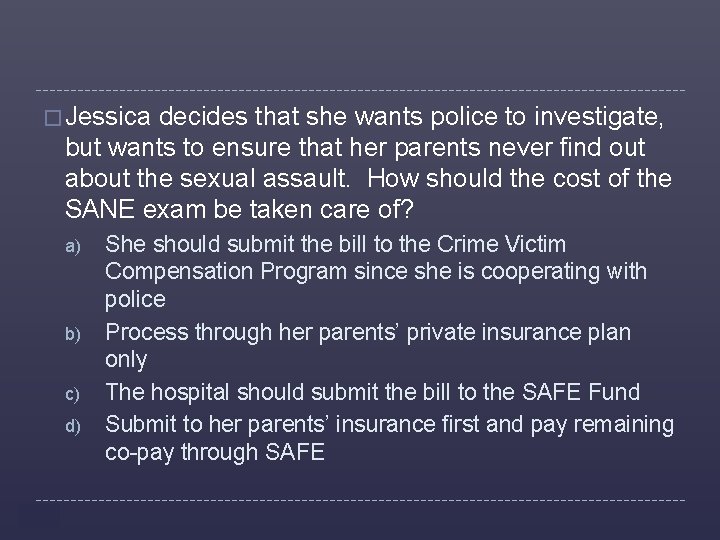
� Jessica decides that she wants police to investigate, but wants to ensure that her parents never find out about the sexual assault. How should the cost of the SANE exam be taken care of? a) b) c) d) She should submit the bill to the Crime Victim Compensation Program since she is cooperating with police Process through her parents’ private insurance plan only The hospital should submit the bill to the SAFE Fund Submit to her parents’ insurance first and pay remaining co-pay through SAFE
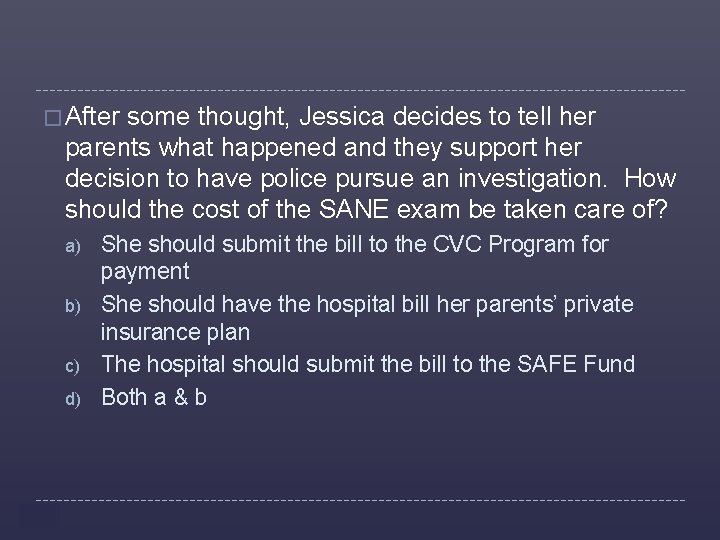
� After some thought, Jessica decides to tell her parents what happened and they support her decision to have police pursue an investigation. How should the cost of the SANE exam be taken care of? a) b) c) d) She should submit the bill to the CVC Program for payment She should have the hospital bill her parents’ private insurance plan The hospital should submit the bill to the SAFE Fund Both a & b
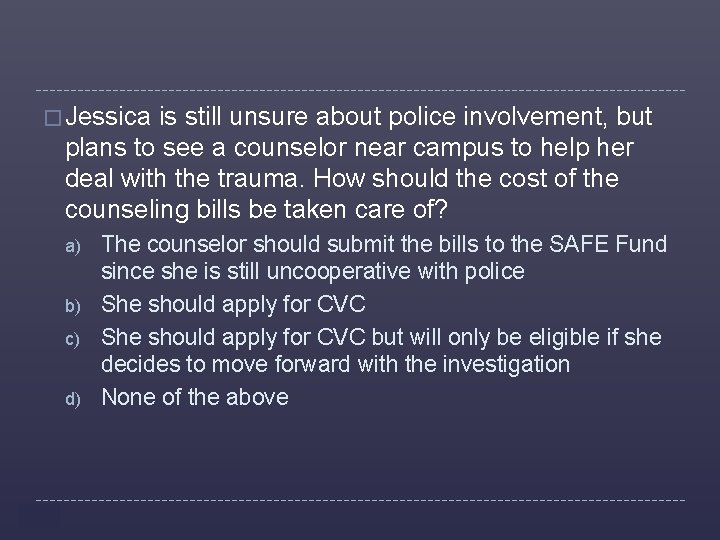
� Jessica is still unsure about police involvement, but plans to see a counselor near campus to help her deal with the trauma. How should the cost of the counseling bills be taken care of? a) b) c) d) The counselor should submit the bills to the SAFE Fund since she is still uncooperative with police She should apply for CVC but will only be eligible if she decides to move forward with the investigation None of the above
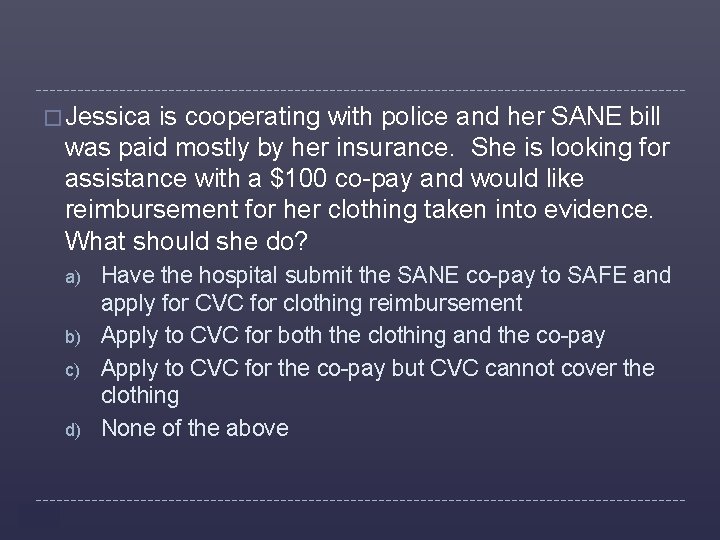
� Jessica is cooperating with police and her SANE bill was paid mostly by her insurance. She is looking for assistance with a $100 co-pay and would like reimbursement for her clothing taken into evidence. What should she do? a) b) c) d) Have the hospital submit the SANE co-pay to SAFE and apply for CVC for clothing reimbursement Apply to CVC for both the clothing and the co-pay Apply to CVC for the co-pay but CVC cannot cover the clothing None of the above
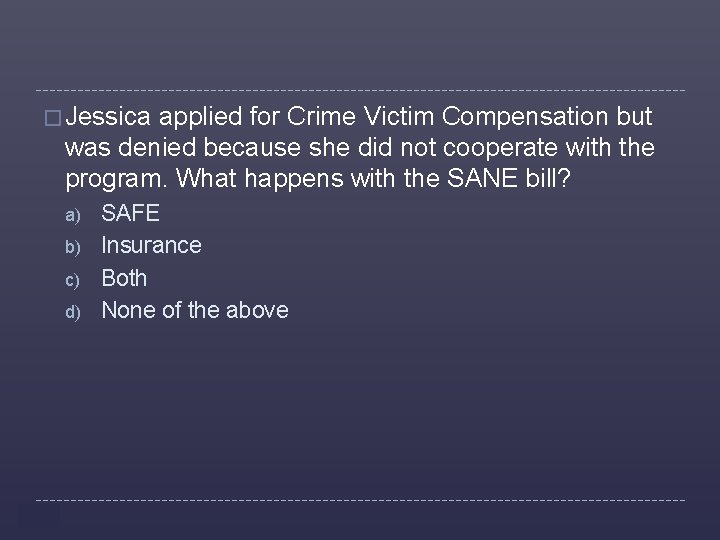
� Jessica applied for Crime Victim Compensation but was denied because she did not cooperate with the program. What happens with the SANE bill? a) b) c) d) SAFE Insurance Both None of the above