
Crime Statistics what do we need them for

- Slides: 23
Crime Statistics, what do we need them for? A discussion based on the situation in the Netherlands Paul Smit Research and Documentation Centre (WODC) Ministry of Justice
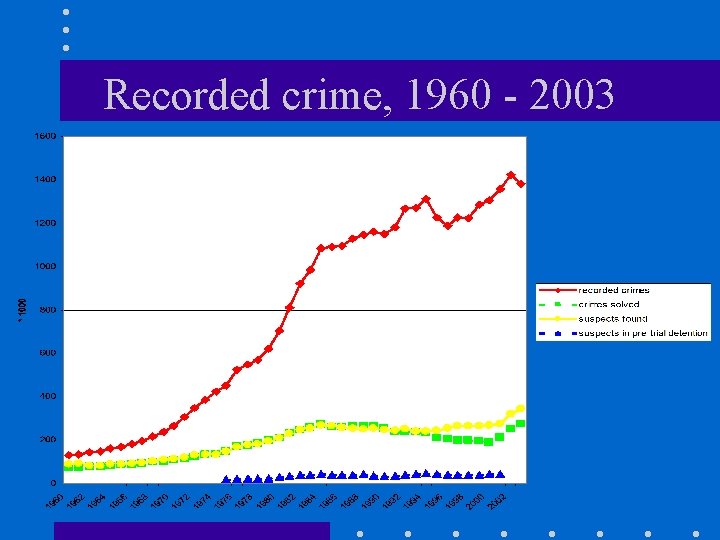
Recorded crime, 1960 - 2003
Why Crime Statistics Passively: • To see what happens, look at trends, and act accordingly Actively: • To measure the success of policies • To help defining policies
Contents • Crime Statistics in the Netherlands • Examples – The policy program: towards a safer society – Modelling the Criminal Justice system – Offenders from ethnic minorities • Discussion / Conclusions
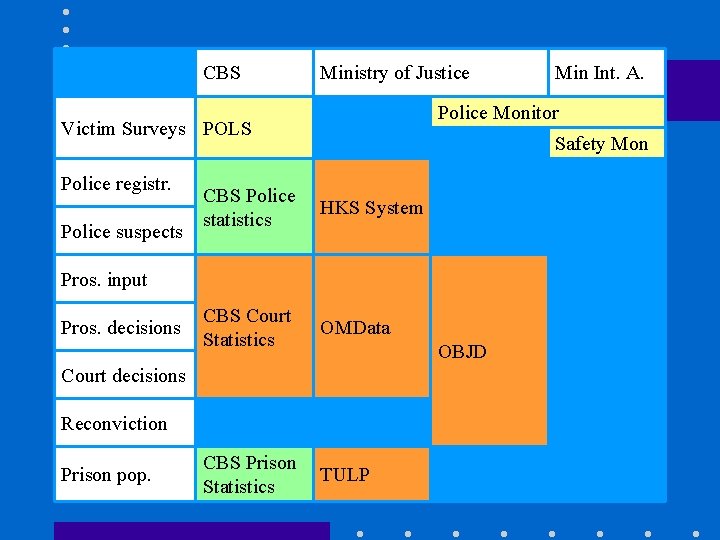
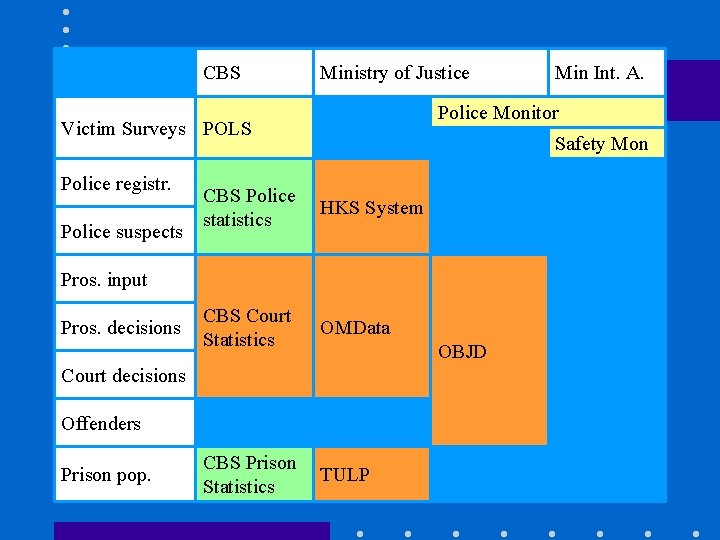
CBS Ministry of Justice Police Monitor Victim Surveys POLS Police registr. Police suspects Safety Mon CBS Police statistics HKS System CBS Court Statistics OMData CBS Prison Statistics TULP Pros. input Pros. decisions OBJD Court decisions Reconviction Prison pop. Min Int. A.
Main characteristics • (Too) many statistics
CBS Ministry of Justice Police Monitor Victim Surveys POLS Police registr. Police suspects Safety Mon CBS Police statistics HKS System CBS Court Statistics OMData CBS Prison Statistics TULP Pros. input Pros. decisions OBJD Court decisions Offenders Prison pop. Min Int. A.
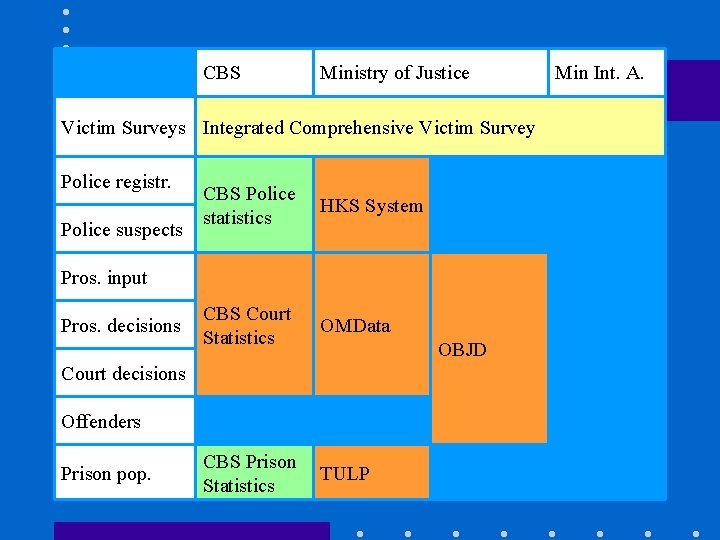
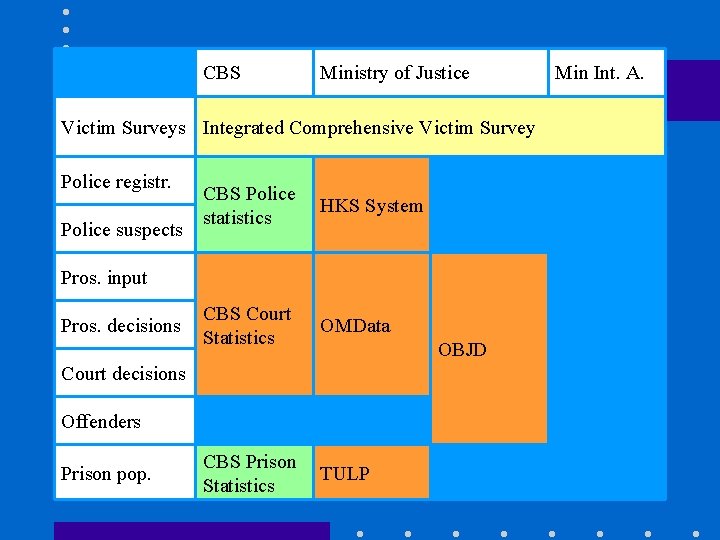
CBS Ministry of Justice Victim Surveys Integrated Comprehensive Victim Survey Police registr. Police suspects CBS Police statistics HKS System CBS Court Statistics OMData CBS Prison Statistics TULP Pros. input Pros. decisions OBJD Court decisions Offenders Prison pop. Min Int. A.
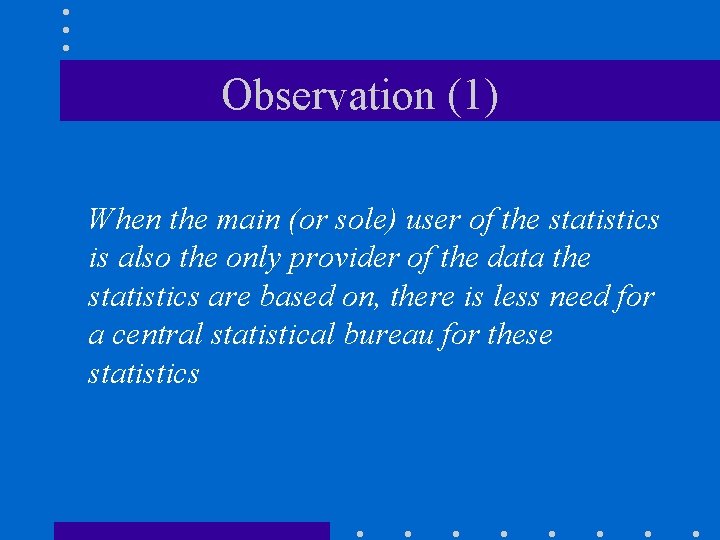
Observation (1) When the main (or sole) user of the statistics is also the only provider of the data the statistics are based on, there is less need for a central statistical bureau for these statistics
Main characteristics • (Too) many statistics • Isolated statistics
Example 1 The policy program: towards a safer society Precise targets: • Reduction of crime in public spaces • Opinion of police and feelings of safety • Repeat offenders
Observation (2) It can be very dangerous to make statements on the success of policy measures based on outcome statistics alone
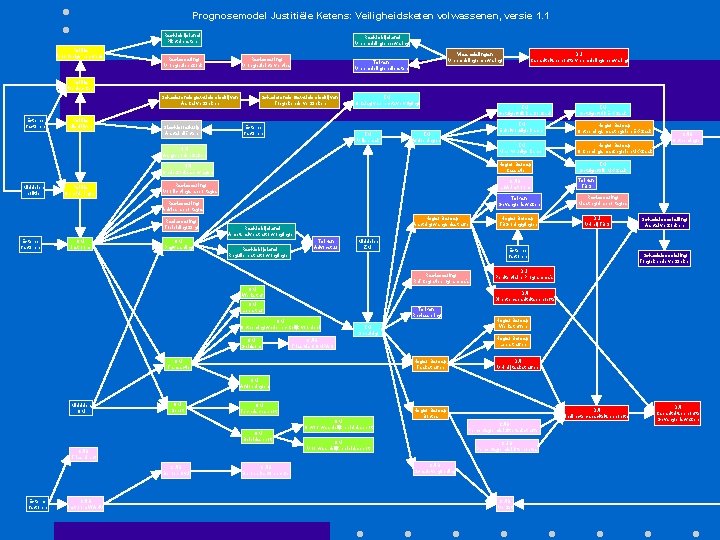
Example 2 Modelling the Criminal Justice system • Econometric model, based on aggragate statistics
Prognosemodel Justitiële Ketens: Veiligheidsketen volwassenen, versie 1. 1 Rechtsbijstand Piketdiensten Politie Voorlopige hechtenis Rechtsbijstand Vreemdelingenbewaring Reclassering Vroeghulpinterventies Reclassering Vroeghulpbezoek Vreemdelingenbewaring Tolken Vreemdelingendiensten DJI Capaciteitsbehoefte vreemdelingenbewaring Politie Verdachten Schadefonds geweldsmisdrijven Aantal verzoeken Externe factoren Politie Misdrijven Slachtofferhulp Aantal cliënten Schadefonds Geweldsmisdrijven Toegekende verzoeken Externe factoren ZM Ontslag van rechtsvervolging ZM Vrijspraak ZM Getuige/tolk kantonzaak ZM Afdoeningen NFI Aangeboden zaken NFI Onderzoeksaanvragen Middelen politie Politie Ophelderingen Reclassering Voorlichtingsrapportages Reclassering Toeleiding zorg Externe factoren OM Instroom OM Dagvaarding ZM Enkelvoudige kamer Hoger Beroep Ontnemingsmaatregelen EK-zaak ZM Meervoudige kamer Hoger Beroep Ontnemingsmaatregelen MK-zaak Hoger Beroep Cassatie ZM Getuige/tolk MK-zaak CJIB LCA instroom Tolken TBS Tolken Gevangeniswezen Reclassering Adviesrapportages Hoger Beroep Aantal gevangenisstraffen Rechtsbijstand Ambtshalve straftoevoegingen Rechtsbijstand Reguliere straftoevoegingen Tolken Advocatuur Middelen ZM Hoger Beroep TBS-opleggingen OM Werkstraf CJIB Ontnemingen Reclassering Maatregelrapportages DJI VH bij TBS Externe factoren Reclassering Reïntegratieprogramma’s Schadeloosstelling Aantal verzoeken Schadeloossteling Toegekende verzoeken DJI Penitentiaire Programma’s DJI Directe capaciteitsbehoefte OM Leerstraf OM Ontneming wederrechtelijk voordeel OM Geldsom ZM Getuige/tolk EK-zaak Tolken Reclassering ZM Schuldig Hoger Beroep Leerstraffen CJIB Trias via COMPAS OM Transactie Hoger Beroep Werkstraffen Hoger Beroep Taakstraffen DJI VH bij taakstraffen OM Afdoeningen Middelen OM OM Sepot OM Technisch sepot OM Onvoorwaardelijk beleidssepot OM Beleidssepot CJIB Trias direct CJIB Beroep Ov. J Externe factoren CJIB Instroom WAHV CJIB Beroep kantonrechter Hoger Beroep Boetes DJI Indirecte capaciteitsbehoefte CJIB Percentage mislukte taakstraffen OM Voorwaardelijk beleidssepot CJIB Percentage mislukte boetes CJIB Schadevergoeding CJIB Verzet DJI Capaciteitsbehoefte Gevangeniswezen
Example 2 Modelling the Criminal Justice System • Econometric model, based on aggragate statistics • Also external factors • Knowledge of the working (the expected behaviour) of the Criminal Justice System
Observation (3) Integrating different areas of Crime Statistics and Statistics from other areas, even if this integration is on an aggragate level only, is very useful in observing the working of the Criminal Justice System as a whole and the expected outcome of specific policy measures
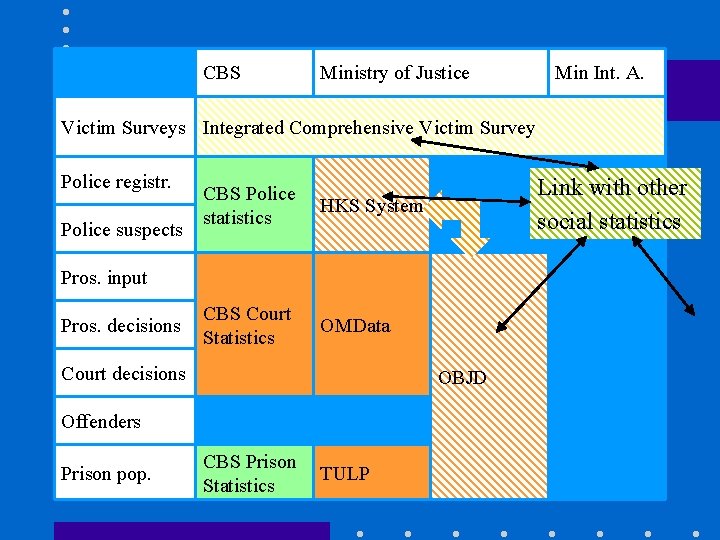
Example 3 Offenders from ethnic minorities • Offender data are linked (on individual level) with demographic data. This gives information on ethnicity • These data are linked to other social and economic statistics • Helpful for implementing specific policy programs
Observation (4) Integrating Crime Statistics on an individual level with statistics from other areas is very useful in understanding crime related phenomena and in formulating specific policy measures
CBS Ministry of Justice Victim Surveys Integrated Comprehensive Victim Survey Police registr. Police suspects CBS Police statistics HKS System CBS Court Statistics OMData CBS Prison Statistics TULP Pros. input Pros. decisions OBJD Court decisions Offenders Prison pop. Min Int. A.
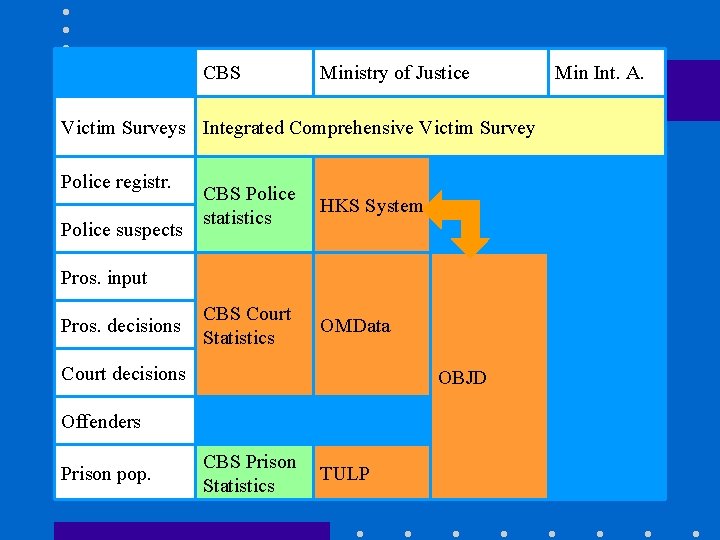
CBS Ministry of Justice Victim Surveys Integrated Comprehensive Victim Survey Police registr. Police suspects CBS Police statistics HKS System CBS Court Statistics OMData Pros. input Pros. decisions Court decisions OBJD Offenders Prison pop. CBS Prison Statistics TULP Min Int. A.
CBS Ministry of Justice Min Int. A. Victim Surveys Integrated Comprehensive Victim Survey Police registr. Police suspects CBS Police statistics HKS System CBS Court Statistics OMData Link with other social statistics Pros. input Pros. decisions Court decisions OBJD Offenders Prison pop. CBS Prison Statistics TULP
Main conclusions The big challenge in the coming years is integration of statistics, preferably on an individual level. Within the different areas of the Criminal Justice System, but also with other (demographic, economic and social) statistics.
Main conclusions (cont. ) This in order to get a better understanding of the working of the Criminal Justice System itself and the influence of external factors. Only then a fact based policy making is possible. To achieve this a central statistical bureau, having access to statistics in different areas is very important.