
Crime Scene Investigations Module 9 Bloodstain Pattern Analysis
Crime Scene Investigations Module 9: Bloodstain Pattern Analysis
Introduction Because blood behaves according to certain scientific principles, trained bloodstain pattern analysts can examine the blood evidence left behind and draw conclusions as to how the blood may have been shed. From what may appear to be a random distribution of bloodstains at a crime scene, analysts can categorize the stains by gathering information from spatterns, transfers, voids and other marks that assist investigators in recreating the sequence of events that occurred after bloodshed. This form of physical evidence requires the analyst to recognize and interpret patterns to determine how those patterns were created.
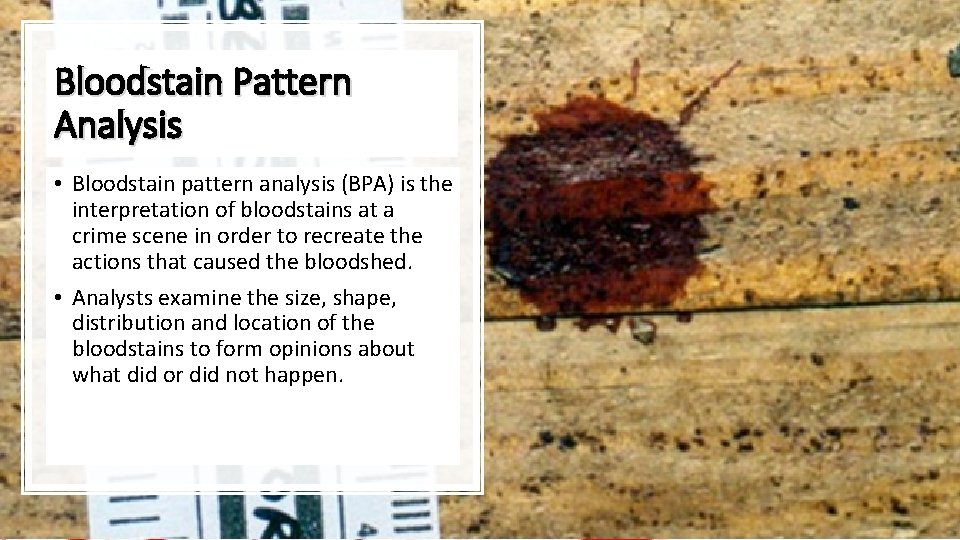
Bloodstain Pattern Analysis • Bloodstain pattern analysis (BPA) is the interpretation of bloodstains at a crime scene in order to recreate the actions that caused the bloodshed. • Analysts examine the size, shape, distribution and location of the bloodstains to form opinions about what did or did not happen.
BPA uses principles of biology to assist investigators in answering questions such as: • Where did the blood come from? • What caused the wounds? • From what direction was the victim wounded? • How were the victim(s) and perpetrator(s) positioned? • What movements were made after the bloodshed? • How many potential perpetrators were present? • Does the bloodstain evidence support or refute witness statements?
Principles of Bloodstain Pattern Analysis • Blood is in a liquid state when inside the body, and when it exits the body, it does so as a liquid. But as anyone who has had a cut or a scrape knows, it doesn’t remain a liquid for long. • Blood can leave the body in many different ways, depending on the type of injury inflicted. It can flow, drip, spray, spurt, gush or just ooze from wounds.
Types of Stains Bloodstains are classified into three basic types: 1. Passive stains include drops, flows and pools, and typically result from gravity acting on an injured body. 2. Transfer stains result from objects coming into contact with existing bloodstains and leaving wipes, swipes or pattern transfers behind such as a bloody shoe print or a smear from a body being dragged. 3. Impact stains result from blood projecting through the air and are usually seen as spatter, but may also include gushes, splashes and arterial spurts.
Blood Spatter • Blood spatter is categorized as impact spatter (created when a force is applied to a liquid blood source) or projection spatter. • Gunshot spatter ‐‐‐ includes both forward spatter from the exit wound and back spatter from the entrance wound. • Cast‐‐‐off‐‐‐results when an object swung in an arc flings blood onto nearby surfaces. • Arterial spray ‐‐‐ refers to the spurt of blood released when a major artery is severed. • Expirated spatter ‐‐‐ is usually caused by blood from an internal injury mixing with air from the lungs being expelled through the nose, mouth or an injury to the airways or lungs.

Bloodshed Events • Sharp force injuries (stabbing) • Blunt force injuries (hitting or beating) • Gunshot injuries
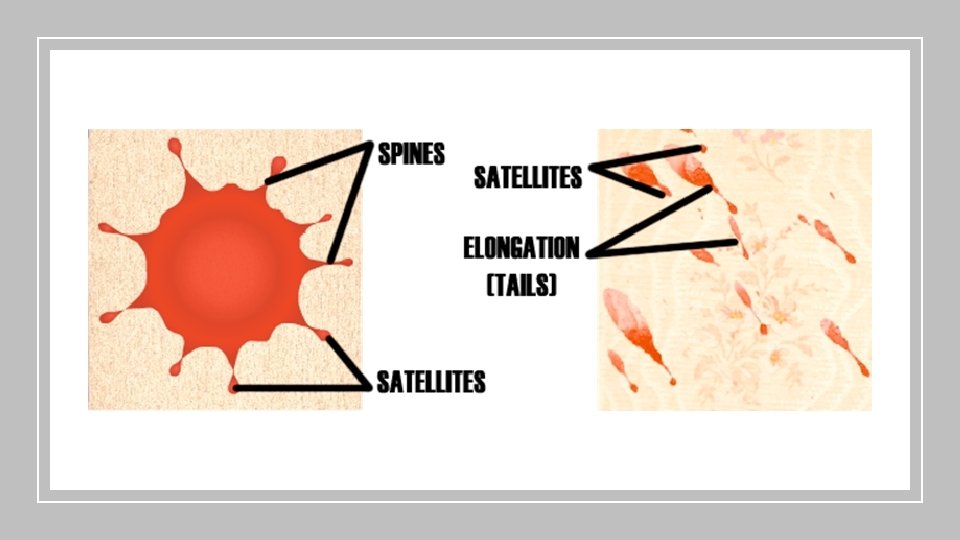
Interpreting the Patterns • By measuring the width and length of the stain, the angle of impact can be calculated, helping investigators determine the actions that may have taken place at the scene. • As the angle of impact changes, so does the appearance of the resulting stain. A blood drop striking a smooth surface at a 90° angle will result in an almost circular stain; there is little elongation, and the spines and satellites are fairly evenly distributed around the outside of the drop.
Void Patterns • A void occurs when a person or object blocks the path of the blood. They are important because voids can show investigators if objects are missing from the scene, where a person or persons were at the time of the incident, and if a body was moved. Void patterns are most useful for establishing the position of the victim(s) and assailant(s) within the scene.
Why and when is bloodstain pattern analysis used? Bloodstain evidence is most often associated with violent acts such as assault, homicide, abduction, suicide or even vehicular accidents. Bloodstains at a crime scene helps investigators by answering basic questions including: • What occurred? • Where did the events occur? • Approximately when and in what sequence? • Who was there? Where were they in relation to each other? • What did not occur?

How Bloodstain Evidence is Collected Bloodstain samples can be collected for BPA by cutting away stained surfaces or materials, photographing the stains, and drying and packaging stained objects. The tools for collecting bloodstain evidence usually include high‐‐‐quality cameras (still and video), sketching materials, cutting instruments and evidence packaging.
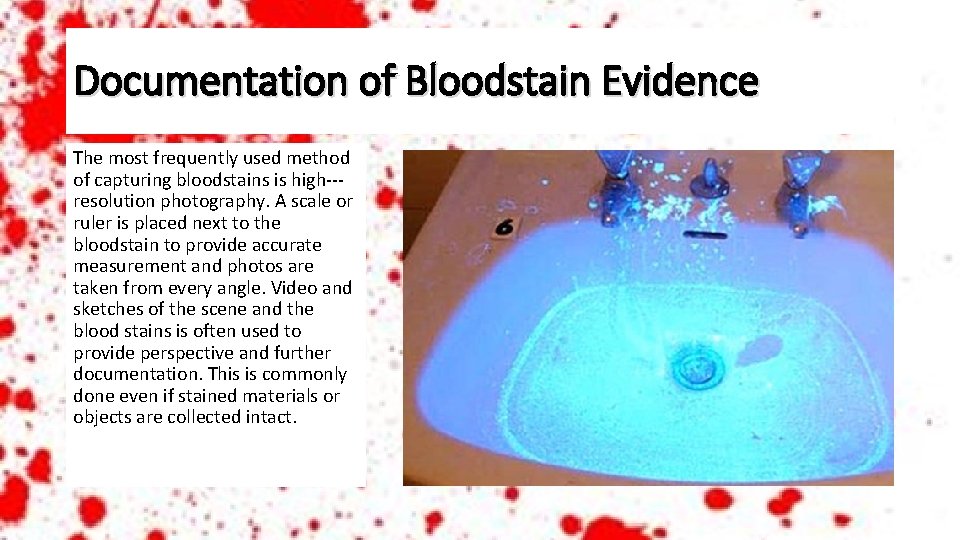
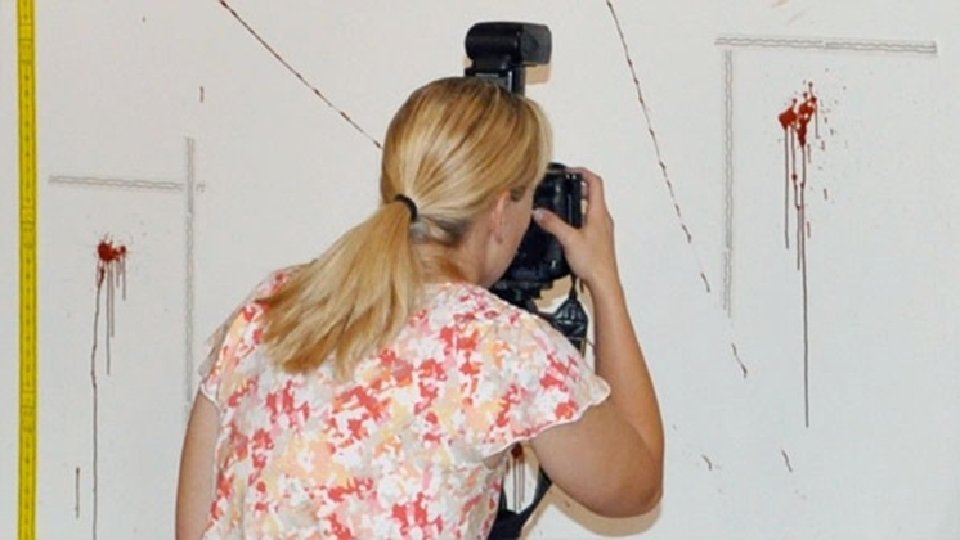
Documentation of Bloodstain Evidence The most frequently used method of capturing bloodstains is high‐‐‐ resolution photography. A scale or ruler is placed next to the bloodstain to provide accurate measurement and photos are taken from every angle. Video and sketches of the scene and the blood stains is often used to provide perspective and further documentation. This is commonly done even if stained materials or objects are collected intact.
How and Where the Analysis is Performed Bloodstain analysts use established scientific methods to examine bloodstain evidence at a crime scene including information gathering, observation, documentation, analysis, evaluation, conclusion and technical (or peer) review. All tests and experiments should be able to be reproduced by independent analysts to ensure accuracy and quality.
Bloodstain pattern analysis is performed in two phases: pattern analysis and reconstruction. • Pattern Analysis looks at the physical characteristics of the stain patterns including size, shape, distribution, overall appearance, location and surface texture where the stains are found. • Reconstruction uses the analysis data to put contextual explanations to the stain patterns: üWhat type of crime has occurred? üWhere is the person bleeding from?
- Slides: 17