
Crime Scene Investigations Module 4 Processing the Scene
- Slides: 34
Crime Scene Investigations Module 4: Processing the Scene
1. Determine Team Composition Principle: It is essential to a successful investigation to select a team of trained personnel to perform scene processing, based on the type of incident and complexity of the scene. Policy: The investigator(s) in charge shall assess the scene to determine team composition and specialized resources required. Summary: The assessment of the scene(s) determines the number of personnel and how responsibilities will be assigned.
2. Ensure Contamination Control Principle: Contamination control and preventing cross contamination at single or multiple scenes is essential to maintaining the safety of personnel and the integrity of evidence. Policy: The investigator(s) in charge shall require all personnel to follow procedures to ensure scene safety and evidence integrity. Summary: Minimize contamination by being safe, clean and careful to ensure the welfare of personnel and the integrity of the evidence.
3. Documentation Principle: An assessment of the scene determines what kind of documentation is needed (e. g. , photography, video, sketches, measurements, notes). Policy: The investigator(s) in charge shall ensure documentation of the scene.
Sketching The accuracy of all measuring devices should be ensured by comparison to a measure of certified accuracy, such as a NIST traceable ruler.
General Considerations Ø A sketch of a crime scene is required when spatial relationships or proportional measurements are needed. Use spatial relationships to relate evidence to other objects. Use proportional measurements to calculate such things as bullet trajectory angles or to reconstruct accident details. Ø The rough sketch is the first sketch drawn at the scene; multiple rough sketches may be required depending on the crime. The sketch includes a scene outline with the location of objects and evidence clearly marked. A finished sketch is derived from the rough sketch. Ø Draw the rough sketch before anything is moved or destroyed, and after photographs are taken. Do not alter the scene.
General Considerations (continued) Ø Depending on the crime, draw one or all of these types of sketches: a sketch showing the surrounding areas, a sketch showing only measurements, and a sketch showing locations of objects, such as the locations of evidence, victim(s), etc. Ø Measurements should be accurate to within ¼”.
General Considerations (continued) Ø Include, outside of the drawn crime scene, measurements for dimensions of rooms, furniture, doors and windows, and distances between objects, entrances and exits, bodies and persons. Draw details, such as object size, proportionally in a rough sketch. Ø Take measurements from fixed location reference point, such as walls or curbs, or from stationary appliances. Ø Include as much information as possible in the sketch: streets, plants, entry and exit points, location of bullets and cartridges, etc.
General Considerations (continued) Ø Do not alter a rough sketch after leaving the crime scene. If changes are required of the rough sketch, photocopy the original rough sketch to preserve its integrity. Ø Newer technology makes use of laser scanning devices to perform crime scene sketching. The employment of these devices should be reserved to investigators trained in their use.
Determining the Scale Ø Determine the scale to use for all sketches. The usual scale for outdoor scenes is one inch equals twenty feet. The usual scale for indoor scenes is one-eighth inch equals one foot. Select which standard units of measurement will be used: metric (meters, centimeters) or English (feet, inches).
Categories of Sketches There are four categories of sketches: 1. Perspective − A perspective sketch contains a vanishing point and depicts objects of evidence as they would appear to the eye with reference to relative distance and depth. 2. Projection − A projection sketch usually contains only one viewpoint and depicts objects on one plane. The overview sketch (of the horizontal plane) is the most common type of sketch and is usually done from a bird’s eye view; it shows the floor plan. Less common is the elevation sketch (of the vertical plane), which shows a side view typically of landscapes or buildings.
4 Categories of Sketches (continued) 3. Schematic − The schematic sketch is used when it is desirable to represent a sequence of events such as following the trajectory of a bullet through a crime scene location. 4. Detailed − The detailed sketch is used when describing a small area that is not easily incorporated into the overall drawing due to the scale chosen for the rough or finished scale drawing. This is especially useful for large crime scenes.
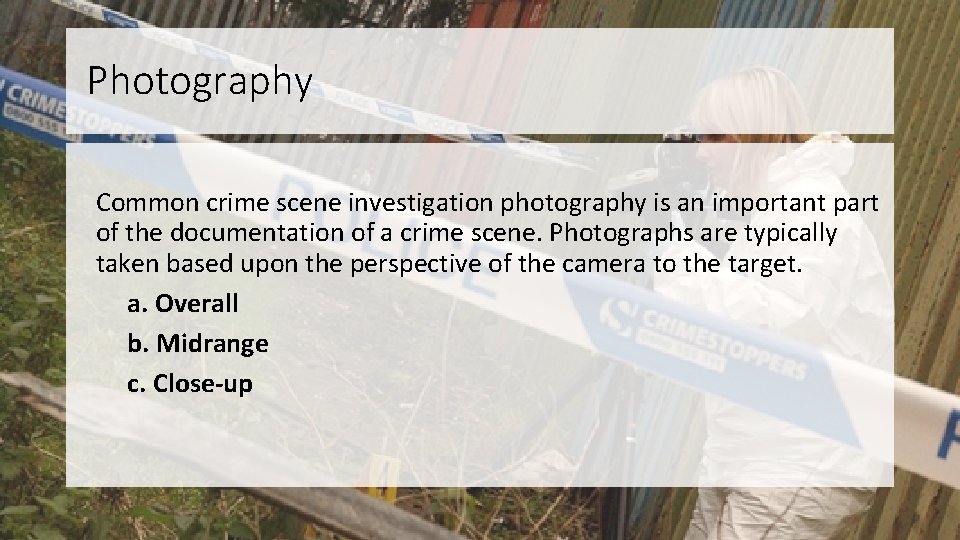
Photography Common crime scene investigation photography is an important part of the documentation of a crime scene. Photographs are typically taken based upon the perspective of the camera to the target. a. Overall b. Midrange c. Close-up
General Considerations Ø Always use the designated safe route when moving through the scene. Avoid disturbing the scene. Ø When it is necessary to alter the scene, such as by placing placards or disassembling equipment, always take photographs of the scene before and after alteration, and with scale when appropriate. Ø When using a digital camera, never delete a photograph from camera or digital media memory. When using film, never discard used film or negatives.
General Considerations Ø Use a sturdy tripod with a cable release or the camera timer feature when placing the camera 90 degrees to the subject, such as when taking fingerprint/footprint/shoeprint/tire track photos. Ø Take interior photographs using a vertical orientation to get the full length of a wall in a photograph. Ø Take a complete set of pictures, including overall (long-range), midrange and close-ups.
General Considerations Ø Remove the film or download the digital images and store in a secure location according to departmental regulations when photography is completed. Caution: Some photographic and flash equipment is flammable. When potentially flammable conditions exist, appropriate precautions must be taken. Note: Do not go beyond boundary markers to take photographs unless absolutely necessary.
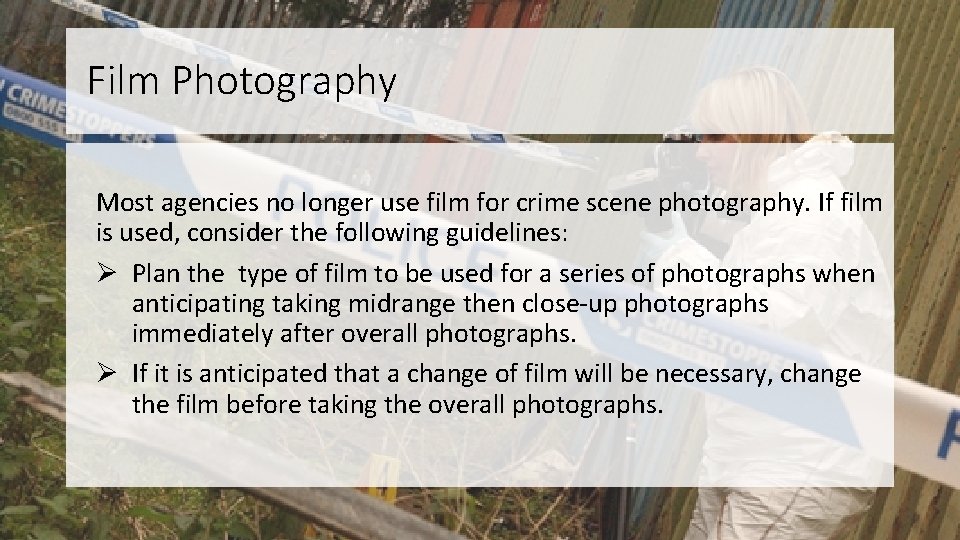
Film Photography Most agencies no longer use film for crime scene photography. If film is used, consider the following guidelines: Ø Plan the type of film to be used for a series of photographs when anticipating taking midrange then close-up photographs immediately after overall photographs. Ø If it is anticipated that a change of film will be necessary, change the film before taking the overall photographs.
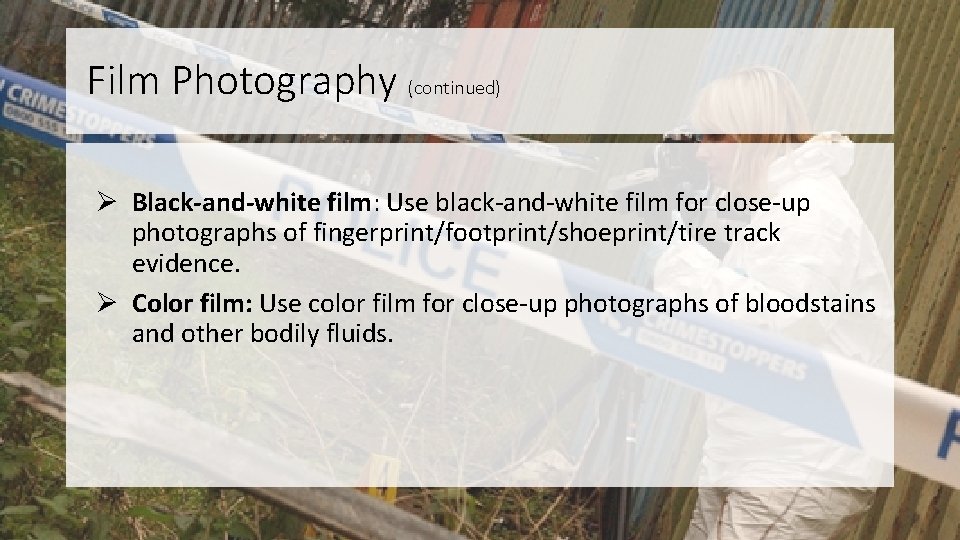
Film Photography (continued) Ø Black-and-white film: Use black-and-white film for close-up photographs of fingerprint/footprint/shoeprint/tire track evidence. Ø Color film: Use color film for close-up photographs of bloodstains and other bodily fluids.
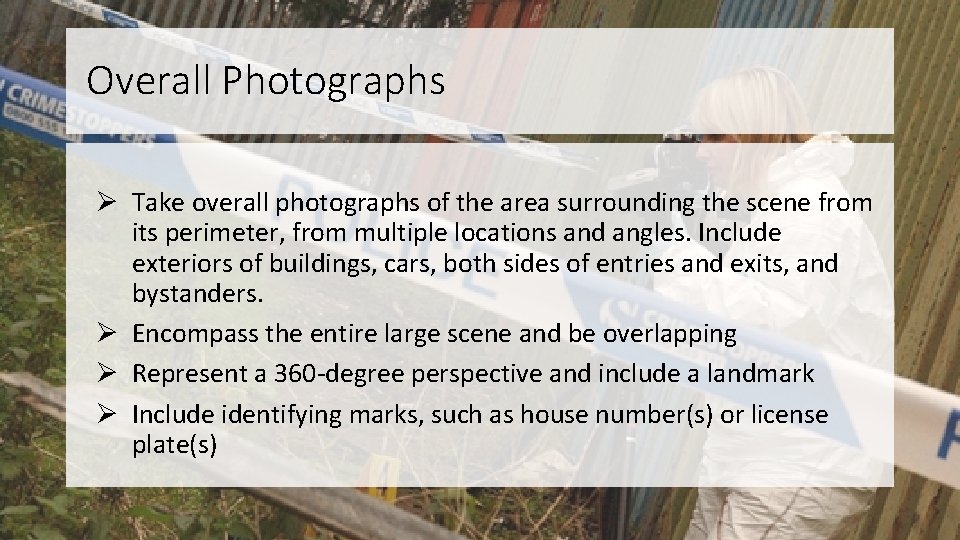
Overall Photographs Ø Take overall photographs of the area surrounding the scene from its perimeter, from multiple locations and angles. Include exteriors of buildings, cars, both sides of entries and exits, and bystanders. Ø Encompass the entire large scene and be overlapping Ø Represent a 360 -degree perspective and include a landmark Ø Include identifying marks, such as house number(s) or license plate(s)
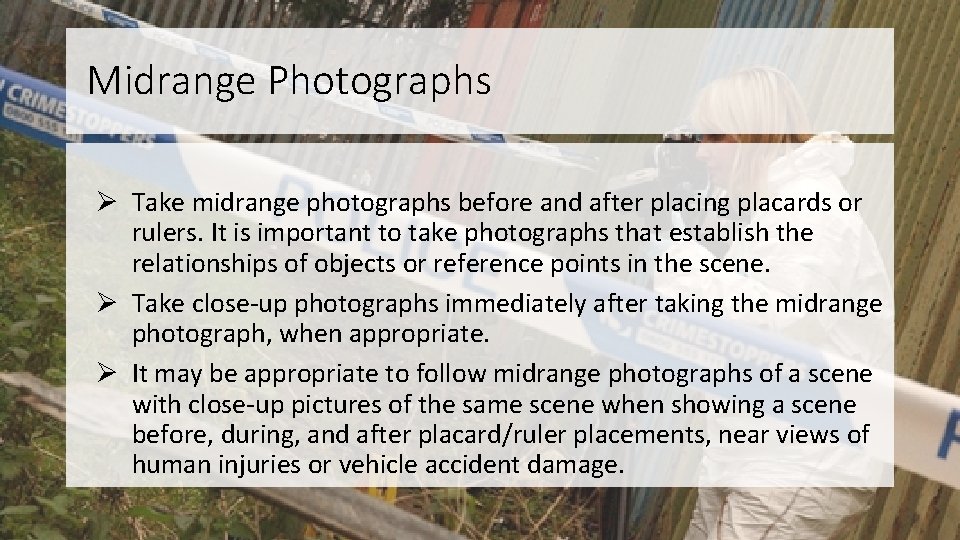
Midrange Photographs Ø Take midrange photographs before and after placing placards or rulers. It is important to take photographs that establish the relationships of objects or reference points in the scene. Ø Take close-up photographs immediately after taking the midrange photograph, when appropriate. Ø It may be appropriate to follow midrange photographs of a scene with close-up pictures of the same scene when showing a scene before, during, and after placard/ruler placements, near views of human injuries or vehicle accident damage.
Midrange Photographs Ø While taking photographs of a scene, record related information in notes. Ø Take photographs of transient evidence from a position that: • Shows the spatter relative to other objects in the area • Is perpendicular to the spatter Ø Take pictures of the scene before and after placing the placards and rulers, and after removing the placards and rulers.
Photographing the Deceased Before the body of a deceased person is moved, it should be photographed. The following guidelines should be followed: Ø Take photographs from all possible angles. Show a facial view, and the positions of the hands and feet when possible to do so without altering the body, its clothing or position. Wound photography should be conducted at close-up range. Ø Take photographs while moving around the body and from an overhead perspective. Photograph the body from two perspectives, when possible: a) As though looking at the body from a standing position b) From the same level as the body is lying, such as at ground level when the body is lying on the ground
Photographing the Deceased Ø Use oblique lighting to show wounds on the body, such as bite marks, with and without a scale. Ø After the deceased has been removed from the scene, photograph the area where the body was.
Photographing the Deceased Ø Signs of activity can include: • TV and room lights turned on • A glass holding a cold beverage (ice melting or still frozen) and a plate with fresh food on it • Scattered clothing, magazines, or other objects • A landline phone that was in use and is making a loud notification sound • Misplaced furniture, as with a tipped stool beside a body • Cigarettes, lit or remains piled in ashtray • Tool marks in unusual location or near entry/exit • Shoeprints and/or fingerprints • Drug paraphernalia
Photographing the Deceased Ø Include the time that photographing was begun and completed in the notes. Ø Remove the film or download the digital images and store in a secure location according to departmental regulations.
Close-up Photographs Ø Photograph fingerprint/footprint/shoeprint/tire track evidence using black-and-white film (when using film). Carefully place the ruler and camera perpendicular to each other and relative to the impression. When the photograph needs to be accurately scaled: • The ruler must be on the same plane as the impression. • The camera lens must be perpendicular (90 degrees) to the subject. • Use a level and tripod to position the camera accurately.
Close-up Photographs Ø Take multiple shots with the light or flash at different angles, such as 0 degrees, 15 degrees, 45 degrees, etc. , to achieve the best possible photographs.
Taking Photos of Impression Evidence Ø Tire Impressions: For tire impressions, take a series of overlapping photographs showing the tire's entire circumference. Ø Impressions on Glass: When the impression is on glass and when possible: • Protect latent prints • Position a colored card or piece of cloth that contrasts with the impression behind the glass • Include in notes that this approach was used for contrast purposes to obtain the photograph
Aerial Photographs Ø Take aerial and/or overhead photographs of a scene to show geographic relationships of locations or objects and aid identification of objects shown in other photographs. Ø Obtain aerial photographs by taking the pictures from a helicopter or plane. News footage can sometimes be a useful source of aerial photographs.
Aerial Photographs Ø Overhead photographs, in this context, are taken from above the scene, such as from a ladder, a second story, a cherry picker; they are not taken from the sky, as from a plane. Ø Aerial and overhead photographs must be overlapping. Ø Remove the film or download the digital images and store in a secure location according to departmental regulations.
4. Prioritize Collection of Evidence Principle: The collection of evidence must be prioritized to prevent loss, destruction, or contamination. Policy: The investigator(s) in charge and team members shall determine the order in which evidence is collected. Summary: Prioritization provides for the timely and methodical preservation and collection of evidence.
5. Crime Scene Search Methods Principle: The thorough search of a crime scene helps ensure that all relevant evidence will be recognized, documented and collected. Policy: The investigator(s) in charge shall consider different search strategies for crime scenes depending upon locale and the number of officials available to aid in searching.
6. Collect, Preserve, Inventory, Package, Transport, and Submit Evidence Principle: The handling of physical evidence is one of the most important factors of the investigation. Policy: The team member(s) shall ensure the effective collection, preservation, packaging, and transport of evidence.
7. Detailed Crime Scene Evidence Collection Principle: The accurate and timely collection of evidence can lead to the reconstruction of a scene to determine if a crime has been committed, to the identification of suspect(s) and to the successful completion of the investigation. Policy: First responders, investigators and specialized personnel who are properly trained, equipped and prepared shall collect any and all potential evidence.