
Crime Scene Investigations Module 3 Evaluation of a







- Slides: 26
Crime Scene Investigations Module 3: Evaluation of a Crime Scene • A Simplified Guide to Footwear & Tire Track Examination
Introduction • When a perpetrator hides evidence of a crime, it’s commonly called “covering their tracks. ”. • Footwear and tire track impressions are referred to as “pattern evidence” because the impressions form a unique pattern. • Shoes and boots leave prints and impressions specific to their particular brand, style and size. • The tread on each tire of a vehicle may provide investigators with similar information.
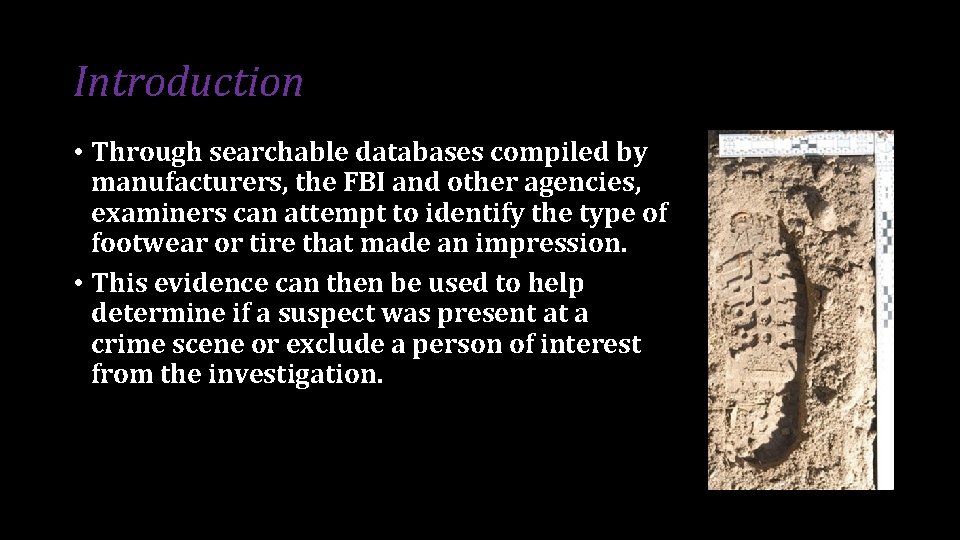
Introduction • Through searchable databases compiled by manufacturers, the FBI and other agencies, examiners can attempt to identify the type of footwear or tire that made an impression. • This evidence can then be used to help determine if a suspect was present at a crime scene or exclude a person of interest from the investigation.
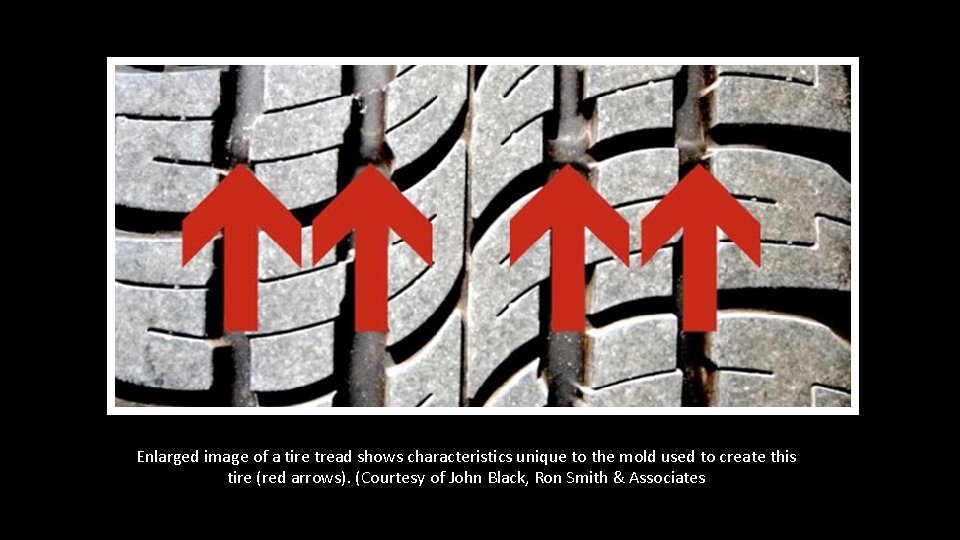
Principles of Footwear & Tire Track Examination • Examiners use three main characteristics to analyze the imprints and impressions: class, individual and wear. • Class characteristics result from the manufacturing process and are divided into general and limited. • General class characteristics include those that are standard for every item of that make and model. • Limited characteristics refer to variations that are unique to a certain mold.
Enlarged image of a tire tread shows characteristics unique to the mold used to create this tire (red arrows). (Courtesy of John Black, Ron Smith & Associates
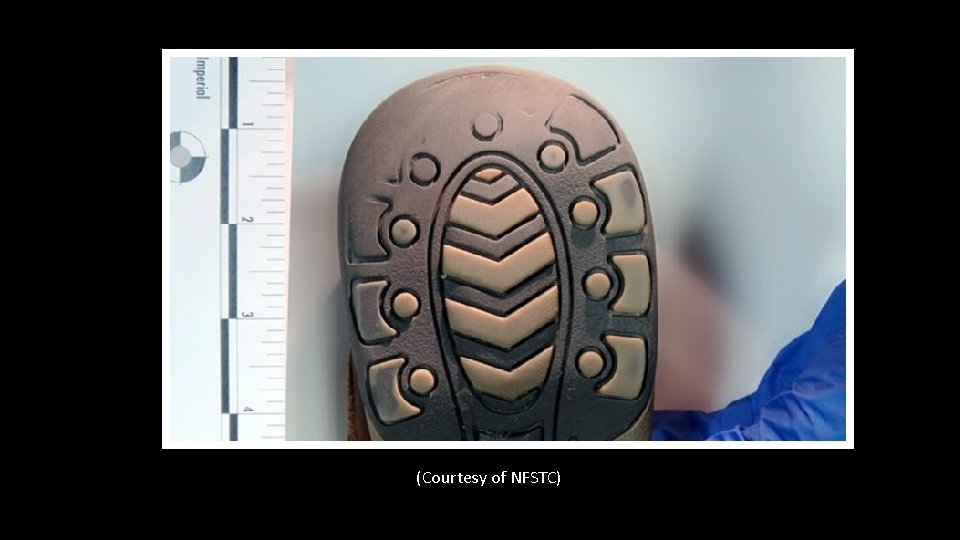
Principles of Footwear & Tire Track Examination • Individual characteristics are unique aspects of a particular shoe or tire that result from use, not the manufacturing process. These could be from damage such as a cut, gouge or crack, or a temporary alteration like a stone or twig stuck in the tread. • Wear characteristics result from the natural erosion of the shoe or tread caused by use. Specific wear characteristics include the wear pattern, the basic position of tread wear; the wear condition, the amount or depth of the wear; and where extreme, the damage to or destruction of the tread.
(Courtesy of NFSTC)
Principles of Footwear & Tire Track Examination • The basic theory behind footwear and tire track analysis is that, much like fingerprints, shoes and tires may leave behind either prints (referred to as “imprints”) or impressions that can be examined by investigators. • The type of evidence left behind depends largely on the type of surface traveled. • As shoes and tires are used, their physical features change over time. This is called wear, and is often reflected in the imprint or pattern left behind. • In the case of a tire track, if a vehicle is out of alignment, the right front tire may be heavily worn on the outer edge, leaving a unique wear pattern. • A forensic examiner can use that wear pattern along with the tread pattern and information gained from database searches to positively match that impression to the suspect’s vehicle.
Databases • The FBI compiles and maintains the Footwear and Tire Tread Files database containing manufacturers’ information and information from previously submitted evidence. • This information can be used by examiners or investigators to determine the brand name and model of shoe or tire imprints and impressions found at crime scenes. • The National Institute of Justice also maintains a list of forensic databases (http: //www. nij. gov/journals/258/forensic‐‐‐databases. html).
Why and when is footwear & tire track examination used? • Footwear and/or tire track evidence can be found at many crime scenes including breaking and entering, assault, hit and run, armed robbery, rape and homicide. • This type of evidence can provide valuable information to investigators including: ü Where the crime occurred ü The number of parties or vehicles present ü The direction a person may have traveled before, during or after the crime ü Whether a person was on foot ü Other crime scenes connected to a perpetrator
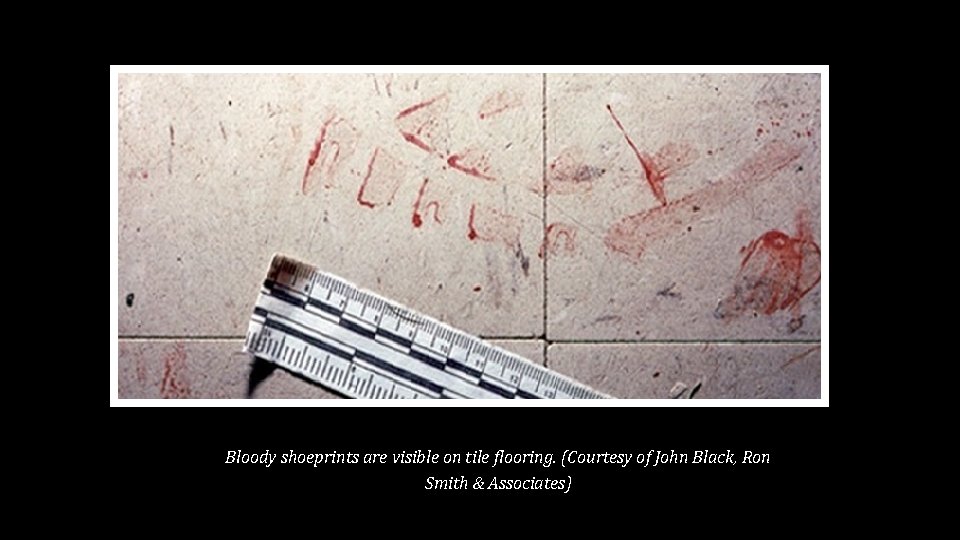
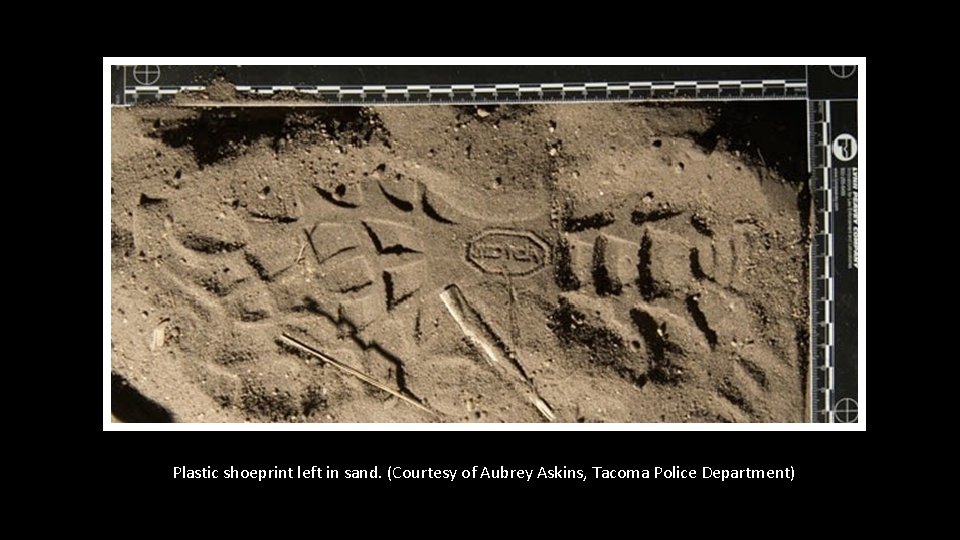
How It’s Done - Evidence that May be Examined • Footwear and tire tracks can be deposited on almost any surface, from paper to the human body. • Prints are divided into three types: visible, plastic and latent. 1. A visible print is a transfer of material from the shoe or tire to the surface. This type can be seen by the naked eye without additional aids. 2. A plastic print is a three‐‐‐dimensional impression left on a soft surface. This includes shoe or tire tracks left in sand, mud or snow.
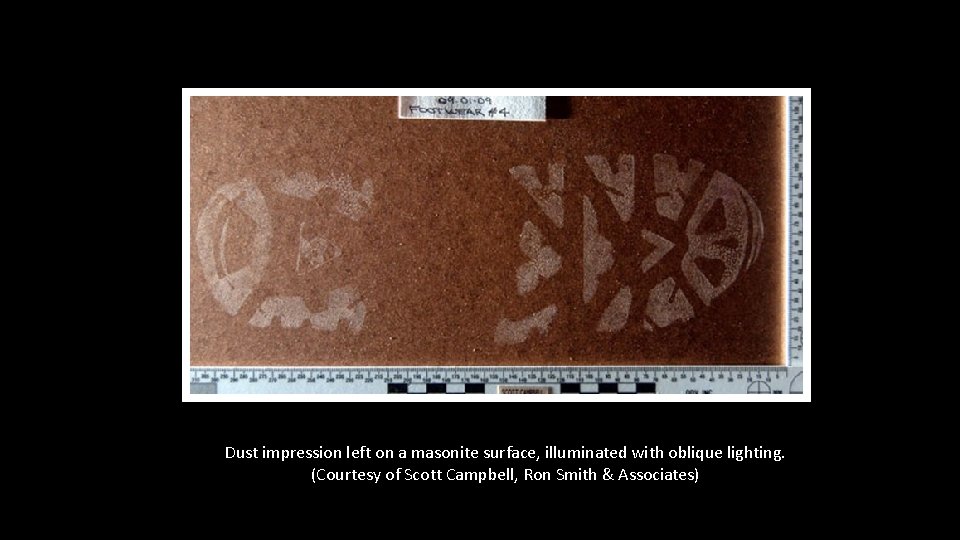
Prints (continued) 3. A latent print is one that is not readily visible to the naked eye. This type is created through static charges between the sole or tread and the surface. • Examiners or investigators use powders, chemicals or alternate light sources to find these prints.
Bloody shoeprints are visible on tile flooring. (Courtesy of John Black, Ron Smith & Associates)
Plastic shoeprint left in sand. (Courtesy of Aubrey Askins, Tacoma Police Department)
Dust impression left on a masonite surface, illuminated with oblique lighting. (Courtesy of Scott Campbell, Ron Smith & Associates)
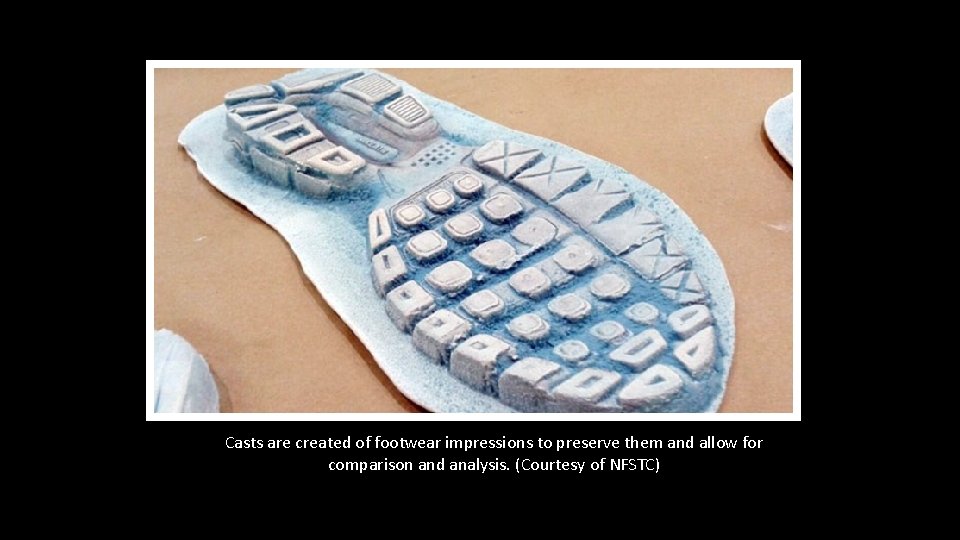
How Samples are Collected • Examiners use several methods for collecting footwear and tire track evidence depending on the type of impression found. • For impressions in soil, snow or other soft surfaces, casting is the most commonly used collection method. • For imprints, examiners generally try to collect the entire object containing the imprint, such as a whole sheet of paper or cardboard with a shoe print.
Casts are created of footwear impressions to preserve them and allow for comparison and analysis. (Courtesy of NFSTC)
How Samples are Collected (continued) • As with any evidence found at a crime scene, shoeprints and tire tracks must be properly documented, collected and preserved in order to maintain the integrity of the evidence. • Properly photographing impressions is crucial. Since there is only a slight difference between different shoe sizes, if the photographs are not taken at a 90° angle to the impression, then the true size cannot be produced in order to compare to the actual shoe.
How Samples are Collected (continued) For shoeprints and tire tracks that cannot be picked up, various lifting techniques are used to recover the evidence. These include: • Adhesive lifter ‐‐‐ a heavy coating of adhesive lifts the imprint from smooth, non‐‐‐delicate surfaces such as tile or hardwood floors, metal counters, etc. It is usually used in conjunction with fingerprint powders. • Gelatin lifter ‐‐‐ a sheet of rubber with a low‐‐‐adhesive gelatin layer on one side that can lift prints from almost any surface, including porous, rough, curved and textured surfaces. It is less tacky and more flexible than an adhesive lifter, allowing it to pick up a dusty shoeprint on a cardboard box, for example, but not tear the surface of the box. • Electrostatic dust‐‐‐print lifting device ‐‐‐ a tool that electrostatically charges particles within dust or light soil, which are then attracted and bonded to a lifting film. This method is best for collecting dry or dusty residue impressions on almost any surface, even the skin of a cadaver.
How Samples are Collected (continued) • Any plastic, or three‐‐‐dimensional, footwear or tire impressions can be collected by casting. • Casting uses a powdered stone material, such as dental stone, that can be mixed with water and poured into the impression. When it dries, this method creates a three‐‐‐dimensional model of the impression.
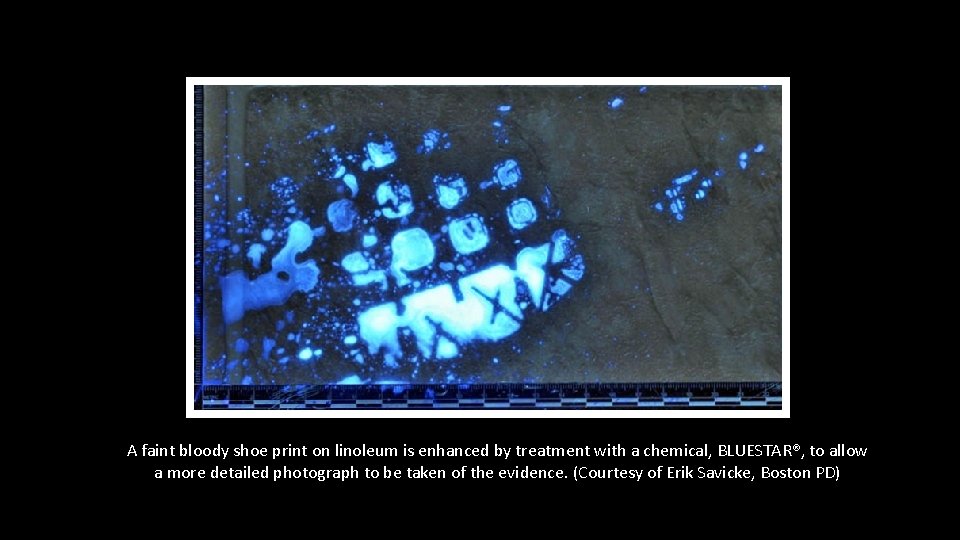
A faint bloody shoe print on linoleum is enhanced by treatment with a chemical, BLUESTAR®, to allow a more detailed photograph to be taken of the evidence. (Courtesy of Erik Savicke, Boston PD)
Who Conducts the Analysis • Evaluation and comparison of impression evidence should be performed by a well‐‐‐trained footwear and tire track examiner. • Typically these professionals have received extensive training on footwear and tire manufacturing, evidence detection, recovery, handling and examination procedures, laboratory and photography equipment and procedures, courtroom testimony and legal issues, and casework.
How and Where the Analysis is Performed • Detection, documentation, photography, and collection of imprints and impressions occur in relation to crime scenes of many types. • Analysis of impression evidence is typically performed at a public crime laboratory or private laboratory by experienced examiners.
Evidence Submission and Examination • Ideally, the suspect’s shoes and/or tires are submitted to the lab along with the collected evidence. • Examiners will use the submitted shoes and/or tires to make test standards, impressions of a known source, which can then be compared to the collected evidence. • This is usually done using transparency overlays or side‐‐‐by‐ ‐‐side comparisons.
Tools and Techniques • During the examination and comparison, examiners use tools such as dividers, calipers, special lighting and low magnification. • Examiners measure the various elements within the tread design as well as the length and width of the impressions, and then compare those measurements to what is seen in the crime scene print or impressions. • Low magnification and special lighting are sometimes used to determine if various characteristics are accidental or something that was created during the manufacturing process.
Resources and References • Investigators or examiners often use searchable databases containing reference files of shoe outsoles and tire treads to determine the brand/model of a shoe or tire. • The FBI, private consultants and fee‐‐‐based commercial systems maintain databases with tens of thousands of prints. • The FBI’s Criminal Justice Information System (CJIS) maintains the Footwear and Tire Tread Files database. • The SWGTREAD website http: //www. swgtread. org/ contains links, resources, information and videos to assist investigators and examiners.