
CRIME SCENE CORPUS DELICTI Body of the Crime
CRIME SCENE

CORPUS DELICTI “Body of the Crime” You must prove: â that a crime occurred â that the person charged with the crime was responsible for the crime Top Reasons for Committing a Crime â Money â Revenge â Sex â Emotion--love, hate, anger Source of Evidence â Body â Primary and/or Secondary Crime Scene â Suspect(s)
Corpus Delicti cont. • Search for Physical Evidence a. Collect adequate & appropriate samples for comparison b. Describe the location & condition of items collected c. Seal, initial, & label all packages, envelopes & containers
Corpus Delicti cont. d. Maintain the integrity of all evidence e. Deliver all items to the appropriate laboratory promptly f. Keep accurate records of all data
Crime Scene Team A group of professionals investigators, each trained in a variety of special disciplines. Team Members ã ã ã First Police Officer on the scene Medics (if necessary) Investigator(s) Medical Examiner (if necessary) Photographer and/or Field Evidence Technician Lab Experts pathologist DNA expert forensic odontologist forensic psychologist firearm examiner document and handwriting experts serologist toxicologist forensic anthropologist forensic entomologist bomb and arson expert fingerprint expert
1. Physical Evidence Encompasses any and all objects that can establish that a crime has been committed or can provide a link between a crime and its victim or a crime and its perpetrator; anything that is tangible, can be seen or measured, with or without magnification.
PHYSICAL EVIDENCE You can lead a jury to the truth but you can’t make them believe it. Physical evidence cannot be intimidated. It does not forget. It doesn’t get excited at the moment something is happening-like people do. It sits there and waits to be detected, preserved, evaluated and explained. This is what physical evidence is all about. In the course of the trial, defense and prosecuting attorneys may lie, witnesses may lie, the defendant certainly may lie. Even the judge may lie. Only the evidence never lies. --Herbert Leon Mac. Donell, The Evidence Never Lies
Physical Evidence • Characteristics 1. Class – common to a group of objects or persons 2. Individual – can be identified with a particular person or source
Physical Evidence • Types 1. Prints – finger, palm, lip, bare feet, shoes, tires 2. Trace – glass, paint, metal, plaster, soil 3. Hair and fiber 4. Physiological fluids – blood, semen, saliva, perspiration, vomit, urine, feces

Physical Evidence 5. Bones 6. Weapons – firearms & bullets, tools & tool marks 7. Additional – drugs, money, jewelry, plant material, documents & associated materials

Criminalistics vs Criminology ý Criminalistics is the scientific examination of physical evidence for legal purposes. ý Criminology includes the psychological angle, studying the crime scene for motive, traits, and behavior that will help to interpret the evidence.
a. Types of Physical Evidence 1) Blood, semen & saliva 2) Documents 3) Drugs 4) Explosives 5) Fibers 6) Fingerprints 7) Firearms & ammunition 8) Glass 9) Hair 10) Impressions
Types of Physical Evidence cont. 11) Organs & physiological fluids 12) Paint 13) Petroleum products 14) Plastic bags 15) Powder residues 16) Serial numbers 17) Soils & minerals 18) Tool marks 19) Vehicle lights 20) Wood or other vegetative matter
b. Identification Determination of the physical or chemical identity of the substance with as near absolute certainty as existing analytical techniques will permit.
c. Comparison Subjects a suspects specimen and a control specimen to the same tests and examination for the ultimate purpose of determining whether or not they have a common origin 1) individual 2) class
d. Assurances of quality control in the lab 1. 2. 3. 4. Duplicate testing Peer review Supervisor review Follow written procedures of the lab
e. Value of evidence (product rule) Probability and statistics related to the evidence that determine its value to the case.
f. Expert Witness Person who has established with a trial judge that he or she possesses a particular skill or knowledge.

2. Processing Physical Evidence a. Evaluate the nature of the scene -
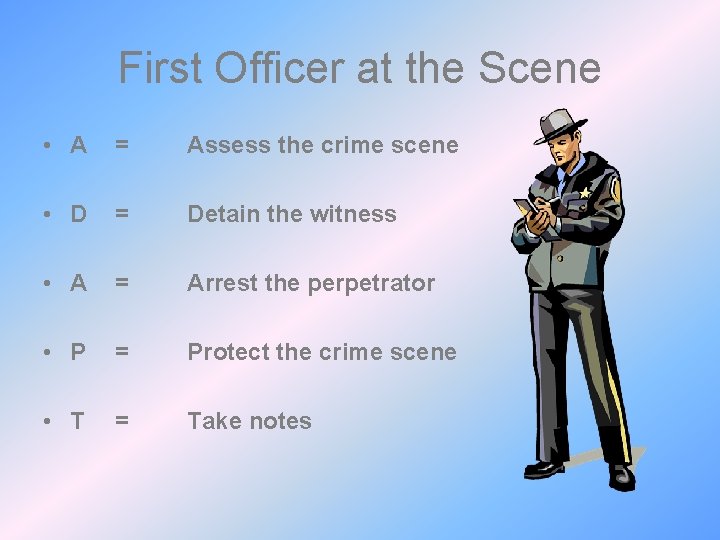
First Officer at the Scene • A = Assess the crime scene • D = Detain the witness • A = Arrest the perpetrator • P = Protect the crime scene • T = Take notes

2. Processing Physical Evidence - cont. b. Protect the scene – establish and protect the integrity of any evidence 1) Four standards for admissible evidence a) legally obtained b) relevant c) identify the item d) maintain the chain of possession
2) Frye standard the questioned procedure, technique, and principles are “generally accepted” by a meaningful segment of the relevant scientific community
Scientific Evidence in the Courtroom 1993 Daubert v. Dow 1923 Admissibility is determined by: Frye v. United States theory or technique Scientific evidence is ý Whether can be tested allowed into the ý Whether the science has been offered for peer review courtroom if it was generally accepted ý Whether the rate of error is acceptable by the scientific ý Whether the method at issue community. enjoys widespread acceptance. ý Whether the opinion is relevant to the issue
Probative Value of Physical Evidence Legally, probative value is the level at which evidence provides proof of the crime. Associative value is used to place a suspect at a crime. Product rule--how often something occurs in nature or the “real world”.
3) Federal Rules of Evidence – any knowledge that will assist the trier of fact to understand the evidence or to determine a fact in issue, a witness qualified as an expert by knowledge, skill, experience, training or education, may testify thereto in the form of an opinion.
Unusual “Physical Evidence” Crazy Criminals Donna Clark, 26, and Paul Kramer, 31, face charges in New Jersey. Clark allegedly grabbed $216 worth of film and walked out of a drugstore. The couple’s names were provided by their 6 year old son, who was in the store at the time but who was forgotten by the couple as they made their getaway.
- Slides: 26