
Crime Prevention Part I Improving Police Community Relations

- Slides: 62
Crime Prevention Part I Improving Police Community Relations Institute for Criminal Justice Studies ©TCLEOSE Course #2101 Crime Prevention Curriculum Part I is the intellectual property of CSCS-ICJS (2009)
Learning Objectives • Define community policing and its principles • Describe the benefits and the importance of citizen involvement • Identify strategies for effective communication • Identify the six factors for improving police community relations • Describe the benefits of Neighborhood Watch ©TCLEOSE Course #2101 Crime Prevention Curriculum Part I is the intellectual property of CSCS-ICJS (2009)
Crime Prevention as a Bridge Crime Prevention efforts reduce polarization that sometimes exists between police and citizens. Community Policing, Policing Neighborhood Watch, Orange Hat Patrols, Weed & Seed, and Mc. Gruff programs build a bridge that enables residents and law enforcement to communicate, collaborate, and work together to build safer, more caring communities. ©TCLEOSE Course #2101 Crime Prevention Curriculum Part I is the intellectual property of CSCS-ICJS (2009)
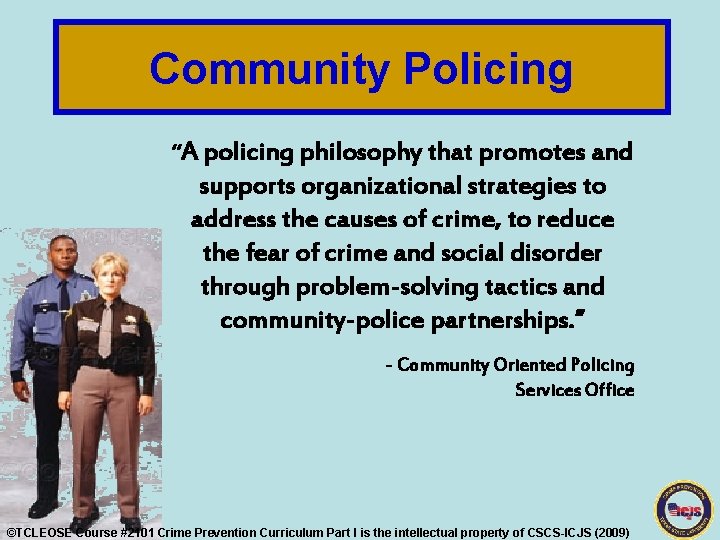
Community Policing “A policing philosophy that promotes and supports organizational strategies to address the causes of crime, to reduce the fear of crime and social disorder through problem-solving tactics and community-police partnerships. ” - Community Oriented Policing Services Office ©TCLEOSE Course #2101 Crime Prevention Curriculum Part I is the intellectual property of CSCS-ICJS (2009)
The 8 “P’s” of Community Service A PHILOSOPHY of full service, PERSONALIZED POLICING, POLICING where the same officer PATROLS and works in the same area on a PERMANENT basis, from a decentralized PLACE, PLACE working in PARTNERSHIP with citizens to identify and solve PROBLEMS ©TCLEOSE Course #2101 Crime Prevention Curriculum Part I is the intellectual property of CSCS-ICJS (2009)
Community Policing The philosophy rests on the belief that lawabiding citizens in the community have the responsibility to participate in the police process. It also rests on the belief that solutions to today’s contemporary community problems demand freeing both community residents and law enforcement to explore creative ways to address neighborhood concerns beyond a narrow focus on individual crimes. ©TCLEOSE Course #2101 Crime Prevention Curriculum Part I is the intellectual property of CSCS-ICJS (2009)
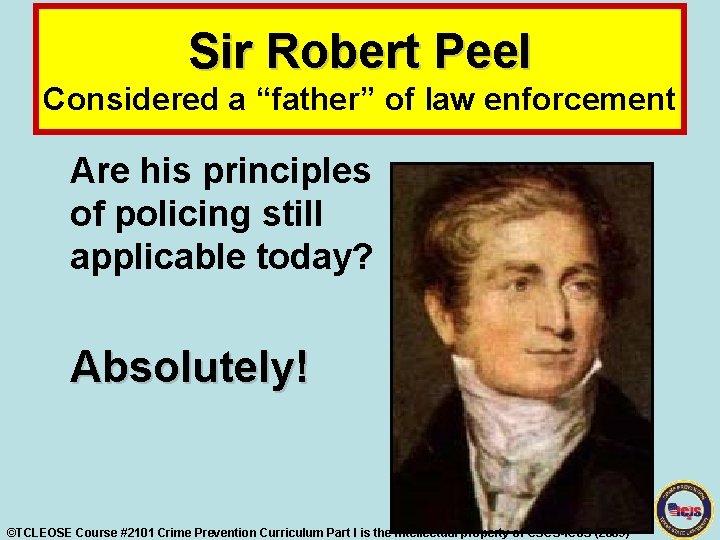
Sir Robert Peel Considered a “father” of law enforcement Are his principles of policing still applicable today? Absolutely! ©TCLEOSE Course #2101 Crime Prevention Curriculum Part I is the intellectual property of CSCS-ICJS (2009)
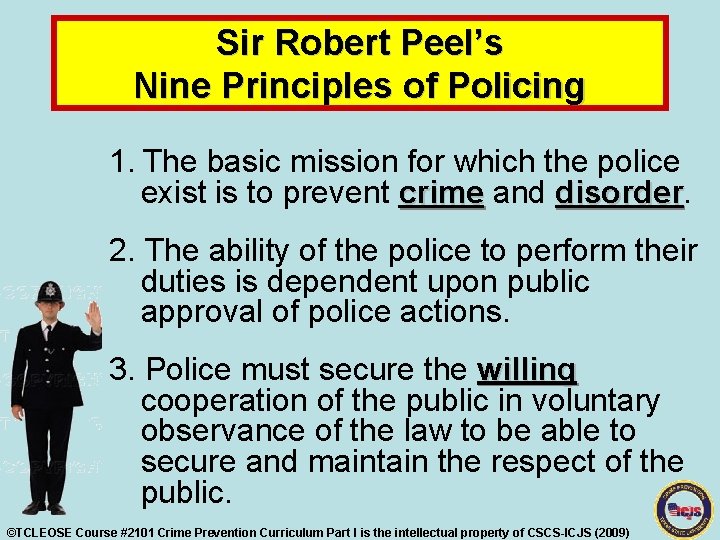
Sir Robert Peel’s Nine Principles of Policing 1. The basic mission for which the police exist is to prevent crime and disorder 2. The ability of the police to perform their duties is dependent upon public approval of police actions. 3. Police must secure the willing cooperation of the public in voluntary observance of the law to be able to secure and maintain the respect of the public. ©TCLEOSE Course #2101 Crime Prevention Curriculum Part I is the intellectual property of CSCS-ICJS (2009)
Sir Robert Peel’s Nine Principles of Policing (cont. ) 4. The degree of cooperation of the public that can be secured diminishes proportionally to the necessity of the use of force. 5. Police seek and preserve public favor not by catering to public opinion but by constantly demonstrating absolute impartial service to the law. 6. Police use physical force to the extent necessary to secure observance of the law or to restore order only when the expertise of persuasion, advice, and warning is found to be insufficient.
7. Police at all time should maintain a relationship with the public that gives reality to the historic tradition; the police are public and the public are the police. The police being only full-time individuals charged with the duties that are incumbent on all of the citizens. 8. Police should always direct their actions strictly towards their functions and never appear to usurp the powers of the judiciary. 9. The test of police efficiency is the absence of crime and disorder, not the visible evidence of police action in dealing with it.
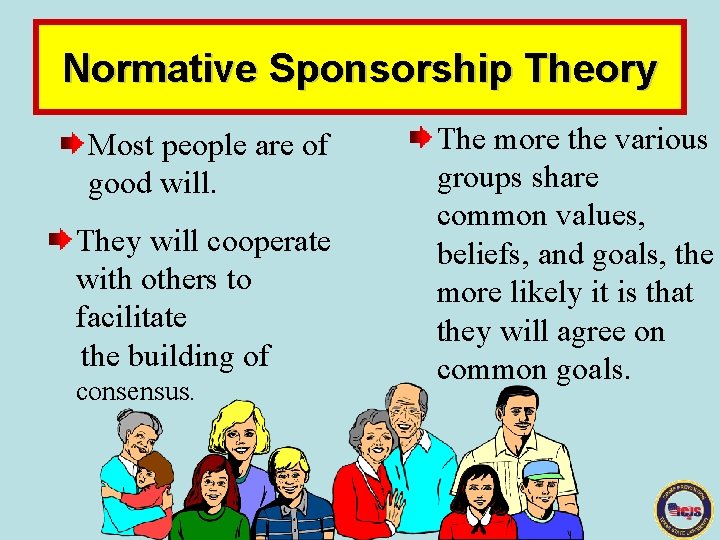
Normative Sponsorship Theory Most people are of good will. They will cooperate with others to facilitate the building of consensus. The more the various groups share common values, beliefs, and goals, the more likely it is that they will agree on common goals.
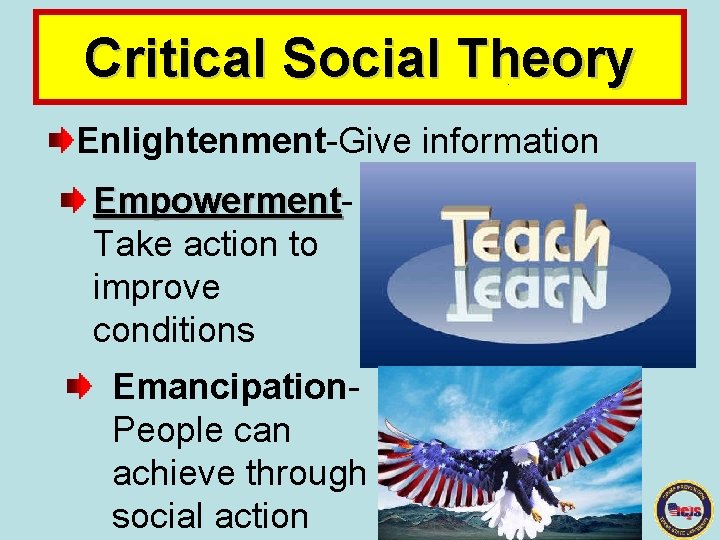
Critical Social Theory Enlightenment-Give information Empowerment Take action to improve conditions Emancipation. People can achieve through social action
Community relationships provide Worth in social value A more informed citizenry Example to young people and others Added value Opportunity to learn about law enforcement while working with law enforcement Learning about citizens’ concerns ©TCLEOSE Course #2101 Crime Prevention Curriculum Part I is the intellectual property of CSCS-ICJS (2009)
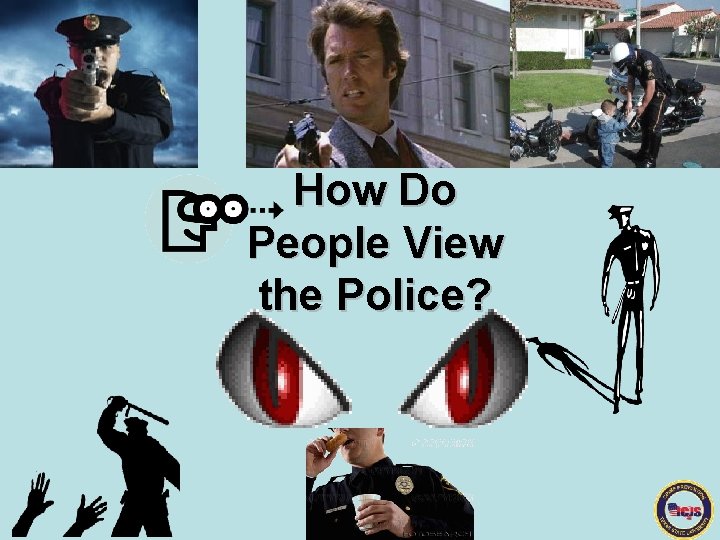
How Do People View the Police?
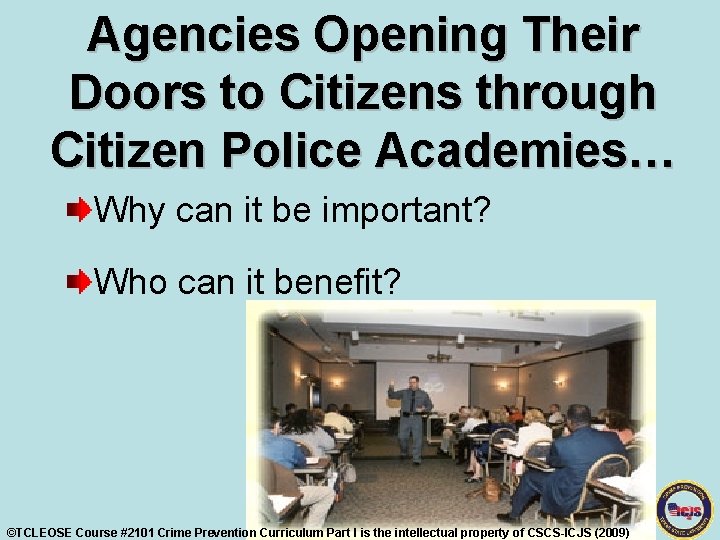
Agencies Opening Their Doors to Citizens through Citizen Police Academies… Why can it be important? Who can it benefit? ©TCLEOSE Course #2101 Crime Prevention Curriculum Part I is the intellectual property of CSCS-ICJS (2009)
Philosophy of the Citizen Police Academy Agency size and demographics can sometimes create barriers between the police and those they serve. Community policing is paramount to the effectiveness of crime reduction. Police Image – There are many misconceptions to dispel. ©TCLEOSE Course #2101 Crime Prevention Curriculum Part I is the intellectual property of CSCS-ICJS (2009)
Philosophy of the Citizen Police Academy (cont. ) Who Will Benefit from It? EVERYONE! àCommunity àPolice àBusiness àSchools àGovernment àYouth ©TCLEOSE Course #2101 Crime Prevention Curriculum Part I is the intellectual property of CSCS-ICJS (2009)
Philosophy of the Citizen Police Academy (cont. ) • • What They Accomplish Improved • Better Cooperation Communications Less Apathy • Improved Police Reduction in Crime Image Reduction in Fear of • Clear Understanding Crime ©TCLEOSE Course #2101 Crime Prevention Curriculum Part I is the intellectual property of CSCS-ICJS (2009)
Introduction to Volunteers in Police Service Foundations of the VIPS Program 2002 Presidential initiative Department of Justice and IACP responsibilities Concept Volunteers from the community Expanding law enforcement to the community Grapevine Police Dept. Has a model VIPS Program in Texas!
Volunteers in Police Service (cont. ) Why they are needed Ease demands on law enforcement Encourage a more informed citizenry Provide an example to young people Improve cooperation and understanding between the police and their community
Considerations of Community Interaction How community volunteers can be used within their community Legal issues Safety issues Expertise issues ©TCLEOSE Course #2101 Crime Prevention Curriculum Part I is the intellectual property of CSCS-ICJS (2009)
Community/Police Needs and Support Filling needs with volunteers Coordinating position Prerecruitment action required Role of the International Association of Chiefs of Police Match volunteers to the organization’s strategic plan Possible volunteer positions (adapt to local needs)
Recruiting and Marketing Recruitment strategy Who is your target? Develop a plan
Recruiting and Marketing Recognize important existing networks and tap in to; Churches, PTAs, community councils, Kiwanis, Rotarians, etc. Elementary and secondary schools Youth, Youth courts, citizen police academies ©TCLEOSE Course #2101 Crime Prevention Curriculum Part I is the intellectual property of CSCS-ICJS (2009)
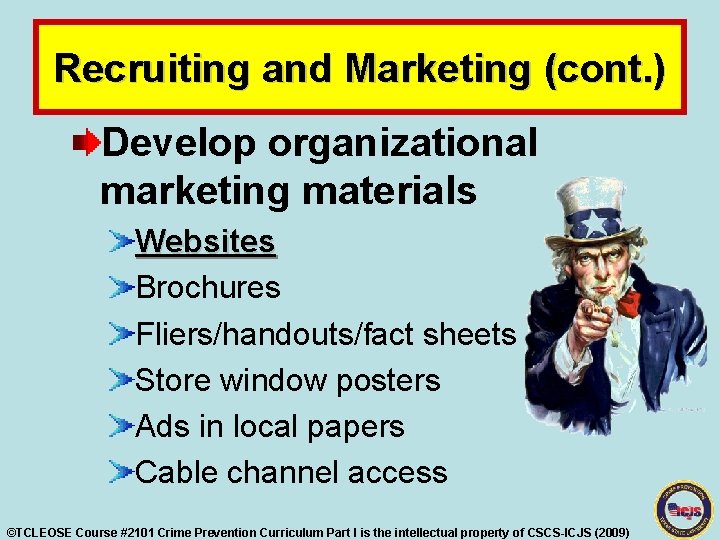
Recruiting and Marketing (cont. ) Develop organizational marketing materials Websites Brochures Fliers/handouts/fact sheets Store window posters Ads in local papers Cable channel access ©TCLEOSE Course #2101 Crime Prevention Curriculum Part I is the intellectual property of CSCS-ICJS (2009)
Recruiting and Marketing (cont. ) Media assistance Public service announcements News releases Pre-recruitment strategy Secure top management buy-in Develop organization marketing materials ©TCLEOSE Course #2101 Crime Prevention Curriculum Part I is the intellectual property of CSCS-ICJS (2009)
What does a citizen needs to know before volunteering? Position description Time commitment Defined program activities Direct supervisor Website access for personal record of service/journal How long should volunteers serve? Age criteria Citizen police academy attendance prior to service
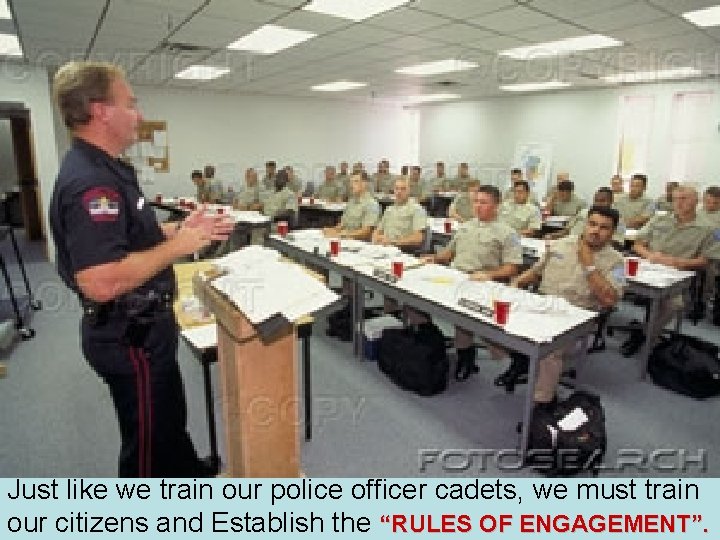
Just like we train our police officer cadets, we must train our citizens and Establish the “RULES OF ENGAGEMENT”.
Police Agency Management and Administrative Issues Agency mission, objectives, and goals Define the agency’s mission, objectives, and goals Volunteer concept and political consideration Volunteer objectives and goals within agency mission Clear and specific department guidelines for volunteers ©TCLEOSE Course #2101 Crime Prevention Curriculum Part I is the intellectual property of CSCS-ICJS (2009)
VIPS Management and Administrative Issues Develop a prerecruitment strategy according to the VIPS’ goal to help resource-constrained agencies Internal management responsibilities External management responsibilities Who can manage the program Training issues Liability issues Funding issues
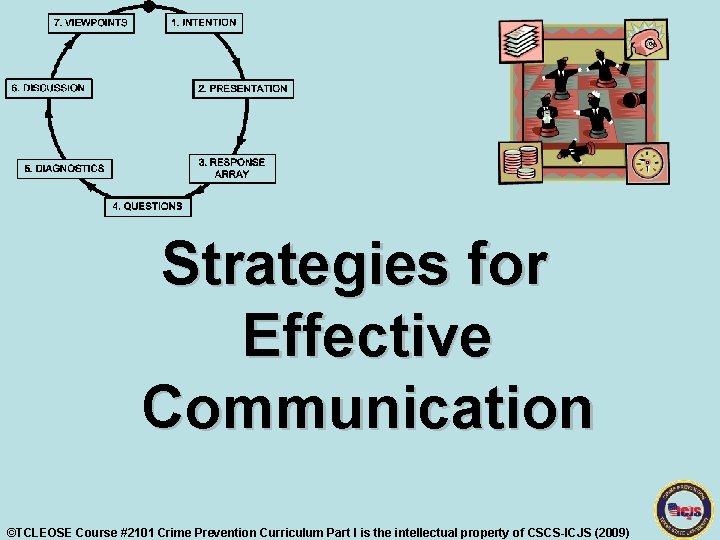
Strategies for Effective Communication ©TCLEOSE Course #2101 Crime Prevention Curriculum Part I is the intellectual property of CSCS-ICJS (2009)
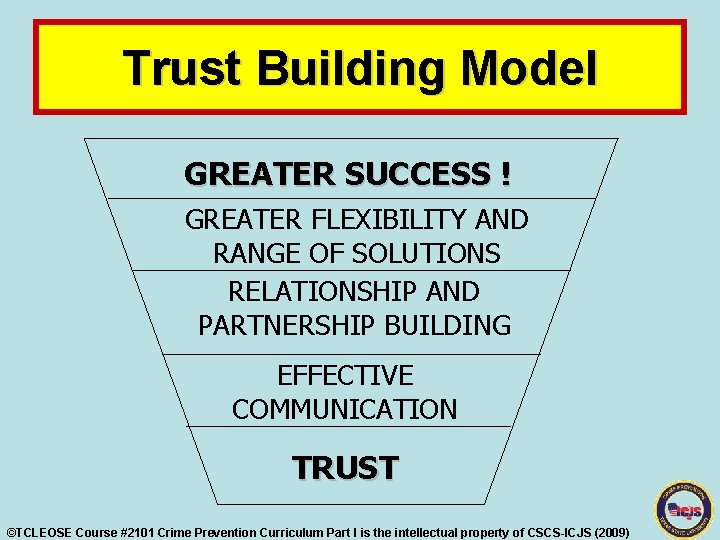
Trust Building Model GREATER SUCCESS ! GREATER FLEXIBILITY AND RANGE OF SOLUTIONS RELATIONSHIP AND PARTNERSHIP BUILDING EFFECTIVE COMMUNICATION TRUST ©TCLEOSE Course #2101 Crime Prevention Curriculum Part I is the intellectual property of CSCS-ICJS (2009)
The Communication Process Message cues Listener supplies meaning Content Relate to your audience and build a rapport ©TCLEOSE Course #2101 Crime Prevention Curriculum Part I is the intellectual property of CSCS-ICJS (2009)
The Communication Process (cont. ) One-way or two-way communication Verbal/nonverbal cues Physical appearance Solicit engagement and participation by using open-ended questions and feedback. ©TCLEOSE Course #2101 Crime Prevention Curriculum Part I is the intellectual property of CSCS-ICJS (2009)
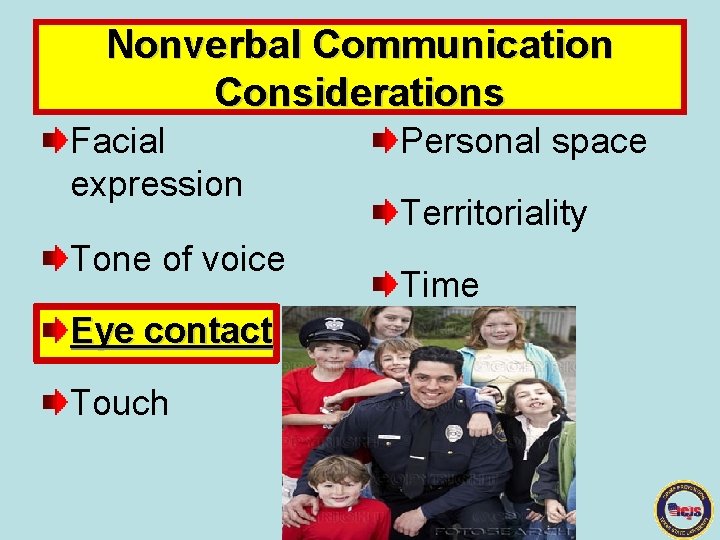
Nonverbal Communication Considerations Facial expression Tone of voice Eye contact Touch Personal space Territoriality Time
Building Trust Through Effective Communication Effective Listening Listen to learn and understand, not to challenge or persuade. Take turns and listen for FACTS and FEELINGS. (Both are important. ) ©TCLEOSE Course #2101 Crime Prevention Curriculum Part I is the intellectual property of CSCS-ICJS (2009)
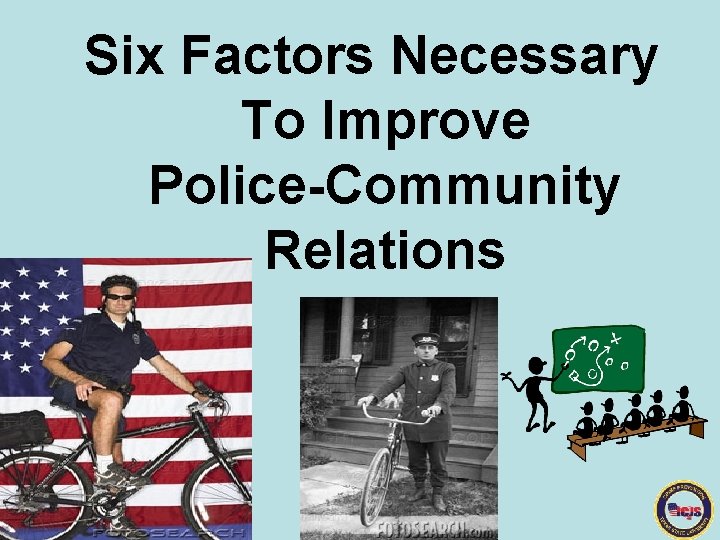
Six Factors Necessary To Improve Police-Community Relations
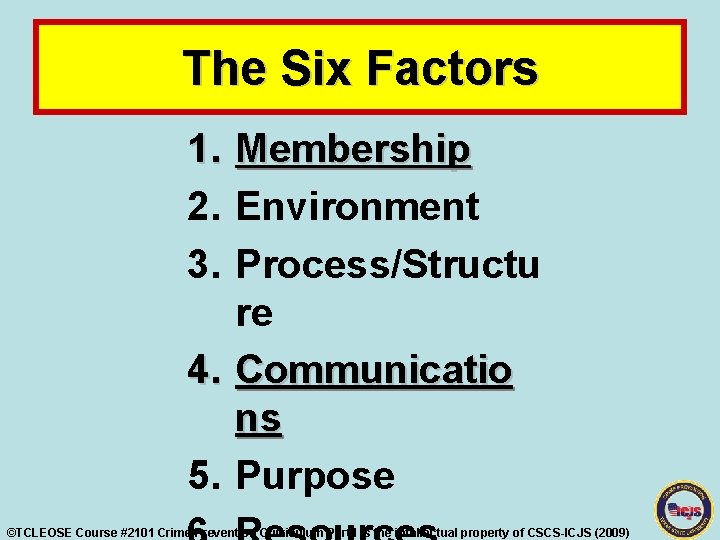
The Six Factors 1. 2. 3. Membership Environment Process/Structu re 4. Communicatio ns 5. Purpose ©TCLEOSE Course #2101 Crime Prevention Curriculum Part I is the intellectual property of CSCS-ICJS (2009)
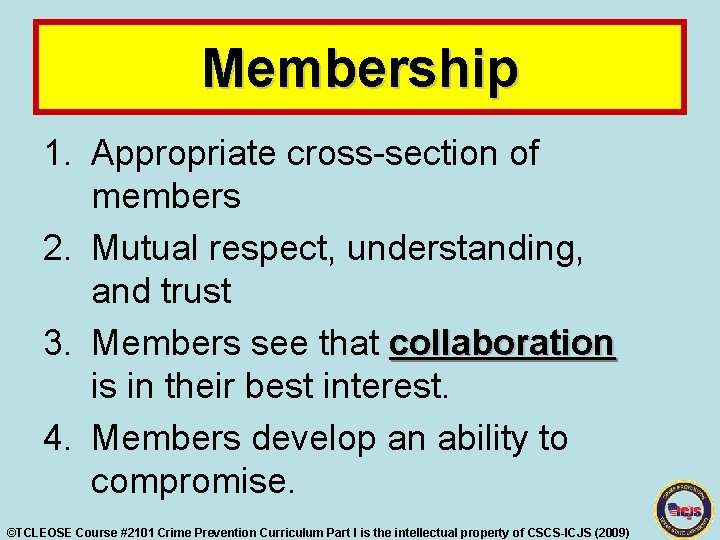
Membership 1. Appropriate cross-section of members 2. Mutual respect, understanding, and trust 3. Members see that collaboration is in their best interest. 4. Members develop an ability to compromise. ©TCLEOSE Course #2101 Crime Prevention Curriculum Part I is the intellectual property of CSCS-ICJS (2009)
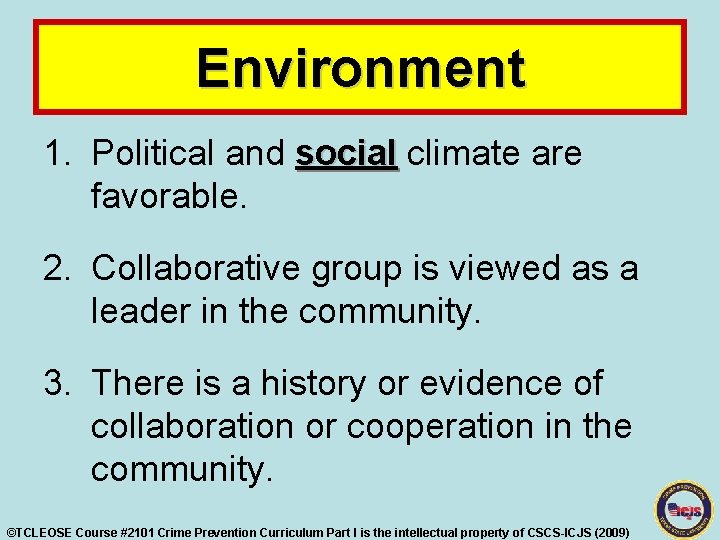
Environment 1. Political and social climate are favorable. 2. Collaborative group is viewed as a leader in the community. 3. There is a history or evidence of collaboration or cooperation in the community. ©TCLEOSE Course #2101 Crime Prevention Curriculum Part I is the intellectual property of CSCS-ICJS (2009)
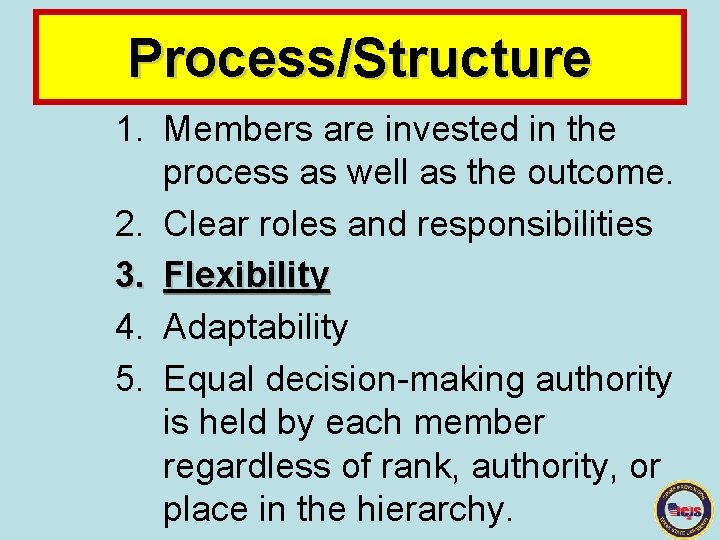
Process/Structure 1. Members are invested in the process as well as the outcome. 2. Clear roles and responsibilities 3. Flexibility 4. Adaptability 5. Equal decision-making authority is held by each member regardless of rank, authority, or place in the hierarchy.
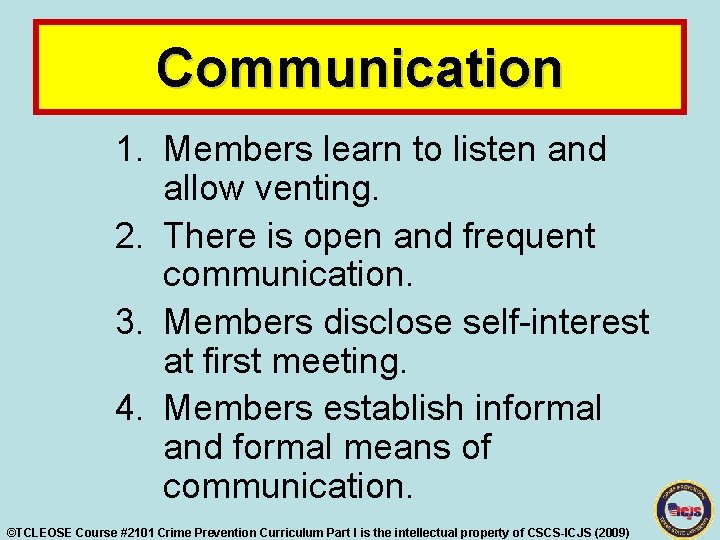
Communication 1. Members learn to listen and allow venting. 2. There is open and frequent communication. 3. Members disclose self-interest at first meeting. 4. Members establish informal and formal means of communication. ©TCLEOSE Course #2101 Crime Prevention Curriculum Part I is the intellectual property of CSCS-ICJS (2009)
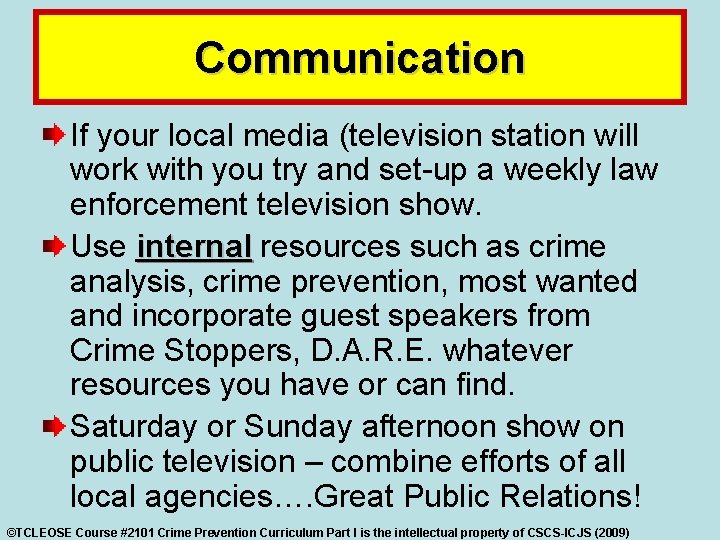
Communication If your local media (television station will work with you try and set-up a weekly law enforcement television show. Use internal resources such as crime analysis, crime prevention, most wanted and incorporate guest speakers from Crime Stoppers, D. A. R. E. whatever resources you have or can find. Saturday or Sunday afternoon show on public television – combine efforts of all local agencies…. Great Public Relations! ©TCLEOSE Course #2101 Crime Prevention Curriculum Part I is the intellectual property of CSCS-ICJS (2009)
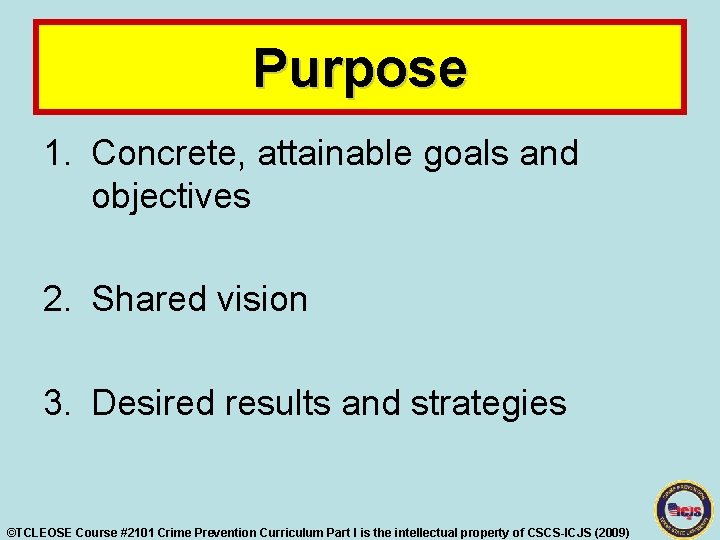
Purpose 1. Concrete, attainable goals and objectives 2. Shared vision 3. Desired results and strategies ©TCLEOSE Course #2101 Crime Prevention Curriculum Part I is the intellectual property of CSCS-ICJS (2009)
Resources 1. A skilled and unbiased convener 2. Staff time and volunteer time 3. Sufficient funds ©TCLEOSE Course #2101 Crime Prevention Curriculum Part I is the intellectual property of CSCS-ICJS (2009)
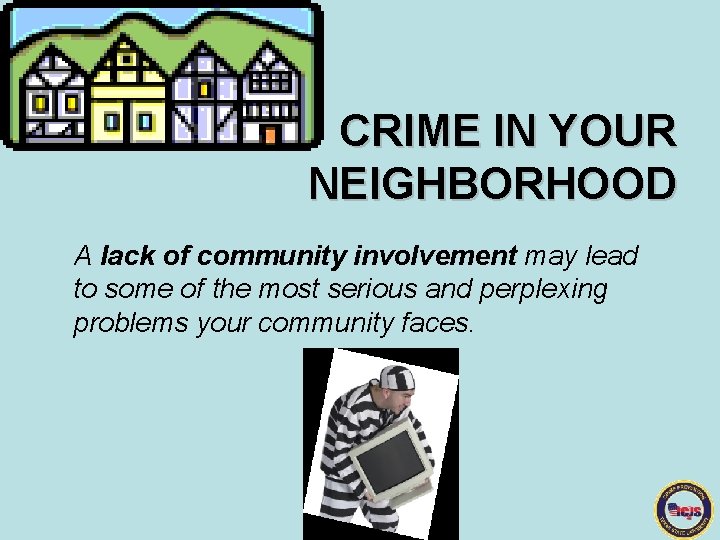
CRIME IN YOUR NEIGHBORHOOD A lack of community involvement may lead to some of the most serious and perplexing problems your community faces.
Why is Community Involvement Important? When members of a community are involved with each other, they know Their neighbors The daily “goings-on” in the neighborhood When something is wrong ©TCLEOSE Course #2101 Crime Prevention Curriculum Part I is the intellectual property of CSCS-ICJS (2009)
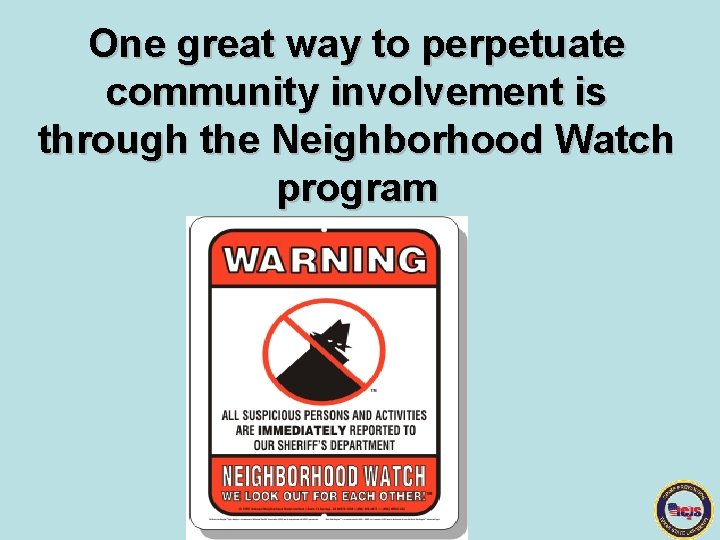
One great way to perpetuate community involvement is through the Neighborhood Watch program
What is the Neighborhood Watch program? Neighborhood Watch was established in 1970 to bring residents together to interact and become the guardians for the police in their community.
Neighborhood Watch Concept Crime prevention group organized around a block, defined neighborhood, or business district Serves as “eyes and ears” ears for law enforcement Helps establish/reclaim informal control of an area by observation, visibility, and increased social interaction ©TCLEOSE Course #2101 Crime Prevention Curriculum Part I is the intellectual property of CSCS-ICJS (2009)
Neighborhood Watch Concept Donates time and resources Usually has no formal budget or funding source Success results in reduction in crime and improved quality of life for neighborhood residents ©TCLEOSE Course #2101 Crime Prevention Curriculum Part I is the intellectual property of CSCS-ICJS (2009)
The Benefits of Neighborhood Watch Studies show Neighborhood Watch is effective because it Brings neighbors together around a common cause – safety and security Provides basic skills to all members on preventing crime and reporting suspicious activity or crimes Builds a base for action to correct neighborhood problems Works well with other civic associations
Additional Citizen Actions Discuss your community’s overall security, including lighting, and contact neighbors or the proper authorities to request necessary improvements. Contact your local law enforcement agency and work with it to discuss basic community modifications that may overcome current problems. ©TCLEOSE Course #2101 Crime Prevention Curriculum Part I is the intellectual property of CSCS-ICJS (2009)
Are state crime prevention associations and Neighborhood Watch programs involved in community policing and homeland security? Absolutely! As citizens, we all share the responsibility for reporting and preventing terrorism in our communities. We can be alert and aware of those activities in our neighborhood that may have links to terrorist and criminal behavior.
How can citizens be more aware? Be informed: Read the newspaper, listen to or watch local and national news reports, and attend community meetings. Be alert: Be familiar with your environment at home, school, work, church, and social events. Be prepared: Have a prepared family plan for emergencies. Create a family first aid kit, attend crime prevention classes, and get involved with your local law enforcement and crime prevention associations. ©TCLEOSE Course #2101 Crime Prevention Curriculum Part I is the intellectual property of CSCS-ICJS (2009)
In Conclusion… Community policing is the responsibility of both law enforcement AND community members. BOTH have important roles in community policing. There are many ways to involve the community in crime-reduction and problem solving, including community meetings and citizen police academies. Police and local citizens are “ALL” members of the community. ©TCLEOSE Course #2101 Crime Prevention Curriculum Part I is the intellectual property of CSCS-ICJS (2009)
Questions and Answers ©TCLEOSE Course #2101 Crime Prevention Curriculum Part I is the intellectual property of CSCS-ICJS (2009)
LUNCH TIME BE BACK AN 1: 00 PM
DEFINE & PROCESS Define community policing and its principles Describe the benefits and the importance of citizen involvement Identify strategies for effective communication Identify the six factors for improving police community relations Describe the benefits of Neighborhood Watch
Sources & Resources • Community Policing Consortium www. communitypolicing. org • Volunteers in Police Service www. policevolunteers. org • Citizen Corps www. citizencorps. gov ©TCLEOSE Course #2101 Crime Prevention Curriculum Part I is the intellectual property of CSCS-ICJS (2009)
The National Crime Prevention Council 1000 Connecticut Avenue, NW Thirteenth Floor Washington, DC 20036 202 -466 -6272 202 -296 -1356 fax www. ncpc. org
Presenter Contact Information Institute for Criminal Justice Studies 350 N. Guadalupe, Suite 140, PMB 164 San Marcos, Texas 78666. 877 -304 -2727 www. cscs. txstate. edu ©TCLEOSE Course #2101 Crime Prevention Curriculum Part I is the intellectual property of CSCS-ICJS (2009)