
Crime Lab Missy Baker is Missing Blonde hair

Crime Lab
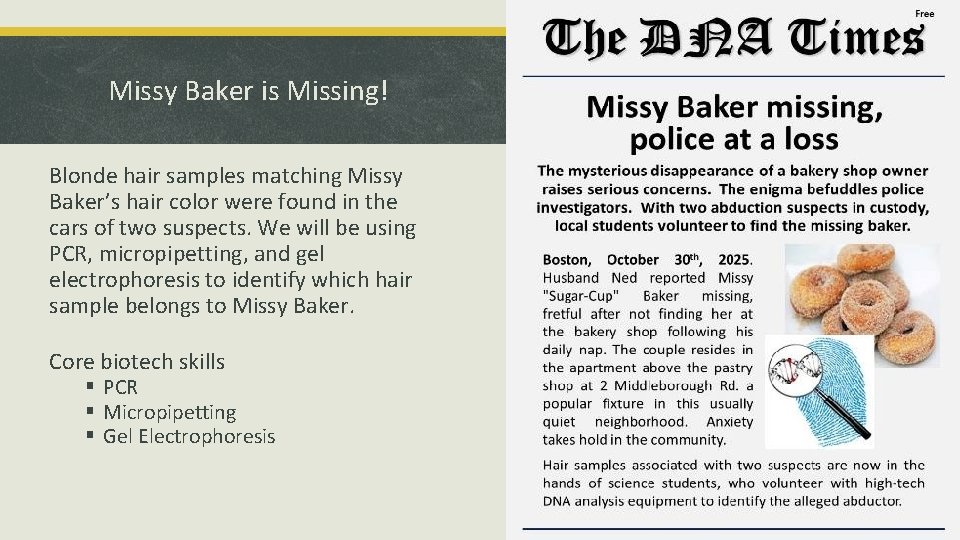
Missy Baker is Missing! Blonde hair samples matching Missy Baker’s hair color were found in the cars of two suspects. We will be using PCR, micropipetting, and gel electrophoresis to identify which hair sample belongs to Missy Baker. Core biotech skills § PCR § Micropipetting § Gel Electrophoresis
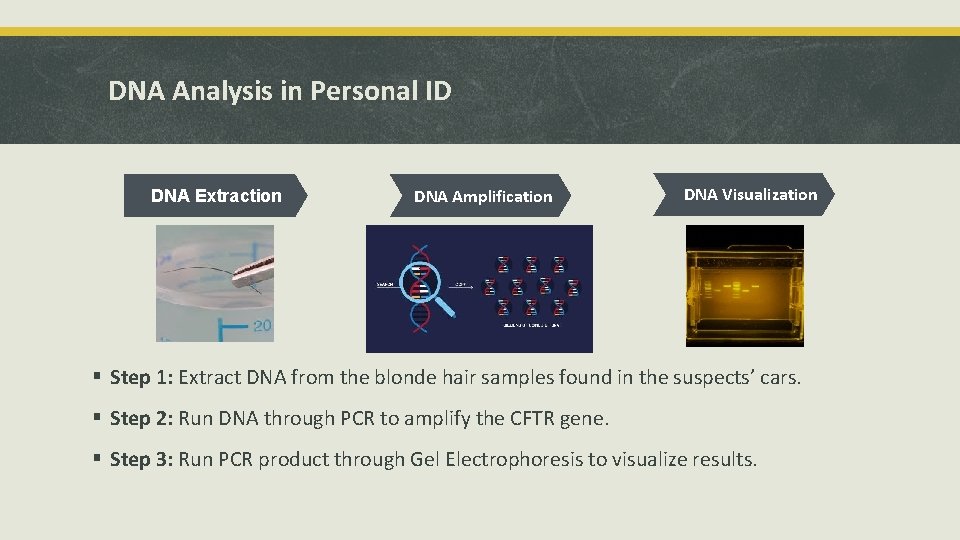
DNA Analysis in Personal ID DNA Extraction DNA Amplification DNA Visualization § Step 1: Extract DNA from the blonde hair samples found in the suspects’ cars. § Step 2: Run DNA through PCR to amplify the CFTR gene. § Step 3: Run PCR product through Gel Electrophoresis to visualize results.
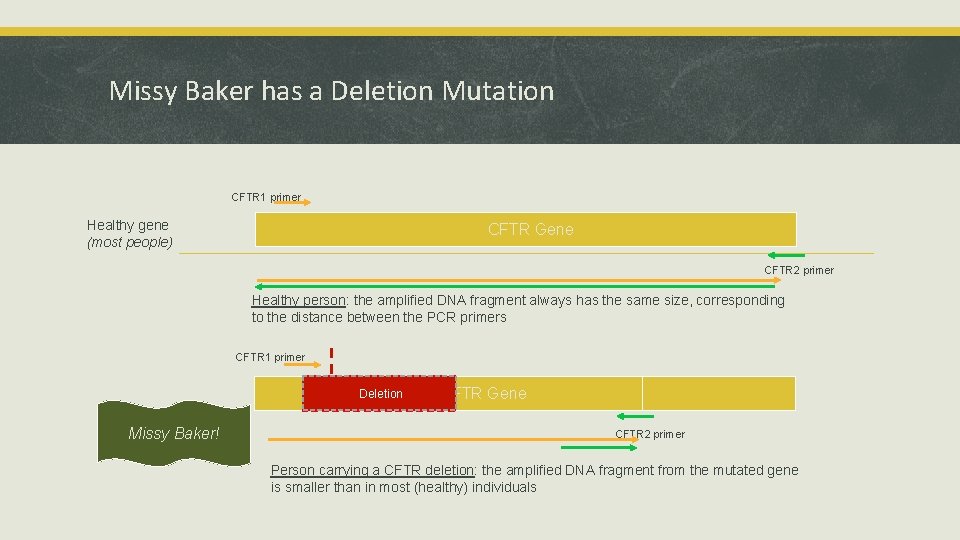
Missy Baker has a Deletion Mutation CFTR 1 primer Healthy gene (most people) CFTR Gene CFTR 2 primer Healthy person: the amplified DNA fragment always has the same size, corresponding to the distance between the PCR primers CFTR 1 primer Deletion Short PCR fragment mutated Missy Baker! CFTR Gene CFTR 2 primer Person carrying a CFTR deletion: the amplified DNA fragment from the mutated gene is smaller than in most (healthy) individuals
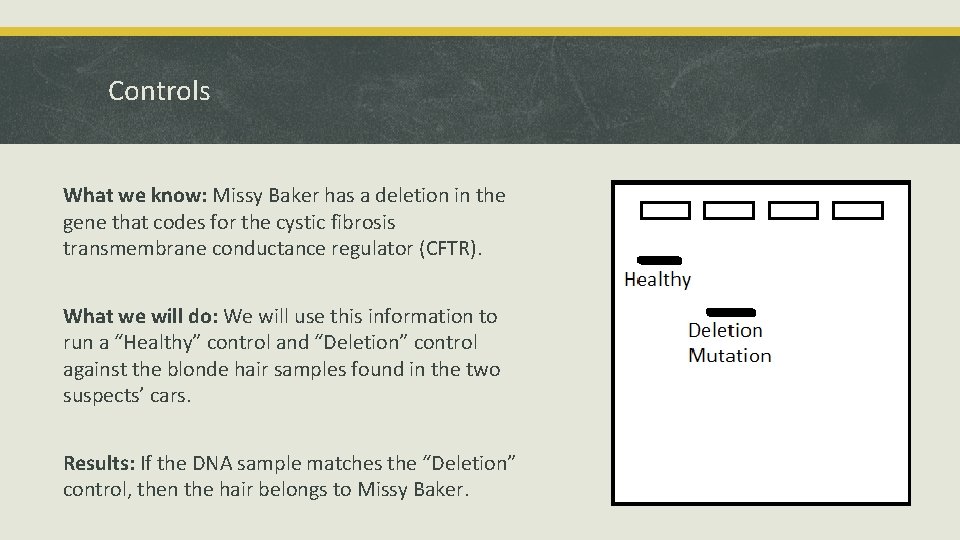
Controls What we know: Missy Baker has a deletion in the gene that codes for the cystic fibrosis transmembrane conductance regulator (CFTR). What we will do: We will use this information to run a “Healthy” control and “Deletion” control against the blonde hair samples found in the two suspects’ cars. Results: If the DNA sample matches the “Deletion” control, then the hair belongs to Missy Baker.
What is a Control? § A scientific control is an experiment or observation designed to minimize the effects of variables other than the independent variable. § A control is your base-line, your reference, in an experiment. If your experiment is unreferenced, you’re just flailing around. § It helps you: Identify and compare the results. § Controls eliminate alternate explanations of experimental results, especially experimental errors and experimenter bias.
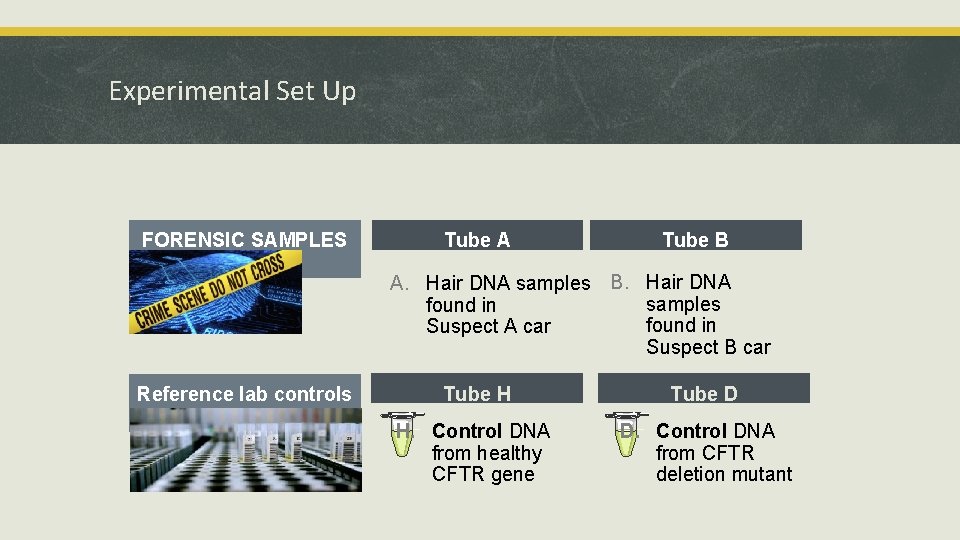
Experimental Set Up FORENSIC SAMPLES Tube A Tube B A. Hair DNA samples B. Hair DNA samples found in Suspect A car Suspect B car Reference lab controls Tube H Tube D H. Control DNA from healthy CFTR gene D. Control DNA from CFTR deletion mutant
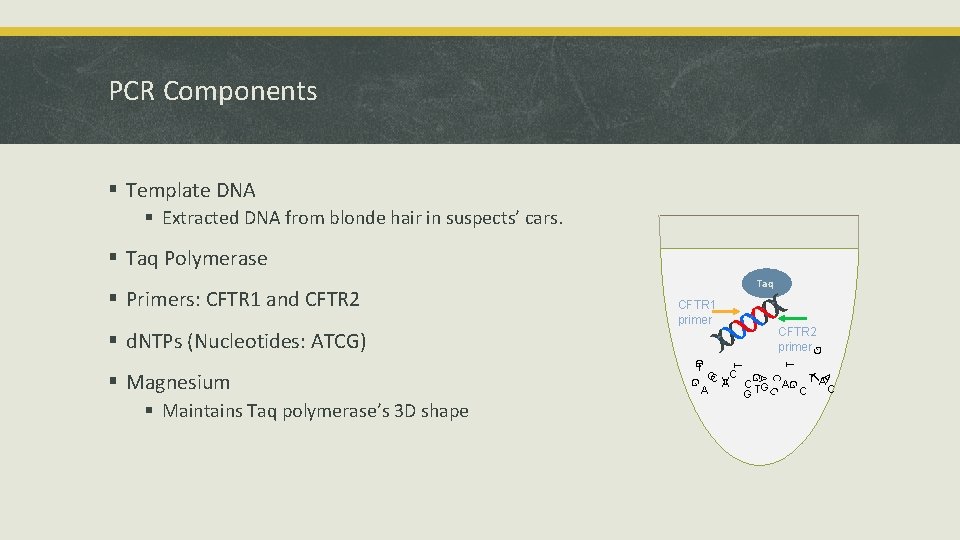
PCR Components § Template DNA § Extracted DNA from blonde hair in suspects’ cars. § Taq Polymerase CFTR 1 primer CFTR 2 primer T T A C TA A G C AC C G A GT G C C A G § Maintains Taq polymerase’s 3 D shape T G § Magnesium G § d. NTPs (Nucleotides: ATCG) T § Primers: CFTR 1 and CFTR 2 Taq C

PCR: Polymerase Chain Reaction Find and replicate a specific DNA target Complex DNA sample Region of interest Amplified DNA (~1 B copies)

PCR: The 3 steps to copy DNA 1 Denaturation 94°C 2 Primer 1 Annealing Primer 2 50 -60°C 3 Extension 72°C Taq DNA polymerase d. NTPs
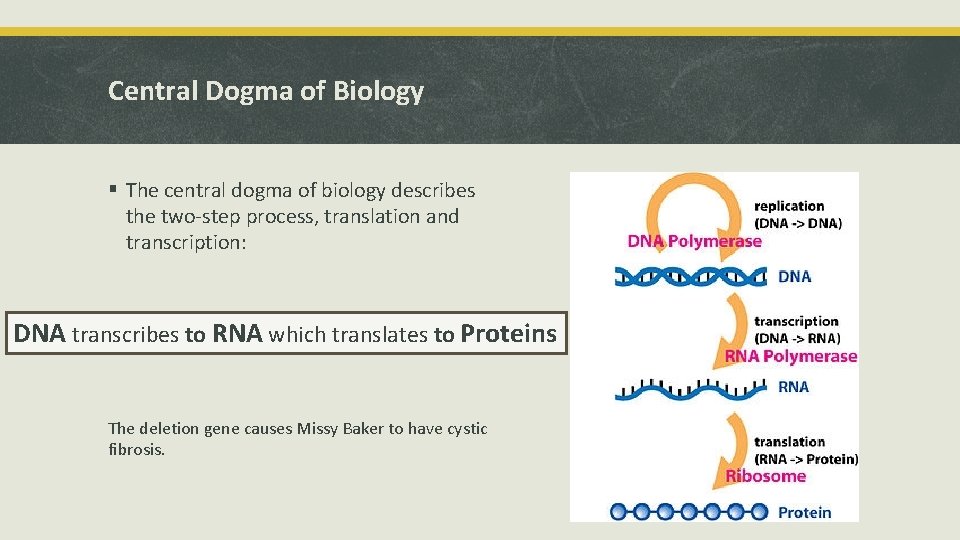
Central Dogma of Biology § The central dogma of biology describes the two-step process, translation and transcription: DNA transcribes to RNA which translates to Proteins The deletion gene causes Missy Baker to have cystic fibrosis.

PCR vs. DNA Replication § PCR is the in vitro version of DNA replication. PCR DNA Replication DNA strand Separated by: Denaturation (Heat) DNA Strand Separated by: Helicase Template: Primers Template: Parental DNA strand Copies: Short sequence (Primers as reference) Copies: Whole Genomic DNA Polymerase: Taq polymerase Polymerase: DNA Polymerase Occurs in different temperatures between 50 -95 o. C Occurs within body temperature: 37 o. C.
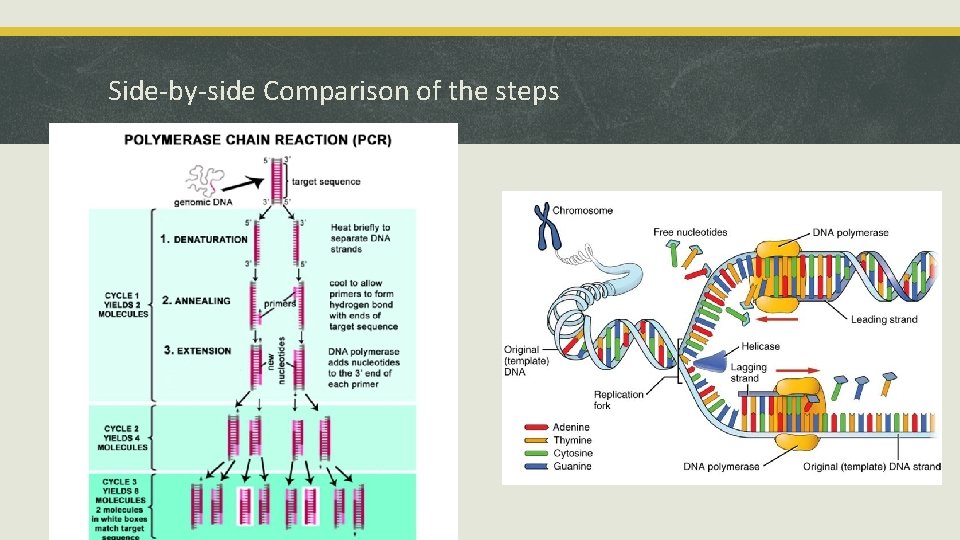
Side-by-side Comparison of the steps
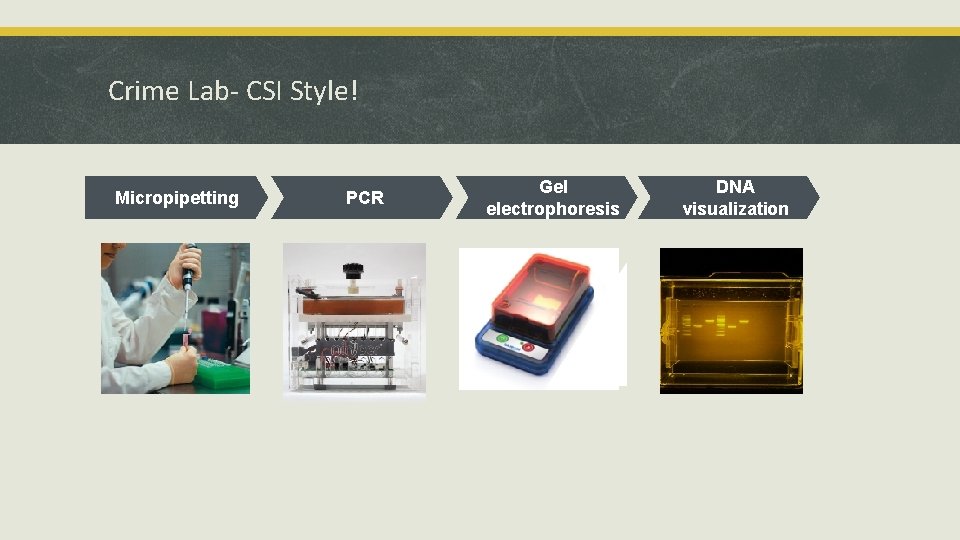
Crime Lab- CSI Style! Micropipetting PCR Gel electrophoresis DNA visualization
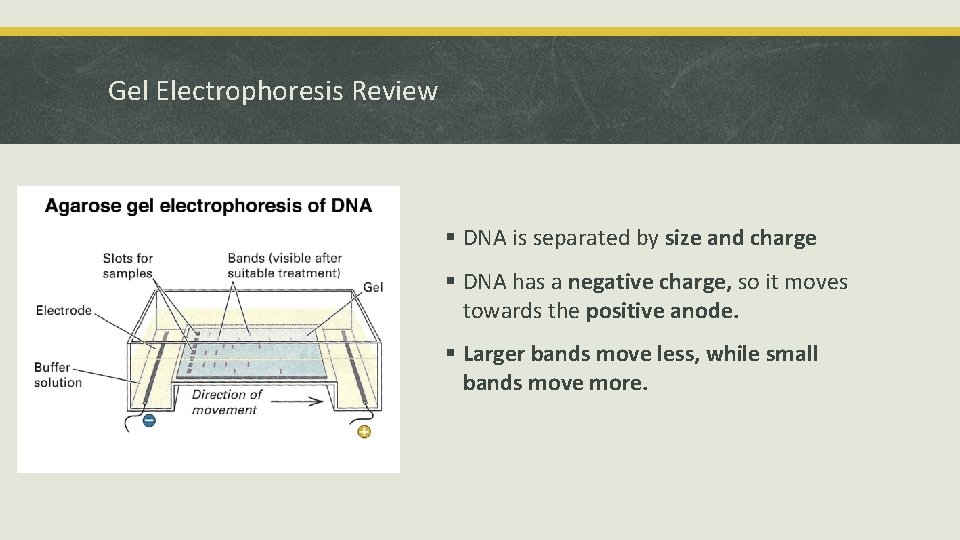
Gel Electrophoresis Review § DNA is separated by size and charge § DNA has a negative charge, so it moves towards the positive anode. § Larger bands move less, while small bands move more.
- Slides: 15