
Crime and Social Policy Dr Boran A Mercan
Crime and Social Policy Dr. Boran A. Mercan
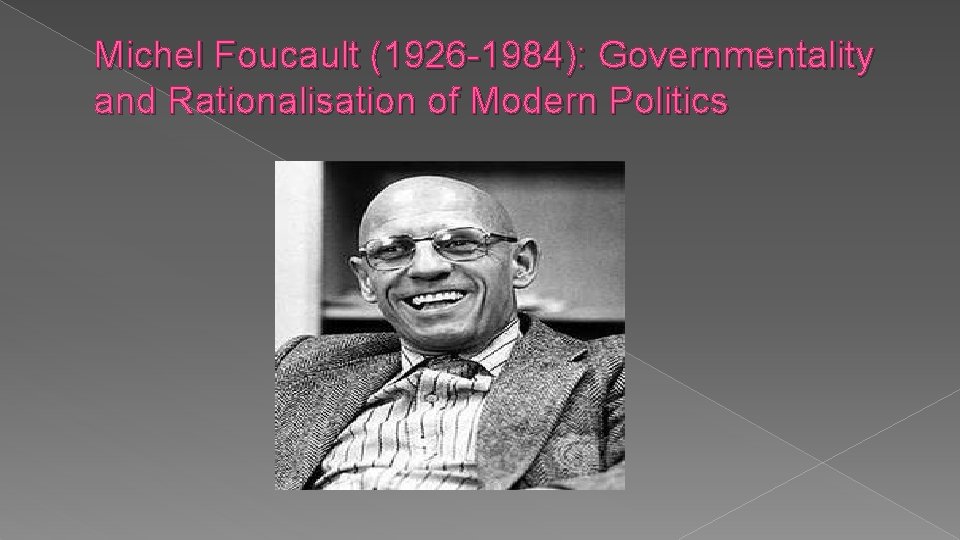
Michel Foucault (1926 -1984): Governmentality and Rationalisation of Modern Politics
Foucault: Governmentality and Biopolitics What is government? Reason of the state Rationality Calculation Preservation and maintenance of the state (in accordance with necessities of conditions) Going back to the 16 th and 17 th centuries Foucault’s courses taught in 1977 and 1978
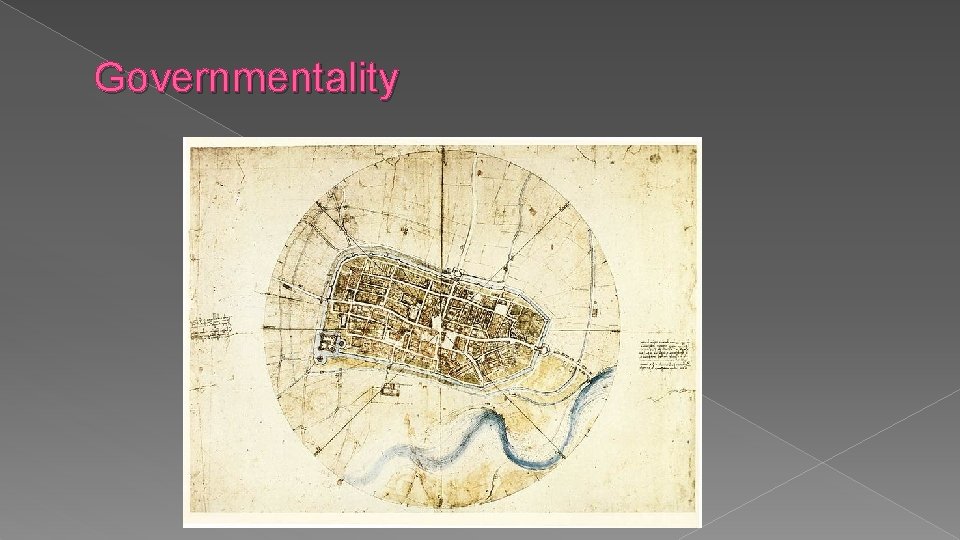
Governmentality
Government as “the conduct [to lead or guide] of conduct [behaviour or action]” (Gordon, 1991; Foucault, 1982) “Government is any more or less calculated and rational activity, undertaken by a multiplicity of authorities and agencies, employing a variety of techniques and forms of knowledge, that seeks to shape conduct by working through our desires, aspirations, interests and beliefs, for definite but shifting ends and with a diverse set of relatively unpredictable consequences, effects and outcomes. ” (Dean, 1999)
The analysis of political reason or of “the mentalities of politics that have shaped our present, the devices invented to give effect to rule, and the ways in which these have impacted upon those who have been the subjects of these practices of government. ” (Barry, Osborne & Rose, Foucault and Political Reason)
“Is it possible to move outside [the state]? Is it possible to place the modern state in a general technology of power that assured its mutations, development and functioning? Can we talk of something like a ‘governmentality’ that would be to the state…what techniques of discipline were to the penal system…? ” (Foucault, Security, Territory, Population)
Social question Governing masses Masses prone to disorder (poverty, deprivation, crime) Governmentality = conduct of conduct How to steer the governing of large masses without falling into chaos and disorder - The role of rational calculation and decision-making
Pastoral Power The metaphor of the shepherd and theme of pastorship (the shepherd-flock relationship) Pastoral power is not exercised over a territory, but over a multiplicity in movement The essential objective of pastoral power is salvation (“Pastoral power is the power of care. ”) Pastoral power is an individualising power – omnes et singulatim (all and each)
Crisis of the pastorate and the “transition from the pastoral of souls to the political government of men” (16 th century) Emergence of raison d’État (Giovanni Botero, Giovanni Antonio Palazzo, Martin Chemnitz) The state is both the principle of intelligibility and the objective of this governmental reason
Raison d’État Botero: “The state is a firm domination over peoples. ” Raison d’État is “the knowledge of the appropriate means for founding, preserving , and expanding such a domination. ”
Police is the apparatus (technological assemblage) that makes reason of state function – “the set of means by which the state’s forces can be increased while preserving the state in good order. ” (Foucault, Security, Territory, Population)

Police Population size (relative to territory, resource, economy) Provision of the necessities of life (food, clothing, shelter, etc. ) Provision of health (epidemics and everyday health) Regulation of activity (prevention of idleness, regulation of professions, etc. ) Circulation of things and people
No difference the tasks of police and social policy Masses being regulated by police Good ordered ensured by police Technologies implemented
Liberalism Foucault points out the link between liberalism and the emergence of “society” consisting of atomistic individuals and interests of each. Government has its own laws of functioning, not reducible to a territory and population.
Liberalism is not a single economic theory or political philosophy. It rather functions as a principle and method for the rationalisation of governmental practices. Liberalism indicates an ethos of government that stresses out how to handle the exercise of political power (in the form of constraints, interventions, etc. )
Ordo-liberalism refers to a conception of the market and competition against the emphasis on the natural economic proceedings and balance (price, wage, rent, interest). The state and the market economy presume the existence of each other The irrationalities and illicit workings of capitalist social formation are not inherent in the logic of capitalism. Rather they are part of a historical contigency.
- The birth of politics The transition from discipline to biopolitics Regulative regimes of bodies Birth and dead, health, disease and so forth under the control effort of government. Body & population at the heart of governing art Social policy = Part of technologies of self, Technologies of governmental power
- Slides: 18