
Crime and Social Policy Dr Boran A Mercan
Crime and Social Policy Dr. Boran A. Mercan
Institutionalisation of Criminology and Welfare State: Titmuss and Radzinowicz � Sir Leon Radzinowicz (1906– 99) � director of the Institute of Criminology at the University of Cambridge in 1959 � Criminological research head on its way � New developing science of crime � Establishment of associations
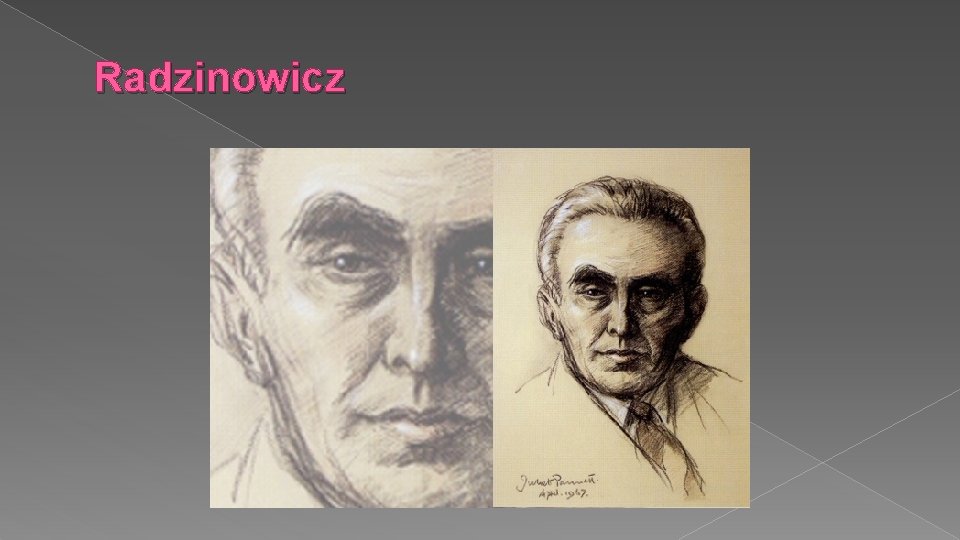
Radzinowicz
pursued a multi-disciplinary criminology, embodied this interest in founding the Institute of Criminology. The Cambridge Institute received the support of Home Secretary in 1957. � Then teams of sociologists, statisticians, psychiatrists, and legal specialists needed � The aim was a systematic investigation into criminal behaviour � with a clear focus on intervention and prevention. � This is also part of social policy=public policy � � �
� � � the use of empirical findings as a means of adding humanitarian dimension into criminal justice apparatus. For him, criminology is a discipline that might promote a ‘rational improvement’ in dealing with the issues of crime and criminals. There needs a long-term plan to humanise criminal justice system in a rational way. No place for political expediency or populist popular reaction Criminal justice procedure must be rational anyway Radzinowicz promoting British liberalism; he was emigrant too
� - Social welfare schemes should not be employed the matters of crime reduction because: Radzinowicz does not believe that social welfare schemes may not necessarily lead to a general reduction in crime. He denied that social welfare could be solution to delinquency The main worry is about politicians intending to turn crime into a political problem for the sake of pursuing political interests. He was Enrico Ferri’s student so he was under the influence of positivism and witnessed the destructive consequences of Fascism. Any response to crime should abide by the rule of law. He advocated the formation of a Ministry of Social Welfare In so doing, the main responsibility of the Home Office would be the law and order.
Richard Titmuss � Problems of Social Policy � ‘Titmuss paradigm’ � crime as ‘a social ill’ or a ‘social problem’ to be understood in � relation to social activity and not individual pathology. � Crime related to social inequality � Crimeas a social problem originating from social injustice and inequalities � Crime based in the market inequalities either �
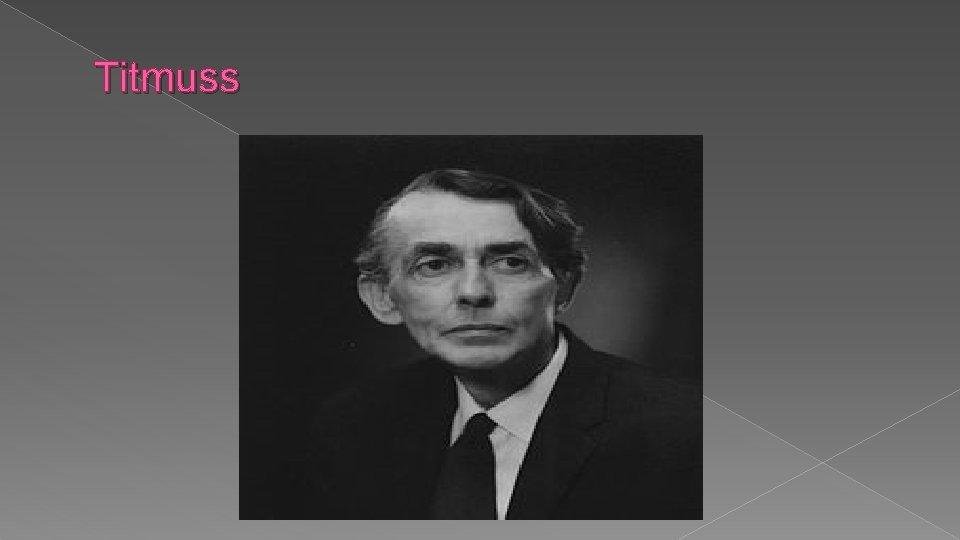
Titmuss
Titmuss defined ‘social accounting’ as the principle of social policy, � That refers to a strategy for measuring the total amount of welfare benefits extended by government. � It’s wrong to suppose a conceptualisation of social welfare in terms of direct services to the poor, unemployed, ill, and so on. � benefits by the help of occupational schemes --- pensions, sick pay, and housing allowances. These would otherwise directly go into the pocket of employers and go through taxation. �
�A great deal of cash benefits --- appearing as welfare benefits through the taxation system. � Social policy mainly involves in that ratio � It is a sum total accounts of: - Various mechanisms by the state decides about the allocation of financial assets, - Also other resources.
� Like Radzinowicz, Titmuss also supported his own discipline social policy as multi-disciplinary. � He enjoyed a bulk of work from history to sociology, from anthropology to political science, from economy to medicine � His aim was to specify the functions of social welfare services.
Titmuss --- a Social Democrat He thought capitalism was threatening social integration. Here some issues have to do with crime and criminology. Because the problematic occurring is about the law and order in some respects. Two principles he suggested: 1) it is crucial to help all citizens, now matter what income they earn and what social class they belong to. Also excluding some sectors and classes disturb some other classes and the helper may tend to humiliate recipients of social relief. . 2) means-testing recipients is unnecessary social benefits should be universalist. The ‘Titmuss paradigm: optimism about human nature, belief in universal services, and opposition to means testing. centralised state bureaucracies and the public ethos of working in them. the administration of social services as a benevolent activity. � � �
Titmuss: has no a theory of crime. � However, he considered crime as ‘a social ill’ or a ‘social problem’ � Crime should be grasped with regard to social matter, not individual pathology as criminological positivism suggests back then. � Societal rebellions and revolutionary attempts come out of citizens being miserable and drastically impoverished in the cities � The cure is social mobility (Titmuss, 1954). �
For Tittmuss, crime is a social problem It originates from market inequalities, Social policy appears to respond to crime as it also tries to eliminate market-oriented inequalities. � Titmuss read Mannheim’s study of delinquency in inter-war England in 1939, � agreed that ‘faulty parenting’ was a causal factor. � He also argued that petty crime and social malice were linked to overcrowding housing conditions and nonsanitary circumstances and lack of parental care. � Universal housing policy: would reduce delinquency � � �
- Slides: 14